Room 101 was a torture chamber in the Ministry of Love in George Orwell’s novel 1984. For women, the trials include racism, poverty, violence, injustice, sexism, trafficking. On the front side are posters protesting Marian Price‘s 295 days in isolation.
Youth mural combining republican symbols (the Bobby Sands quotation “Our revenge will be the laughter of our children” and Easter lilies) with community symbols (such as nearby Tulach Mhór [Tullymore] and The Larks) and social concerns such as the peace/anti-nuclear symbol, the blue-and-pink anti-suicide ribbon, and Banksy’s flower-thrower.
“Over a third of all children, are growing up in poor households. About 185,000 of households are in poverty, representatin about 502,000 people. Over 148,000 of these are children.” This is in contradiction with the aims of both the Proclamation of Éırí Amach Na Cásca, 1916 – “… cherishing all of the children of the nation equally and oblivious of the differences carefully fostered by an alien government, which have divided a minority from the majority in the past” – and the Democratic Programme of An Chéad Dáıl, 1919 “… to secure that no child shall suffer hunger or cold from lack of food, clothing or shelter, but that all shall be provided with the means and facilities requisite for their proper education and training as citizens of a free and Gaelic Ireland.” The other images are of Béal Feırste 1969, Léana An Dúın 1972, and Na Staılceanna Ocraıs, 1981.
This looks very much like a Rıstead Ó Murchú creation.
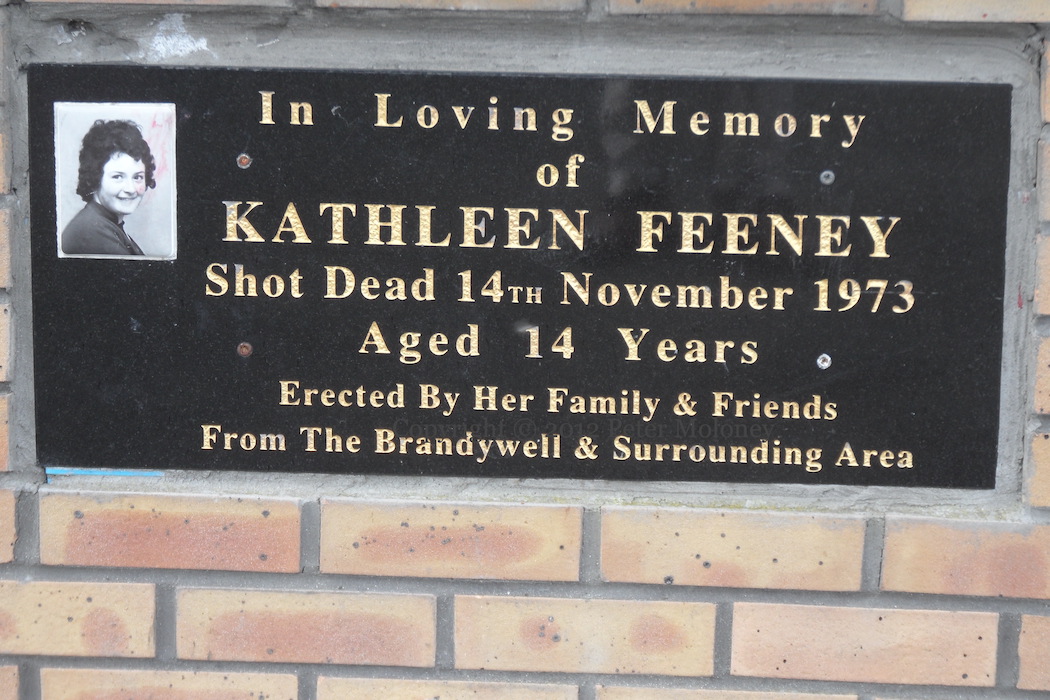
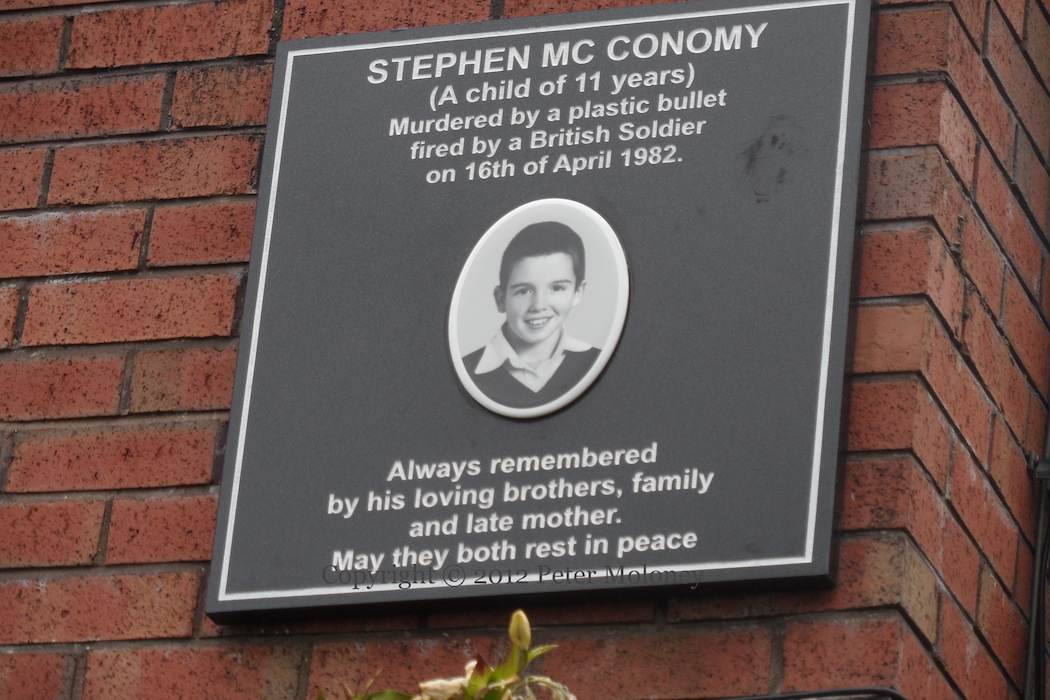
Two boards are added to either end of the many panels of the portraits of victims and the plastic bullet board (State Sponsored Killings) in Beechmount Ave/Ascaıll Ard Na bhFeá.
“At 8:47 pm on Saturday 4th December 1971, a no-warning bomb, planted by British terrorists, exploded on the doorstep of family-run McGurk’s Bar. Fifteen innocent men, women and children perished. Those who were not crushed or slowly asphyxiated by masonry where horrifically burned to death when shattered gas mains burst into flames beneath the rubble. Nearly the same again were dragged from the debris alive. In the aftermath of the atrocity, the British and Unionist Governments, RUC police force and British military disseminated disinformation that the bomb was in-transit and that the civilians guilty by association, if not complicit in this act of terrorism. This is despite a mountain of forensic evidence including a witness statement that saw the bomb being planted and lit before the British terrorists escaped into the night. From the moment the bomb exploded and for 40 years since, the families and friends of those murdered have campaigned constitutionally and with great dignity to clear the names of their lived ones. It is a Campaign for Truth that continues to this day. Join us at themcgurksbarmassacre.com” “
“Springhill–Westrock Massacre. Belfast’s Bloody Sunday. Time for truth! On the 9th July 1972 a team of British Army snipers took up firing positions in Corry’s timber yard overlooking the nationalist Springhill/Westrock estates. Within less than an hour five civilians lay dead and two critically wounded. Among the dead were three teenagers, a father of six and a priest on his way to administer the last rites to the dead and injured. There has never been a proper police investigation, and not one solider has spent a single day in prison in connection with their deaths. The families deserve, and demand the comprehensive facts be told by the British establishment. The truth costs nothing.”
East Tyrone remembers IRA volunteers Patrick Vincent, Sean O’Farrell, Peter Clancy, and Barry O’Donnell, who were killed by the SAS after attacking Coalisland RUC station with a machine gun mounted on the back of a lorry on February 16th, 1992 as they were switching from the attack vehicles to getaway cars in Clonoe (WP). With republican graffiti: “End strip searches in Maghaberry jail on republican POWs”.
The Amnesty International symbol – a candle in barbed wire – is added to a thirtieth anniversary hunger strike mural in Melvin Road, Strabane. It’s not clear if there is any official connection. The rest of the image – a blanketman over the towers of Long Kesh – is the same as in murals in Derry and in Belfast.