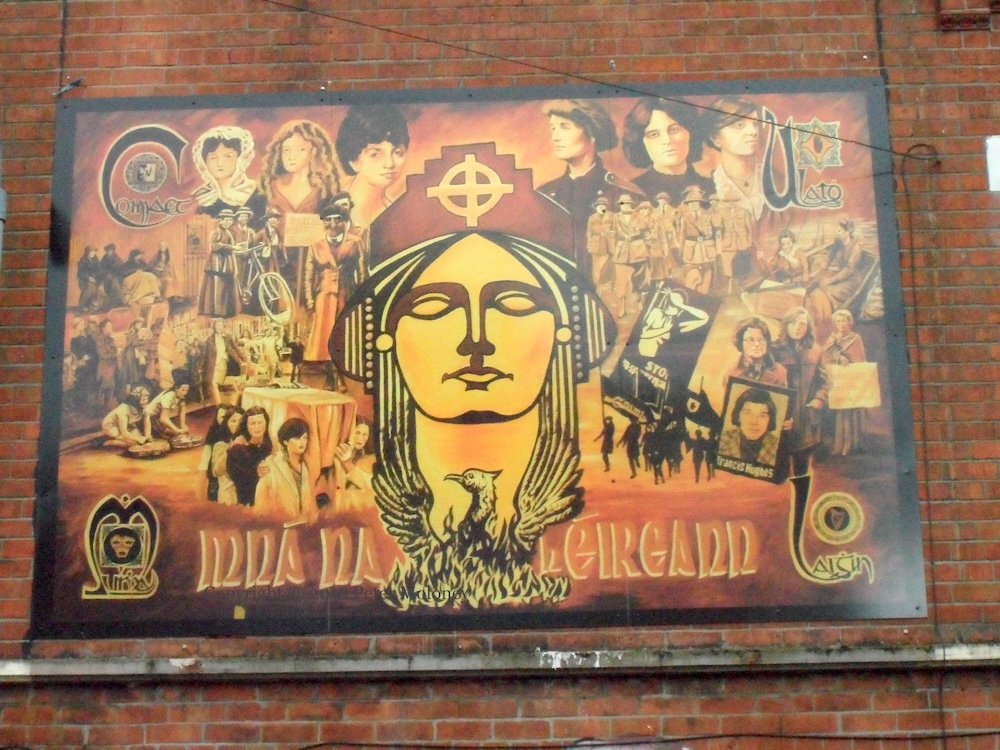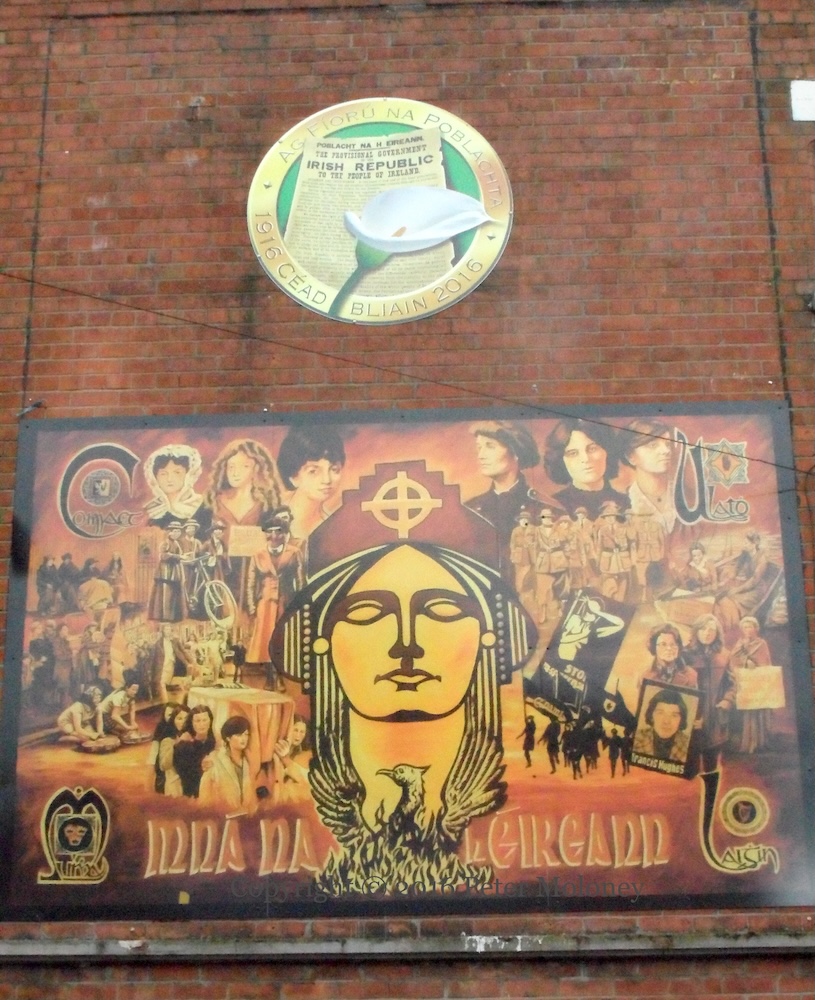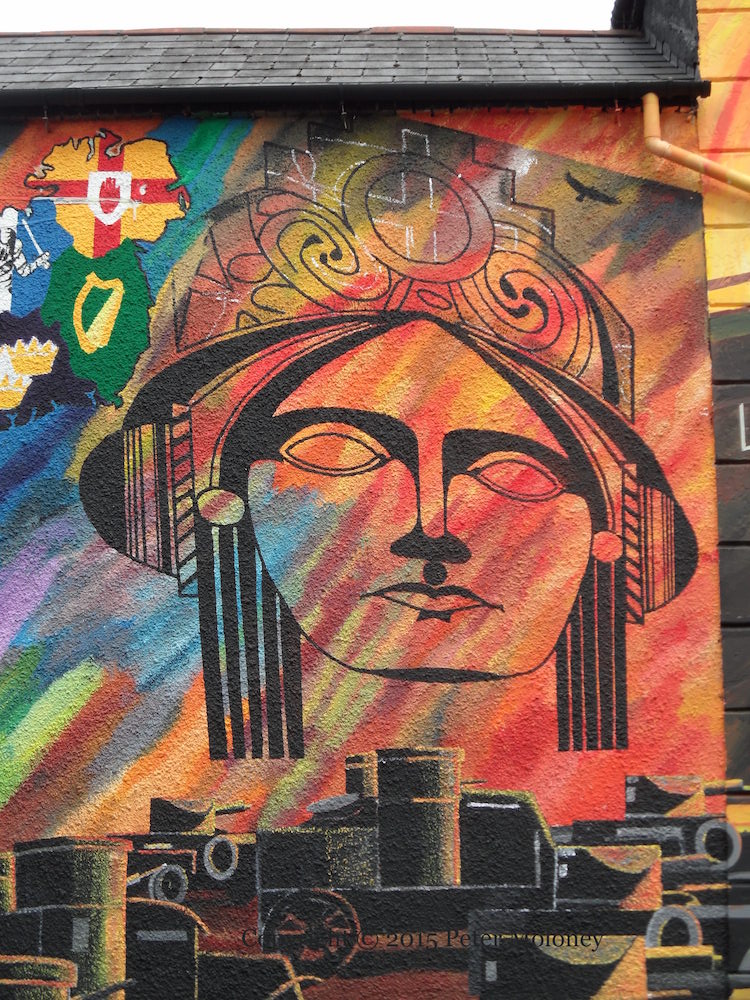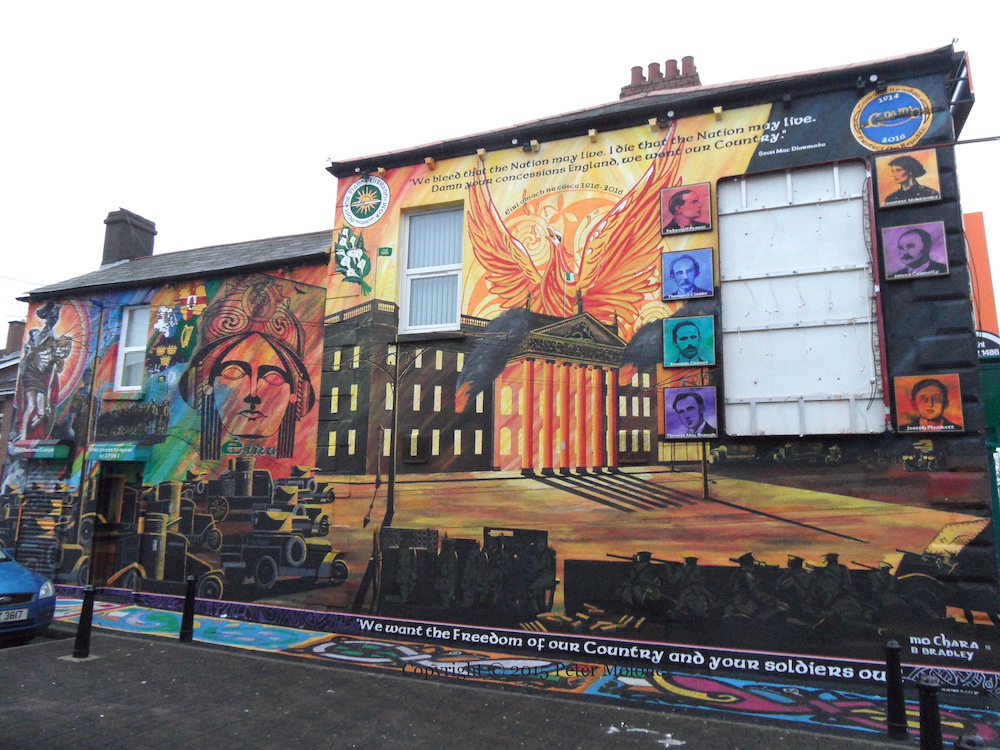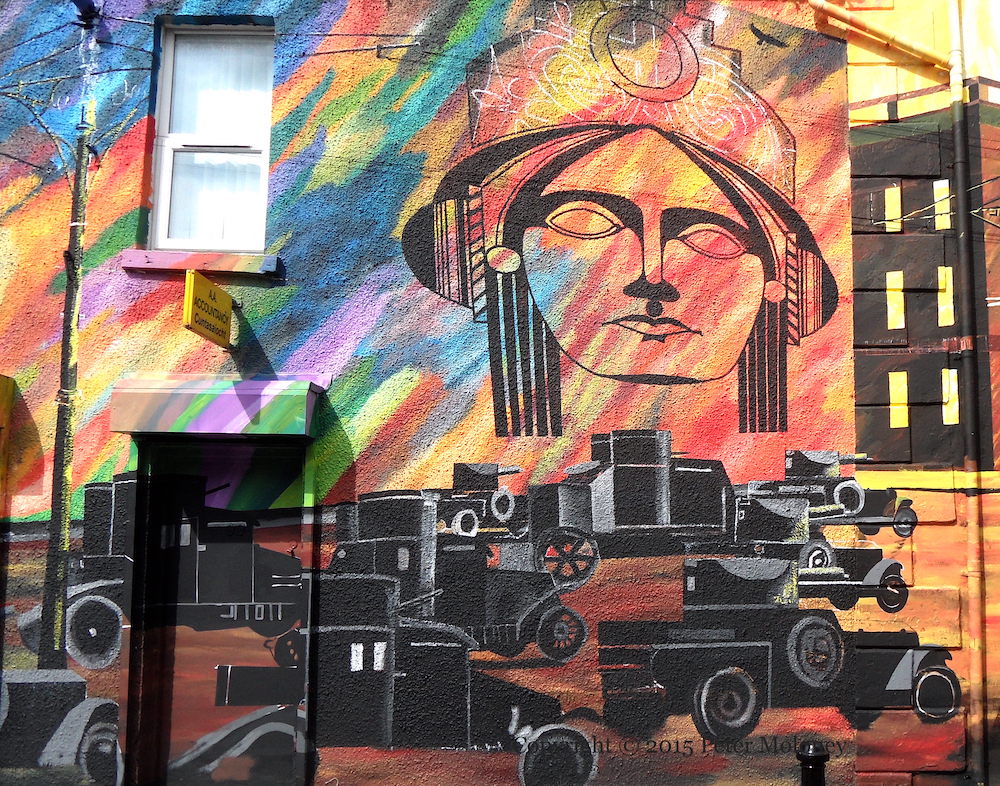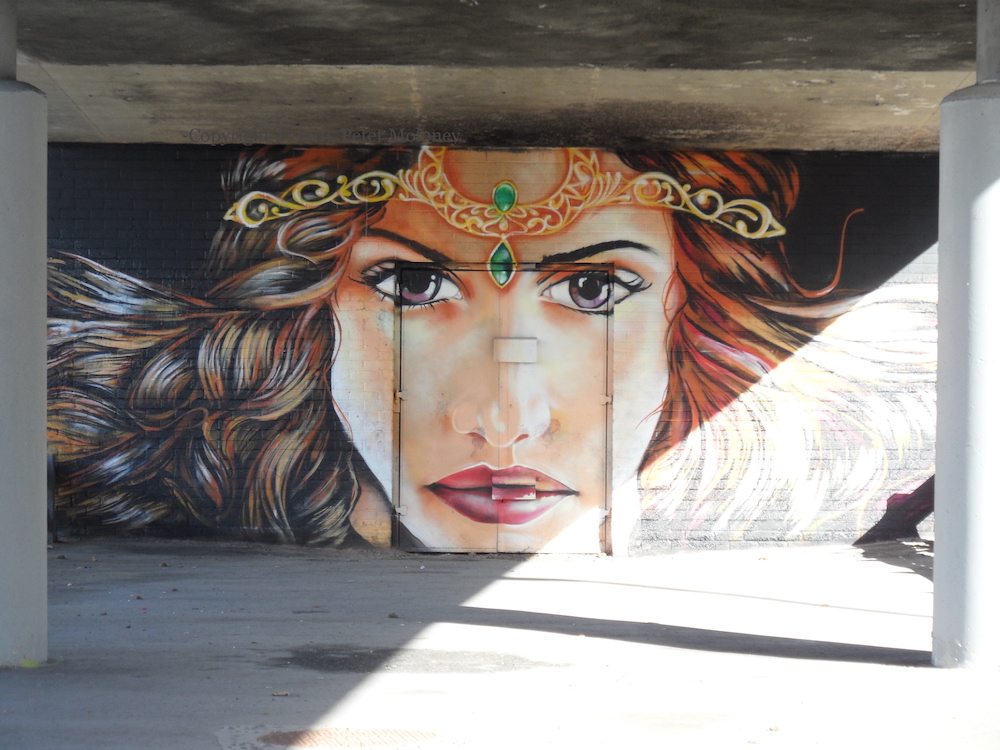
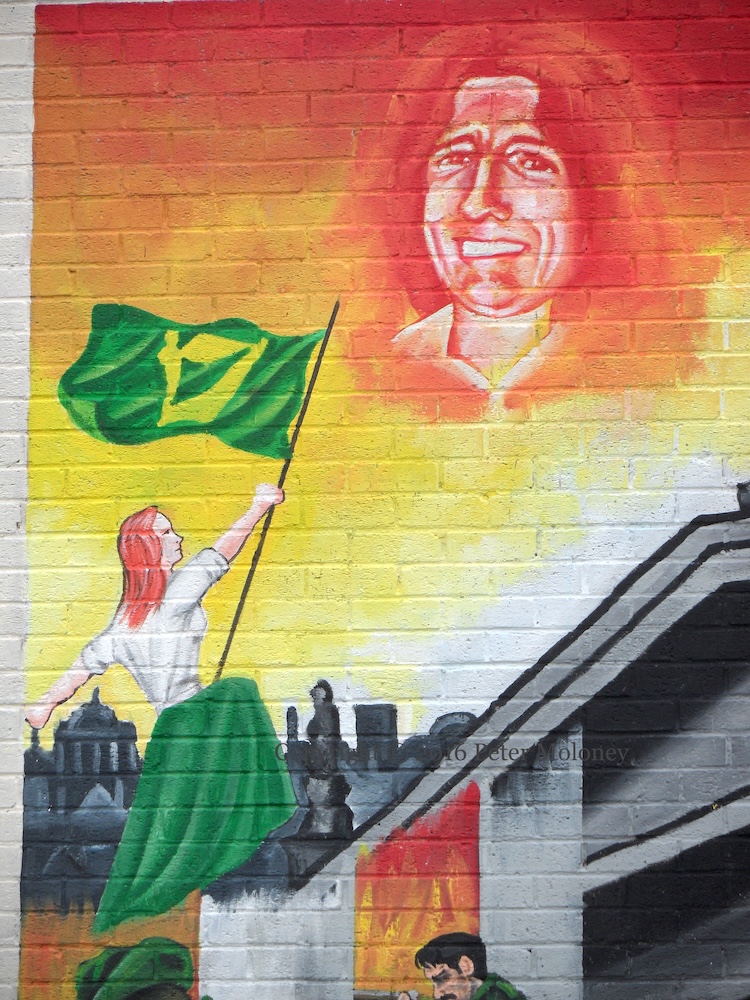
Érıu/Éıre of the Tuatha Dé Danann, queen of Ireland, (as depicted by Richard J King) is at the centre of various representations of republican women.
Along the top are Ann Devlin, Betsy Gray, Mary Ann McCracken, Countess Markievicz, Nora Connolly?, and Winifred Carney. Suffragettes, the modern IRA, and Cumman Na mBan are depicted, as are Máıre Drumm at the Falls Curfew, Tom McElwee’s sisters carrying his coffin, and Molly Childers and Mary Spring Rice running guns on the Asgard. There is also an unusual ‘four provinces’ in the corners.
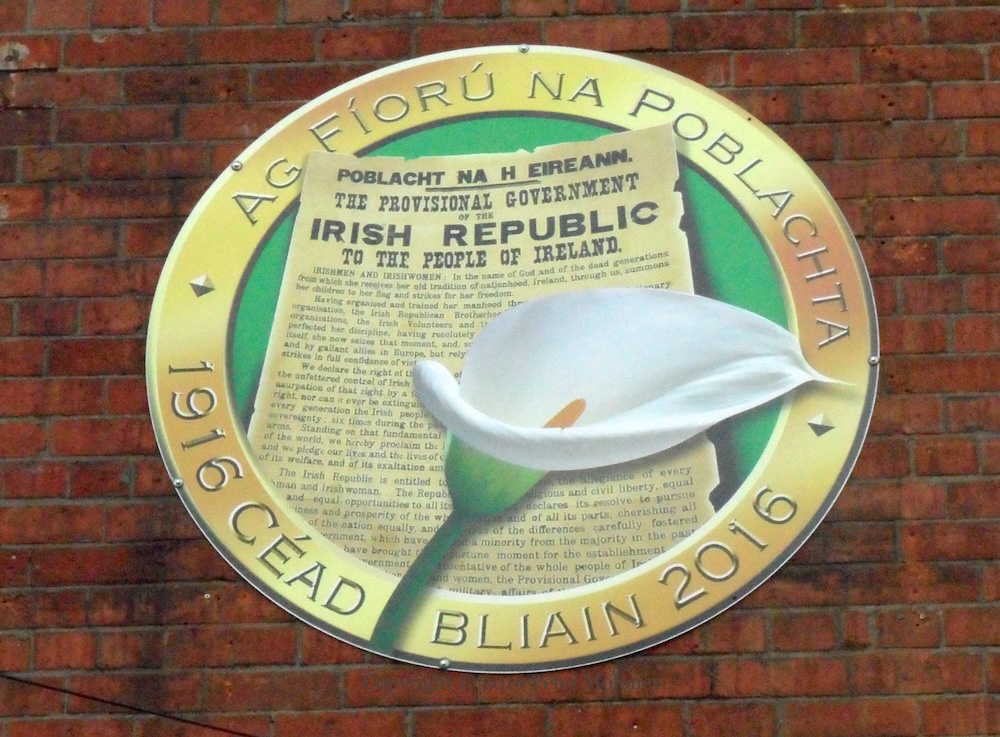
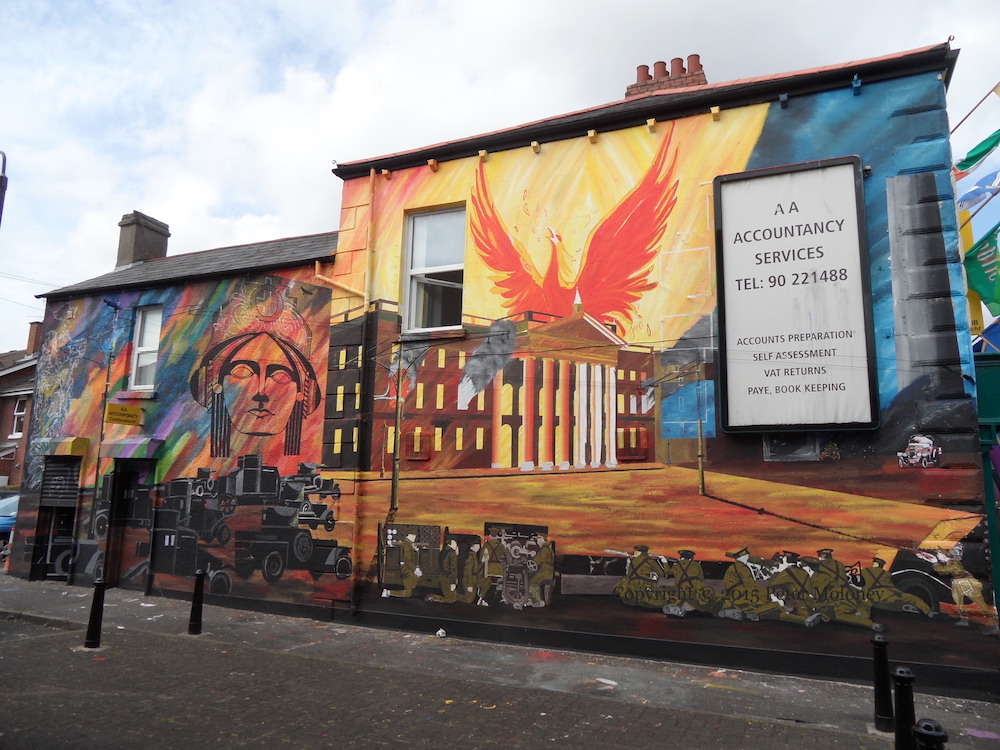
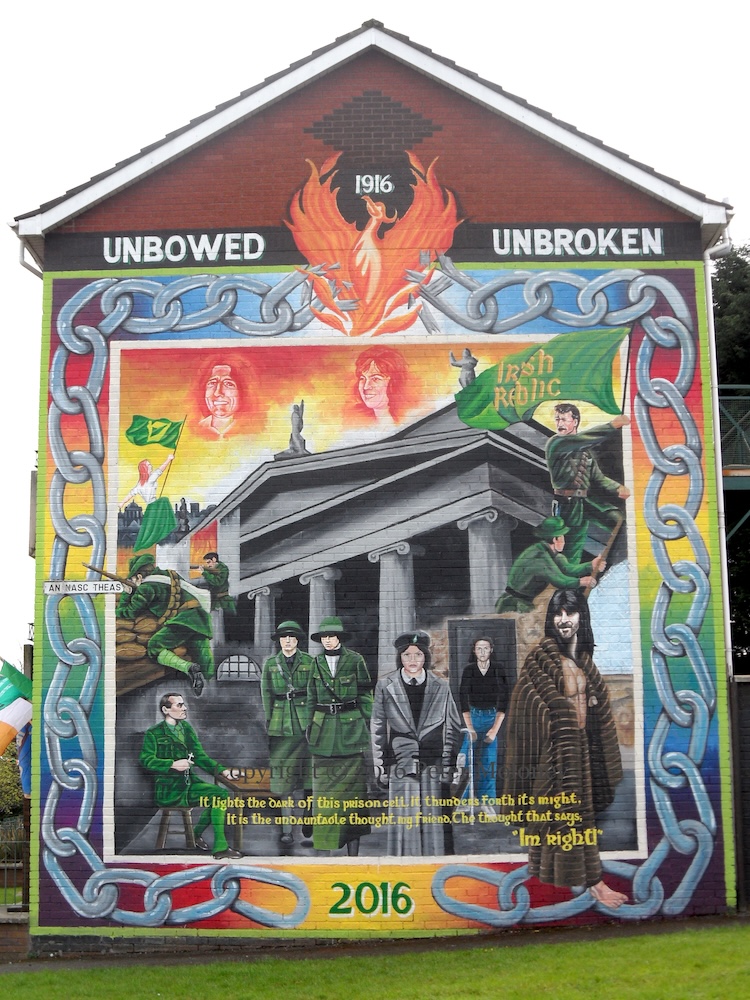
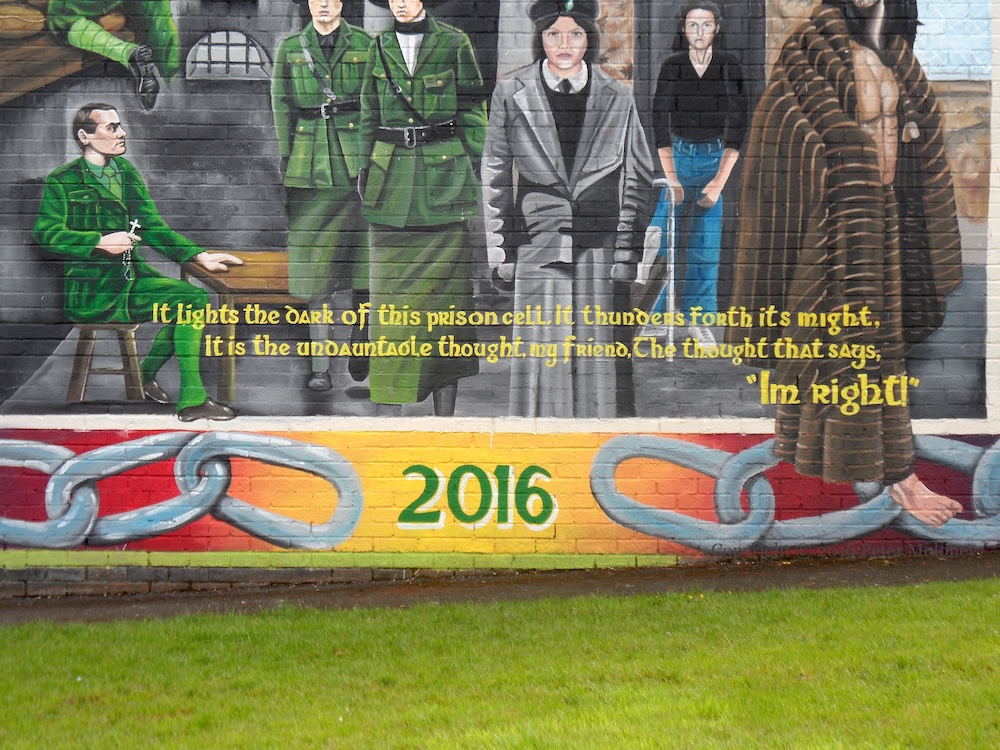
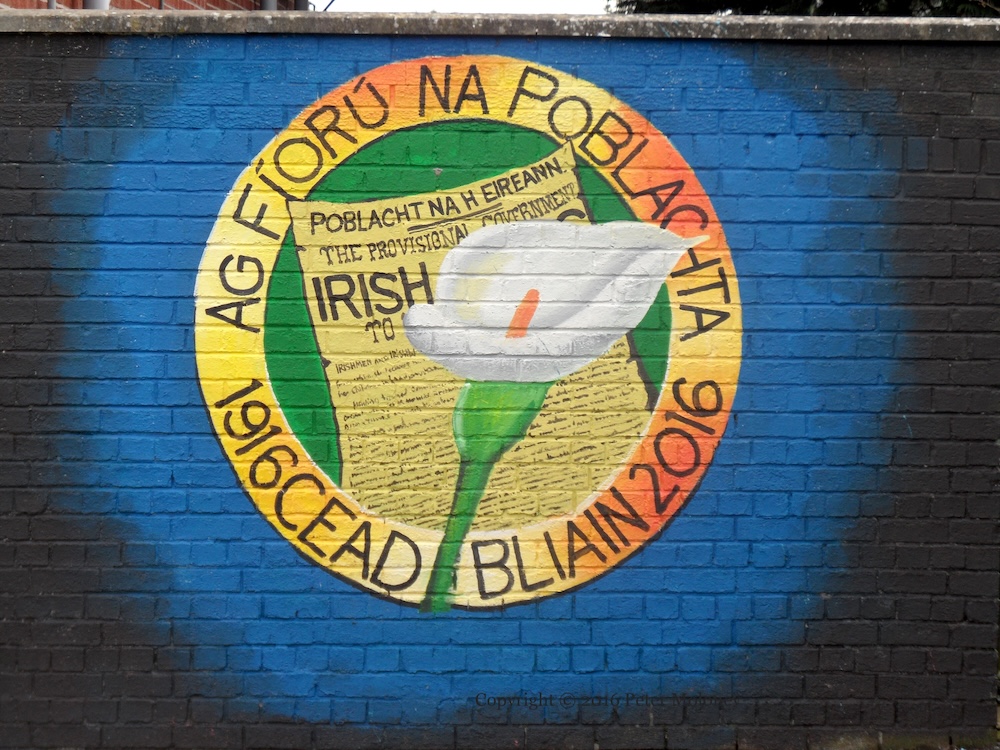
The wide shot (below) shows a 1916 centenary (“céad blıaın”) board: “Ag fíorú na poblachta”.
repainted knot-work on the right in front, form July 8th, 2016:
detail shots, from August 9th, 2025, December 15th, 2025, and March 26th, 2016:
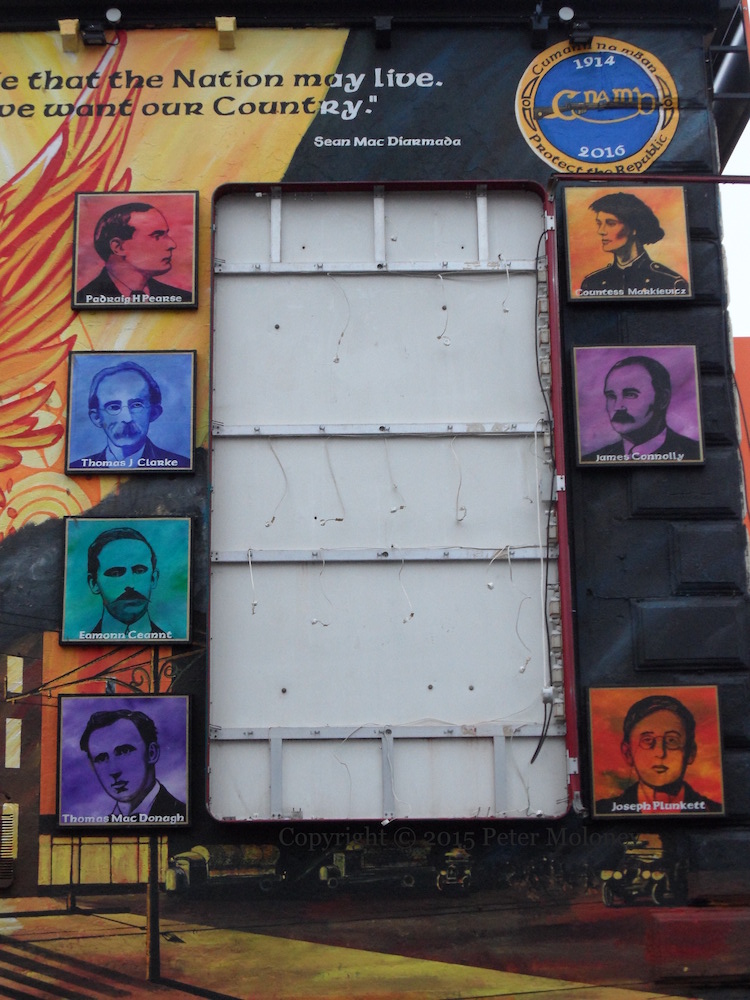
December 15th, 2025, portraits on small boards being added to either side of the (temporarily removed) proclamation:
July 31st, 2025:
July 14th, 2025:
May 5th, 2025:
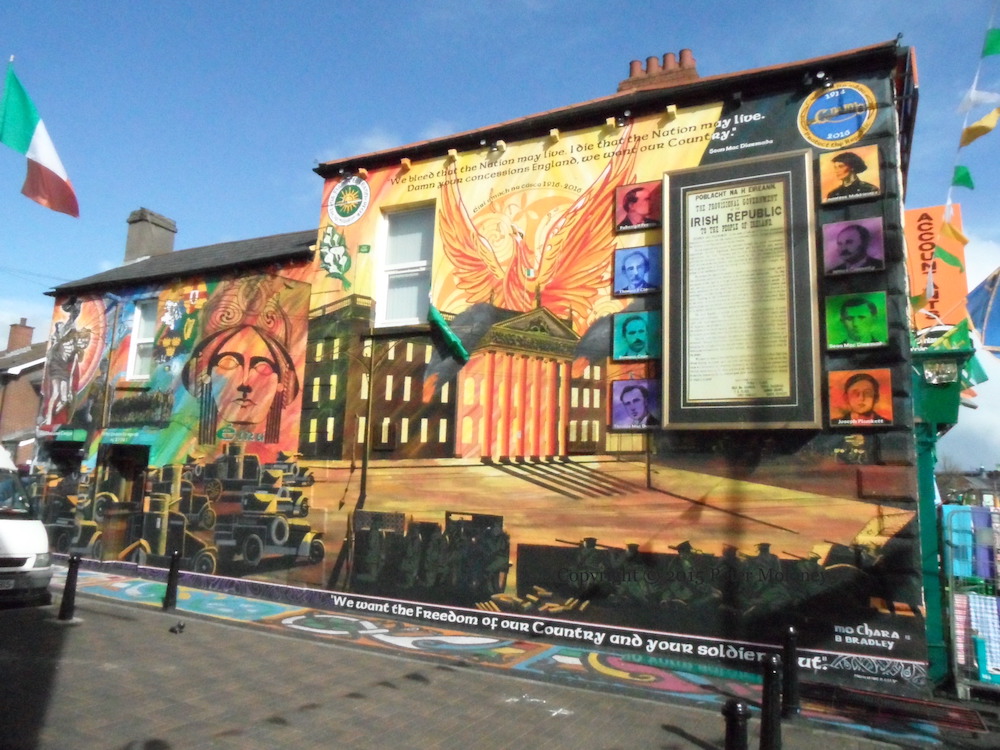
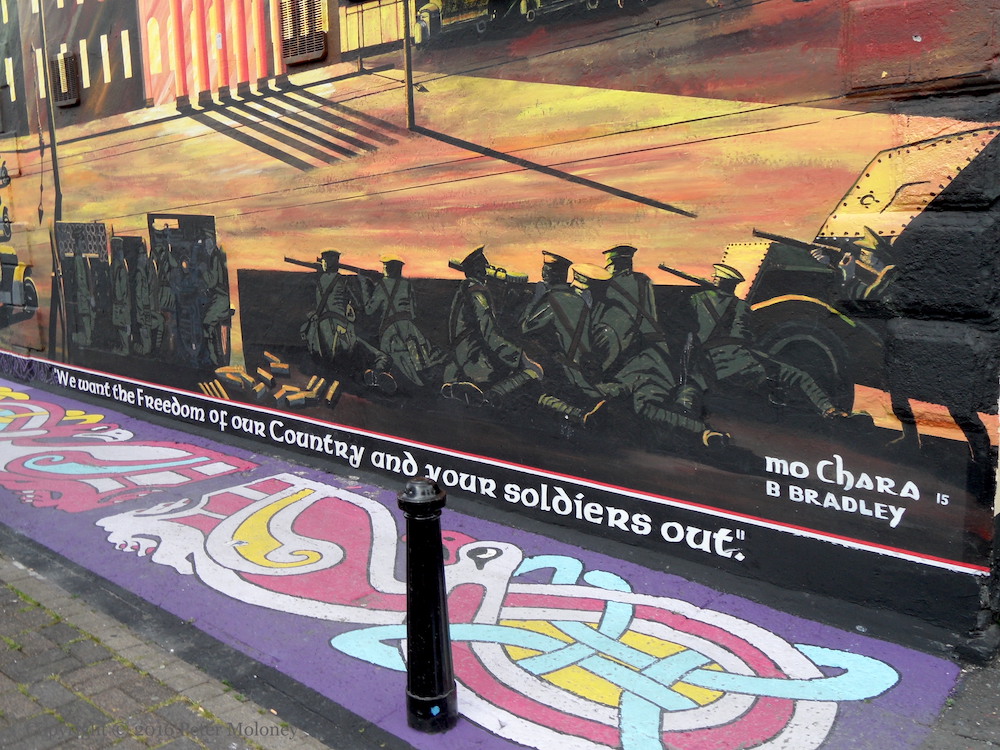
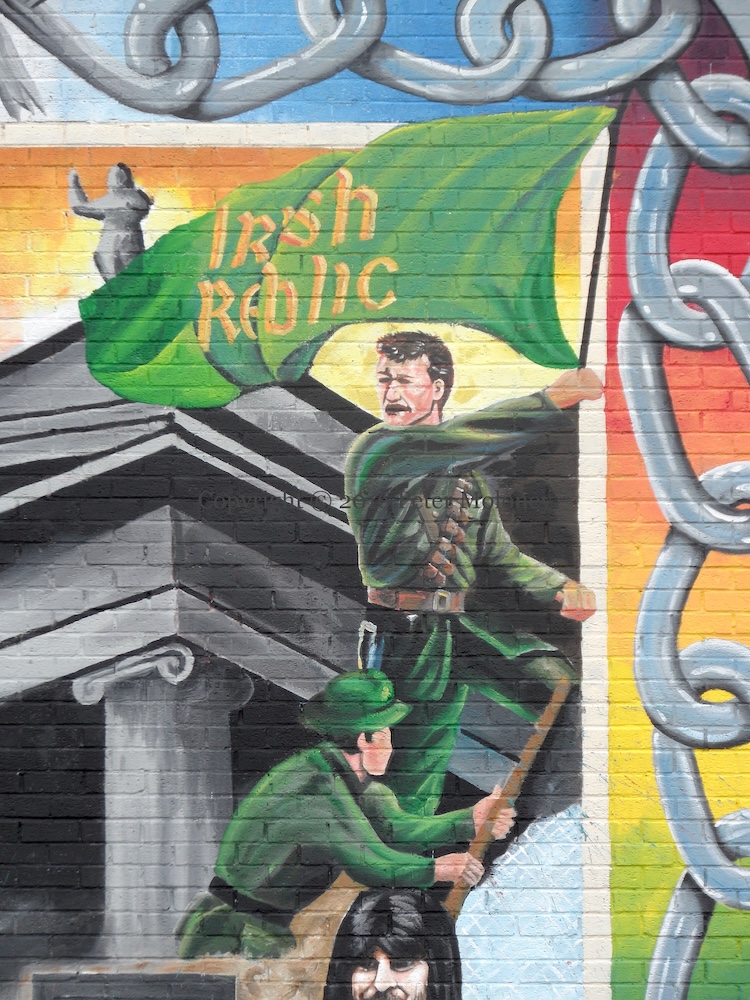
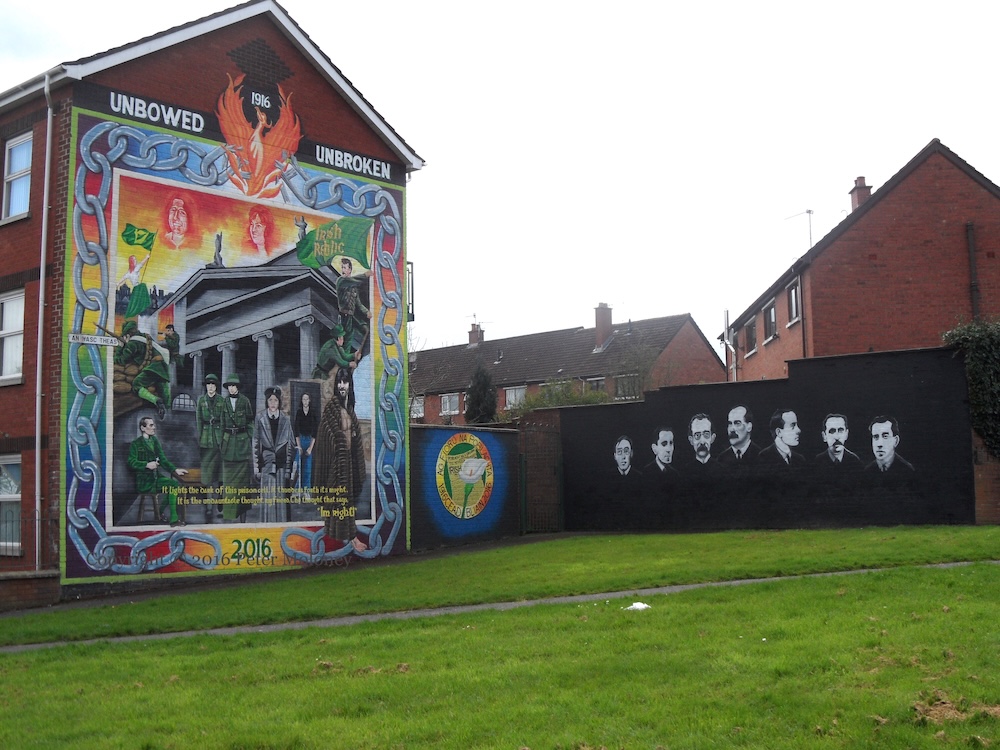
Arrayed against the forces of the British Army (which are shown laying siege to the Dublin GPO during the Easter Rising in armoured cars and in sniping positions in the foreground of the mural, along the whole length of the wall) are various symbols of Irish nationalism:
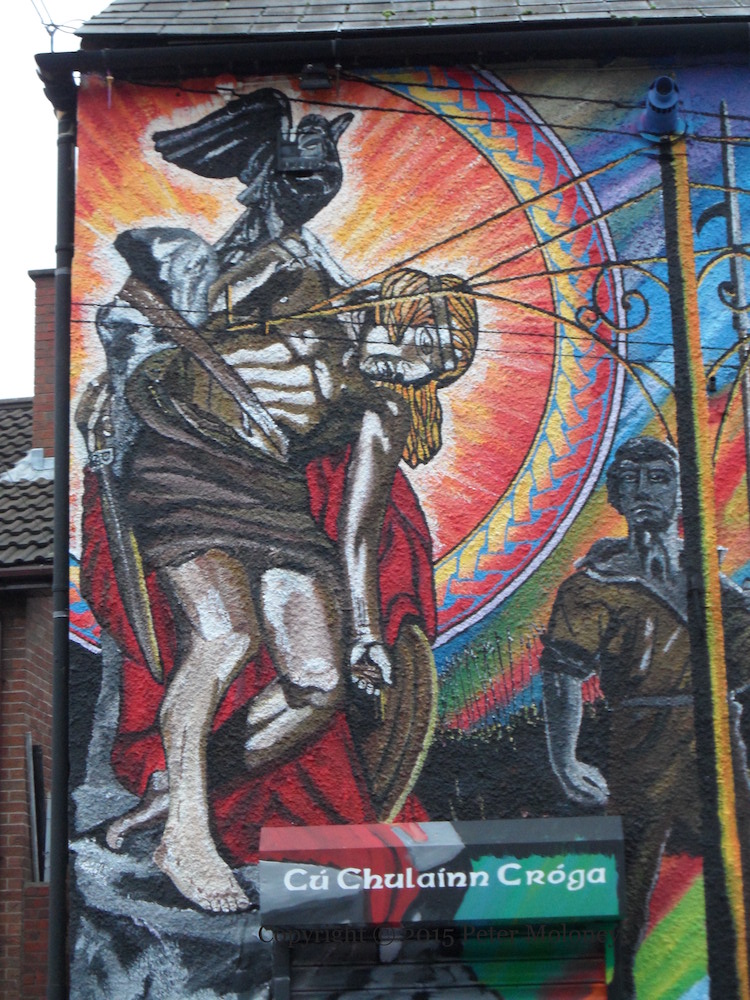
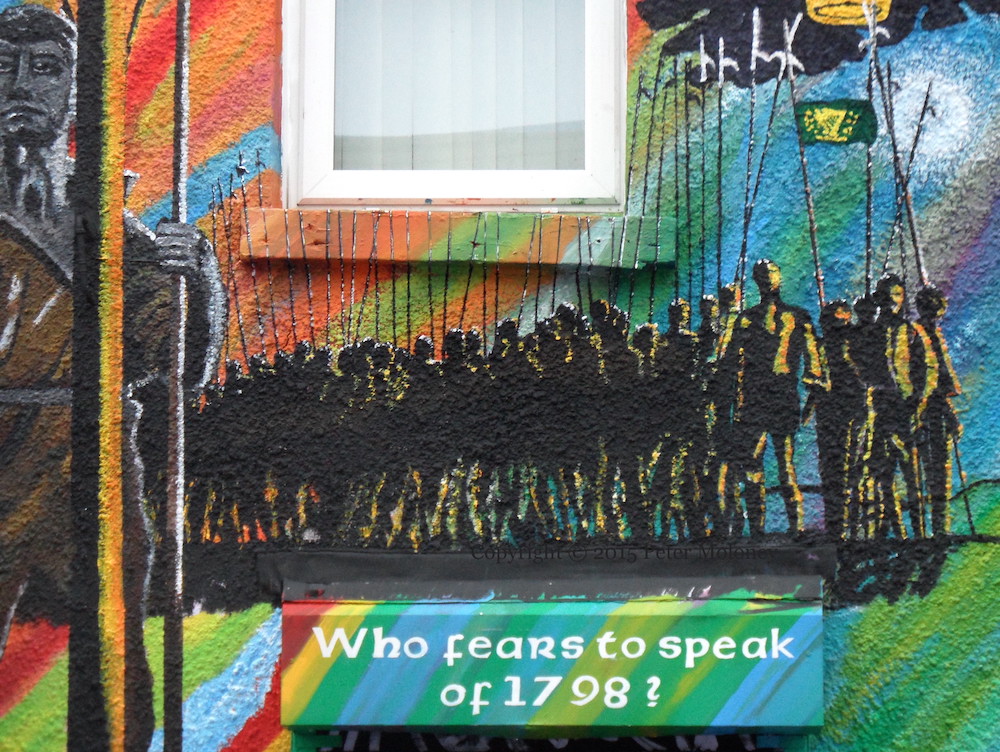
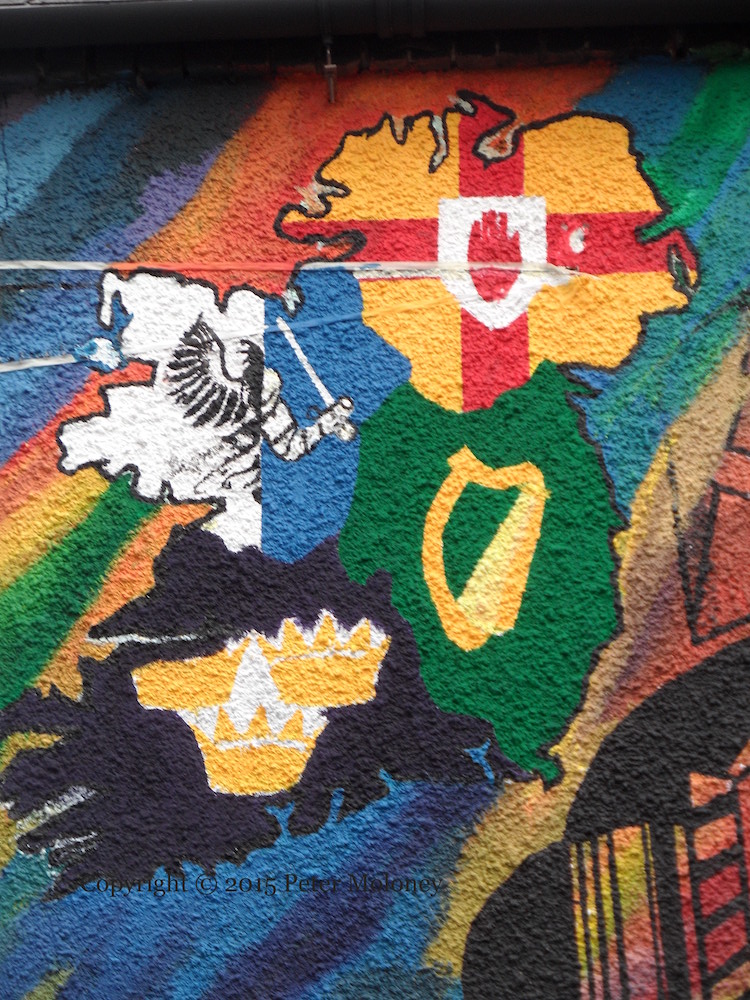
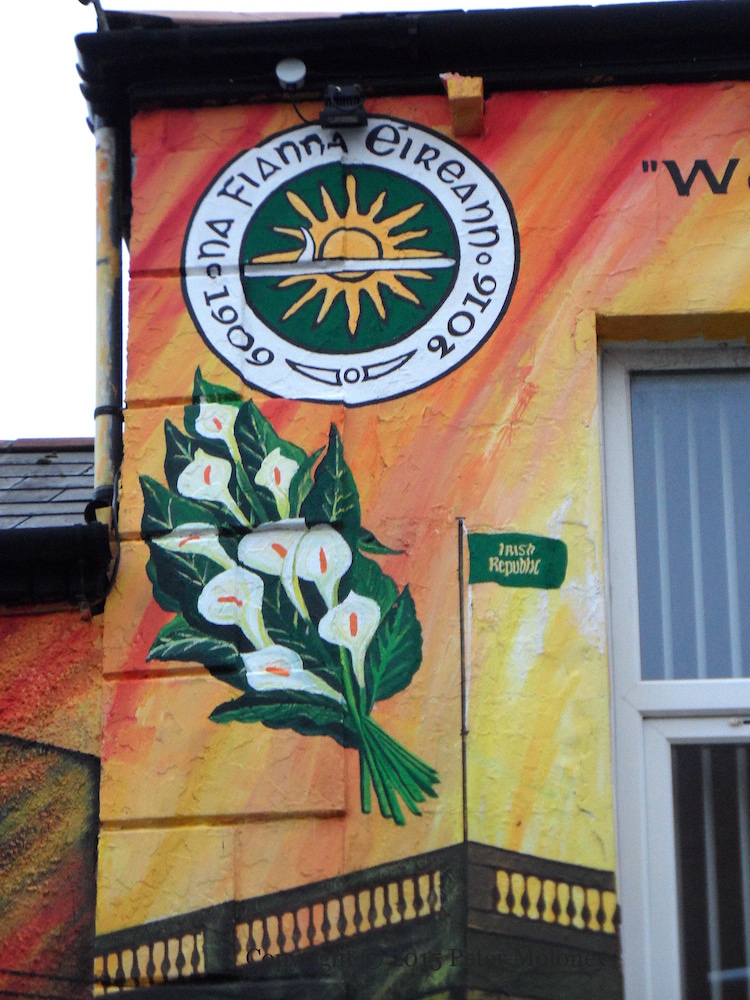
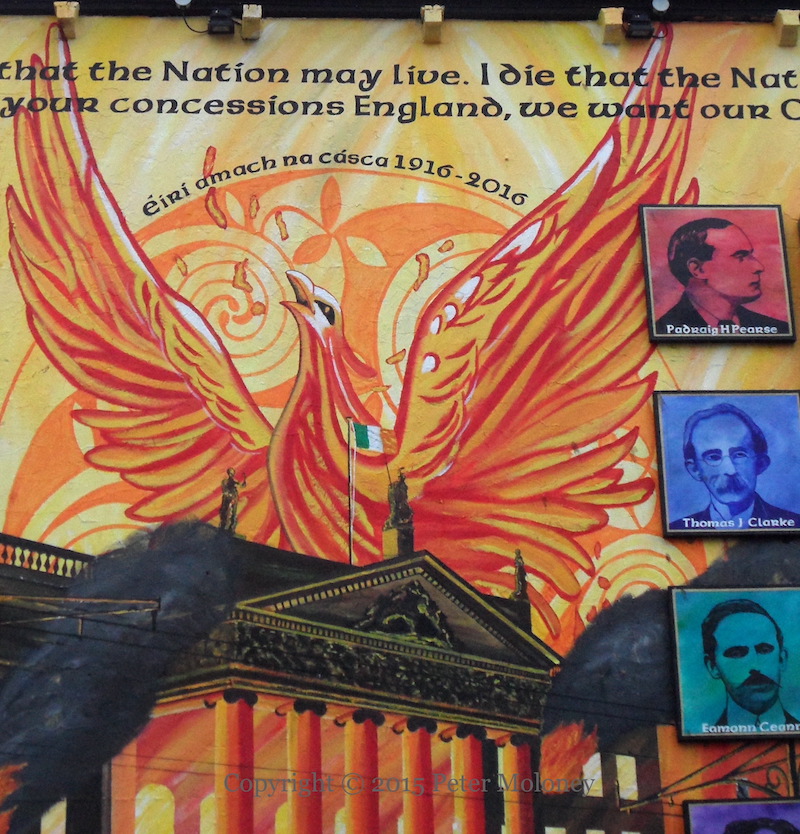
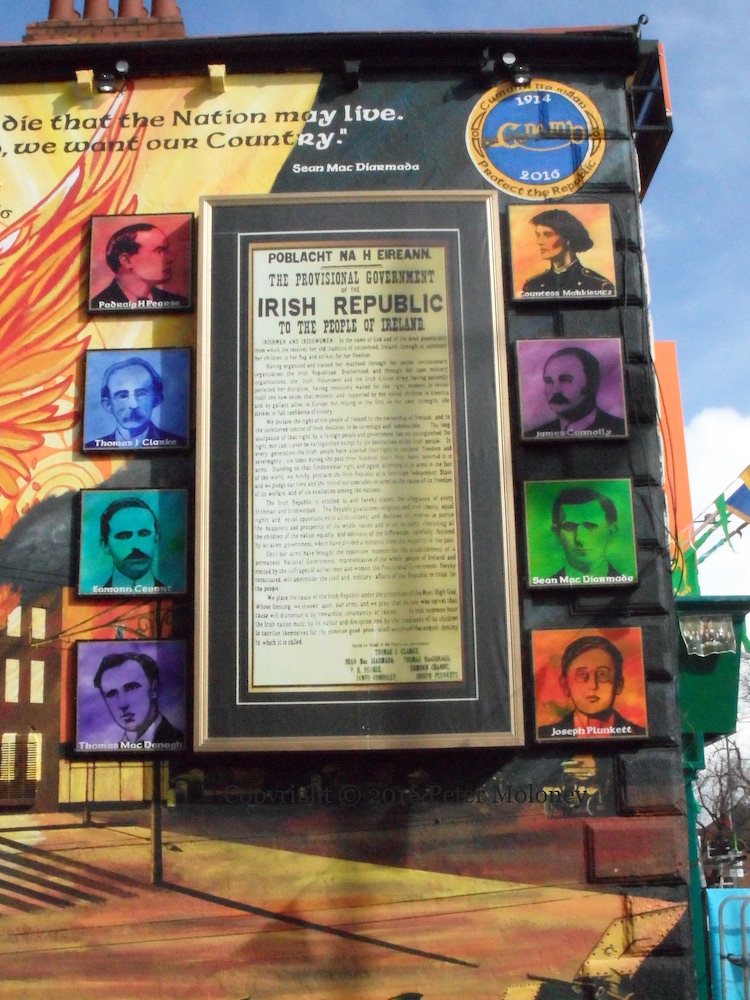
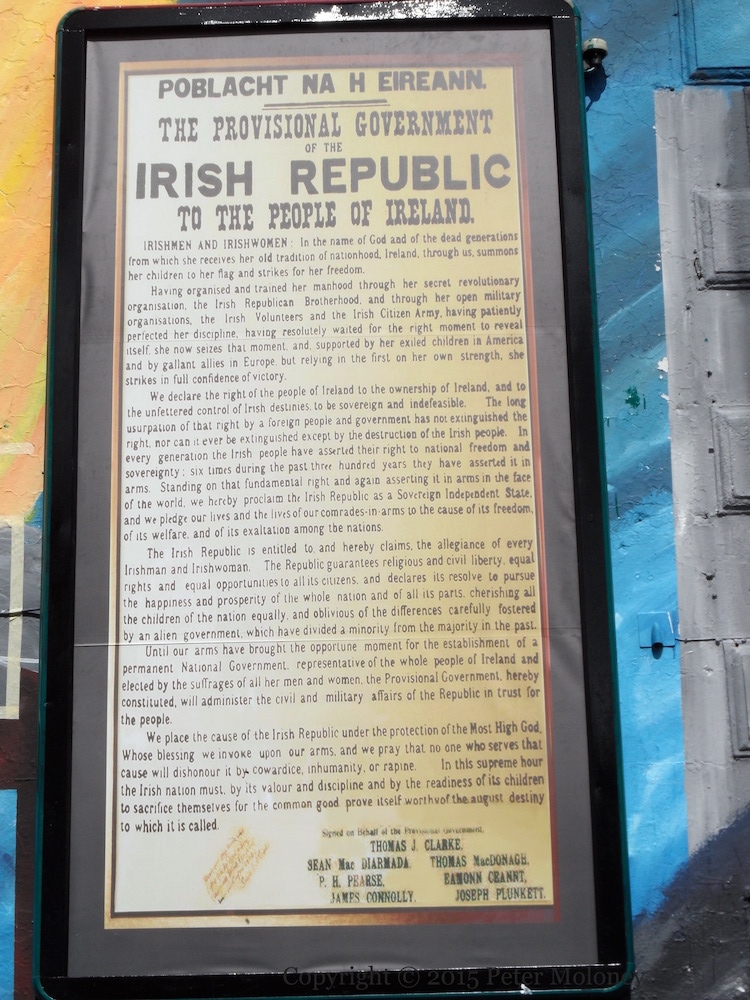
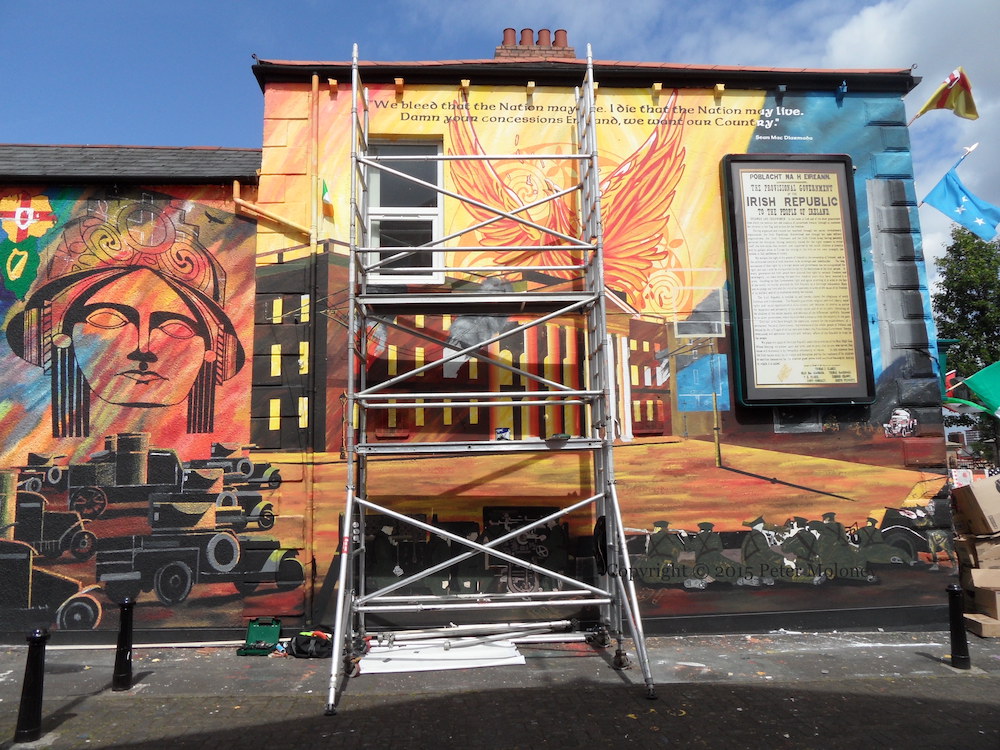
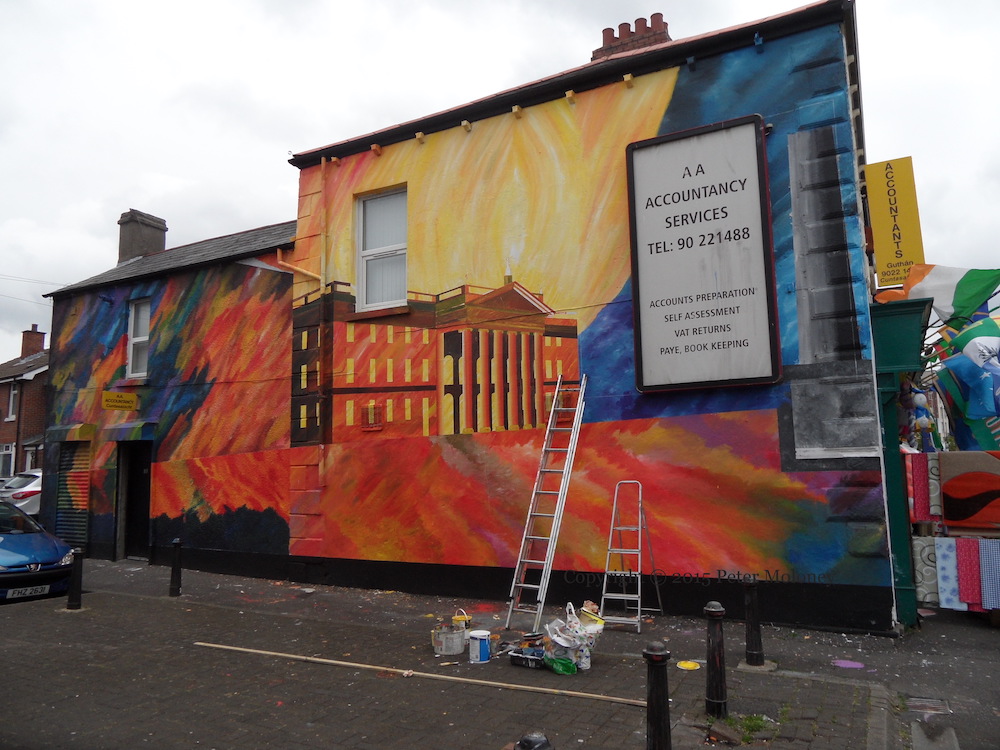
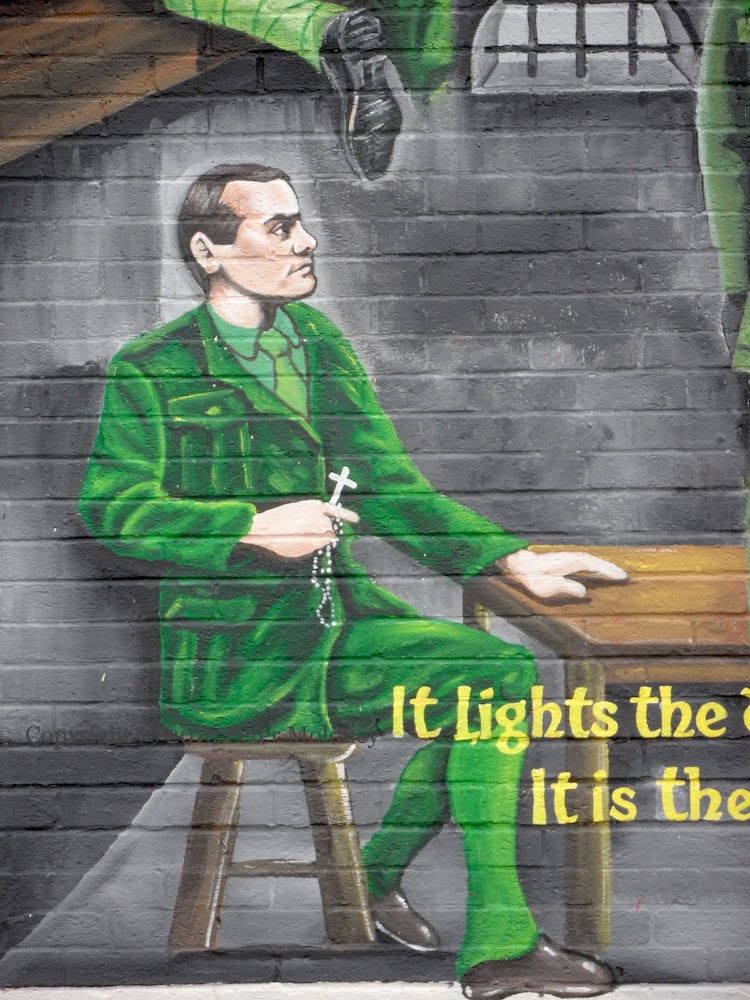
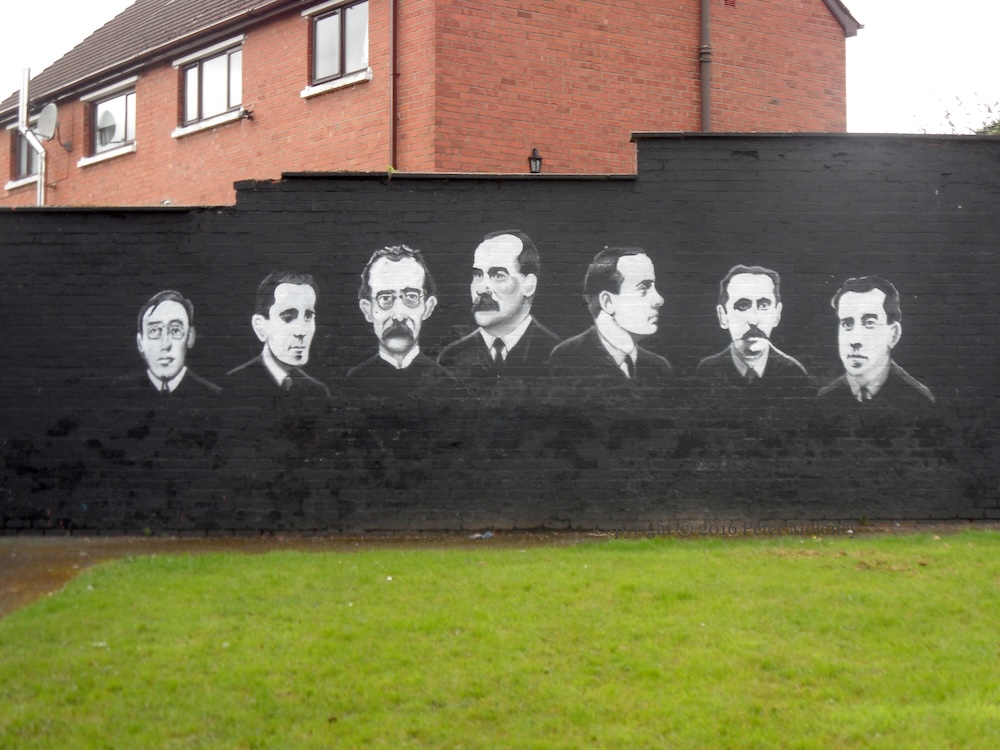
Oliver Sheppard‘s 1911 statue of Cú Chulaınn dying (see the Visual History page); the pikemen of the 1798 Rebellion; the four provinces of Ireland; Érıu the mythological queen of Ireland/Éıre as designed by Richard J King/Rísteard Ó Cíonga; Easter lilies; the emblems of Na Fıanna Éıreann and Cumann Na mBan on either side of a quote from (The Mainspring) Seán Mac Dıarmada, “We bleed that the nation may live; I die that the nation may live. Damn your concessions, England: we want our country”; a phoenix rising from the flames of the burning Dublin GPO (inspired by Norman Teeling’s 1998 painting The GPO Burns In Dublin); the GPO flying an ‘Irish Republic’ flag; portraits of signatories and other rebels — (left) Padraig H. Pearse, Thomas J Clarke, Eamonn Ceannt, Thomas MacDonagh, (right) Countess Markievicz, James Connolly, Sean MacDiarmada, Thomas Plunkett; the declaration of independence, placed over the advertising box of AA Accountants – see the in-progress shot below.
At the very bottom is a quote from the mother of painted Gerard ‘Mo Chara’ Kelly, Harriet Kelly: “We want the freedom of our country and your soldiers out.”
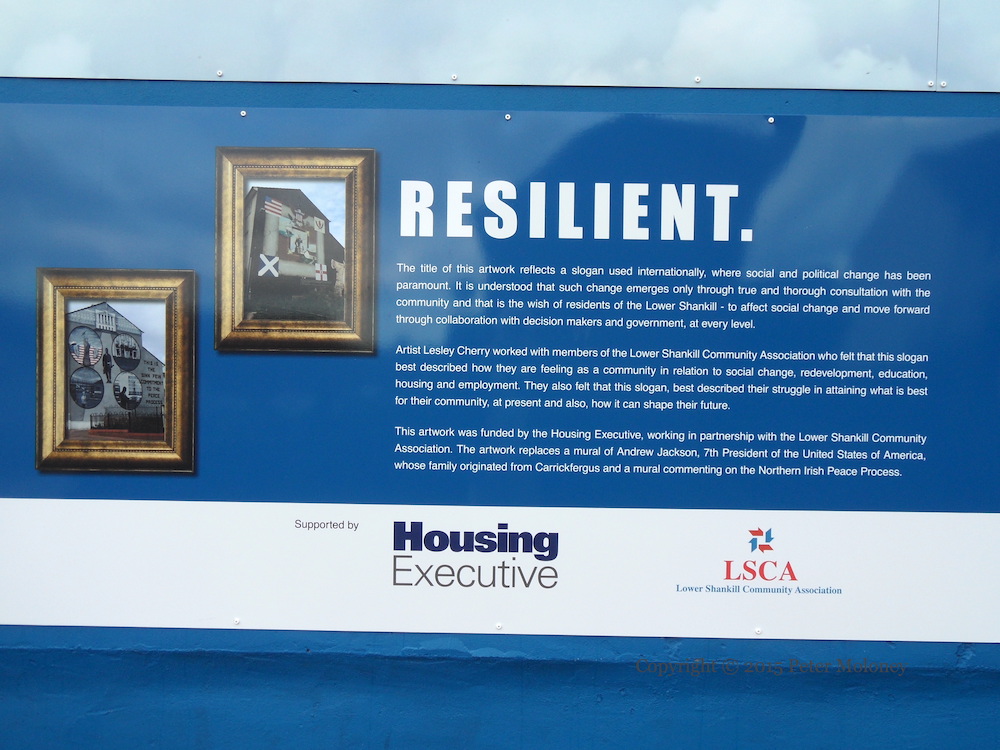
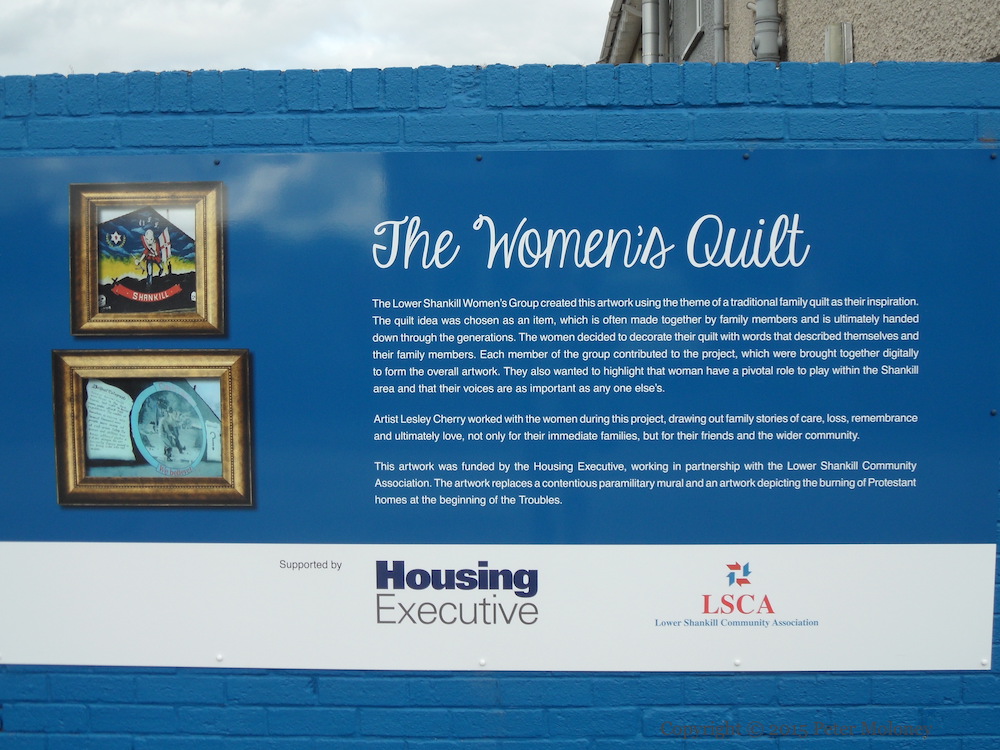
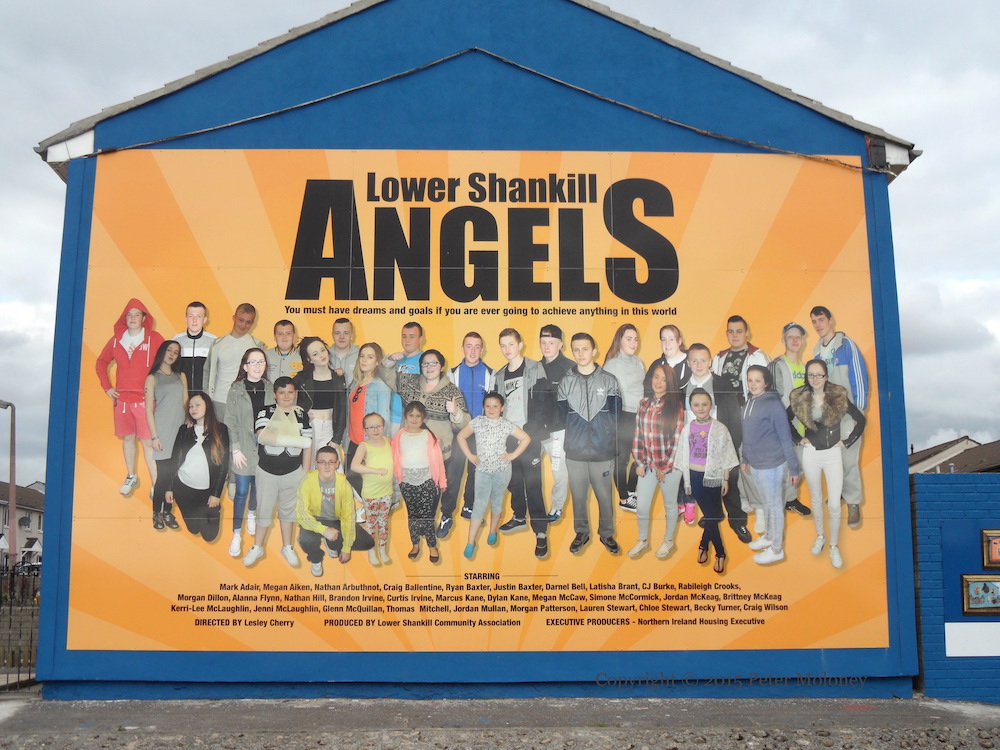
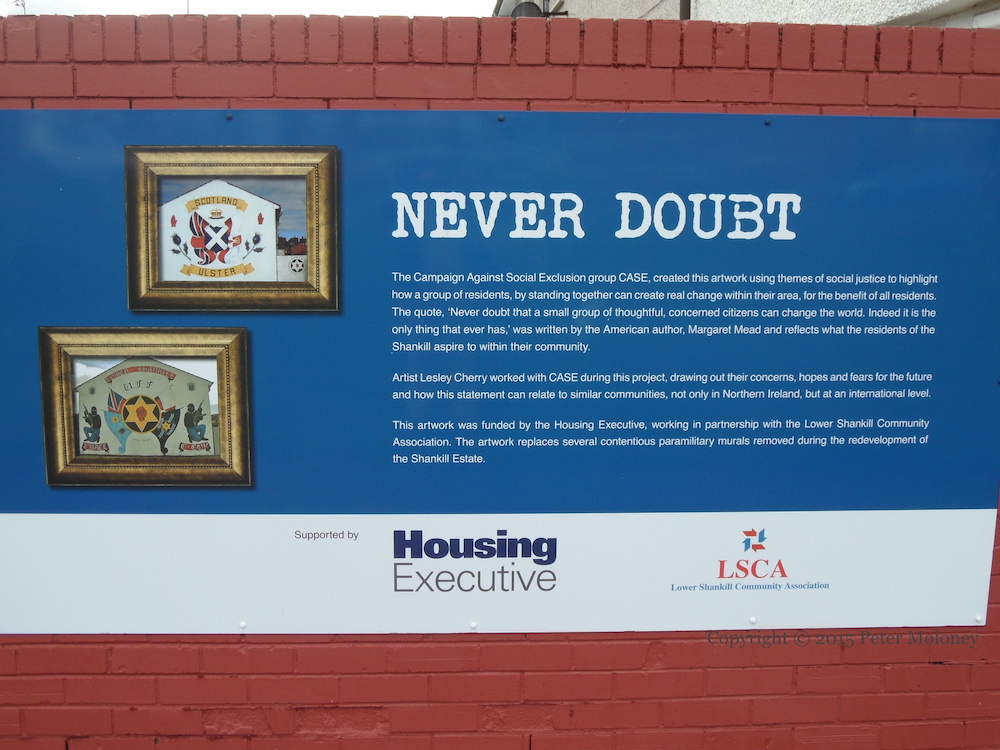
As can be seen from the images of the information boards that accompany them, these pieces are part of a second wave of re-imaging (Visual History 10) in the lower Shankill estate. Compared to the pieces they replace, these are even more neutral in theme, replacing cultural themes with community (and also all printed rather than painted).
Most of these are in the centre of the estate, alongside various UDA murals. There has also been a small wave of UDA stencilling and signage on the periphery of the estate – see Loyalist Lower Shankill.
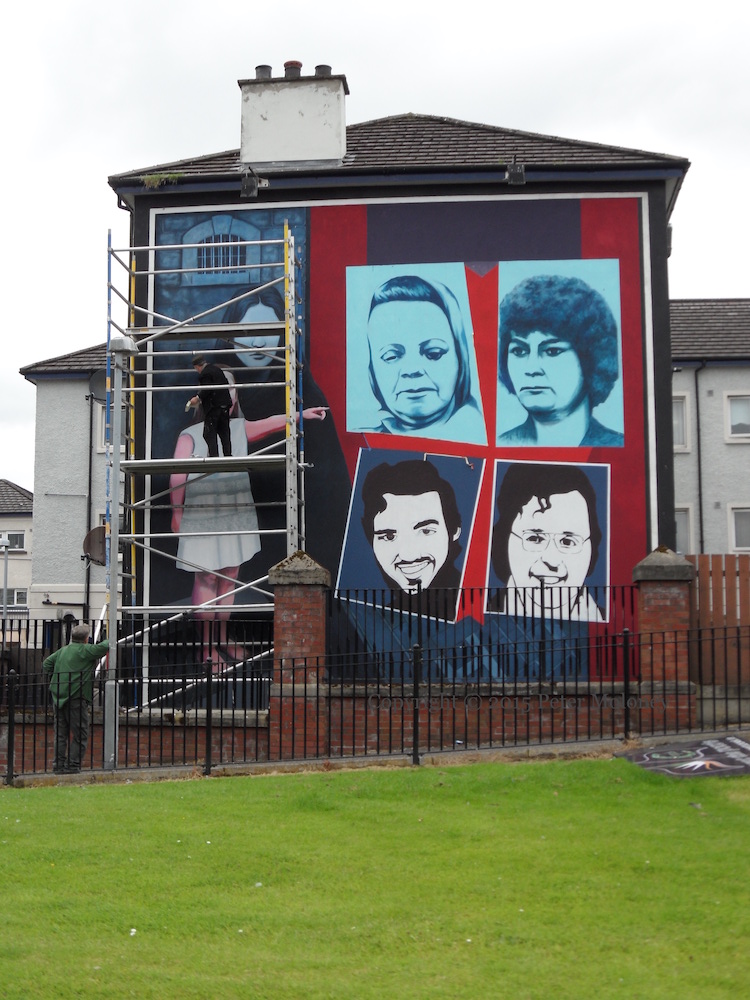
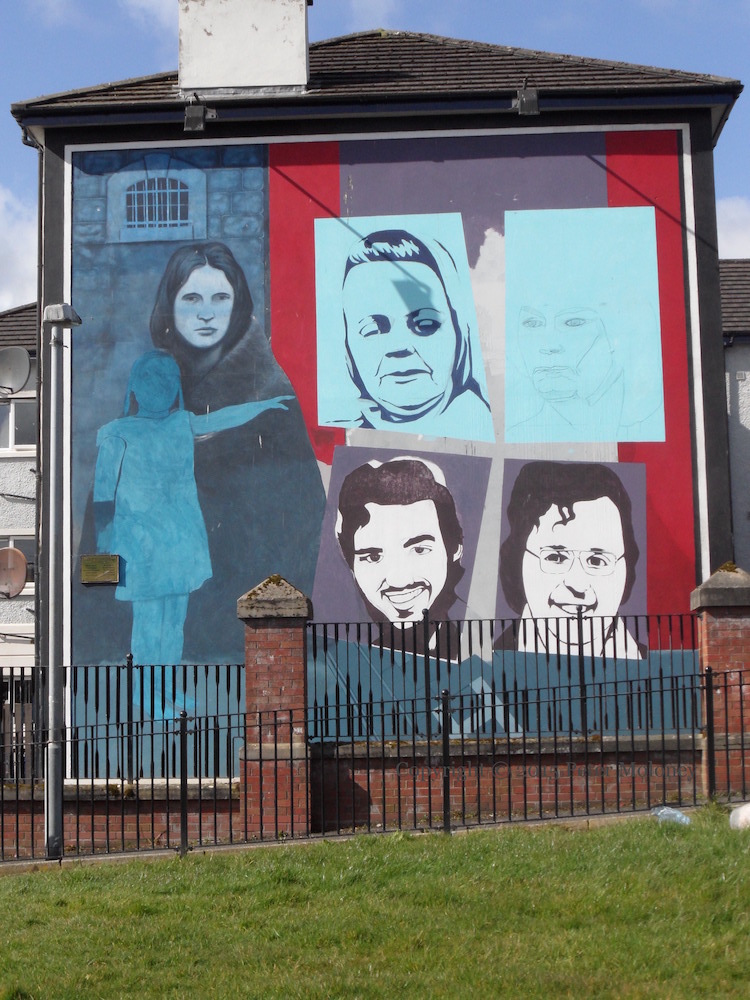
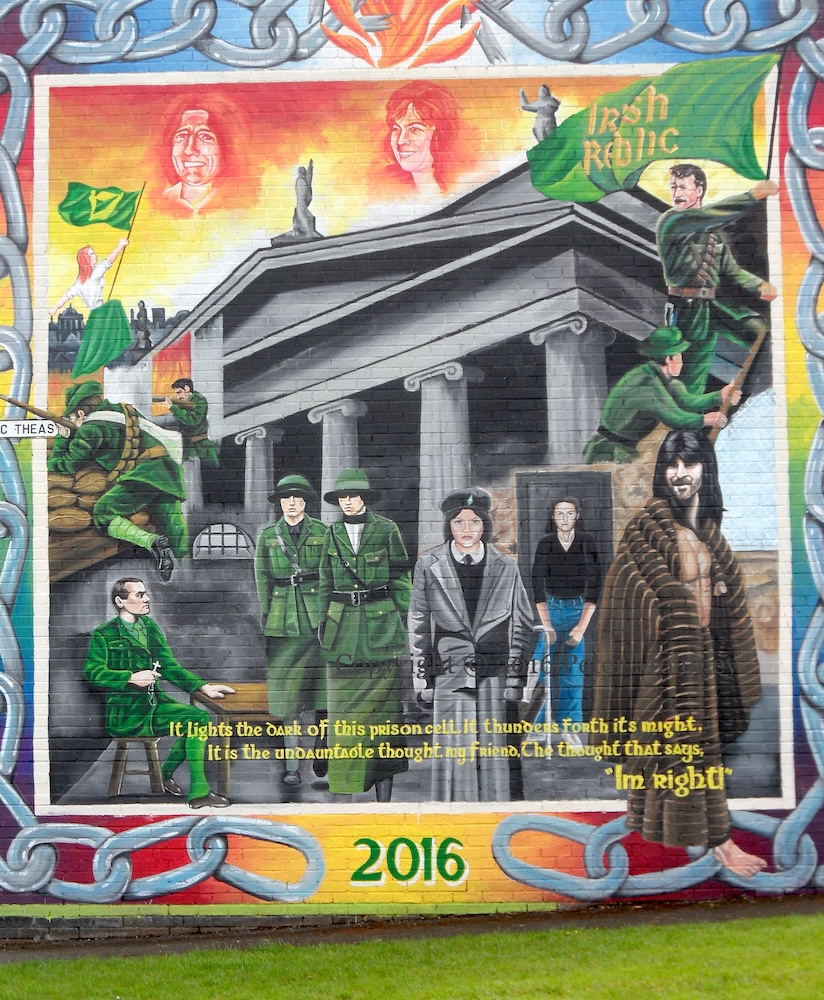
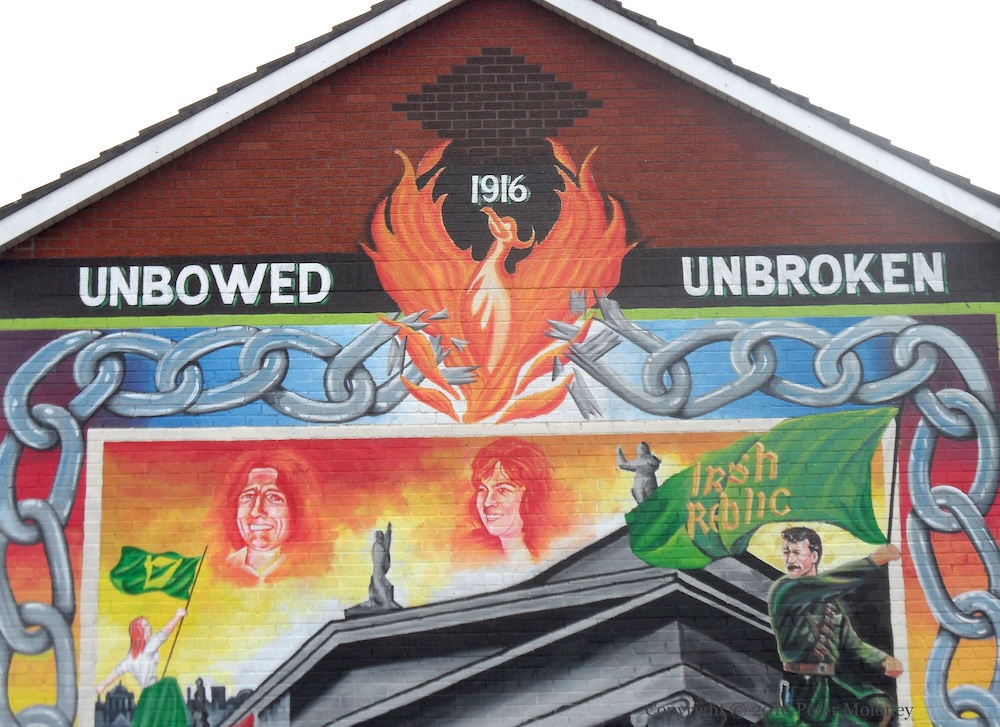
The figure in the centre of the mural above is Peggy O’Hara, mother of INLA hunger striker Patsy O’Hara, who remained active in socialist and republican circles and stood in the assembly elections in 2007 as an independent. She died in 2015 and was given a paramilitary funeral, including a volley of shots fired over the coffin (BBC | Irish Times | An Phoblacht).
The female figure above Mickey Devine (in the bottom right) is his sister Margaret, from whose house his coffin processed after his death in 1981. (See the plaque in Breaking The Chains.) The girl on the left is pointing towards another mural, a dove of peace.
The standing figure, and the plaque, are retained from the previous mural.
This pair of boards is outside the Ulster Rangers Supporters Club (Fb) on the Shankill Road.
Above: The painting features a tram going under an Orange arch between the public baths on one side an Spin-A-Disc records on the other, surrounded by notable figures from the Shankill area. (Many thanks to Johnny Dougan of Shankill Area Social History (Fb) for the information below.)
Front, from left to right: Manchester United and Northern Ireland Soccer player Norman Whiteside (WP) and behind him boxer Davy Larmour and community worker Saidie Patterson (see WRDA), boxer Sammy (Cisco) Cosgrove, Senator Charlie McCullough (WP), Tommy Henderson, boxer Jimmy Warnock (original photograph here), Hugh Smyth (see previously Third Class Citizens), artist William Conor (see previously Conor’s Corner, Jack Henning (running), musician Belter Bell, writer Albert Haslett (Northern Visions interview).
Atop the tram: on the left is Jackie Redpath of the Save the Shankill Campaign (note other members of the group with placard on right; Northern Visions has a documentary about the Save The Shankill campaign) and Jack Higgins holding his book The Eagle Has Landed (WP). Up there too is Miss Sands, the music teacher in the Girls Model School, and historian Bobby Foster (Northern Visions interview). On the stairs are May Blood MBE and above her D.I. Nixon.
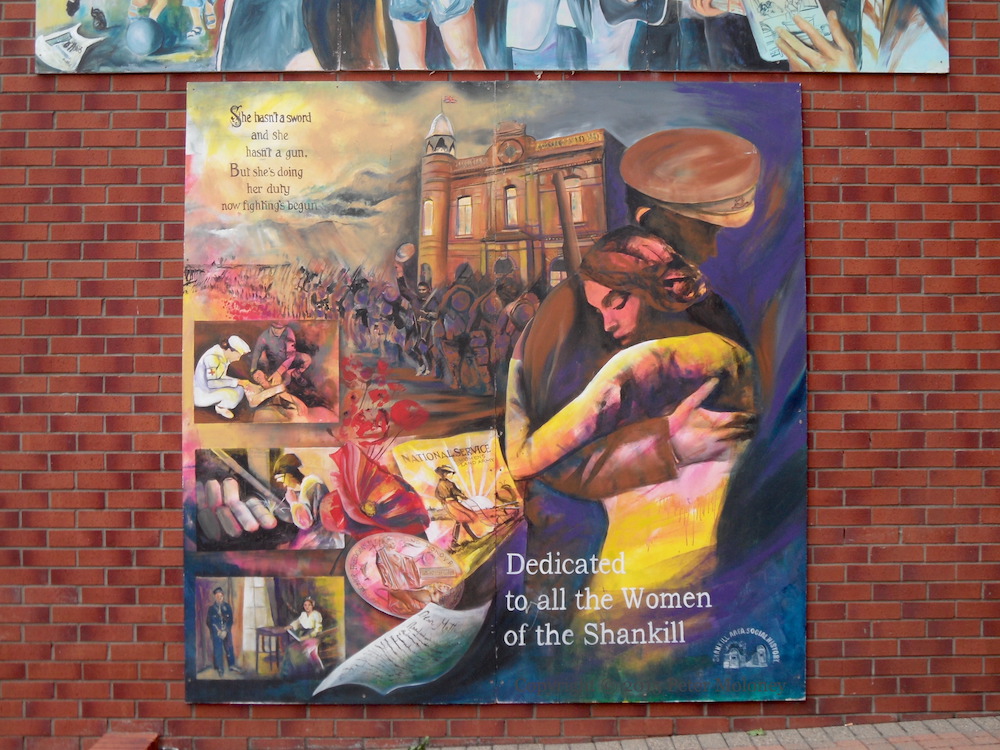
Below is a board highlighting the roles played by women during WWI as nurses and welders and in the Land Army. “She hasn’t a sword and she hasn’t a gun. But she’s doing her duty now fighting’s begun.”
The central image of soldiers at the battle of the Somme is surrounded by images of various occupations: shipyard workers and miners (perhaps), along with images of women welding, carrying coke, and nursing. It’s not clear what the “fair wartime wage” refers to: there was a general strike at the shipyards in 1919 (The Great Unrest | Workers’ Liberty).
“Viva Palestine”. This pro-Palestine mural features sky-jacker Leila Khaled (also seen in in Hugo Street) and the emblem of the Popular Front For The Liberation Of Palestine (WP). The Arabic on the right is an equivalent of “Tıocfaıdh ár lá” on the left.
“Cumann Na mBan” in Irish is “the women’s organization/council/society” in English. The organization in question is the republican paramilitary group which was founded on April 2, 1914 and celebrated its 100th anniversary in 2014.
The mural is at the bottom of Teach Na bhFıann/Fianna House (formerly Dill House) in the New Lodge.