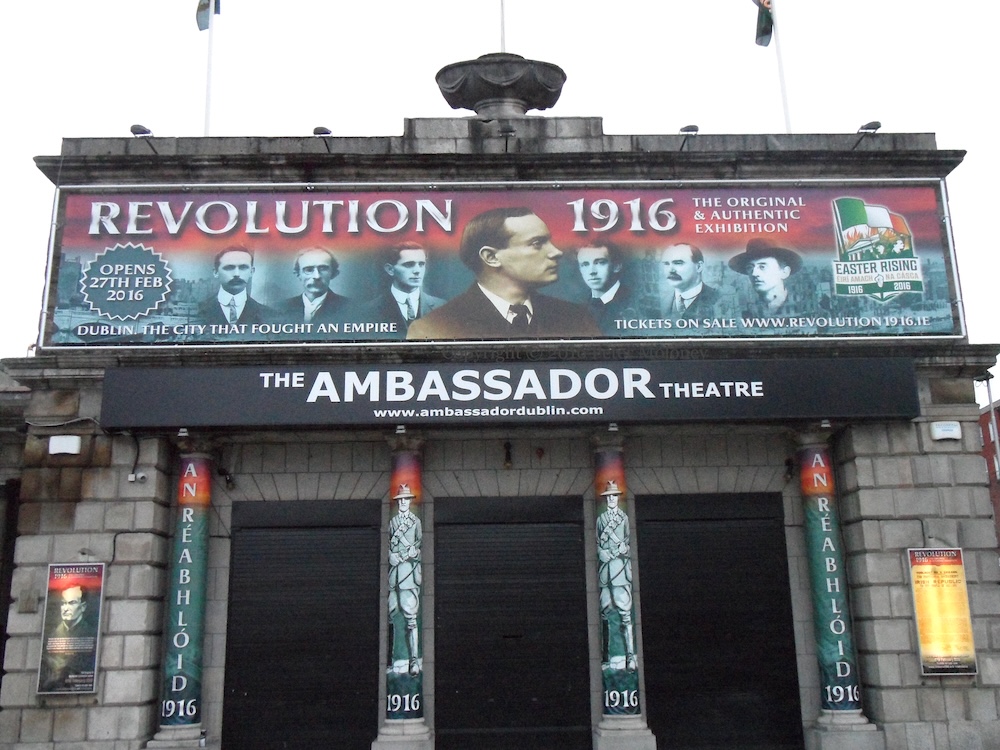
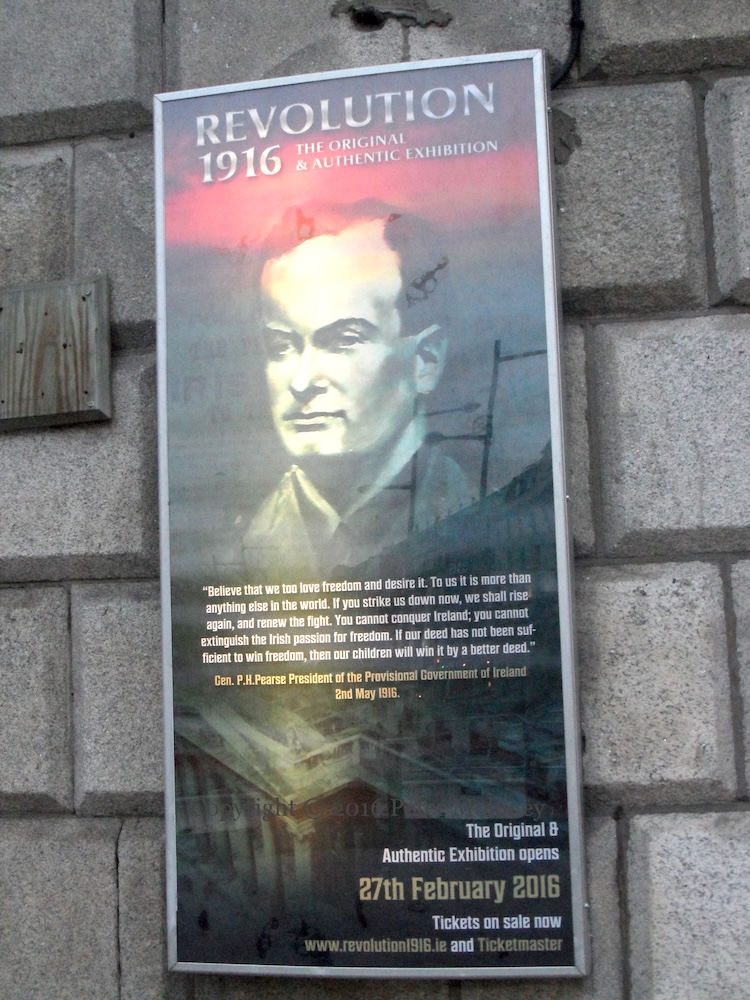
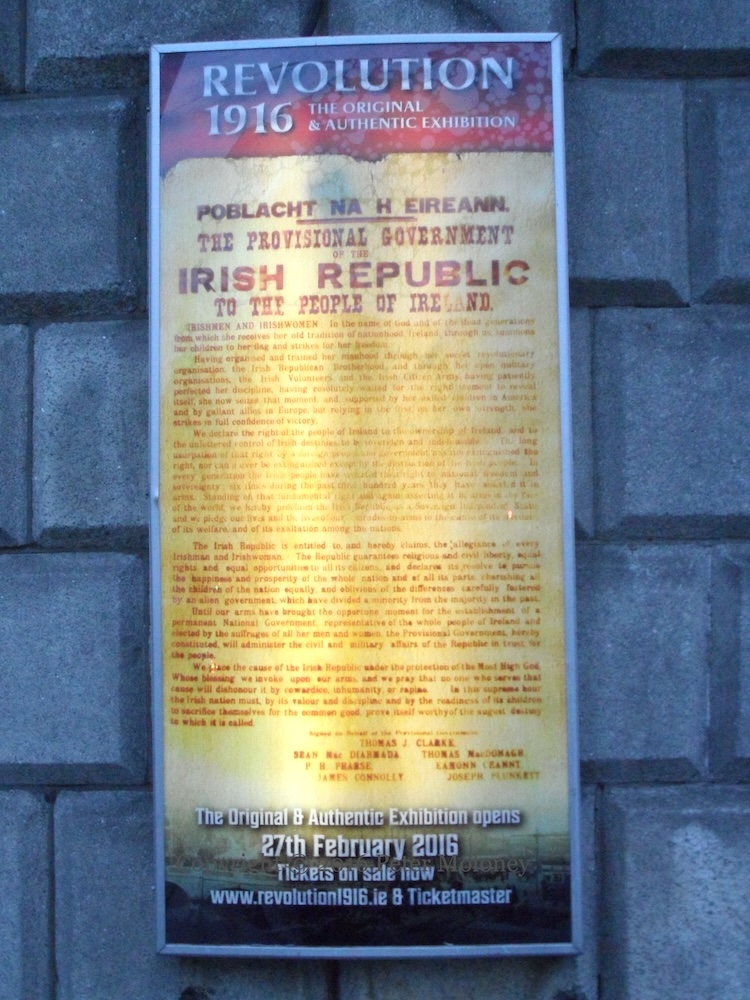
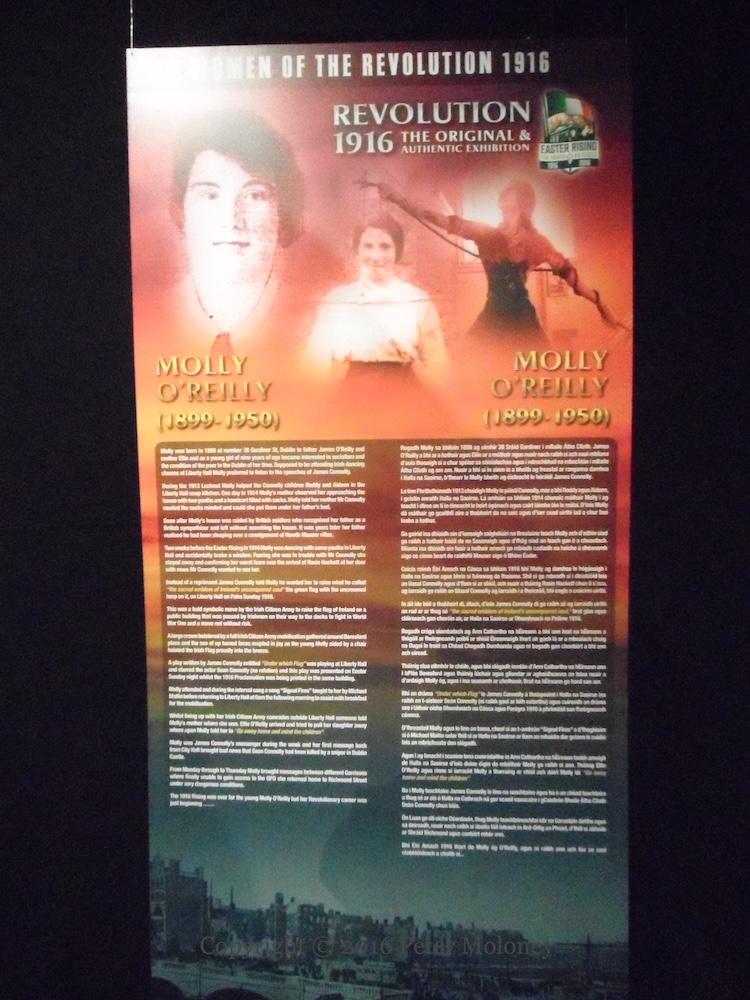
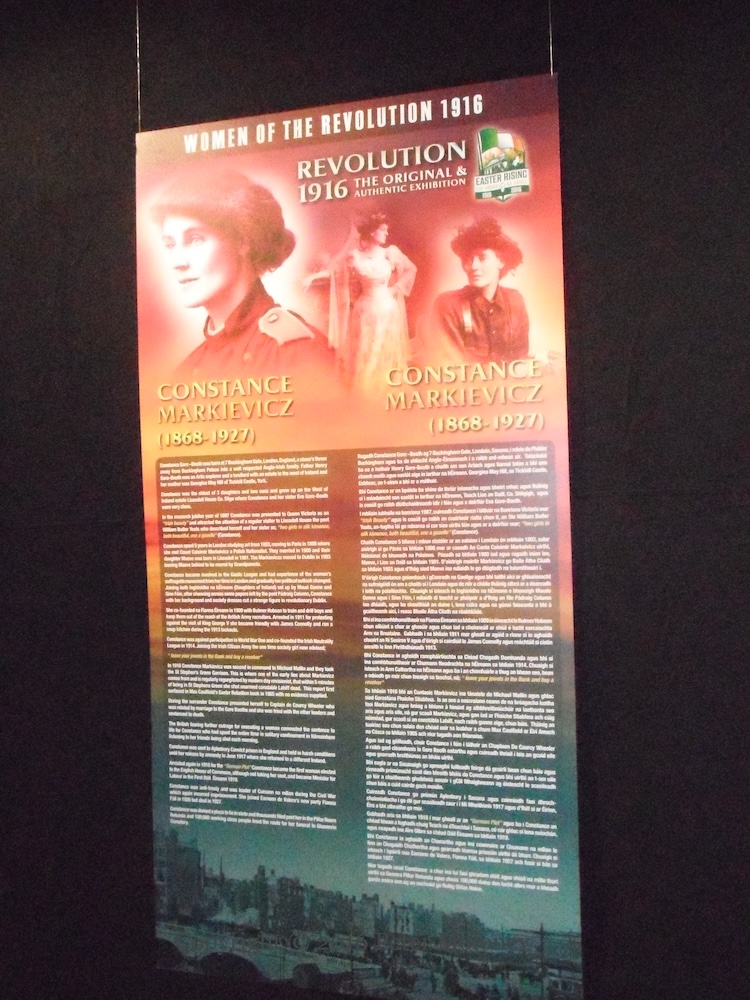
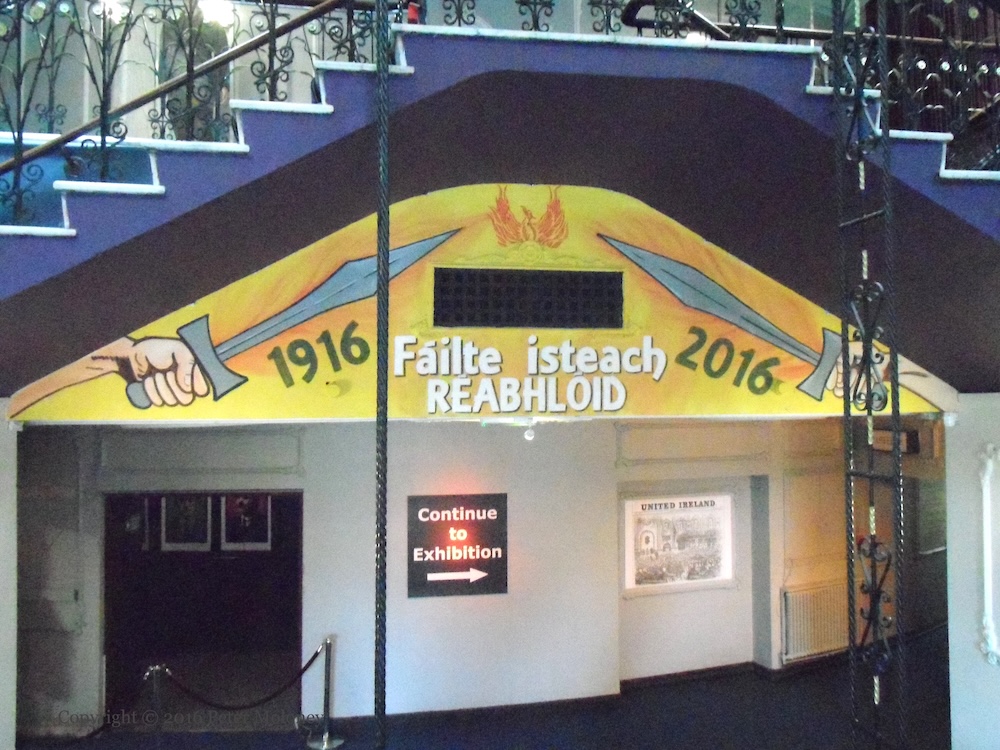
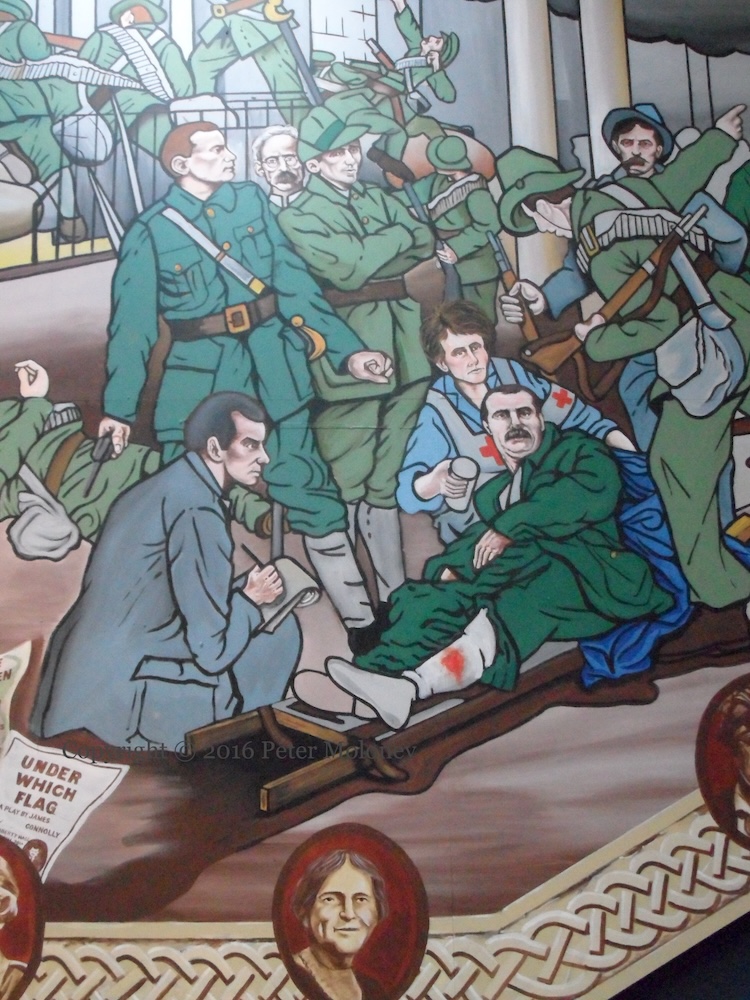
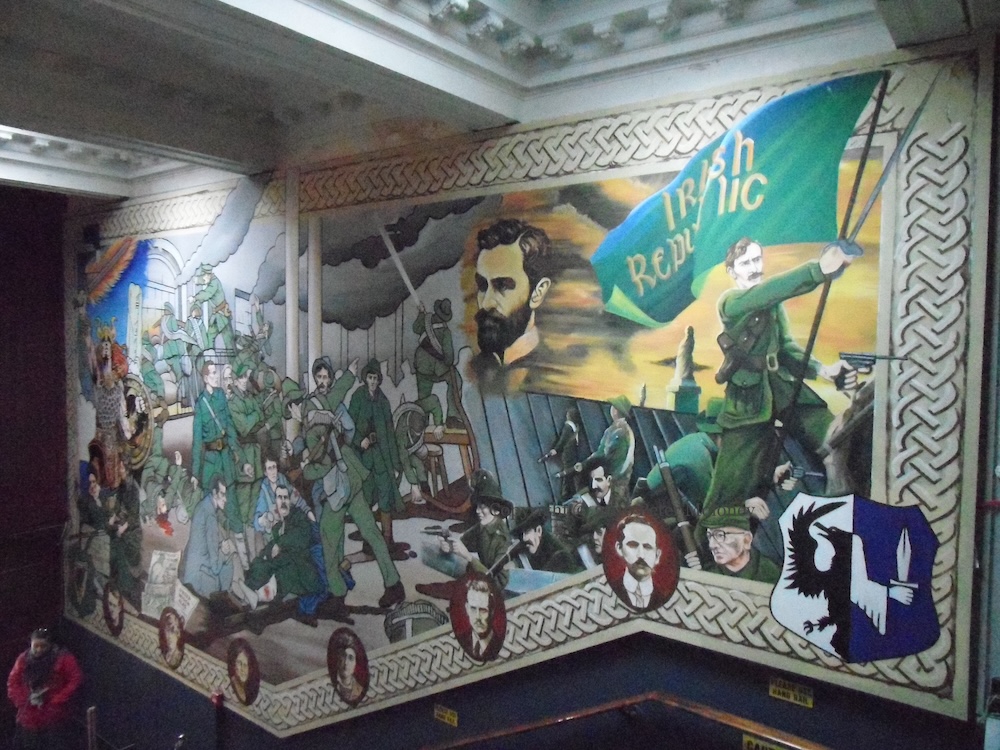
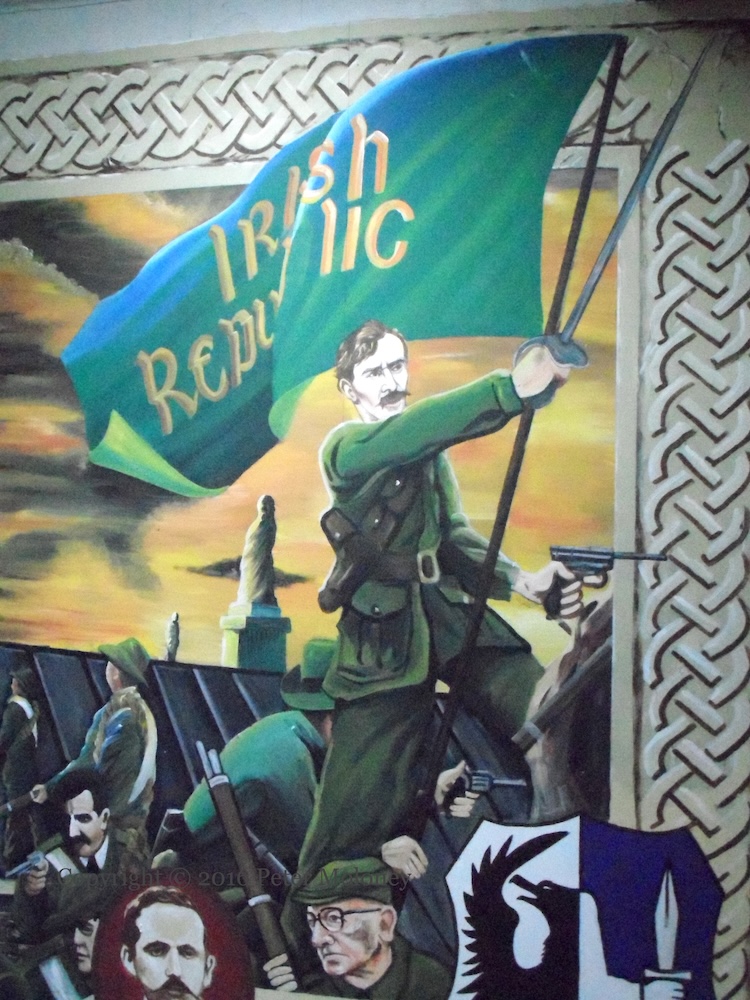
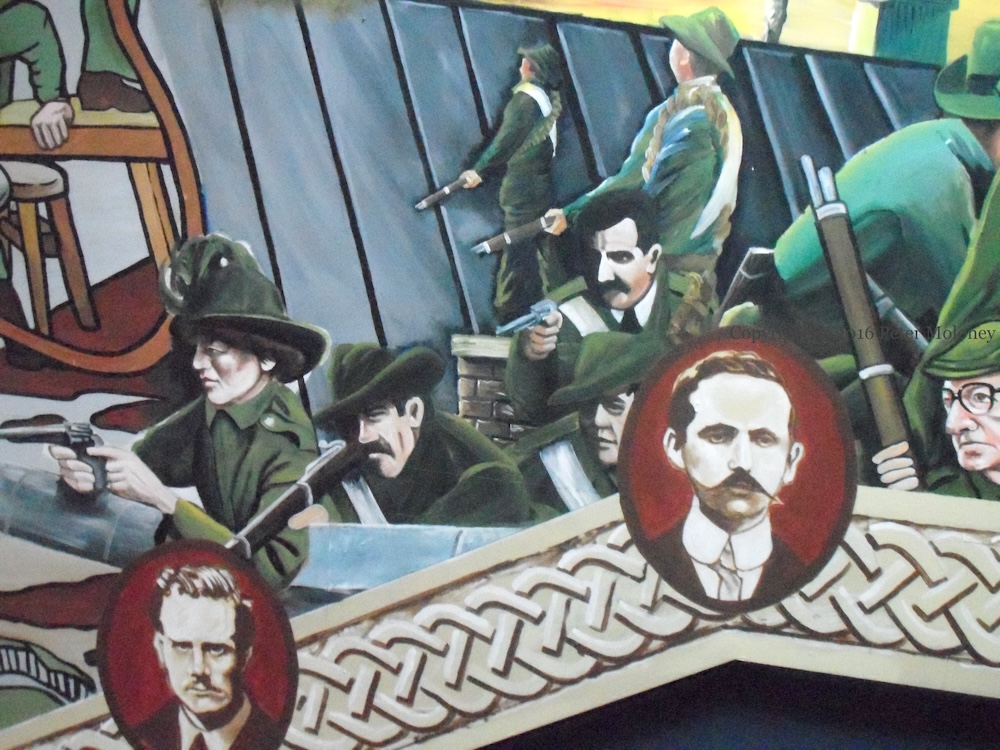
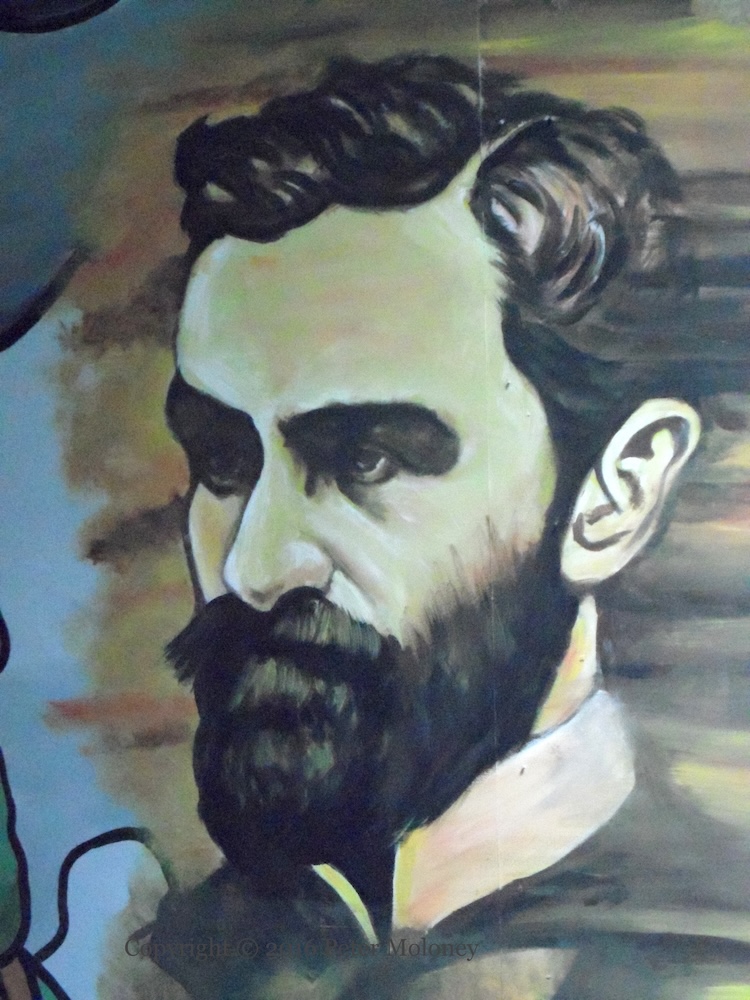
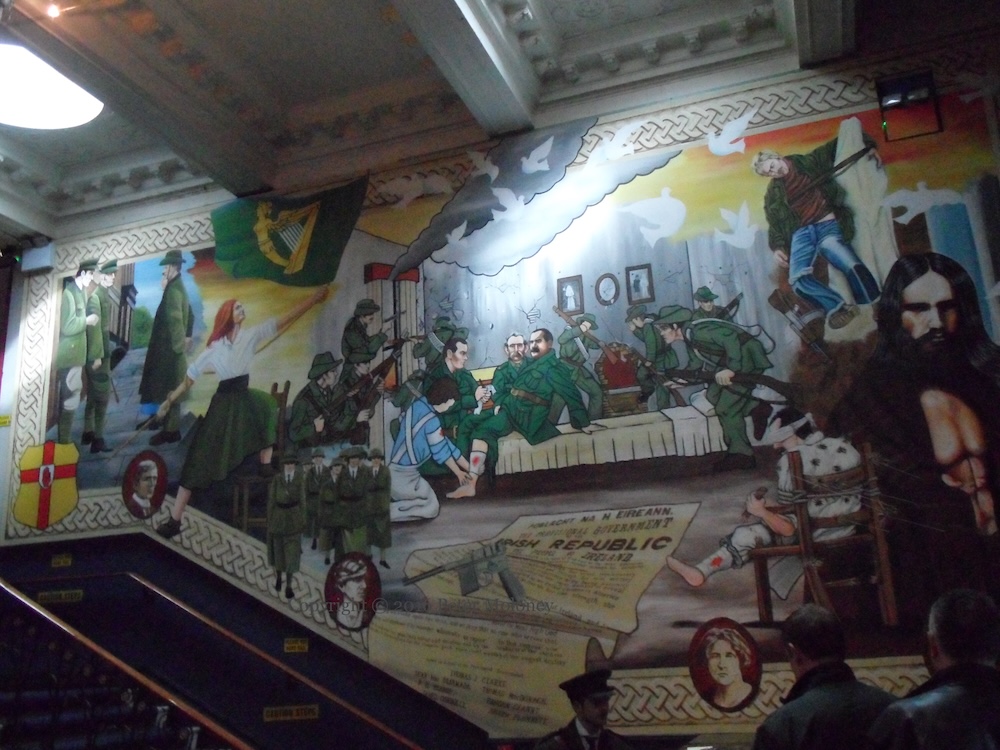
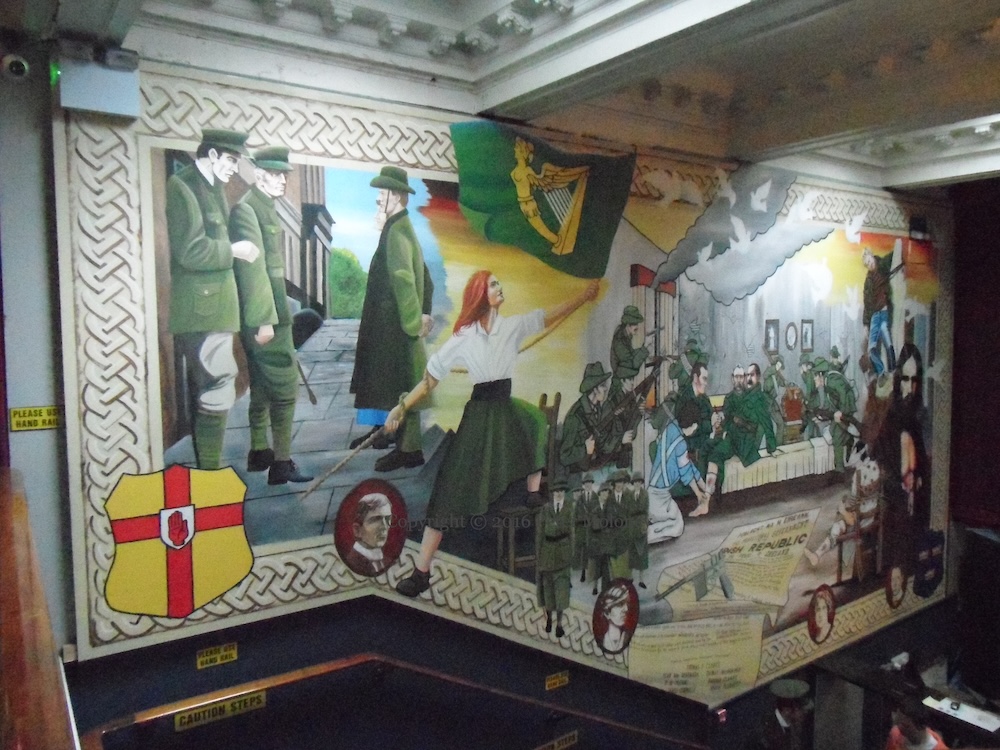
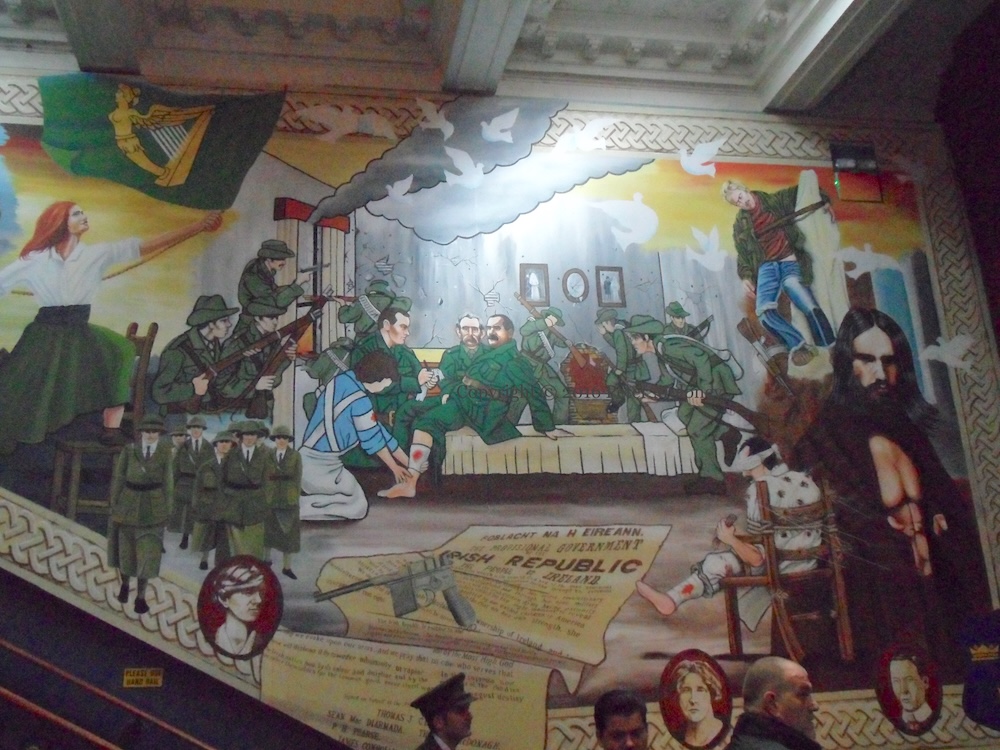
The ‘Revolution 1916’ exhibition commemorating the Easter Rising opened on February 27th at the Ambassador theatre in Dublin, “the city that fought an empire”. Images of some of the pieces on display can be seen in this An Phoblacht article.
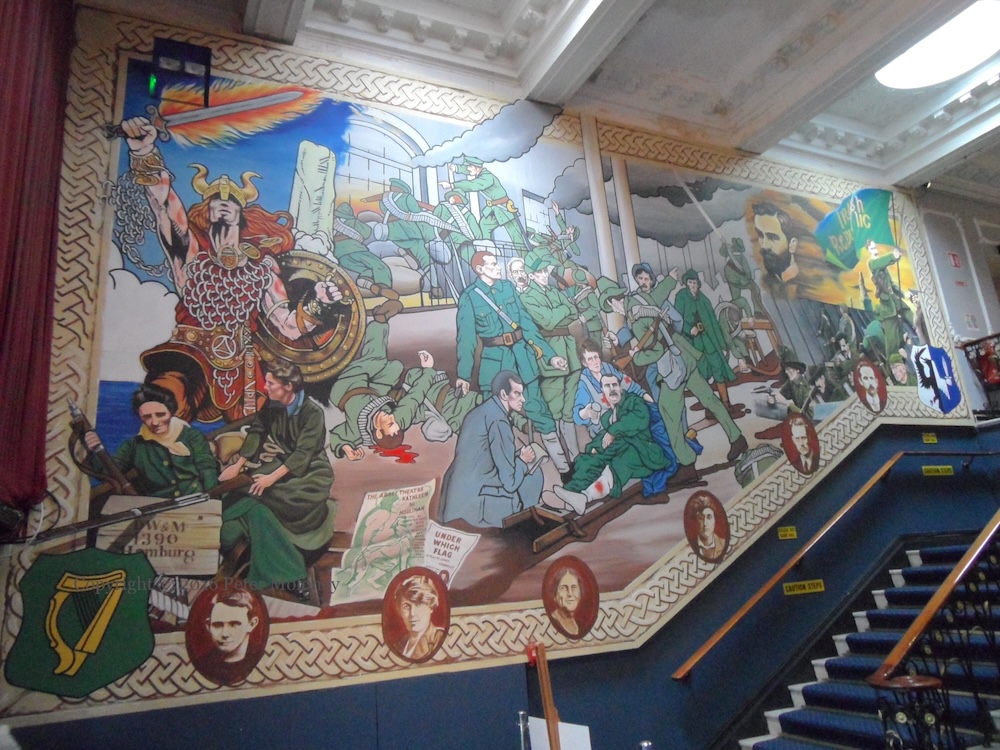
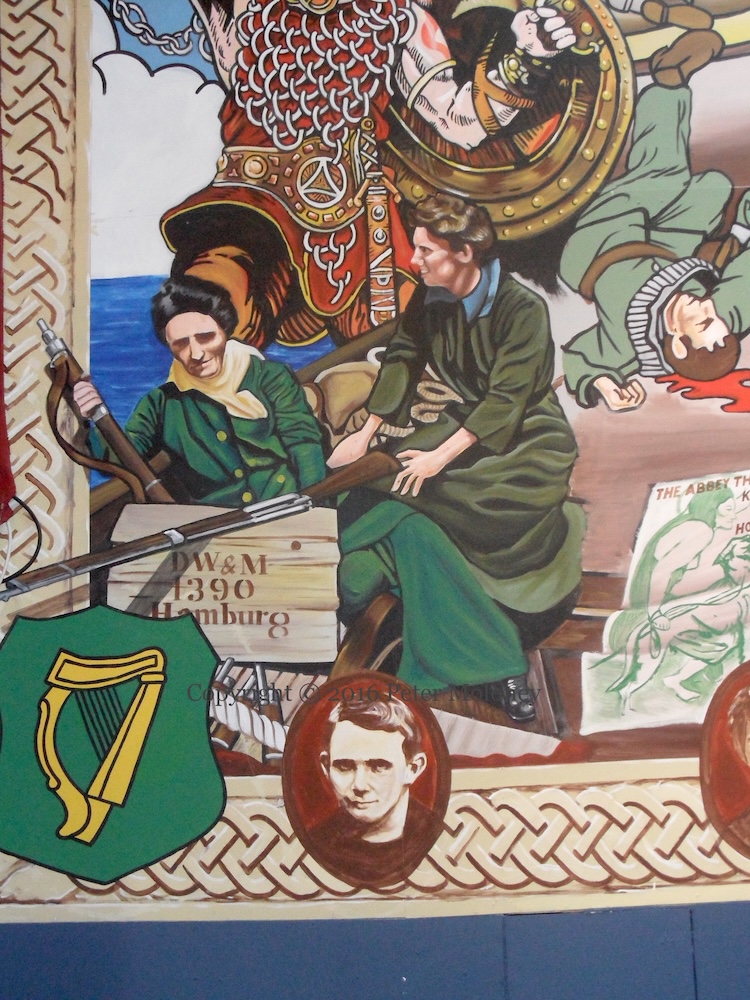
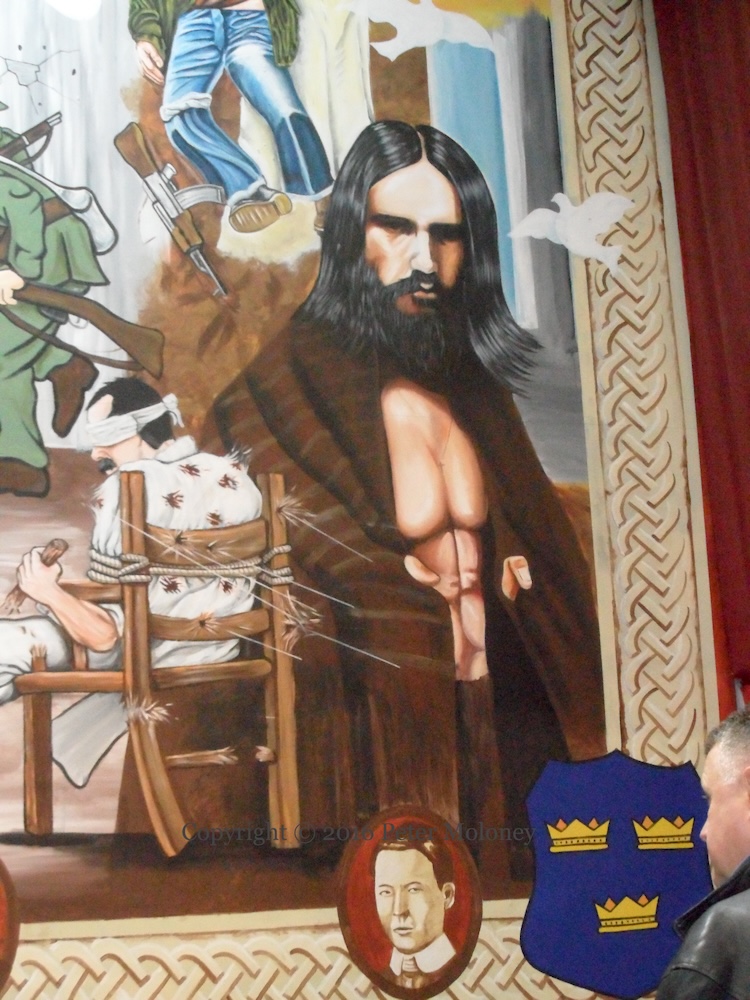
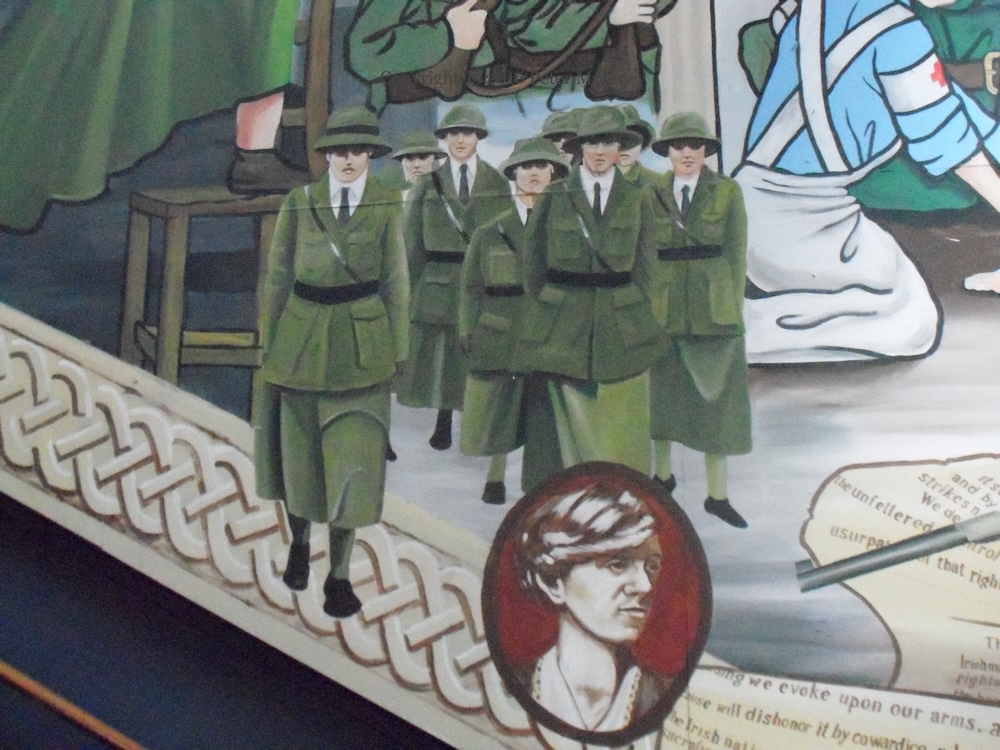
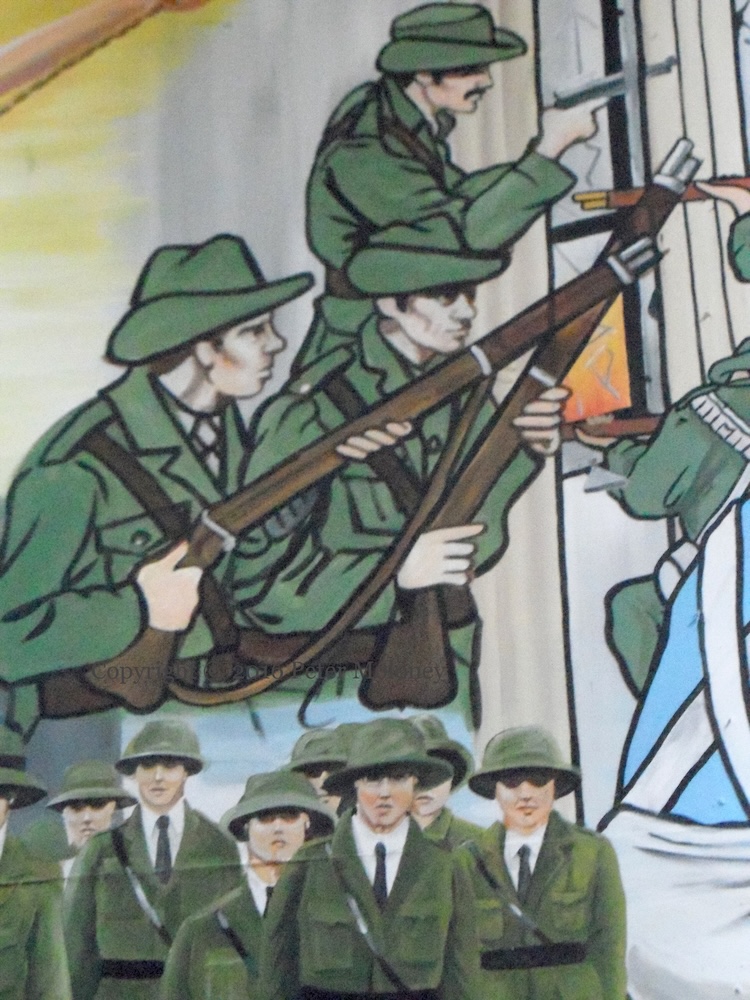
In addition to the artefacts and recreated locations, two murals were painted by three Belfast artists depicting Irish culture and the republican struggle throughout the ages, from Nuada to the blanket protest. (Here is video of DD talking about the murals – youtube.)
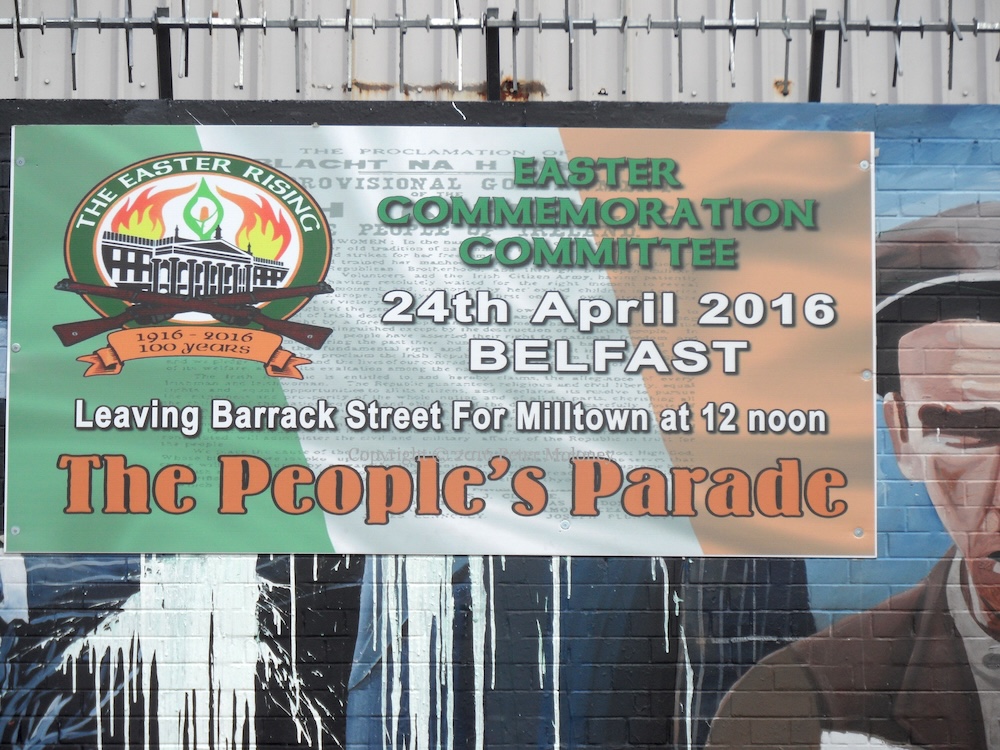
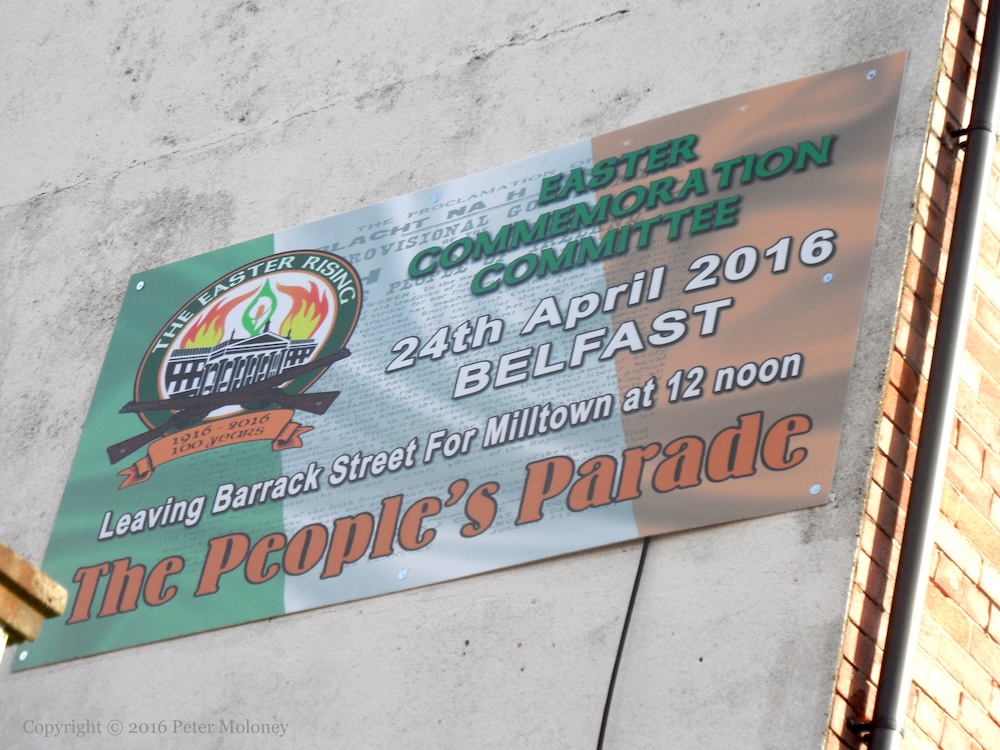
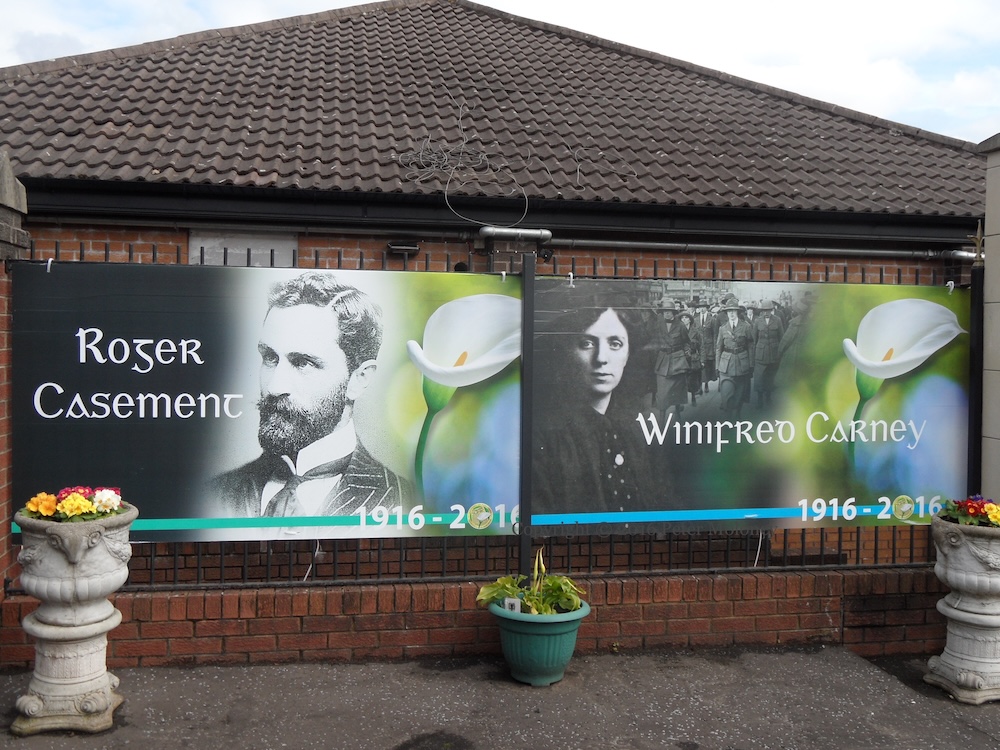
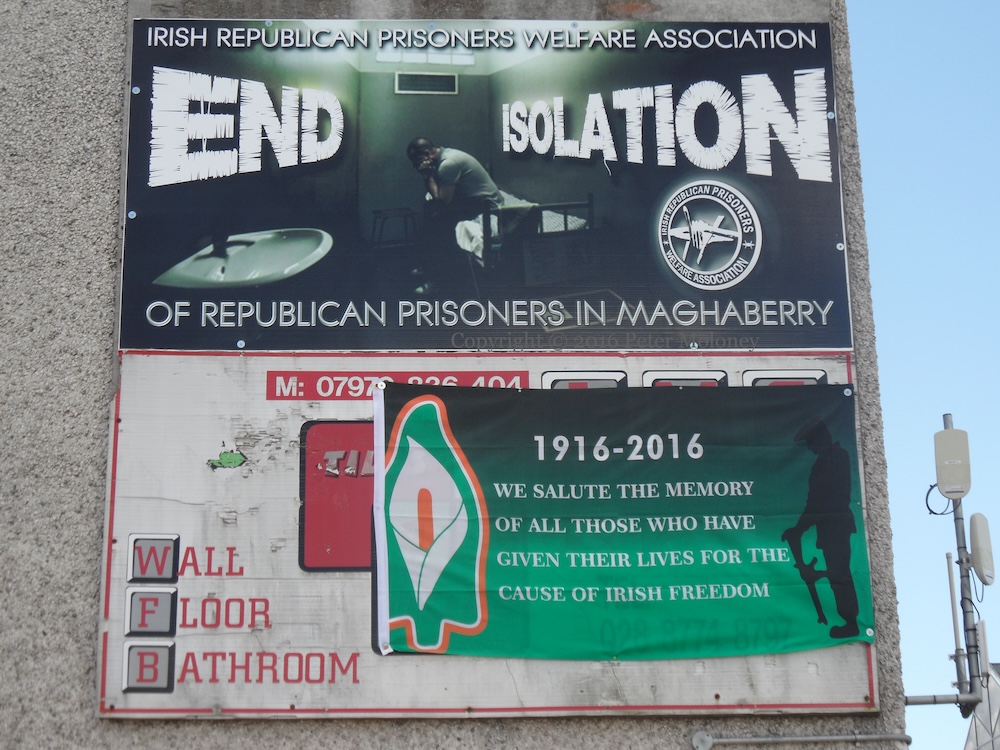
The People’s Parade (i.e. the parade supported by anti-Agreement groups) takes place April 24th, the date of the Rising in 1916; the other (Sınn Féın) parade was held on Easter Sunday, which this year was March 27th. The second board is above the RSF office/shop in the middle Falls; the upper image is on the International Wall, Divis Street, during the long time that it was being painted (and vandalised) for the centenary – it would eventually be launched on the anniversary of Casement’s execution, on August 3rd.
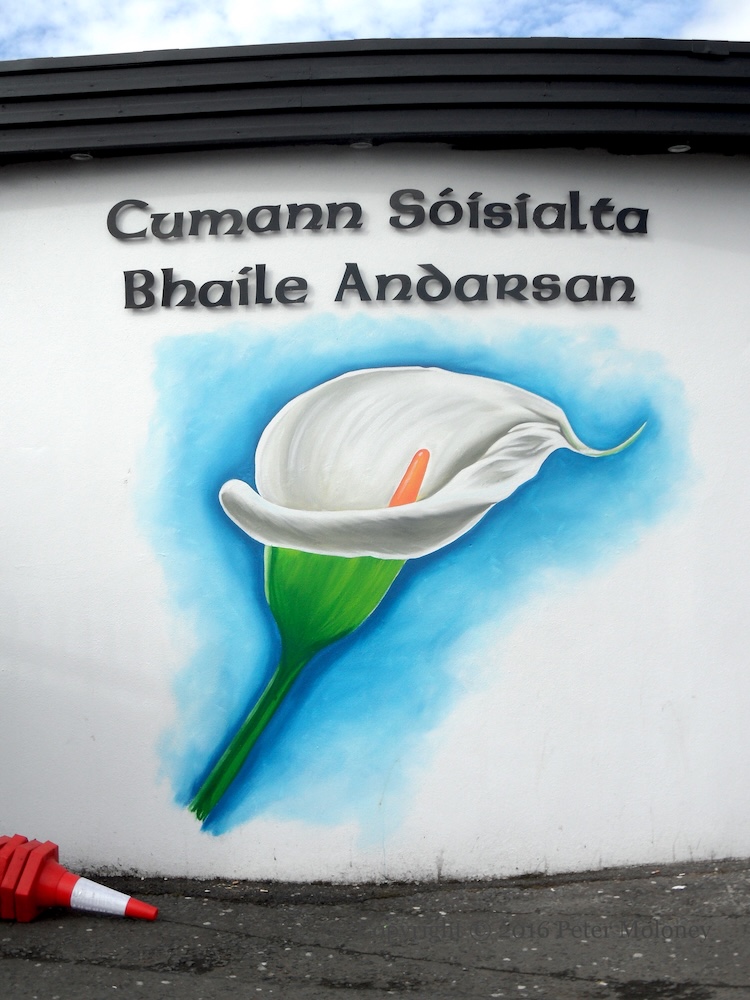
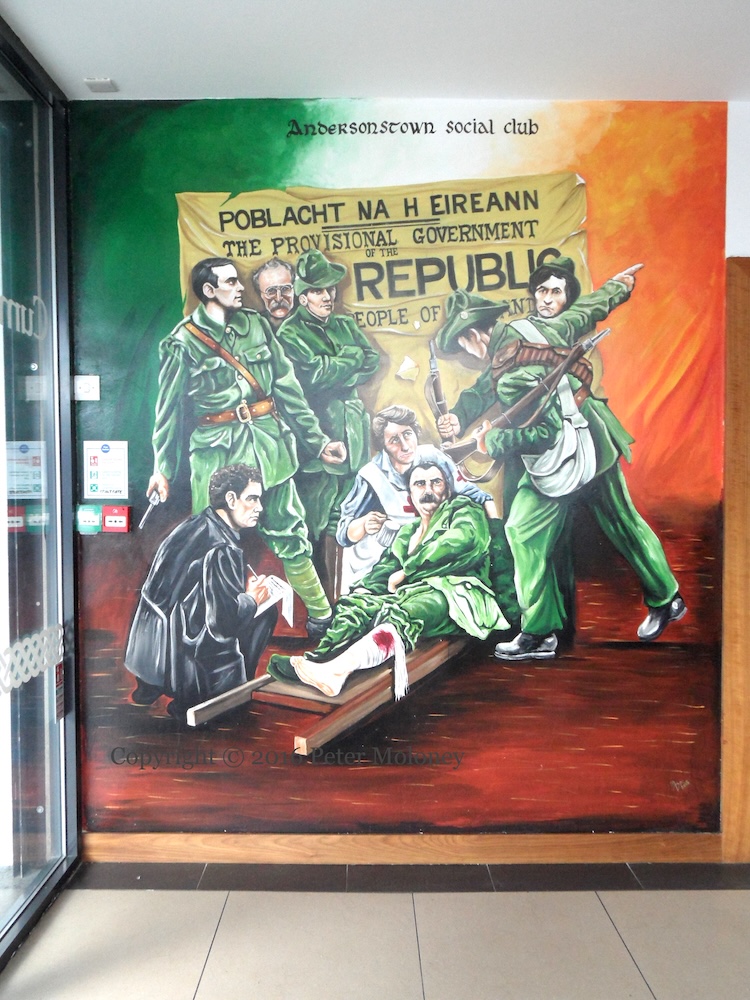
The PD/Cumann Sóısıalta Bhaıle Andarsan/Andersonstown Social Club was one of the early stops for the travelling version of the ‘Revolution 1916’ exhibition that was hosted by the Ambassador theatre – see Revolution 1916.
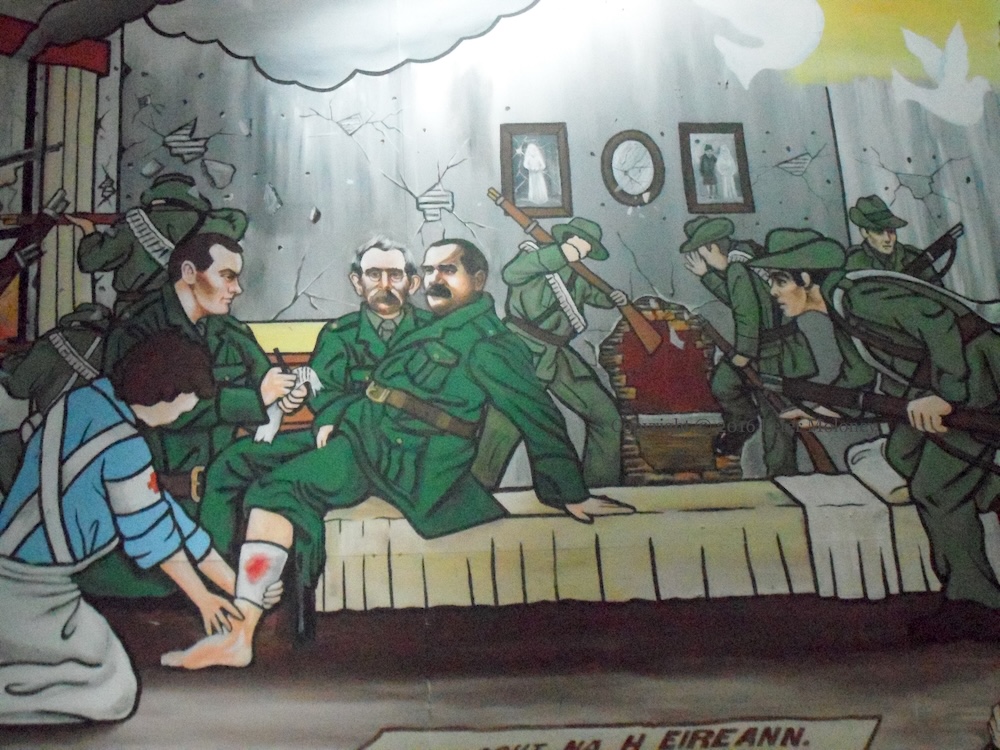
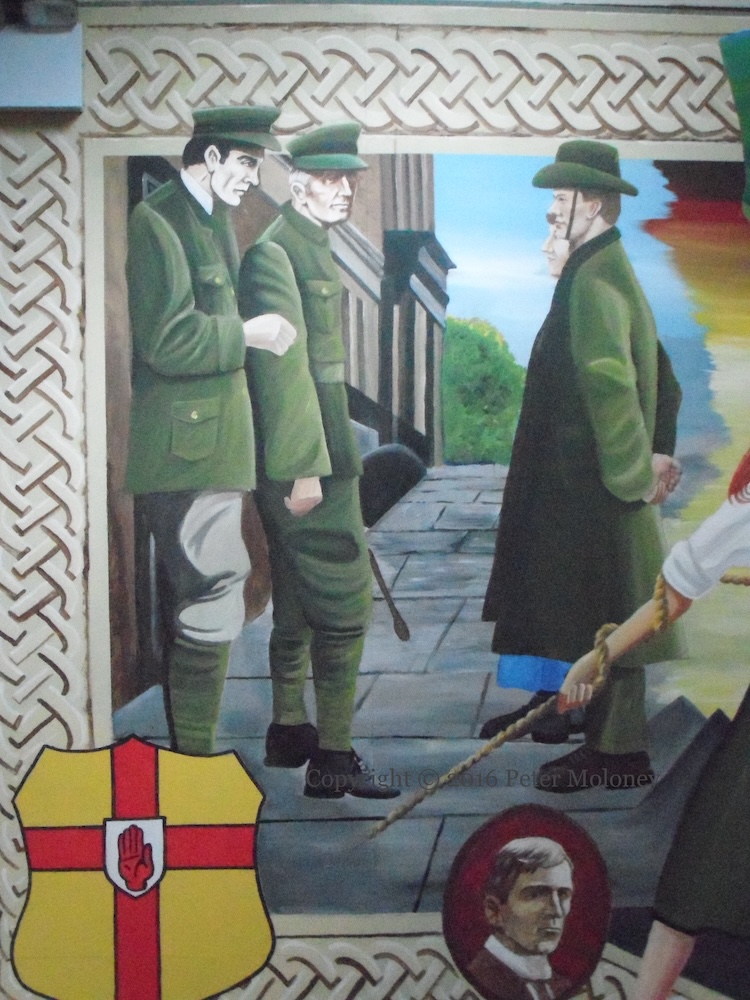
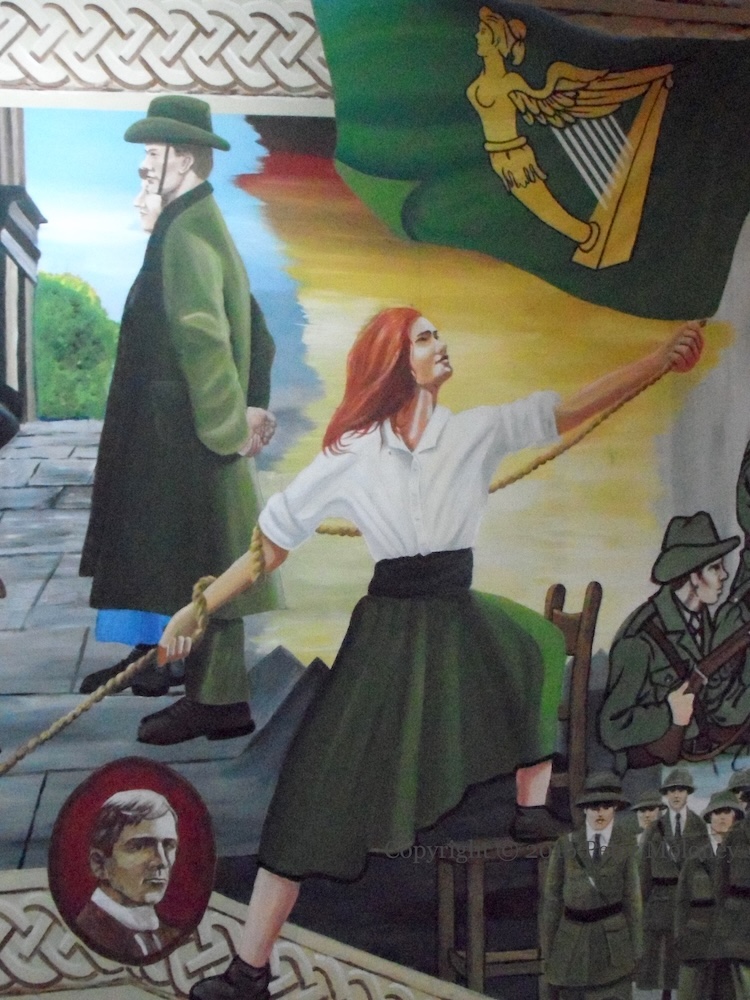
The mural immediately above was painted to accompany the exhibition, reproducing the left-hand grouping from Walter Paget’s Birth Of The Irish Republic and putting the proclamation in the background. For Paget’s original oil painting and other versions of it, see the painting’s Visual History page.
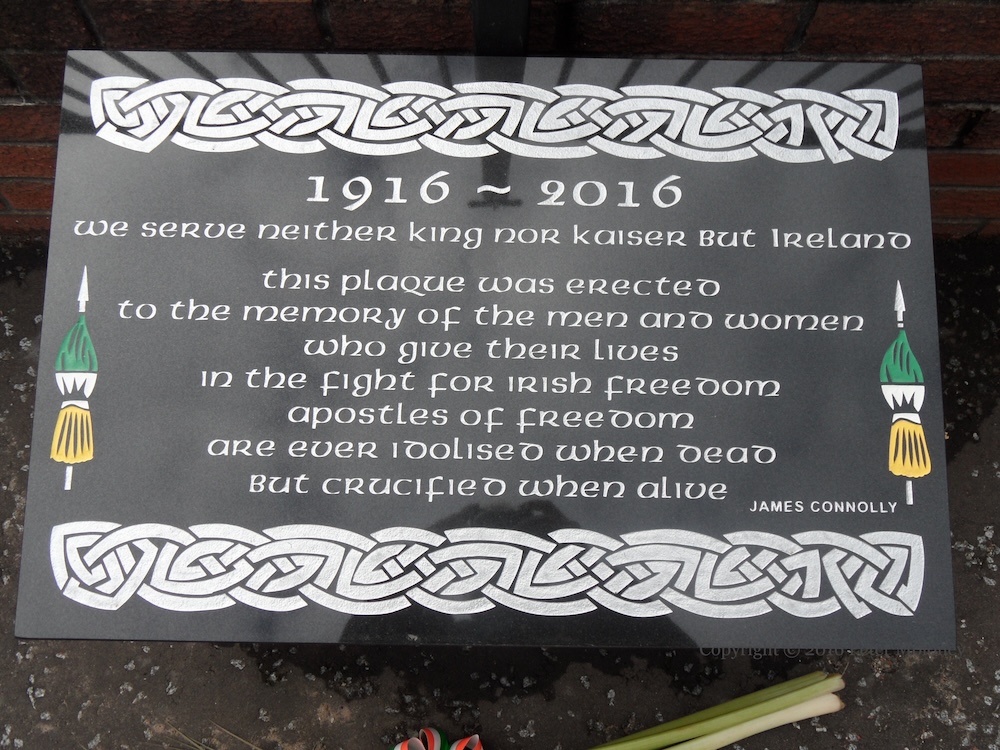
The new plaque (added to the memorial garden) reads, “1916 – 2026. We serve neither king nor kaiser, but Ireland. This plaque was erected to the memory of the men and women who give their lives in the fight for Irish freedom. “Apostles of freedom are ever idolised when dead but crucified when alive.” – James Connolly.” [from 1898’s The Men We Honour]
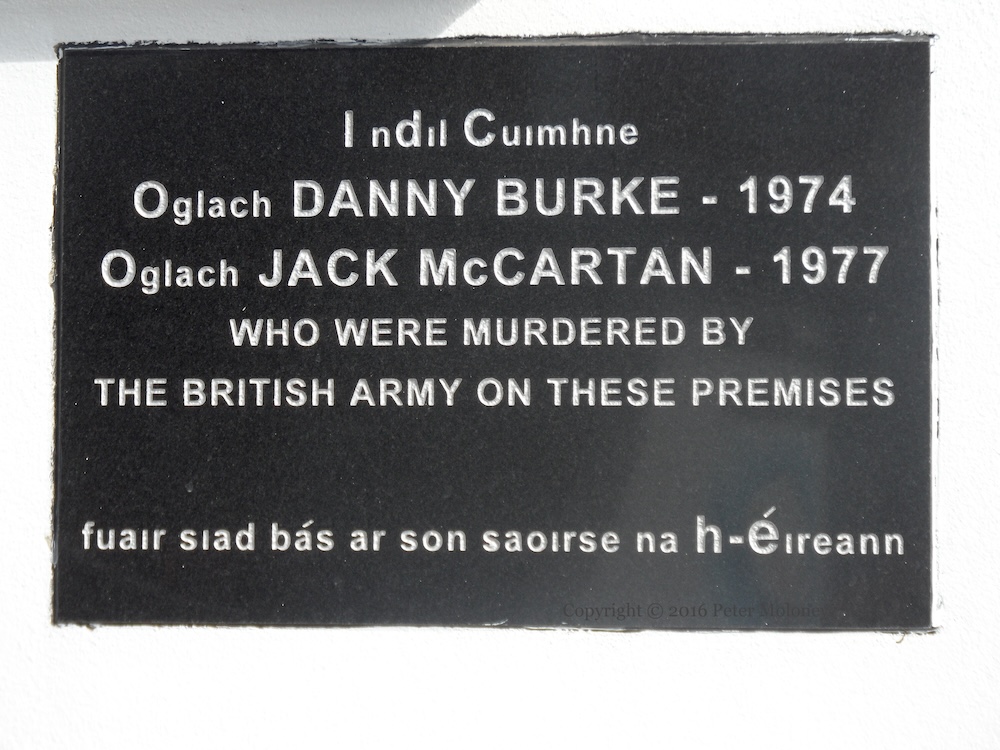
Also featured are Roger Casement and Winifred Carney, and a long-standing plaque to Danny Burke and Jack McCartan, former managers of the club who were “murdered by the British Army on these premises” (An Phoblacht).
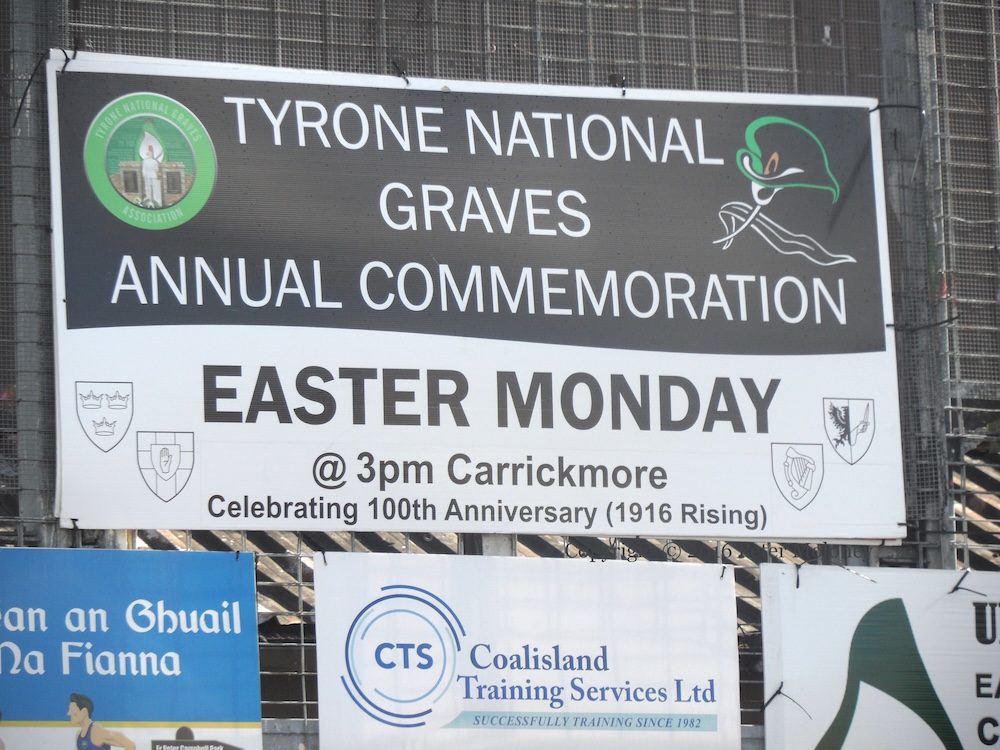
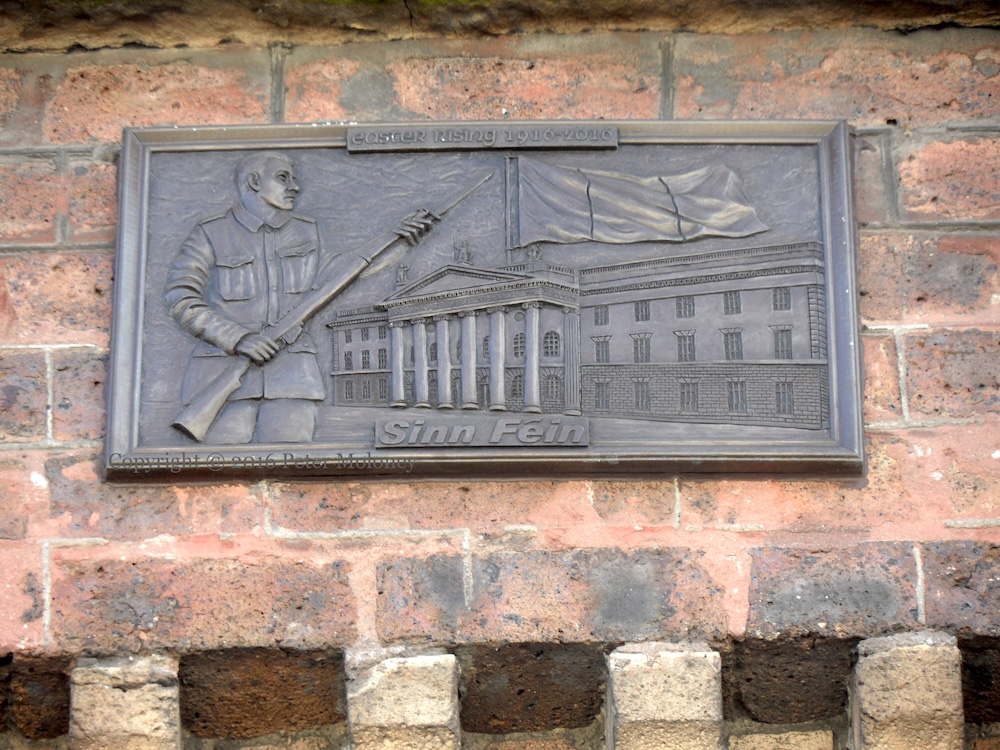
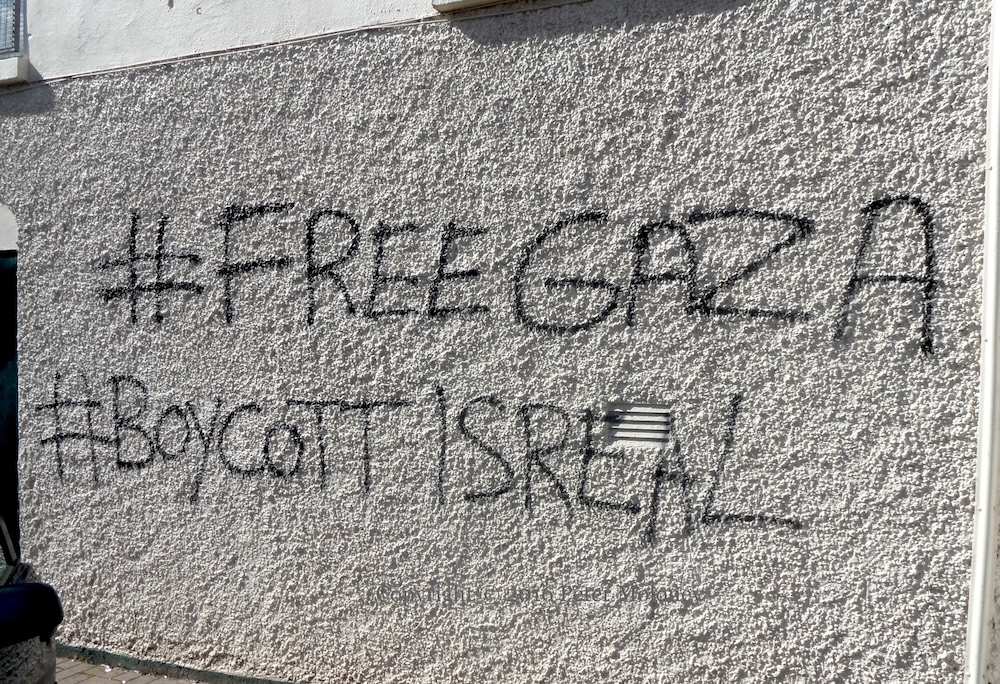
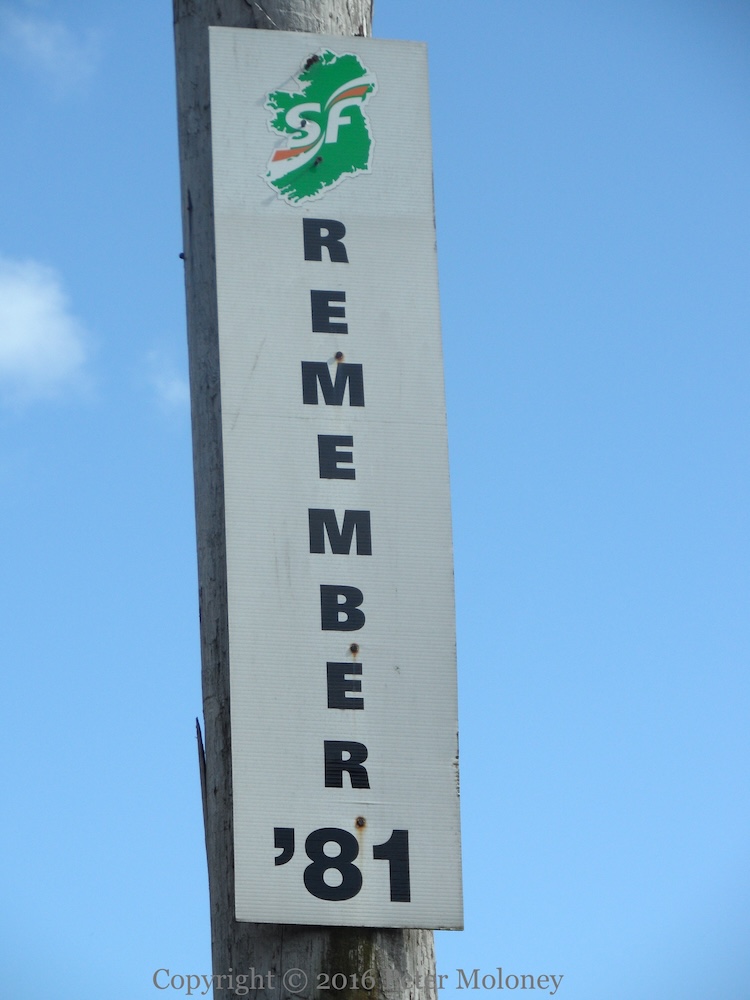
“We salute the memory of all those who have given their lives for the cause of Irish freedom.” Both pro-Agreement (Sinn Féin) and anti-Agreement (IRPWA/Saoradh/New IRA) groups are marking the centenary of the Easter Rising. Also included is a commemoration of the (1981) Hunger Strike and support expressed for Gaza: “#FreeGaza #BoycottIsreal [sic]”
Lineside, Barrack Street, and Mourne Road, Coalisland
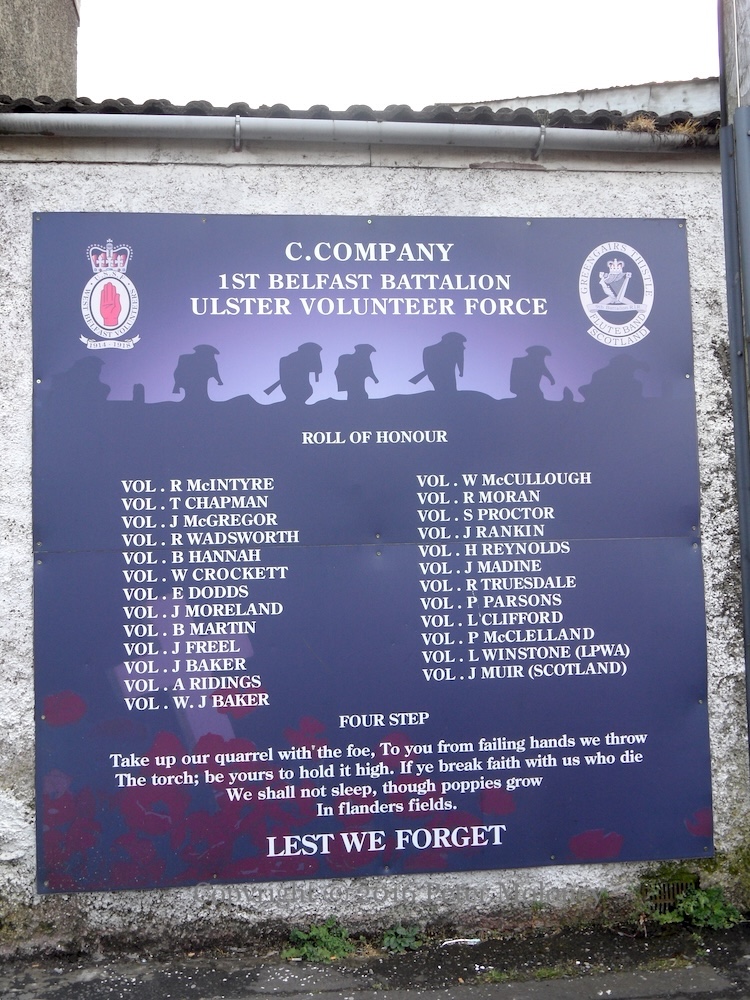
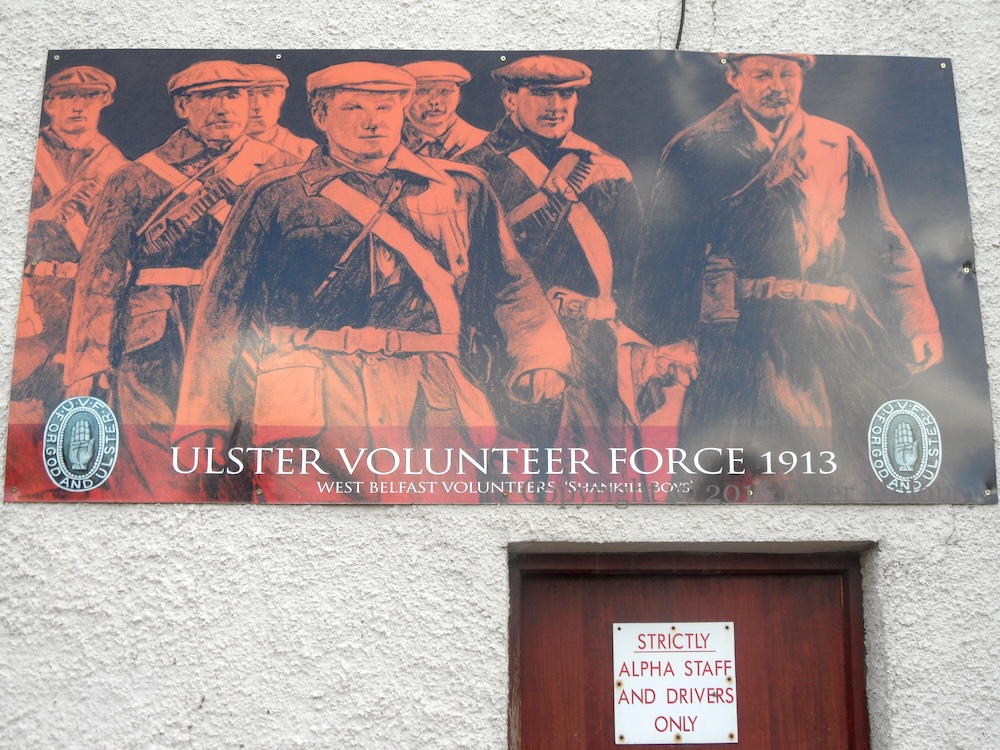
The “Shankill Boys” were the roughly 700 men of the West Belfast battalion of the Ulster Volunteers who were almost all killed at the Somme. (This board – or a previous copy of it – was previously in Carnan St.)
As with all of the Belfast battalions, West Belfast had a “USSF” [Ulster Special Service Force] – its emblem is in the top left of the second board, below. (See previously USSF and Shankill Protestant Boys.) The other emblem is that of the ‘Greengairs Thistle Flute Band’. Although the background comes from WWI, the roll of honour lists modern-day volunteers from the UVF. Thomas Chapman, James McGregor, Robert McIntyre, William Hannah, and Robert Wadsworth are portrayed in Carnan Street – see C. Coy Street. The modern-day C Company, formed in 1974, is named after the Four Step Inn, which was bombed in September 1971 (see Four Step).
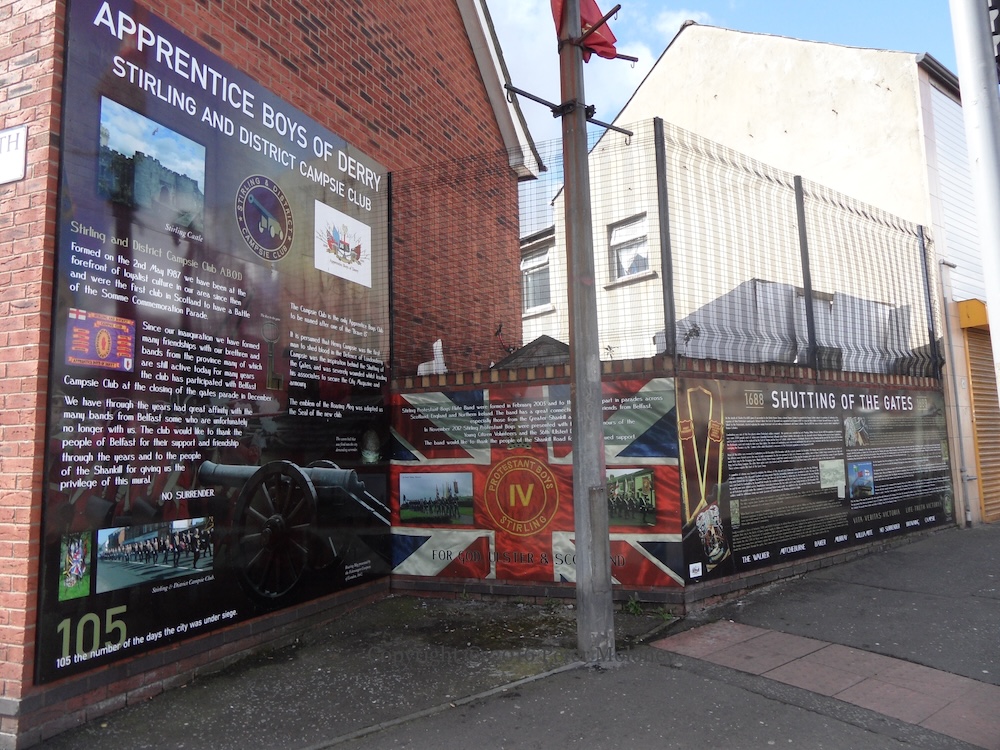
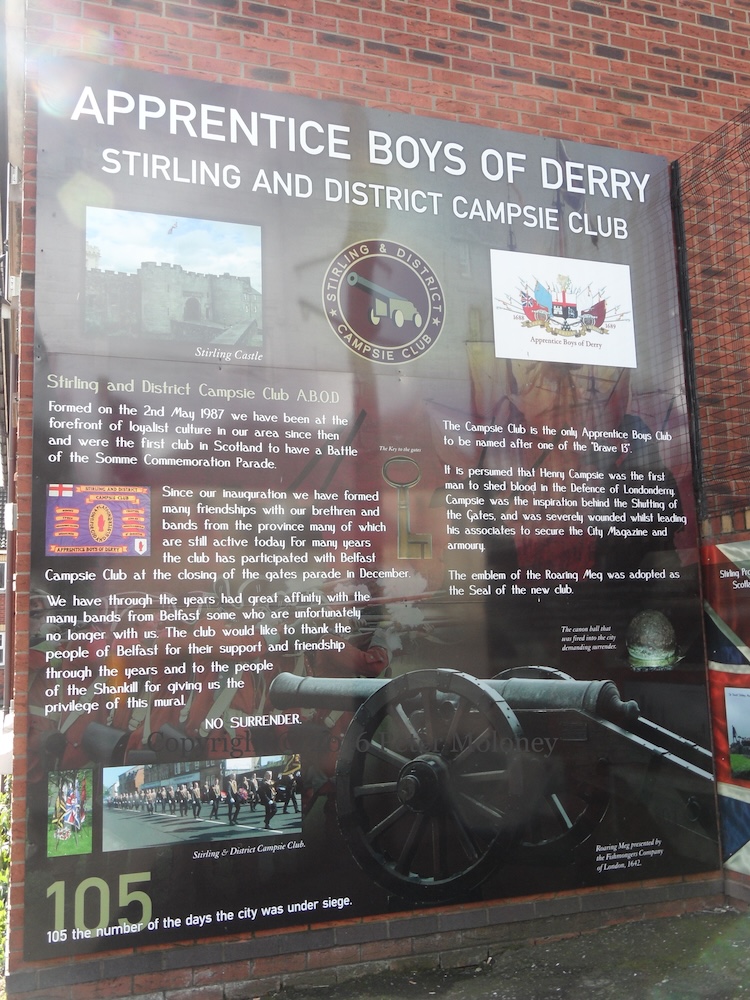
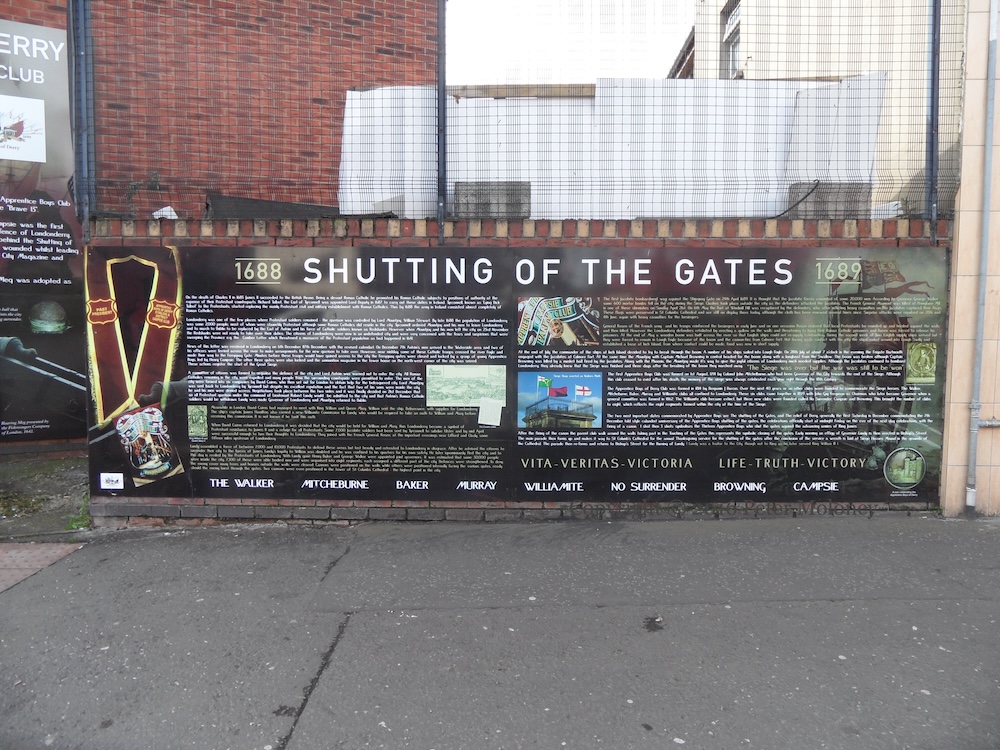
The first panel features the cannon “Roaring Meg” (“presented by the Fishmongers Company of London 1642″) which is used as the seal for the club, and includes the club’s flag, the key to the gates, and the emblem and coat of arms of the Apprentice Boys.
“Formed on the 2nd May 1987 we have been at the forefront of loyalist culture in our area since then and were the first club in Scotland to have a Battle of the Somme Commemoration Parade. Since our inauguration we have formed many friendships with our brethren and bands from the province many of which are still active today. For many years the club has participated with Belfast Campsie Club at the closing of the gates parade in December. We have through the years had great affinity with the many bands from Belfast some who are unfortunately no longer with us. The club would like to thank the people of Belfast for their support and friendship through the years and to the people of the Shankill for giving us the privilege of this murals. / No surrender. / The Campsie Club is the only Apprentice Boys Club to be named after one of the “Brave 13″. It is persumed [presumed] that Henry Campsie was the first man to shed blood in the Defence of Londonderry. Campsie was the inspiration behind the Shutting of the Gates and was severely wounded whilst leading his associates to secure the City Magazine and armoury. The emblem of the Roaring Meg was adopted as the Seal of the new club.”
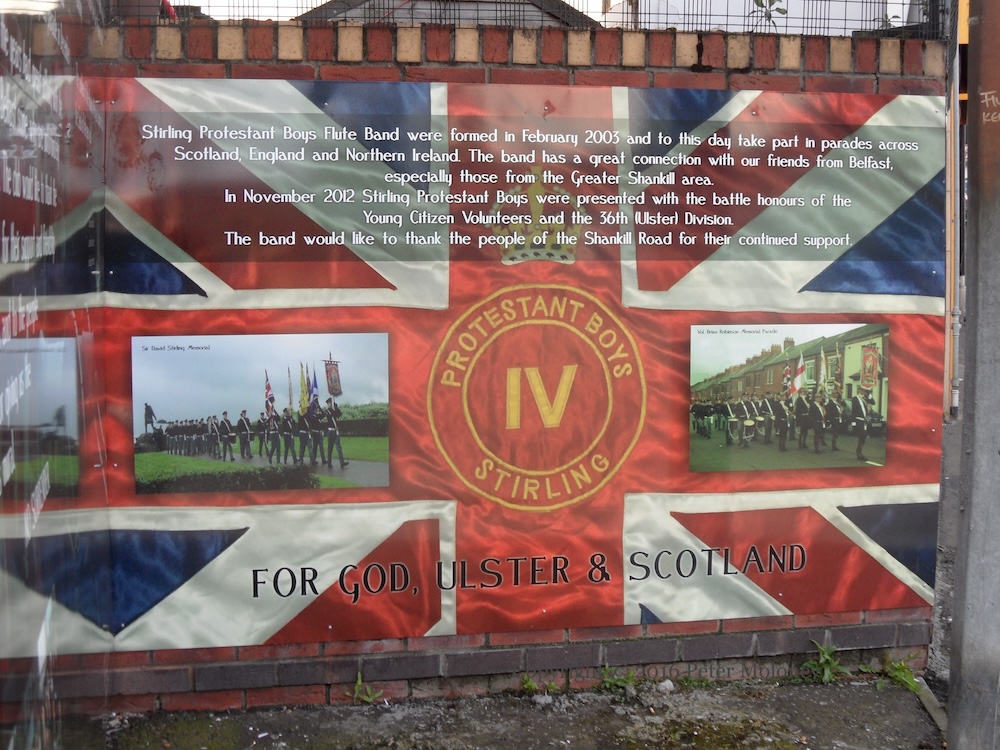
The middle panel celebrates the Stirling Protestant Boys Flute Band and its association with the Shankill Road: “Stirling Protestant Boys Flute Band [Fb] were formed in February 2003 and to this day take part in parades across Scotland, England and Northern Ireland. The band has a great connection with our friends from Belfast, especially those from the Greater Shankill area. In November 2012 Stirling Protestant Boys were presented with the battle honours of the Young Citizen Volunteers and the 36th (Ulster) Division. The band would like to thank the people of the Shankill Road for their continued support.”
The third contains a long description of the Shutting Of The Gates in December 1688 and the Siege Of Derry, which was ended with the breaking of the boom across the river Foyle in July 1689.
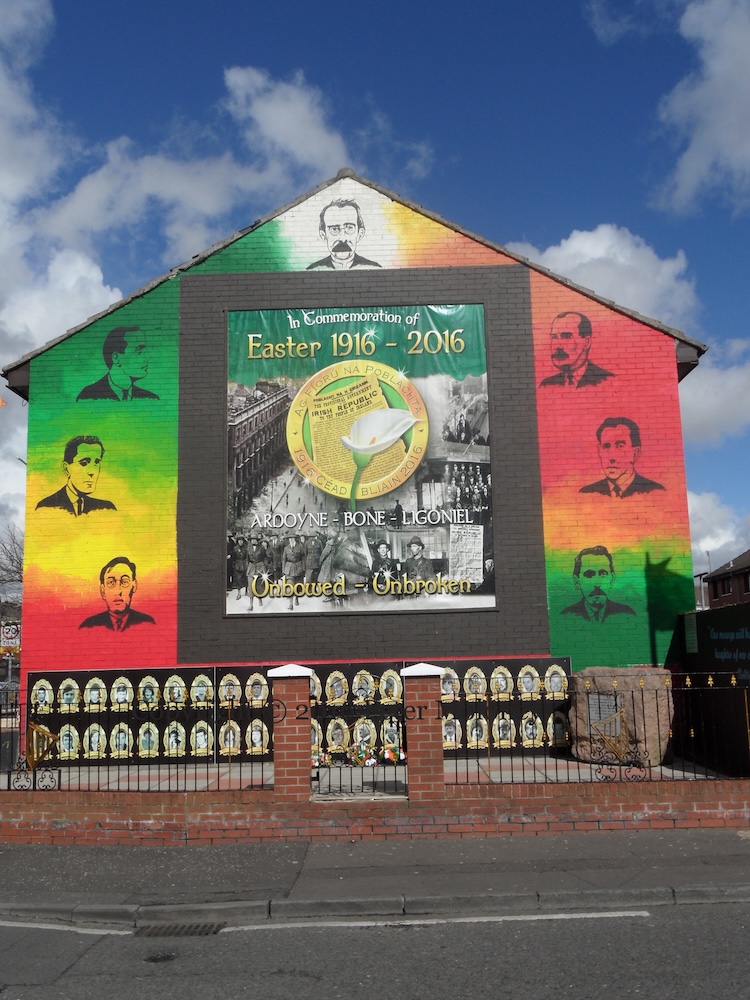
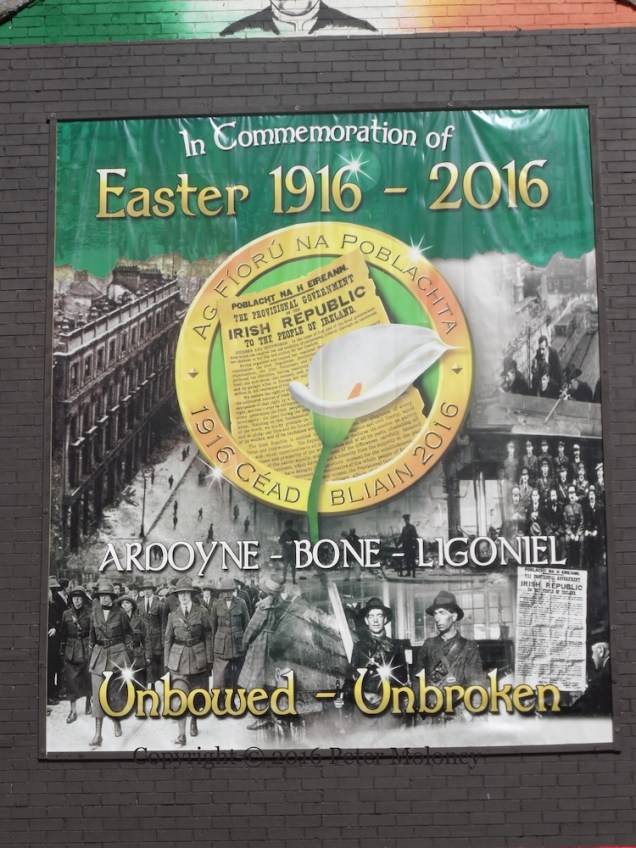
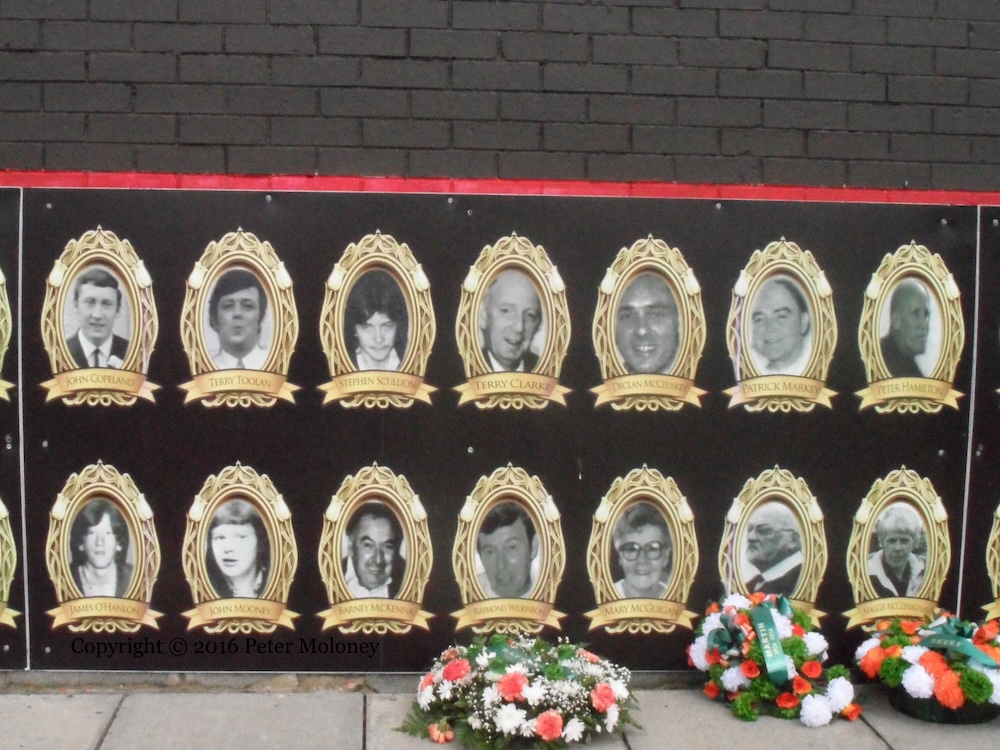
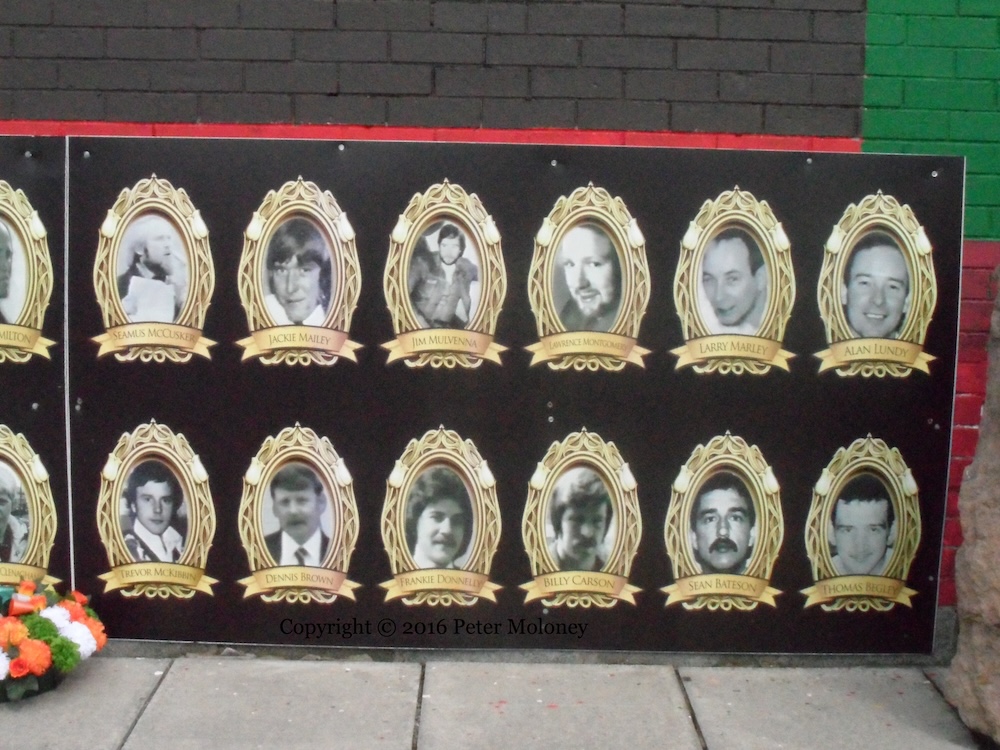
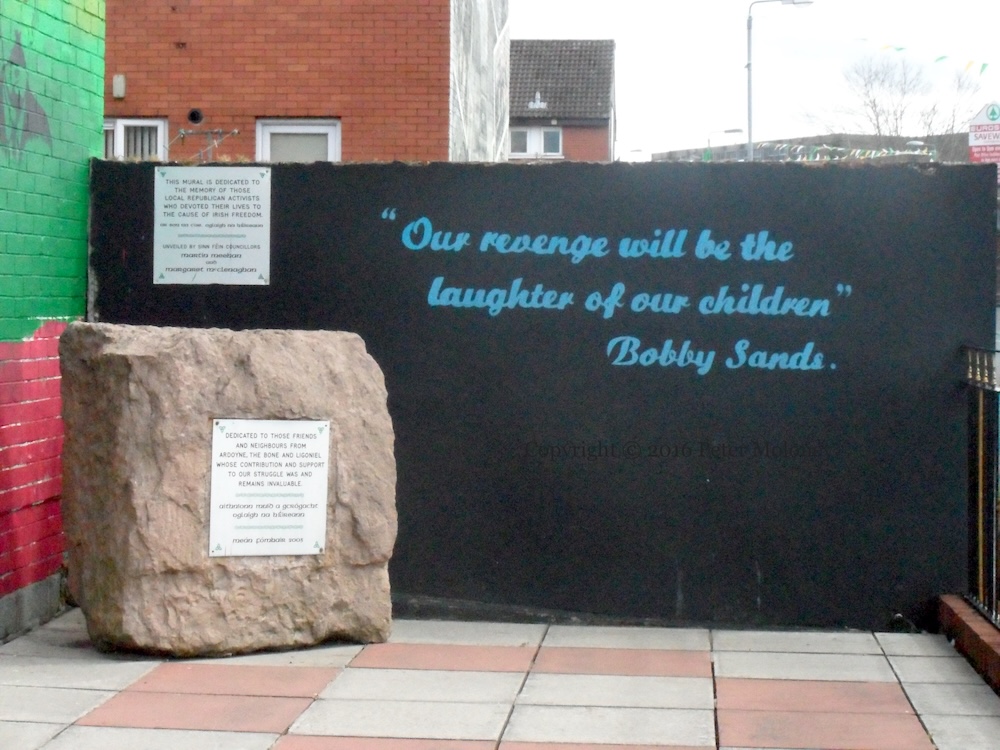
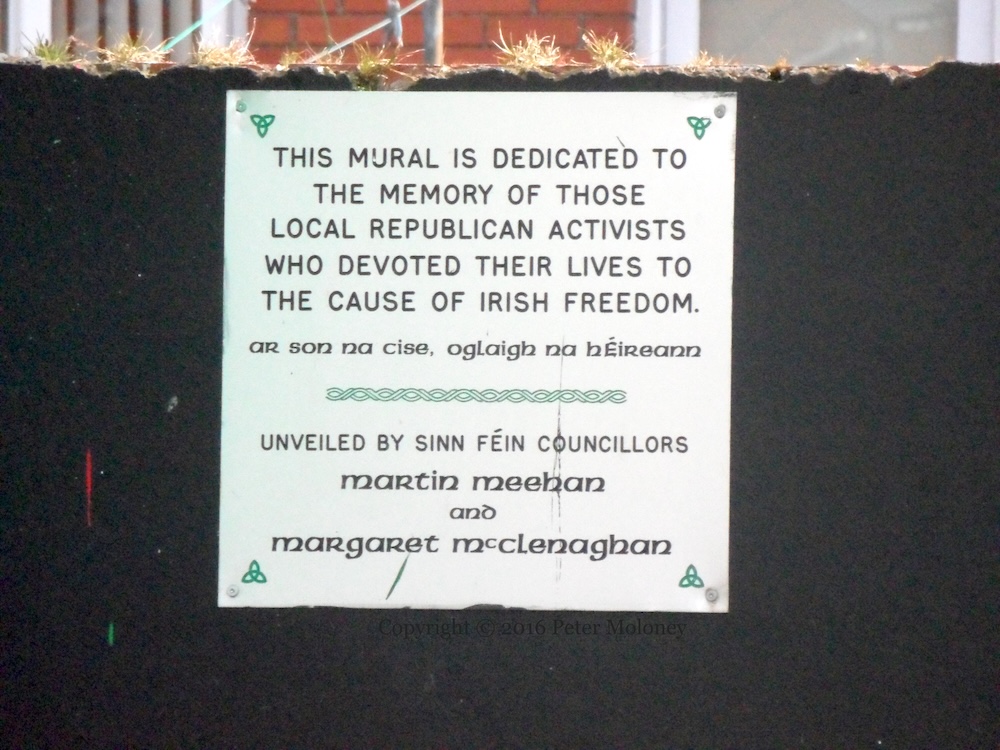
“In commemoration of Easter 1916 – 2016. Ardoyne – Bone – Ligoniel. Unbowed – unbroken.”
Tom Clarke is at the head of his fellow signatories as he looks down over a printed tarp reproducing photographs of events surrounding the Easter Rising of 1916, including soldiers from the Irish Citizen Army on a rooftop (see the original in this Spectator article) and members of Cumann Na mBan on parade. For the photo of the building in the top left, see this Irish Times article.
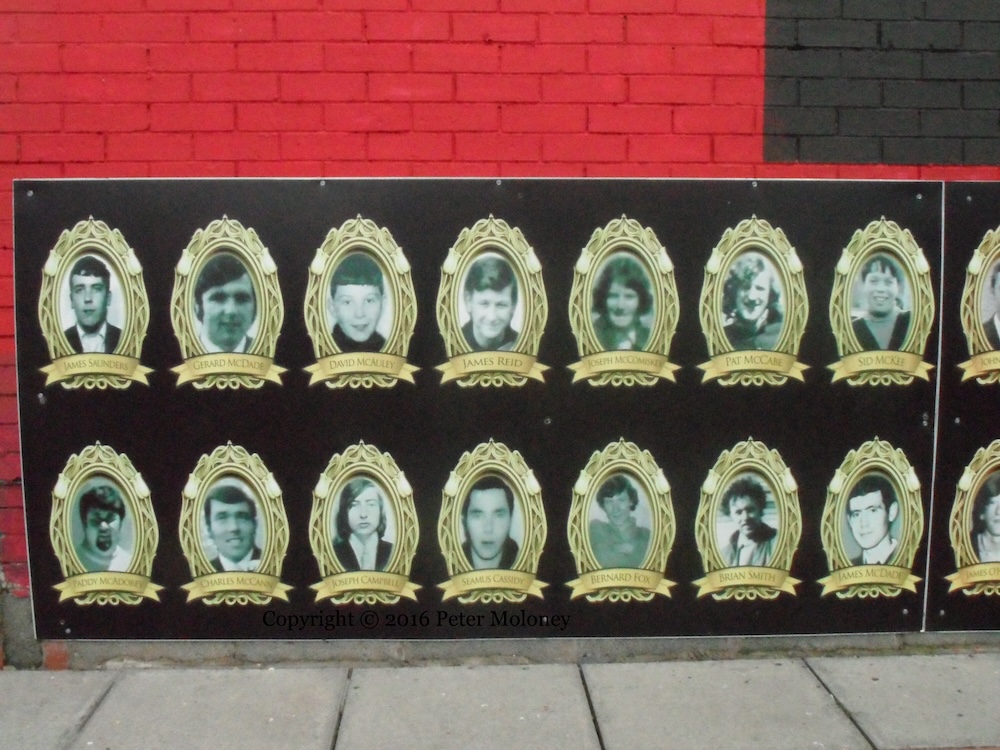
The previous Ardoyne – Bone – Ligoniel mural fell down almost as soon as it was completed, leaving only the boards with portraits of locals killed during the troubles. The stone and plaque (in the final images) go back to the mural before that.
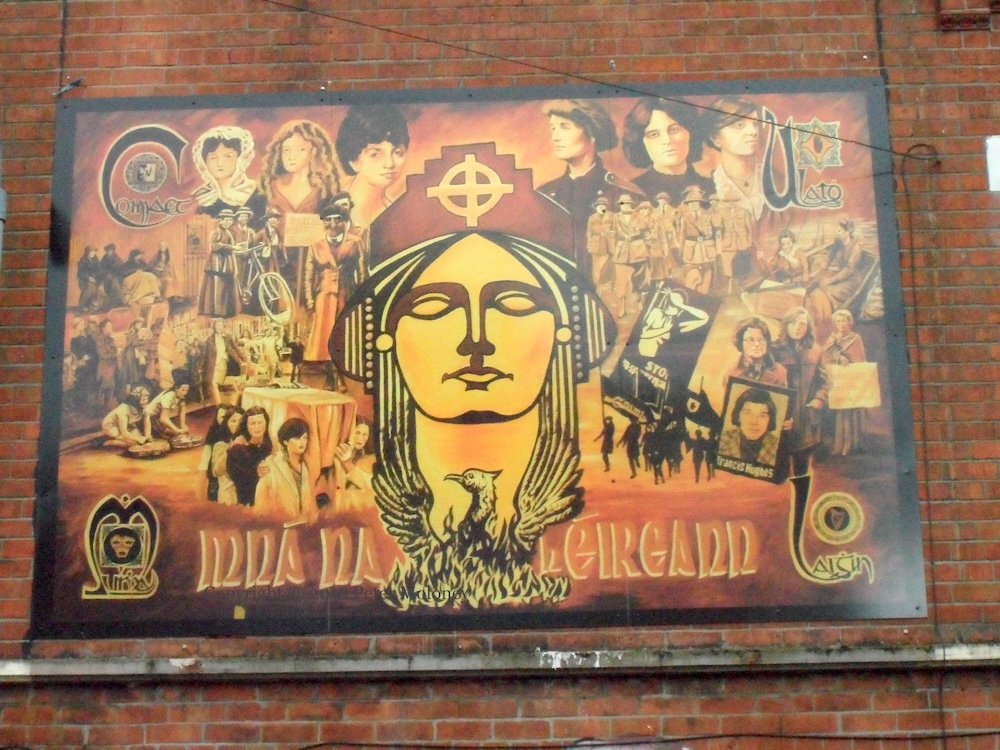
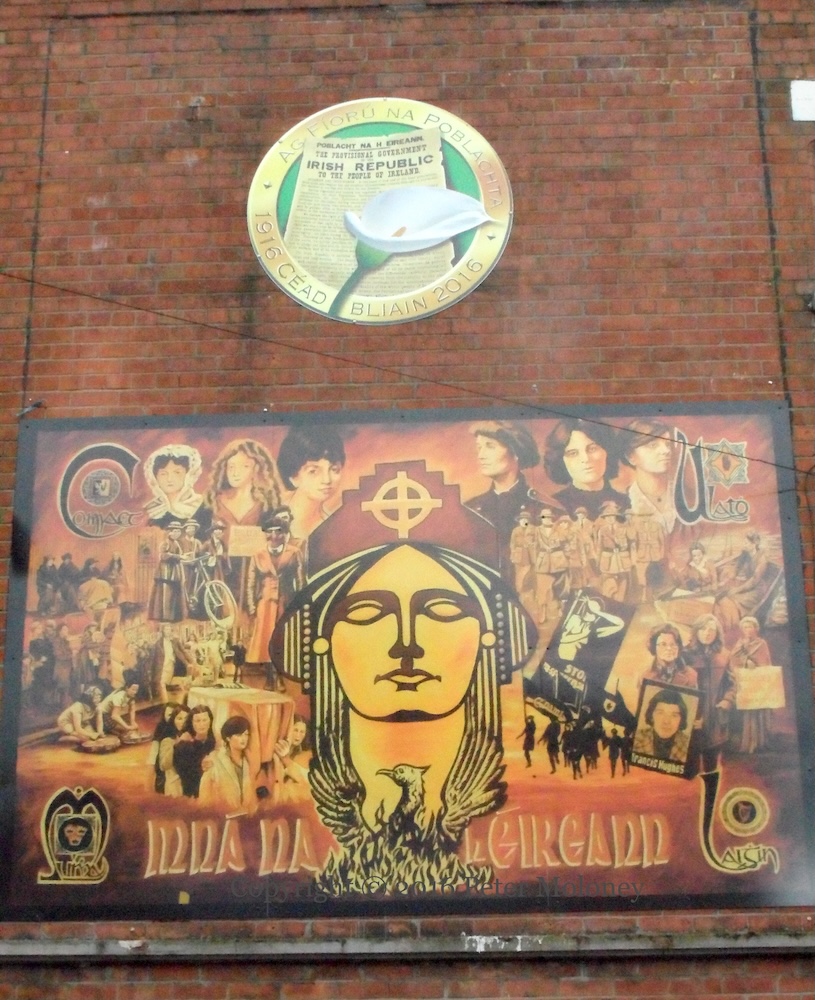
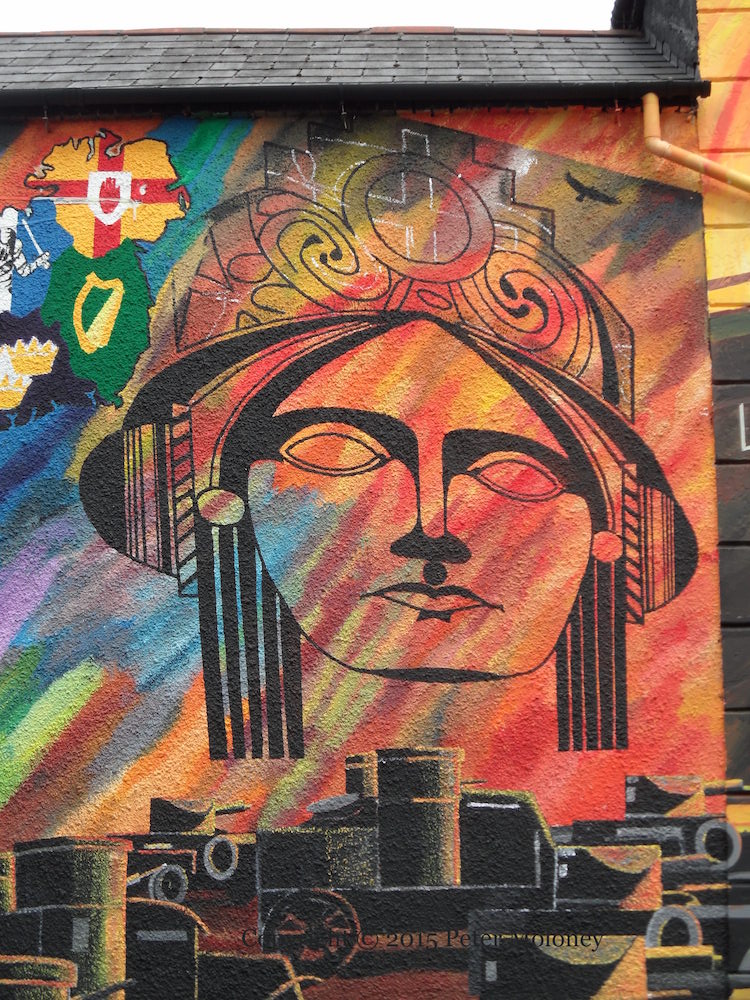
Érıu/Éıre of the Tuatha Dé Danann, queen of Ireland, (as depicted by Richard J King) is at the centre of various representations of republican women.
Along the top are Ann Devlin, Betsy Gray, Mary Ann McCracken, Countess Markievicz, Nora Connolly?, and Winifred Carney. Suffragettes, the modern IRA, and Cumman Na mBan are depicted, as are Máıre Drumm at the Falls Curfew, Tom McElwee’s sisters carrying his coffin, and Molly Childers and Mary Spring Rice running guns on the Asgard. There is also an unusual ‘four provinces’ in the corners.
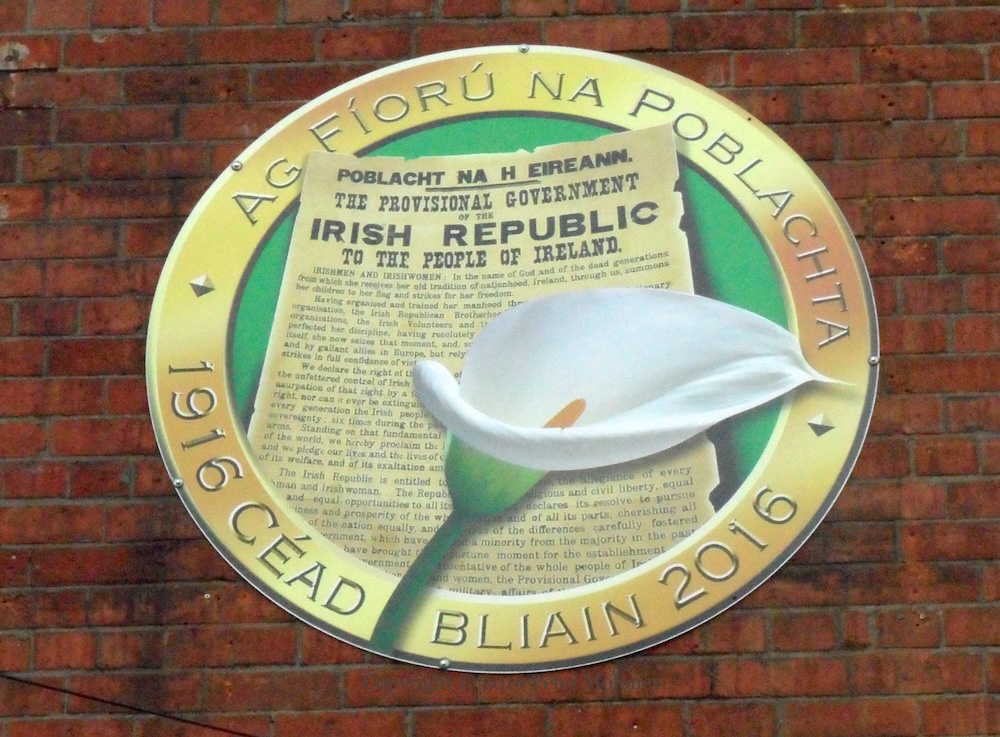
The wide shot (below) shows a 1916 centenary (“céad blıaın”) board: “Ag fíorú na poblachta”.
repainted knot-work on the right in front, form July 8th, 2016:
detail shots, from August 9th, 2025, December 15th, 2025, and March 26th, 2016:
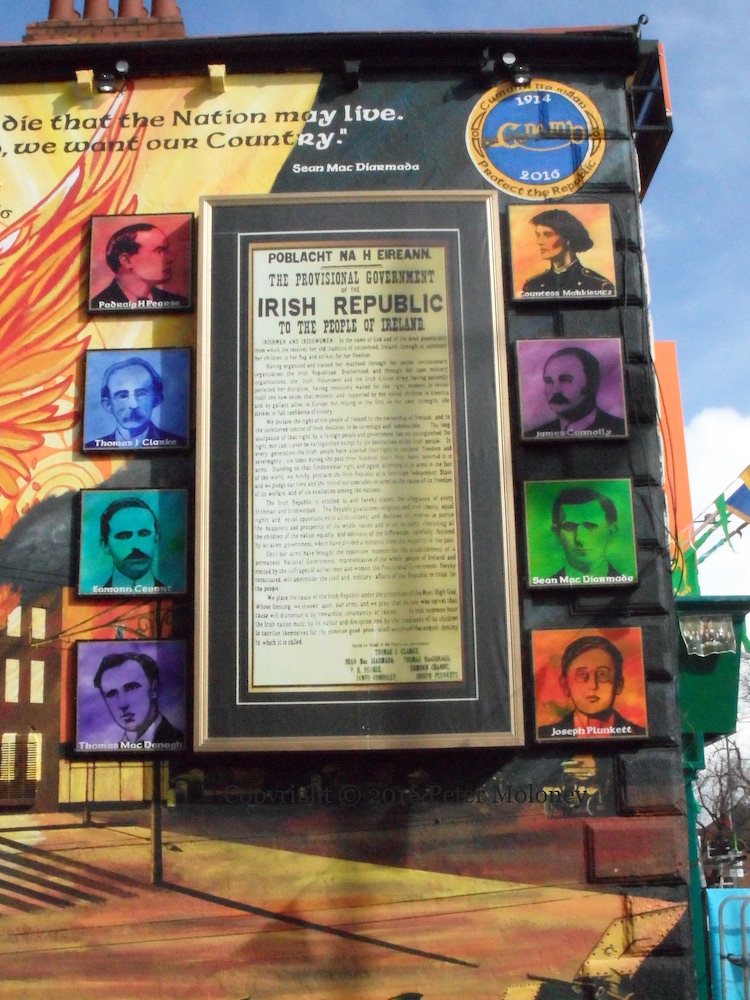
December 15th, 2025, portraits on small boards being added to either side of the (temporarily removed) proclamation:
July 31st, 2025:
July 14th, 2025:
May 5th, 2025:
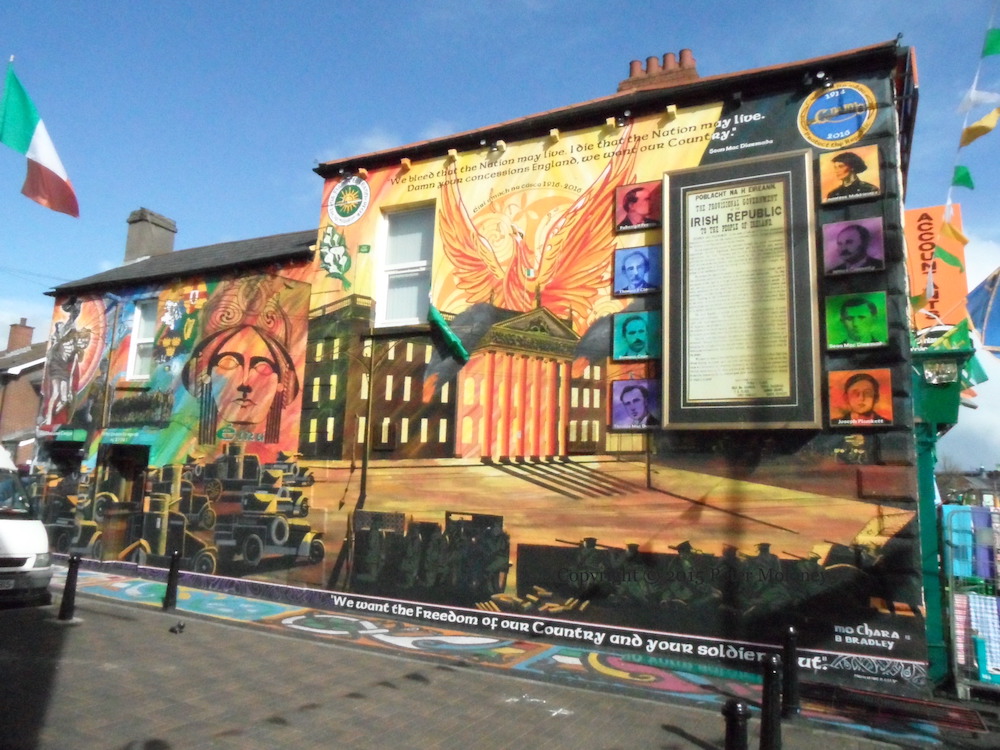
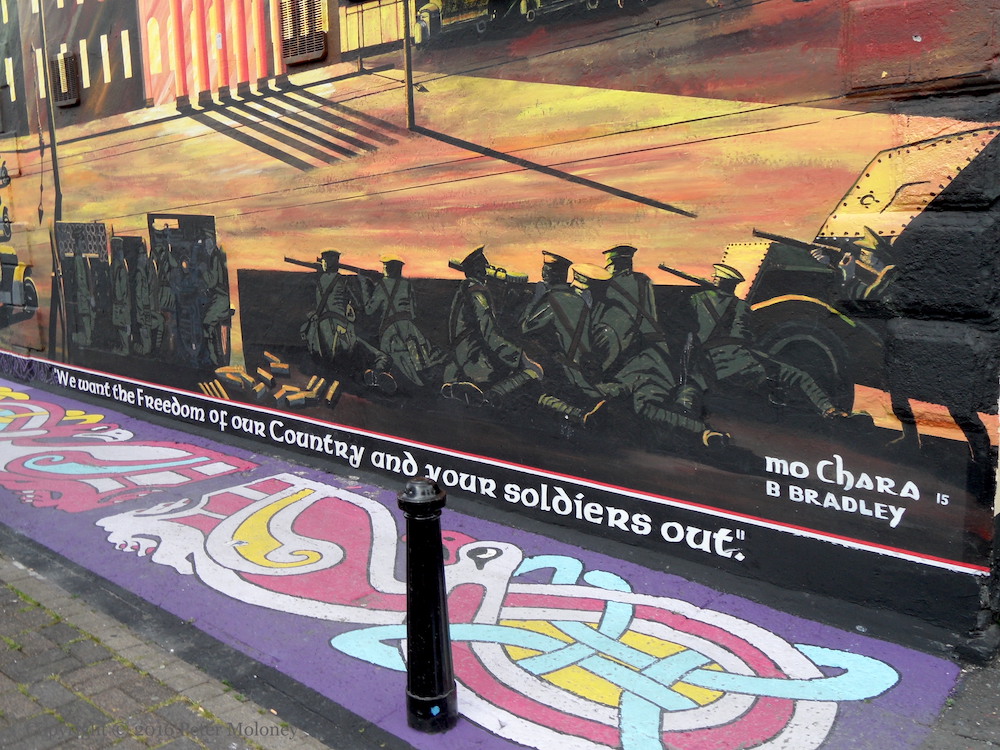
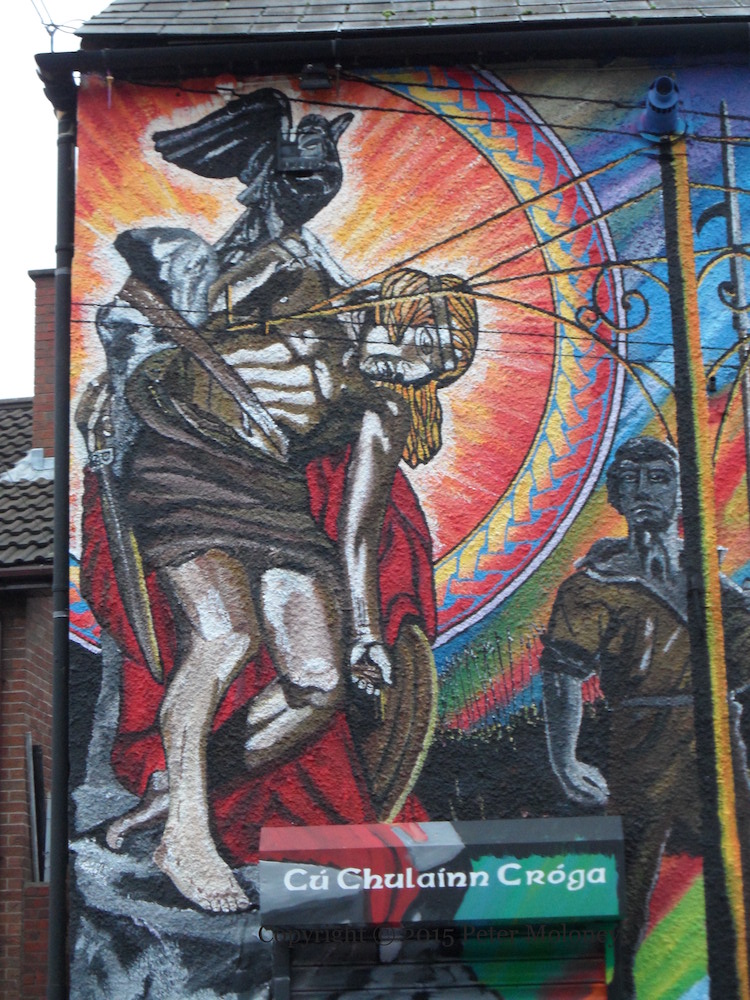
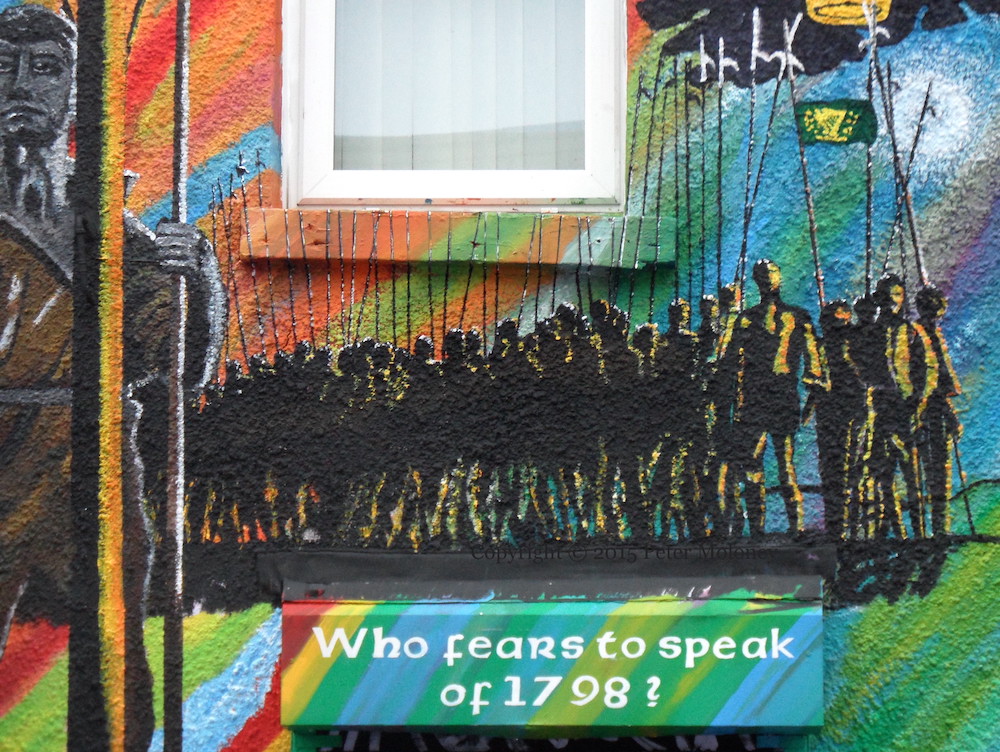
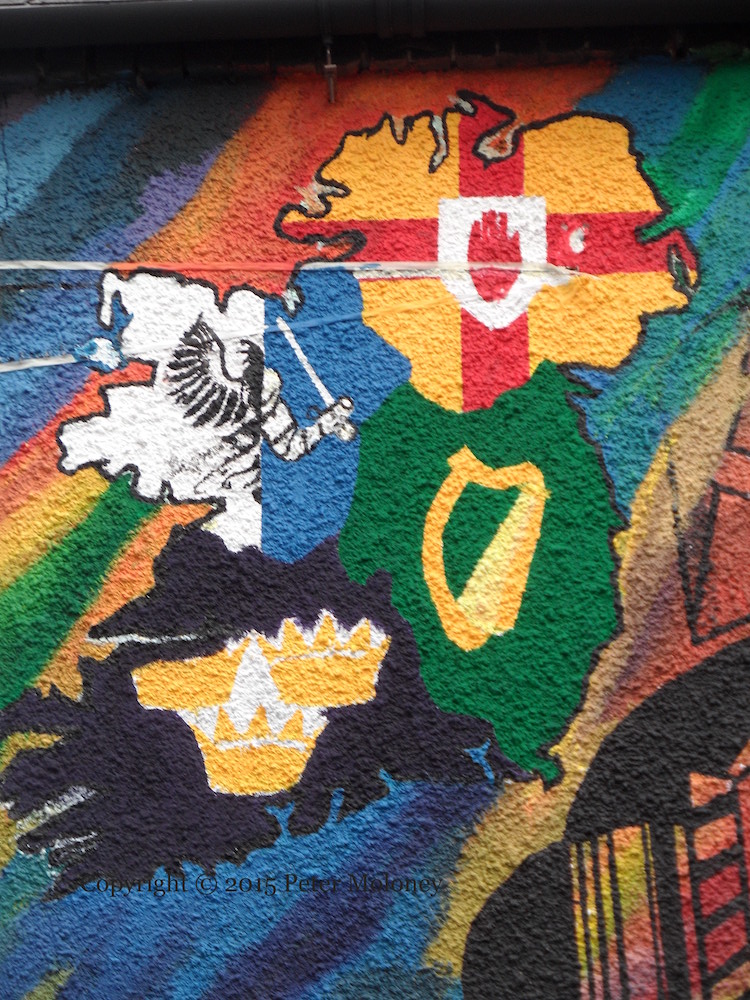
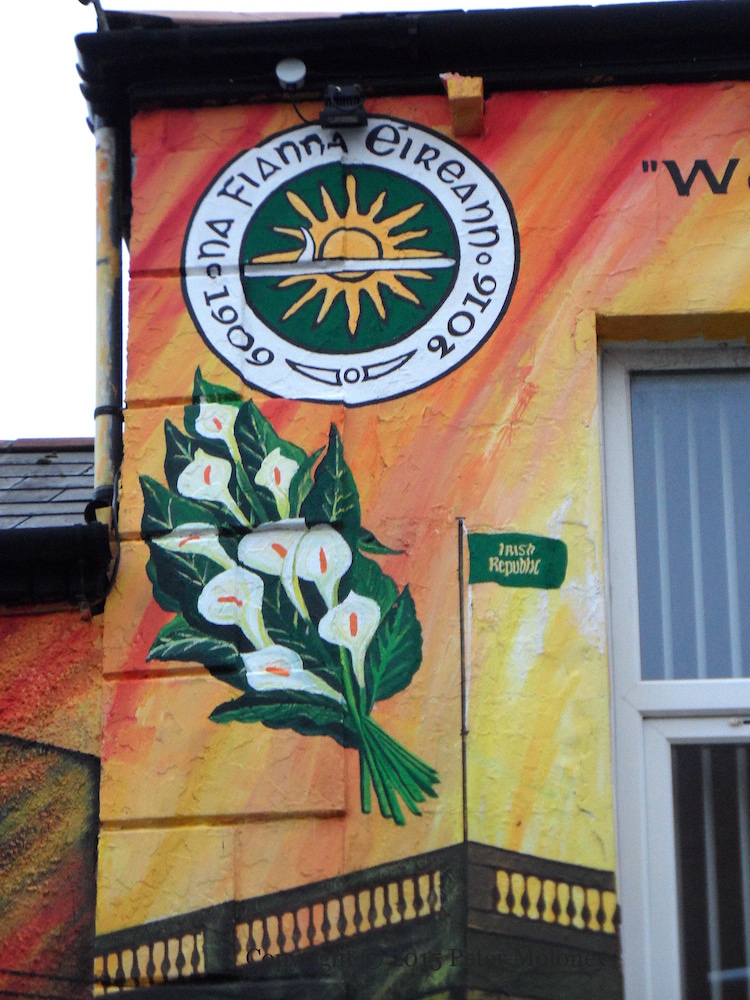
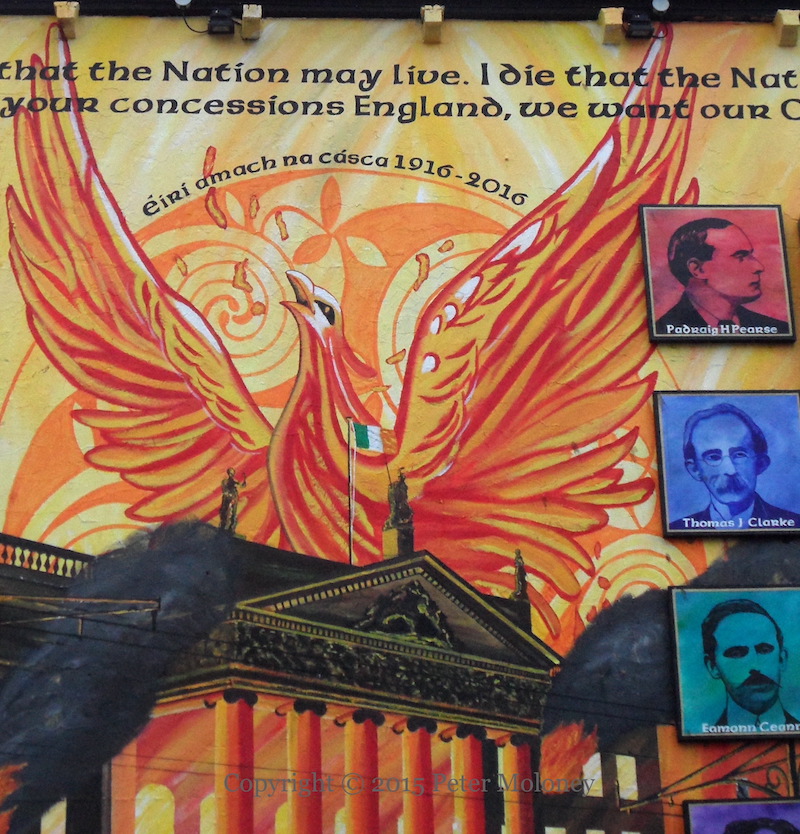
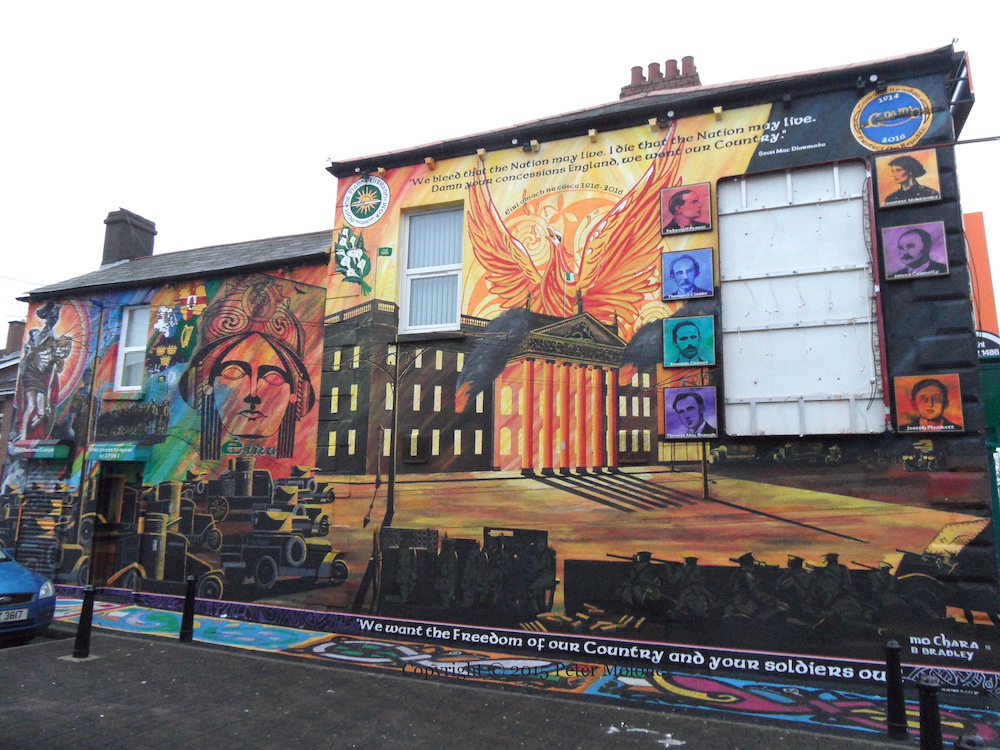
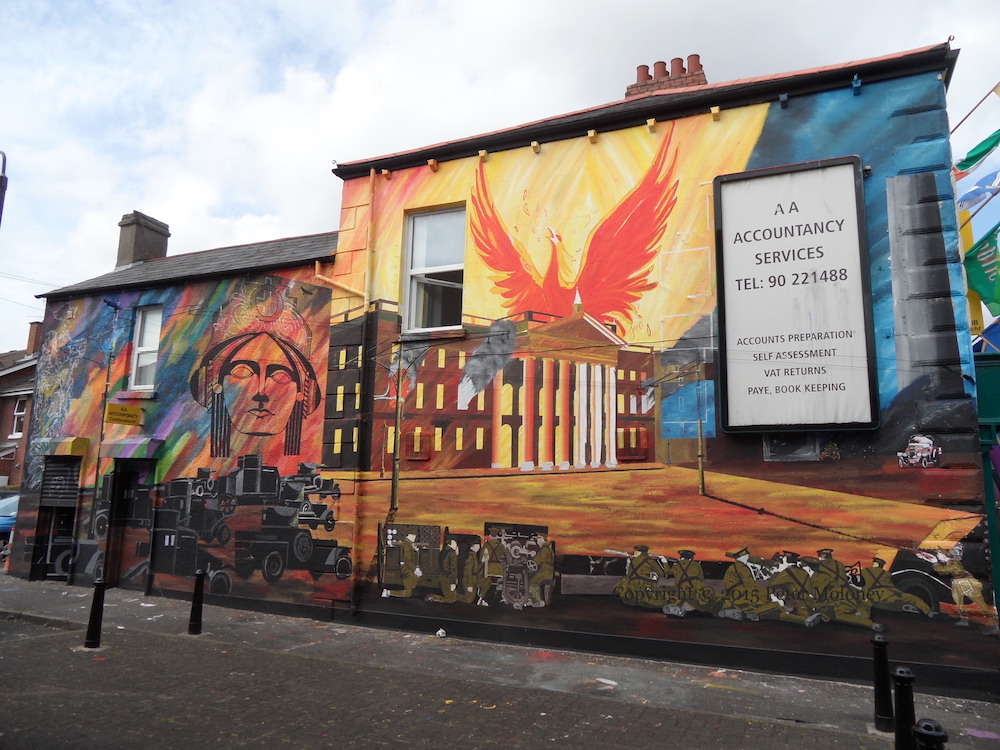
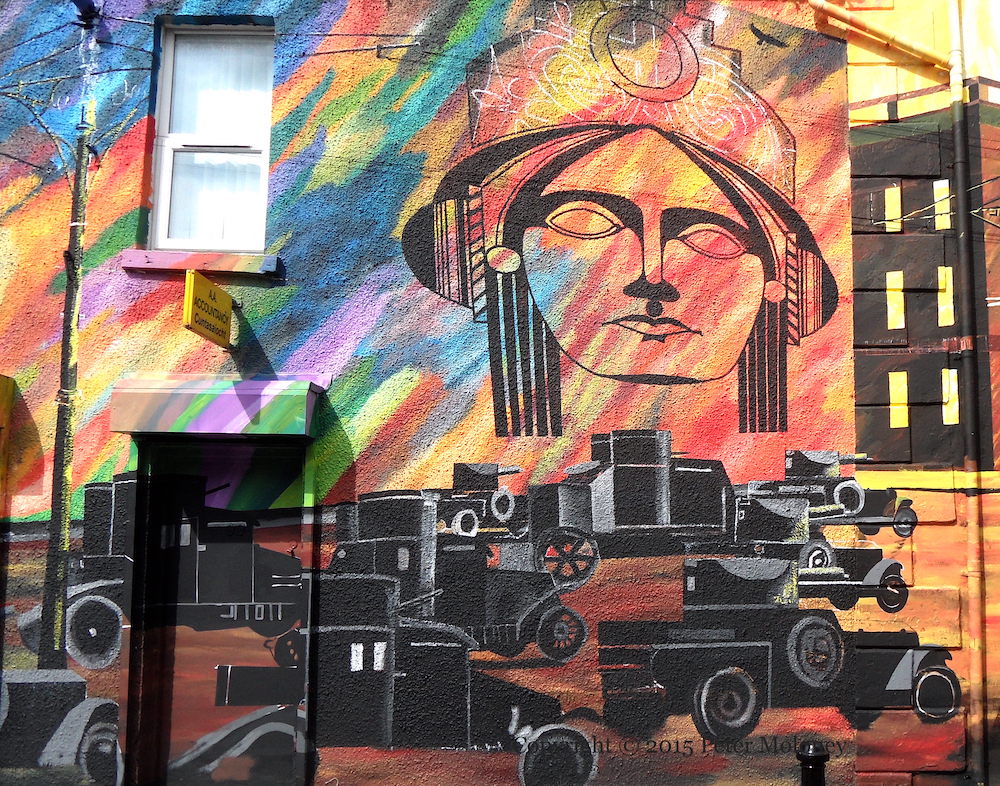
Arrayed against the forces of the British Army (which are shown laying siege to the Dublin GPO during the Easter Rising in armoured cars and in sniping positions in the foreground of the mural, along the whole length of the wall) are various symbols of Irish nationalism:
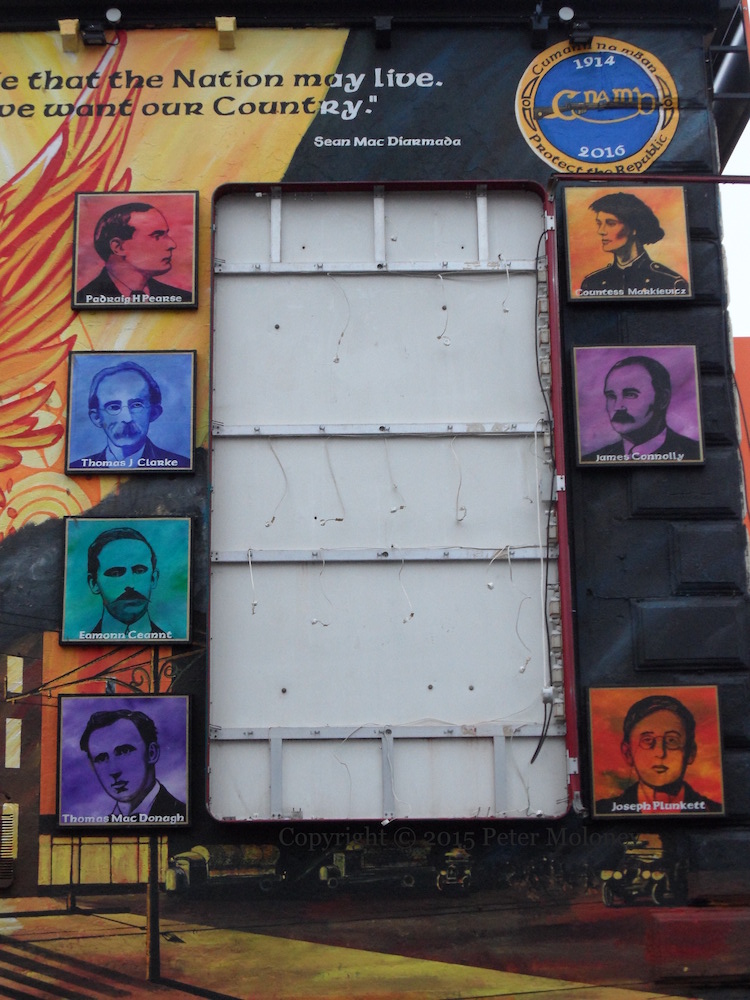
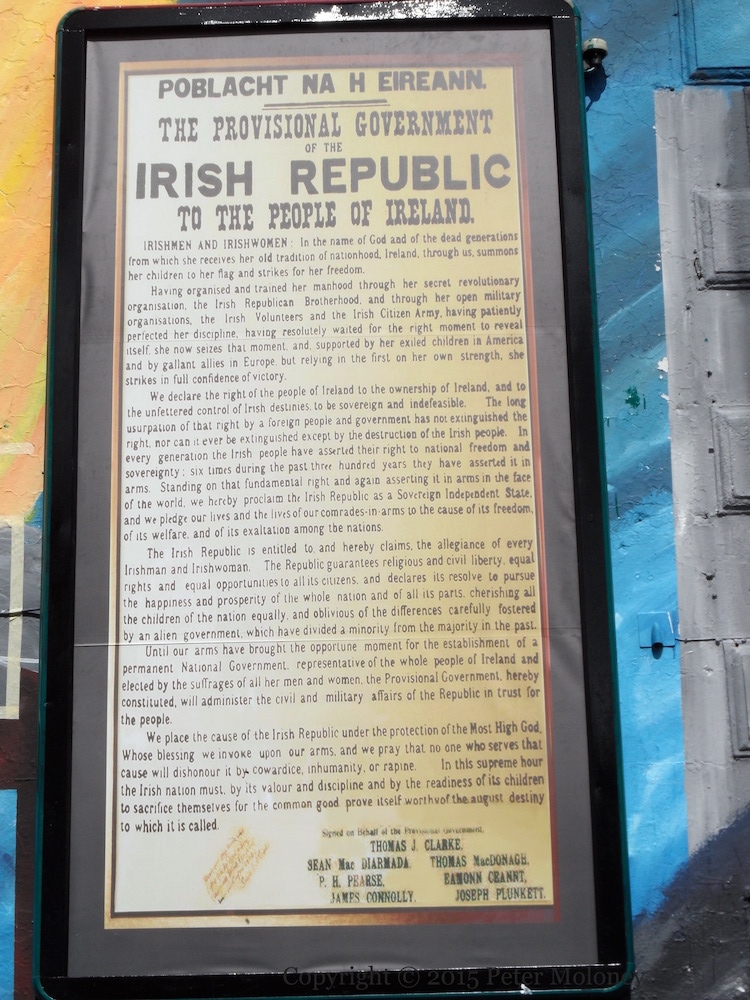
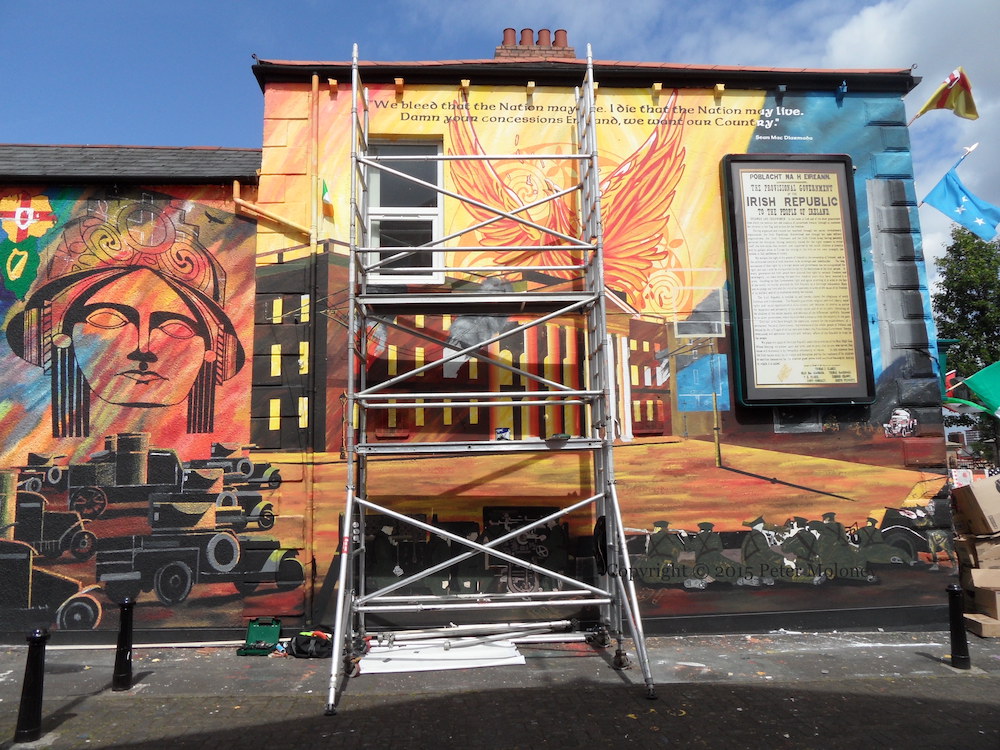
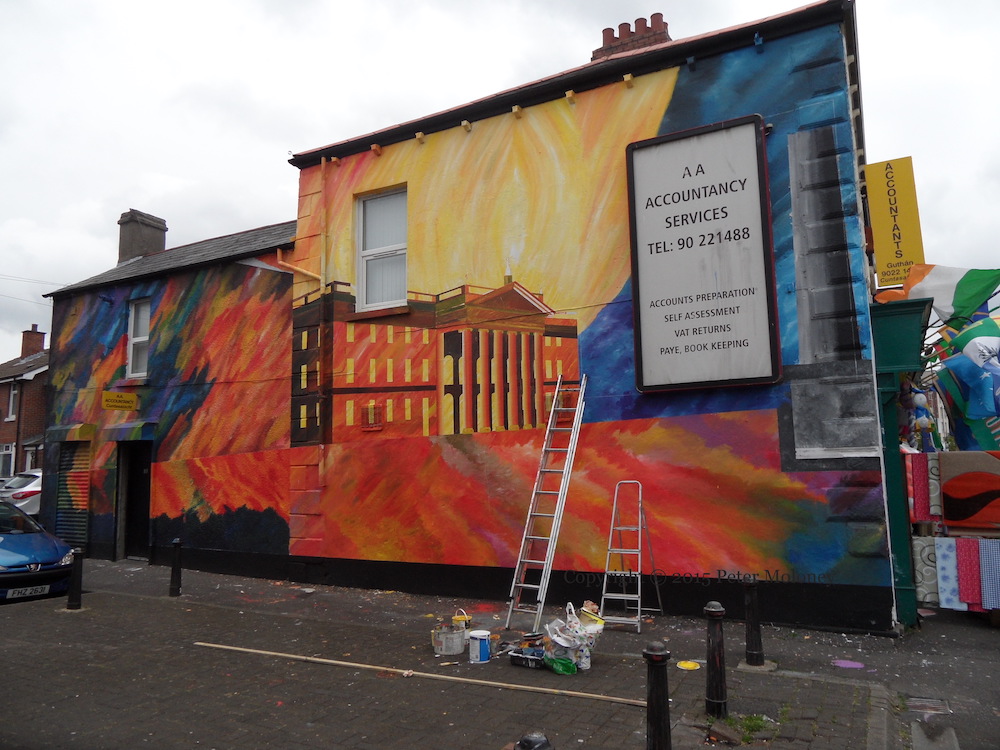
Oliver Sheppard‘s 1911 statue of Cú Chulaınn dying (see the Visual History page); the pikemen of the 1798 Rebellion; the four provinces of Ireland; Érıu the mythological queen of Ireland/Éıre as designed by Richard J King/Rísteard Ó Cíonga; Easter lilies; the emblems of Na Fıanna Éıreann and Cumann Na mBan on either side of a quote from (The Mainspring) Seán Mac Dıarmada, “We bleed that the nation may live; I die that the nation may live. Damn your concessions, England: we want our country”; a phoenix rising from the flames of the burning Dublin GPO (inspired by Norman Teeling’s 1998 painting The GPO Burns In Dublin); the GPO flying an ‘Irish Republic’ flag; portraits of signatories and other rebels — (left) Padraig H. Pearse, Thomas J Clarke, Eamonn Ceannt, Thomas MacDonagh, (right) Countess Markievicz, James Connolly, Sean MacDiarmada, Thomas Plunkett; the declaration of independence, placed over the advertising box of AA Accountants – see the in-progress shot below.
At the very bottom is a quote from the mother of painted Gerard ‘Mo Chara’ Kelly, Harriet Kelly: “We want the freedom of our country and your soldiers out.”
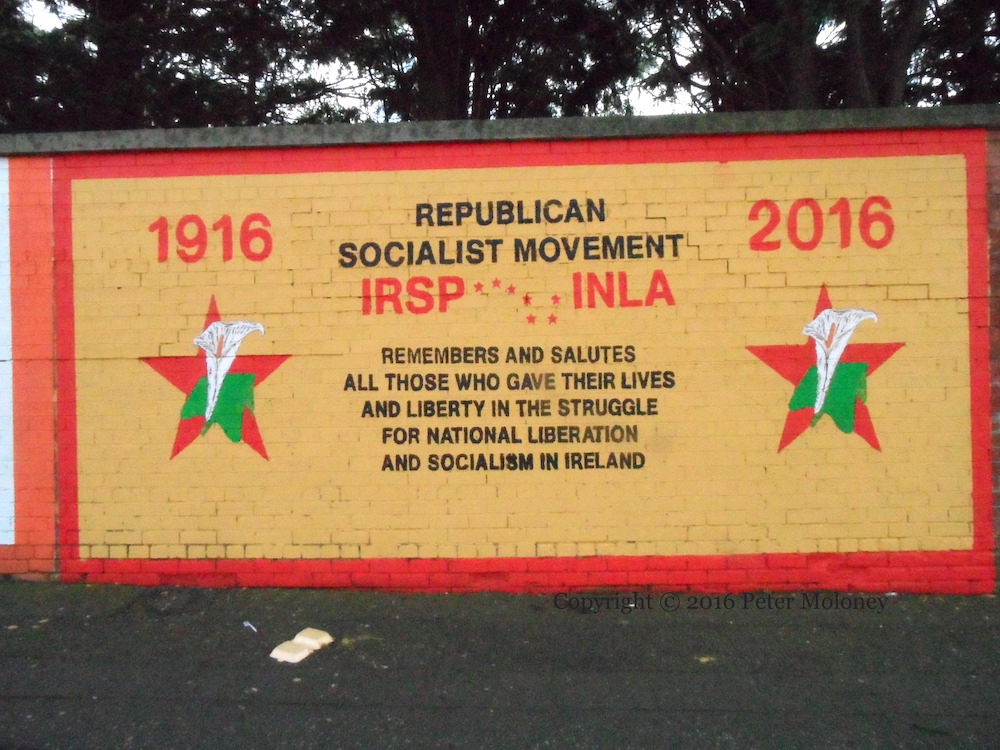
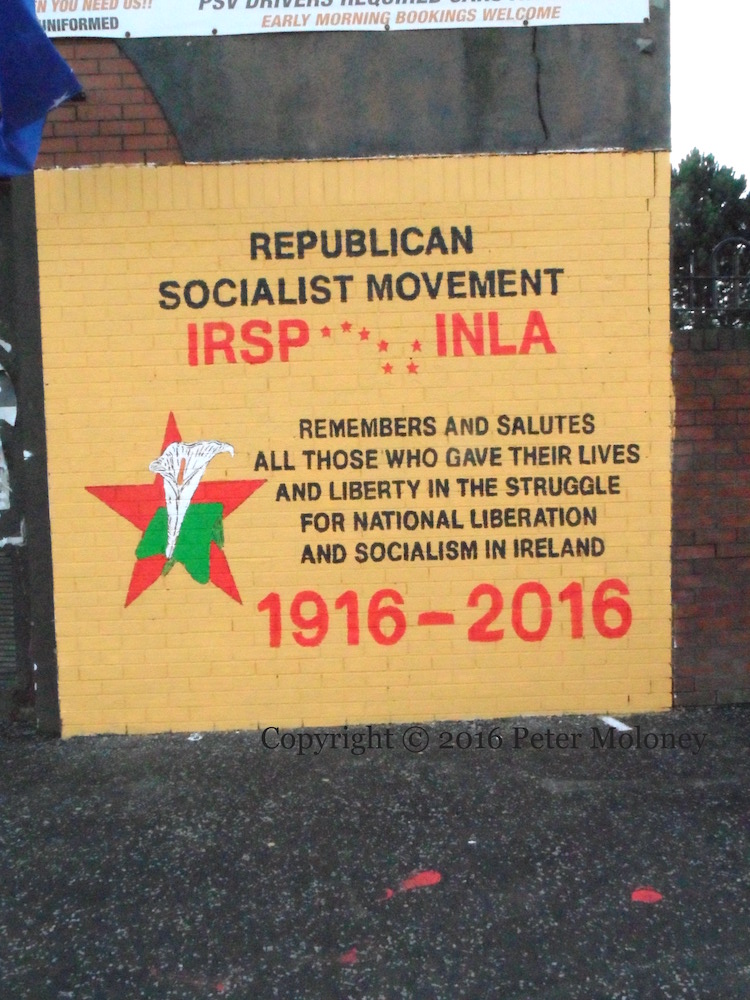
“Republican socialist movement, IRSP/INLA, remembers and salutes all those who gave their lives and liberty in the struggle for national liberation and socialism in Ireland 1916 – 2016.”
The Easter Lily on a red, five-pointed, star ties together the centenary of the Easter Rising with republican socialism. These are IRSP/INLA stencilled murals commemorating the centenary of the Rising. The first is in Beechmount, the second in Divis.