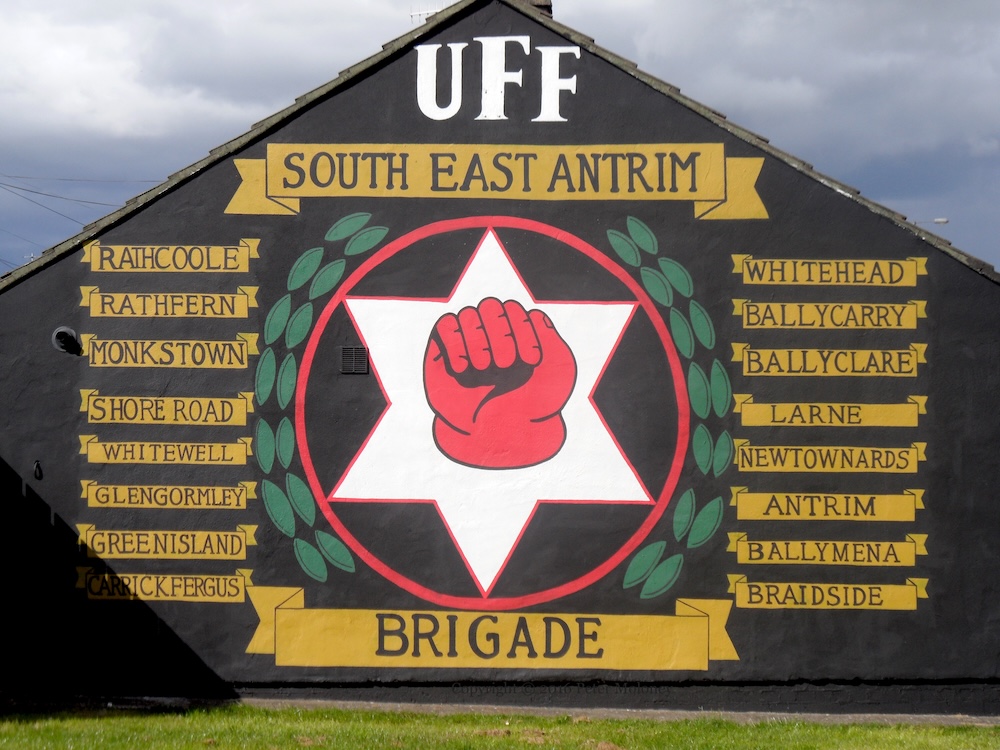
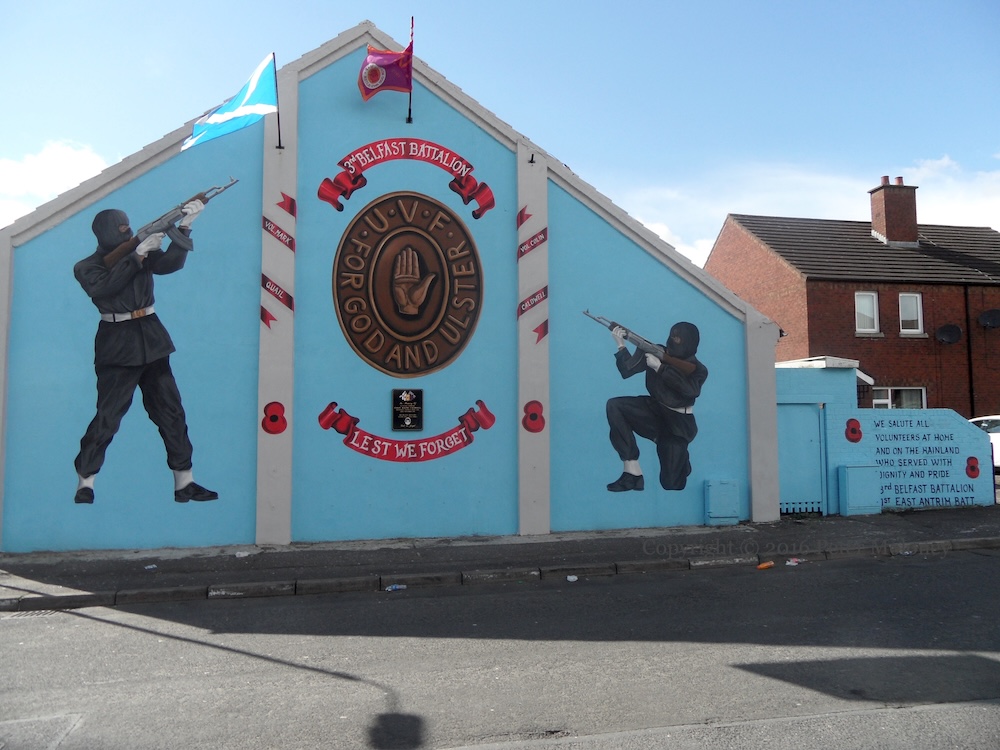
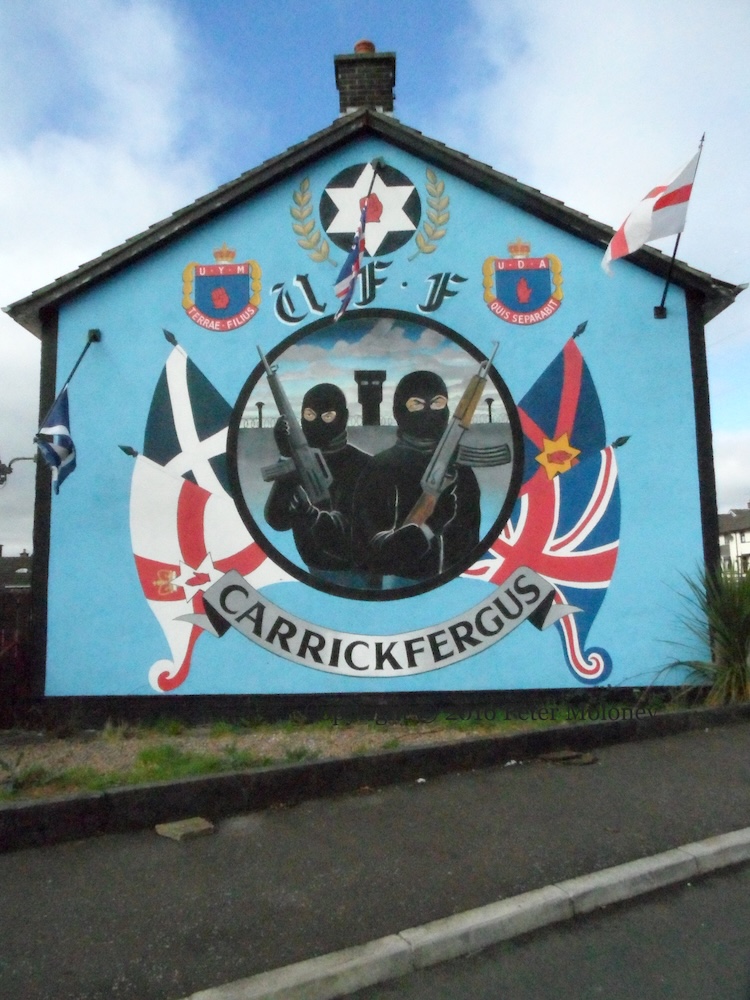
16 towns and town-lands of south-east County Antrim are named in this recent UFF mural: Rathcoole, Rathfern, Monkstown, Shore Road, Whitewell, Glengormley, Greenisland, Carrickfergus, Whitehead, Ballycarry, Ballyclare, Larne, Newtownards, Antrim, Antrim, Ballymena, Braidside.
This mural was painted in late summer, 2015, on a wall that had been blank since at least 2008. In 2006, it bore a UDA mural, for which see M03060.
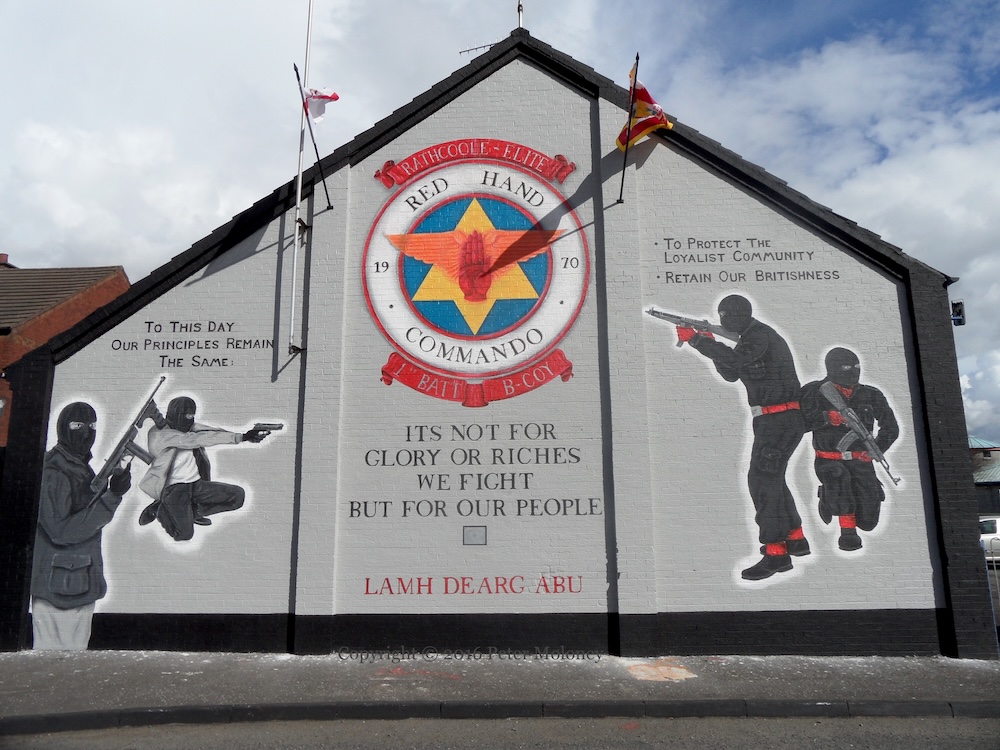
Here is a new mural of the “Rathcoole Elite” unit (1st Batt., B. Coy) of the Red Hand Commando, complete with four masked men each bearing weapons. Founded in 1970, “To this day our principles remain the same: to protect the loyalist community, to retain our Britishness. It is not for glory or riches we fight but for our people. Lamh Dearg Abu.”
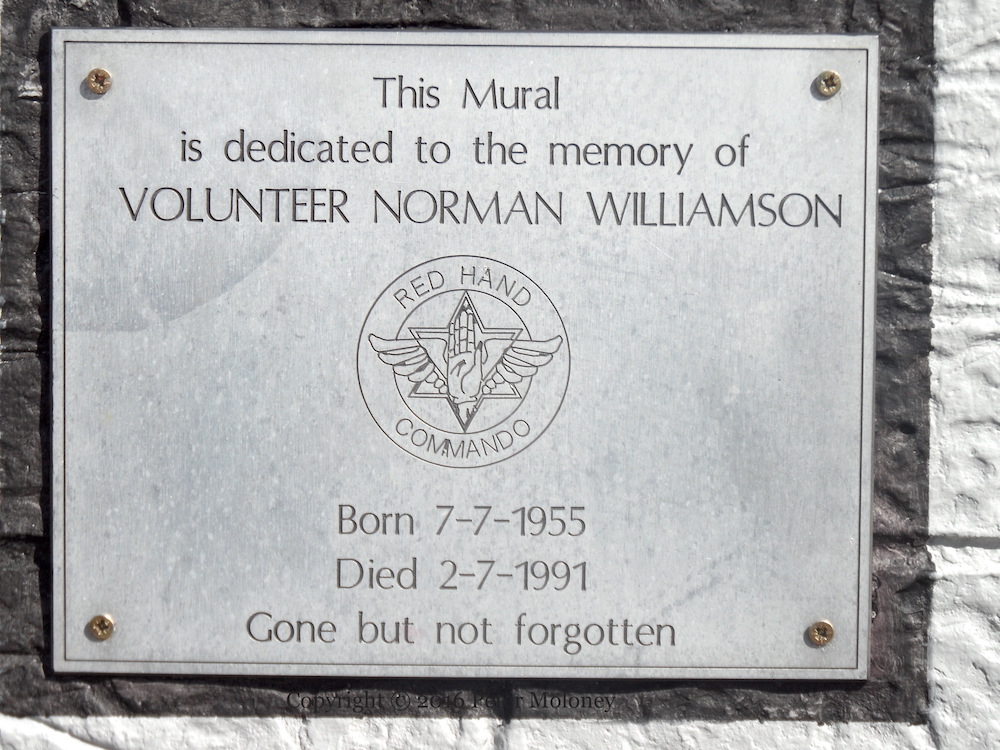
The small plaque reads, “This mural is dedicated to the memory of Volunteer Norman Williamson, born 7-7-1955, died 2-7-1991. Gone but not forgotten.”
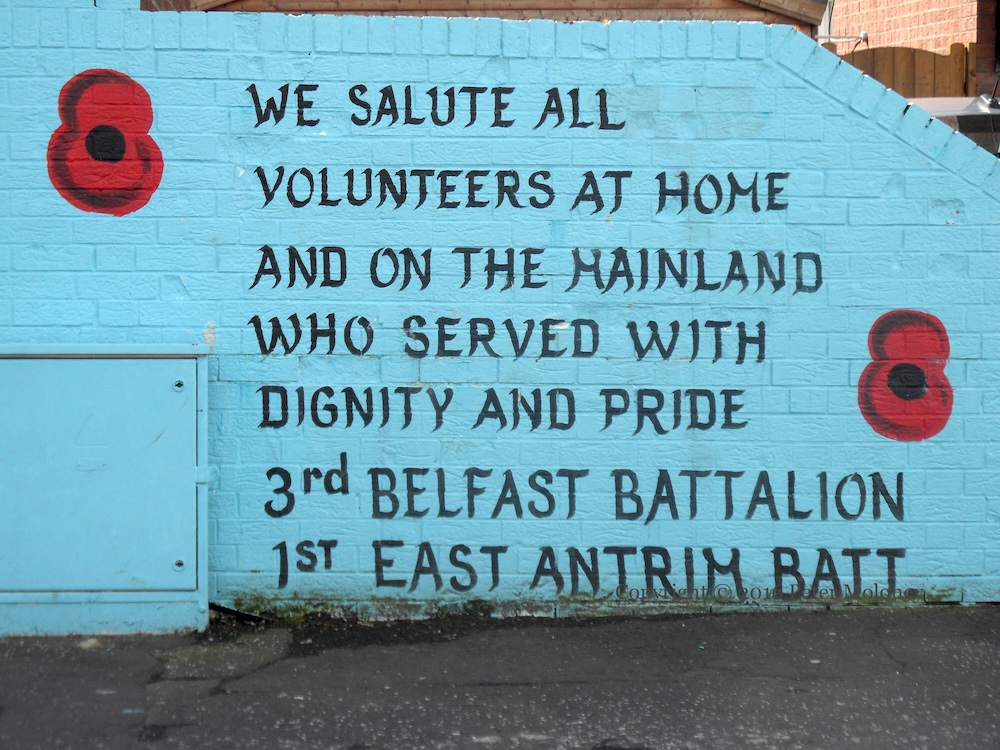
“We salute all volunteers at home and on the mainland who served with dignity and pride.”
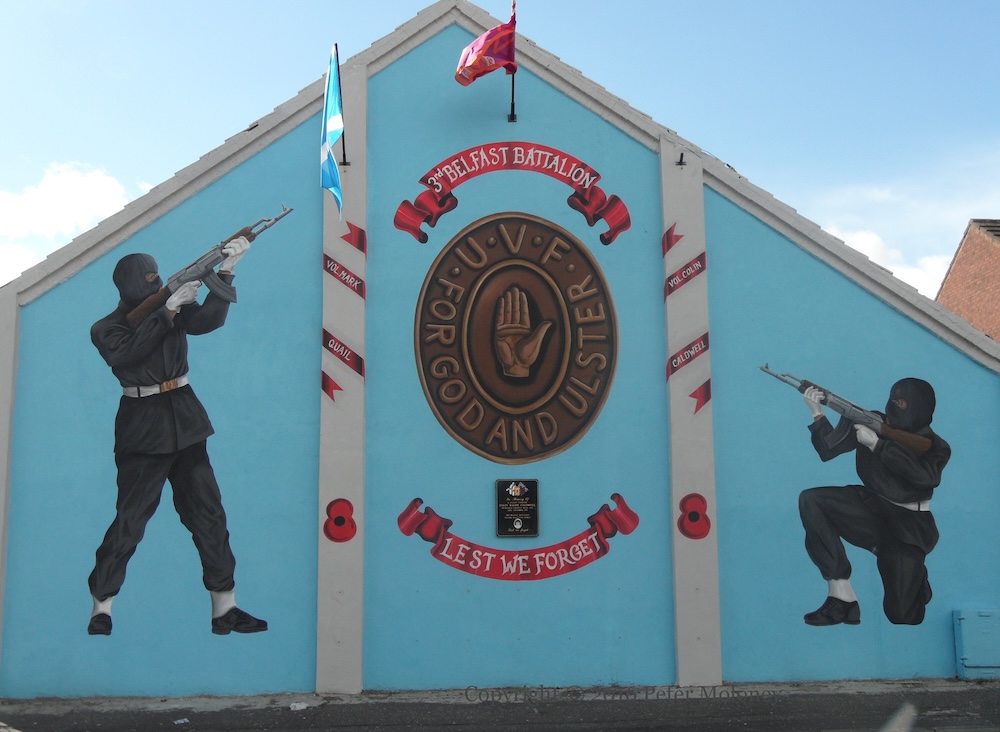
The mural shows two hooded volunteers — from the UVF’s 3rd [north] Belfast battalion and 1st east Antrim battalion – aiming rifles.
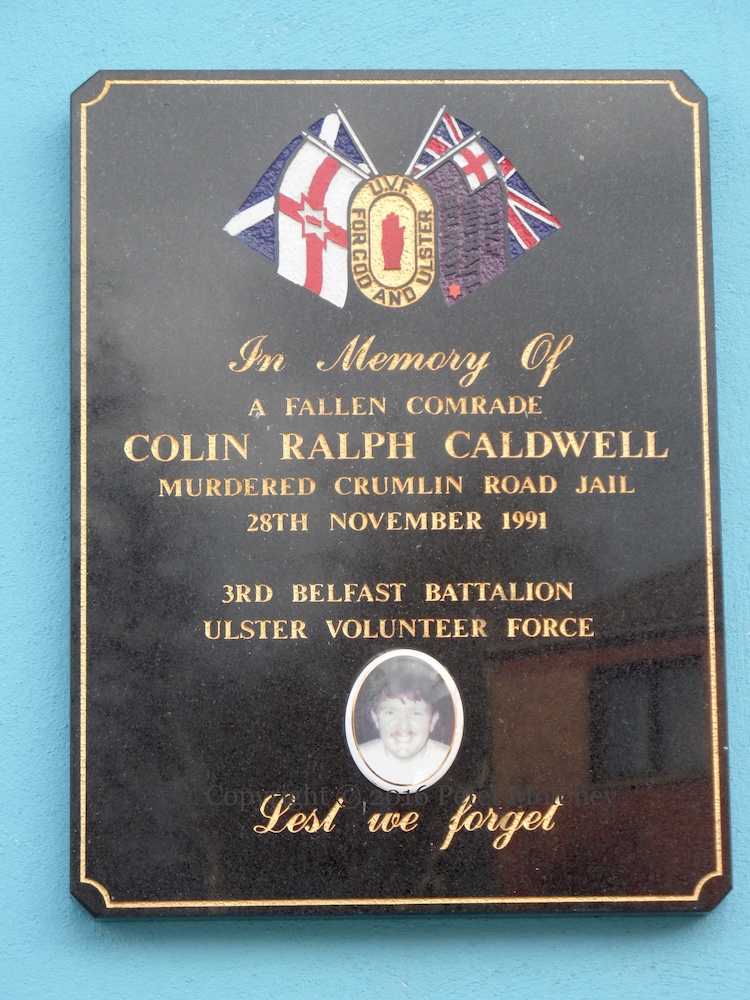
The central plaque to Colin Caldwell has been retained from the previous mural and both Caldwell and Marky Quail are named on the ribbons painted around the building’s columns.
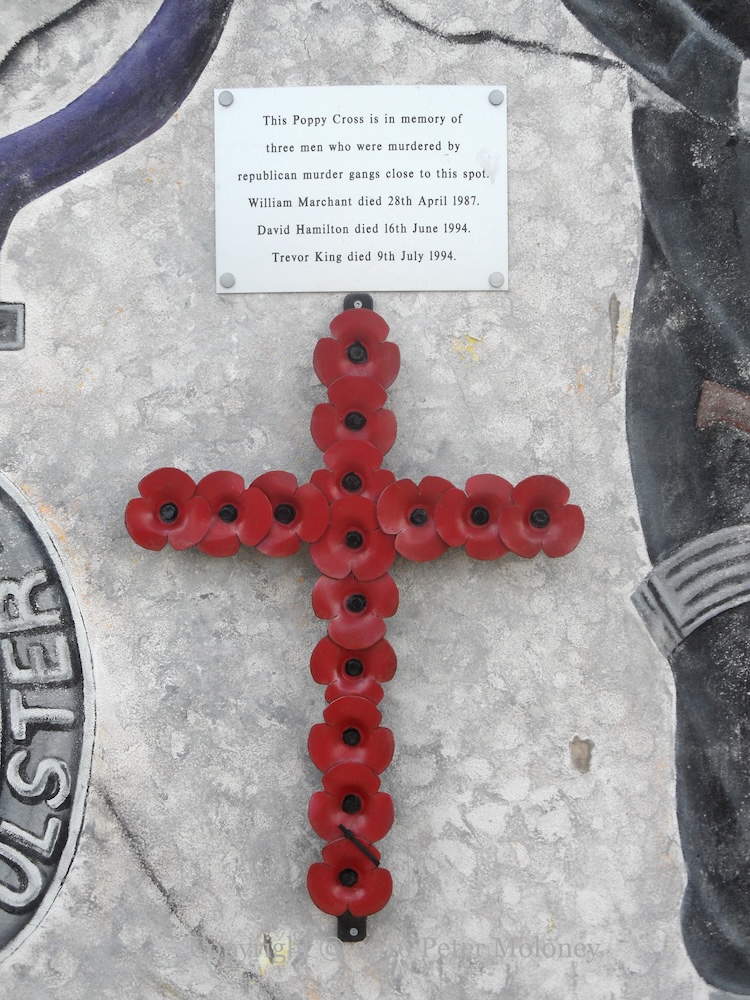
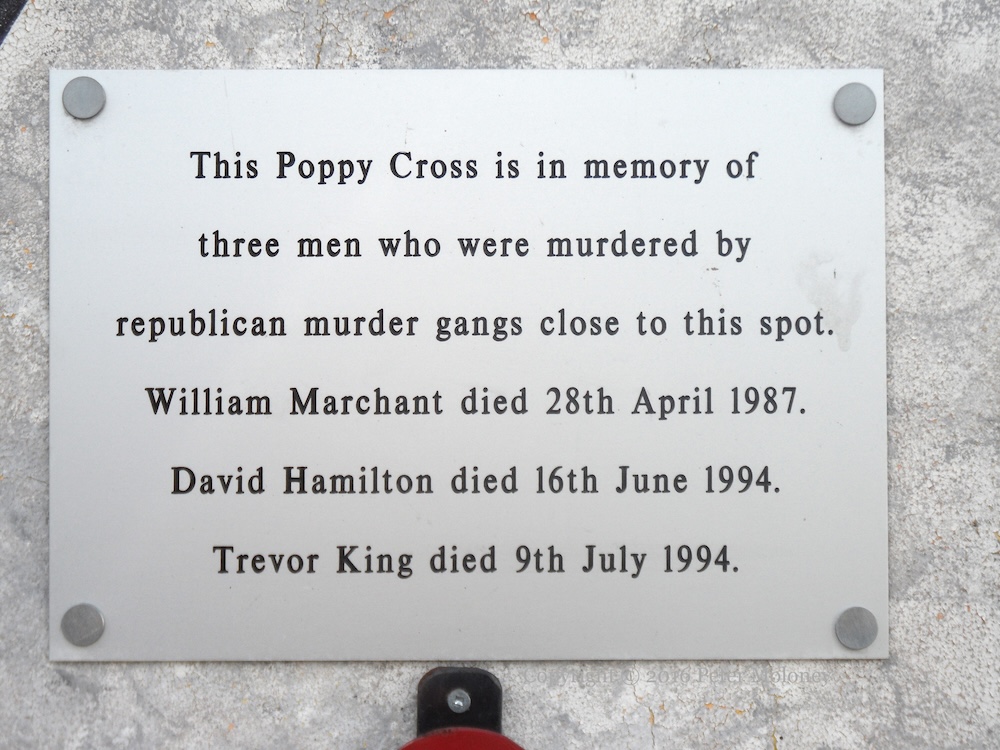
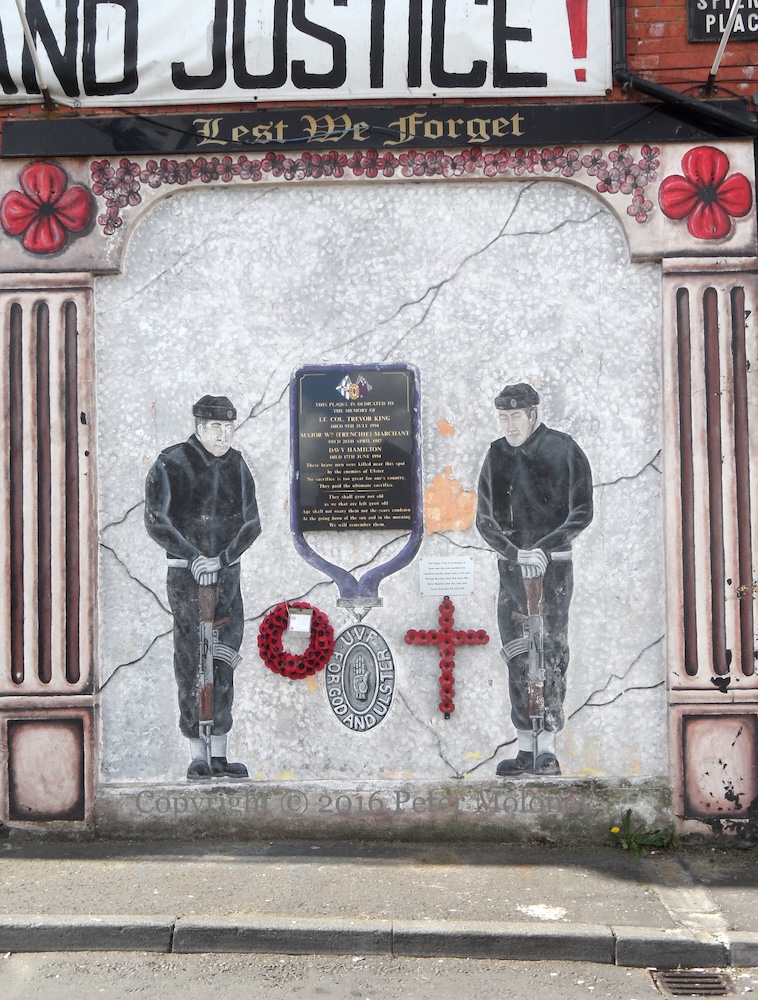
A poppy cross has been added to the UVF memorial mural and plaque at Spier’s Place. The accompanying plaque reads “This poppy cross is in memory of three men who were murdered by republican murder gangs close to this spot. William Marchant died 28th April 1987, David Hamilton died 16th June 1994, Trevor King died 9th July 1994.” For some background, see Ordinary People, Extraordinary Roles.
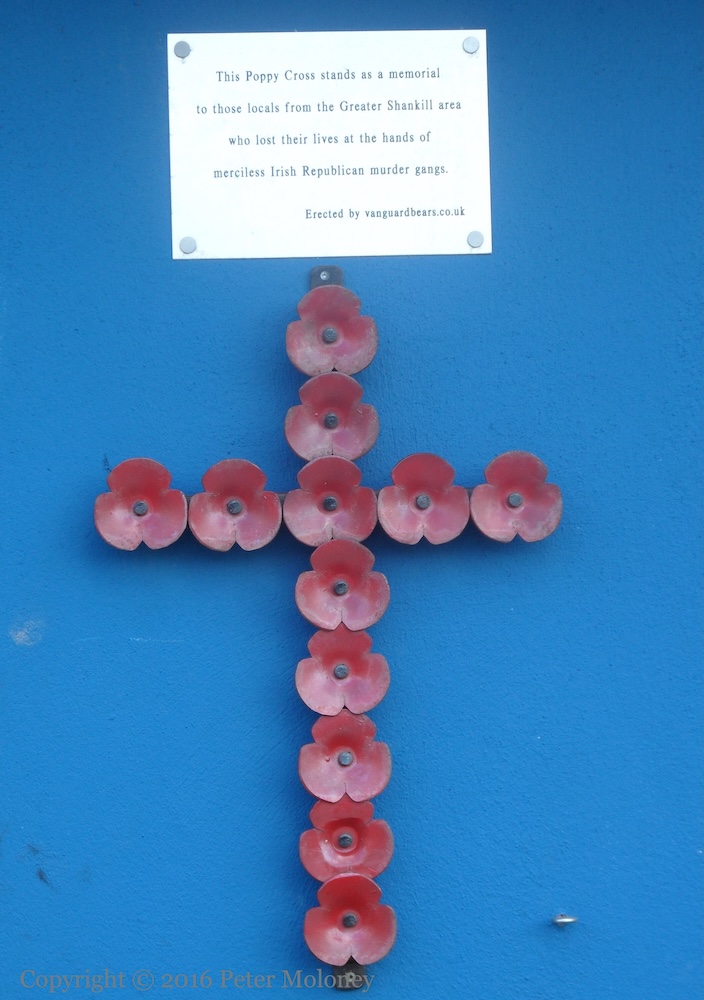
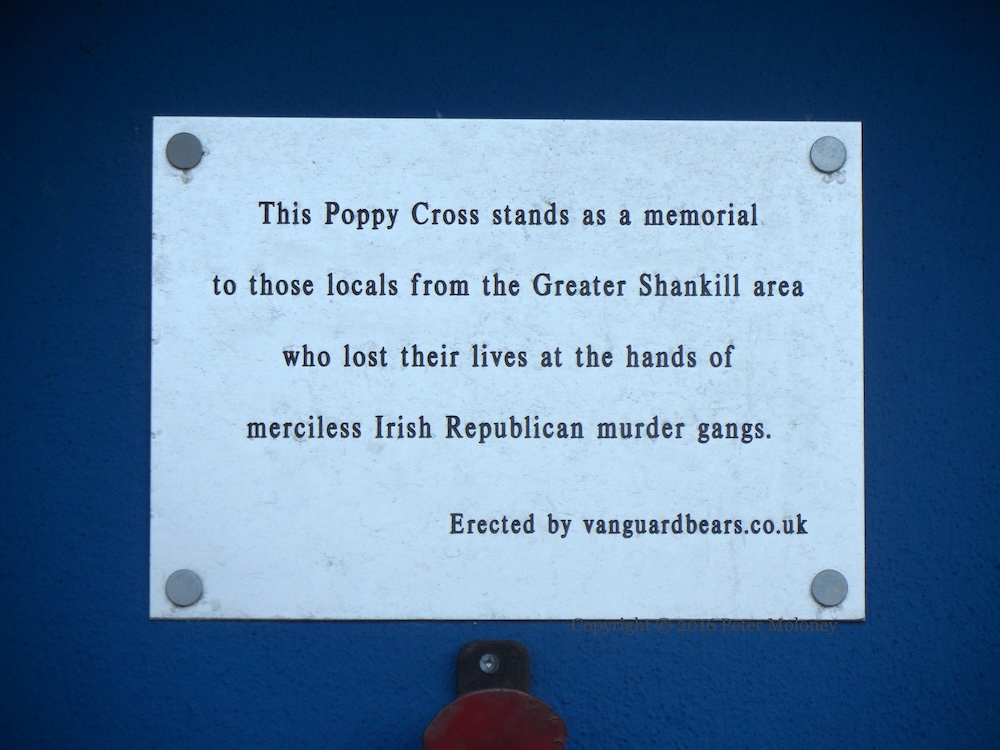
“This poppy cross stands as a memorial to those locals from the Greater Shankill area who lost their lives at the hands of merciless Irish republican murder gangs. Erected by vanguardbears.co.uk” For a mural commemorating bombings on the Shankill, see Shankill Atrocities.
This cross has been mounted on the corner of Sugarfield Street and the Shankill Road, adjacent to the Vanguard Bears board.
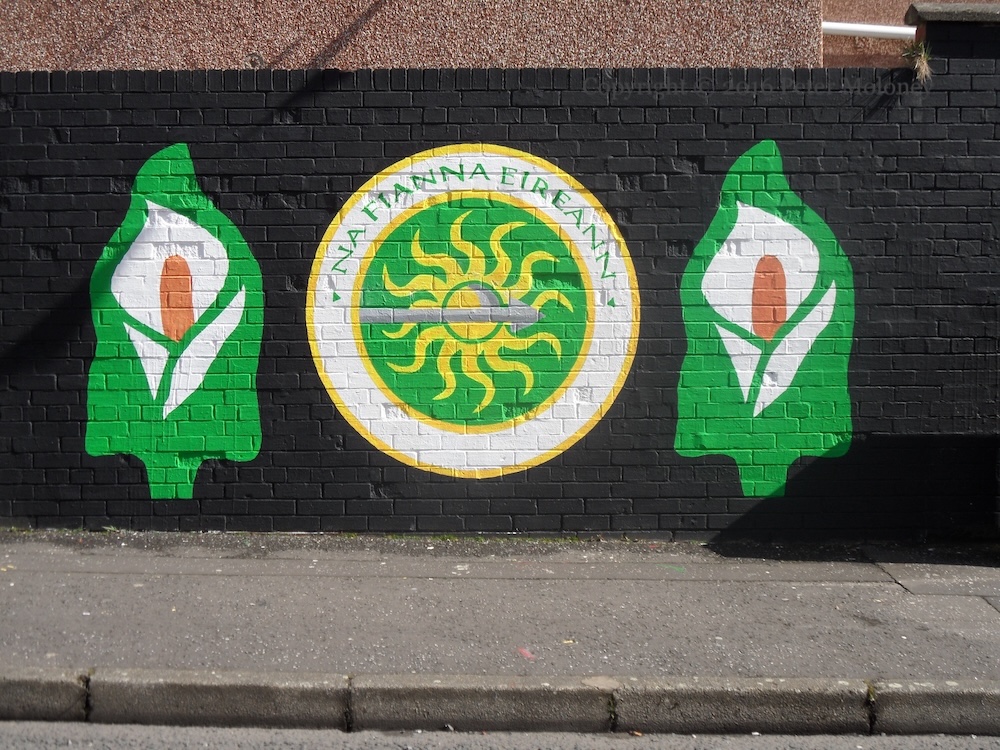
Here is a Na Fıanna Éıreann mural in Ardoyne with Easter lilies on each side of the Fıanna’s ‘sunburst’ (gal gréıne) emblem (which also includes a pike or bill).
For a history of sunburst flags, with lots of images, see An Sıonnach Fıonn. A banner sporting an early version of the emblem, owned by Countess Markievicz during the Rising, was recently returned from London to Dublin (Irish Times).
Like the name “Óglaıgh Na hÉıreann”, “Na Fıanna Éıreann” has been used by many organisations for their youth division; this one is associated with the RNU (web).
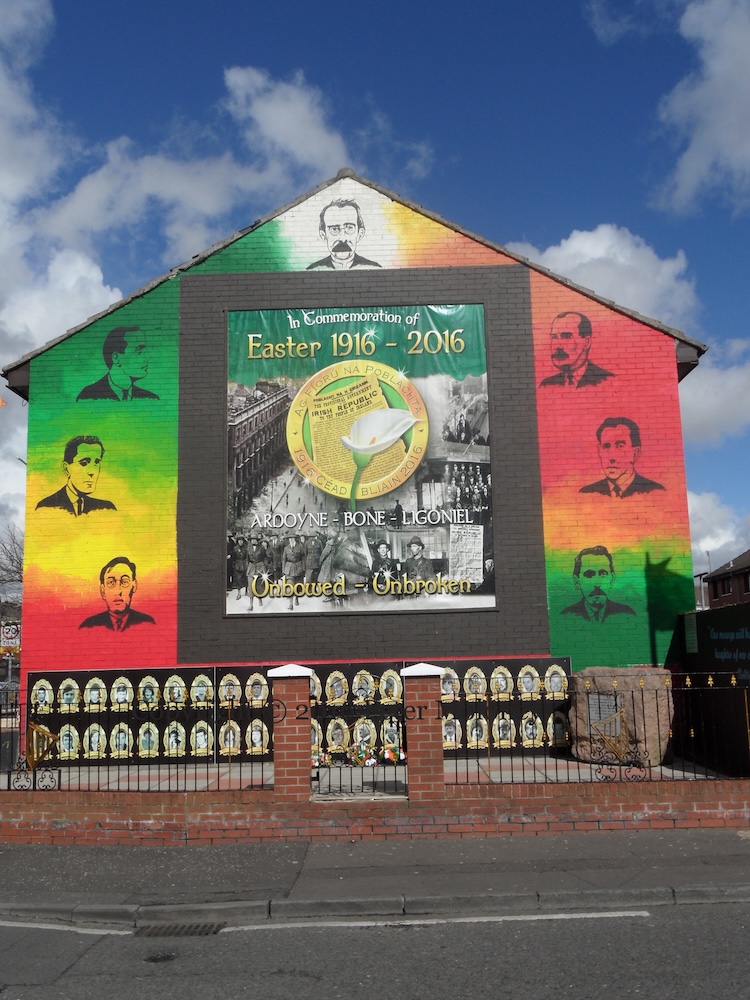
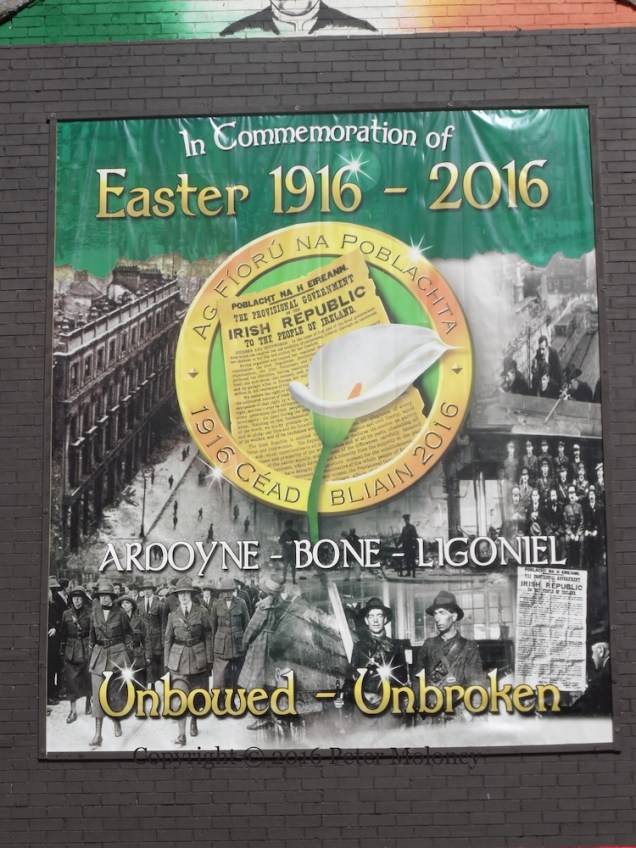
“In commemoration of Easter 1916 – 2016. Ardoyne – Bone – Ligoniel. Unbowed – unbroken.”
Tom Clarke is at the head of his fellow signatories as he looks down over a printed tarp reproducing photographs of events surrounding the Easter Rising of 1916, including soldiers from the Irish Citizen Army on a rooftop (see the original in this Spectator article) and members of Cumann Na mBan on parade. For the photo of the building in the top left, see this Irish Times article.
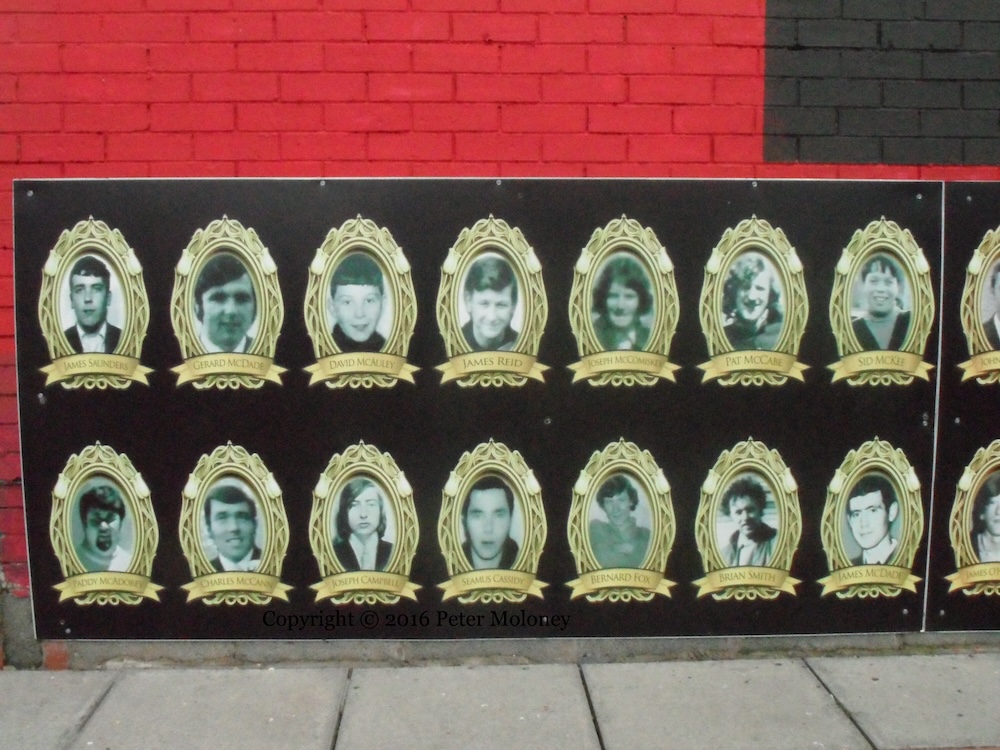
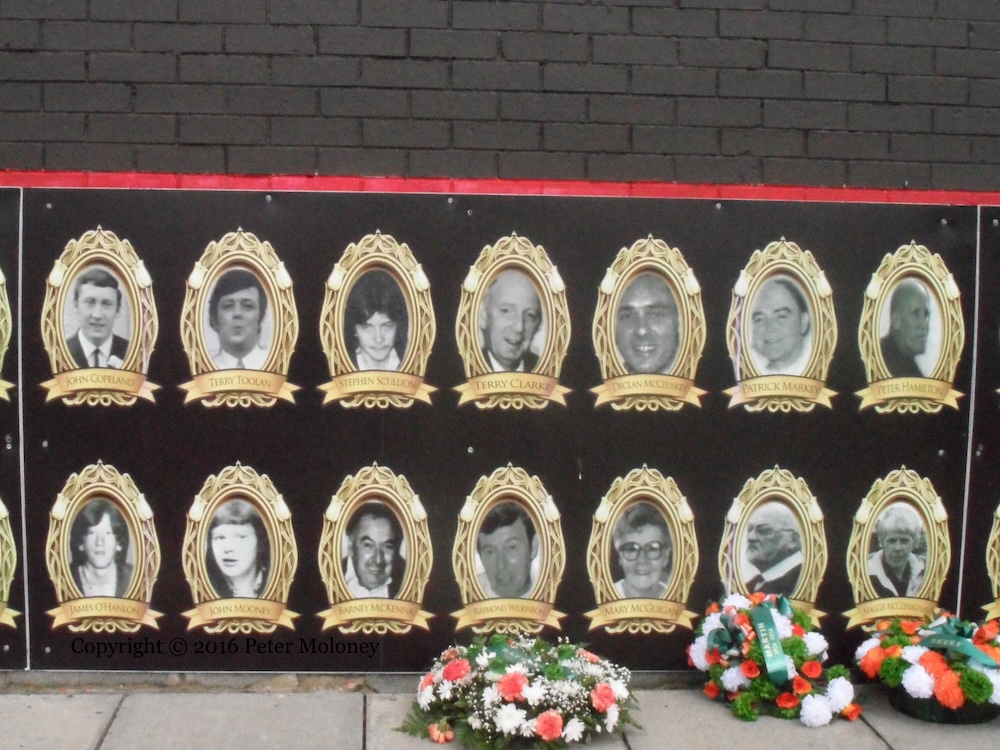
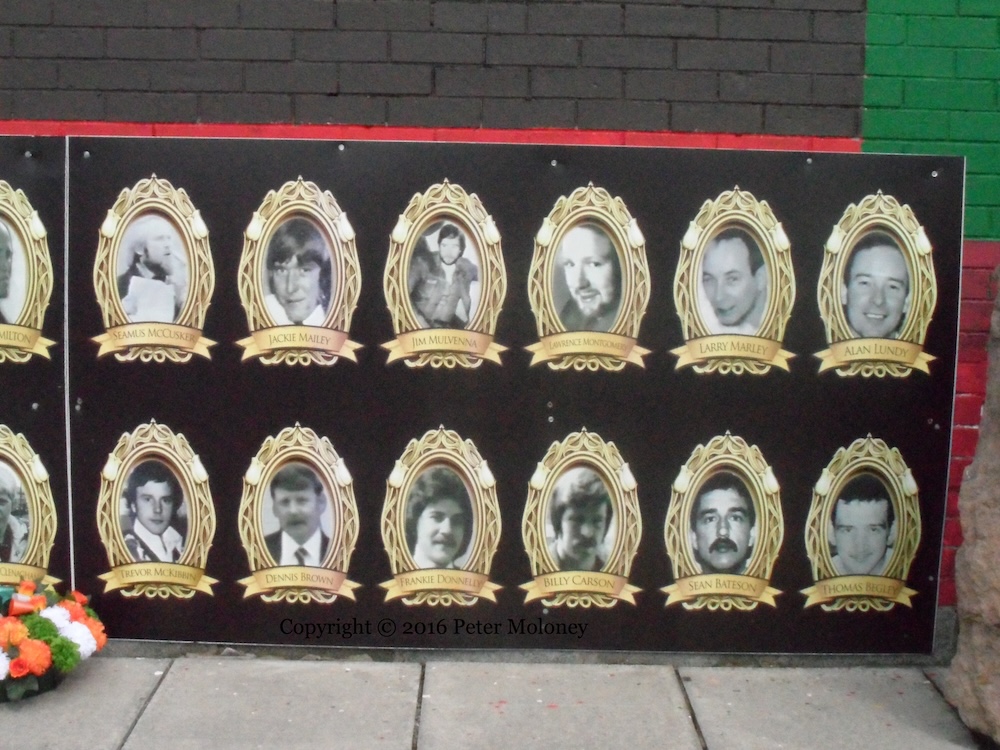
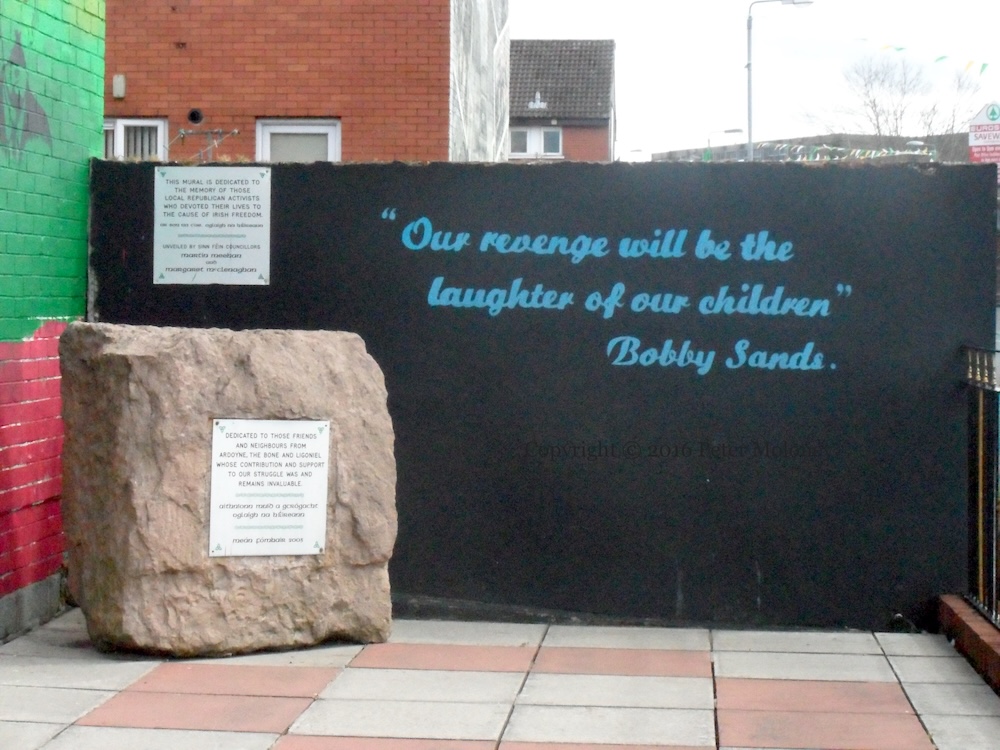
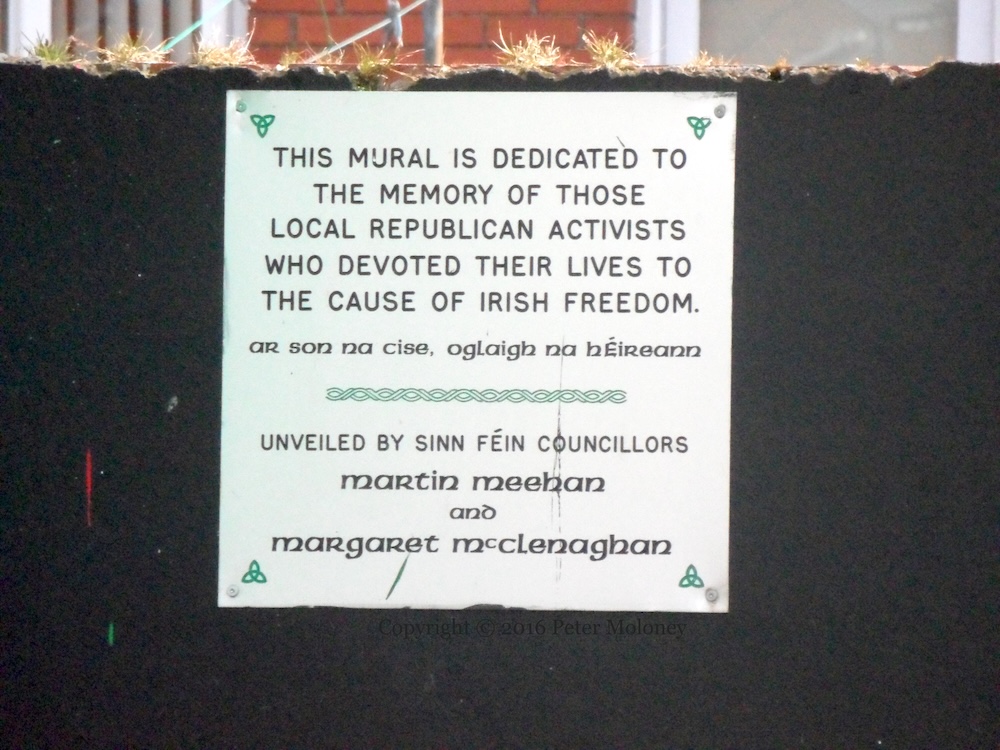
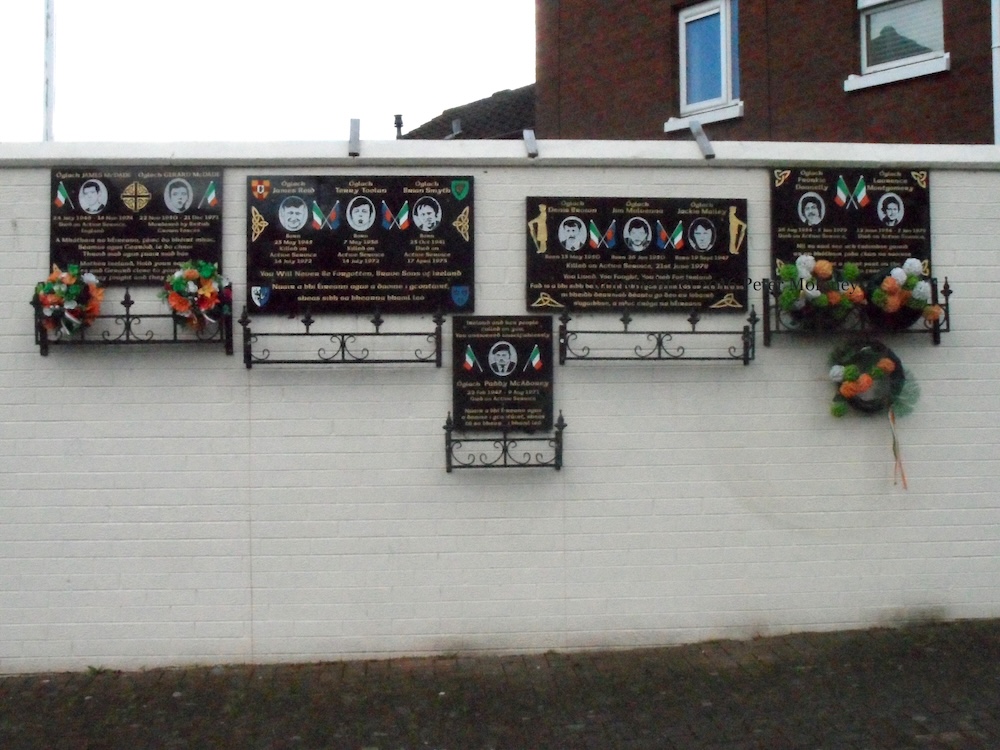
The previous Ardoyne – Bone – Ligoniel mural fell down almost as soon as it was completed, leaving only the boards with portraits of locals killed during the troubles. The stone and plaque (in the final images) go back to the mural before that.
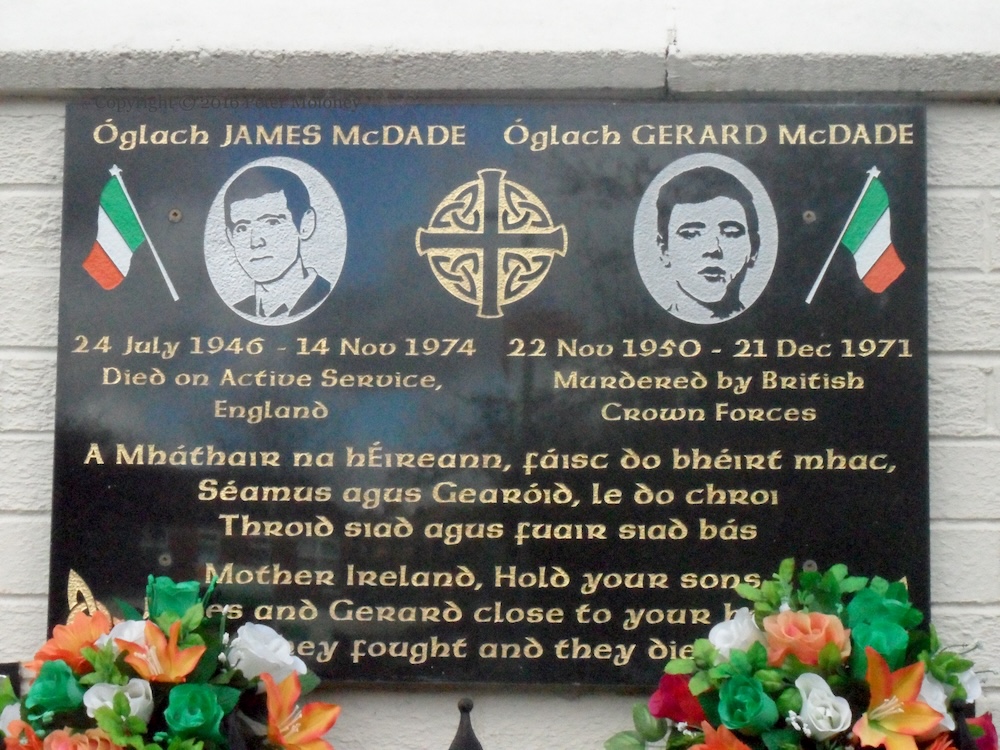
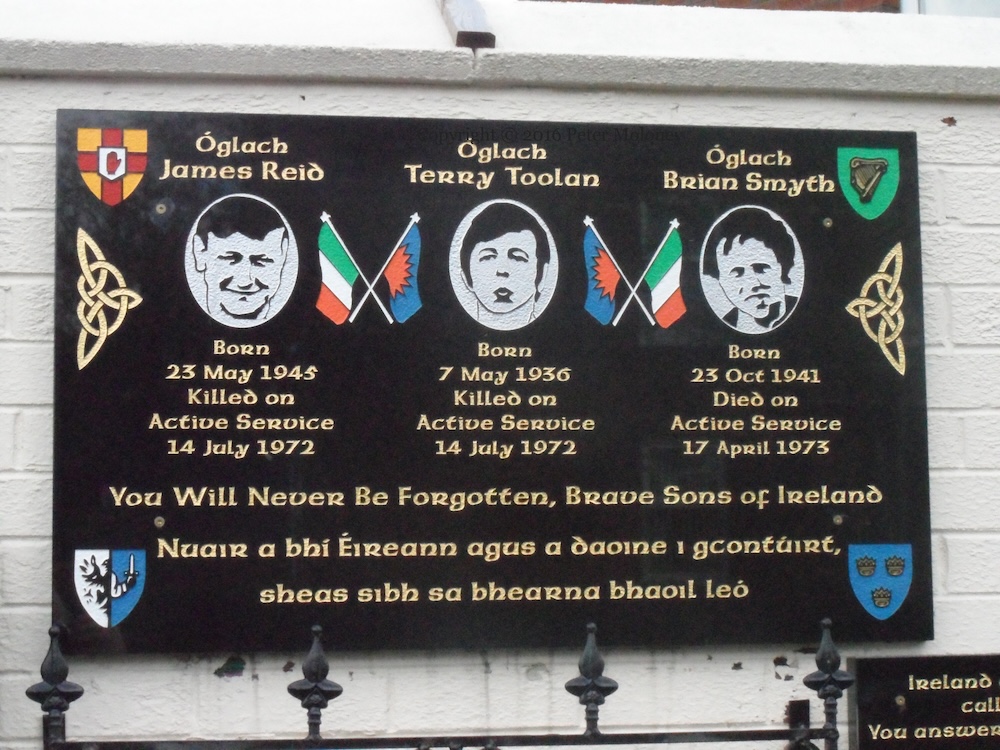
Three plaques have been added to the two seen previously, the McDade and Donnelly-Montgomery plaques.
“Óglach James McDade 24 July 1946 – 14 Nov 1974 died on active service, England; Óglach Gerard McDade 22 Nov 1950 – 21 Dec 1971 murdered by British Crown Forces. A Mháthaır na hÉıreann, fáısc do bhéırt mhac, Séamus agus Geraóıd, le do chroí. Throıd sıad agus fuaır sıad bás. Mother Ireland, hold your sons, James and Gerard, close to your heart. They fought and they died.”
“Óglach James Reid born 23 May 1945 killed on active service 14 July 1972. Óglach Terry Toolan born 7 May 1936 killed on active service 14 July 1972. Óglach Brian Smyth born 23 Oct 1941 died on active service 17 April 1973. You will never be forgotten, brave sons of Ireland. Nuaır a bhí Éıreann agus a daoıne ı gcontúırt, sheas sıbh sa bhearna bhaoıl leó [sic leo].”
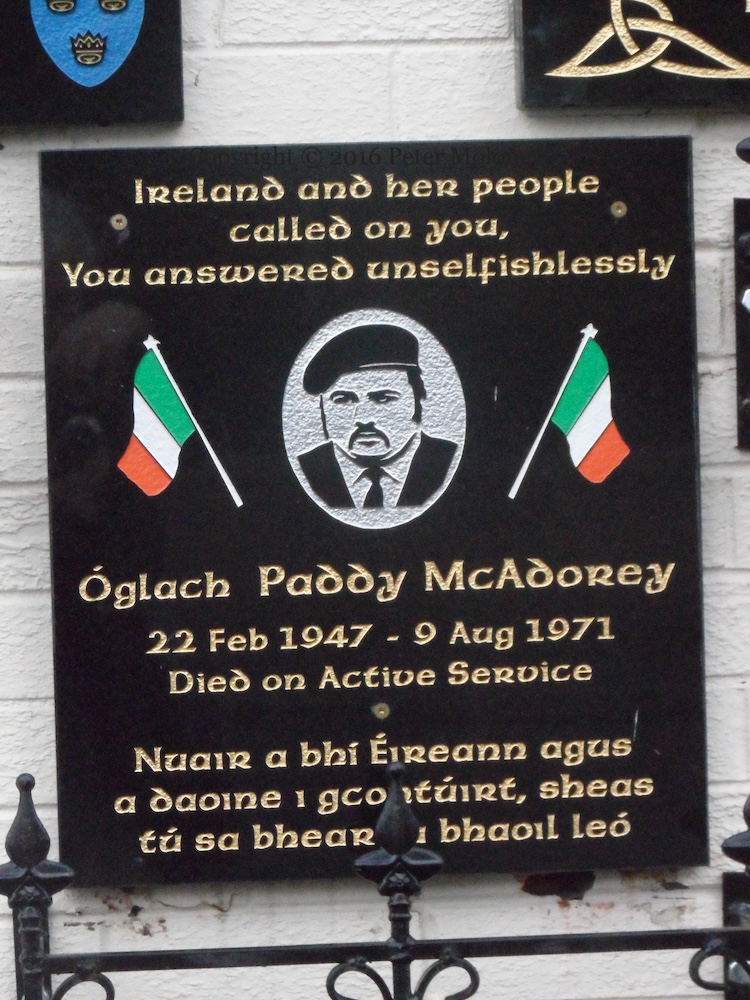
“Ireland and her people called on you, you answered unselfishlessly. Óglach Paddy McAdorey 22 Feb 1947 – 9 Aug 1971 died on active service. Nuaır a bhí Éıreann agus a daoıne ı gcontúırt, sheas sıbh sa bhearna bhaoıl leó.”
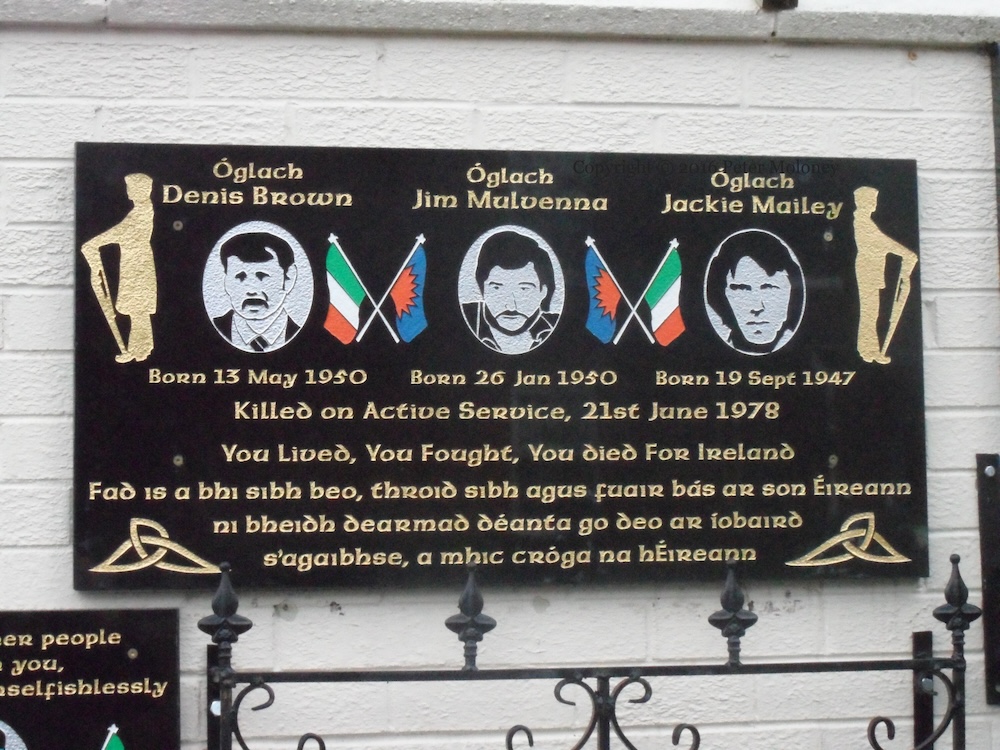
“Óglach Denis Brown born 13 May 1950, Óglach Jim Mulvenna born 26 Jan 1950, Óglach Jackie Mailey born 19 Sept 1947 – killed on active service, 21st June 1978. You lived, you fought, you died for Ireland. Fad ıs a bhí sibh beo, throıd sıbh agus fuaır bás ar son Éıreann ní bheidh dearmad déanta go deo ar íobaırd s’agaıbhse, a mhıc cróga na hÉıreann.”
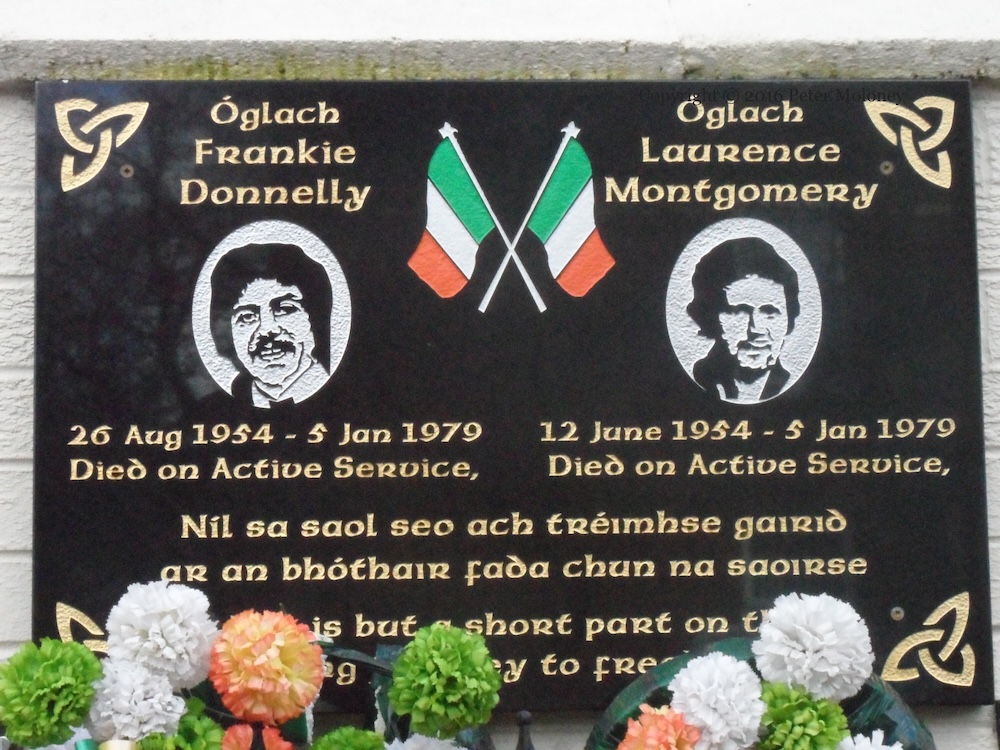
“Óglach Frankie Donnelly 26 Aug 1954 – 5 Jan 1979 died on active service; Óglach Laurence Montgomery 12 June 1954 – 5 Jan 1979 died on active service. Níl sa saol seo ach tréımhse gaırıd ar an bhóthaır fada chun na saoırse – life is but a short part on the long journey to freedom.”
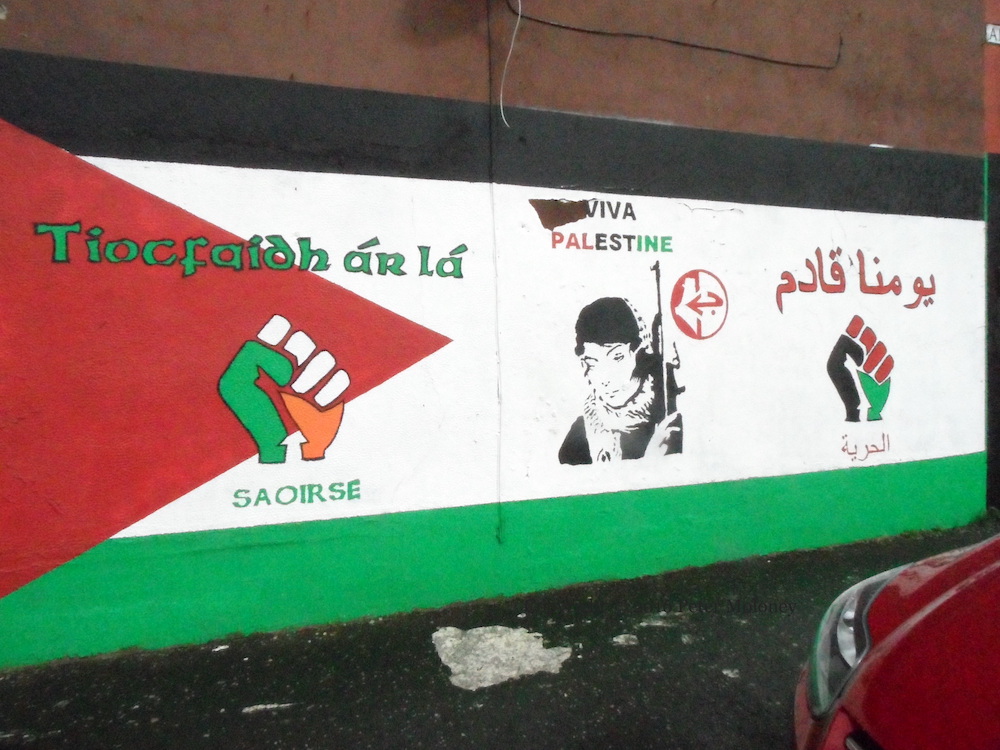
“Tıocfaıdh ár lá”, “يومنا قادم” [yeomna qadm, our day is coming] (and below, “Saoırse” and “حرية” [freedom].
The figure at the centre of the mural, with the PFLP emblem, is sky-jacker Leila Khaled – for background on her see the same stencil of her in Hugo Street.
Seen previously in better condition in 2015. AMCOMRI St (AMerican COMmittee [for] Relief [in] Ireland), Beechmount, west Belfast