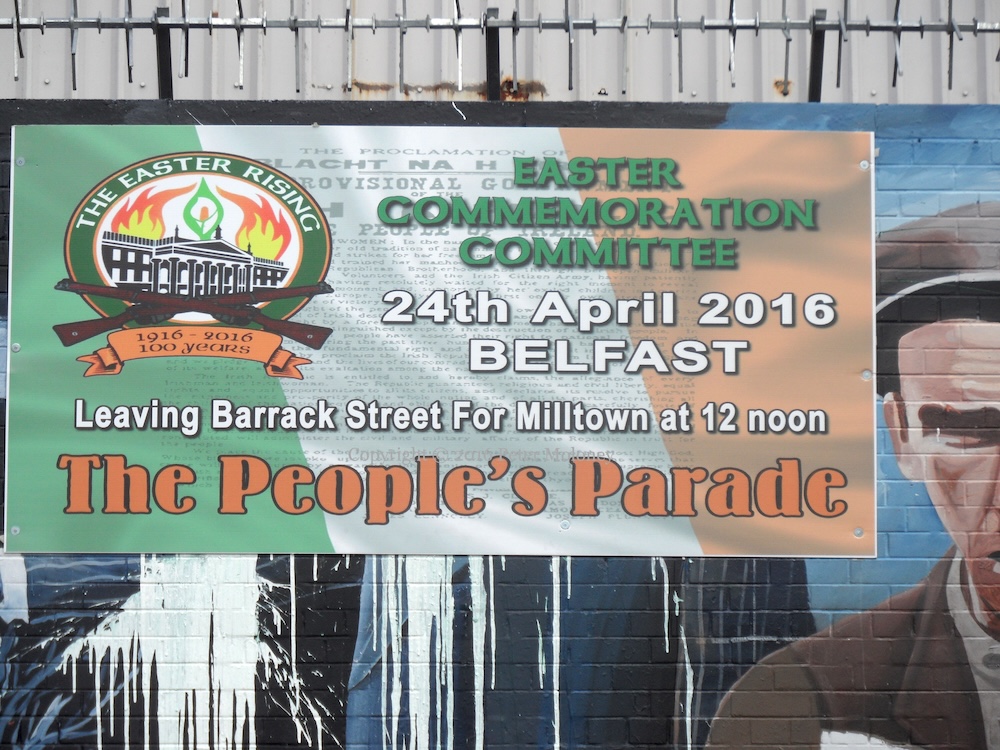
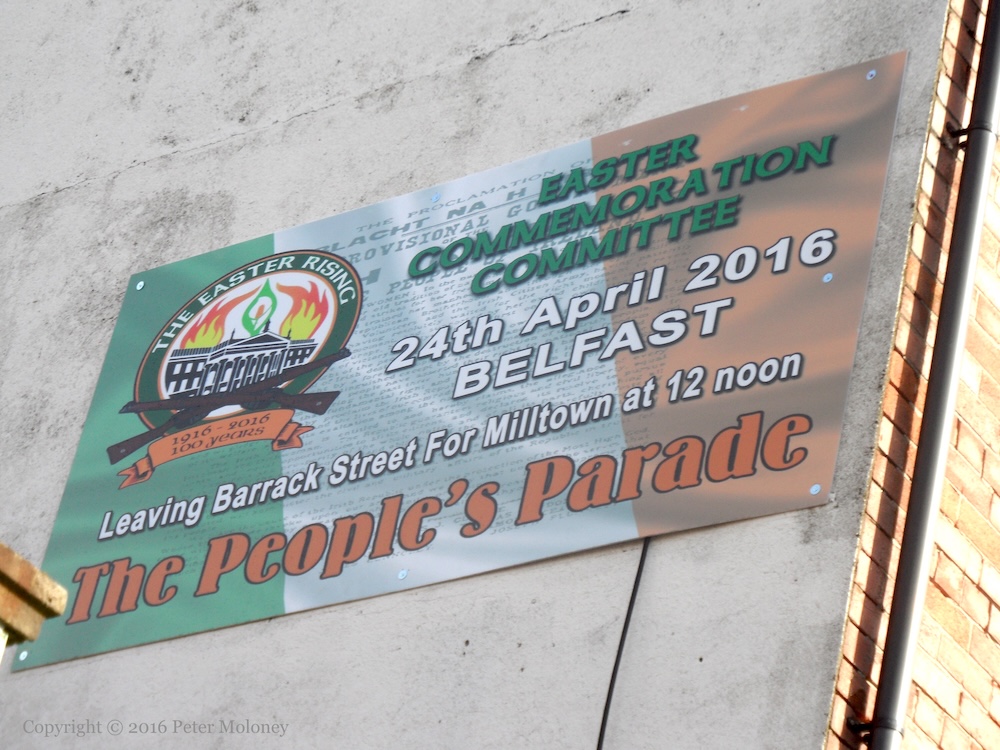
The People’s Parade (i.e. the parade supported by anti-Agreement groups) takes place April 24th, the date of the Rising in 1916; the other (Sınn Féın) parade was held on Easter Sunday, which this year was March 27th. The second board is above the RSF office/shop in the middle Falls; the upper image is on the International Wall, Divis Street, during the long time that it was being painted (and vandalised) for the centenary – it would eventually be launched on the anniversary of Casement’s execution, on August 3rd.
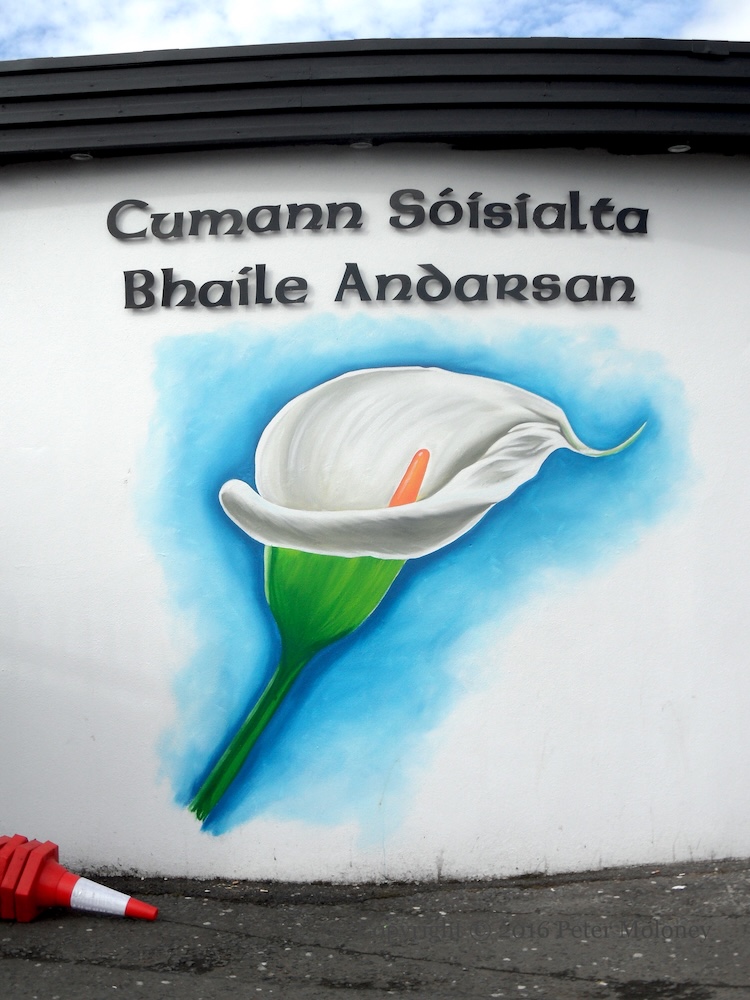
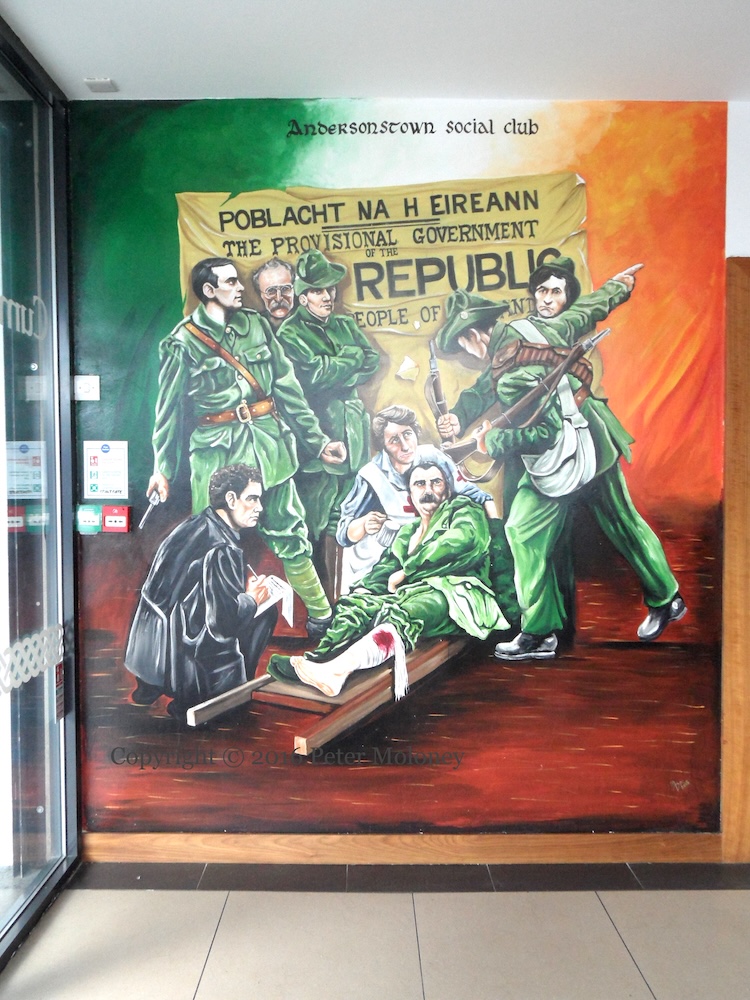
The PD/Cumann Sóısıalta Bhaıle Andarsan/Andersonstown Social Club was one of the early stops for the travelling version of the ‘Revolution 1916’ exhibition that was hosted by the Ambassador theatre – see Revolution 1916.
The mural immediately above was painted to accompany the exhibition, reproducing the left-hand grouping from Walter Paget’s Birth Of The Irish Republic and putting the proclamation in the background. For Paget’s original oil painting and other versions of it, see the painting’s Visual History page.
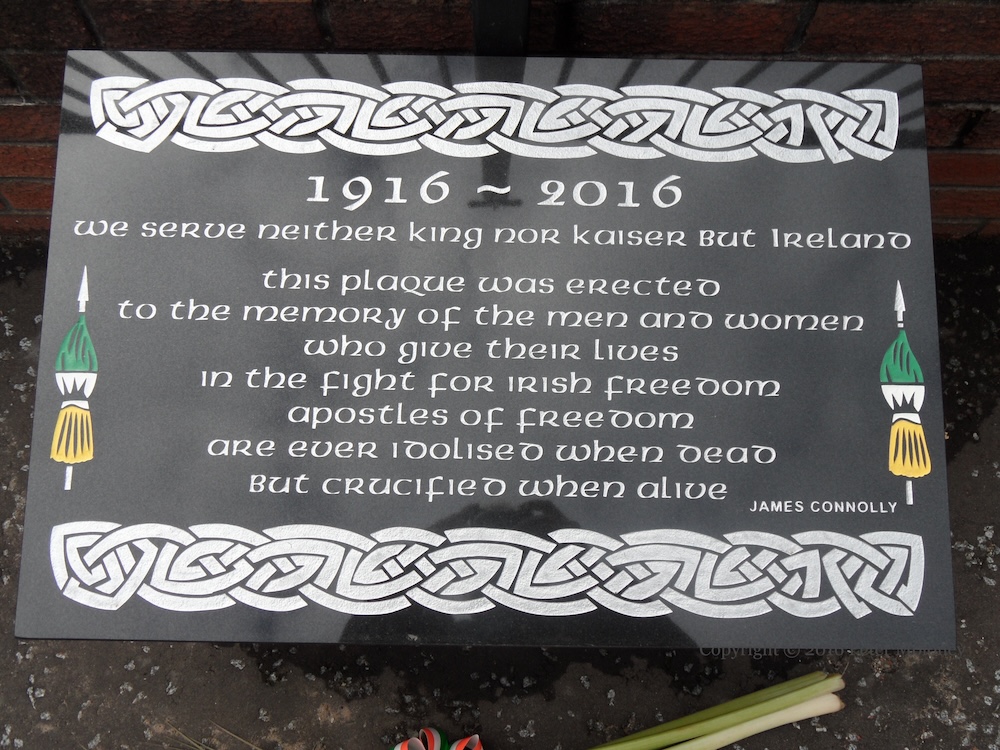
The new plaque (added to the memorial garden) reads, “1916 – 2026. We serve neither king nor kaiser, but Ireland. This plaque was erected to the memory of the men and women who give their lives in the fight for Irish freedom. “Apostles of freedom are ever idolised when dead but crucified when alive.” – James Connolly.” [from 1898’s The Men We Honour]
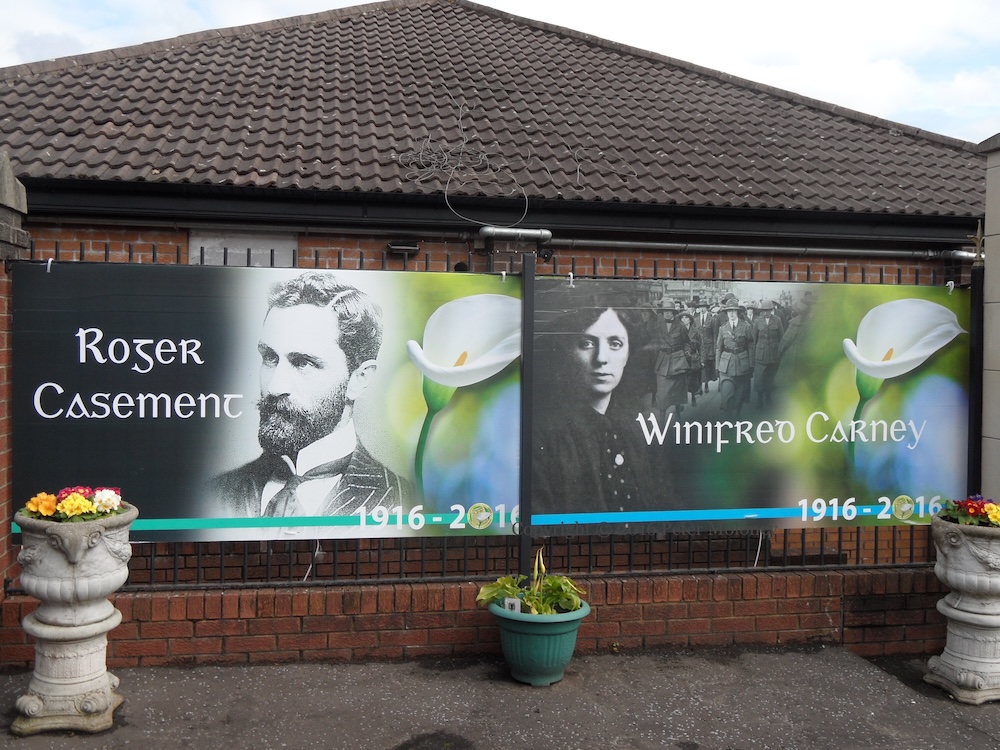
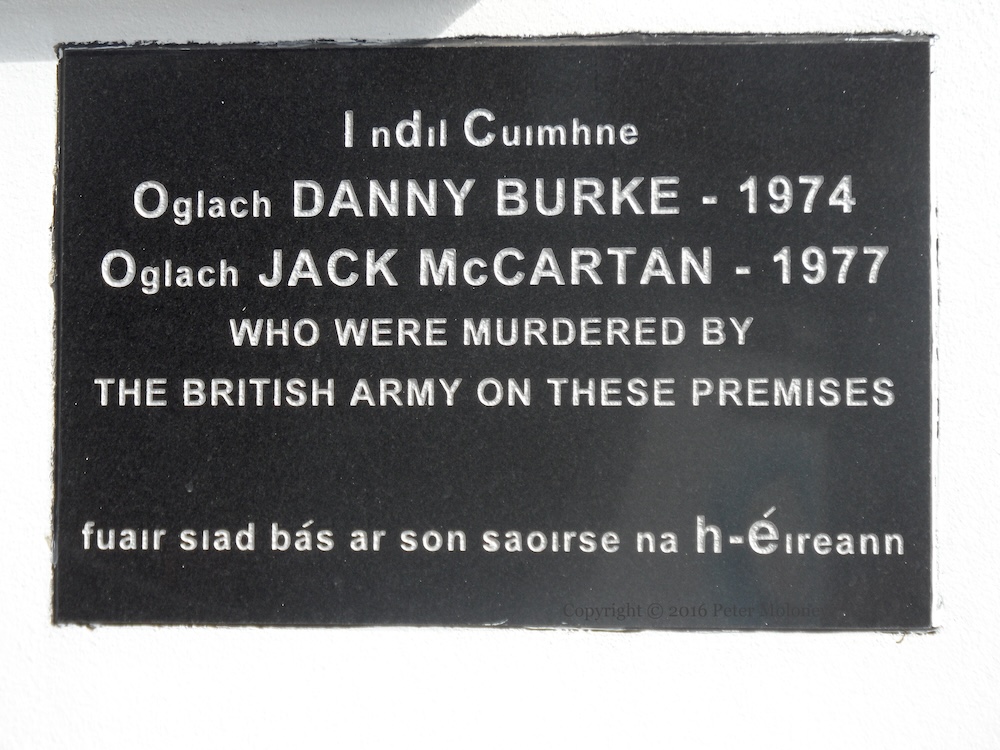
Also featured are Roger Casement and Winifred Carney, and a long-standing plaque to Danny Burke and Jack McCartan, former managers of the club who were “murdered by the British Army on these premises” (An Phoblacht).
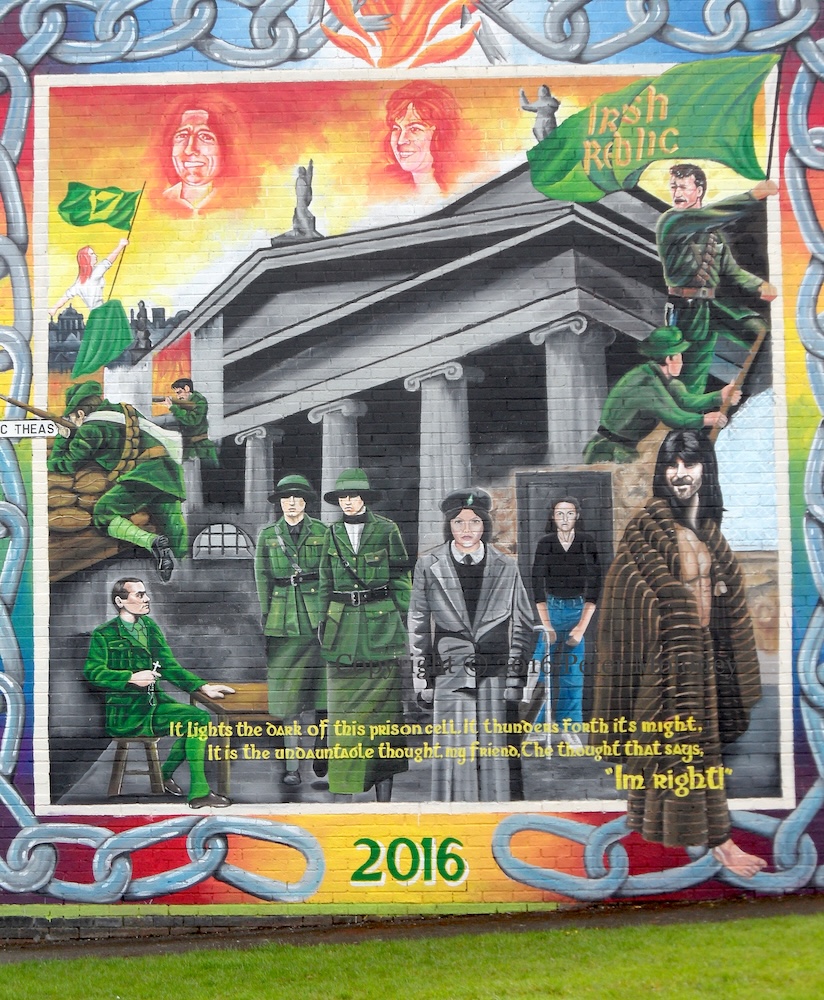
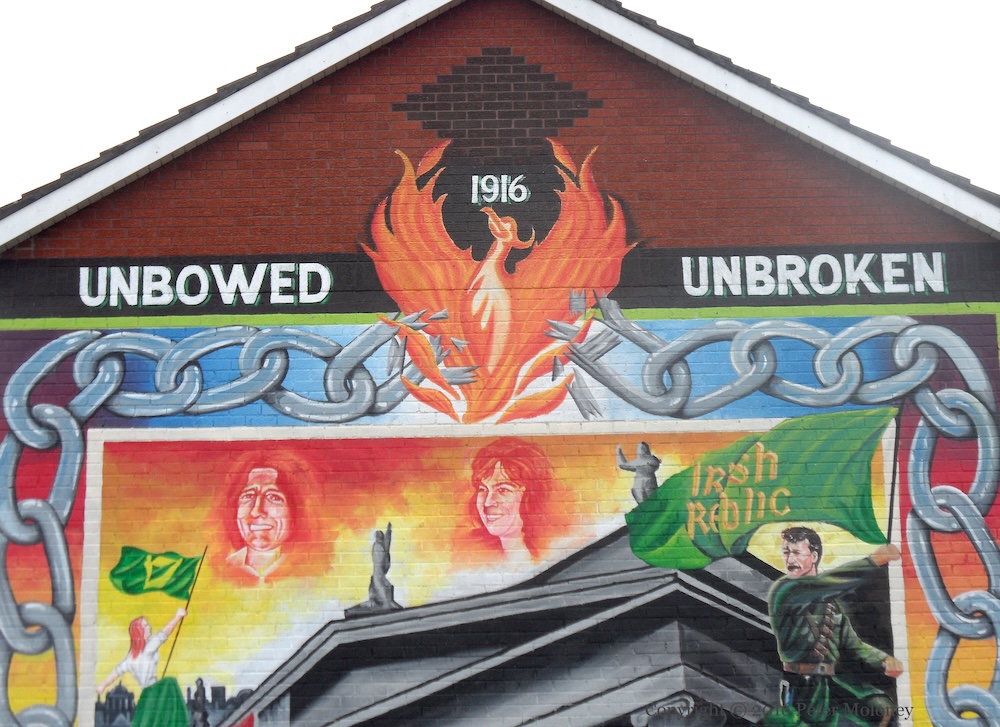
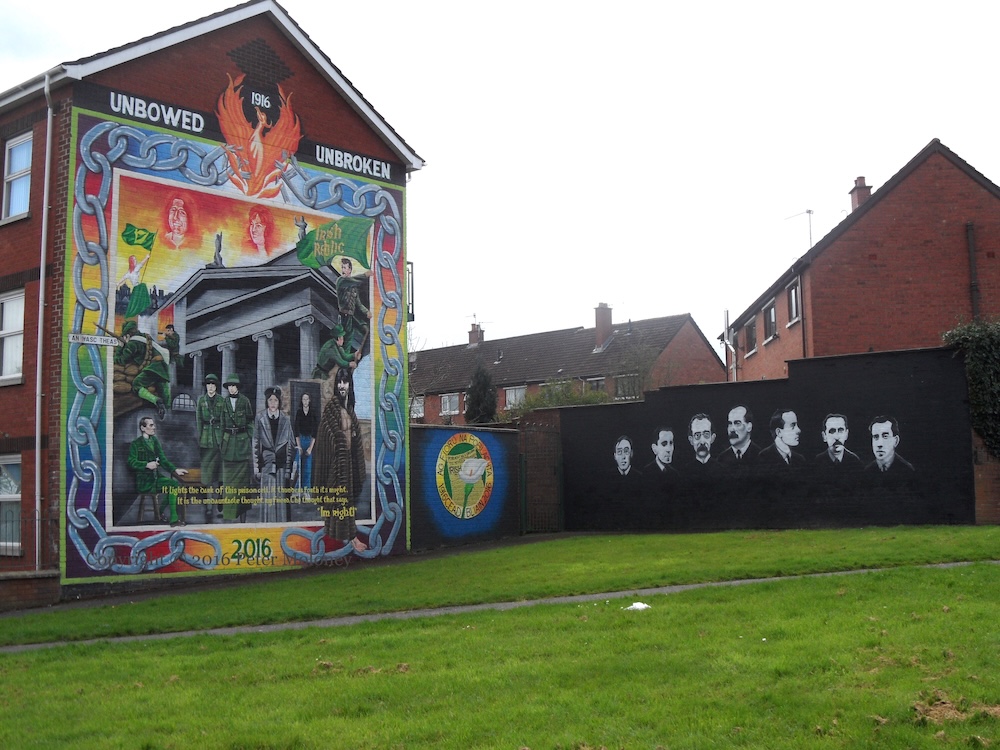
The walls at South Link, Andersonstown, have been painted with three new murals for the centenary of the Easter Rising.
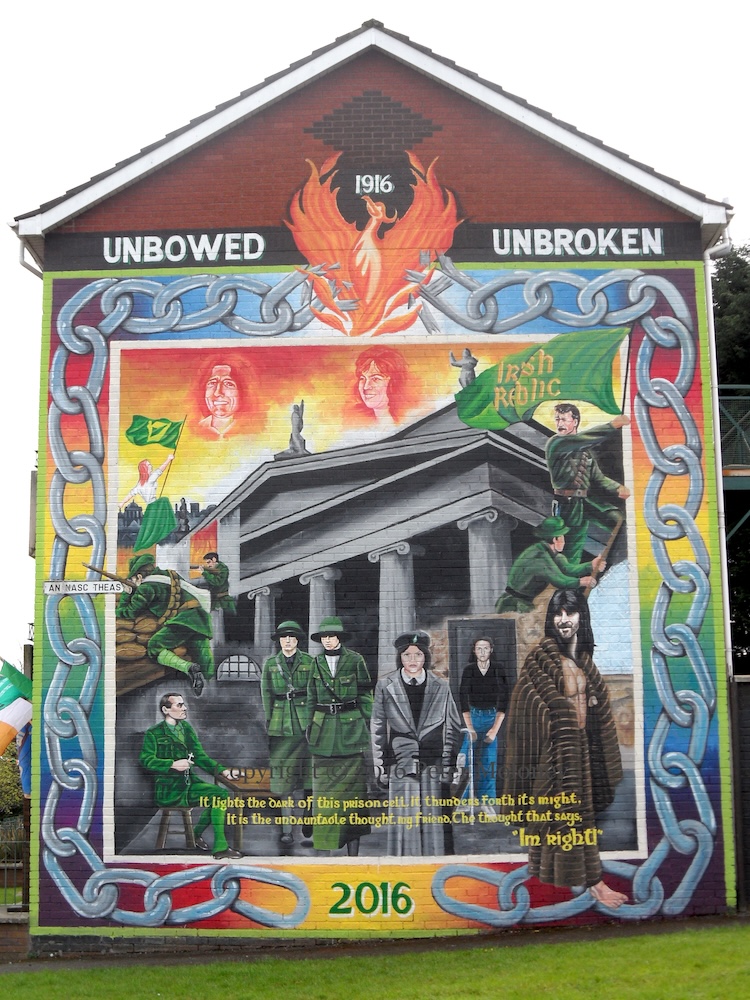
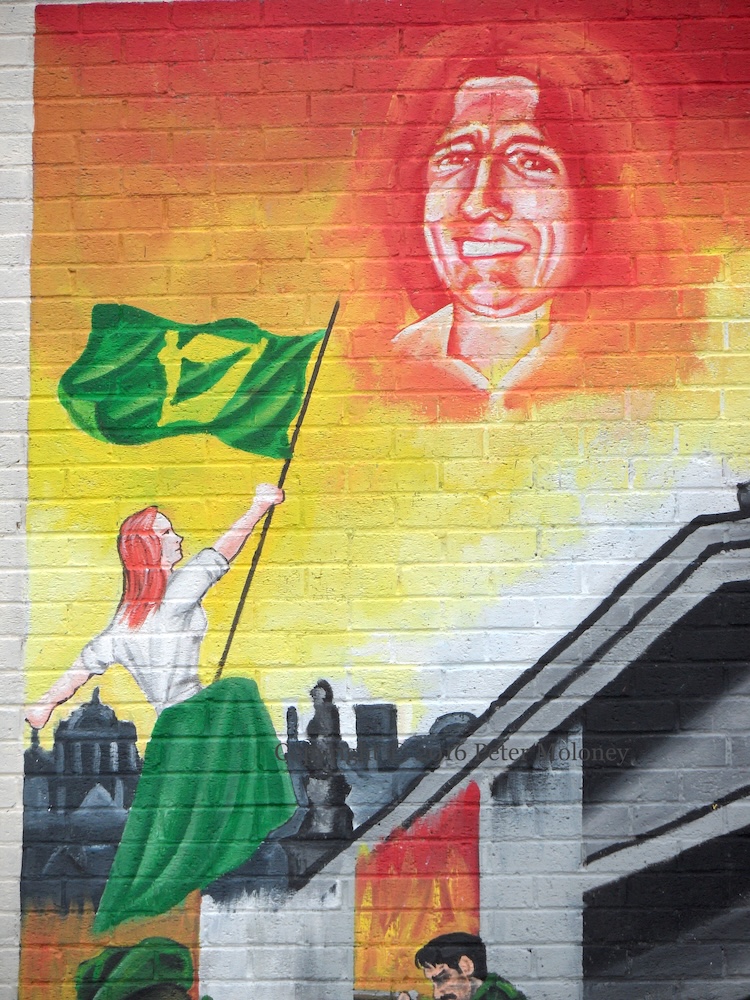
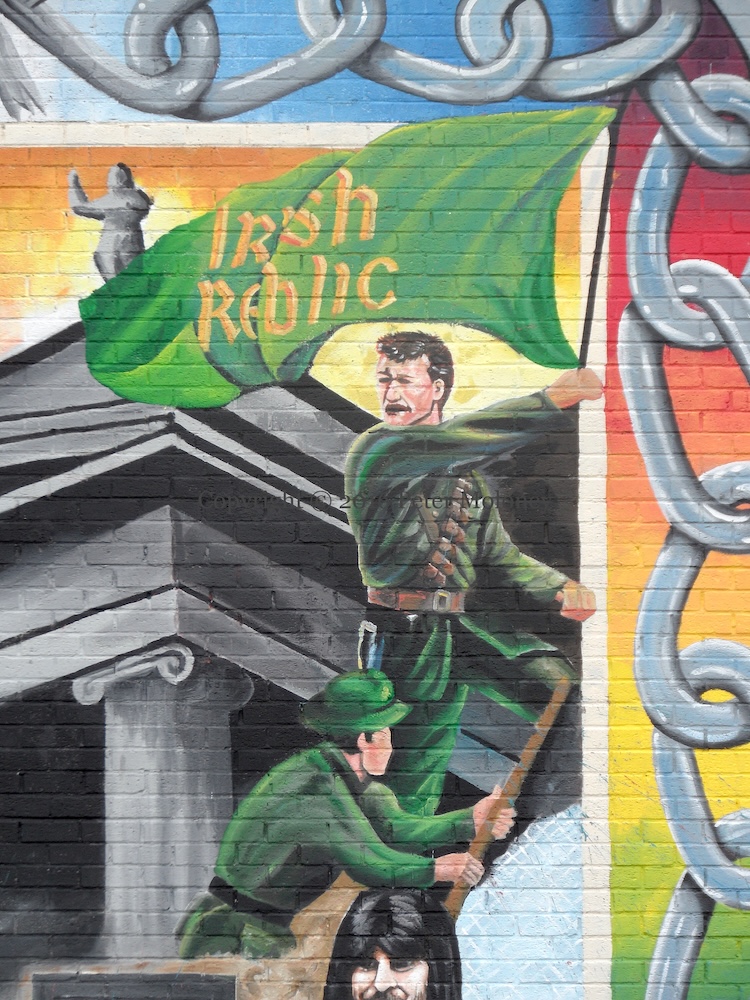
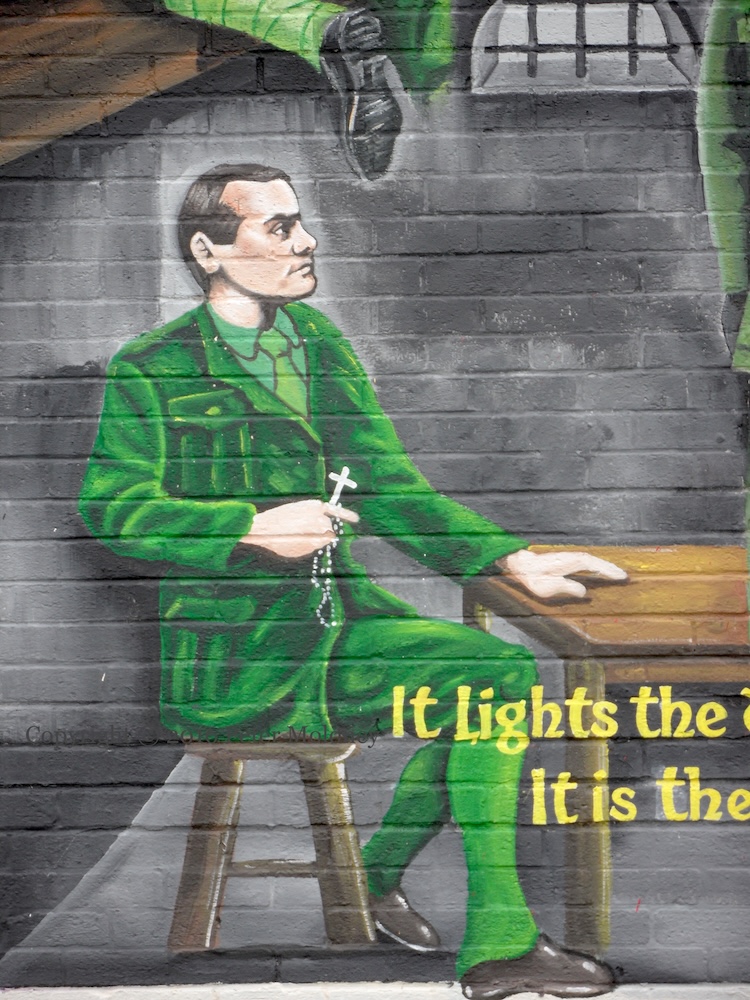
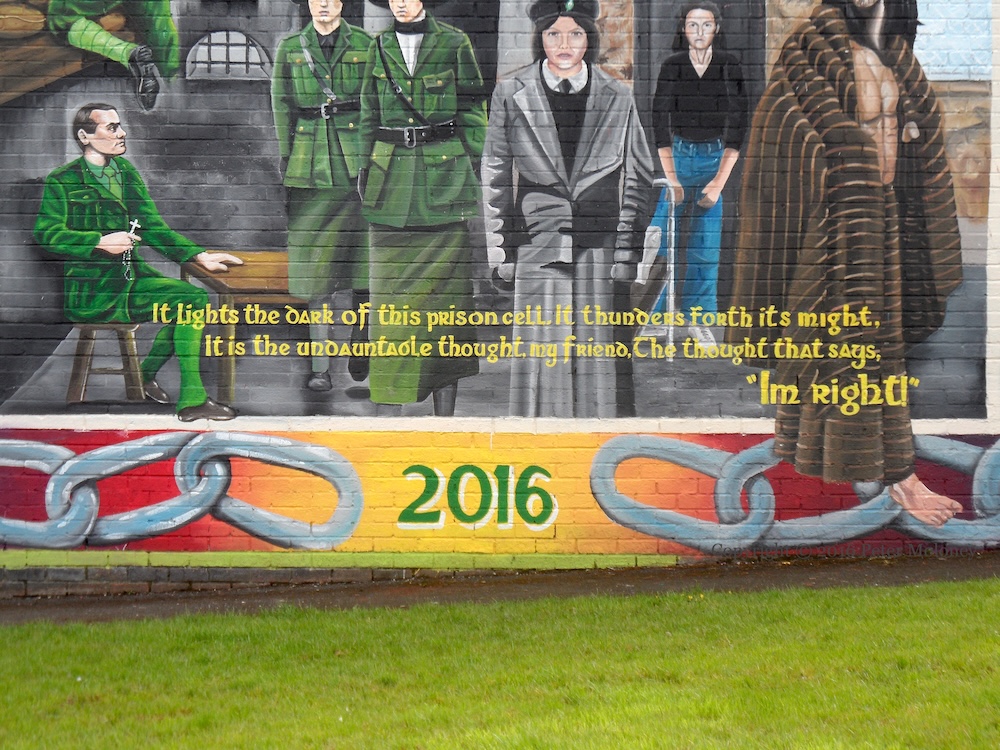
The large piece shows a succession of Irish rebels. It begins (top left) with the rebellion of 1798 and then to the Easter Rising of 1916 at the GPO in Dublin. In the lower left, a pious Padraıg Pearse awaits his execution with rosary beads in hand. There are then shown female figures from Cumann Na mBán and the IRA (see previously: United Irishwomen and Cumann Na mBan Centenary), and then Maıréad Farrell in Armagh Women’s Prison. In the bottom right corner there is a blanketman. The busts of Bobby Sands and Joe McDonnell float above the GPO and the last verse of Sands’s The Rhythm Of Time form the epigraph: “It lights the dark of this prison cell, it thunders forth its might, it is the undauntable thought, my friend, the thought that says, “I’m right”.
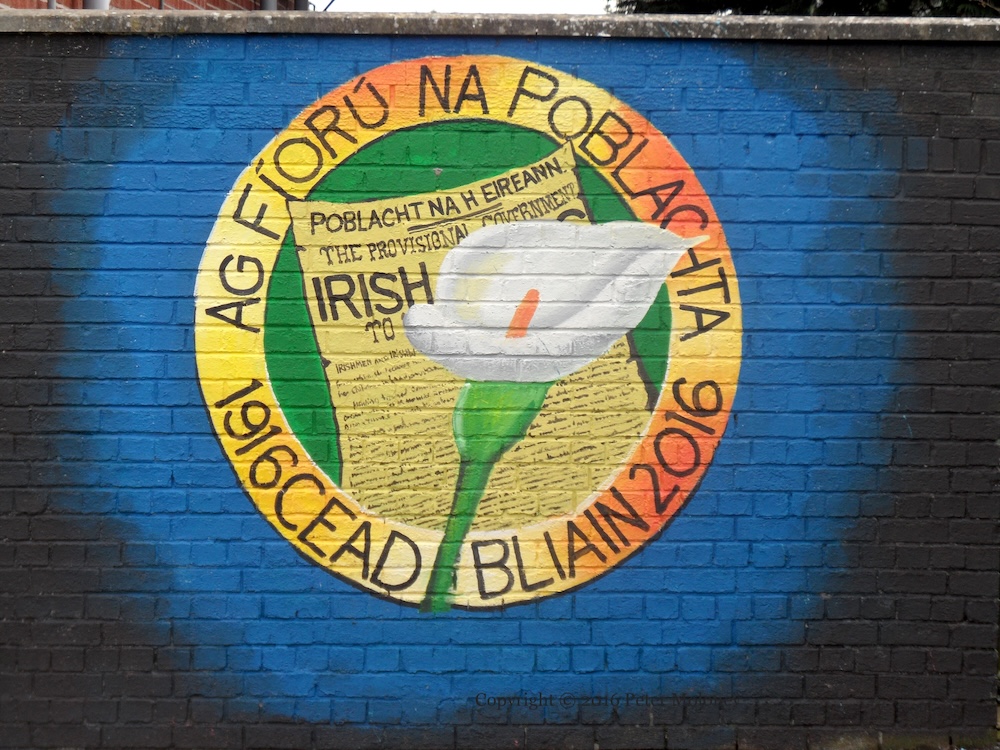
In the corner, “realising the Republic” celebrates the centenary (“Céad Blıaın 1916 – 2016”) of the Easter Rising and shows a copy of the proclamation of the republic and an Easter lily.
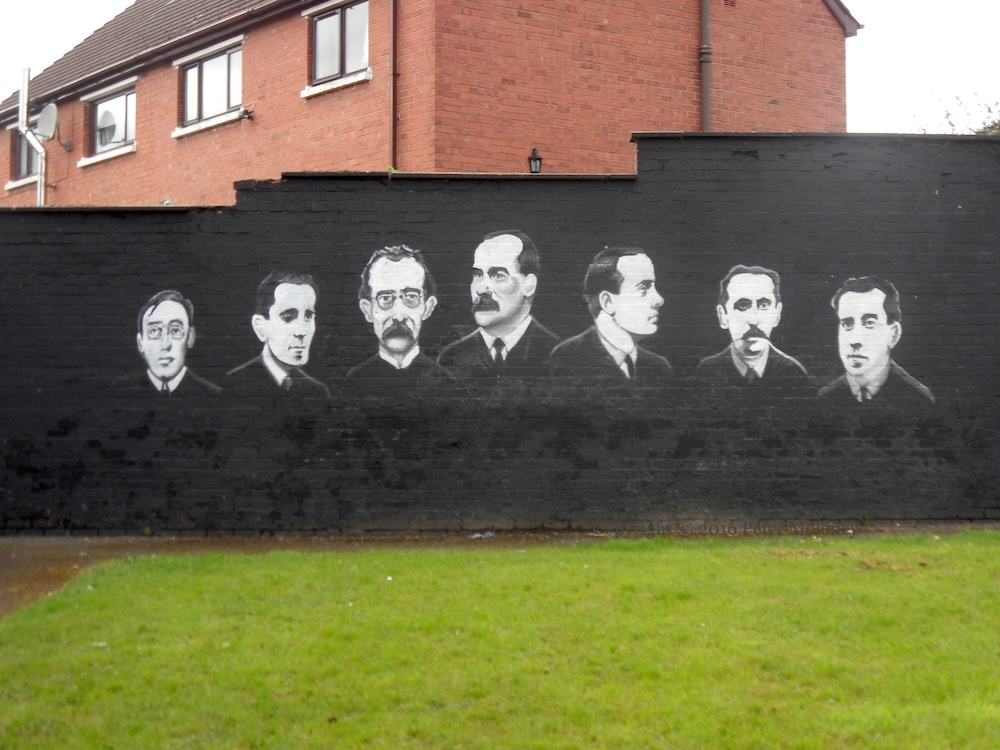
The third wall shows the seven signatories of the 1916 Proclamation of the provisional government of the Irish Republic. From left to right: Joseph Plunkett, Sean MacDiarmada, Thomas Clarke, James Connolly, Padraıg Pearse, Éamonn Ceannt, Thomas MacDonagh.
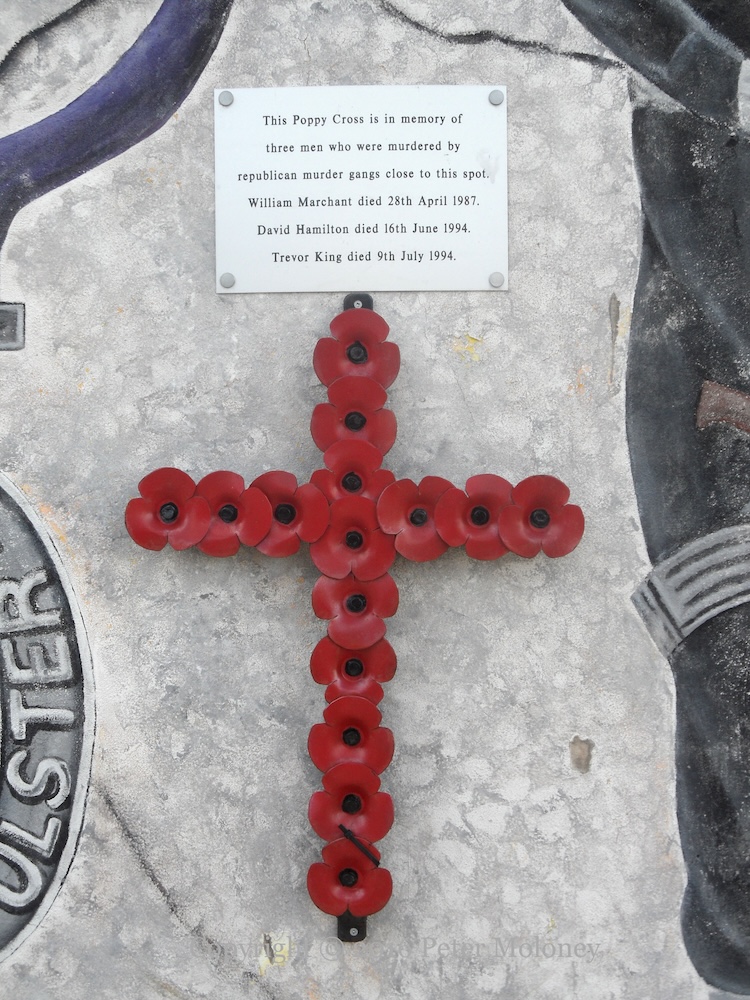
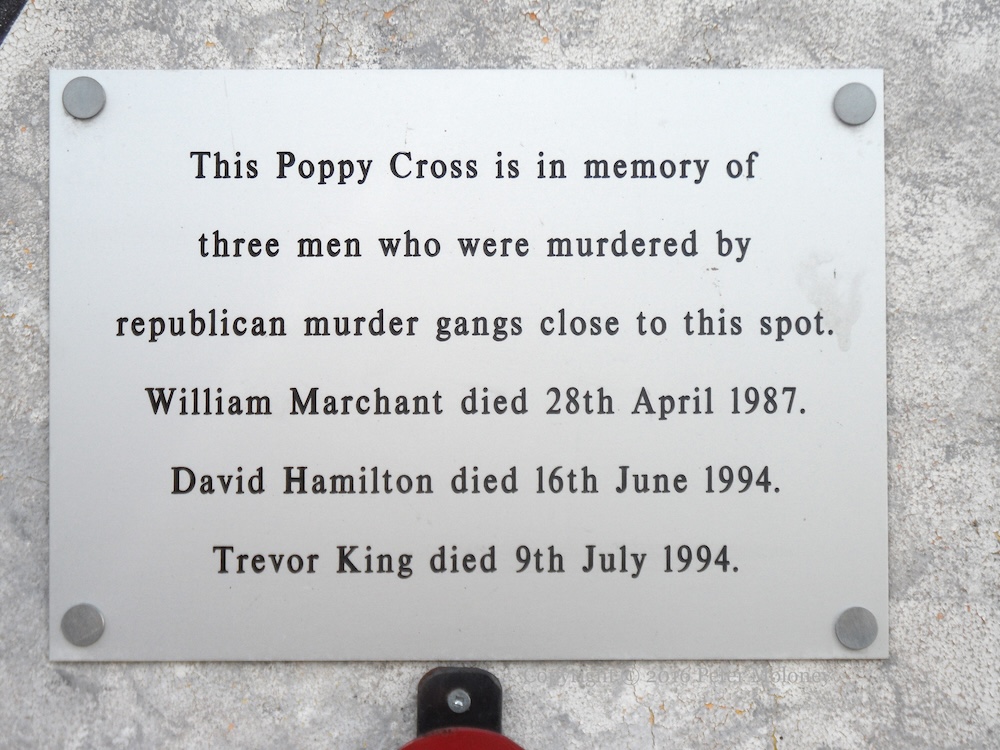
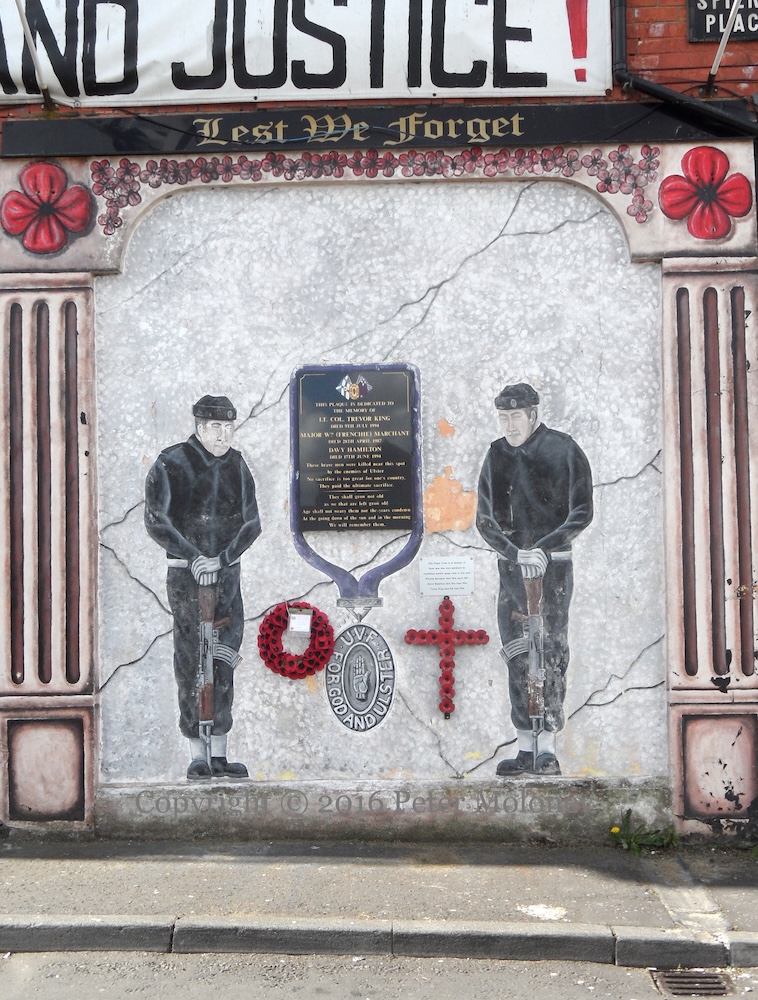
A poppy cross has been added to the UVF memorial mural and plaque at Spier’s Place. The accompanying plaque reads “This poppy cross is in memory of three men who were murdered by republican murder gangs close to this spot. William Marchant died 28th April 1987, David Hamilton died 16th June 1994, Trevor King died 9th July 1994.” For some background, see Ordinary People, Extraordinary Roles.
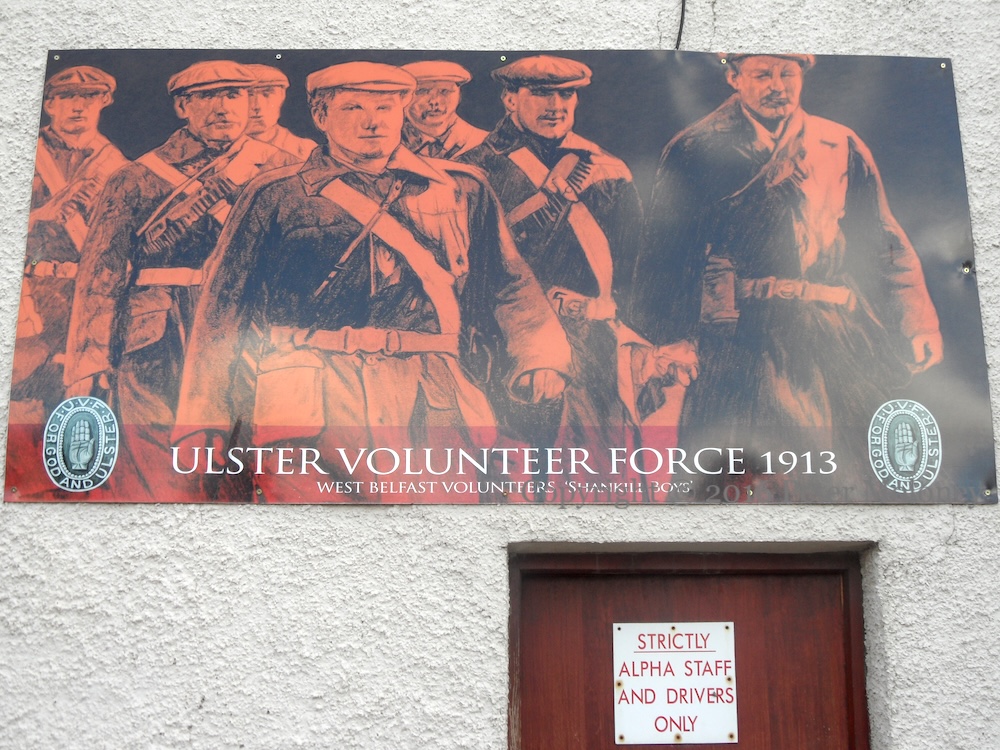
The “Shankill Boys” were the roughly 700 men of the West Belfast battalion of the Ulster Volunteers who were almost all killed at the Somme. (This board – or a previous copy of it – was previously in Carnan St.)
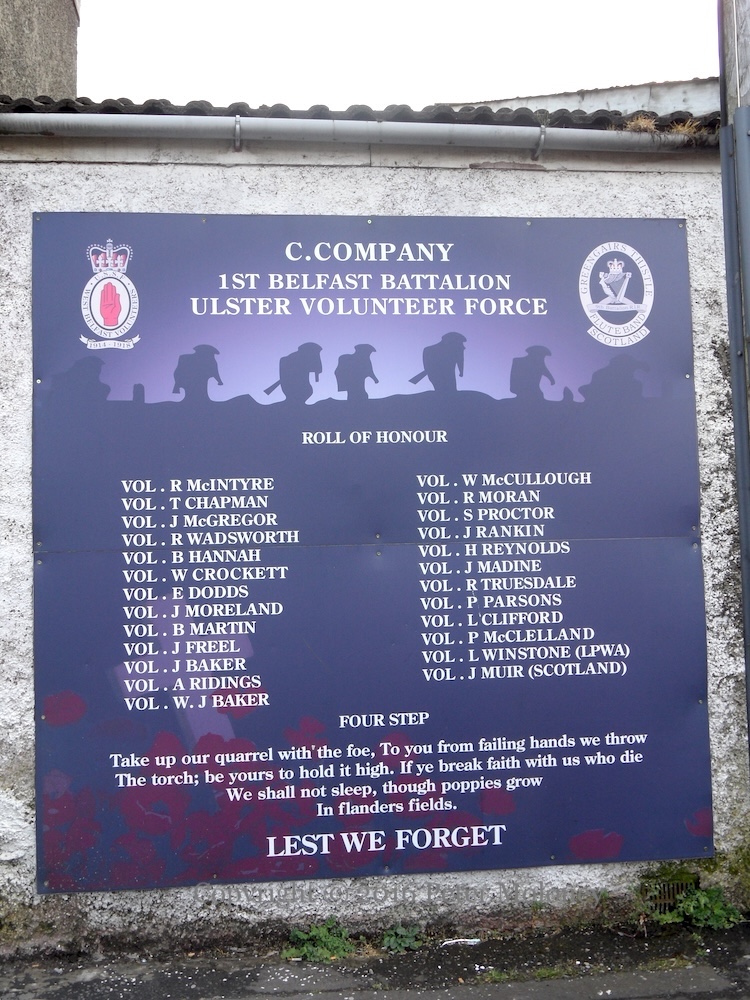
As with all of the Belfast battalions, West Belfast had a “USSF” [Ulster Special Service Force] – its emblem is in the top left of the second board, below. (See previously USSF and Shankill Protestant Boys.) The other emblem is that of the ‘Greengairs Thistle Flute Band’. Although the background comes from WWI, the roll of honour lists modern-day volunteers from the UVF. Thomas Chapman, James McGregor, Robert McIntyre, William Hannah, and Robert Wadsworth are portrayed in Carnan Street – see C. Coy Street. The modern-day C Company, formed in 1974, is named after the Four Step Inn, which was bombed in September 1971 (see Four Step).
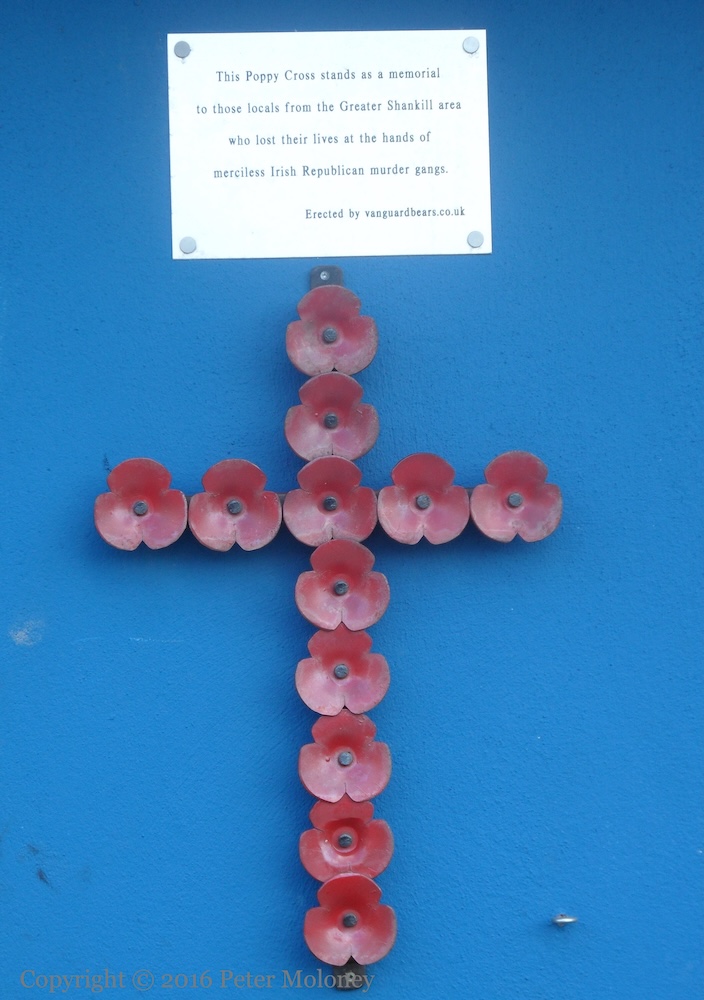
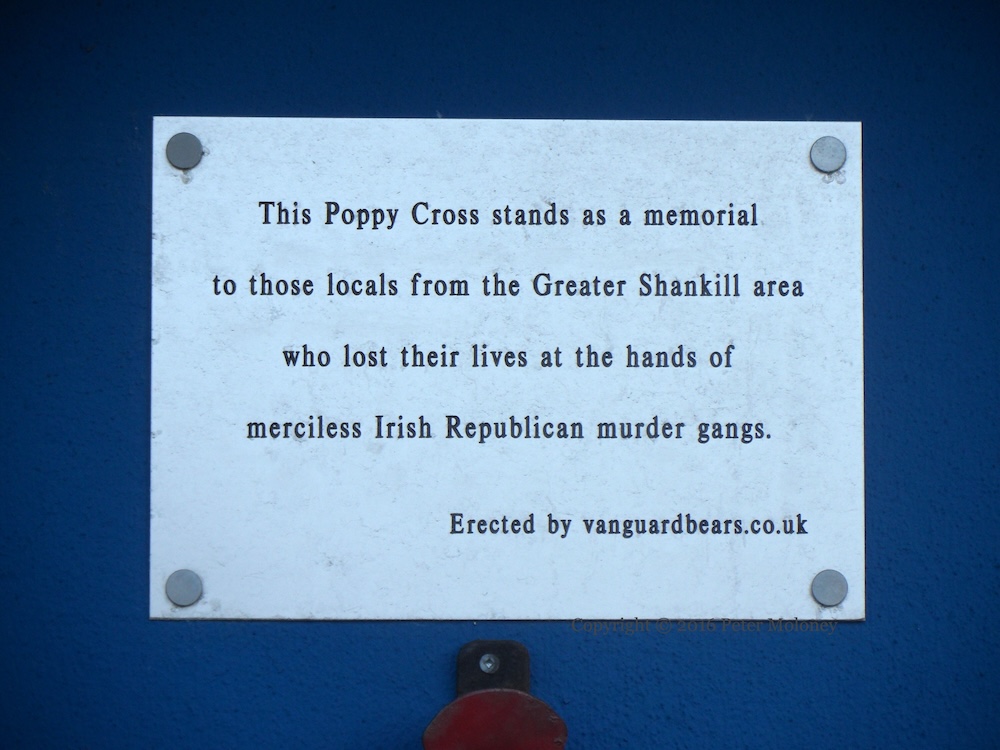
“This poppy cross stands as a memorial to those locals from the Greater Shankill area who lost their lives at the hands of merciless Irish republican murder gangs. Erected by vanguardbears.co.uk” For a mural commemorating bombings on the Shankill, see Shankill Atrocities.
This cross has been mounted on the corner of Sugarfield Street and the Shankill Road, adjacent to the Vanguard Bears board.
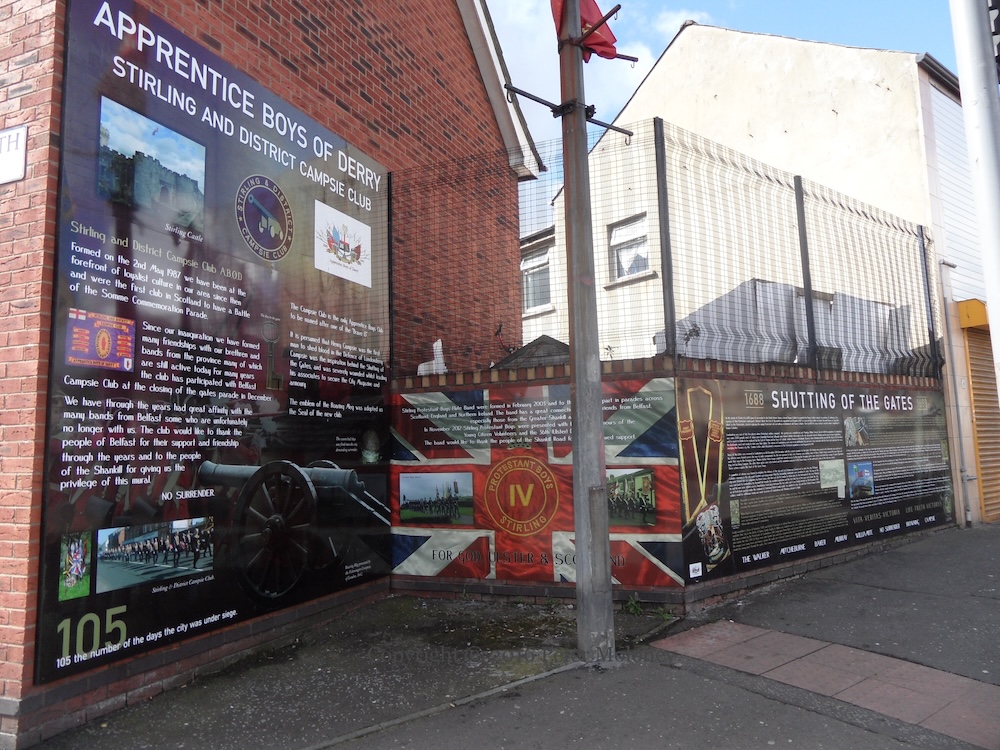
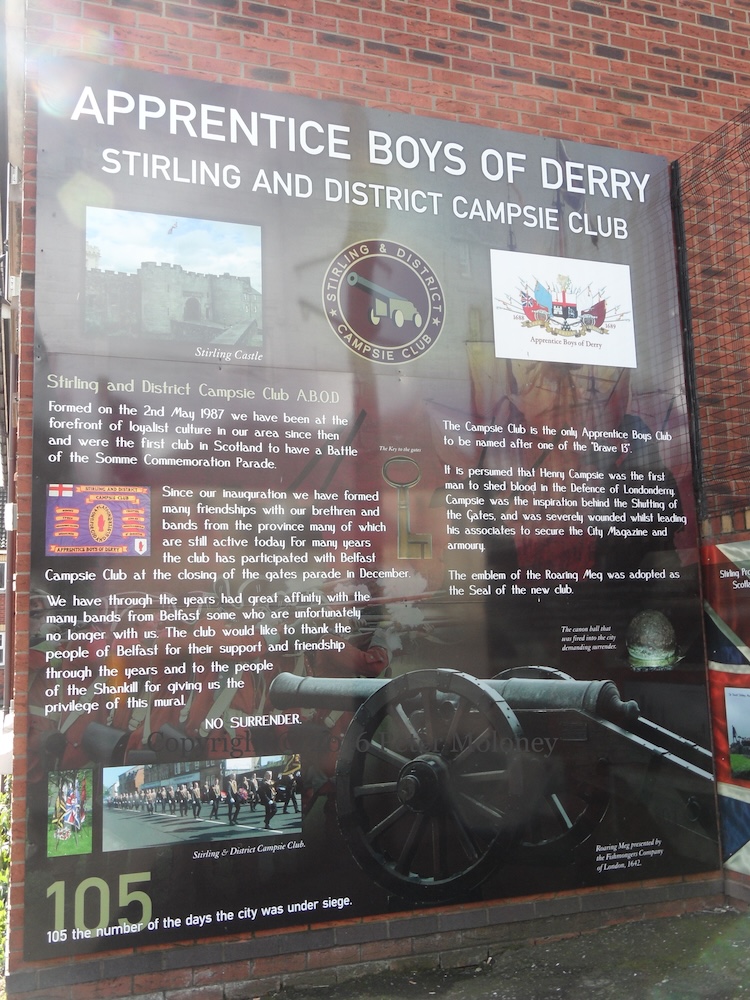
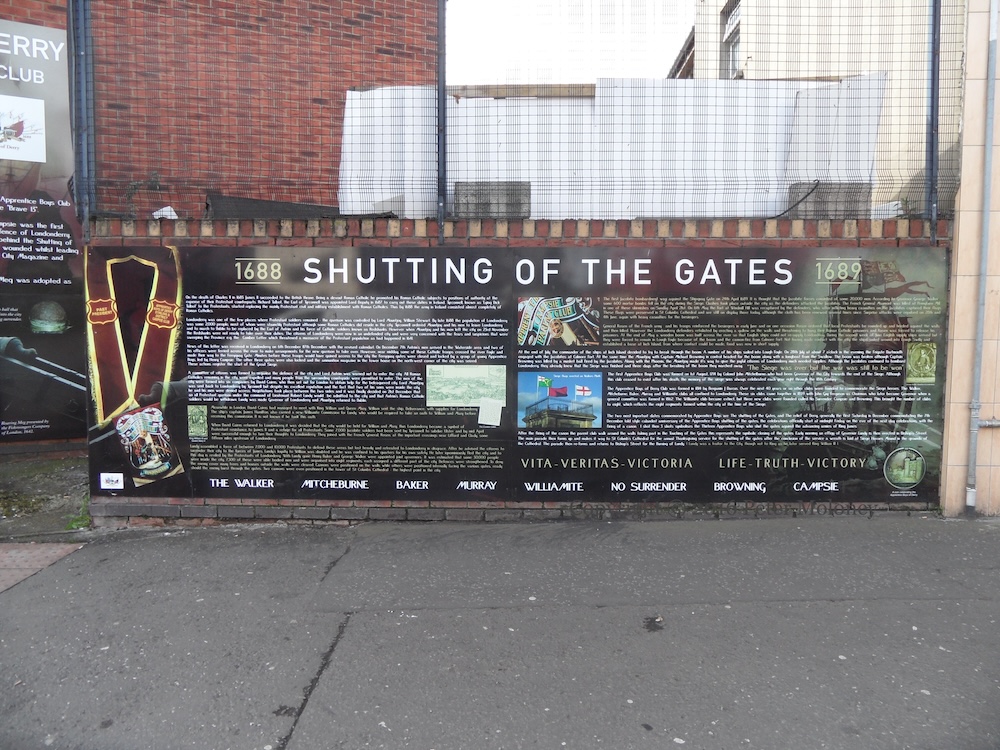
The first panel features the cannon “Roaring Meg” (“presented by the Fishmongers Company of London 1642″) which is used as the seal for the club, and includes the club’s flag, the key to the gates, and the emblem and coat of arms of the Apprentice Boys.
“Formed on the 2nd May 1987 we have been at the forefront of loyalist culture in our area since then and were the first club in Scotland to have a Battle of the Somme Commemoration Parade. Since our inauguration we have formed many friendships with our brethren and bands from the province many of which are still active today. For many years the club has participated with Belfast Campsie Club at the closing of the gates parade in December. We have through the years had great affinity with the many bands from Belfast some who are unfortunately no longer with us. The club would like to thank the people of Belfast for their support and friendship through the years and to the people of the Shankill for giving us the privilege of this murals. / No surrender. / The Campsie Club is the only Apprentice Boys Club to be named after one of the “Brave 13″. It is persumed [presumed] that Henry Campsie was the first man to shed blood in the Defence of Londonderry. Campsie was the inspiration behind the Shutting of the Gates and was severely wounded whilst leading his associates to secure the City Magazine and armoury. The emblem of the Roaring Meg was adopted as the Seal of the new club.”
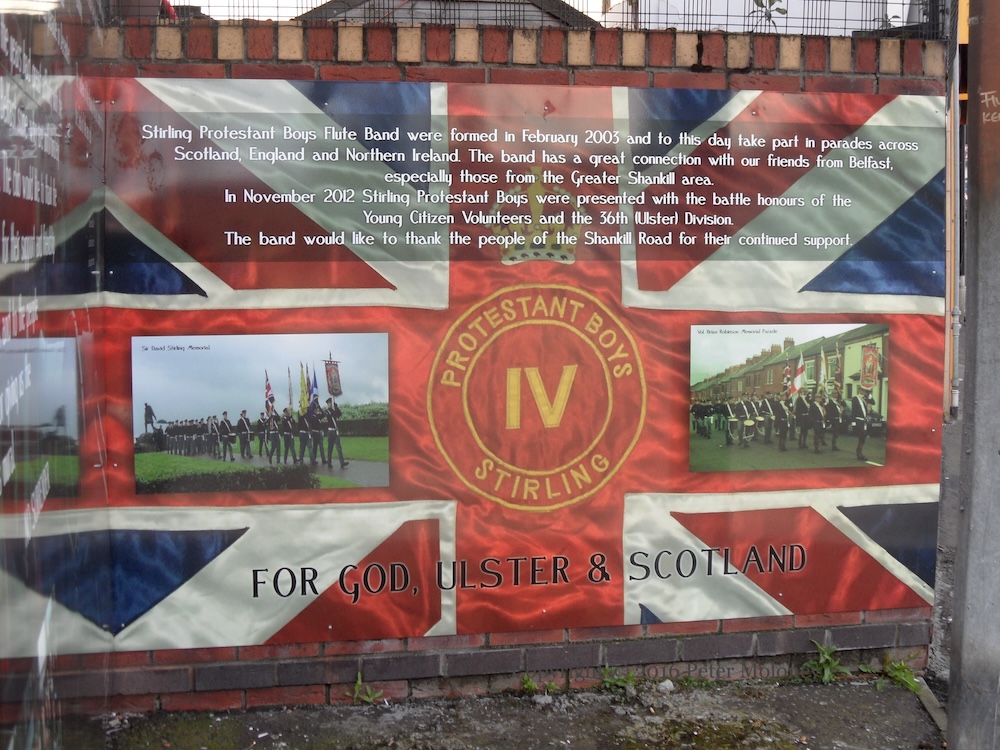
The middle panel celebrates the Stirling Protestant Boys Flute Band and its association with the Shankill Road: “Stirling Protestant Boys Flute Band [Fb] were formed in February 2003 and to this day take part in parades across Scotland, England and Northern Ireland. The band has a great connection with our friends from Belfast, especially those from the Greater Shankill area. In November 2012 Stirling Protestant Boys were presented with the battle honours of the Young Citizen Volunteers and the 36th (Ulster) Division. The band would like to thank the people of the Shankill Road for their continued support.”
The third contains a long description of the Shutting Of The Gates in December 1688 and the Siege Of Derry, which was ended with the breaking of the boom across the river Foyle in July 1689.
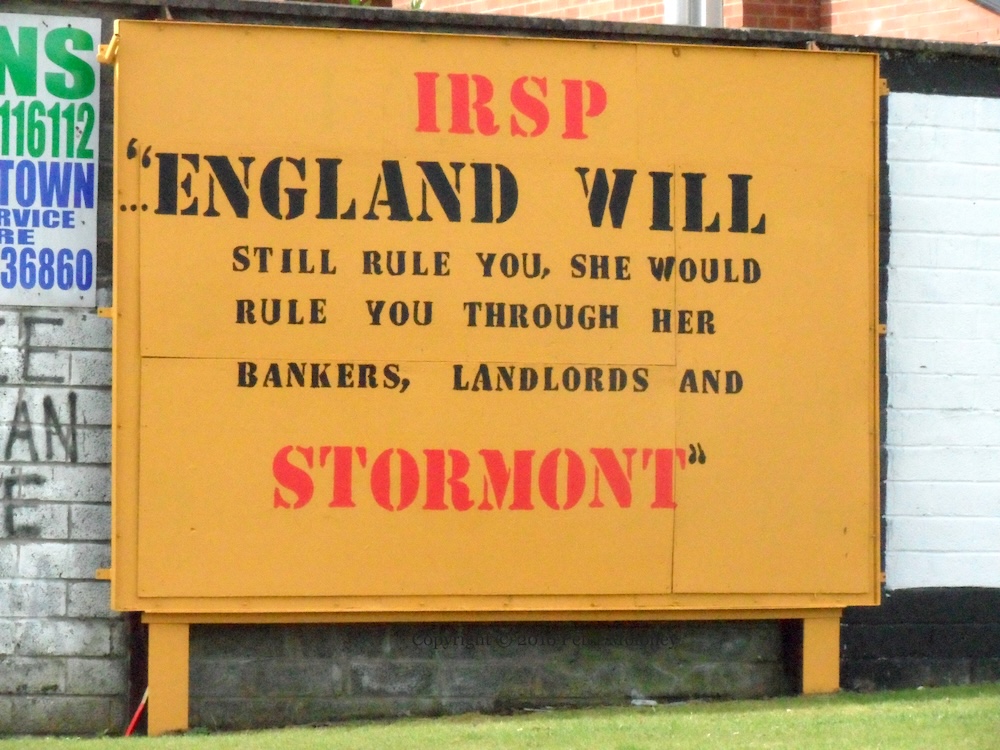
A line from James Connolly’s 1897 piece “Socialism And Nationalism” is adapted by the IRSP for the current post-partition situation: “England will still rule you, she would rule you through her bankers, landlords and Stormont”.
Connolly’s original thought is that – even in a self-governing republic – nationalism is not enough to establish an authentically Irish state: “If you remove the English army tomorrow and hoist the green flag over Dublin Castle, unless you set about the organization of the Socialist Republic your efforts would be in vain. England would still rule you. She would rule you through her capitalists, through her landlords, through her financiers, through the whole array of commercial and individualist institutions she has planted in this country and watered with the tears of our mothers and the blood of our martyrs.”
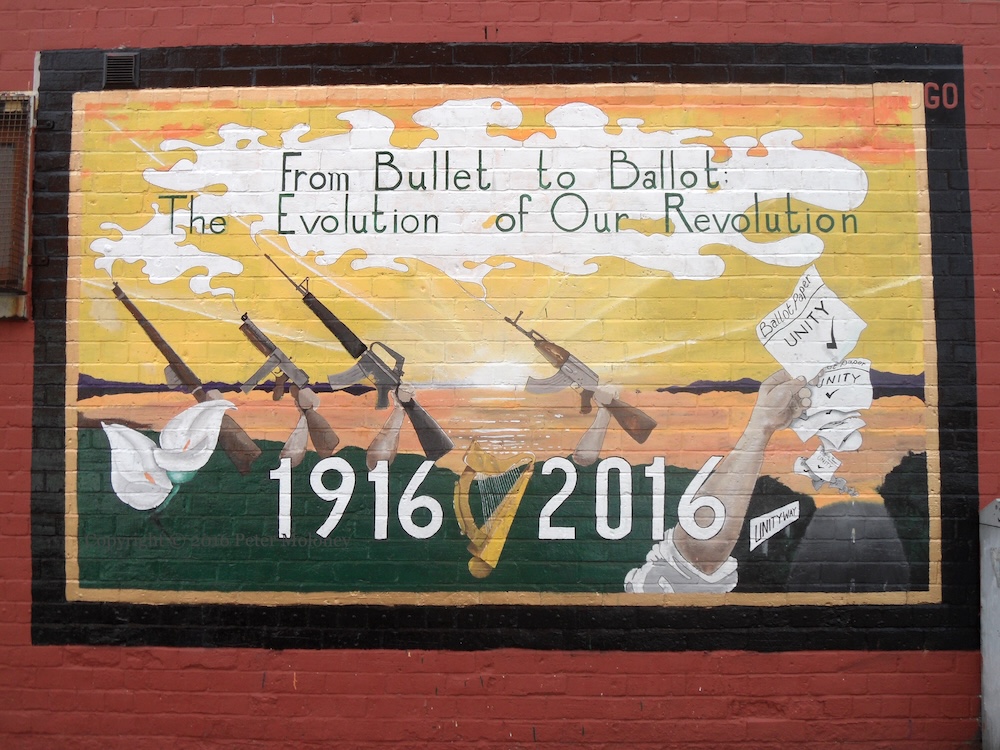
A history of nationalism/republicanism from left to right: a pair of Easter lilies, four generations of rifles, and then a switch to a ballot paper with a check in favour of “unity” and a road named “Unity Way”: “From bullet to ballot: the evolution of our revolution. 1916 – 2016”
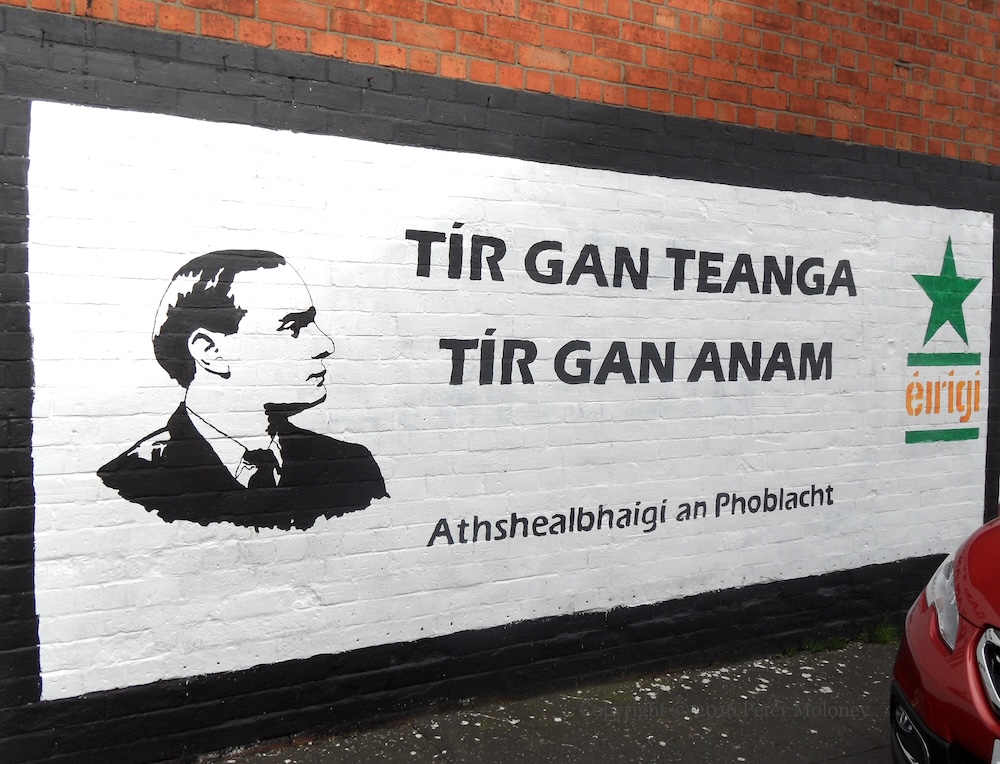
The mural was painted by Con on the north side of Hugo Street – the south side remains exclusively éırígí.