
The memorial gallery on the right-hand side of Ardilea Close has been expanded from three panels to five (compared to last year/2013) and the first new face is “Charlie Wilson – age 66”.
Click image to enlarge
Copyright © 2014 Peter Moloney
M10896
The memorial gallery on the right-hand side of Ardilea Close has been expanded from three panels to five (compared to last year/2013) and the first new face is “Charlie Wilson – age 66”.
Click image to enlarge
Copyright © 2014 Peter Moloney
M10896
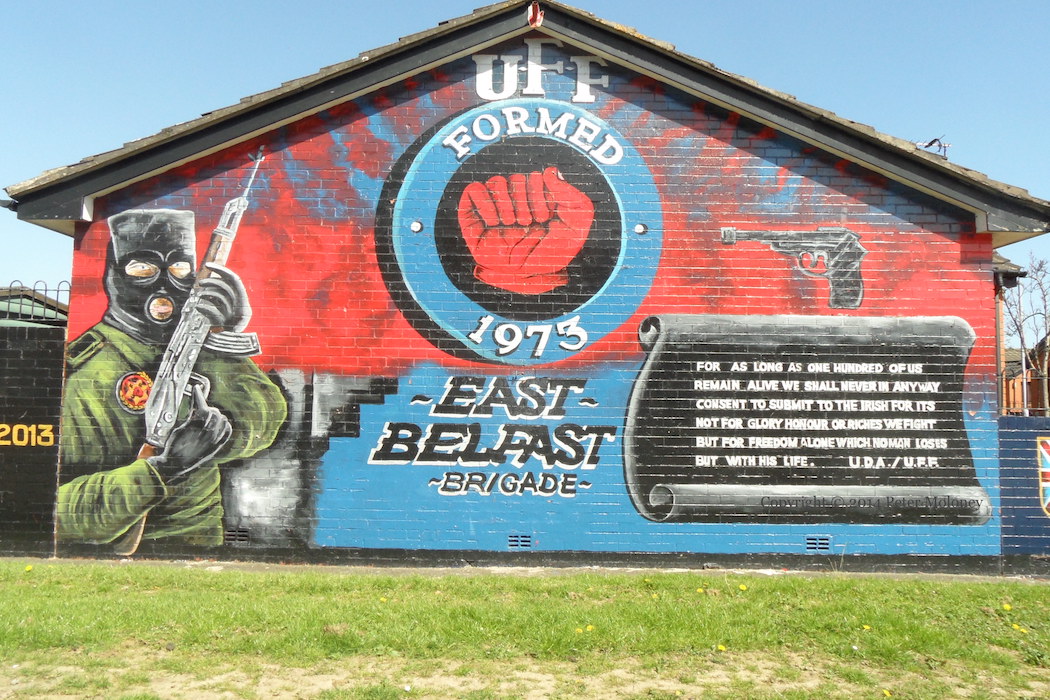
The UFF mural on the first gable of (so-called) Freedom Corner in east Belfast has been repainted many times since the first one took over – in 1991 – from a Gertrude Star mural (D00388). Repaints followed in roughly 2001, 2008, and 2011, now followed by the image shown above. The elements remain as before: a balaclava’d volunteer with assault rifle, the UFF emblem, a pistol, and a modified version of the Declaration of Arbroath: “For as long as one hundred of us remain alive we shall never in anyway consent to submit to the Irish [instead of “English”] for it’s not for glory, honour or riches we fight but for freedom alone which no man loses but with his life – U.D.A./U.F.F”
Click image to enlarge
Copyright © 2014 Peter Moloney
M10893


1ú Caṫlán Oırṫear Tıreoın Óglaıġ Na hÉıreann [more typically “Tír Eoghaın”; 1st battalion east Tyrone IRA]
“Beannaımıs spıorad do-ċlaoıte na laoċra atá ına luı ıns na huıgheanna seo.” [We bless the indomitable spirit of the heroes who are buried in these graves.] “do-ċlaoıte” appears to be a Connacht form of “do-ċloíte”, meaning “indomitable”, “indefatigable” (Focaıl Fholaıthe).
The volunteers named on the various stones are Patrick Kelly, Patrick Vincent, Kevin Murray, Patrick Quinn, Patrick Carty, Seán Loughan, Patrick McDonald.
Kelly was killed in the Loughgall ambush – see the Loch gCál/Loughgall tribute mural in west Belfast (also a smaller mural in north Belfast).
Vincent was the driver of the lorry in the Clonoe Ambush.
Murray and McDonald were “killed in action” in 1974 (Fb).
Quinn was “killed in action” in 1973, along with Daniel McAnallen (Fb).
Loughan and Carty were “killed in action”, along with Dermot Crowley, in June 1973 (An Phoblacht).
The flat stone with the phoenix reads: “Romantic Ireland never dies!/O’Leary lies in fertile ground./And songs and spears throughout the years/Rise up where patriot graves are found.”
St Malachy’s churchyard, Coalisland Road, Edendork.
Click image to enlarge
Copyright © 2014 Peter Moloney
M10874 [M10875] [M10876] [M10877] [M10878] M10879 M10880 [M10881] [M10882] [M10883] [M10884] [M10885] [M10886] [M10887]
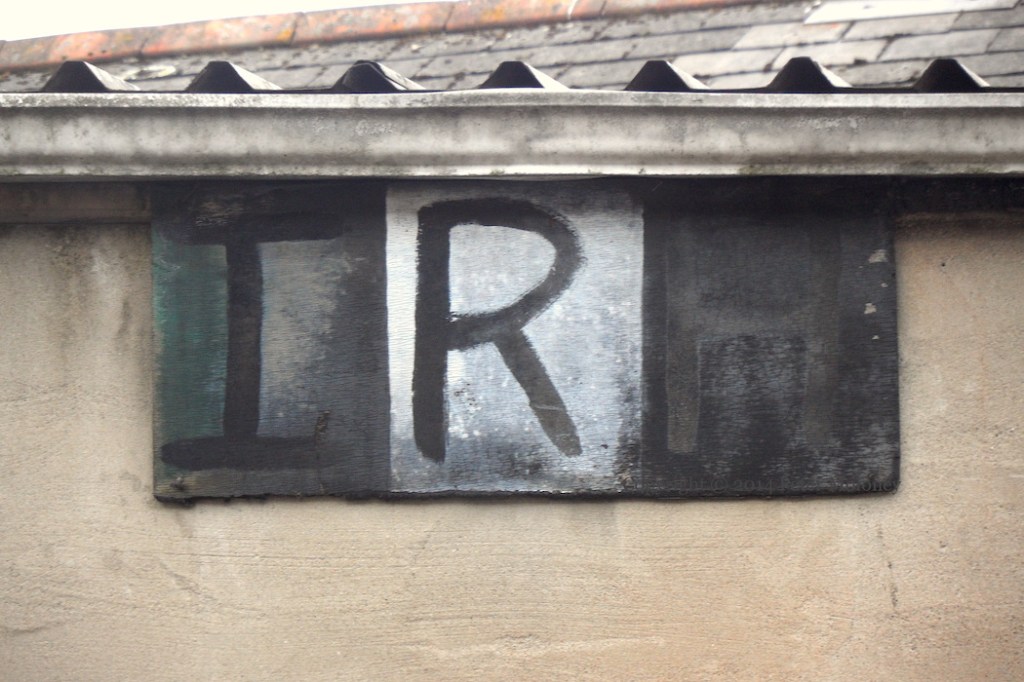
A faded “IRA” board hangs on in the Main Street of Coalisland (at the back of the Canal End bar), perhaps of the same vintage as this PIRA gunman and these PIRA rifles.
Click image to enlarge
Copyright © 2014 Peter Moloney
M10873

“Republican socialist movement – IRSP-INLA Easter 1916 commemoration. Assemble: 11 AM, Dunville Park, Easter Sunday.”
This stencilled board is on the railings outside the IRSP offices, Costello House, on the Falls Road, west Belfast.
Click image to enlarge
Copyright © 2014 Peter Moloney
M10852
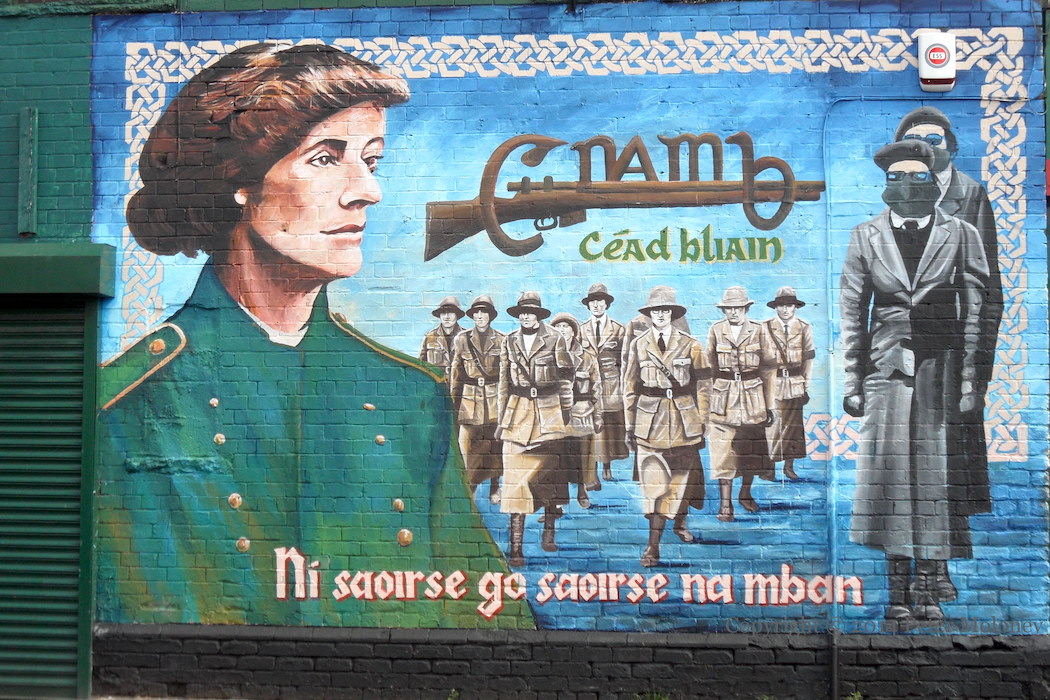
Cumann Na mBan was founded on April 2nd, 1914, and it is being commemorated in various ways, including a mural on Ascaıll Ard na bhFeá/Beechmount Avenue.
Cumann Na mBan was the women’s division of the Irish Volunteers and is best remembered for its role in the Easter Rising of 1916. Its members were involved in the occupation of many locations. Some, including (non-combatant) Winifred Carney, were in the GPO, while Countess Markievicz, the main figure of the mural, was in St. Stephen’s Green. (Here is an RTÉ gallery of vintage photographs, including one of Markievicz surrendering.)
The letters “Cnamb” on a rifle formed the badge of Cumann Na mBan. The Irish “Ní saoırse go saoırse na mban” means “[There is] No freedom until the freedom of women”.
Replaces the Fıanna Éıreann centenary, 1909-2009, in which Countess Markievicz was also featured.
Click image to enlarge
Copyright © 2014 Peter Moloney
M10854 [M10855] [M10856] [M10857] [M10858] [M10859]

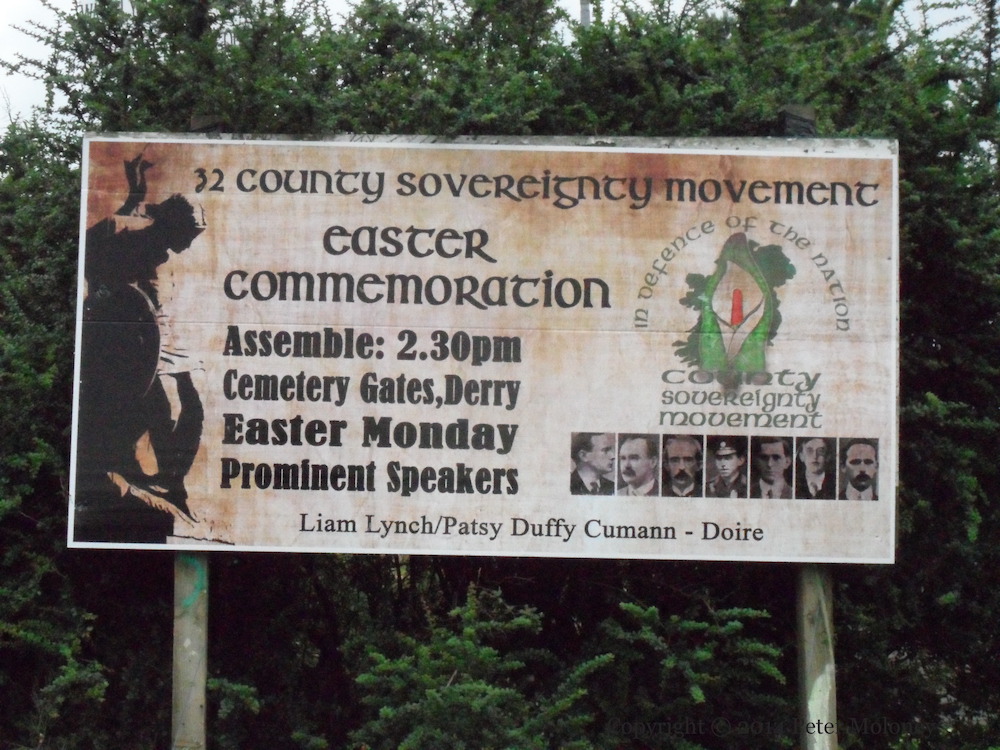
Top is a 1916 Societies board (in Rossville Street) announcing a commemoration for Richard Quigley on Easter Saturday; below is a 32 County Sovereignty Movement board (in Eastway) for an Easter Rising commemoration on Easter Monday.
Richie Quigley died on “active service” on April 21st, 1984 when he was hit by debris from a van-bomb that exploded prematurely (UPI). 2014 is the thirtieth anniversary of his death.
Click image to enlarge
Copyright © 2014 Peter Moloney
M10837 [M10837] [M10839] [M10840]
M10834

Above is a local interpretation of Robert Ballagh’s 1970 rendering of Goya’s The Third Of May 1808 in Glenfada Park, Derry/Doıre, site of four deaths on Bloody Sunday, 1972.
The original commemorates Spanish resistance to the forces of Napoleon (WP). For this Derry version, features from the city’s skyline – the Guildhall, St. Columb’s Cathedral, and an intact Governor Walker column – have replaced the original’s outline of Madrid, and an insignia of the Paras appears on the arm of a soldier.
For Ballagh’s original (“1970”) version and a description and video of the launch see bloodysundaymarch.org. Here is an Eamonn McCann lecture on the political history of the Goya painting. Until recently, the piece above was adjacent to a version of Picasso’s Guernica.
Click image to enlarge
Copyright © 2014 Peter Moloney
M10671


“IRA” has been added to the tricolour that used to read “Get off my island“, with “All touts shall be executed” below – Lone Moor Road.
The “Free all POWs” graffiti is in Tyrconnell Street, Derry.
Click image to enlarge
Copyright © 2014 Peter Moloney
M10835 M10836

“100 years of struggle” – Cumann Na mBan was formed in Dublin in April 1914 and celebrates its centenary in 2014.
The Countess Markievicz (pictured on the left) was a member of both Cumann Na mBan and the Irish Citizen Army.
The photograph on the right, of Troubles-era Cumann Na mBan (including Máıre Drumm on the right), can be seen at An Phoblacht.
The rear of Free Derry Corner has its own Visual History page.
See also: mural for 2014 International Women’s Day.
Click image to enlarge
Copyright © 2014 Peter Moloney
M10814 [M10815]
 Peter Moloney Collection