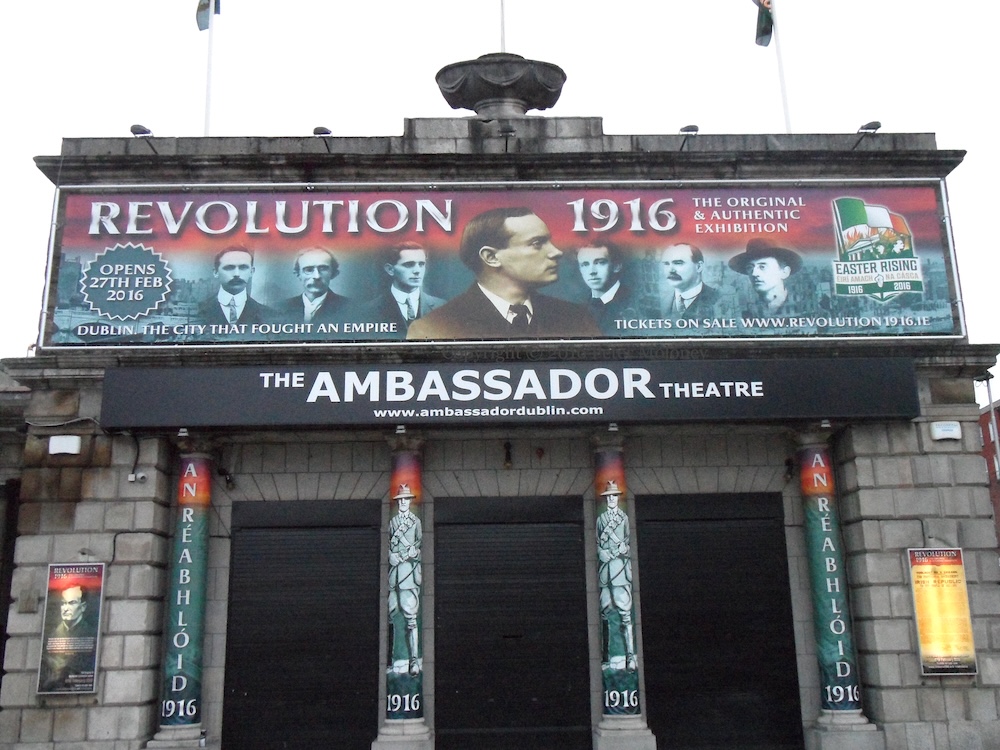
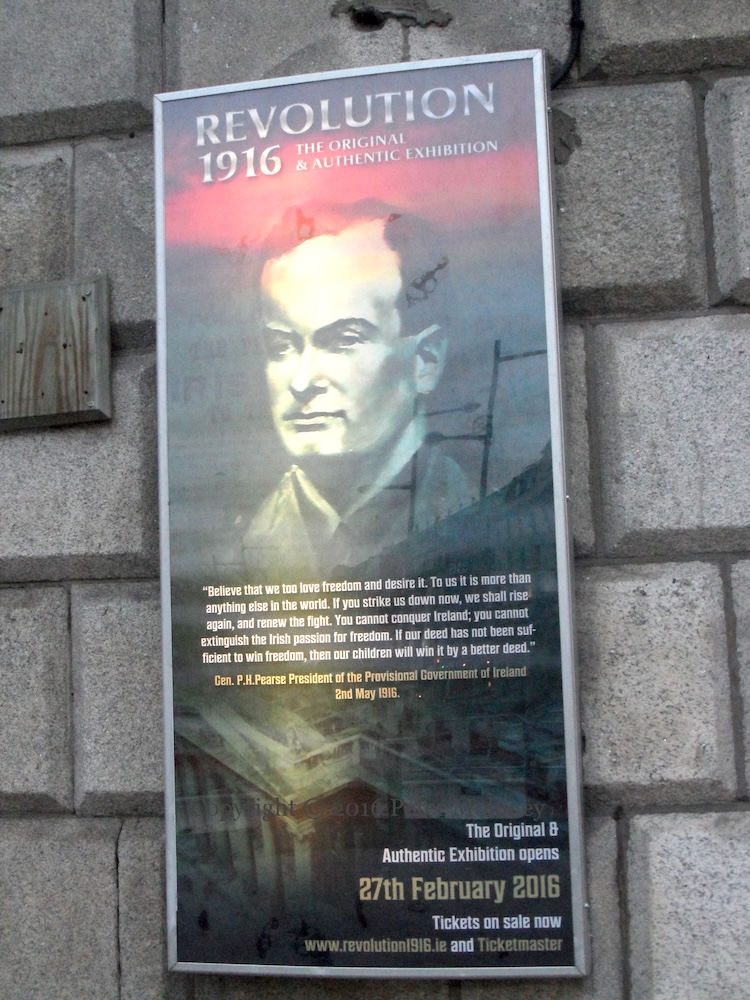
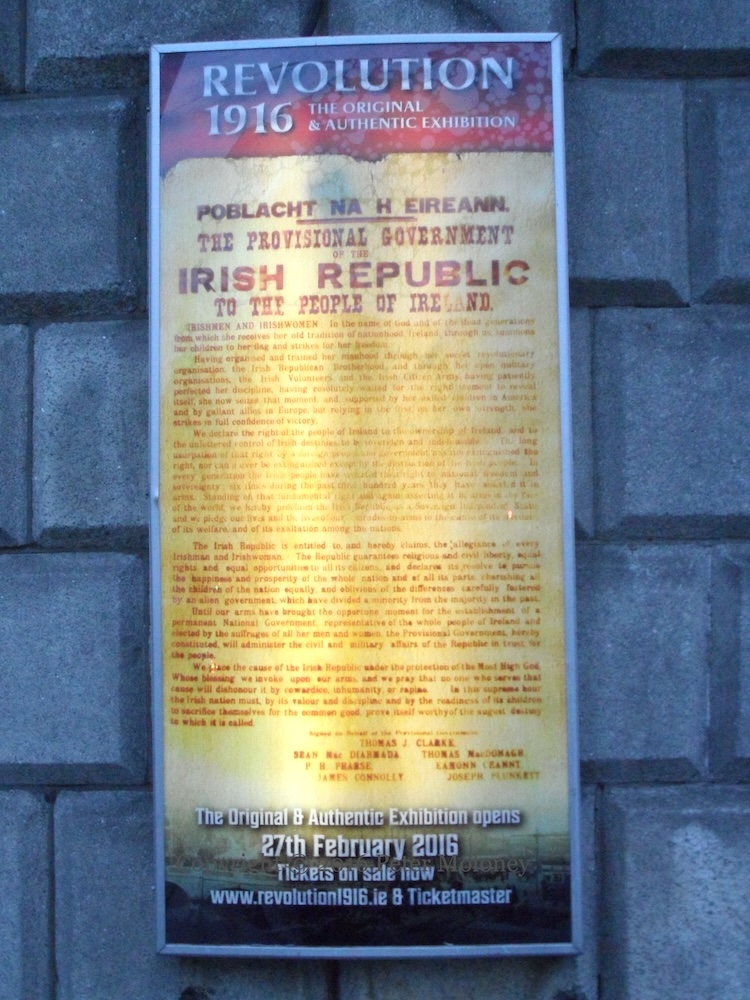
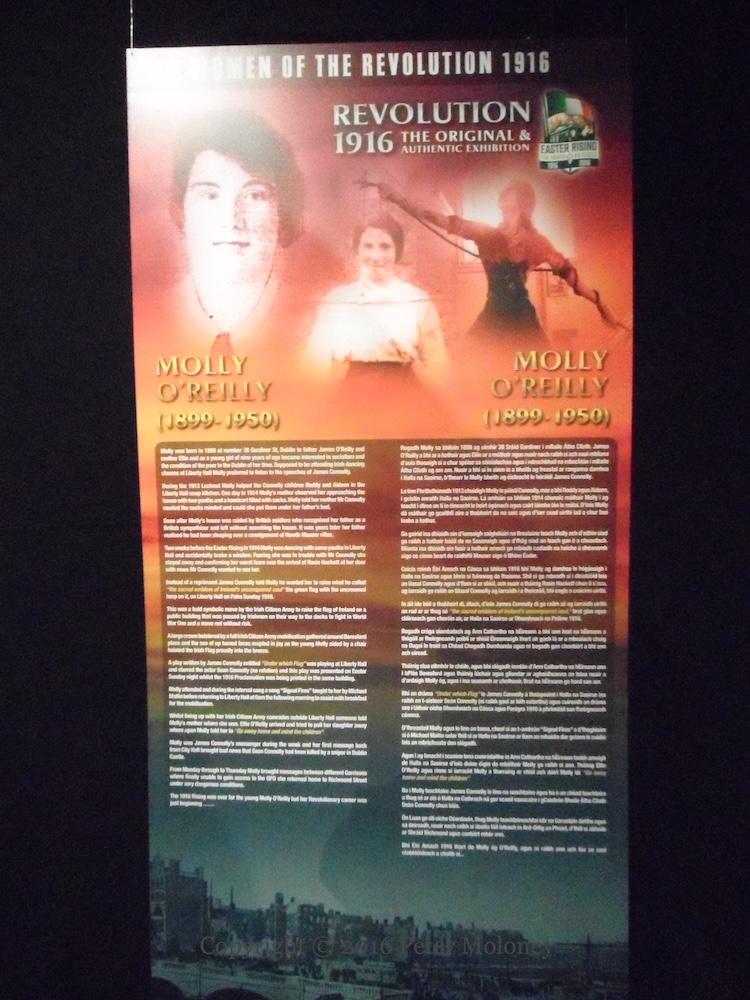
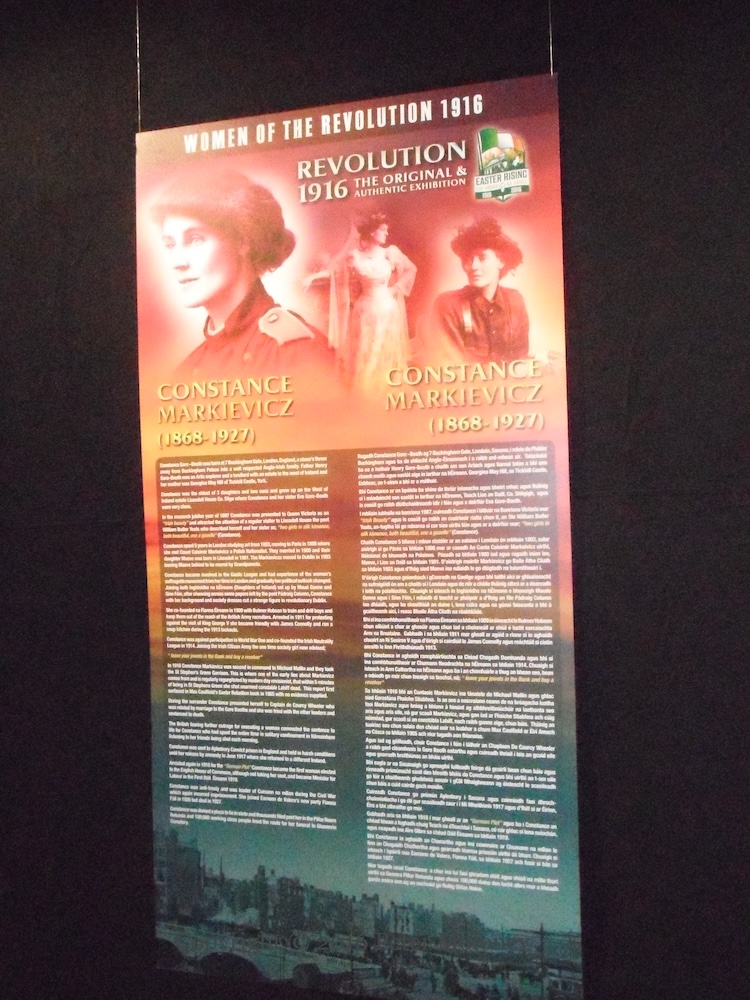
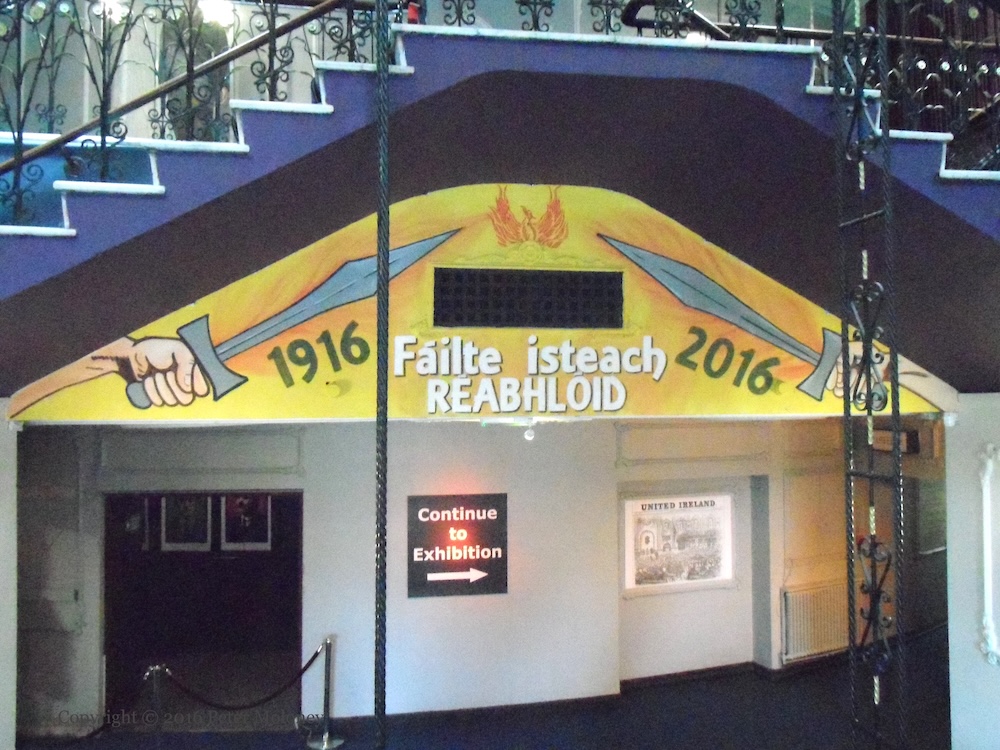
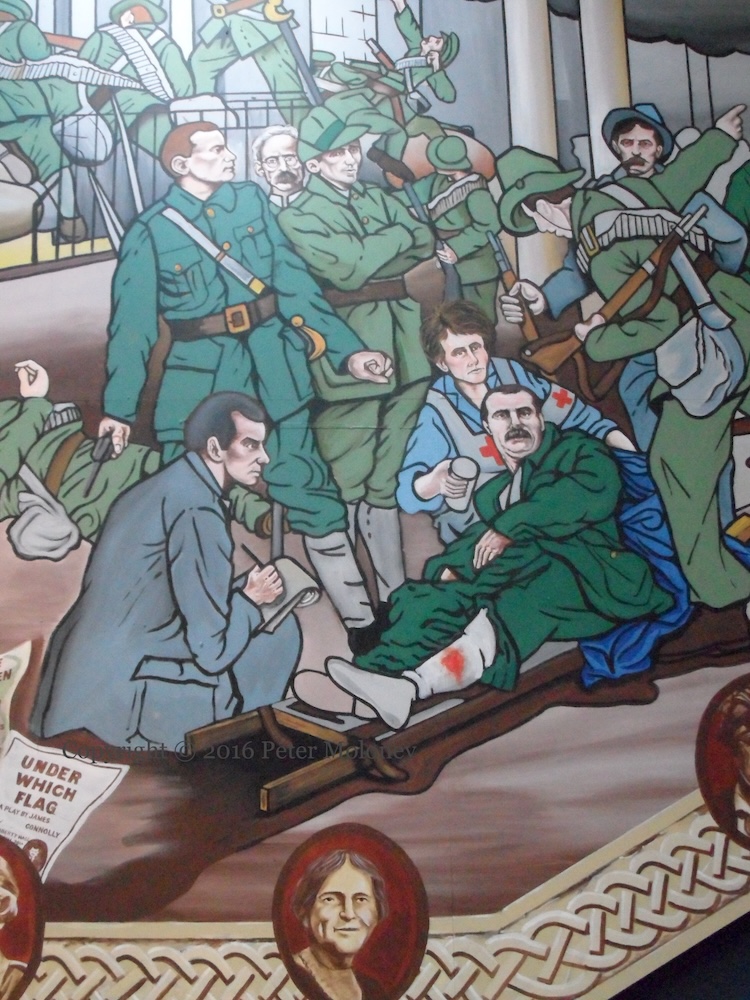
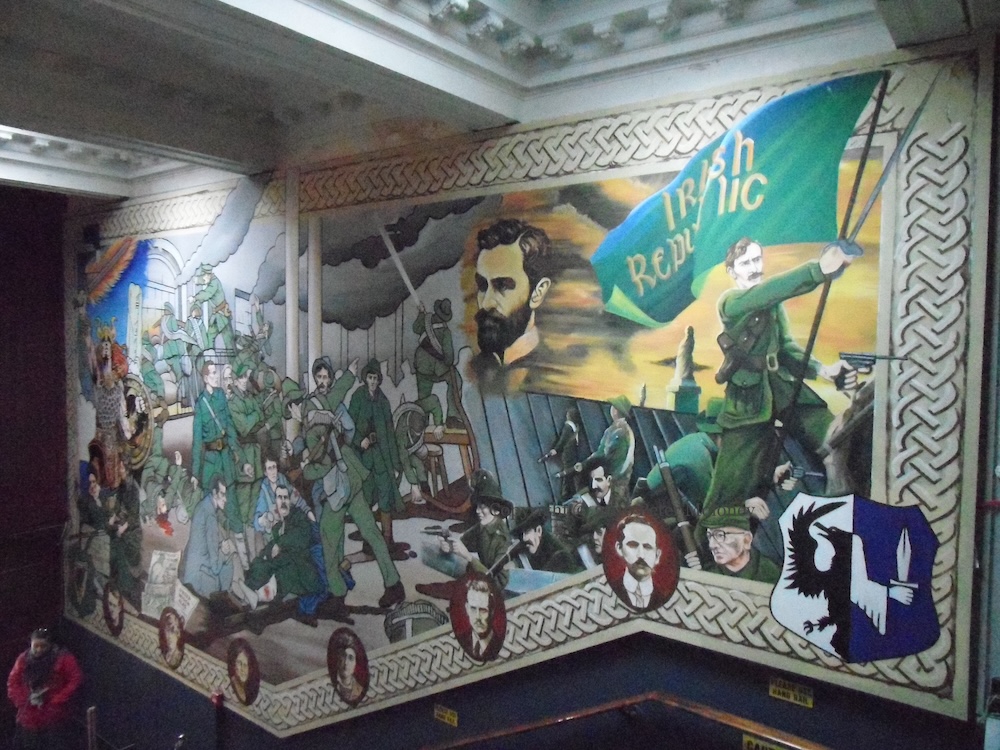
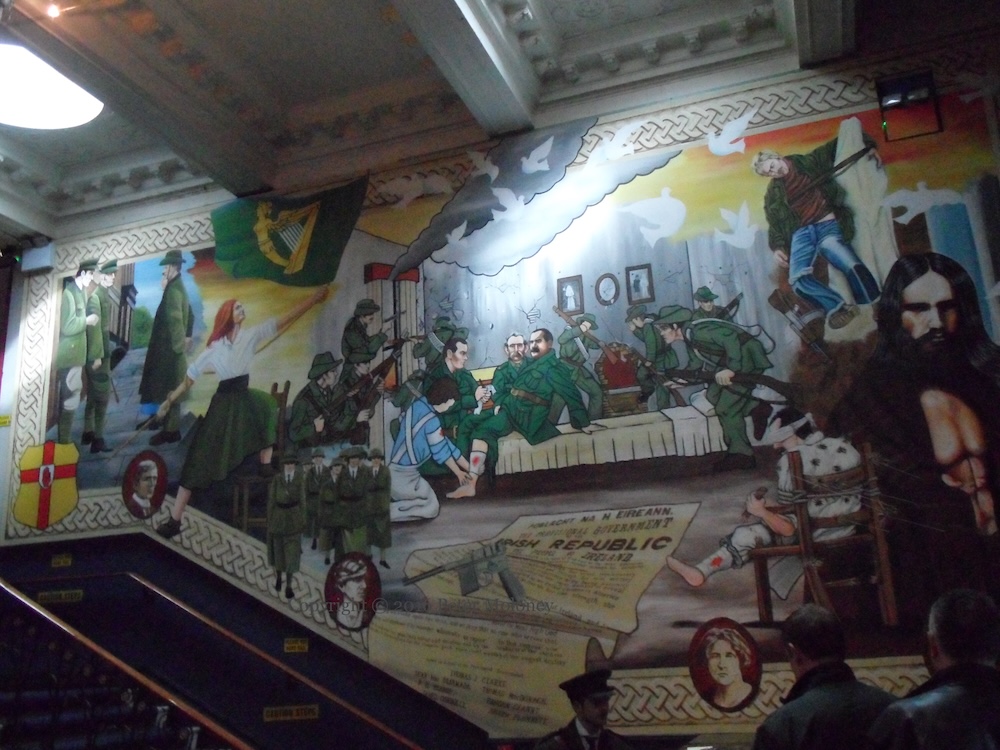
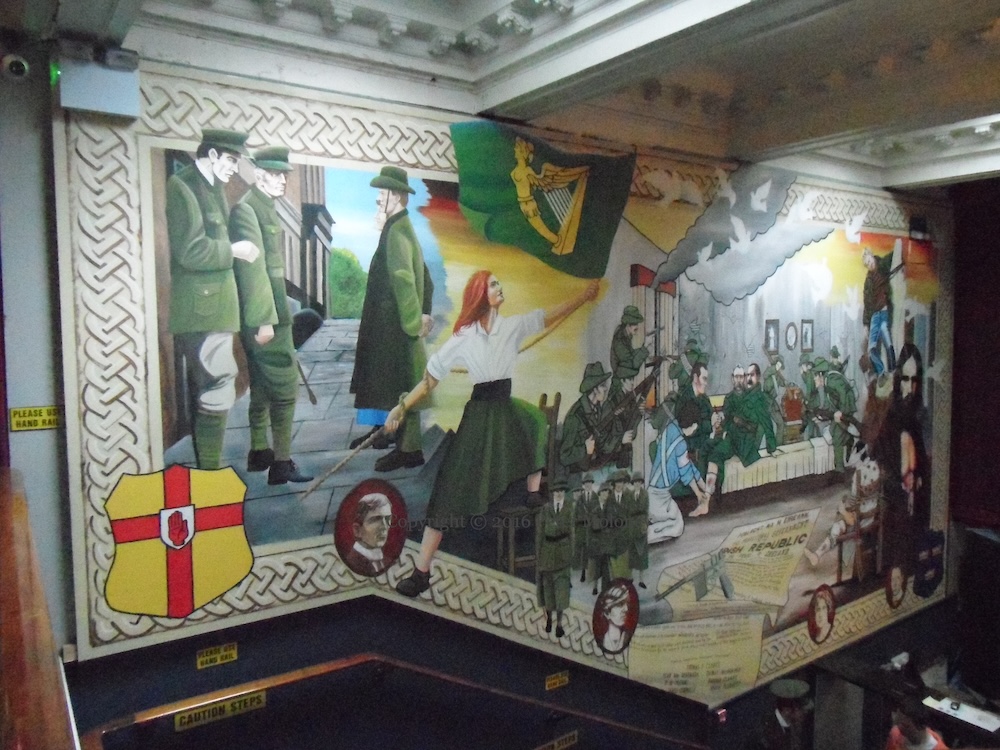
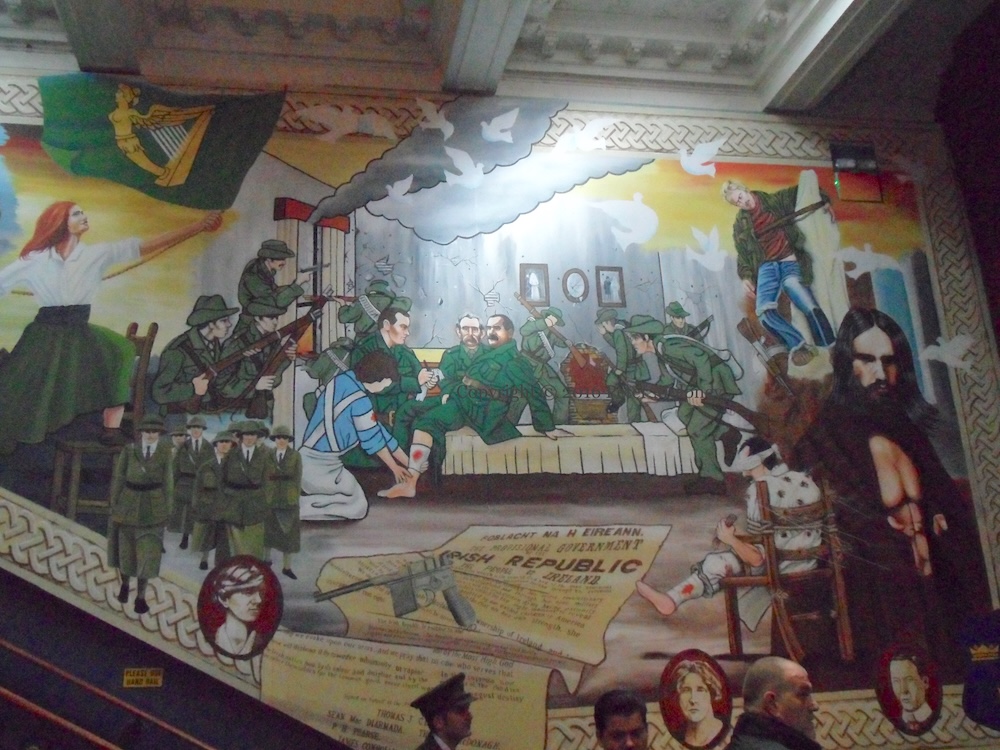
The ‘Revolution 1916’ exhibition commemorating the Easter Rising opened on February 27th at the Ambassador theatre in Dublin, “the city that fought an empire”. Images of some of the pieces on display can be seen in this An Phoblacht article.
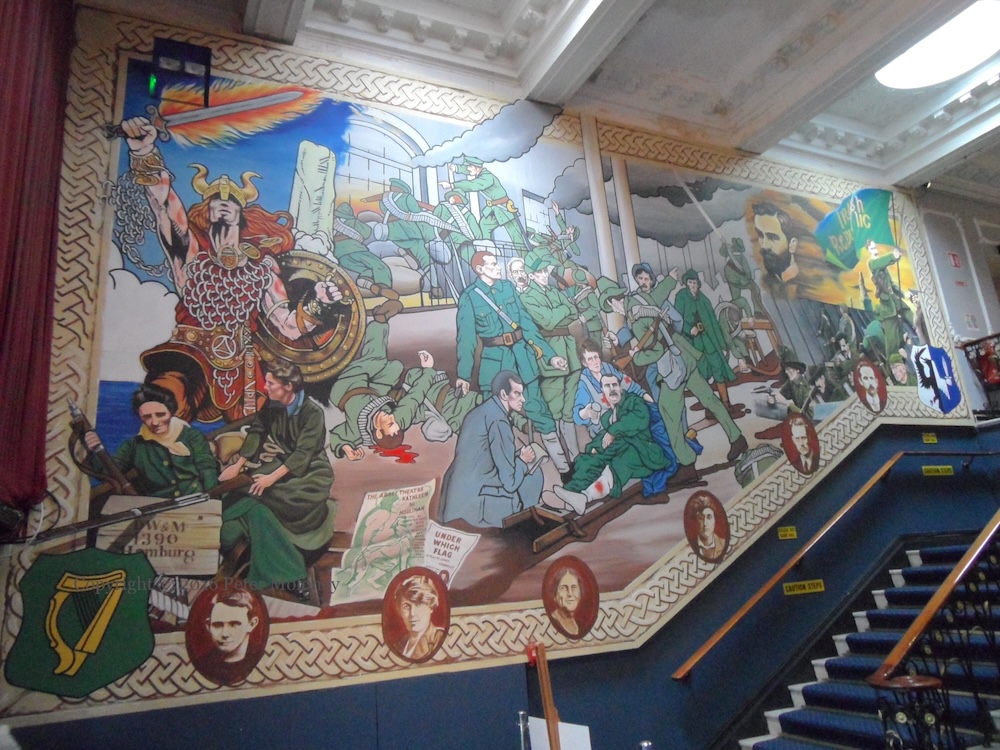
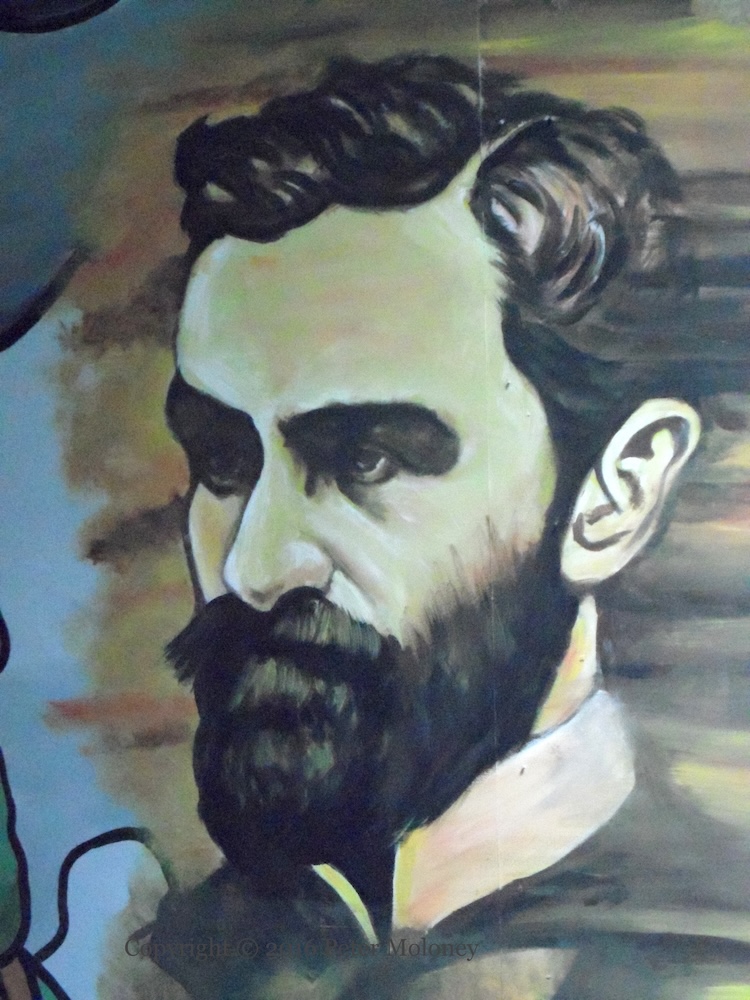
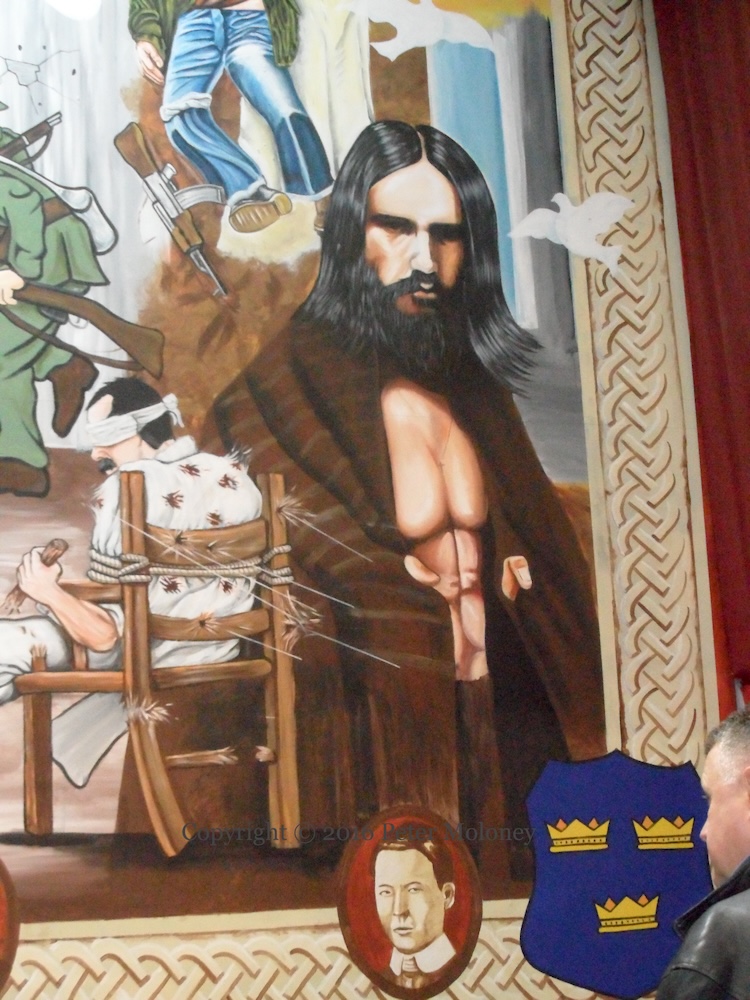
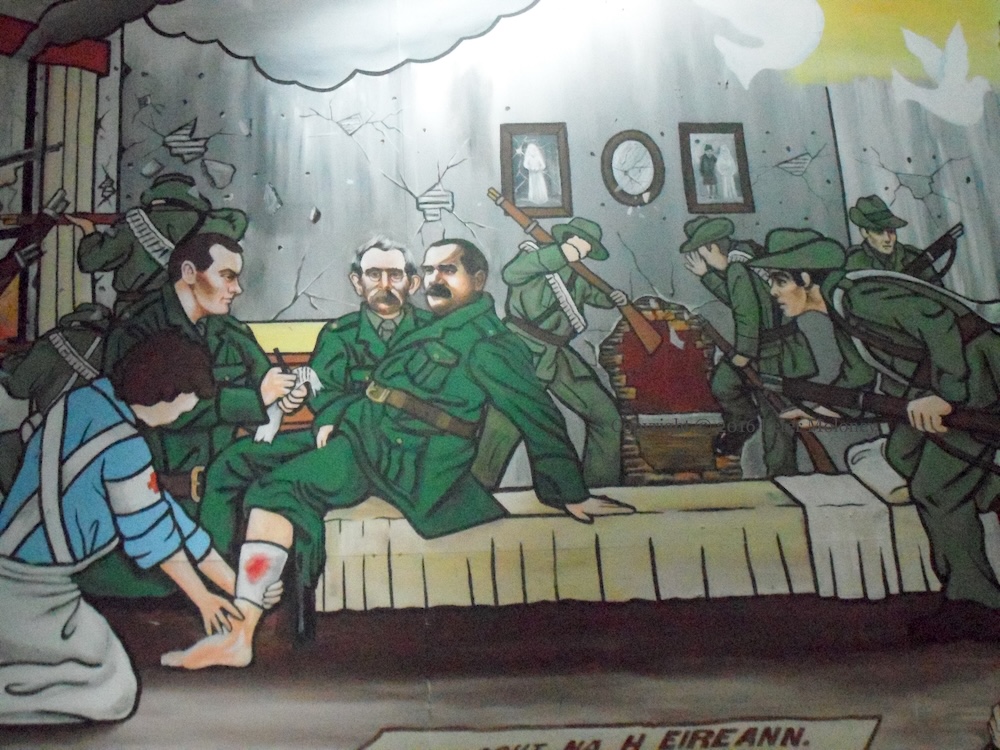
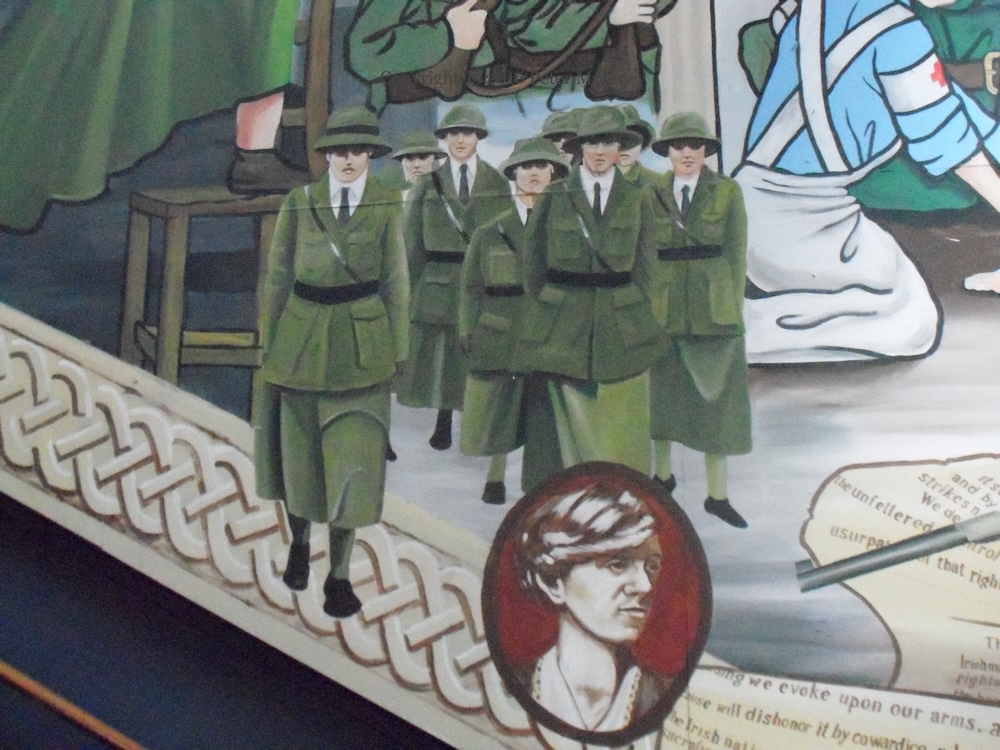
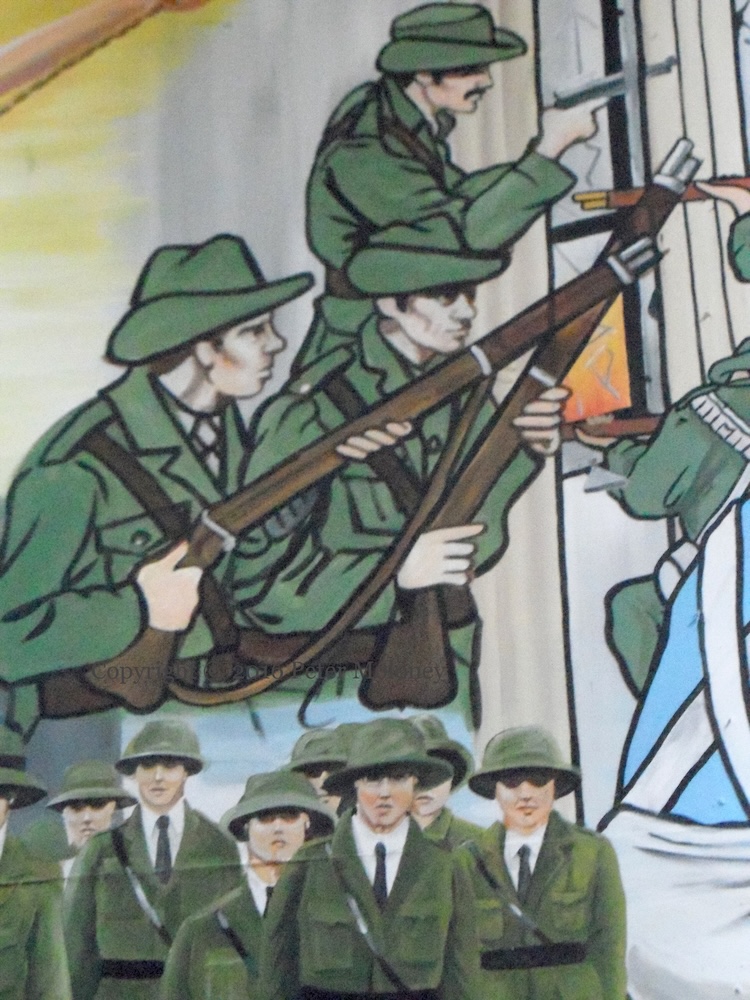
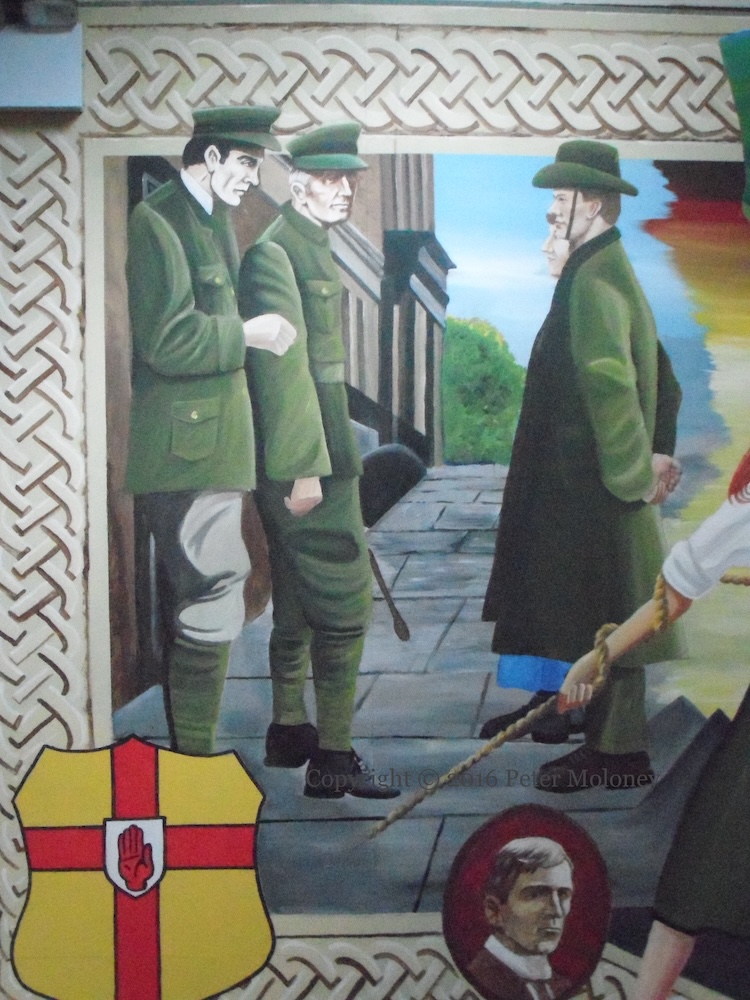
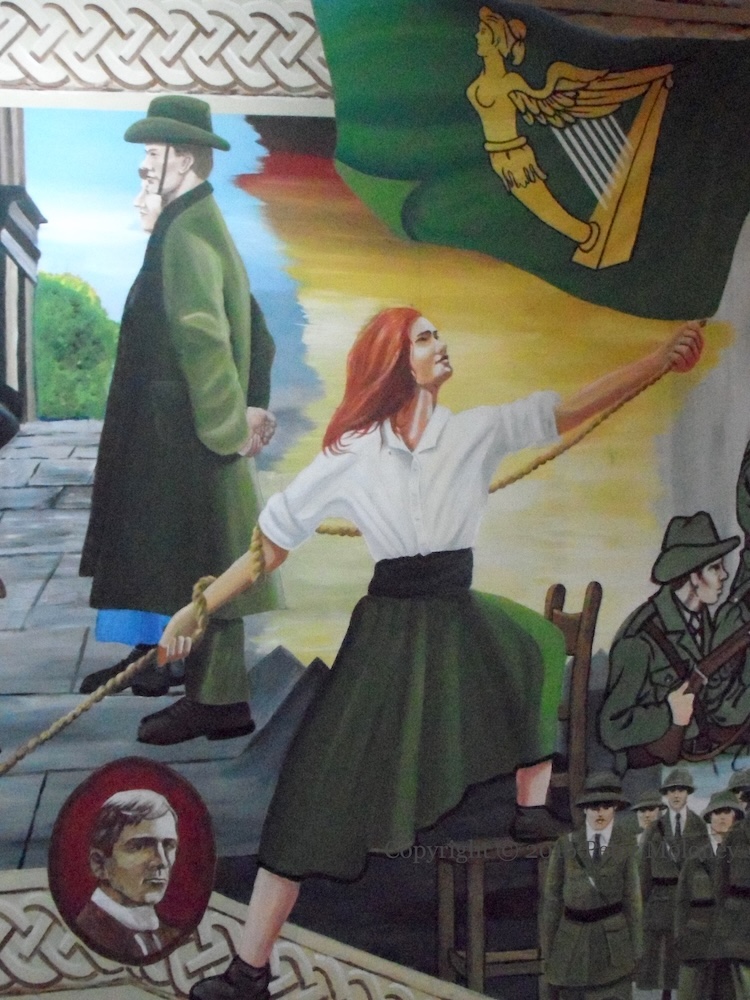
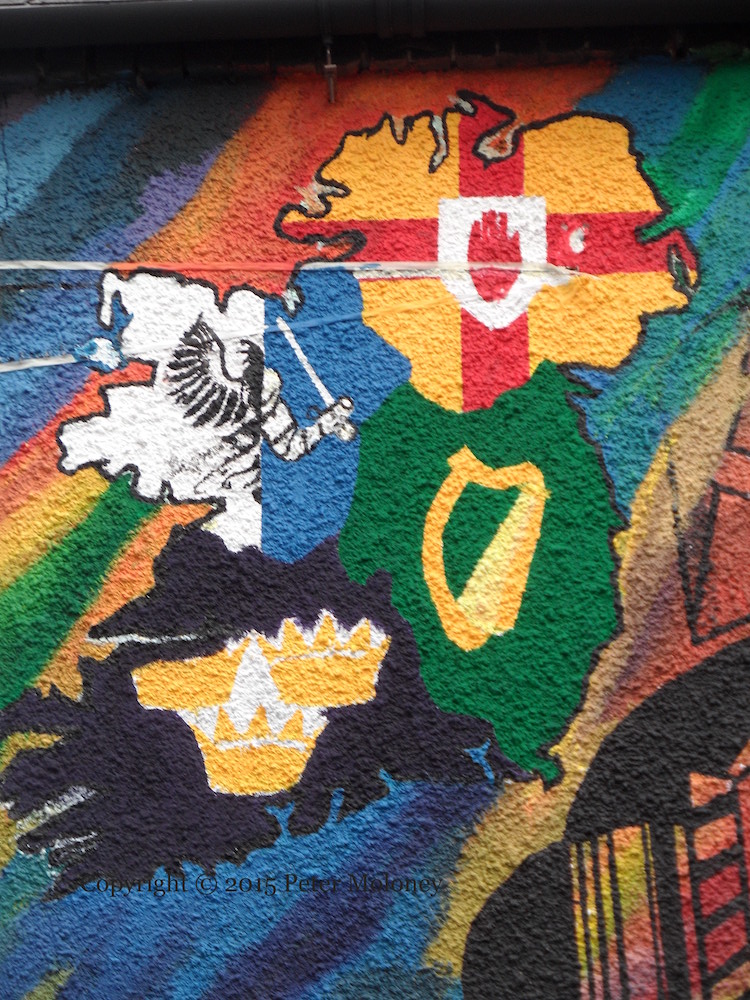
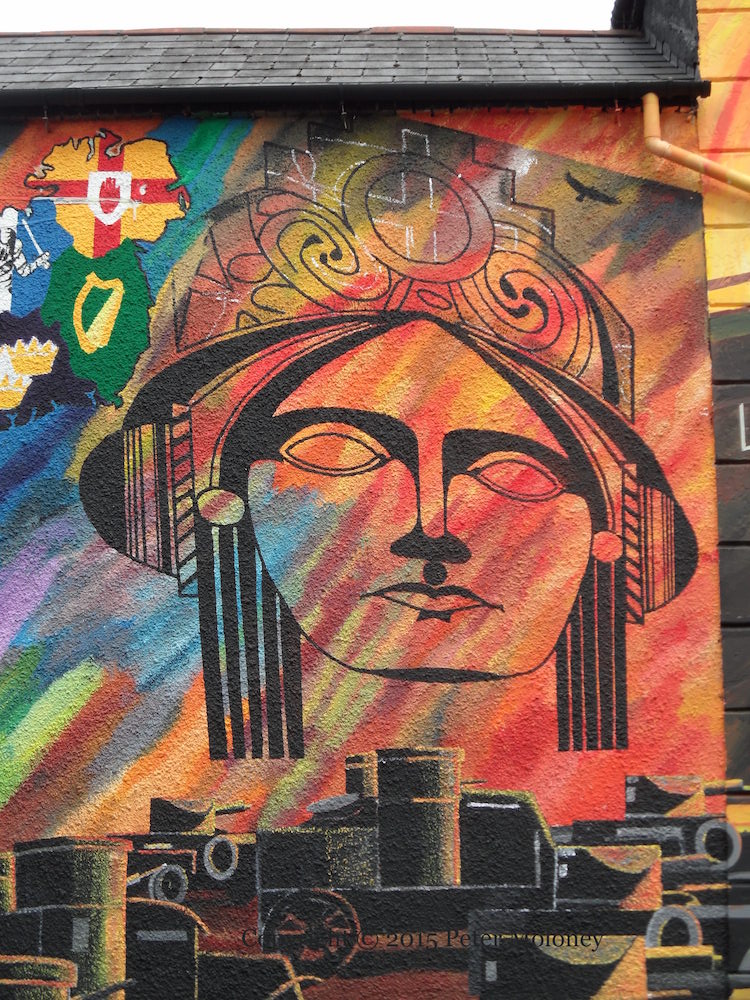
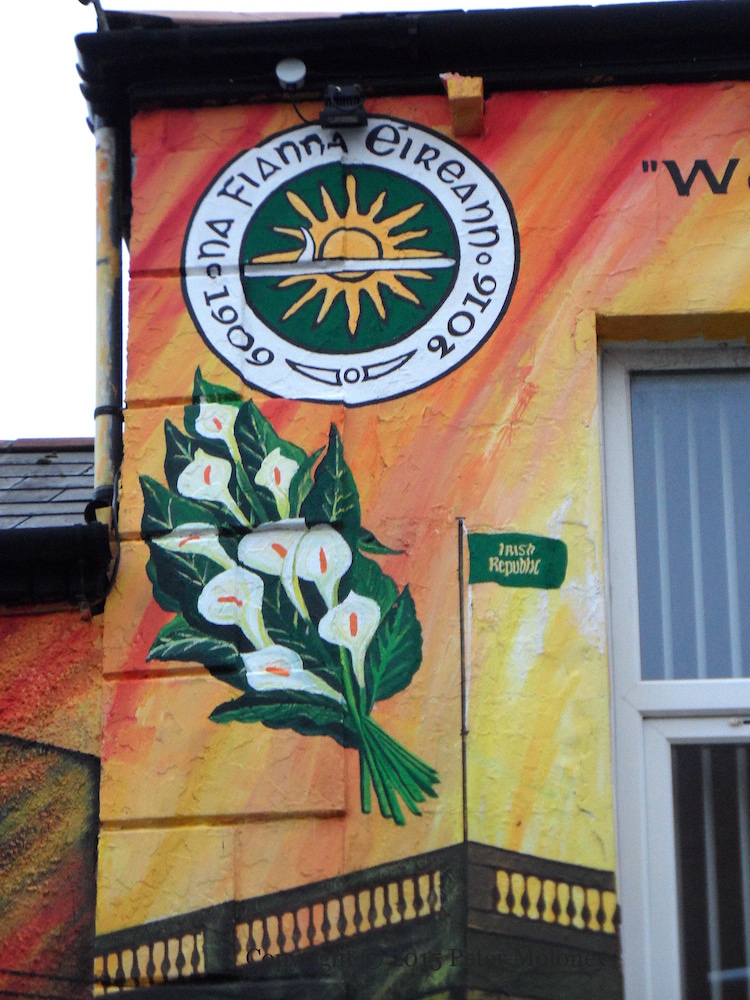
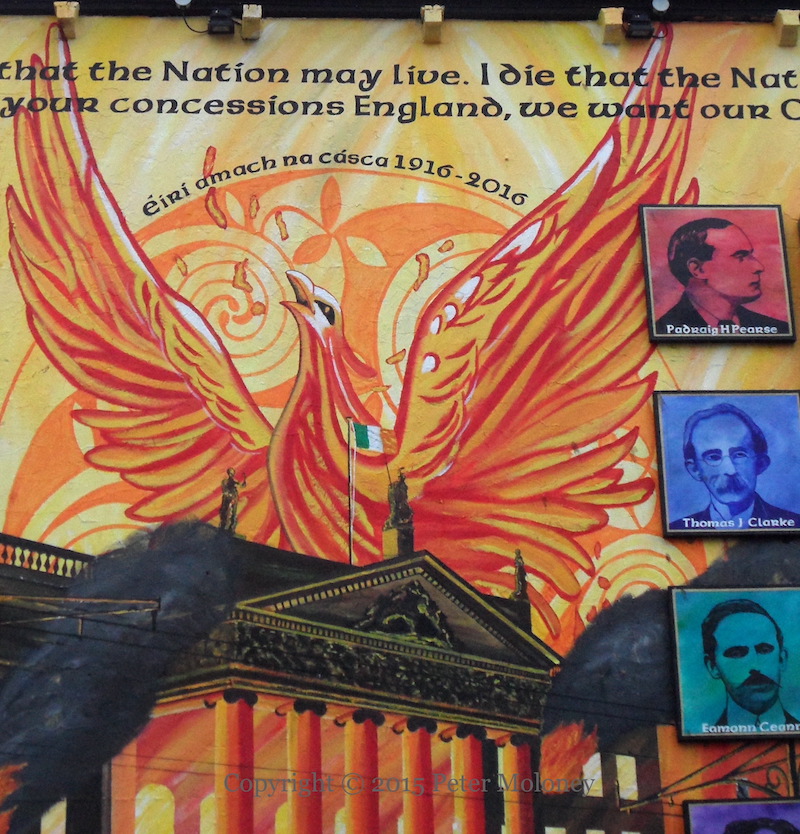
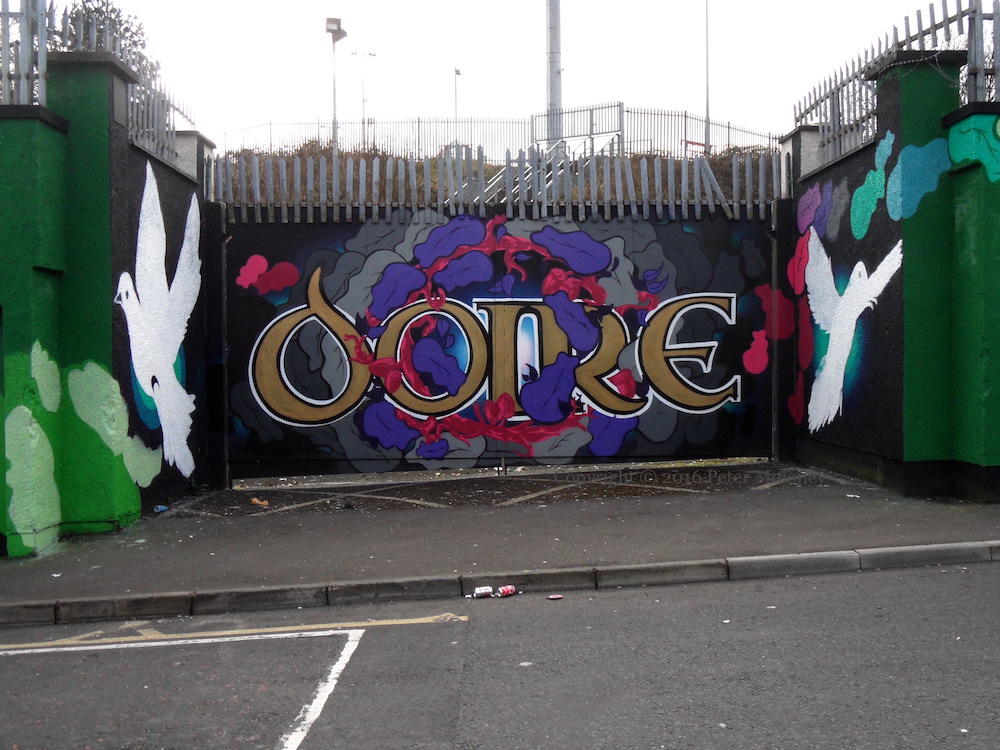
In addition to the artefacts and recreated locations, two murals were painted by three Belfast artists depicting Irish culture and the republican struggle throughout the ages, from Nuada to the blanket protest. (Here is video of DD talking about the murals – youtube.)
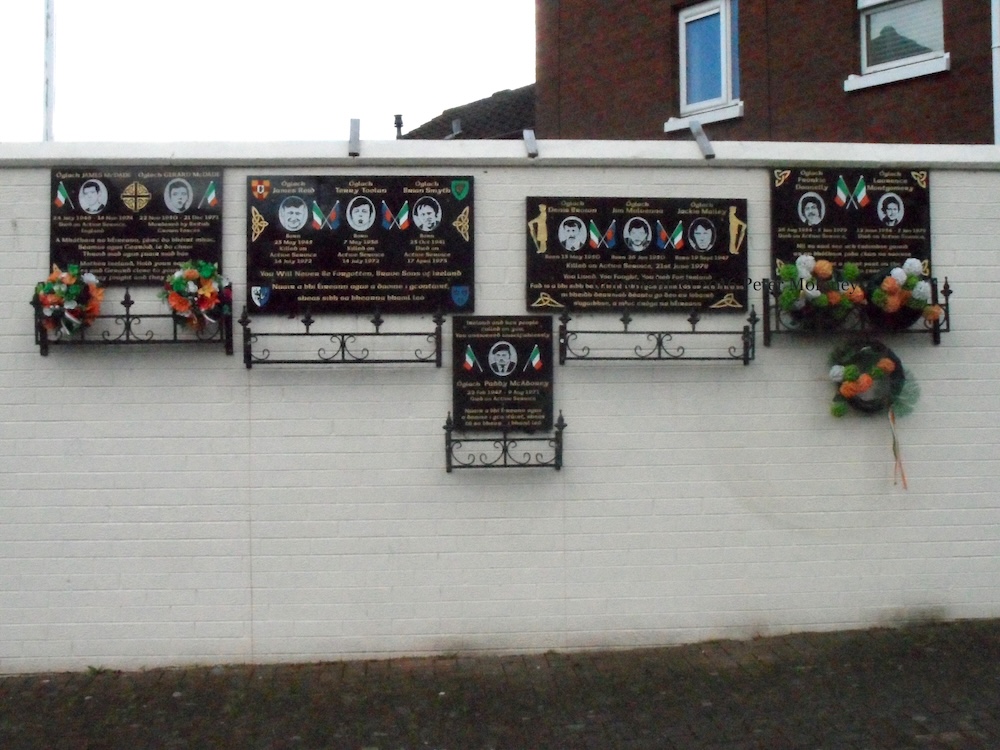
Three plaques have been added to the two seen previously, the McDade and Donnelly-Montgomery plaques.
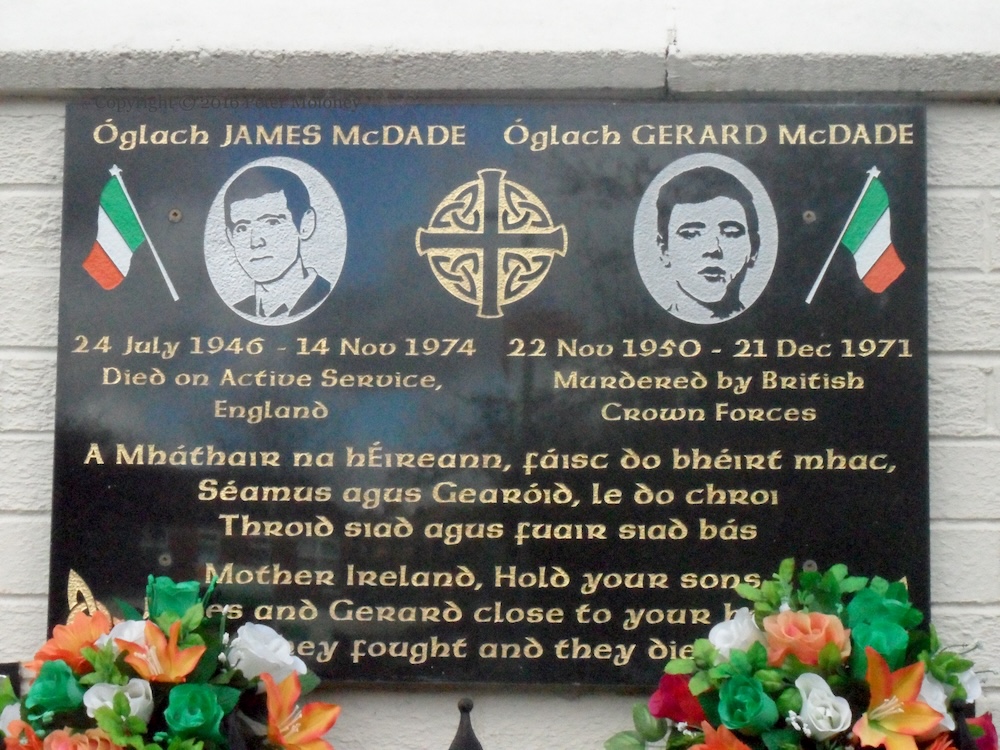
“Óglach James McDade 24 July 1946 – 14 Nov 1974 died on active service, England; Óglach Gerard McDade 22 Nov 1950 – 21 Dec 1971 murdered by British Crown Forces. A Mháthaır na hÉıreann, fáısc do bhéırt mhac, Séamus agus Geraóıd, le do chroí. Throıd sıad agus fuaır sıad bás. Mother Ireland, hold your sons, James and Gerard, close to your heart. They fought and they died.”
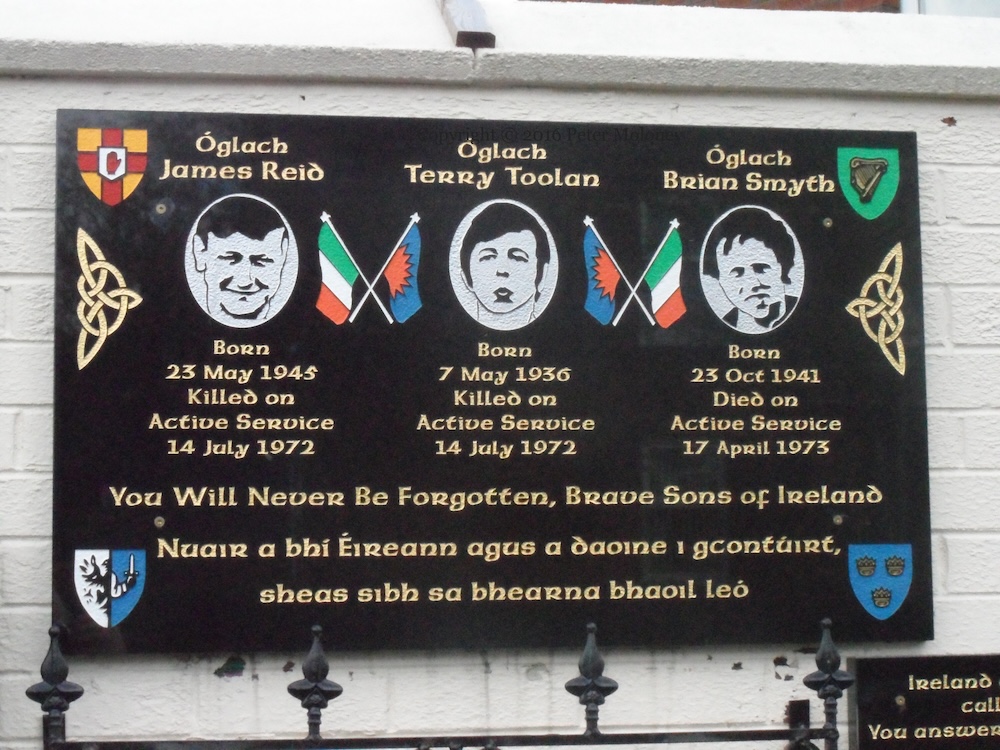
“Óglach James Reid born 23 May 1945 killed on active service 14 July 1972. Óglach Terry Toolan born 7 May 1936 killed on active service 14 July 1972. Óglach Brian Smyth born 23 Oct 1941 died on active service 17 April 1973. You will never be forgotten, brave sons of Ireland. Nuaır a bhí Éıreann agus a daoıne ı gcontúırt, sheas sıbh sa bhearna bhaoıl leó [sic leo].”
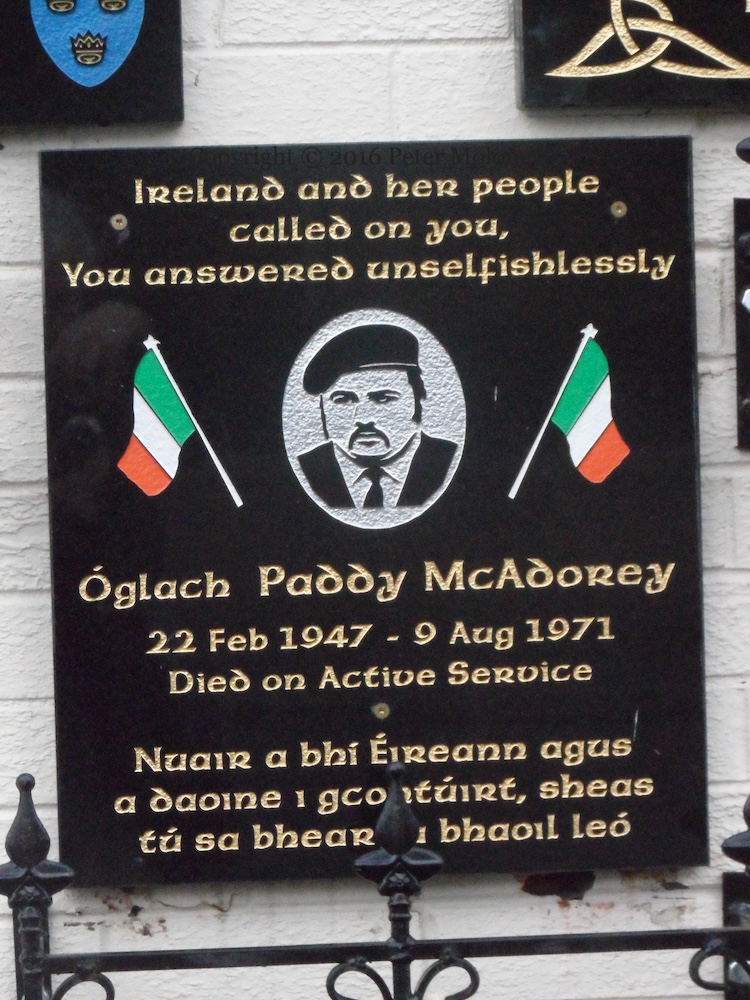
“Ireland and her people called on you, you answered unselfishlessly. Óglach Paddy McAdorey 22 Feb 1947 – 9 Aug 1971 died on active service. Nuaır a bhí Éıreann agus a daoıne ı gcontúırt, sheas sıbh sa bhearna bhaoıl leó.”
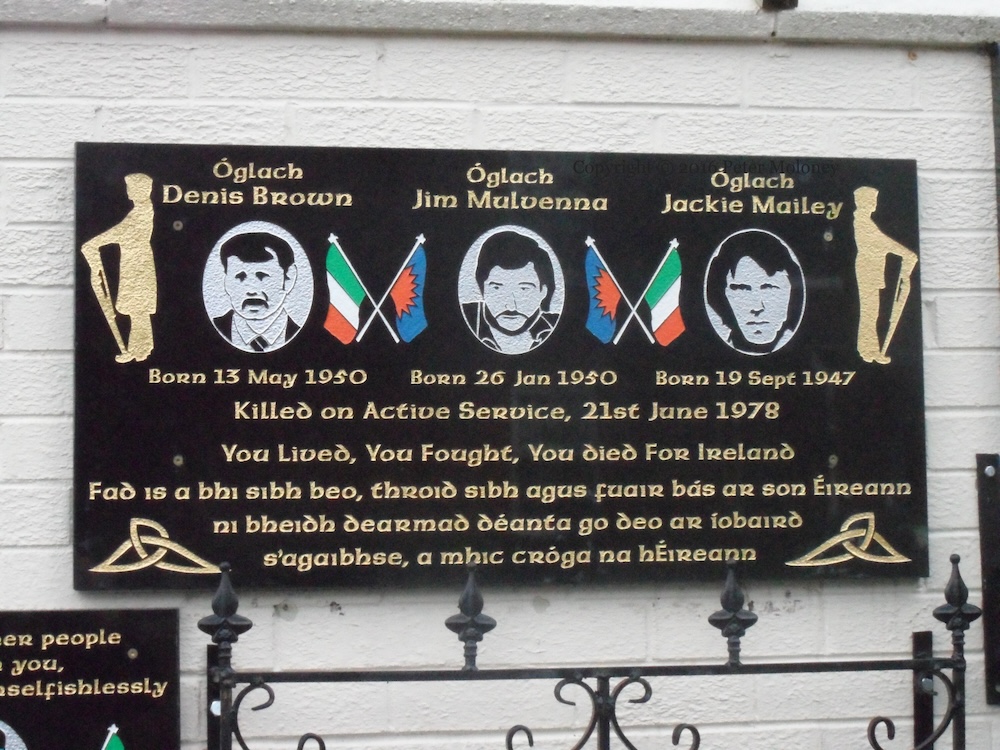
“Óglach Denis Brown born 13 May 1950, Óglach Jim Mulvenna born 26 Jan 1950, Óglach Jackie Mailey born 19 Sept 1947 – killed on active service, 21st June 1978. You lived, you fought, you died for Ireland. Fad ıs a bhí sibh beo, throıd sıbh agus fuaır bás ar son Éıreann ní bheidh dearmad déanta go deo ar íobaırd s’agaıbhse, a mhıc cróga na hÉıreann.”
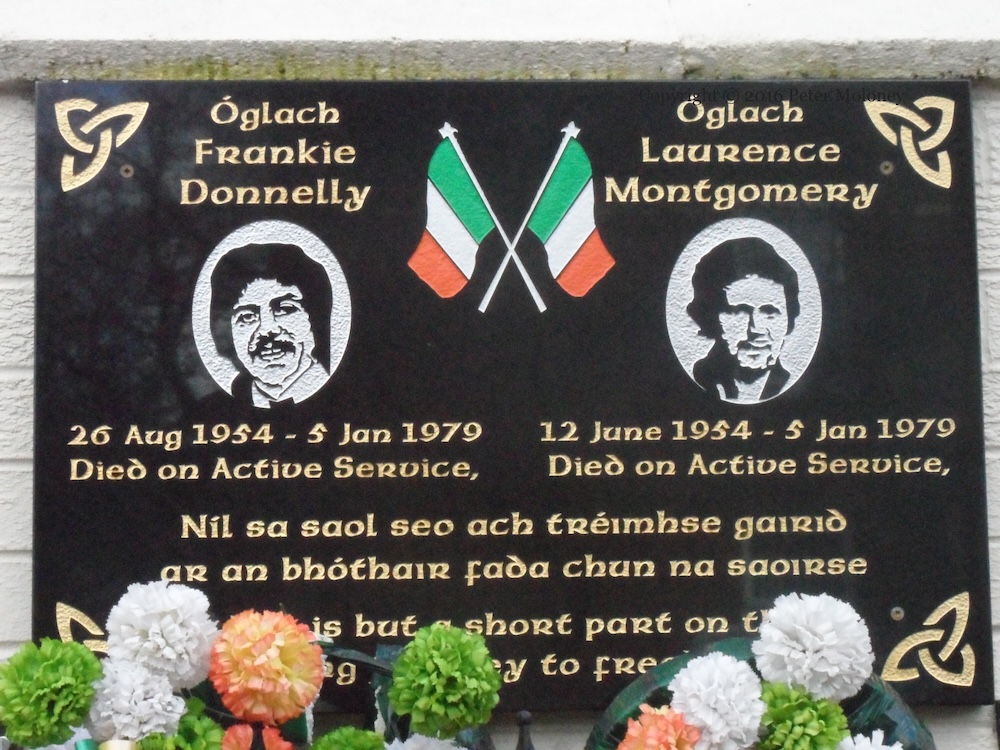
“Óglach Frankie Donnelly 26 Aug 1954 – 5 Jan 1979 died on active service; Óglach Laurence Montgomery 12 June 1954 – 5 Jan 1979 died on active service. Níl sa saol seo ach tréımhse gaırıd ar an bhóthaır fada chun na saoırse – life is but a short part on the long journey to freedom.”
repainted knot-work on the right in front, form July 8th, 2016:
detail shots, from August 9th, 2025, December 15th, 2025, and March 26th, 2016:
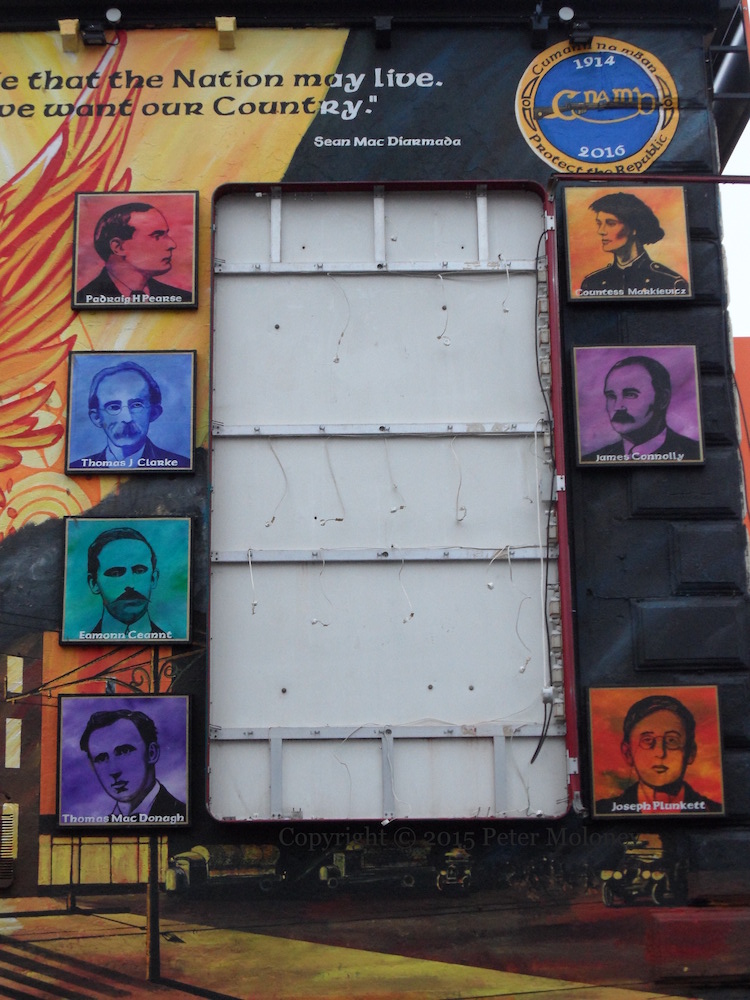
December 15th, 2025, portraits on small boards being added to either side of the (temporarily removed) proclamation:
July 31st, 2025:
July 14th, 2025:
May 5th, 2025:
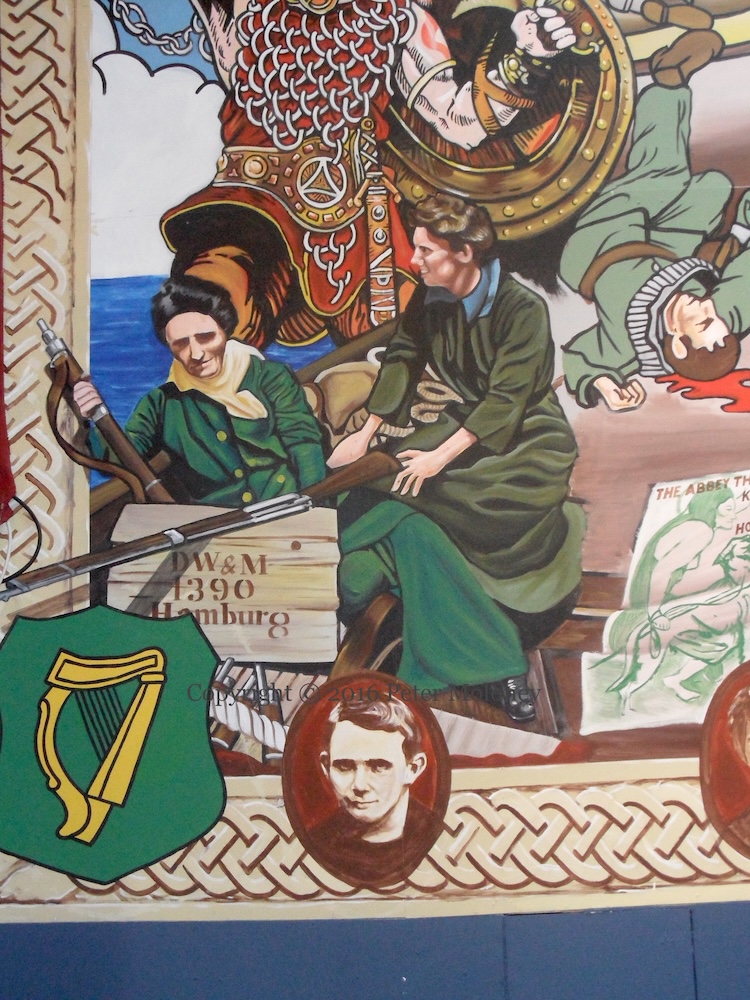
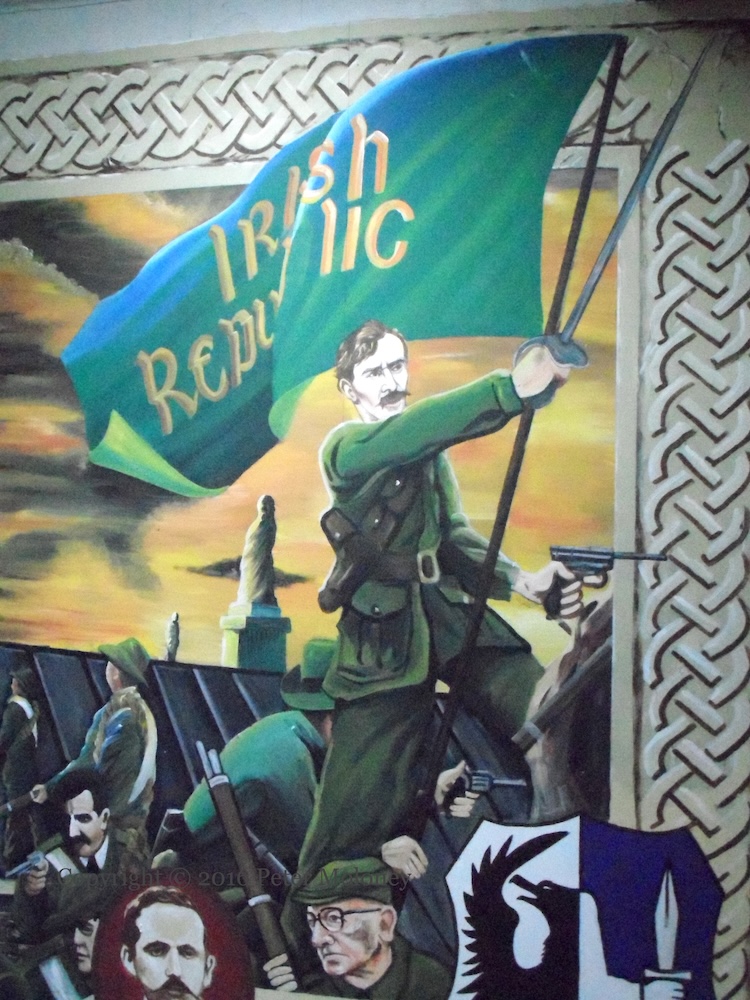
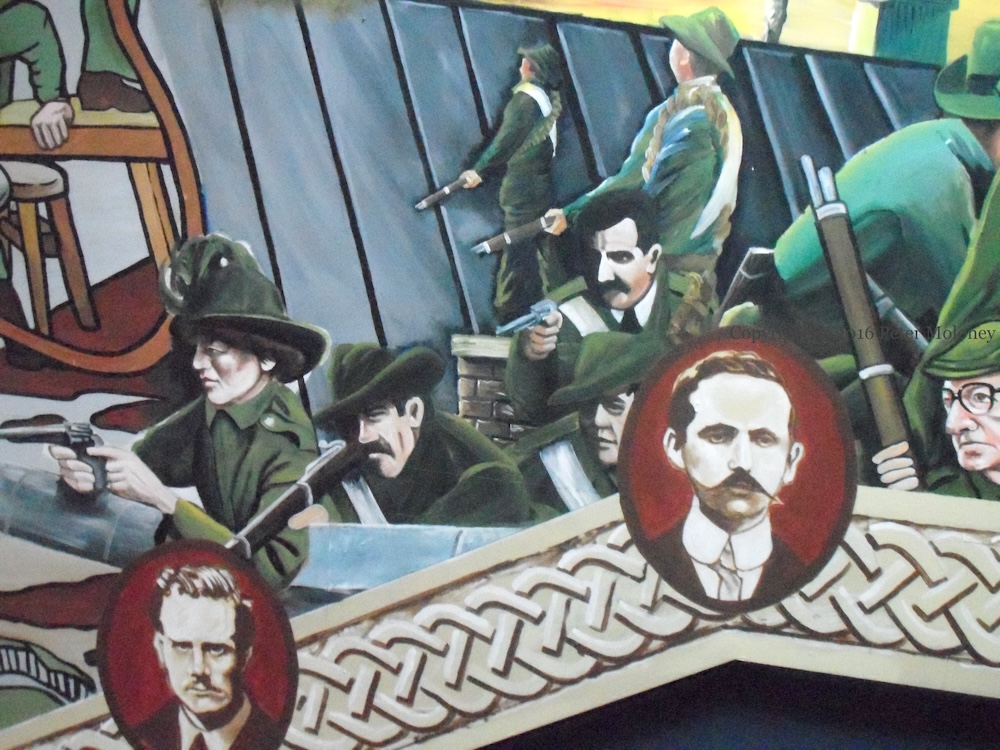
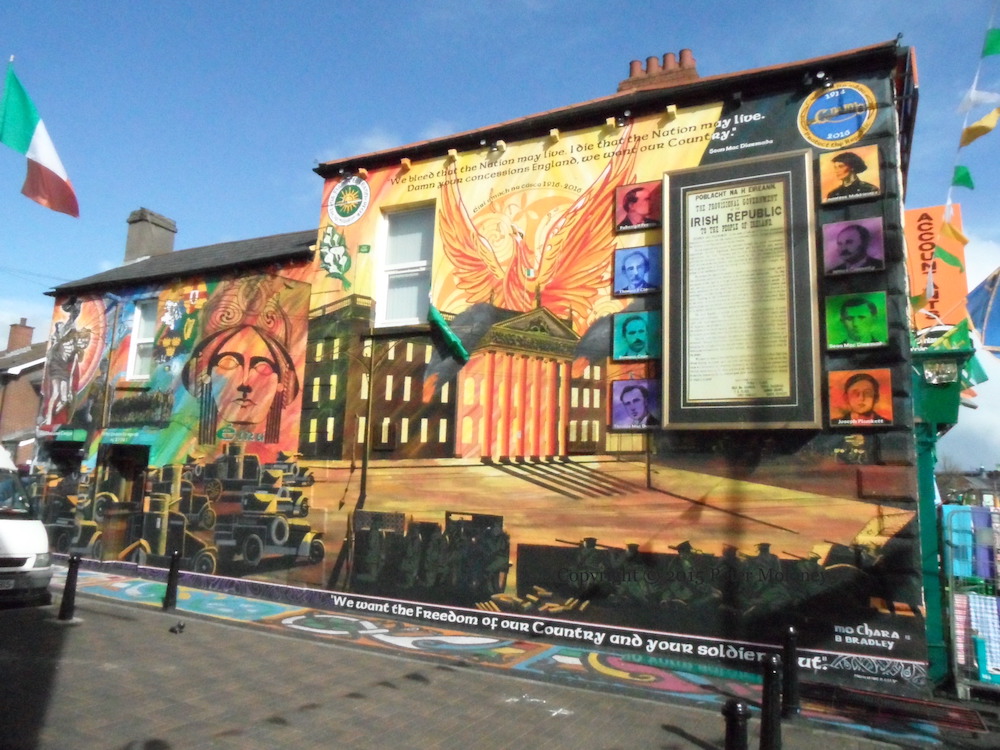
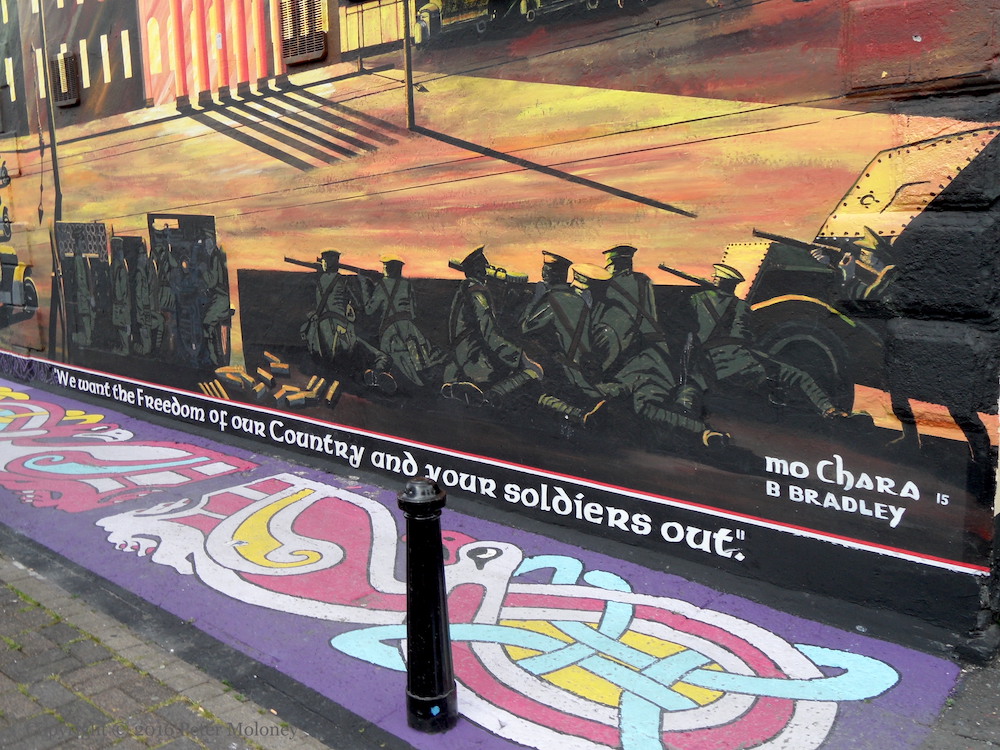
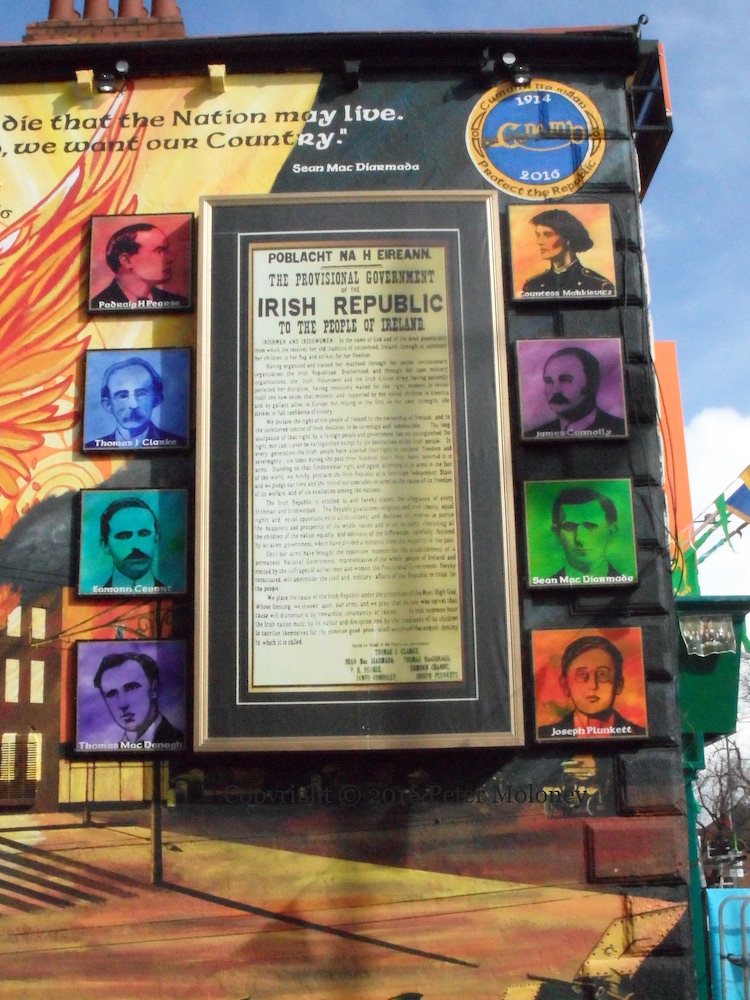
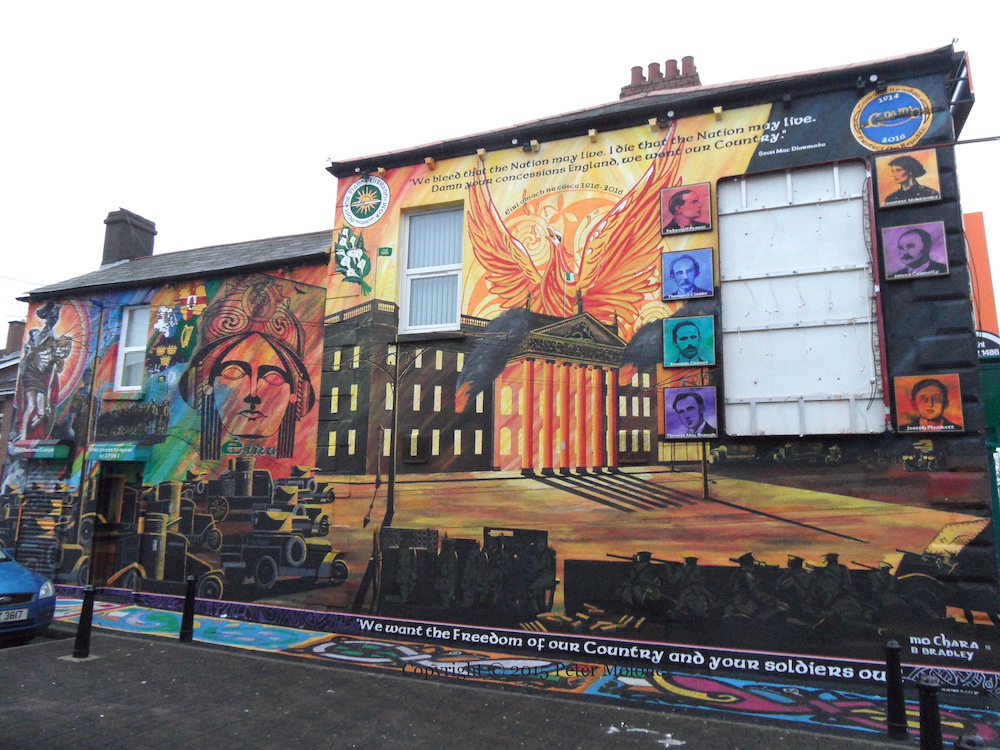
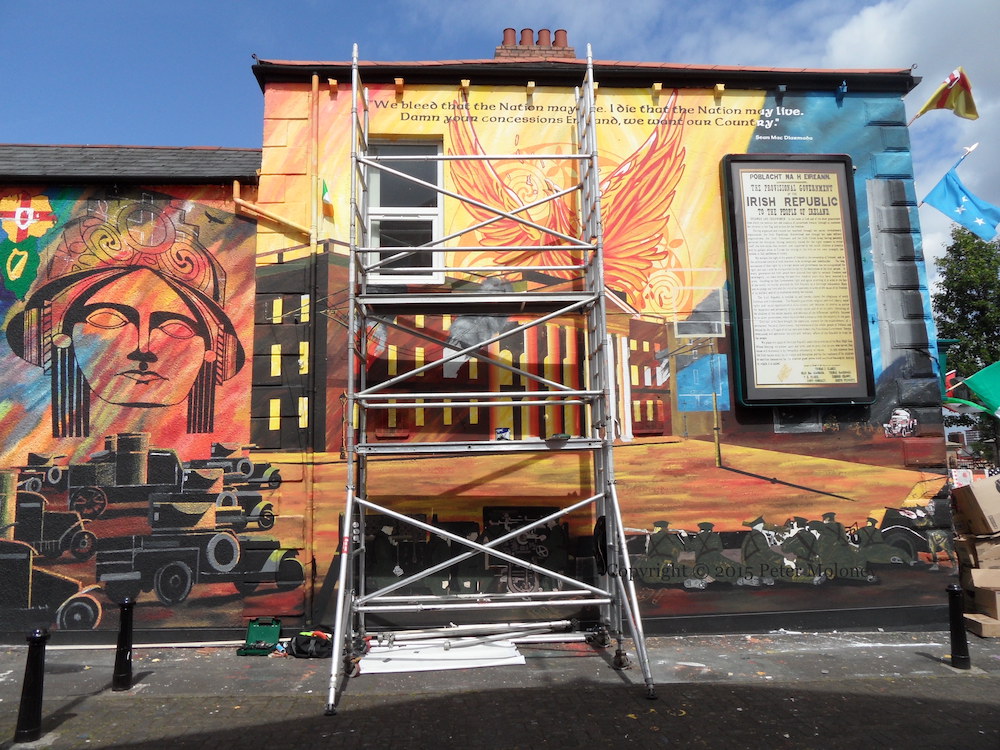
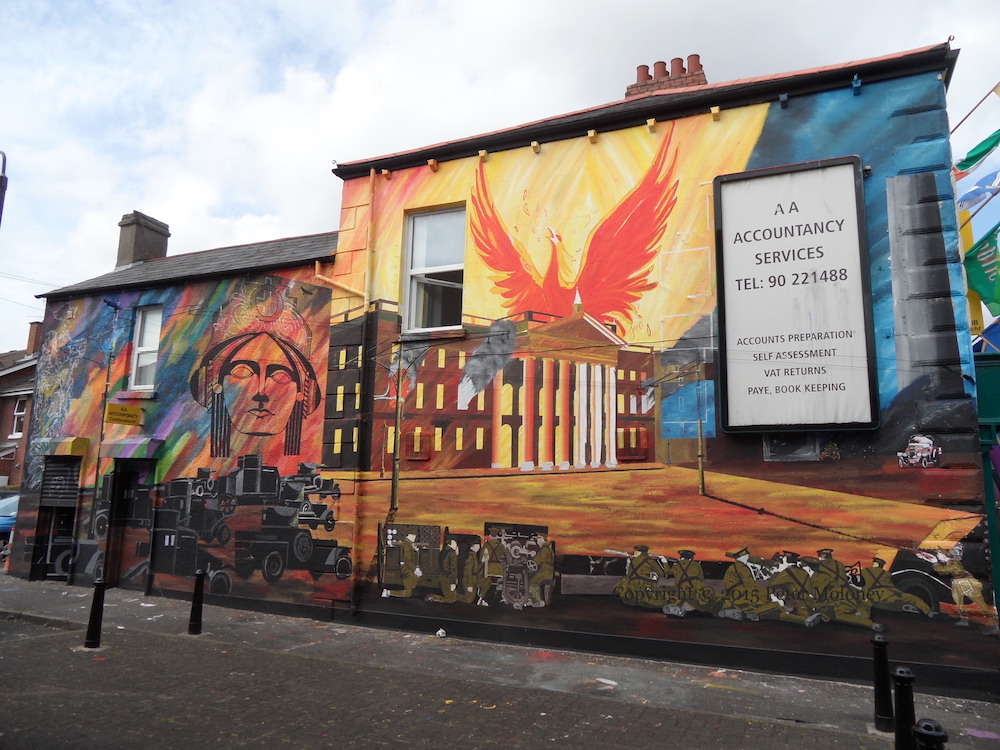
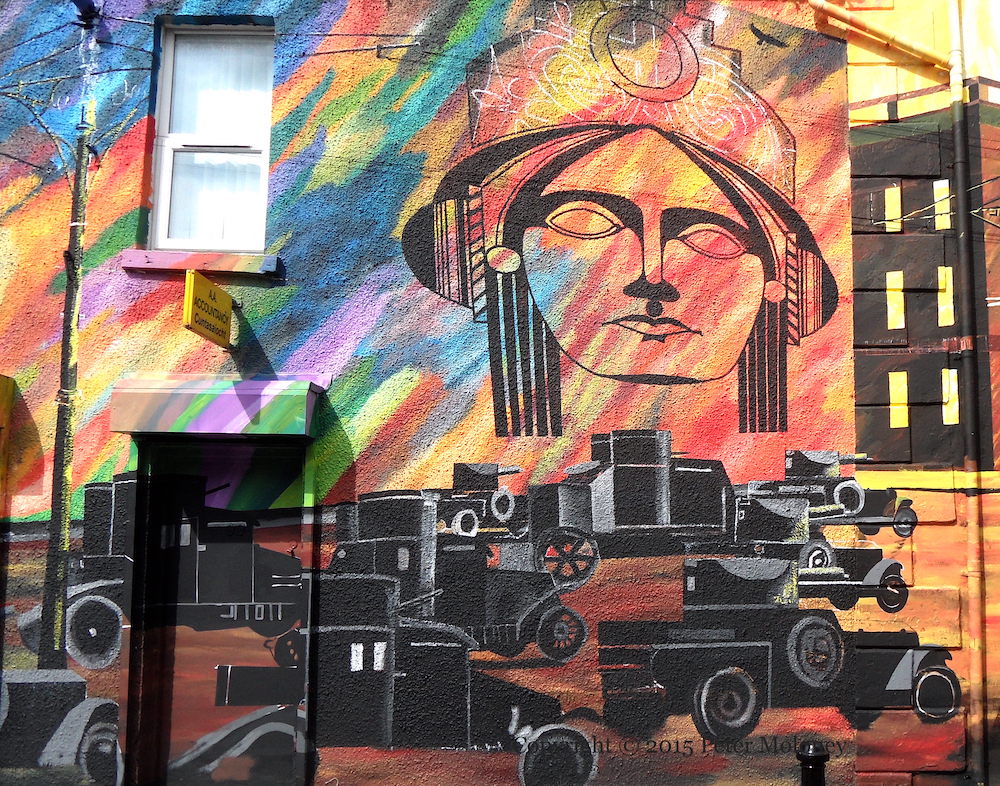
Arrayed against the forces of the British Army (which are shown laying siege to the Dublin GPO during the Easter Rising in armoured cars and in sniping positions in the foreground of the mural, along the whole length of the wall) are various symbols of Irish nationalism:
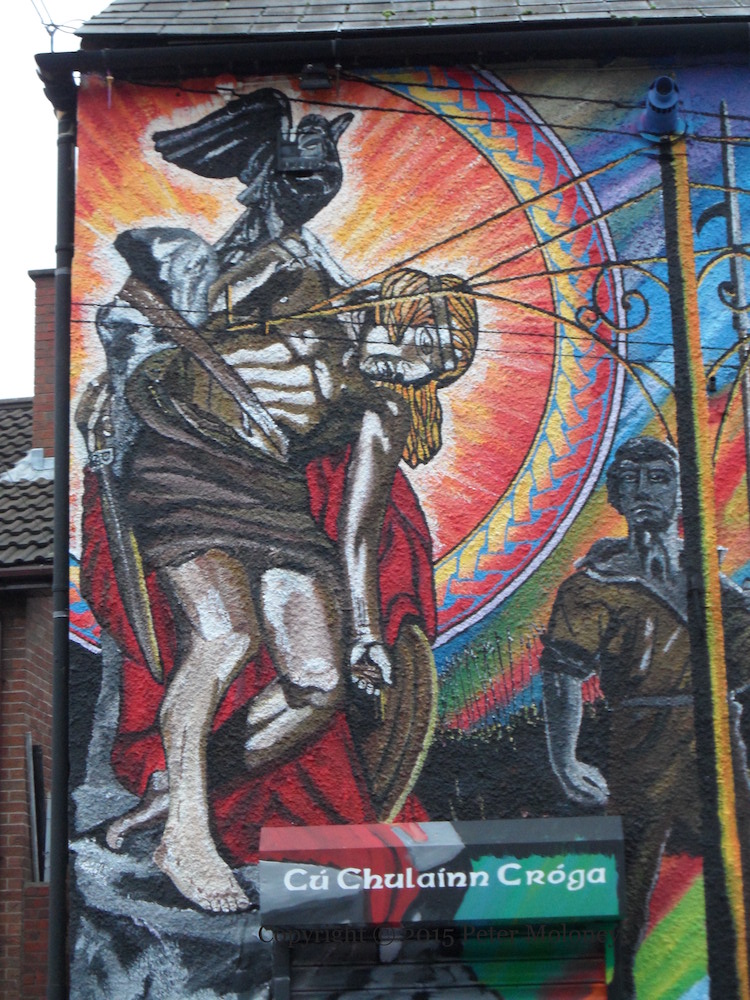
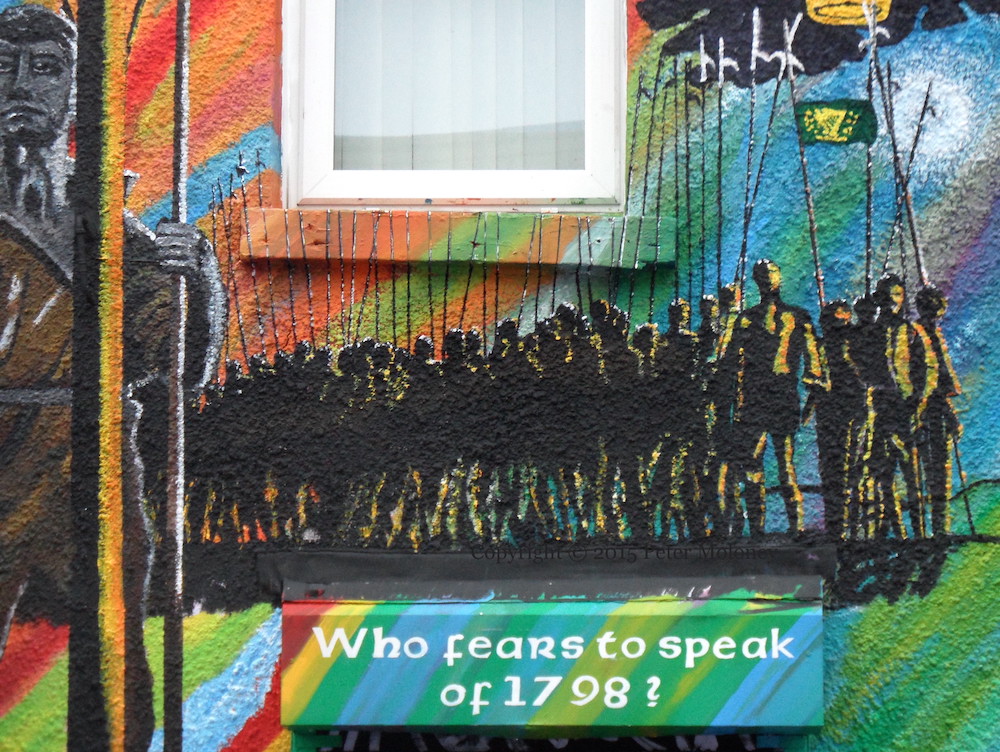
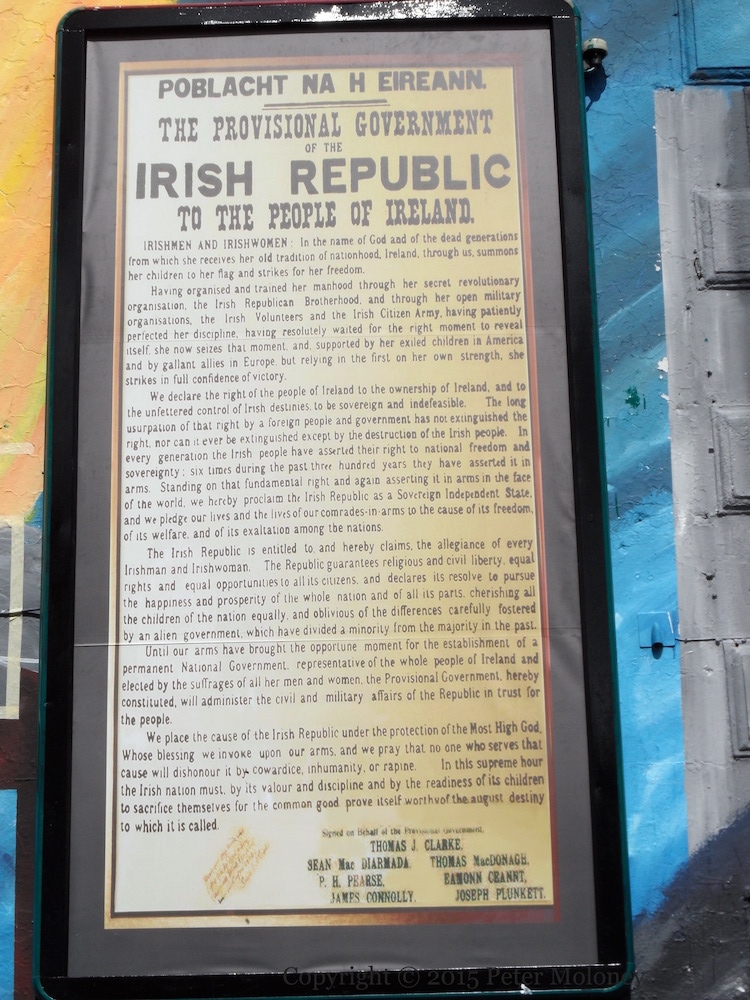
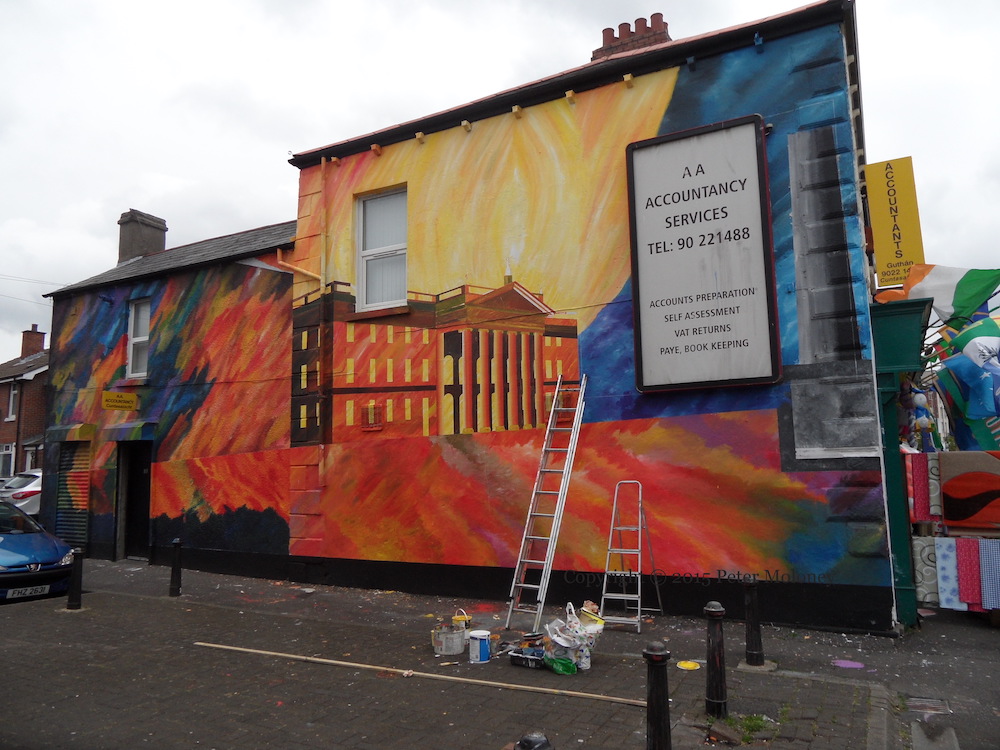
Oliver Sheppard‘s 1911 statue of Cú Chulaınn dying (see the Visual History page); the pikemen of the 1798 Rebellion; the four provinces of Ireland; Érıu the mythological queen of Ireland/Éıre as designed by Richard J King/Rísteard Ó Cíonga; Easter lilies; the emblems of Na Fıanna Éıreann and Cumann Na mBan on either side of a quote from (The Mainspring) Seán Mac Dıarmada, “We bleed that the nation may live; I die that the nation may live. Damn your concessions, England: we want our country”; a phoenix rising from the flames of the burning Dublin GPO (inspired by Norman Teeling’s 1998 painting The GPO Burns In Dublin); the GPO flying an ‘Irish Republic’ flag; portraits of signatories and other rebels — (left) Padraig H. Pearse, Thomas J Clarke, Eamonn Ceannt, Thomas MacDonagh, (right) Countess Markievicz, James Connolly, Sean MacDiarmada, Thomas Plunkett; the declaration of independence, placed over the advertising box of AA Accountants – see the in-progress shot below.
At the very bottom is a quote from the mother of painted Gerard ‘Mo Chara’ Kelly, Harriet Kelly: “We want the freedom of our country and your soldiers out.”
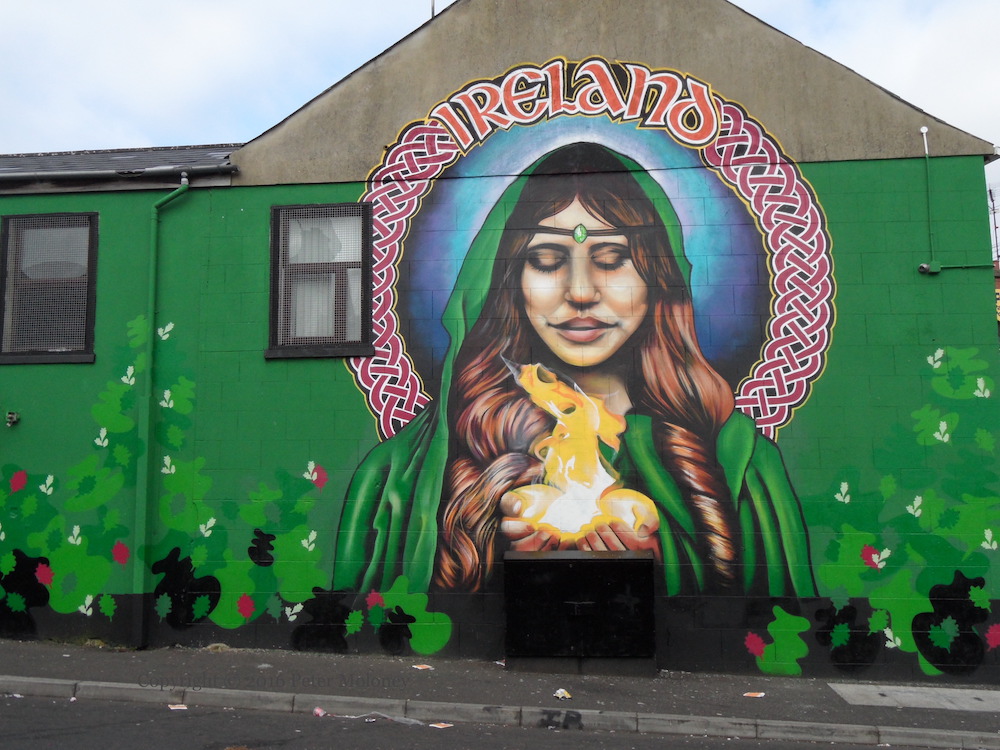
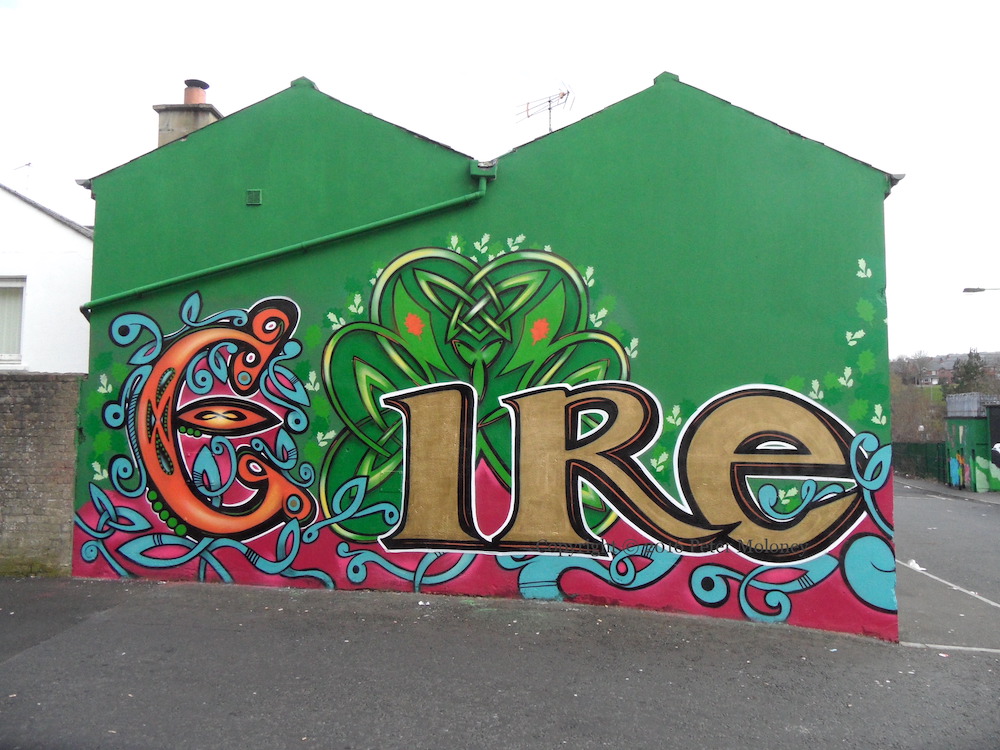
The “Éire” and “Ireland” pieces, and perhaps the Doıre piece, were painted by RAZER (ig). The three are perhaps part of a larger installation at Celtic Park – see Fáılte Go Paırc Na gCeılteach.
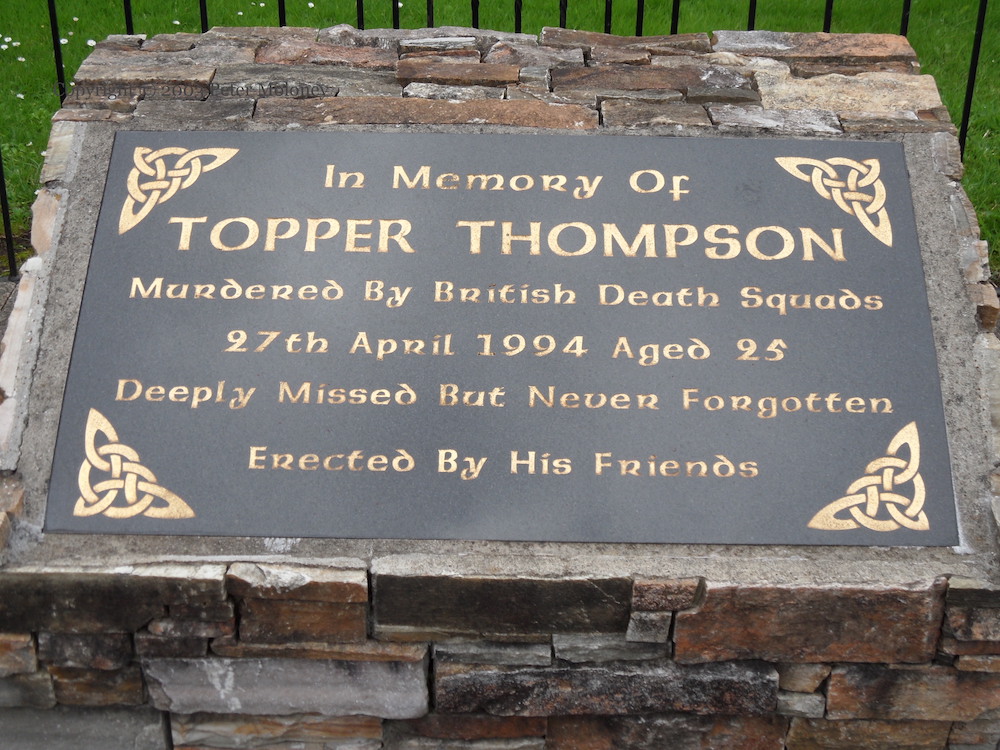
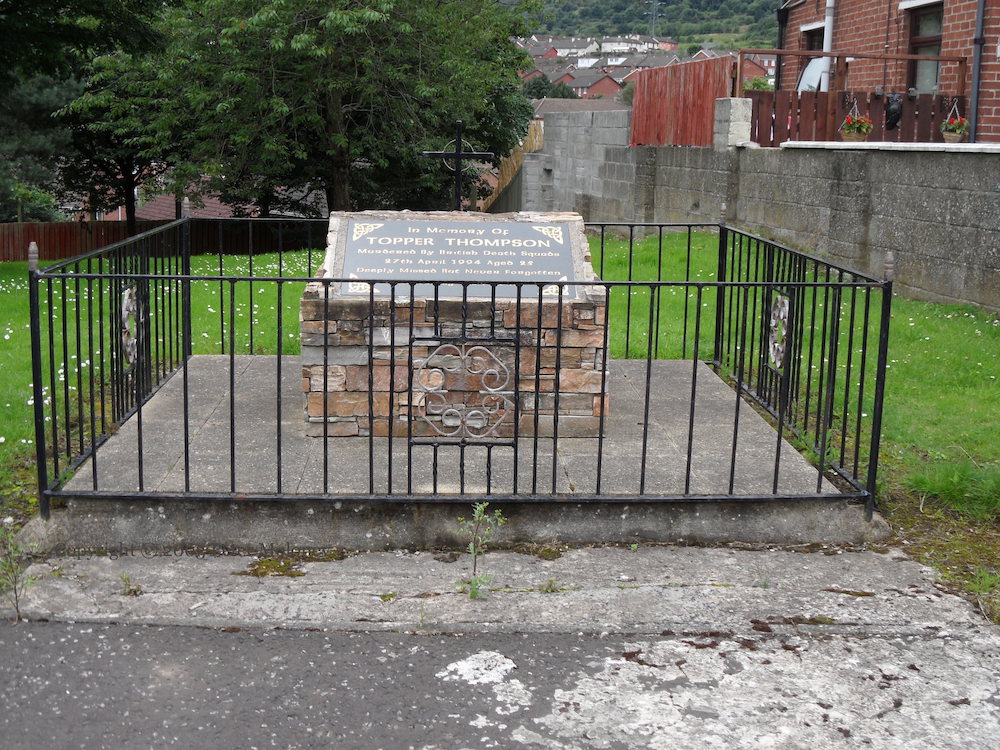
“In memory of Topper Thompson, murdered by British death squads, 27th April 1994 aged 25. Deeply missed by never forgotten. Erected by his friends.” Paul Thompson was shot by a UDA gunman through a hole that had been cut in the security fence and about which the RUC had been notified earlier in the day (Relatives For Justice).
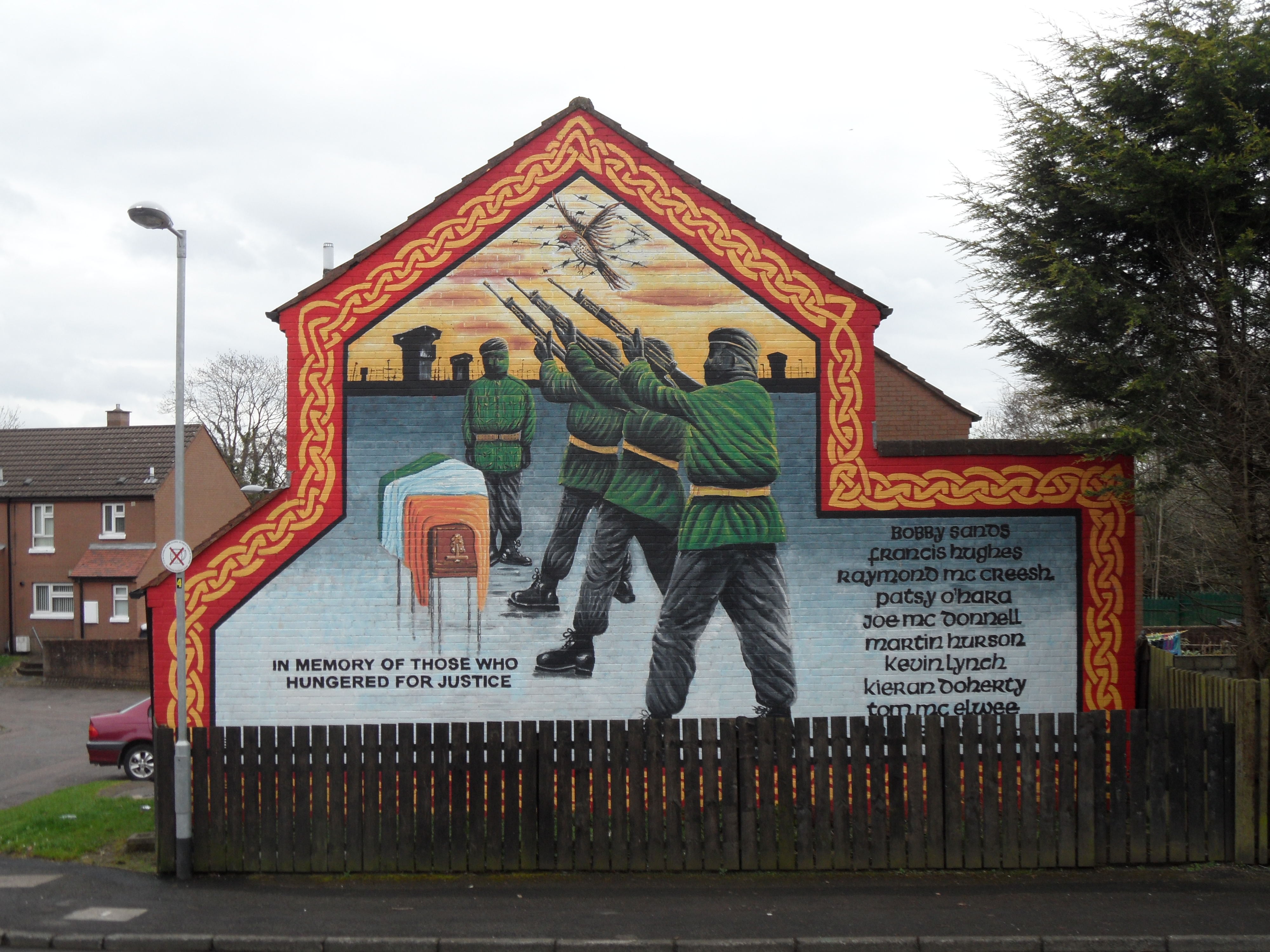
This is a 2015 repainting of a 2001 mural in Glenwood. The ten deceased hunger-strikers of 1981 are listed in the bottom right: Bobby Sands, Francis Hughes, Raymond McCreesh, Patsy O’Hara, Joe McDonnell, Martin Hurson, Kevin Lynch, Kieran Doherty, Tom McElwee, Mickey Devine. In the main panel, a lark in barbed wire flies over the H-blocks of Long Kesh and a funeral volley being fired over a Tricolour-draped coffin.
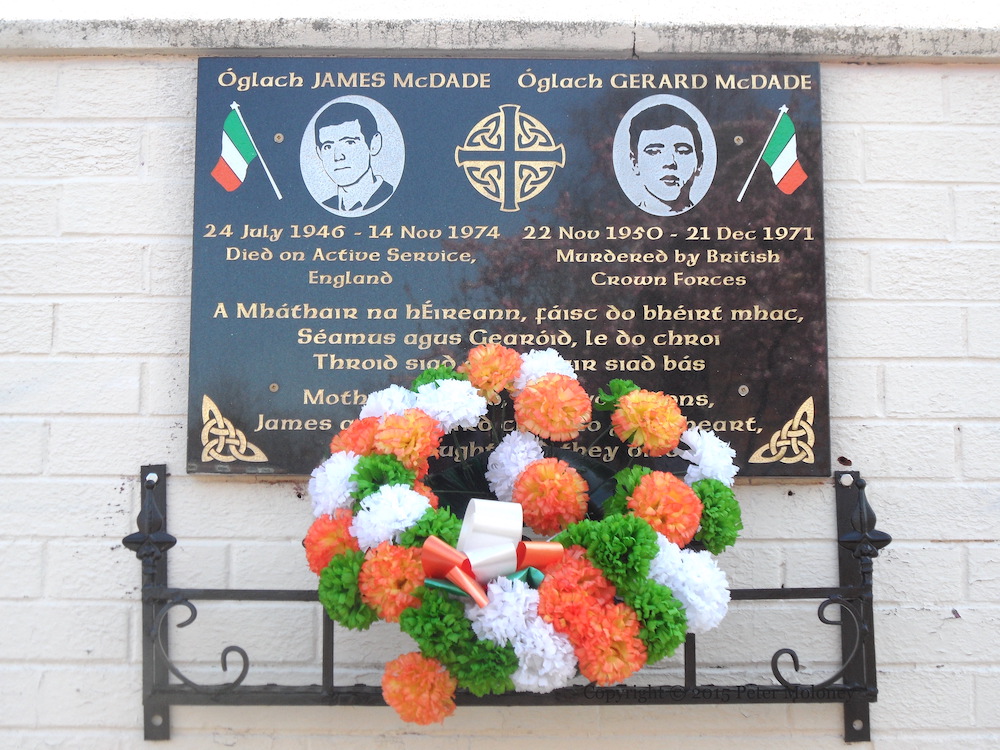
Two IRA memorial plaques have been mounted on a wall in Herbert Street, Ardoyne, close to the Sammy McLarnon plaque:
“Óglach James McDade 24 July 1946 – 14 Nov 1974 died on active service, England; Óglach Gerard McDade 22 Nov 1950 – 21 Dec 1971 murdered by British Crown Forces. A Mháthaır na hÉıreann, fáısc [strain, draw tight] do bhéırt mhac, Séamus agus Geraóıd, le do chroí. Throıd sıad agus fuaır sıad bás. Mother Ireland, hold your sons, James and Gerard, close to your heart. They fought and they died.”
The McDade family lived in Ardoyne. James died while planting a bomb in Birmingham, England; Gerard was shot by a British Army soldier – there is a plaque to his memory in Beechmount. (Sutton)
“Óglach Frankie Donnelly 26 Aug 1954 – 5 Jan 1979 died on active service; Óglach Laurence Montgomery 12 June 1954 – 5 Jan 1979 died on active service. Níl sa saol seo ach tréımhse gaırıd ar an bhóthaır fada chun na saoırse [in this life there is only a short period on the long road to freedom] – life is but a short part on the long journey to freedom”
Donnelly and Montgomery were killed in Northwick Drive, Ardoyne, by the premature detonation of a car-bomb. (Sutton)
“Fáılte go dtí Brandywell” – this is a long mural about the welfare of children, citing rights 3, 6, 9, 23, 24, and 31 from the UN’s Convention On The Rights Of The Child, as rendered by Caroline Castle.
Countess Markievicz, carrying a flag of Cumann Na mBan, and Ethel Lynch, carrying a flag of the Derry IRA, take centre stage in the Mná Na hÉıreann mural in London-/Derry/Doıre’s bogside. Markievicz is famous for her role in the Easter Rising of 1916 (WP); Lynch died in December 1974 of injuries sustained when a bomb exploded prematurely. Between them, “Liberty leads the people” waving an Irish Tricolour.
To their left are three Derry women protesting the conditions in Armagh Women’s Prison and in the H-Blocks. This article on Mary Nelis (the protester on the right, with Kathleen Deeny and Theresa Deery) describes the photograph on which this part of the mural is based. The women in Armagh prison were allowed to wear their own clothes and so were not ‘on the blanket’ as their male counterparts in the H-Blocks of Long Kesh were. However, they did engage in a “no wash” protest, which lasted from February 1980 until March 1981, and three of them – Maıréad Farrell, Mary Doyle, and Margaret Nugent – joined the 1980 hunger strike.
To their right (beyond the coffin scene) members of Cumann Na mBan are on parade; the photo of on which this is based can be seen in Mothering Sunday In Beechmount, though the faces have been changed here, presumably to those of more contemporary volunteers.
The figure wearing a cloth cap and holding a rifle is Eithne Coyle, a leader and later president of Cumann Na mBan, imprisoned both by the Black and Tans before the treaty and after it by the Provisional Irish government (WP). For the photograph on which her pose here is based, see An Phoblacht‘s History Of Cumann Na mBan.
In the four corners are circles of Betsy Gray, Anne Devlin, Mary Ann McCracken, and Máıre Drumm. Gray and McCracken were Presbyterians; Gray fought (or at least, was killed) in the 1798 rebellion, as did McCracken’s brother Henry Joy; Mary Ann went on to work for the poor of Belfast and lobby against slavery. Anne Devlin assisted in Robert Emmet’s 1803 rising. (National Graves Assoc) Máıre Drumm was vice-president of Sınn Féın and commander of Cumann Na mBan, who are shown marching on the right-hand side.
The local New Lodge GAA club Cumman An Phıarsaıgh is named in honour of Patrick Pearse, executed after the 1916 rising. The club’s new mural features footballers contesting a ball and Pearse’s image appears at the centre of a Celtic cross along with part of his 1912 poem Mıse Éıre in the bottom corner (shown in the close-up).
Painted by Lucas Quigley and Michael Doherty. Replaces ‘New Lodge 2000‘.
Mıse Éıre: Sıne mé na an Chaılleach Bhéarra. Mór mo ghlóır: Mé a rug Cú Chulaınn croga. Mór mo náır: Mo chlann féın a dhíol a máthaır. [Mór mo phıan: Bıthnaımhde do mo shíorchıapadh. Mór mo bhrón: D’éag an dream ınar chuıreas dóchas.] Mıse Éıre: Uaıgní mé ná an Chaılleach Bhéarra.
I am Ireland: I am older than the old woman of Beare. Great my glory: I who bore Cuchulainn, the brave. Great my shame: My own children who sold their mother. [Great my pain: My irreconcilable enemy who harasses me continually. Great my sorrow: That crowd, in whom I placed my trust, died.] I am Ireland: I am lonelier than the old woman of Beare.