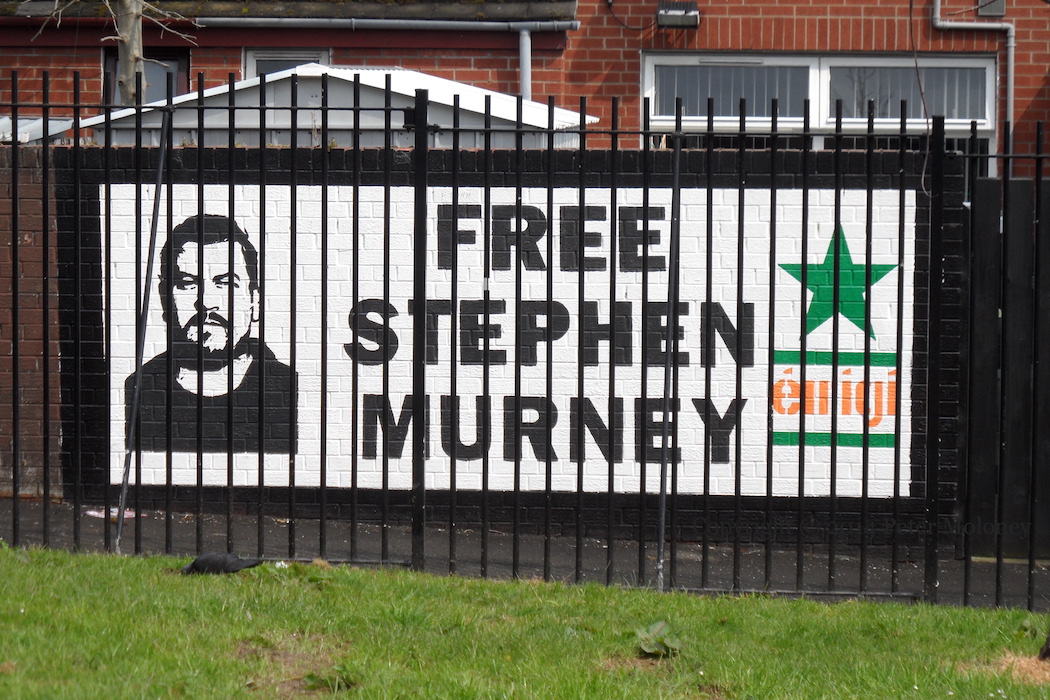
Stephen Murney, an éırígí (web) activist, was released in February after fourteen months in Maghaberry (RN | BBC-NI). This stencil in support of Murney is in the New Lodge, north Belfast. For a gallery of other such pieces from 2013, see Free Stephen Murney.
“Sınn Féın – putting Ireland first / Éıre chun cınn. Vótáıl Mary McConville, Jim McVeigh, toghcheantar na Cuırte / Court”. Local elections will be held on May 22nd, for the newly amalgamated councils (11 rather than 26); the Court district has also changed somewhat – it now includes the [CNR] areas of Clonard and Falls as well as [PUL] Ballygomartin, Forth River, Shankill, and Woodvale (WP).
“Belfast Easter Commemoration 1916 – Sunday 20th April. Assemble Beechmount Ave 1pm, parade leave 1.30 pm sharp. Speaker: Martina Anderson MEP. Honour Ireland’s patriot dead, wear an Easter lily. Cumann Uaıgheann[a] Na Laochra Gael – National Graves Association”
RNU (Republican Network For Unity) mural at the top of Berwick Road (Paráıd An Ardghleanna) featuring the words of Maıréad Farrell, one of the PIRA members shot on Gibraltar.
“Everyone tells me I’m a feminist. All I know is that I’m just as good as others … and that especially means men. I am definitely a socialist and I am definitely a Republican. I believe in a united socialist country, definitely socialist. Capitalism can offer our people nothing and yet that’s the main interest of the British in Ireland.”
The memorial gallery on the right-hand side of Ardilea Close has been expanded from three panels to five (compared to last year/2013) and the first new face is “Charlie Wilson – age 66”.
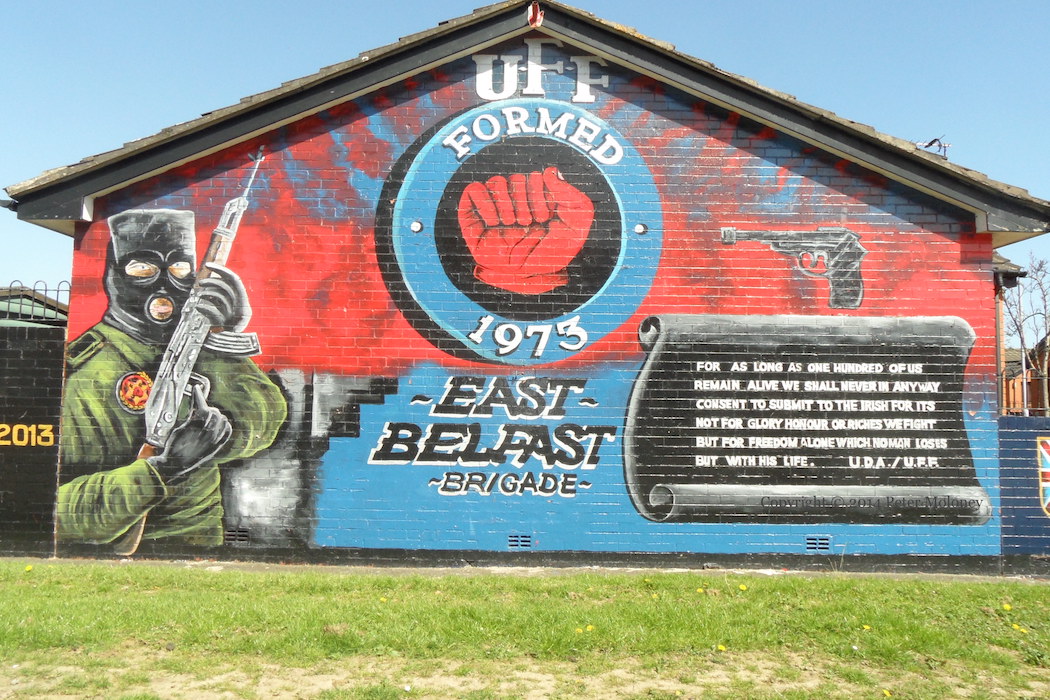
The UFF mural on the first gable of (so-called) Freedom Corner in east Belfast has been repainted many times since the first one took over – in 1991 – from a Gertrude Star mural (D00388). Repaints followed in roughly 2001, 2008, and 2011, now followed by the image shown above. The elements remain as before: a balaclava’d volunteer with assault rifle, the UFF emblem, a pistol, and a modified version of the Declaration of Arbroath: “For as long as one hundred of us remain alive we shall never in anyway consent to submit to the Irish [instead of “English”] for it’s not for glory, honour or riches we fight but for freedom alone which no man loses but with his life – U.D.A./U.F.F”
1ú Caṫlán Oırṫear Tıreoın Óglaıġ Na hÉıreann [more typically “Tír Eoghaın”; 1st battalion east Tyrone IRA]
“Beannaımıs spıorad do-ċlaoıte na laoċra atá ına luı ıns na huıgheanna seo.” [We bless the indomitable spirit of the heroes who are buried in these graves.] “do-ċlaoıte” appears to be a Connacht form of “do-ċloíte”, meaning “indomitable”, “indefatigable” (Focaıl Fholaıthe).
The volunteers named on the various stones are Patrick Kelly, Patrick Vincent, Kevin Murray, Patrick Quinn, Patrick Carty, Seán Loughan, Patrick McDonald.
Murray and McDonald were “killed in action” in 1974 (Fb).
Quinn was “killed in action” in 1973, along with Daniel McAnallen (Fb).
Loughan and Carty were “killed in action”, along with Dermot Crowley, in June 1973 (An Phoblacht).
The flat stone with the phoenix reads: “Romantic Ireland never dies!/O’Leary lies in fertile ground./And songs and spears throughout the years/Rise up where patriot graves are found.”
St Malachy’s churchyard, Coalisland Road, Edendork.
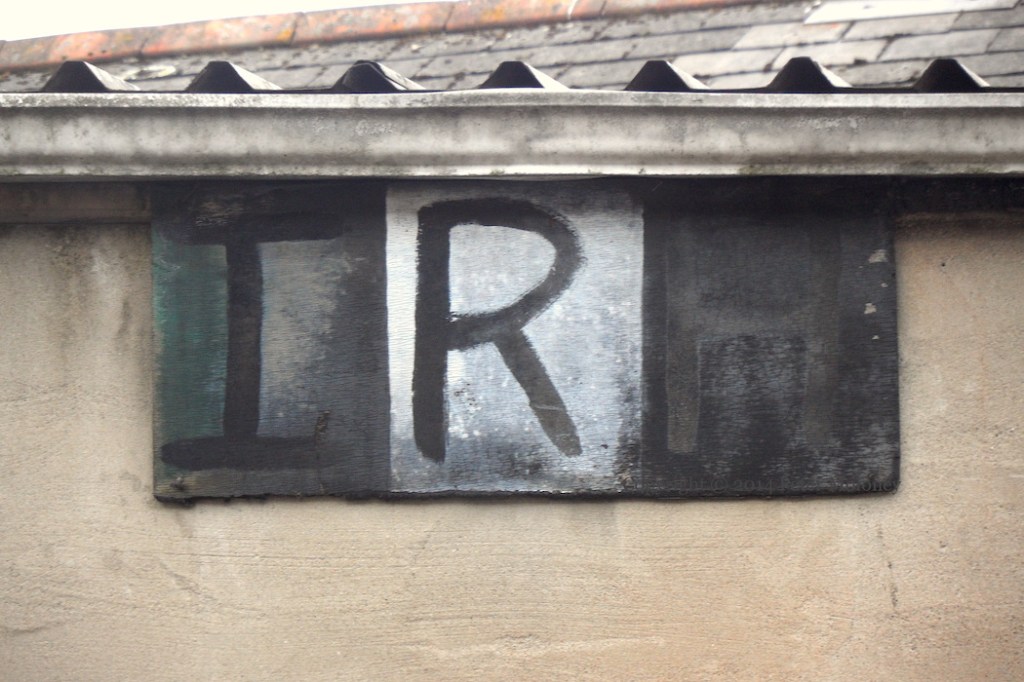
A faded “IRA” board hangs on in the Main Street of Coalisland (at the back of the Canal End bar), perhaps of the same vintage as this PIRA gunman and these PIRA rifles.
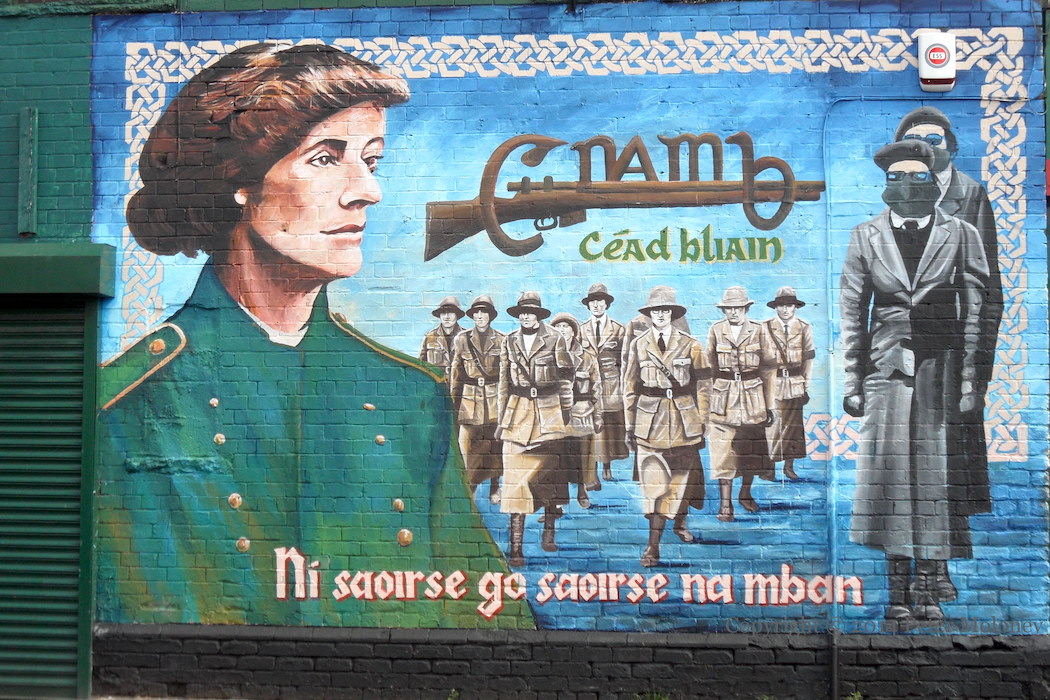
Cumann Na mBan was founded on April 2nd, 1914, and it is being commemorated in various ways, including a mural on Ascaıll Ard na bhFeá/Beechmount Avenue.
Cumann Na mBan was the women’s division of the Irish Volunteers and is best remembered for its role in the Easter Rising of 1916. Its members were involved in the occupation of many locations. Some, including (non-combatant) Winifred Carney, were in the GPO, while Countess Markievicz, the main figure of the mural, was in St. Stephen’s Green. (Here is an RTÉ gallery of vintage photographs, including one of Markievicz surrendering.)
The letters “Cnamb” on a rifle formed the badge of Cumann Na mBan. The Irish “Ní saoırse go saoırse na mban” means “[There is] No freedom until the freedom of women”.