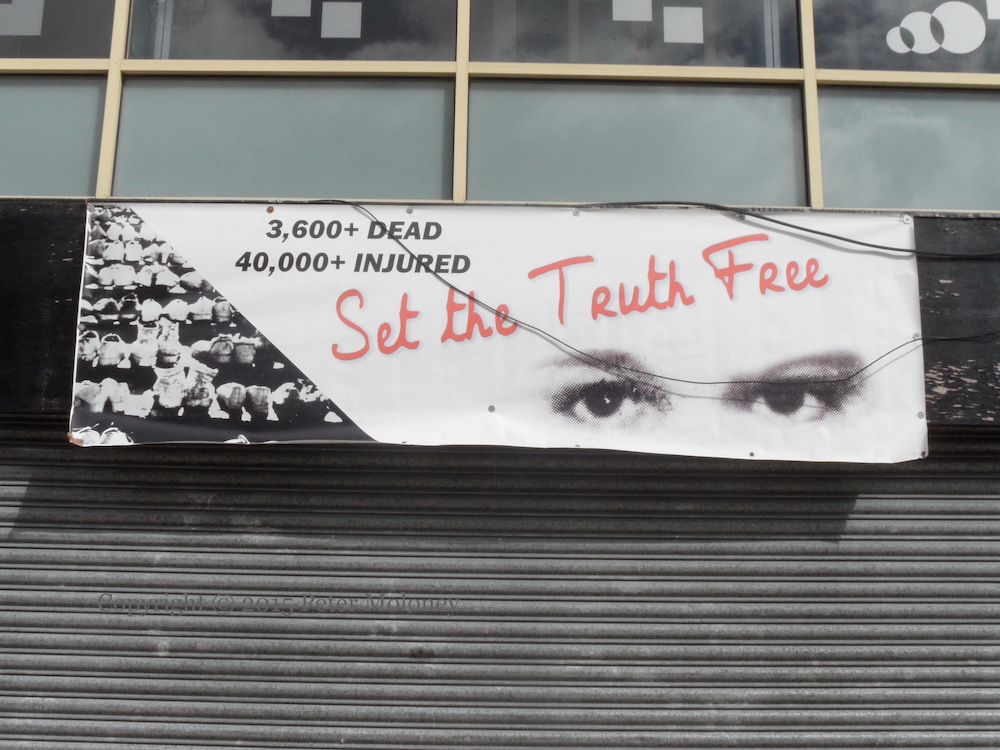
“Set The Truth Free” was the name of a campaign for justice and transparency concerning Bloody Sunday (see An Phoblacht | Pierce Youtube | Bell (2010)) but the numbers cited on this banner – “3,600 dead, 40,000 injured” – refer to the Troubles as a whole.
“Easter Sunday Commemoration 2015 – Sunday April 5th, Westland Street, 2pm sharp, main speakers Gearóıd Ó hEára. Cuımhnıgh ár maırbh thírghrácha [patriotic dead] le bród.”
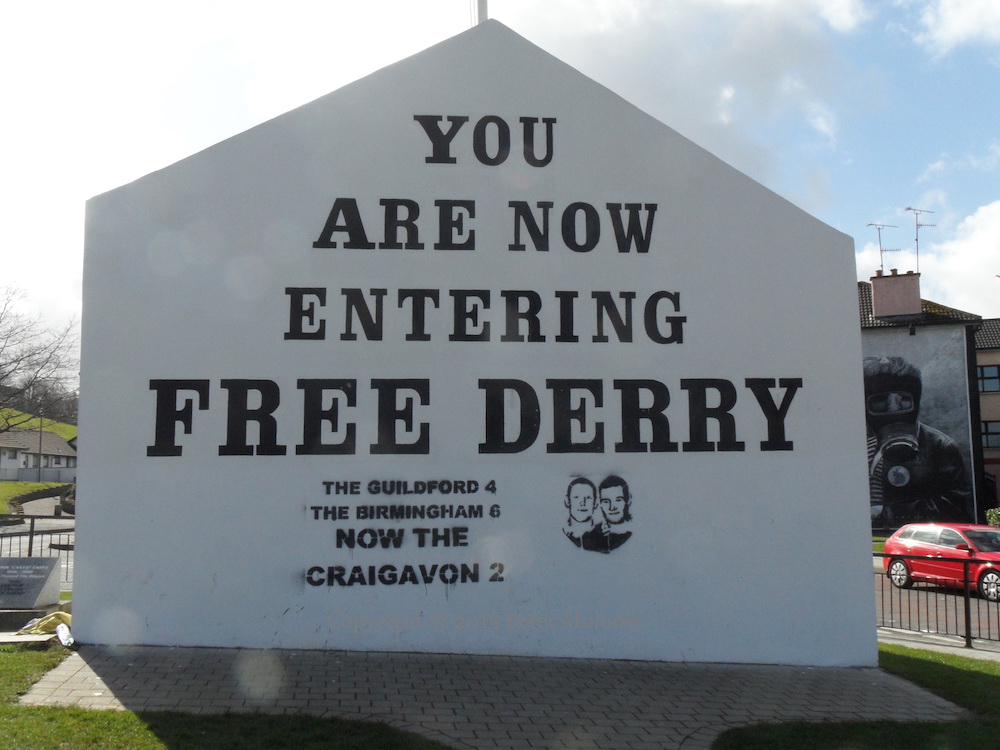
“The Guilford 4, the Birmingham 6, now the Craigavon 2”. “There may be times when we are powerless to prevent injustice, but there must never be a time when we fail to protest.”
The Birmingham 6 were sentenced to life sentences in August, 1975, but their convictions were deemed unsafe in 1991. The Guilford 4 were sentenced in October, 1975, but their convictions were deemed unsafe in 1989. The Craigavon 2 – John-Paul Wootton and Brendan McConville – were sentenced in 2012 to terms of 18 and 25 years, respectively, for the murder of PSNI Constable Steven Carroll; their appeals so far have been thrown out (Hearty 2015 pdf).
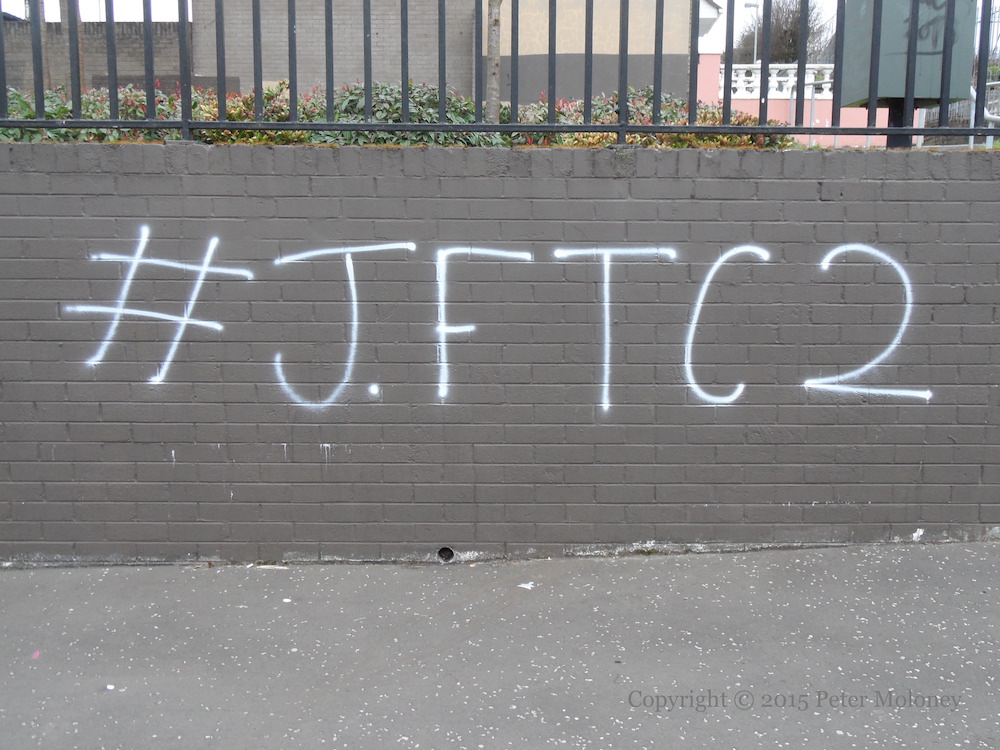
Free Derry Corner, Derry (Visual History). The simple graffiti is in Bishop Street; the other pieces are in the Brandywell.
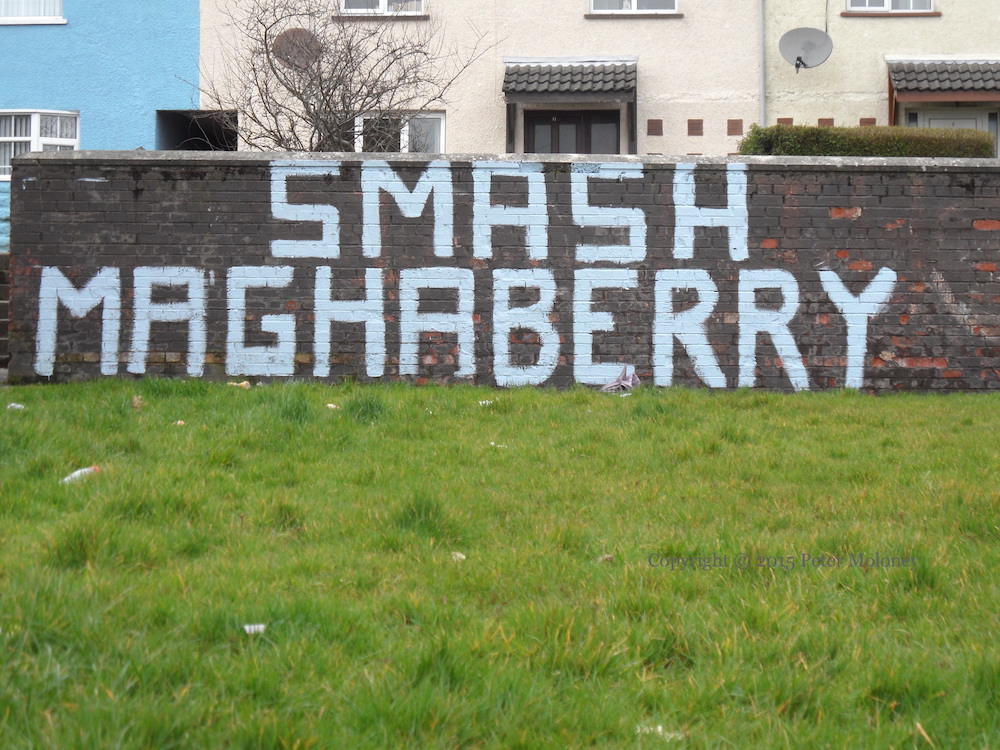
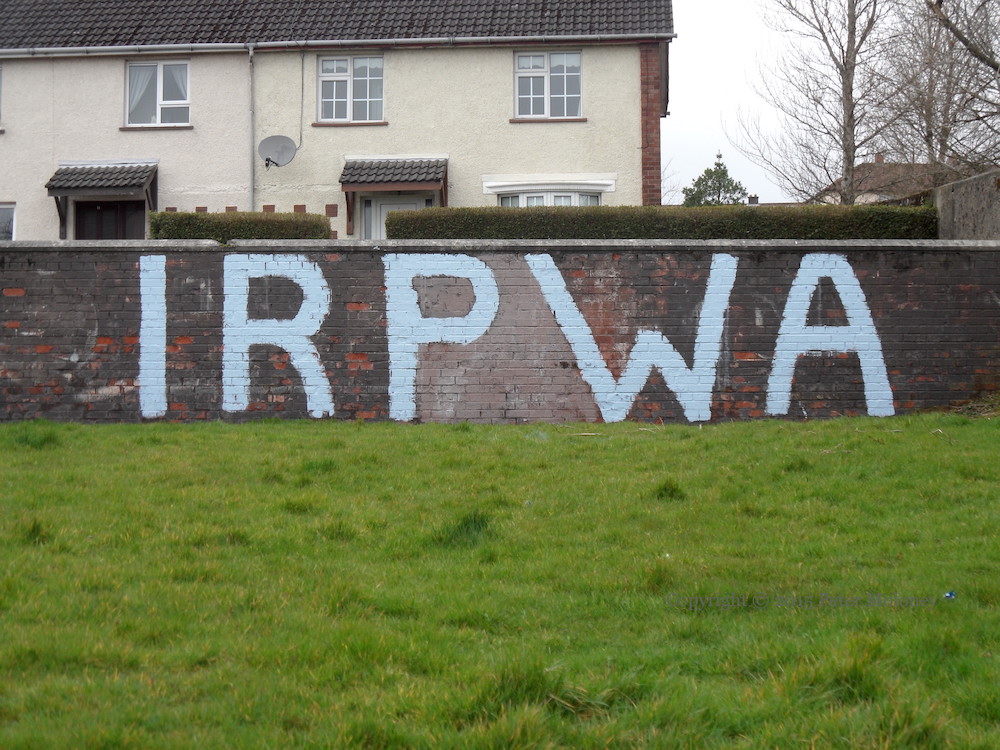
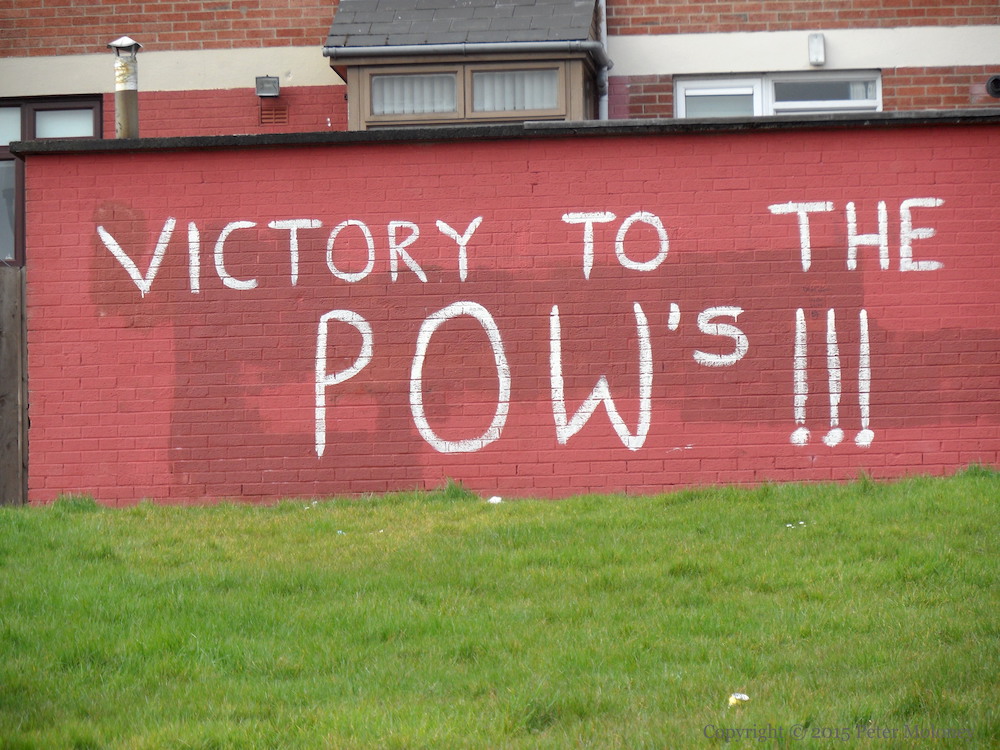
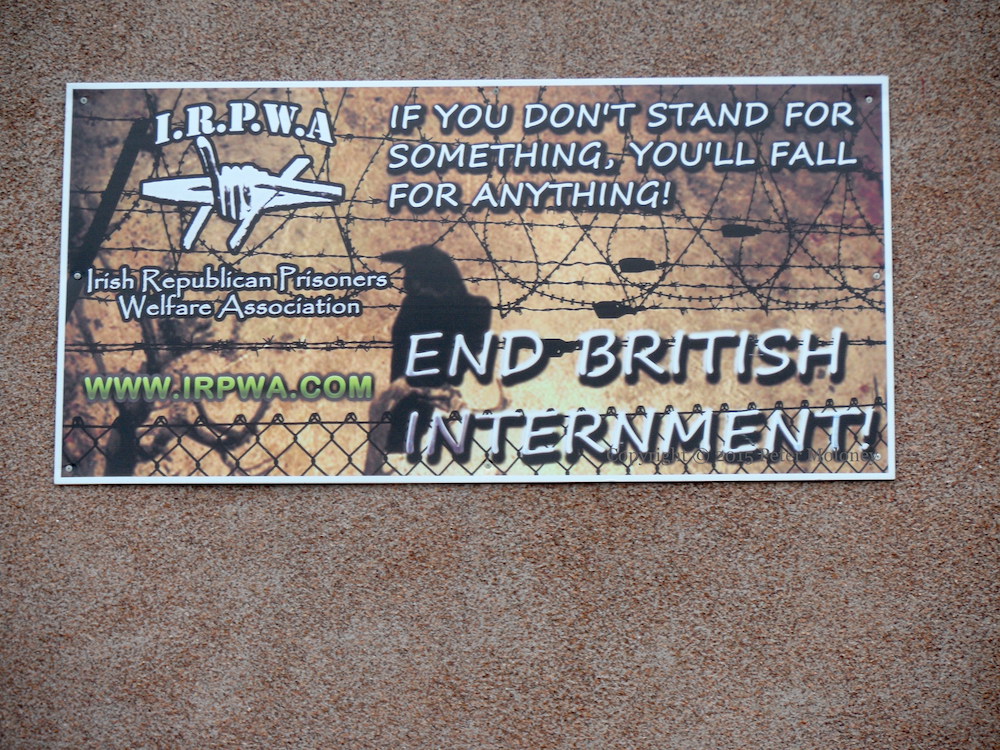
These anti-Agreement graffiti are in Foylehill (mostly Kildrum Gardens and Southway): “Smash Maghaberry”, “IRPWA”, “RUC not welcome in Foylehill”, “Victory to the POWs”, “End British internment”, Tıocfaıdh ár lá”.
The phrase “We only have to be lucky once” is from the IRA statement on the 1984 Brighton hotel bombing (WP).
The final piece dates back to 2009: “Internment 71-09. What has changed? Brits out, not sell out.”
“Attempted criminalisation of republican prisoners is alive and well”: Above is a recent board (erected 2015-01-23) by Republican Network For Unity (RNU)’s Cogús committee in support of “Republican prisoner welfare and support”: “End controlled movement [and] forced strip searches now.”
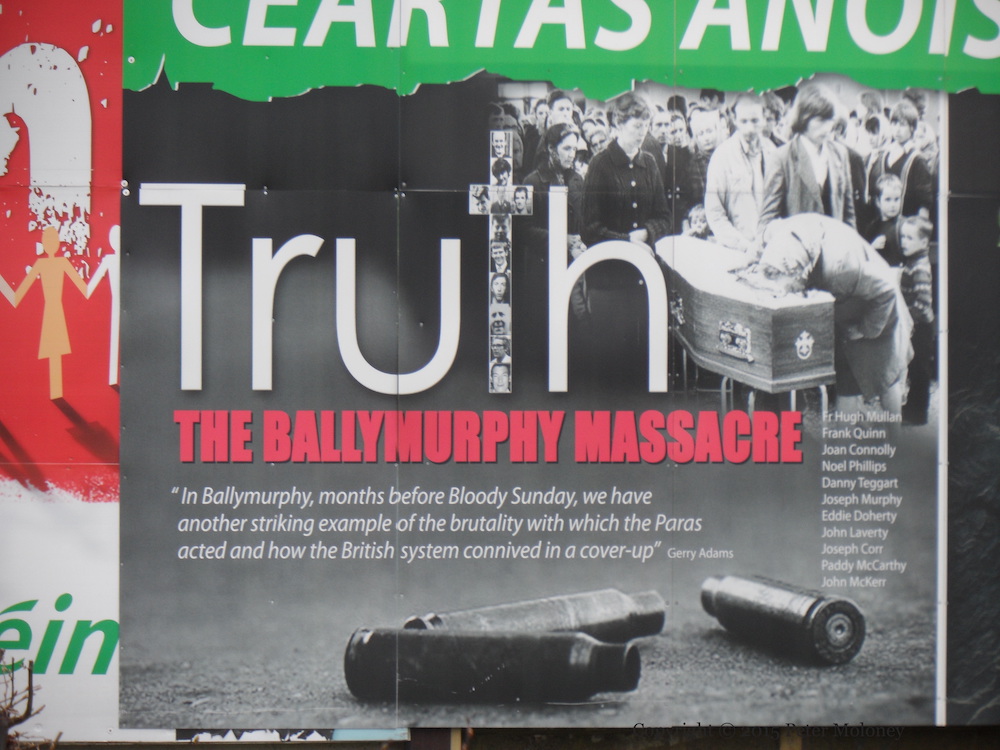
Three different campaigns for inquiries into deaths at the hands of British paratroopers are brought together into a single board on the site of the former Andersonstown RUC station (Visual History): the Ballymurphy Massacre of August, 1971, in which 11 were killed; the Springhill Massacre of July 1972, in which 5 were killed, and the killing of IRA volunteer Pearse Jordan, who, like the others, lived in the greater Ballymurphy area.
Countess Markievicz, carrying a flag of Cumann Na mBan, and Ethel Lynch, carrying a flag of the Derry IRA, take centre stage in the Mná Na hÉıreann mural in London-/Derry/Doıre’s bogside. Markievicz is famous for her role in the Easter Rising of 1916 (WP); Lynch died in December 1974 of injuries sustained when a bomb exploded prematurely. Between them, “Liberty leads the people” waving an Irish Tricolour.
To their left are three Derry women protesting the conditions in Armagh Women’s Prison and in the H-Blocks. This article on Mary Nelis (the protester on the right, with Kathleen Deeny and Theresa Deery) describes the photograph on which this part of the mural is based. The women in Armagh prison were allowed to wear their own clothes and so were not ‘on the blanket’ as their male counterparts in the H-Blocks of Long Kesh were. However, they did engage in a “no wash” protest, which lasted from February 1980 until March 1981, and three of them – Maıréad Farrell, Mary Doyle, and Margaret Nugent – joined the 1980 hunger strike.
To their right (beyond the coffin scene) members of Cumann Na mBan are on parade; the photo of on which this is based can be seen in Mothering Sunday In Beechmount, though the faces have been changed here, presumably to those of more contemporary volunteers.
The figure wearing a cloth cap and holding a rifle is Eithne Coyle, a leader and later president of Cumann Na mBan, imprisoned both by the Black and Tans before the treaty and after it by the Provisional Irish government (WP). For the photograph on which her pose here is based, see An Phoblacht‘s History Of Cumann Na mBan.
In the four corners are circles of Betsy Gray, Anne Devlin, Mary Ann McCracken, and Máıre Drumm. Gray and McCracken were Presbyterians; Gray fought (or at least, was killed) in the 1798 rebellion, as did McCracken’s brother Henry Joy; Mary Ann went on to work for the poor of Belfast and lobby against slavery. Anne Devlin assisted in Robert Emmet’s 1803 rising. (National Graves Assoc) Máıre Drumm was vice-president of Sınn Féın and commander of Cumann Na mBan, who are shown marching on the right-hand side.
“End The Forced Strip Search” – IRPWA (web) board in Westland Street, Bogside, Derry. In the name “Maghaberry” a fist is smashing the enlarged “H”, reminiscent of the ‘Smash H-Block’ campaign of the 70s and 80s.













 Peter Moloney Collection