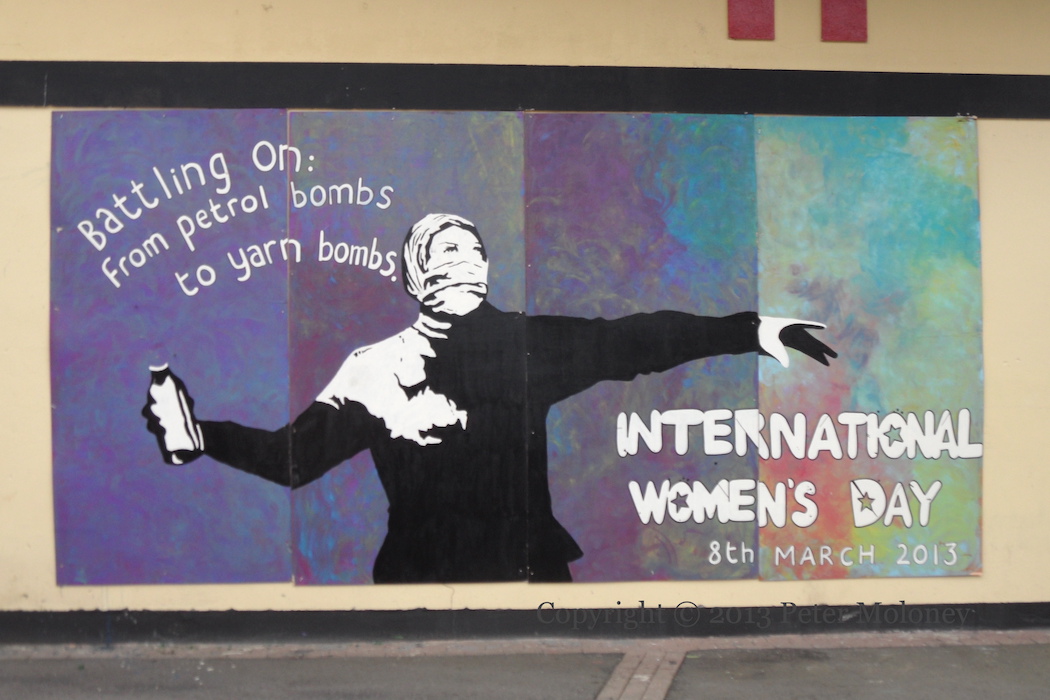
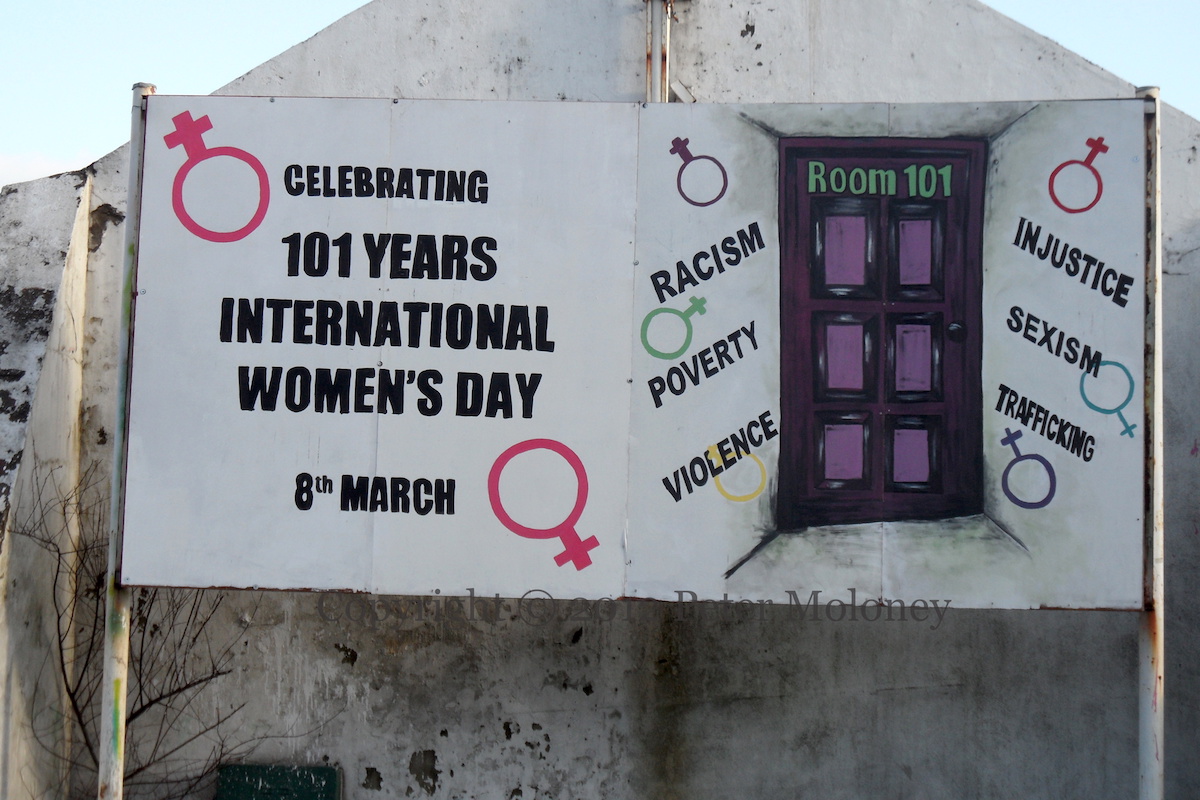
A board in the Bogside for “International Women’s Day, 8th March 2013 – Battling On: From petrol bombs to yarn bombs.” The woman in the painting – in the style of Banksy’s Flower Thrower (also imitated in Bundoran Banksy) – seems to have a petrol bomb rather than a yarn bomb.
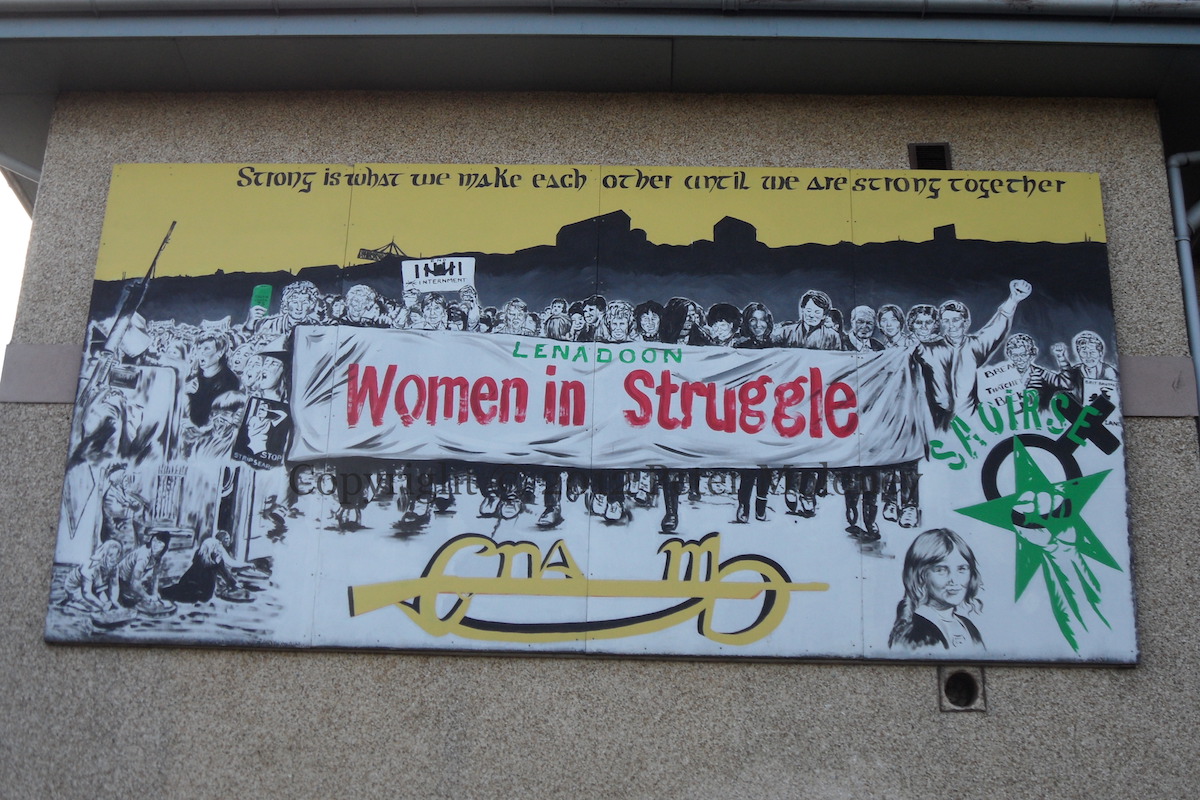
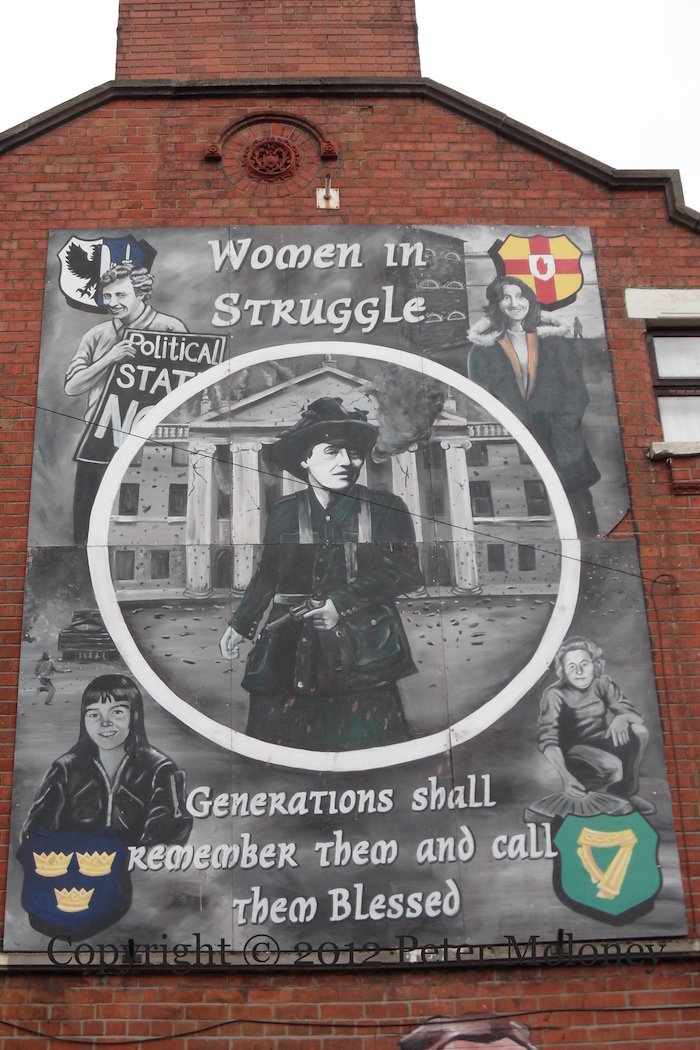
“Strong is what we make each other until we are strong together.” Women in struggle, (clockwise) banging binlids, undergoing strip searches, protesting internment, victims of plastic bullets (Julie Livingstone), fighting in Cumann Na mBan. On the right are the astrological symbol for woman and the republican symbol of “Saoırse” with the green star and fist.
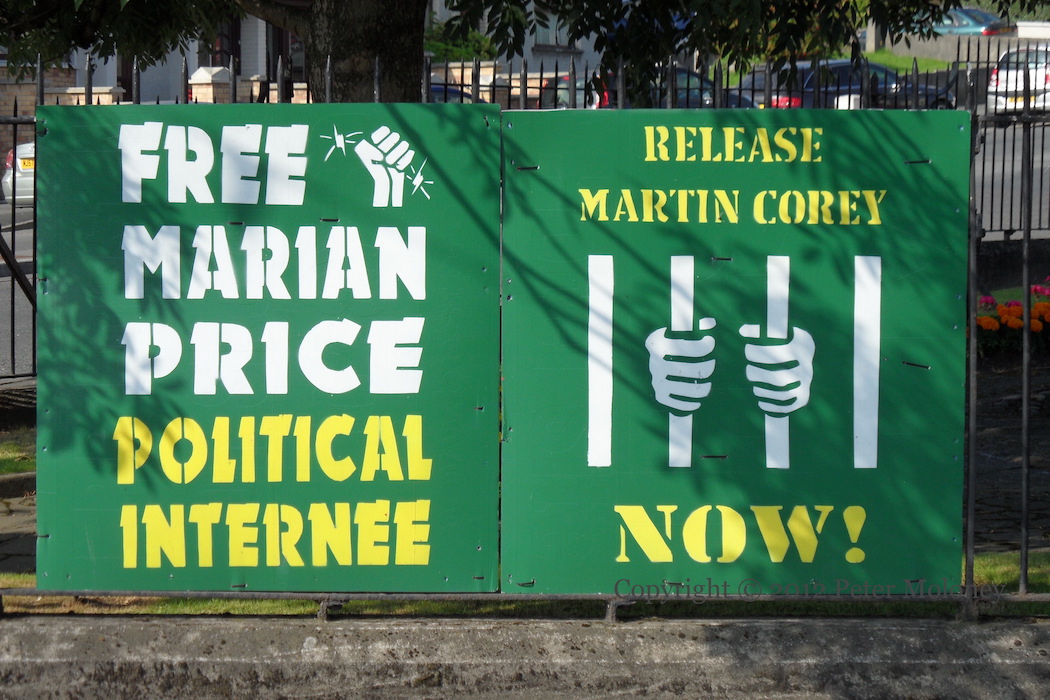
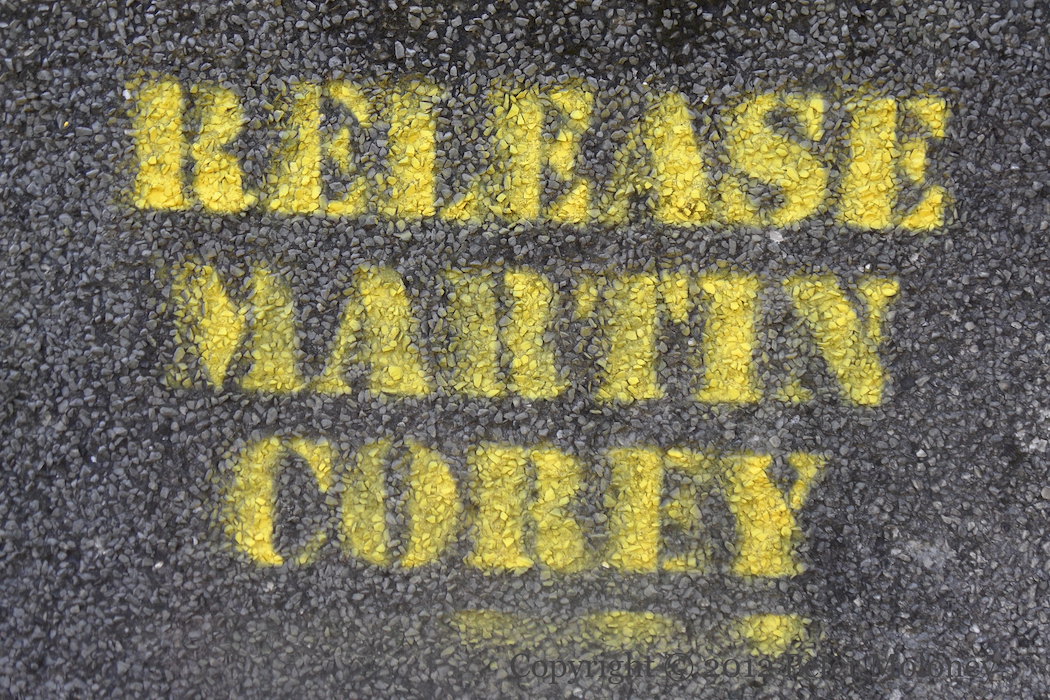
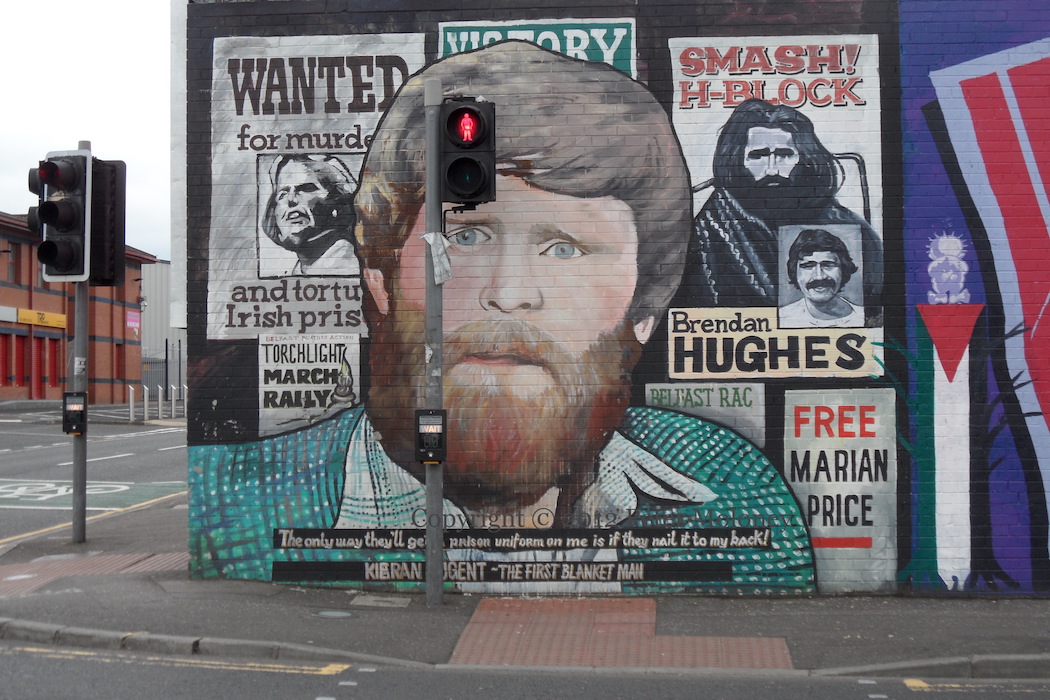
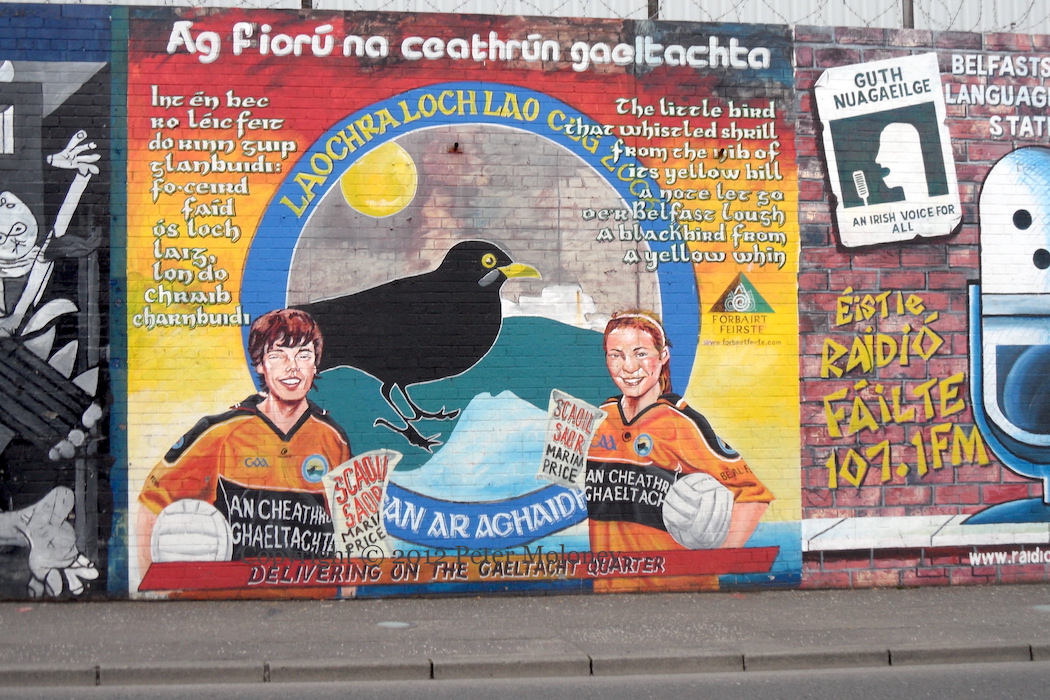
“Free Marian Price – political internee.” “Release Martin Corey now!”
For Price, see Free Marian Price. Martin Corey was returned to prison in 2010 and a 2011 commission ruled that he was a member of the CIRA (WP | Belfast Telegraph).
The Antrim Road at Carlisle Circus also bears the street-name ‘Winifred Carney Road’, given as part of the ‘Naming Our Streets’ project. Carney’s name was chosen for this location – SIPTU offices – because she was a trade unionist and also because she grew up on Carlisle Circus. The project celebrates 50 historically important Belfast women, seven of whom were honoured in this way (Women’s Resource & Development Agency).
“The British government has no right in Ireland, never had any right in Ireland, and never can have any right in Ireland.” (Last Statement, 1916)
“James Connolly 1868-1916 James Connolly was born in June 5th 1868. In 1810 he became organiser for the Irish Transport And General Workers Union in Belfast. In 1913 he co-founded the Irish Citizen Army. He was one of the signatories of the 1916 Proclamation and commanded HQ in the GPO during the 1916 Rising. He was executed by the British on May 12th 1916.”
“Nora Connolly O’Brien 1893-1981 Nora Connolly was the 2nd daughter of James Connolly. Nora was a member of Cumann Na mBan and the Gaelic League in Belfast. She played an organisational role in the ICA in the run up to the 1916 Rising. She was a trade unionist and remained so throughout her life.”
This is a second painting of the ‘Women In Struggle’ board in the Rock streets, using the same layout and figures as before. The original was seen previously in 2002.
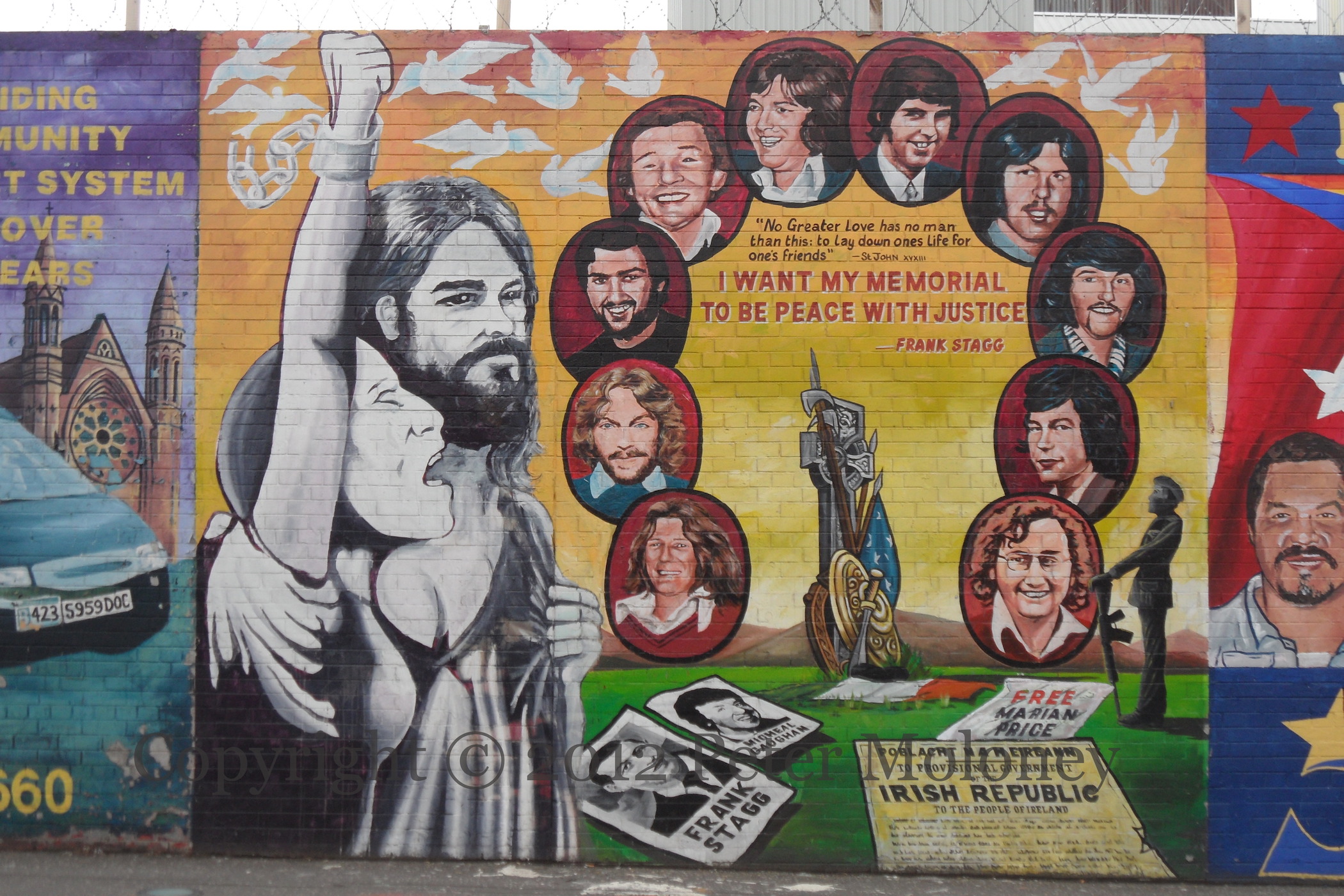
The Maghaberry/Strip Searches mural did not have a painted poster added to it but (as can be seen in Street View) it did have a placard added to the bottom reading “Justice for Marian Price” – this difference is because this mural is under the control of anti-Agreement republicanism rather than pro-Agreement republicanism/Sınn Féın. (The same placard was also mounted in three places in the barbed wire above the wall – see the final image and the Street View link.)
The Guernica mural was left untouched, perhaps for aesthetic reasons, perhaps because it had outside funding.
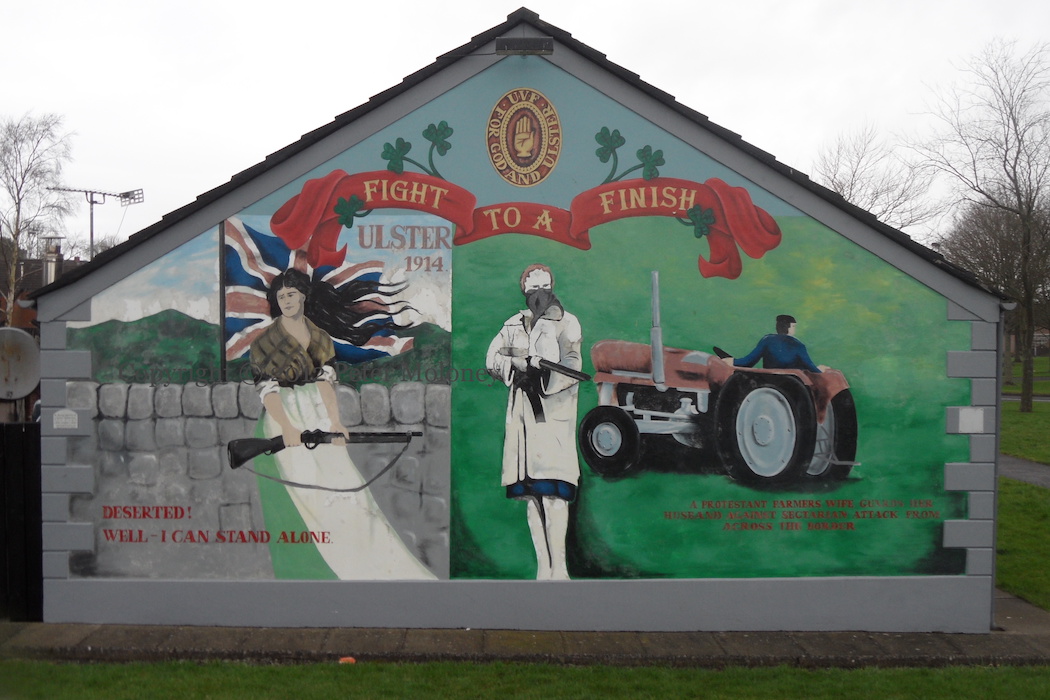
This is the updated version of a mural seen previously in 2007. The main panels remain the same, but the apex has been changed from Orange Order flag and St Andrew’s Saltire to a ribbon read “Fight to a finish”, with shamrocks.
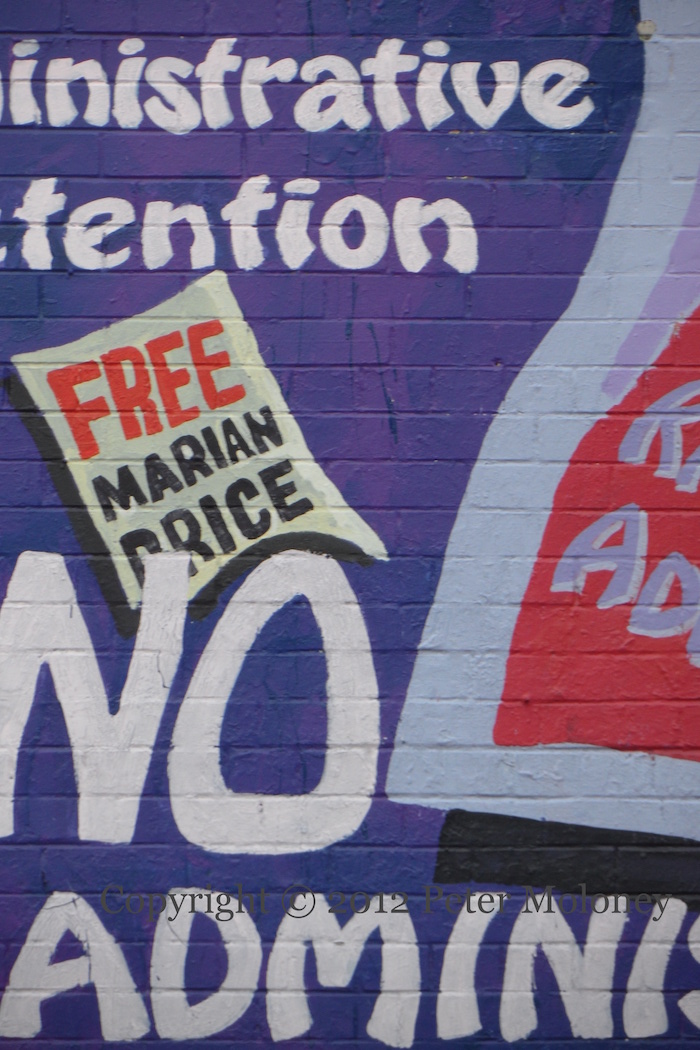
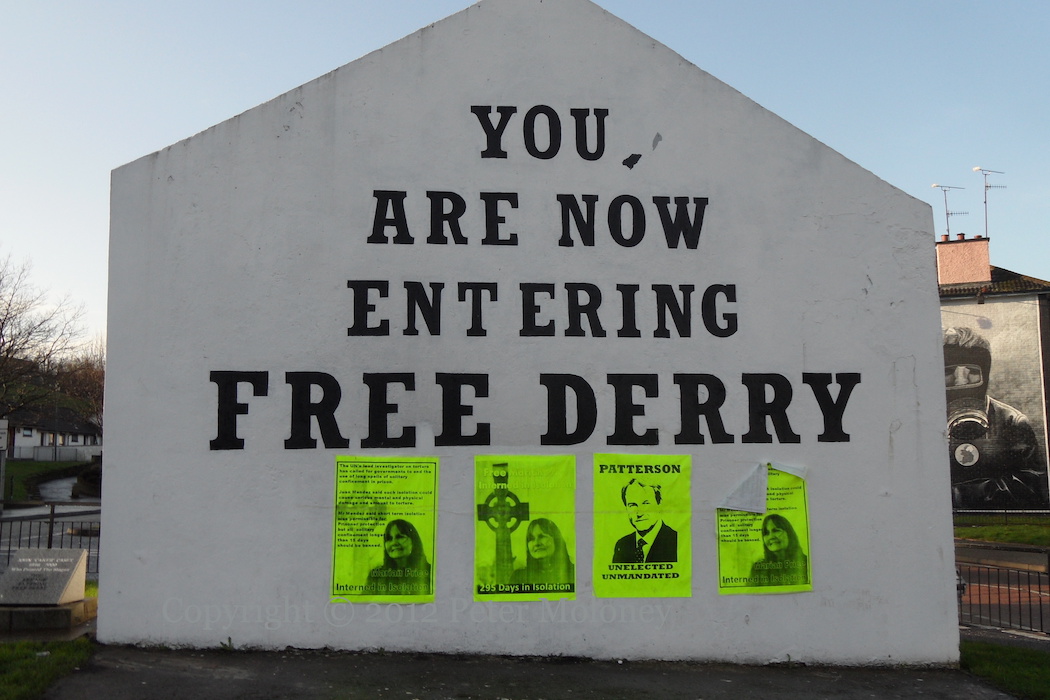
Room 101 was a torture chamber in the Ministry of Love in George Orwell’s novel 1984. For women, the trials include racism, poverty, violence, injustice, sexism, trafficking. On the front side are posters protesting Marian Price‘s 295 days in isolation.
Abolitionist mural with quotes from Douglass (“It is easier build strong children than to repair broken adults.”), Abraham Lincoln (“As I would not be a slave, so I would not be a master. This expresses my idea of democracy.”, Angela Davis (“We have to talk about liberating minds as well as liberating society.”), Muhammad Ali (“Why should I drop bombs on brown people in Vietnam while so-called negro people in Louisville are treated like dogs …”), Steven Biko (“The most potent weapon of the oppressor is the mind of the oppressed.”), MLK (“I have a dream … black men and white men, Jews and Gentiles, Protestants and Catholics, will be able to join hands and sing in the words of the old Negro spiritual, “Free at last, free at last! Thank God Almighty, we are free at last.””), Bob Marley (“Until the basic human rights are equally guaranteed to all without regard to race.”), Nelson Mandela (“For to be free is not merely to cast off one’s chains but to live in a way that respects and enhances the freedom of others.”), Paul Robeson “The artist must elect to fight for freedom or for slavery. I made made [sic] my choice. I had no alternative”, and (without attribution) James Connolly (“The worker is the slave capitalist society, the woman [female worker] is the slave of that slave.”) Also portrayed are Harriett Tubman, Barack Obama, Betty Sinclair, Mary Ann McCracken, Aung San Suu Kyi, the Haitian Revolution, Chief Joseph, El Salvador, CoMadres.








 Peter Moloney Collection