The central image of soldiers at the battle of the Somme is surrounded by images of various occupations: shipyard workers and miners (perhaps), along with images of women welding, carrying coke, and nursing. It’s not clear what the “fair wartime wage” refers to: there was a general strike at the shipyards in 1919 (The Great Unrest | Workers’ Liberty).
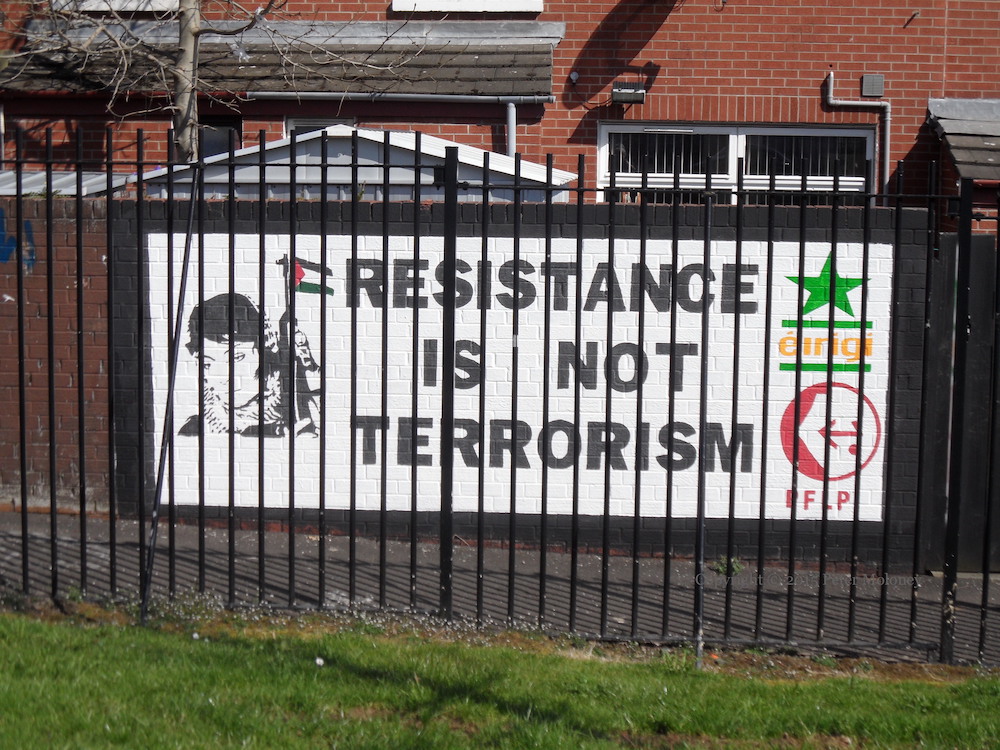
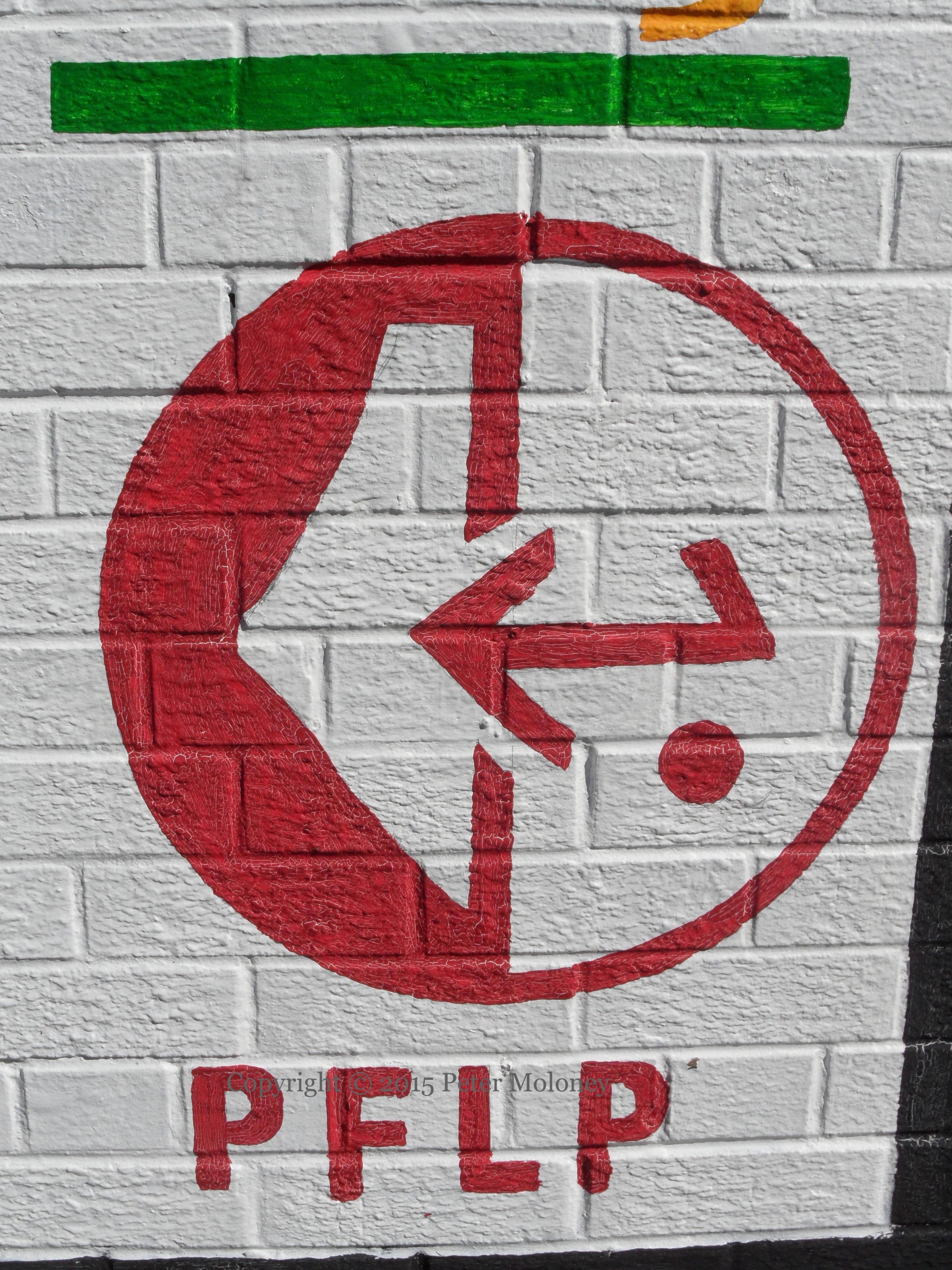
“Viva Palestine”. This pro-Palestine mural features sky-jacker Leila Khaled (also seen in in Hugo Street) and the emblem of the Popular Front For The Liberation Of Palestine (WP). The Arabic on the right is an equivalent of “Tıocfaıdh ár lá” on the left.
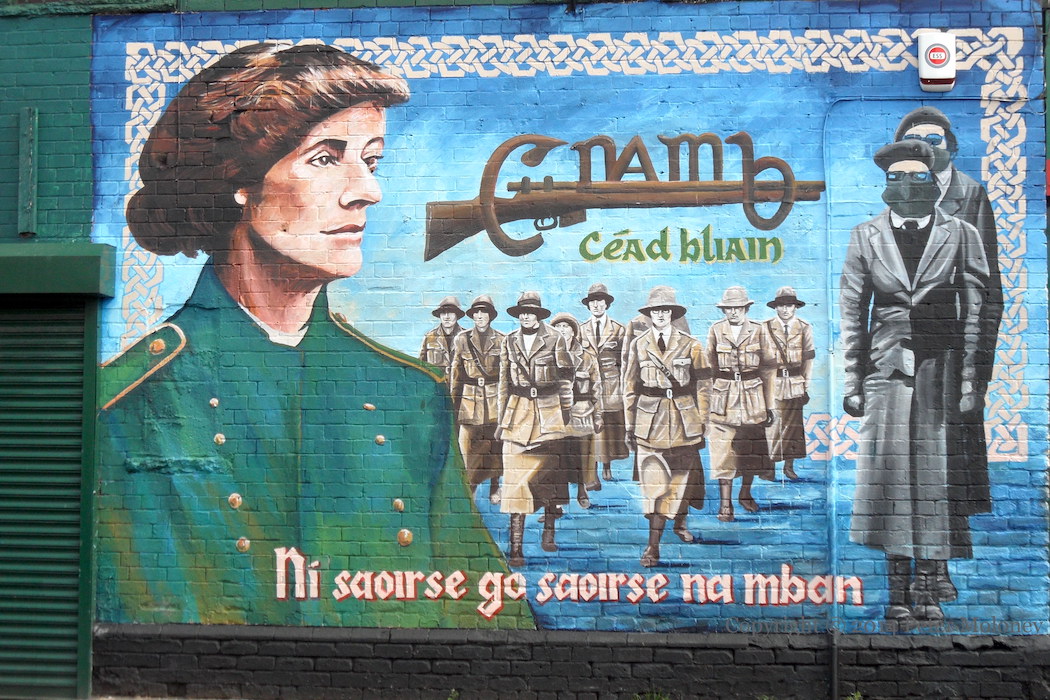
“Cumann Na mBan” in Irish is “the women’s organization/council/society” in English. The organization in question is the republican paramilitary group which was founded on April 2, 1914 and celebrated its 100th anniversary in 2014.
The mural is at the bottom of Teach Na bhFıann/Fianna House (formerly Dill House) in the New Lodge.
Countess Markievicz, carrying a flag of Cumann Na mBan, and Ethel Lynch, carrying a flag of the Derry IRA, take centre stage in the Mná Na hÉıreann mural in London-/Derry/Doıre’s bogside. Markievicz is famous for her role in the Easter Rising of 1916 (WP); Lynch died in December 1974 of injuries sustained when a bomb exploded prematurely. Between them, “Liberty leads the people” waving an Irish Tricolour.
To their left are three Derry women protesting the conditions in Armagh Women’s Prison and in the H-Blocks. This article on Mary Nelis (the protester on the right, with Kathleen Deeny and Theresa Deery) describes the photograph on which this part of the mural is based. The women in Armagh prison were allowed to wear their own clothes and so were not ‘on the blanket’ as their male counterparts in the H-Blocks of Long Kesh were. However, they did engage in a “no wash” protest, which lasted from February 1980 until March 1981, and three of them – Maıréad Farrell, Mary Doyle, and Margaret Nugent – joined the 1980 hunger strike.
To their right (beyond the coffin scene) members of Cumann Na mBan are on parade; the photo of on which this is based can be seen in Mothering Sunday In Beechmount, though the faces have been changed here, presumably to those of more contemporary volunteers.
The figure wearing a cloth cap and holding a rifle is Eithne Coyle, a leader and later president of Cumann Na mBan, imprisoned both by the Black and Tans before the treaty and after it by the Provisional Irish government (WP). For the photograph on which her pose here is based, see An Phoblacht‘s History Of Cumann Na mBan.
In the four corners are circles of Betsy Gray, Anne Devlin, Mary Ann McCracken, and Máıre Drumm. Gray and McCracken were Presbyterians; Gray fought (or at least, was killed) in the 1798 rebellion, as did McCracken’s brother Henry Joy; Mary Ann went on to work for the poor of Belfast and lobby against slavery. Anne Devlin assisted in Robert Emmet’s 1803 rising. (National Graves Assoc) Máıre Drumm was vice-president of Sınn Féın and commander of Cumann Na mBan, who are shown marching on the right-hand side.
“Derry women made more than shirts – they made communities”.
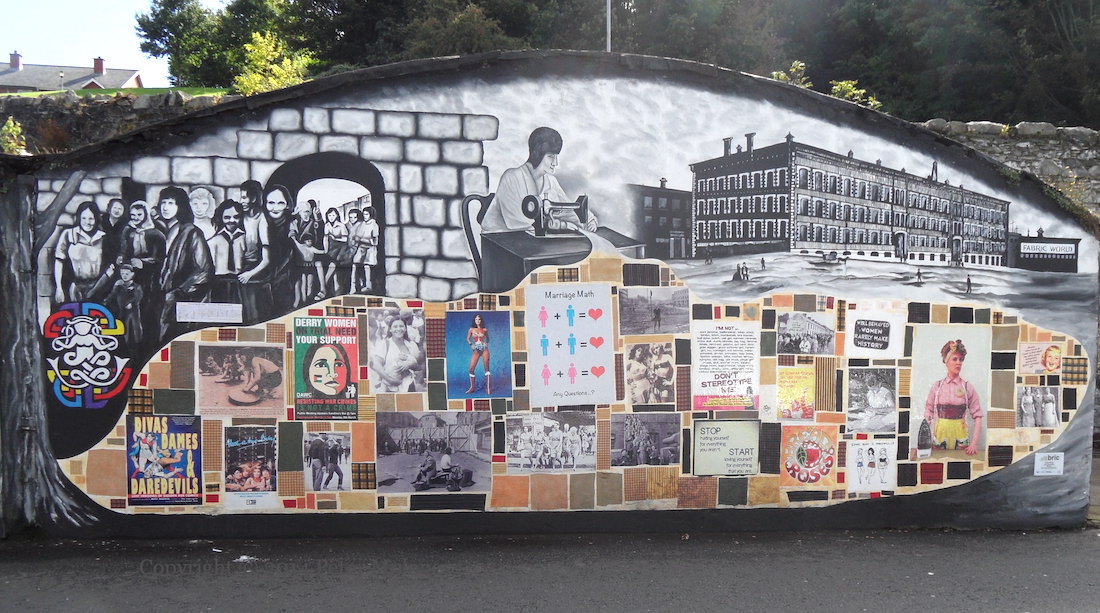
Here is a Derry mural celebrating the role of women in society, both locally and world-wide.
On the left of the main panel, women march out of one of the city’s gates. The information sheet reads as follows: “On International Women’s Day, March 8th [1991, not 1981 as the hand-written addition suggests], the first ever women’s mural in Derry was unveiled on the back of Free Derry Wall. It was designed and painted by Patricia Hegarty and Joe Coyle, and helpers, both men and women. The mural takes its inspiration from a march in November 1968, after Minister for Home Affairs Bill Craig banned all civil rights marches in the walled city. Women factory workers walked out and spent the afternoon marching in and out of every gate in the city, deliberately “breaking the ban”. Men marched in from DuPont to join them, and a rally was held in the Diamond. In the mural you can find the faces of some of those marching on that historic day, as well as other women who played their part in the ongoing struggle for justice. Civil rights workers Bridget Bond and Women’s Aid refuge founder Cathy Harkin march alongside republicans such as Ethel Lynch, Bridget Sheils, Peggy Derry, prisoners’ rights activists Susie Coyle, and many others. You may find images of your granny, sister or aunt. The mural is dedicated to all those women whose energy and determination have changed their lives and the world about them.”
The board on FDC can be seen in Woods’s Seeing Is Believing?, plate 19.
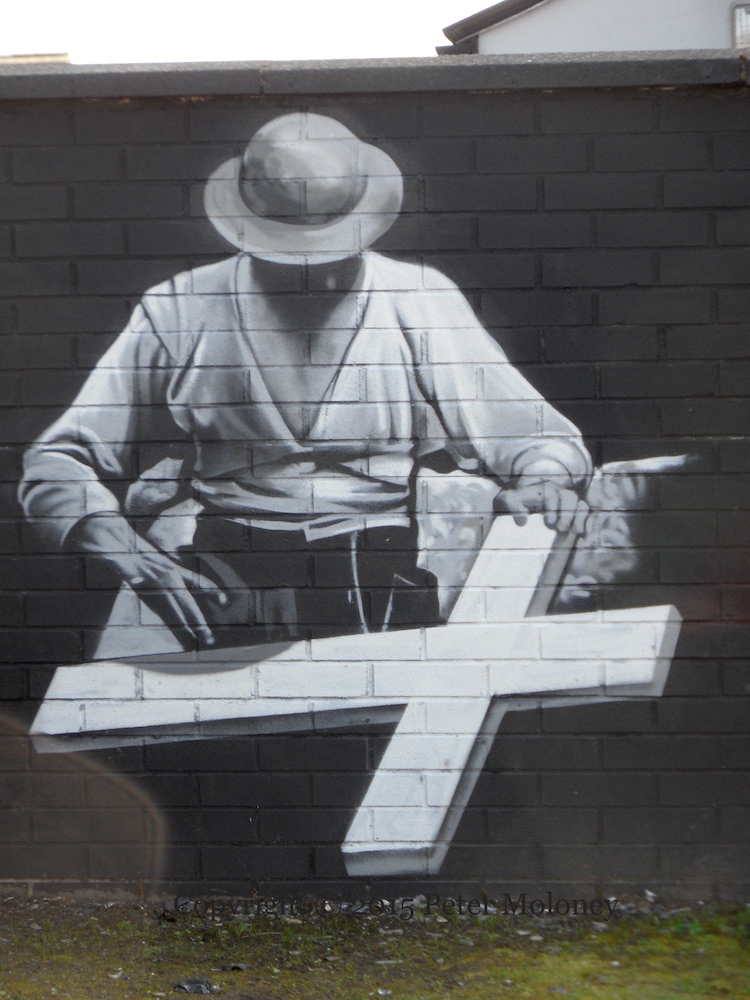
In the centre of the main panel, a tapestry of images and posters is being sewn by a woman at a sewing-machine in one of Derry’s large shirt- and collar-making factories (one of which, attached to “Fabric World”, is shown on the right).
The tapestry includes flyers/posters of local women banging bin lids at the death of Tom McElwee, marching past the ‘Free Derry’ slogan on Free Derry corner, striking, and protesting; there are also posters supporting Palestine and gay rights, celebrating femininity, and one of Wonder Woman.
This is an interesting set of images from Main Road, Moygashel.
The first three employ familiar imagery of the UVF and the 36th Division (the Home-Rule era “Deserted! Well – I Can Stand Alone” is less familiar but goes back to at least 1988; the UVF flag also references the anti-Home Rule movement in the “1912” date of the founding of the Ulster Volunteers).
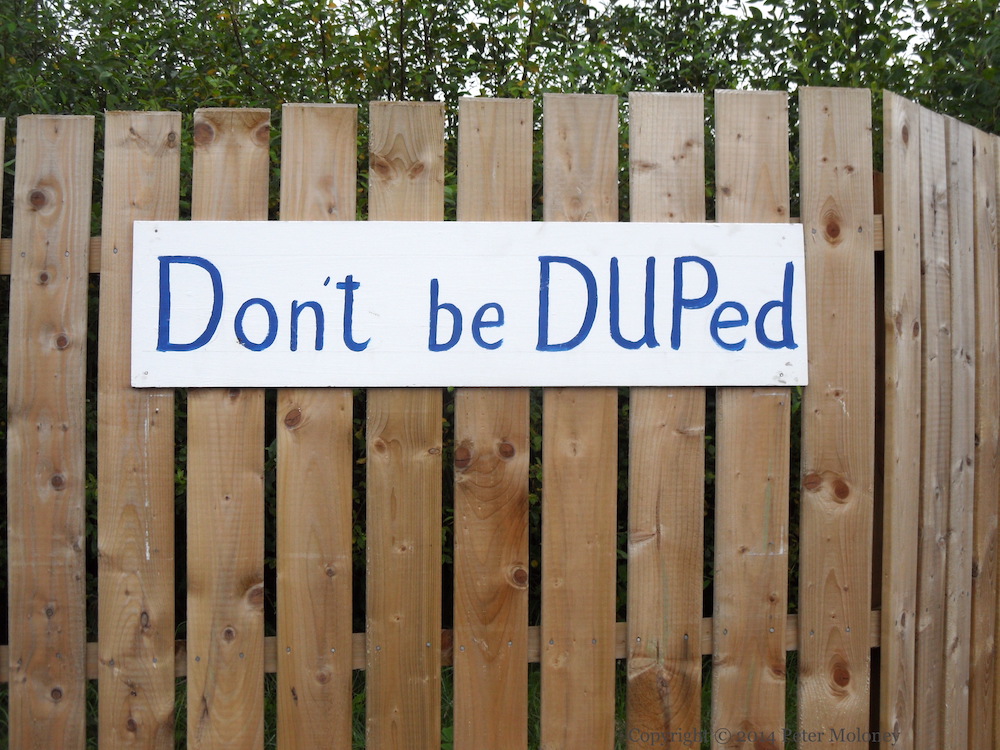
The stencil (“It is not racist to protect your own community”) and hand-painted board (“Don’t be DUPed”) indicate a recent change in attitudes.
In the May elections for the European Parliament, UKIP received the most votes and the most seats (24), campaigning on an anti-immigrant and Euro-skeptical message; this is its best electoral performance to date (WP). Perhaps in response to UKIP’s increasing popularity, Conservative leader David Cameron last year (2013) promised (gov.uk) a referendum on EU membership, should the Conservatives be elected in next year’s (2015) general election.
The source of dissatisfaction with the DUP is less clear. The party won the largest number of seats in the local elections in May (WP).
These are perhaps the first appearance in the Peter Moloney Collection of both sentiments.
RNU (Republican Network For Unity) mural at the top of Berwick Road (Paráıd An Ardghleanna) featuring the words of Maıréad Farrell, one of the PIRA members shot on Gibraltar.
“Everyone tells me I’m a feminist. All I know is that I’m just as good as others … and that especially means men. I am definitely a socialist and I am definitely a Republican. I believe in a united socialist country, definitely socialist. Capitalism can offer our people nothing and yet that’s the main interest of the British in Ireland.”
Cumann Na mBan was founded on April 2nd, 1914, and it is being commemorated in various ways, including a mural on Ascaıll Ard na bhFeá/Beechmount Avenue.
Cumann Na mBan was the women’s division of the Irish Volunteers and is best remembered for its role in the Easter Rising of 1916. Its members were involved in the occupation of many locations. Some, including (non-combatant) Winifred Carney, were in the GPO, while Countess Markievicz, the main figure of the mural, was in St. Stephen’s Green. (Here is an RTÉ gallery of vintage photographs, including one of Markievicz surrendering.)
The letters “Cnamb” on a rifle formed the badge of Cumann Na mBan. The Irish “Ní saoırse go saoırse na mban” means “[There is] No freedom until the freedom of women”.