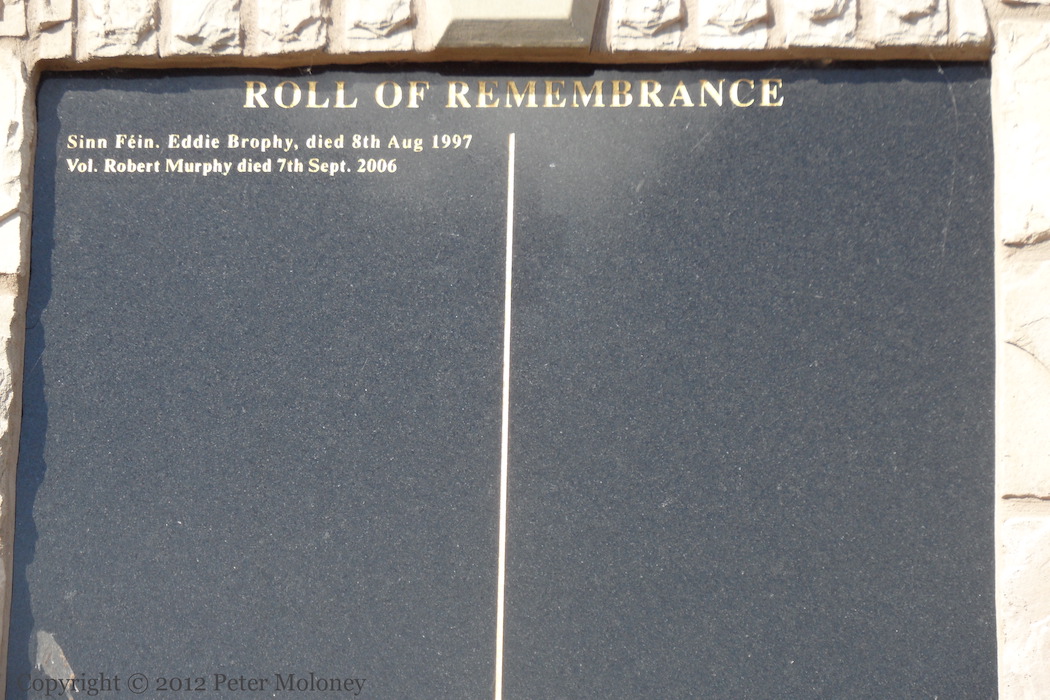
“I ndıl chuımhne: fuaır sıad bás ag troıd ar son saoırse agus muıntır na hÉıreann. In proud memory of the volunteers of Óglaıgh Na hÉıreann and dedicated friends of the republican movement from the greater Turf Lodge area who died fighting for the establishment of a socialist republic. … Go ndéanfar cuımhne orthú go deo. ‘Carry on. No matter what odds are against you, no matter what the enemy call you, no matter what torments are inflicted on you, the road to freedom is paved with suffering, hardships and torture, carry on, my gallant comrades, until that certain day’ – Tom Williams. We also remember the civilians who were murdered by British crown forces, loyalist extremists, and enemies of Ireland.”
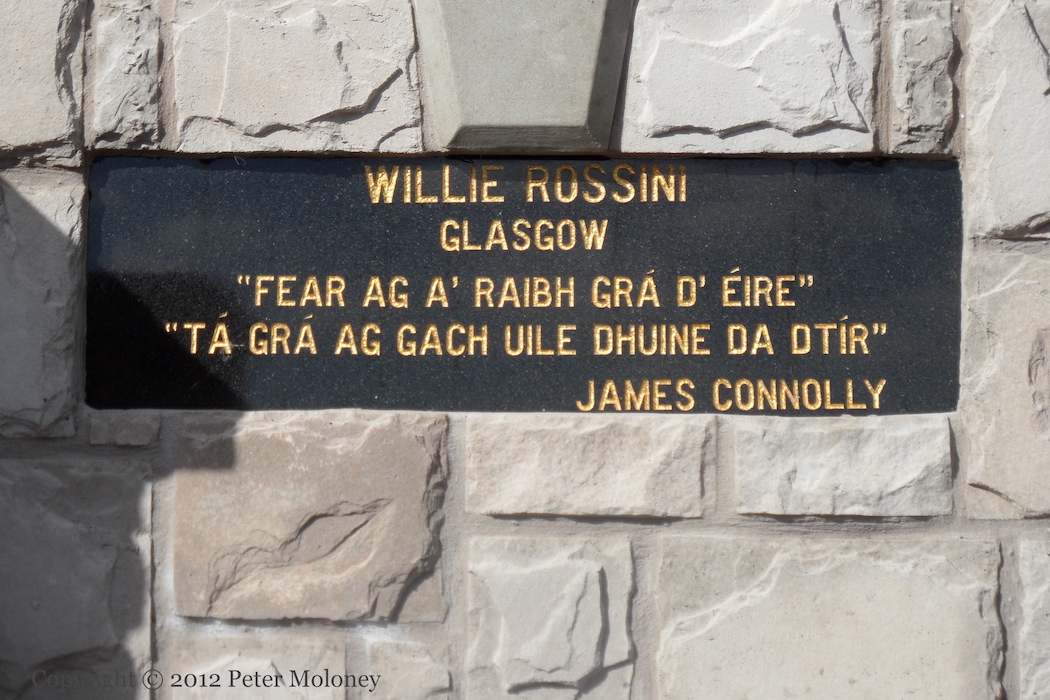
The main panel, memorial plaque to Willie Rossini of Glasgow, and the dedication plaque – by Lily Fitzsimons, a local activist (dating back to the Relatives Action Committees) and SF councillor, were seen previously in 1999. The other three plaques are new. (“Neamhfholaıgh” seems to be a conjunction of translations of the English words “un” and “cover”; the Irish for the verb “to bare” (or as here,”unveil”) is “nocht”.)
“H-Block 1981, Maghaberry 2012”, “End forced strip searches”, “End controlled movement”, “Stop the torture of Irish political prisoners.”
The “August 2010 Agreement” is an agreement reached between prisoners and authorities about treatment in Roe House, an exclusively republican wing in Maghaberry. The tower beyond is the Springfield Rd police station.
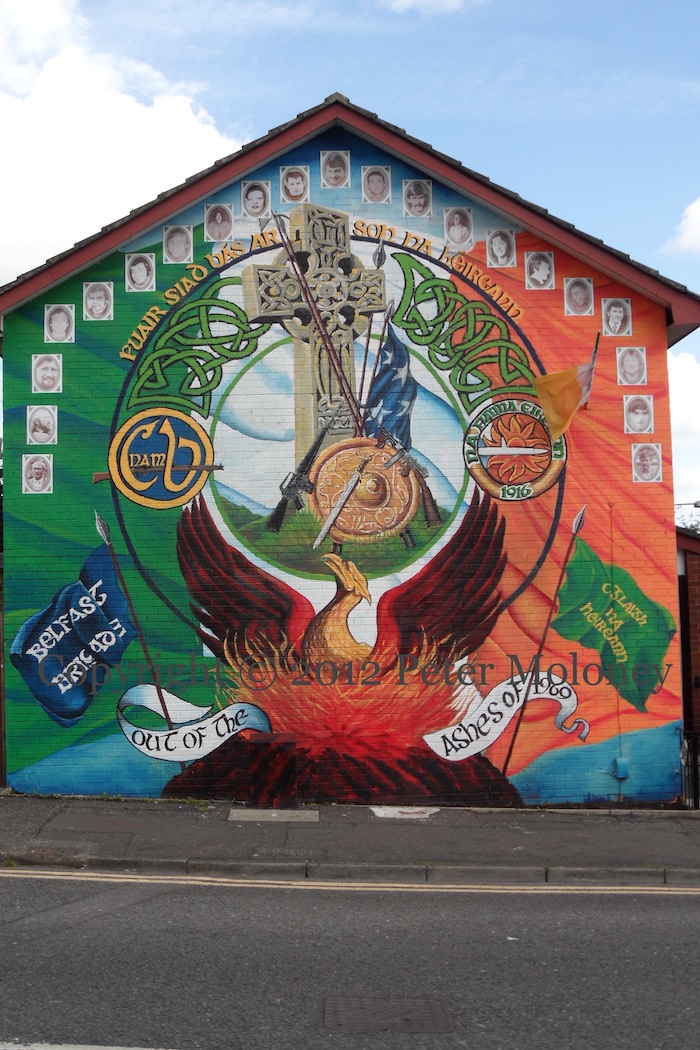
The scroll reads “Out of the ashes of 1969” arose the Provisional IRA, but the lineage is a long one and all but one of the organisations, events, and arms depicted here precede 1969: Cumann Na mBan, Na Fıanna Éıreann, Óglaıgh Na hÉıreann, a Celtic shield and sword, a pike (from the 1798 Rebellion), a Thompson gun, the Tricolour; only the assault rifle is modern and perhaps also is meant to indicate the Provisionals, Belfast Brigade. “Fuaır sıad bás as son saoırse na hÉıreann.”
Jim O’Neill was killed in February 1976 during an IRA arson attack on a furniture warehouse on the Antrim Road near the New Lodge – Gerry Fitt’s house next door might have been the ultimate target (Belfast Child); Robert Allsopp appears to have accidentally shot himself in March 1975 (Irish Peace Process). Both were members of Na Fıanna. The flute band (Fb) is named in their memory.
Below the portraits of Jim O’Neill and Robert Allsopp is written “Glaıne ınár cgroí, neart ınár ngéaga, beart de reír [réır] ar [ár] mbrıathar.” [Purity in our hearts, strength in our limbs, action consistent with our words]
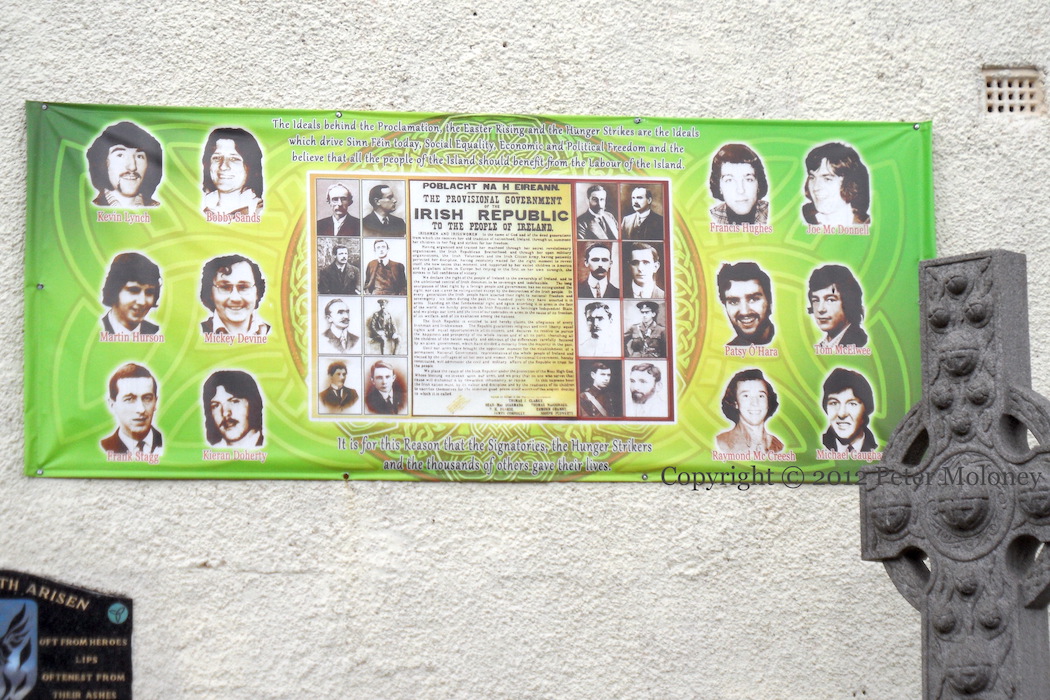
A tarp is added to the Ardoyne memorial garden putting the 12 deceased hunger strikers from the modern Troubles alongside those who were executed for their part in the Easter Rising. “The ideals behind the Proclamation, the Easter Rising and the hunger strikes are the ideals which drive Sınn Féın today, social equality, economic and political freedom and the believe [sic] that all the people of the island should benefit from the labour of the island. It is for this reason that this signatories, the hunger strikers and the thousands of others gave their lives.”
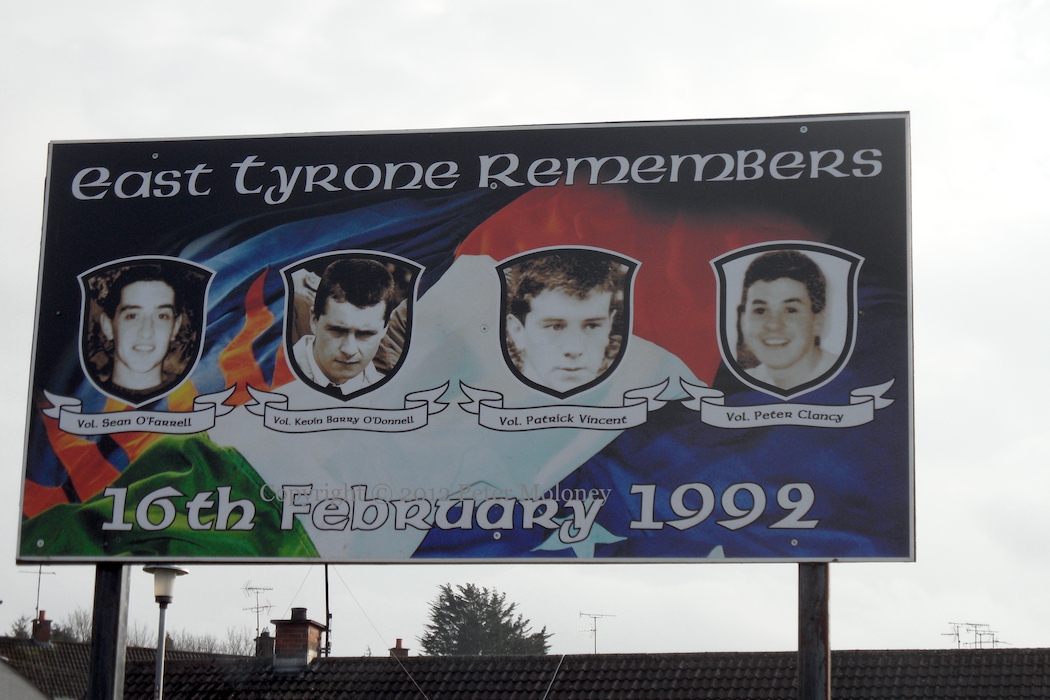
East Tyrone remembers IRA volunteers Patrick Vincent, Sean O’Farrell, Peter Clancy, and Barry O’Donnell, who were killed by the SAS after attacking Coalisland RUC station with a machine gun mounted on the back of a lorry on February 16th, 1992 as they were switching from the attack vehicles to getaway cars in Clonoe (WP). With republican graffiti: “End strip searches in Maghaberry jail on republican POWs”.
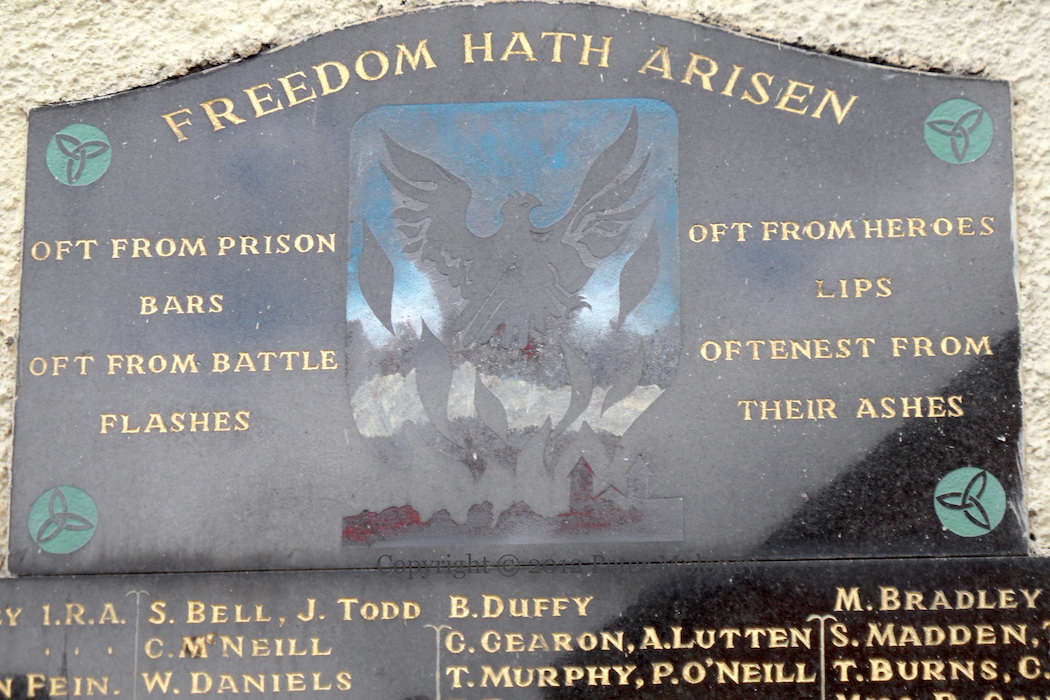
For the 30th anniversary of the 1981 hunger strike, the mosaics of the Troubles-era hunger strikers are mounted around the blanket-men board and above the Phoenix in Clowney Street; for a few years they were previously at the Falls-Beechmount corner.










 Peter Moloney Collection