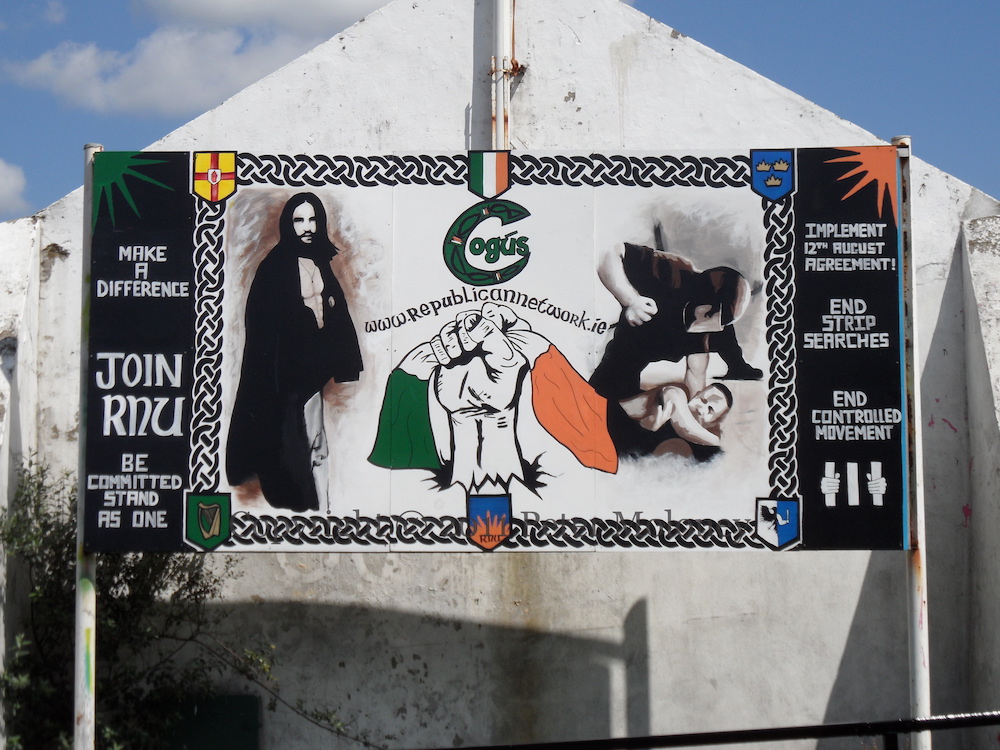
“Make a difference – Join RNU – Be committed – Stand as one – Implement 12th August Agreement! – End strip searches – End controlled movement.” Cogús is the POW department of the RNU, no longer on-line at http://www.republicannetwork.ie. The board is on the rear of Free Derry Corner, which has its own Visual History page.
This is a two-part electoral mural from Sınn Féın: on the left, the mural is for the specific candidacy of local man Nıall Ó Donghaılle – he was successfully elected to Belfast City Council and served as Lord Mayor; on the right, for Sınn Féın generally, using words from (the song) On The One Road (here’s a Wolfe Tones rendition): “Dublin, Belfast, Cork and Donegal” … and Short Strand too!
For the 30th anniversary of the 1981 hunger strike, the mosaics of the Troubles-era hunger strikers are mounted around the blanket-men board and above the Phoenix in Clowney Street; for a few years they were previously at the Falls-Beechmount corner.
In addition to three plaques, a wrought-iron head-piece, multiple flag-pole holders and railings fencing in a small area, this mural in Clós Ard An Lao/Ardilea Close in Ardoyne uses painted discs for each of the twelve hunger strikers (the ten in Long Kesh 1981 and two from the 70s in English prisons, Michael Gaughan and Frank Stagg – the twelve also featured in Derry’s Spirit Of Freedom mural), rather than painting their likenesses directly onto the wall. The two quotes are from Bobby Sands “Let our revenge by the laughter of our children” and Michael Gaughan “Let there be no bitterness on my behalf to achieve a united Ireland”.
The items above the mural are new, compared to 2010. The plaque on the left is to people who died “in defence of the area” and on the right to those who died “of natural causes” who endured discrimination, hardship, suffering, imprisonment.
“I ndıl chuımhne orthu sıúd a bhaın le ceantar Bhaıle Bocht agus a throıd ar son saoırse na hÉıreann. Ar dheıs Dé go raıbh a n-anamacha. Erected in proud and loving memory of all those associated with the district of Ballybot who were part of Ireland’s struggle for freedom. Muıntır Bhaıle Bocht a thóg an leacht cuımhneacháın seo. Nochtadh é ar an 12ú lá de Mheán Fómhaır 1997.” Dorans Hill, Newry.
“I ndılchuımhne orthu sıúd ó pharóıste N. Muıre a thug a rıabh [raıbh] acu ar son saoırse na hÉıreann. Erected in proud and loving memory of all those from St Mary’s parish, Newry who have fought for Irish freeedom. Ar dheıs Dé go raıbh a n-anamacha. Pobal pharóıste N. Muire a thóg an leacht cuımhneacháın seo.” Pike-men are used on the base as a generic symbol of Irish nationalism, rather than mention of any particular group. In later years, stones to the Signatories and the hunger strikers will be added, along with graveside volunteers in modern garb.
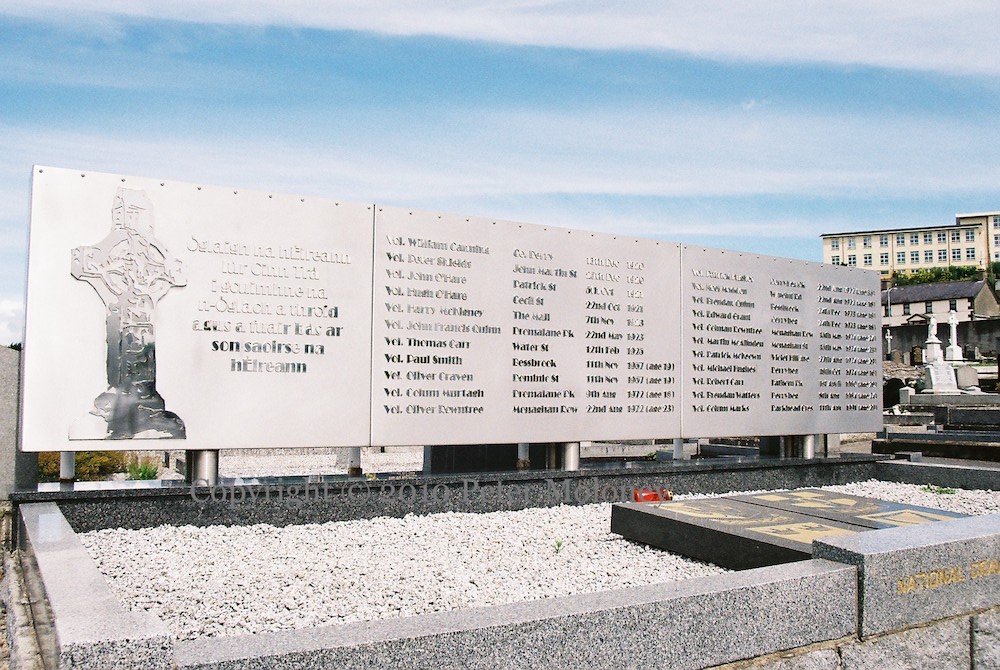
“Óglaıgh na hÉıreann Iúr Cınn Trá [Newry] ı gcuımhne na n-Óglaıgh a throıd agus a fuaır bás [who fought and died] ar son saoırse na hÉıreann”. National Graves Association headstone over the republican plot in St Mary’s cemetery. Old Warrenpoint Road, Newry.
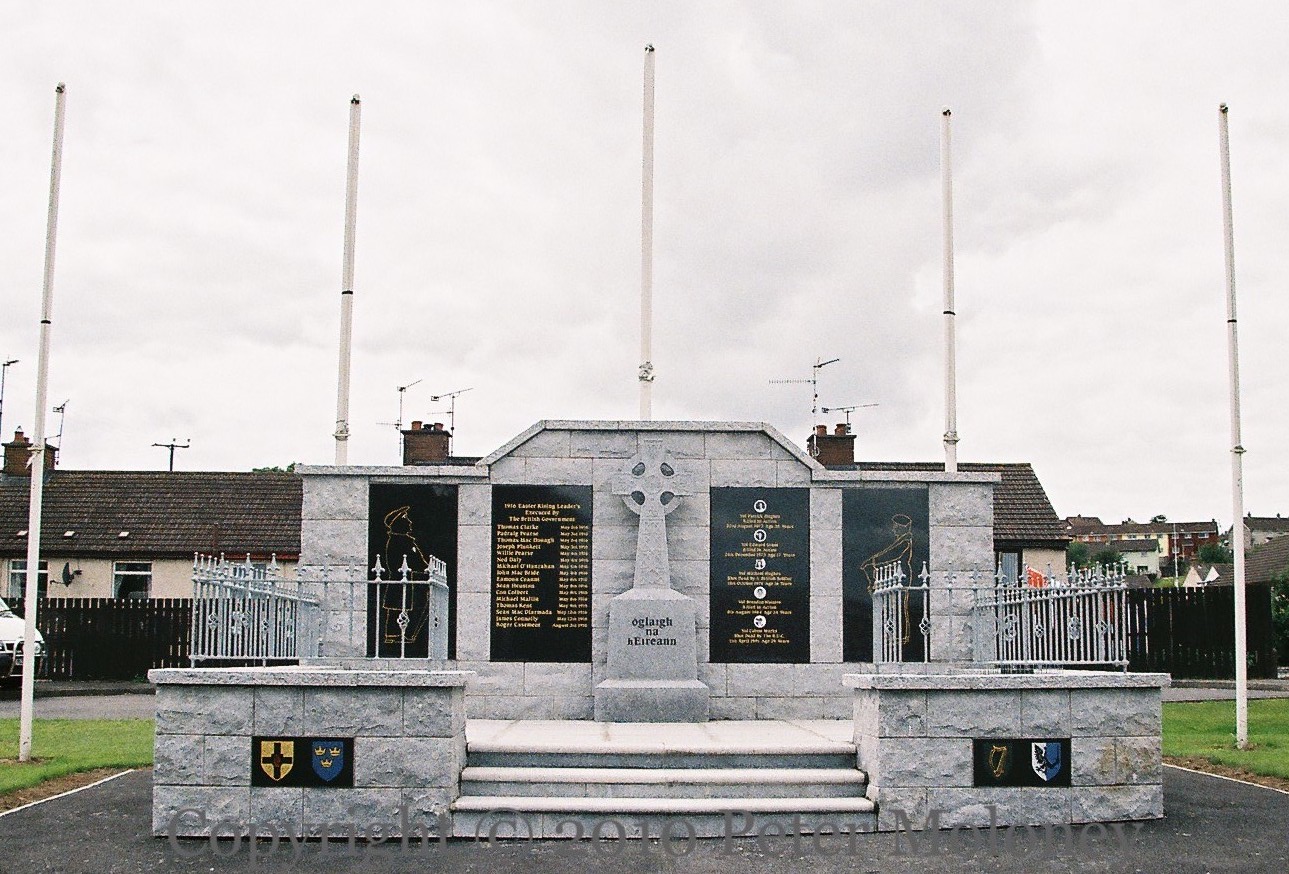
Monument in Newry’s Derrybeg estate. The central panels are to (left) the “1916 Easter Rising leader’s [sic] executed by the British government” and (right) Newry IRA volunteers Patrick Hughes, Edward Grant, Michael Hughes, Brendan Watters, and Colum Marks.
This memorial board in Lisnahull Road, Dungannon, is to IRA volunteers Sean Loughran, Patrick Carty, Patrick Quinn, Patrick McDonald, Kevin Murray, Paddy Kelly, Patrick Vincent. With support from Tyrone National Graves and the Thomas Clarke Society.



 Peter Moloney Collection