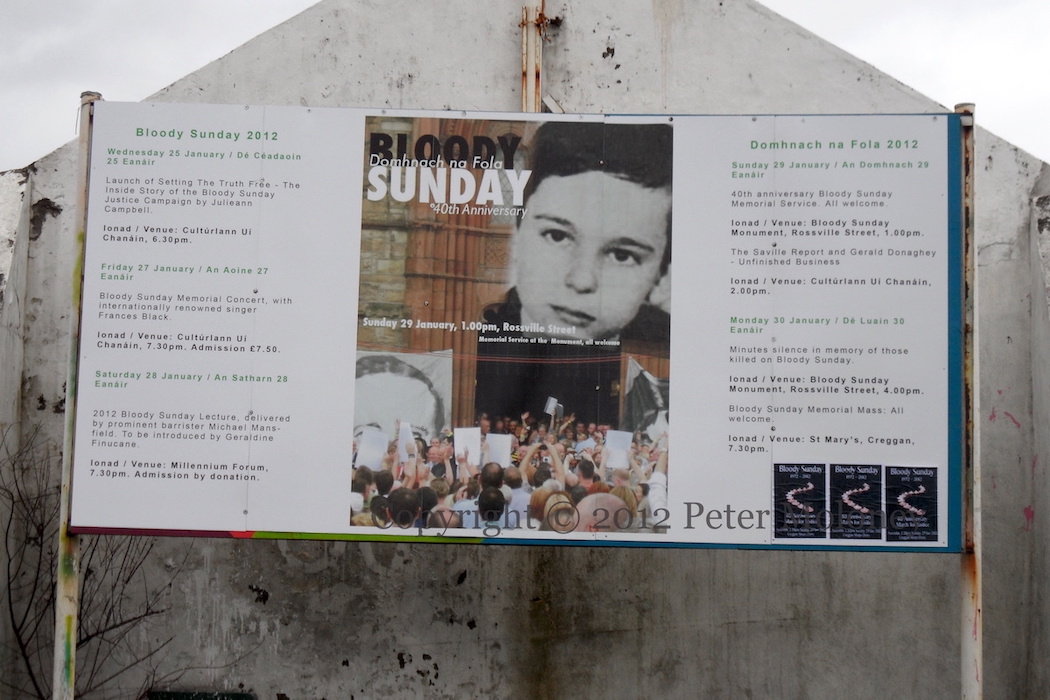
Heroes With Their Hands In The Air is a play by Fintan Brady based on Eamonn McCann’s “The Bloody Sunday Inquiry: The Families Speak Out” (BelTel). After playing Derry’s Playhouse it will move to An Chultúrlann in Belfast (promo video).
The black ribbon (on the left) is used to symbolise the victims of Bloody Sunday – see the 1997 and 1998 images of the front of Free Derry Corner.
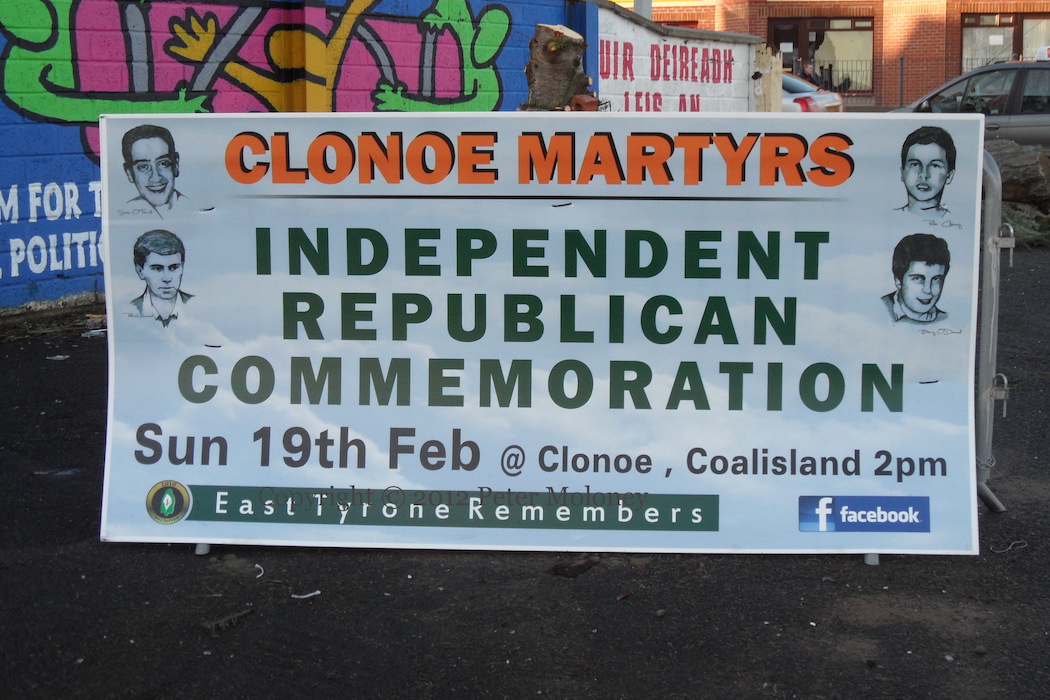
“East Tyrone remembers the “Clonoe Martyrs” – four IRA volunteers who were killed by the SAS after attacking Coalisland RUC station with a machine gun mounted on the back of a lorry on February 16th, 1992 as they were switching from the attack vehicles to getaway cars in Clonoe (WP).
“2012 Centenary year” – a history of Michael Davitt’s GAA (Belfast) can be found at its web site. Davitt was a central figure in the IRB, argued for land reform, and was an MP (WP | VP); he was one of the three original patrons of the GAA, along with Archbishop Croke and Charles Stewart Parnell (Cork GAA). The mural is at the club’s premises in Clonard Street; home games are played at St Mary’s Gardens.
This is a new version of the Derry brigade board in Westland Street – everything remains as before (see 2010) except for a new picture of the dolmen memorial in Lecky Road.
The scroll in the bottom right reads “I gcuımhne dhíl orthu sıud a fuaır bás ar son saoırse na hÉıreann – In fond & loving memory of those who died in the cause for Ireland’s freedom”.
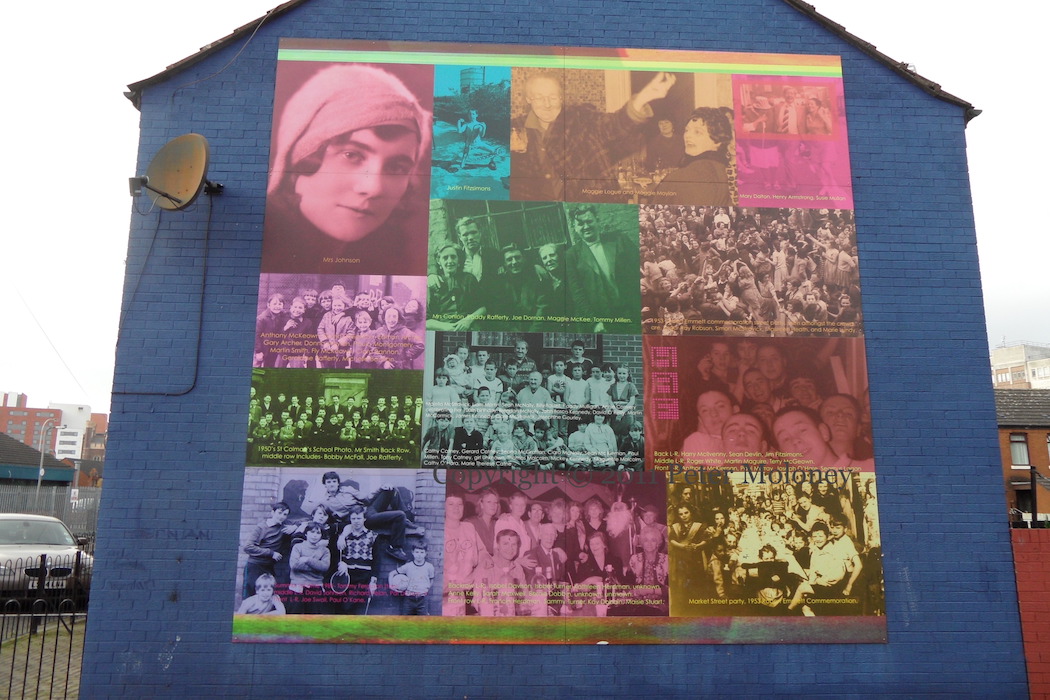
In 2008 and 2009 artist Raymond Henshaw completed a series of cultural murals about the Markets area of Belfast. This one showcases the people of the Markets. Two of the images – bottom right and two spots above it – show a street party to commemorate the 150th anniversary of the death of Robert Emmet in 1953. For a mural from that occasion (in Ardoyne) see Visual History 02.
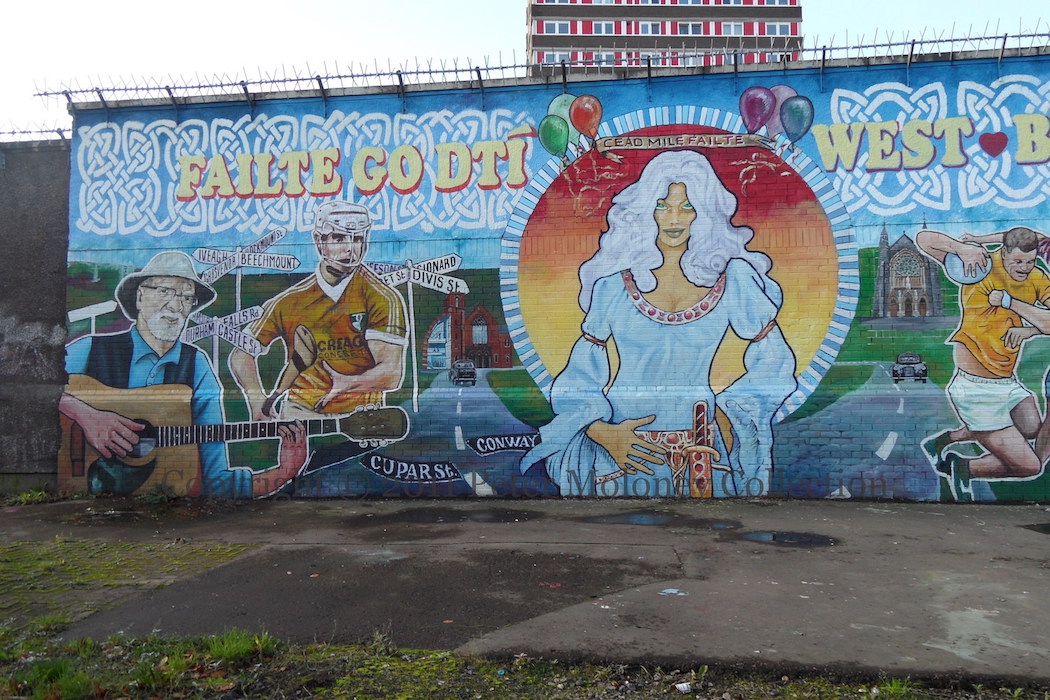
“Welcome to west Belfast”. West Belfast is portrayed as a place of music, sport, and dancing, whose landmark buildings and streets are under the watchful eye (and sword) of the goddess Érıu.
The image of the little boy with the “I [heart] Belfast” stickers and a bag of sweets, standing in the waste ground of Divis flats, is a photograph from the early days of Féıle An Phobaıl/West Belfast Festival.
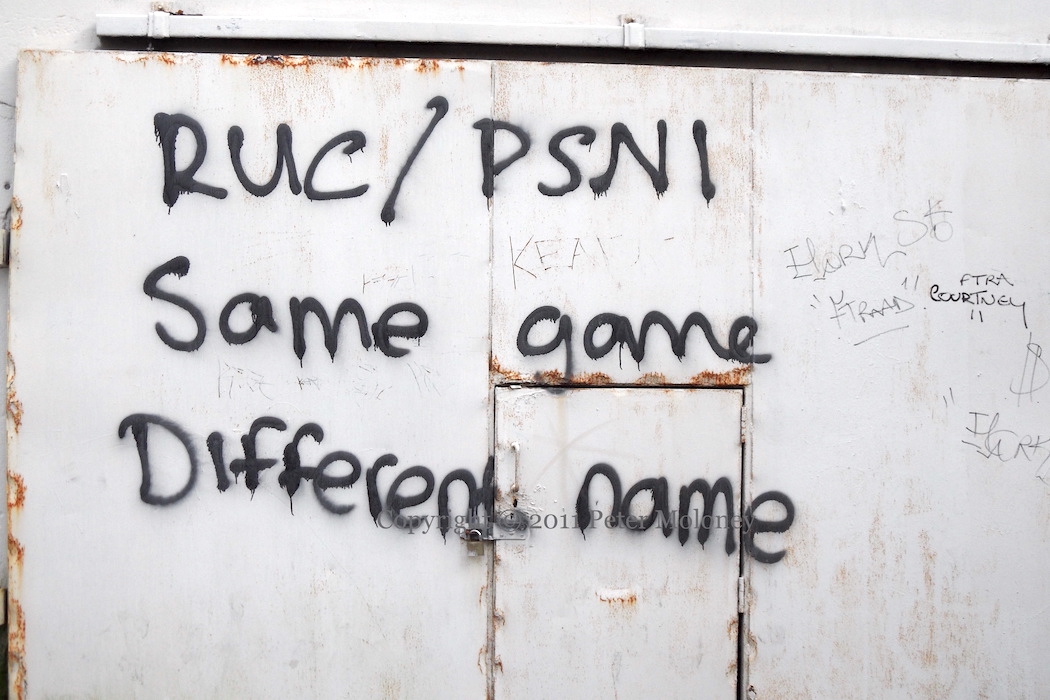
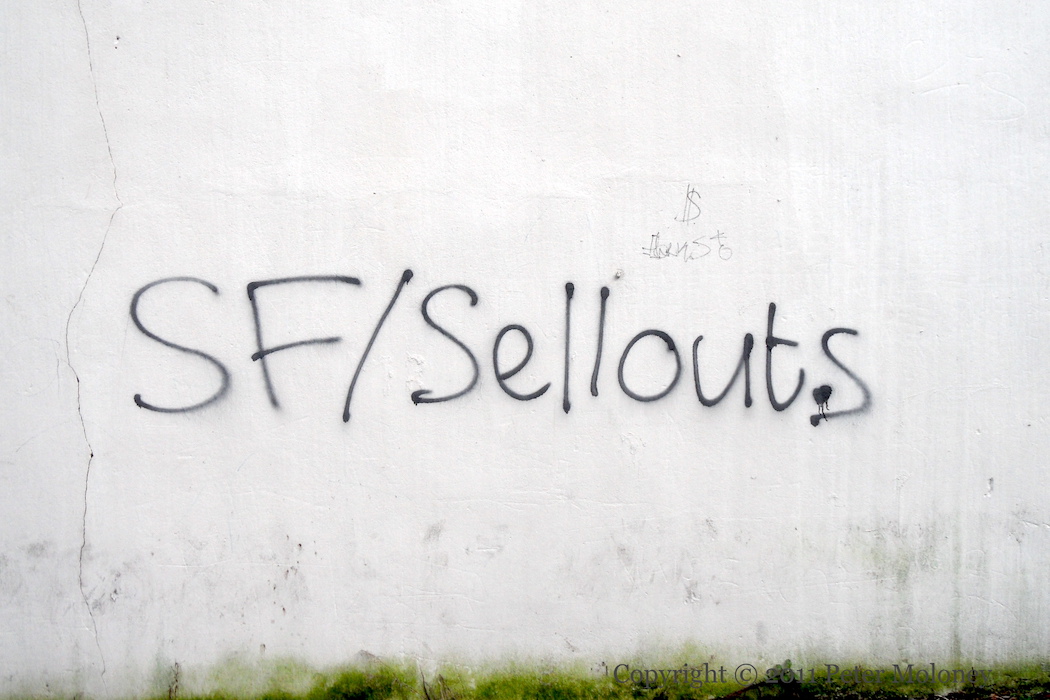
On the Divis Street side, characters in the style of cartoonist Cormac (see e.g. Notes) are “Promoting west Belfast tourism” for “Fáılte Feırste Thıar”, “www.visitwestbelfast.com“. The attractions touted are: “Bop at the August “fleadh”. “Craıc agus ceol” (for Robert Ballagh’s dove coming out of the concrete block, see Féile An Phobail 2008), “The only thing you have here is “choice”. Tar ısteach agus (lıg do scíth)”. “Baın sult as. Tá mé ag éısteacht le Raıdıó Fáilte 107.1 FM”, “For more ideas on things to do, visit Oıfıg Fáılte at An Chultúrlann. There’s really nice food there too! at Caıfe Feırste”, “If it’s history you want go on a cemetery tour “City or Milltown””, “Enjoy a walk on ‘Slıabh Dubh’ (The black … … mountain)”, “Make sure you visit the “Irish republican history museum” at Conway Mill” (with ‘Long Kesh University Of Freedom’ sweater; “Sinn Féin touts” is not a sweater but graffiti.)
The ten deceased 1981 hunger strikers were preceded in the 1970s by two prisoners who died in English prisons: Michael Gaughan (d. 1974 WP) and Frank Stagg (1976 WP). Posters depicting these two, along with the Proclamation and the Tricolour, lie on the grass. The larger of the two quotations here is from Stagg: I want my memorial to be peace with justice.
The protesters on the left date back to a 1981 poster which was used on the very first mural – for both, see I’ll Wear No Convict’s Uniform.





 Peter Moloney Collection