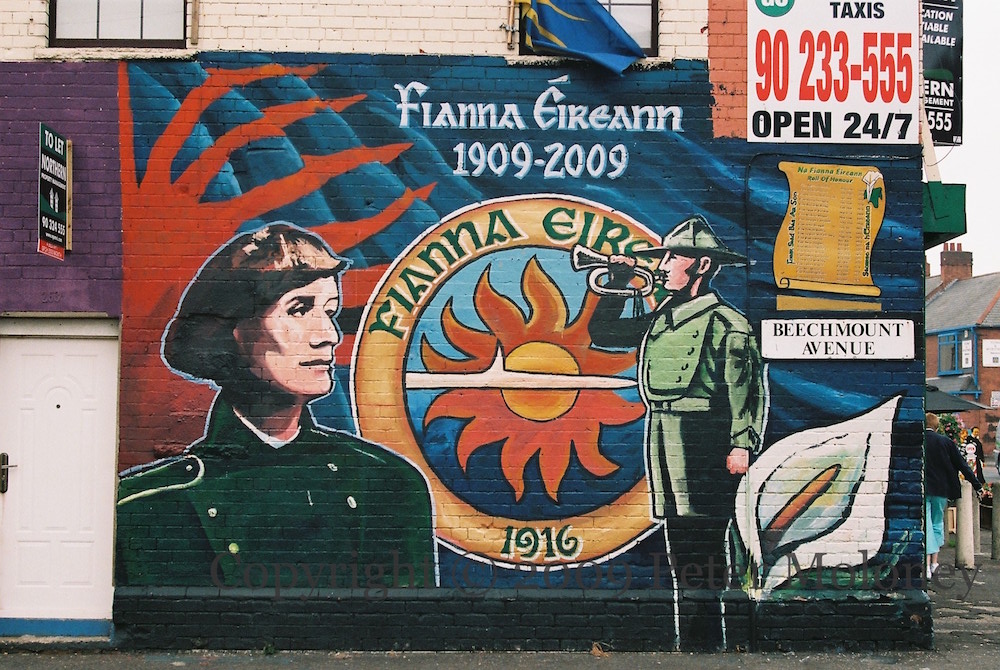
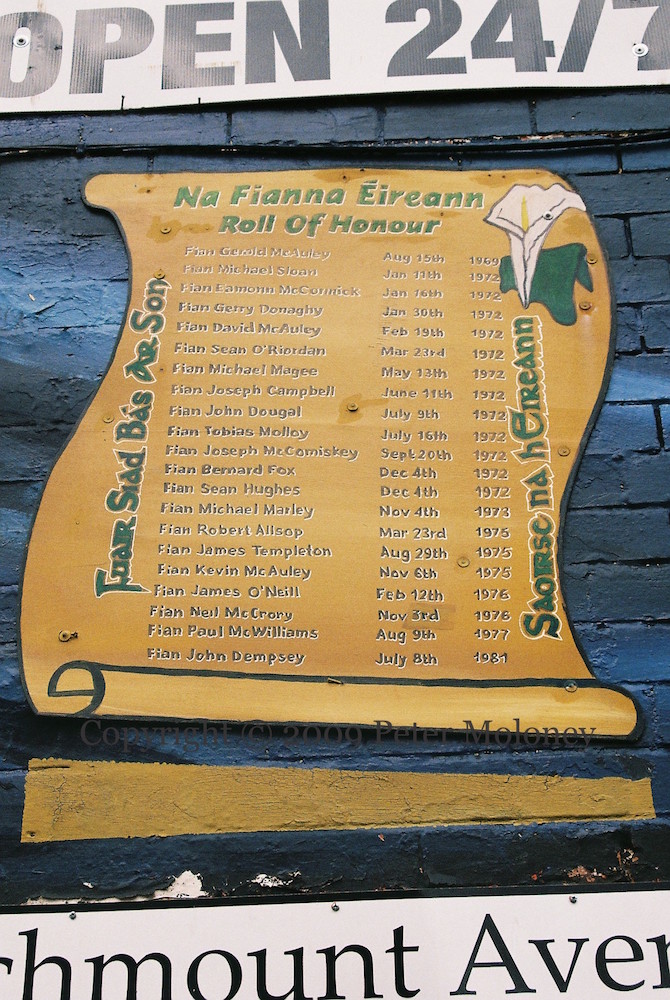
“Fuaır sıad bás ar son saoırse na hÉıreann” [they died for the freedom of Ireland]. Na Fıanna Éıreann [warriors of Ireland; IRA youth] were begun in 1909 by Countess Markievicz and Belfast man Bulmer Hobson (WP). They took part in the Easter Rising of 1916. The role of honour lists deaths from 1969 to 1984 – the Troubles. After the Agreement, the Fıanna are affiliated with Republican Sınn Féın and the Continuity IRA. At the corner of Beechmount Avenue and the Falls Road – see the Visual History of this wall.
The Éırí Amach Na Cásca 1916 [Easter Rising 1916] mural in Beechmount Avenue/Ascaıll Ard Na bhFeá/RPG Avenue is repainted (by DD and Seany McVeigh) due to the new doorway. Compare to the previous version. (See also the IRA plaque.)
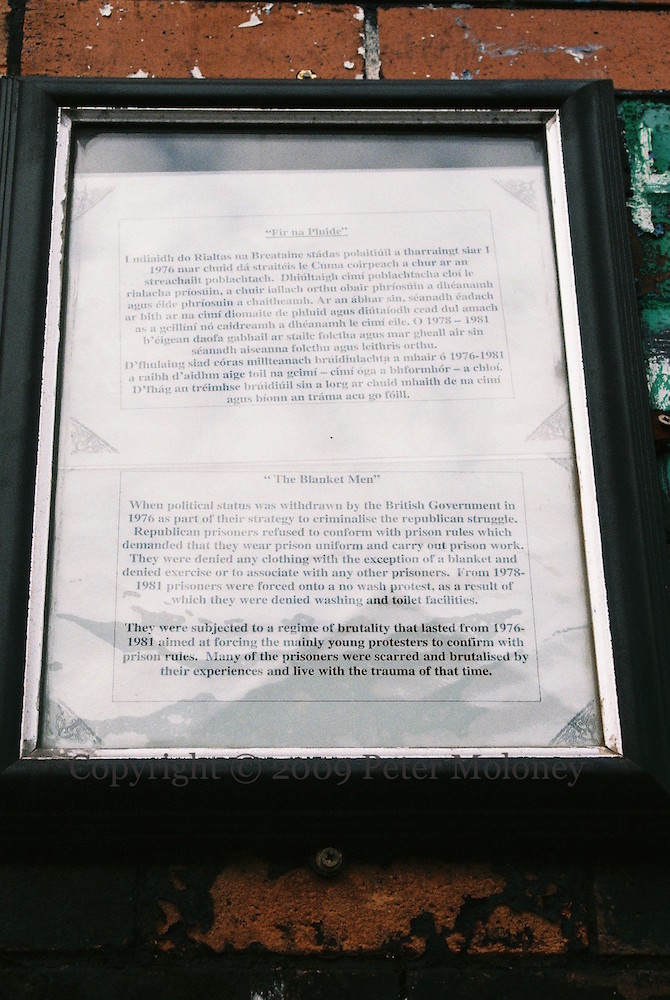
“Fır na Pluıde: ı ndıaıdh do Rıaltas na Breataıne stadás polaıtıúıl a tharraıngt sıar ı 1976 mar chuıd dá straıtéıs le Cuma coırpeach a chur ar an streachaılt poblachtach. Dhıúltaıgh cımí poblachtacha cloí de rıalacha príosıún, a chur ıallach orthu obaır phríosúın a dhéaneamh agus éıde phríosúın a chaıtheamh. Ar an ábhar sın, séanach éadach ar bıth ar na cımí dıomaıte de phluıd agus dıútaíodh cead dul amach as a gcıllıní nó caıdreamh a dhéanamh le cımí eıle. Ó 1978-1981 b’éıgean daofa gabhal ar staılc folchta agus mar gheall aır sın séanadh aıseanna folctha agus leıthreas orthu. D’fhulaıng sıad córas mıllteanach brúıdıulachta a mhaır ó 1976-1981 a raıbh d’aıdhm aıge toıl na gcımí – cımí óga a bhformhór – a chloí. D’fhag an tréımhse brúıdıúıl sın a lorg ar chuıd mhaıth de na cımí agus bíonn an tráma acu go fóıll.”
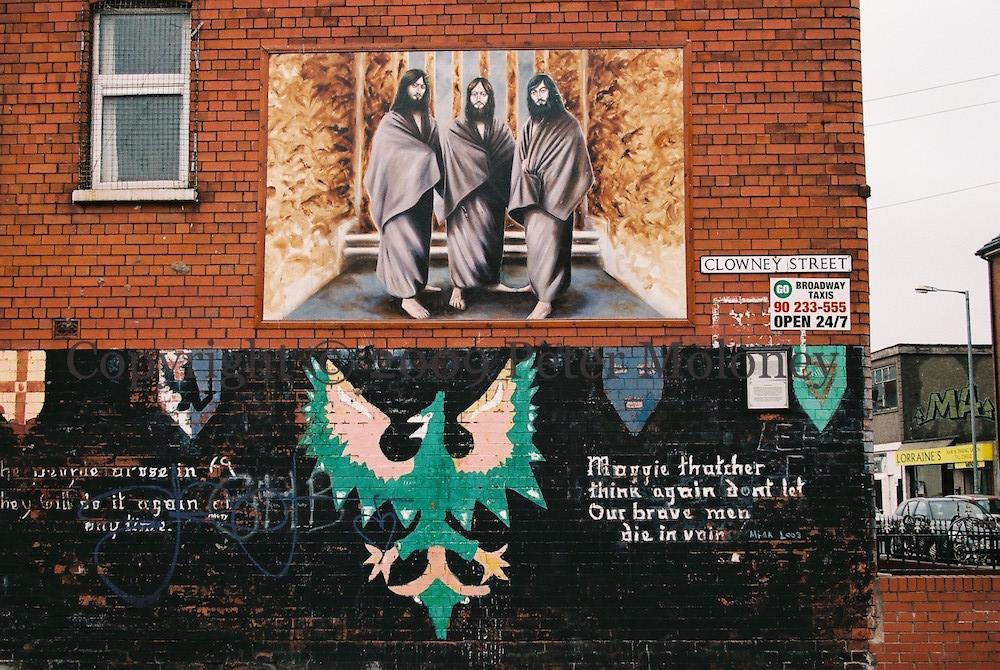
“The Blanket Men: When political status was withdrawn by the British Government in 1976 as part of their strategy to criminalise the republican struggle, Republican prisoners refused to conform with prison rules which demanded that they wear prison uniform and carry out prison work. They were denied any clothing with the exception of a blanket and denied exercise or to associate with any other prisoners. From 1978-1981 prisoners were forced onto a no wash protest, as a result of which they were denied washing and toilet facilities. They were subjected to a regime of brutality that lasted from 1976-1981 aimed at forcing the mainly young protesters to confirm [sic] with prison rules. Many of the prisoners were scarred and brutalised by their experiences and live with the trauma of that time.”
Help with substance abuseis offered by Resolve. The plaque on the right describes the board that was previously on this gable, to Stan Carberry and other Beechmount dead (see Crossed Rifles).
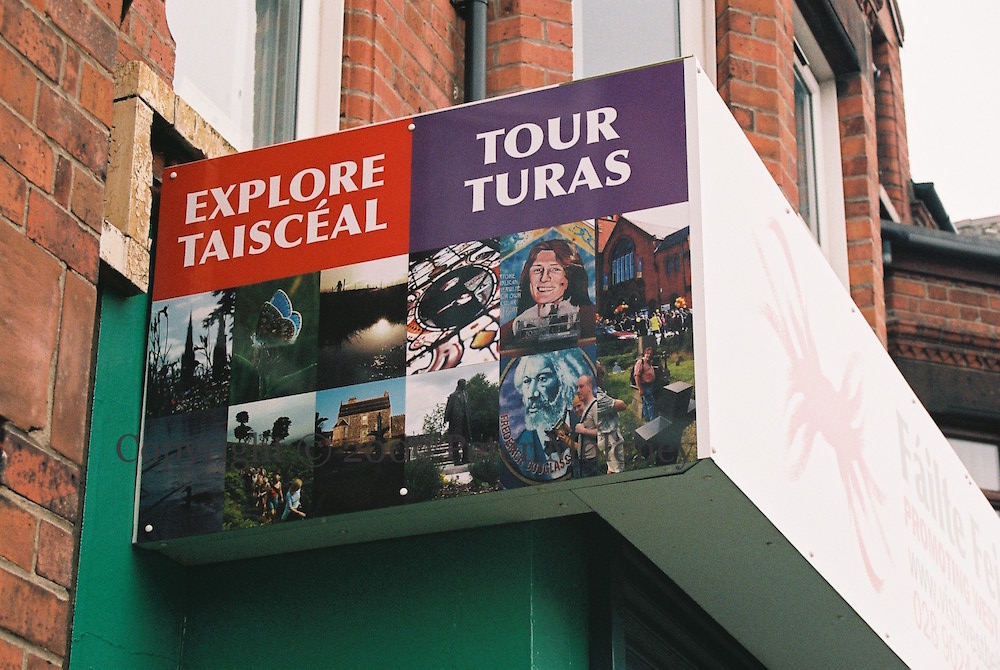
Murals are featured as part of an invitation to explore/taiscéal and take a tour/turas of west Belfast, on the office of Fáılte Feırste Thıar (in its second location: moved from 221 Falls Road to 243 Falls Road – and later again to 217 Falls Road). This BBC article describes a 1999 Fáılte map to help tourists get around.
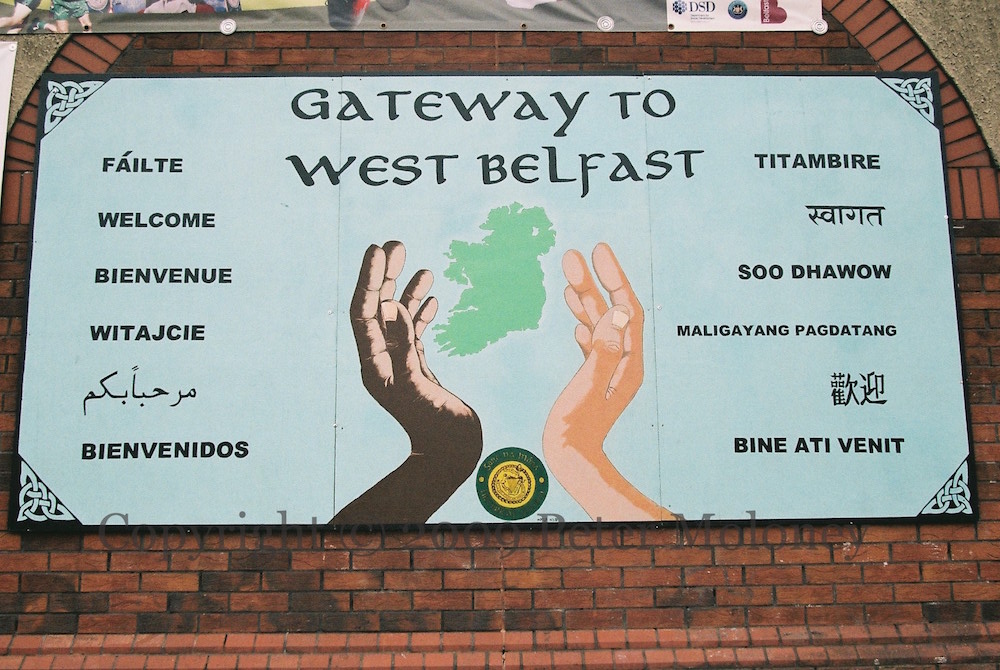
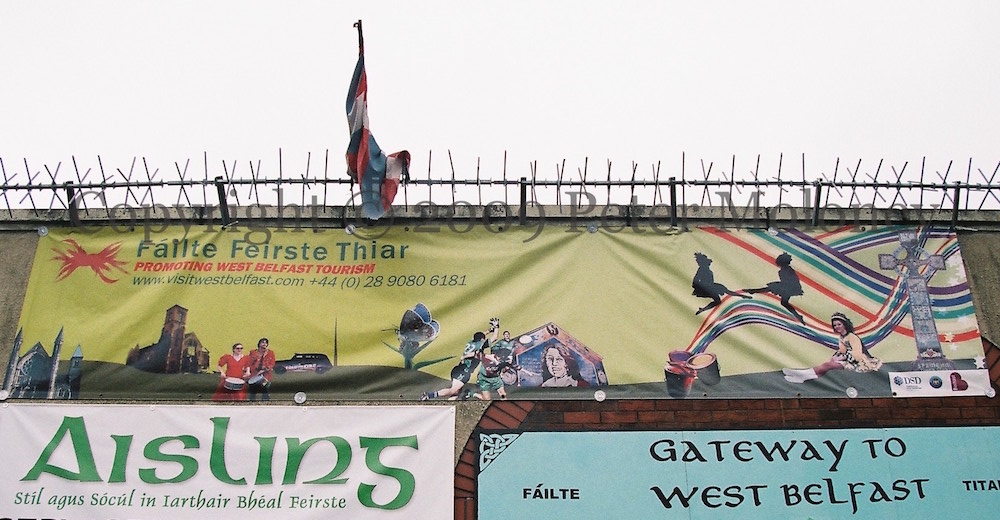
The power station below Divis tower, rather than the so-called International Wall a little further up the road, is becoming the starting point for (republican) west Belfast. Visitors from around the world are greeted in a variety of languages. The board is sponsored by Gort Na Móna Historical Society. Above it is a Fáılte Feırste Thıar [Welcome To West Belfast] tarp: “Promoting west Belfast tourism”.
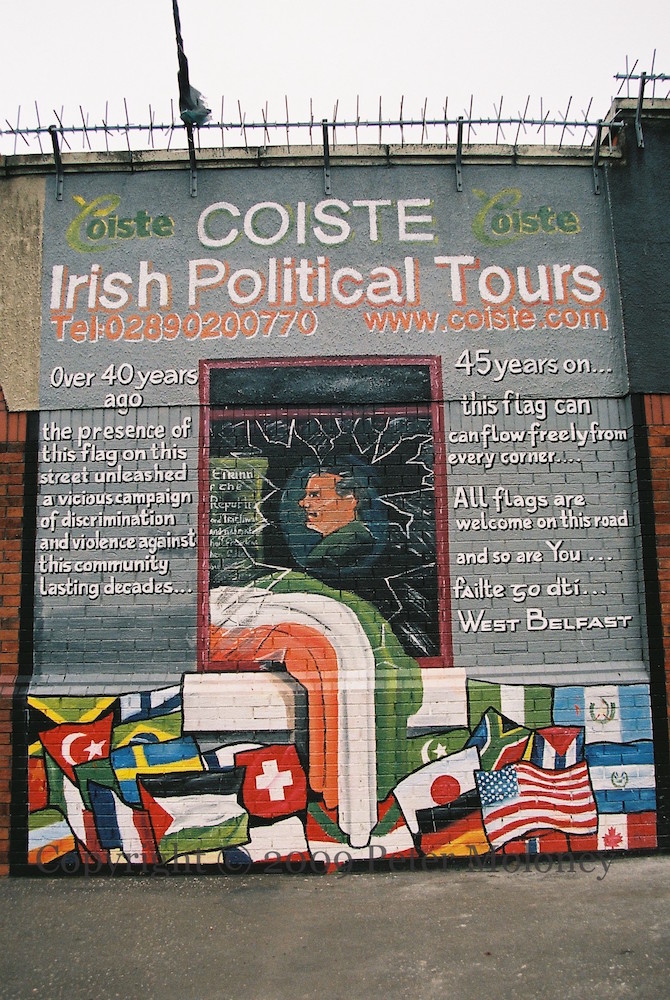
“Over 40 years ago, the presence of this flag on this street unleashed a vicious campaign of discrimination and violence against this community lasting decades … 45 years on this flag can flow freely from every corner… all flags are welcome on this road and so are you … fáılte go dtí west Belfast .” The incident referred to is the “Tricolour Riots” of the 1964 Westminster election campaign, in which the IRA’s Billy McMillen (shown in the middle) stood for office. Armed police raided his Divis Street headquarters and removed a Tricolour in the window. An Phoblacht has an account of the election and events. Here is news video from 1964 of charges subsequently brought against 70 people. The US Stars & Stripes is included prominently in the array of flags, but the Union Flag is absent. Coıste’s website is now coiste.ie rather than .com.
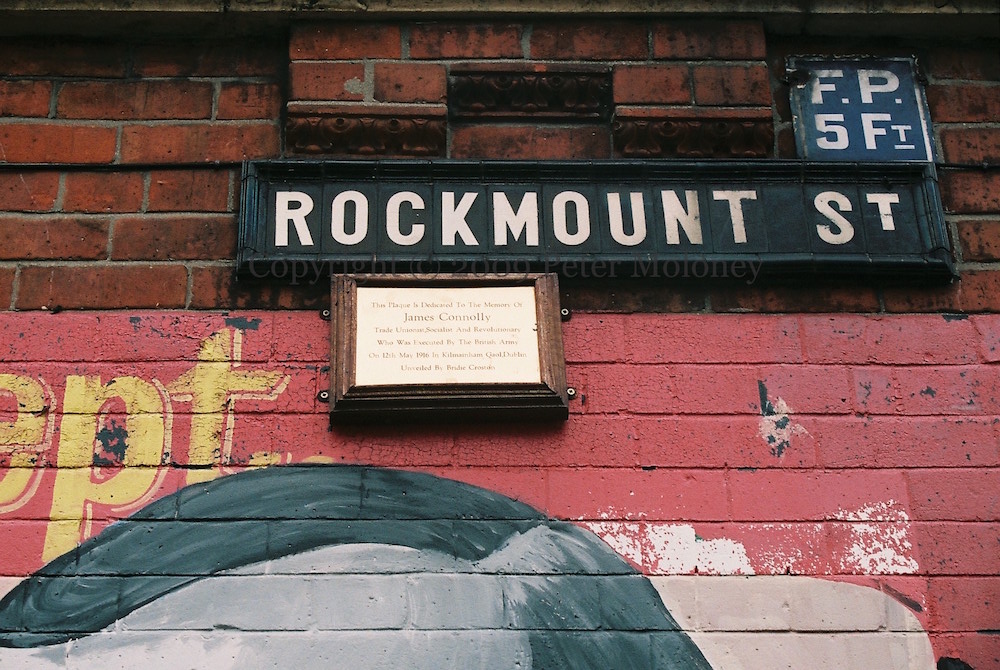
Here is a close-up of the plaque on the James Connolly mural in Rockmount Street, Belfast. “This plaque is dedicate to the memory of James Connolly, trade unionist, socialist and revolutionary who was executed by the British Army on 12th May 1916 in Kilmainham gaol, Dublin. Unveiled by Bridie Croston.” For background on the mural and a picture of it in better condition in 2006 see M03108.




 Peter Moloney Collection