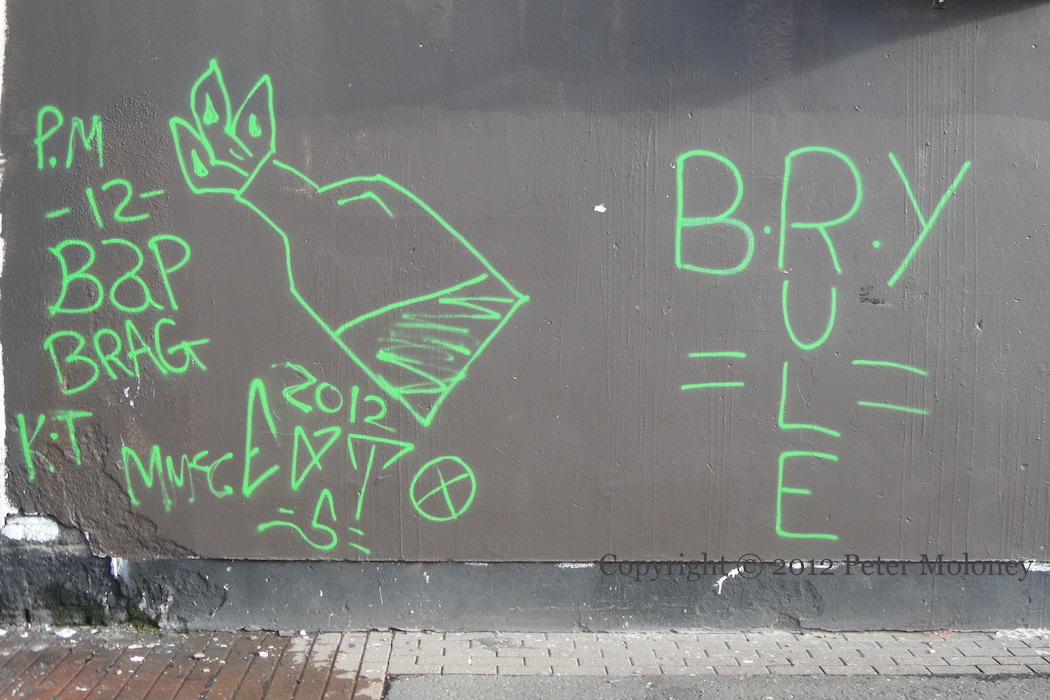
“BRAG” is “Bogside Republican Action Group” and “BRY” is “Bogside Republican Youth”; the rest of the writing seems to be initials/signatures. See previously: BRY Petrol Bombers. (The petrol bomb was long ago a symbol of Ógra Shınn Féın (J2182).)
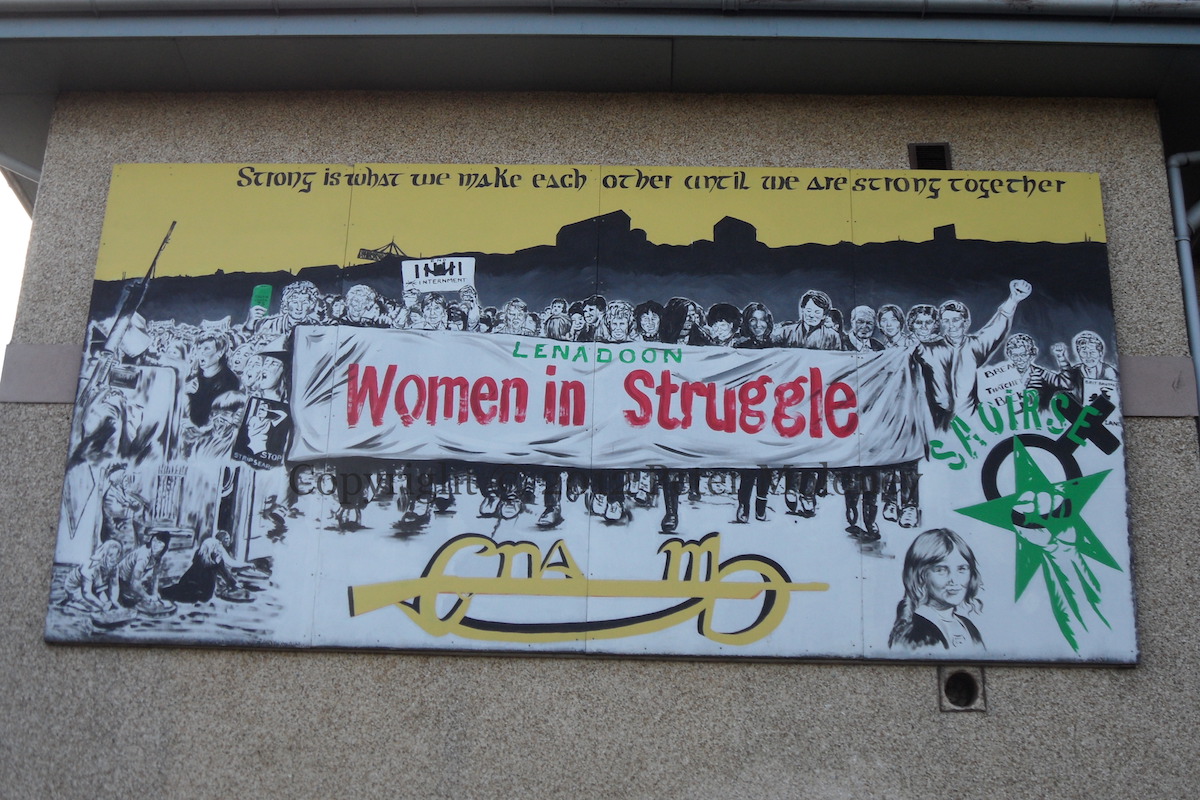
“Strong is what we make each other until we are strong together.” Women in struggle, (clockwise) banging binlids, undergoing strip searches, protesting internment, victims of plastic bullets (Julie Livingstone), fighting in Cumann Na mBan. On the right are the astrological symbol for woman and the republican symbol of “Saoırse” with the green star and fist.
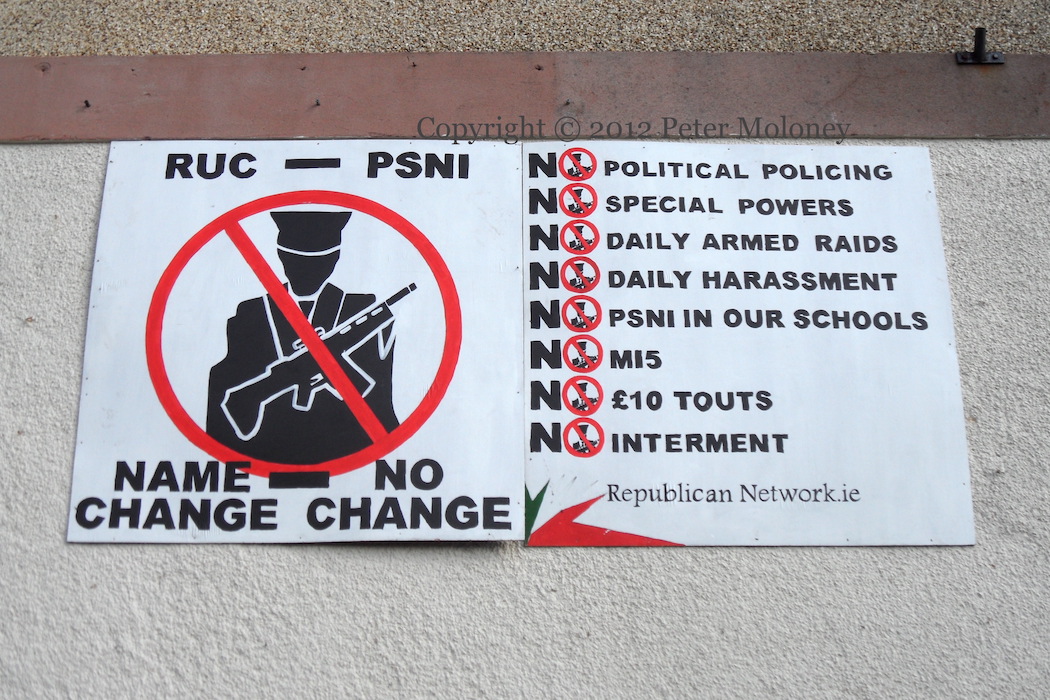
“RUC – PSNI. Name change – no change. No political policing. No special powers. No daily armed raids. No daily harassment. No PSNI in our schools. No MI5. No £10 touts. No interment [sic]. Republican Network.ie.” (The web address no longer functions but there is a Fb page.)
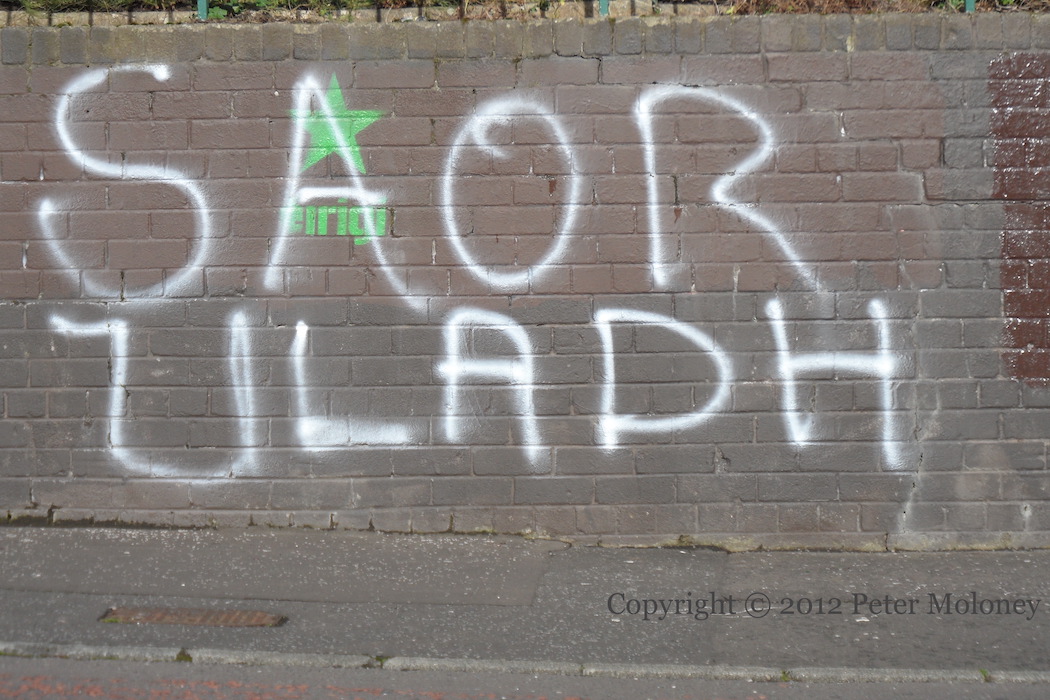
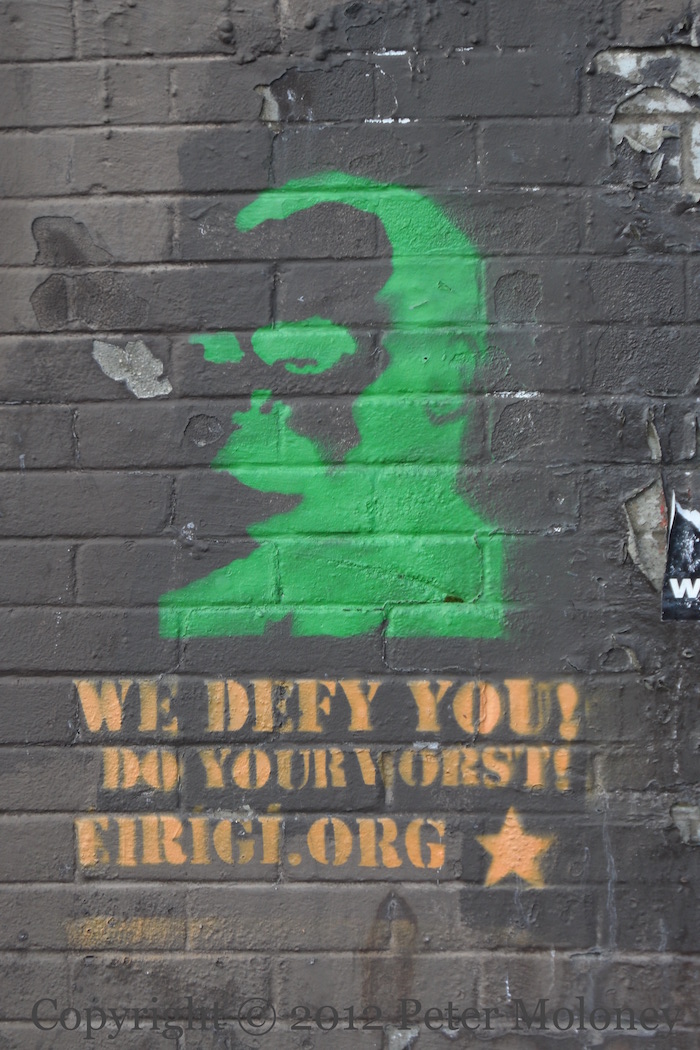
Five small éirígí (web) pieces of graffiti and stenciling from Creeslough Park (at the corner with Lenadoon Avenue), Belfast. The stencils are of James Connolly (“We defy you! Do your worst!”) and the 3-in-1 figure combining police (“RUC-PSNI – different name, same aim”), Orange Order, and paramilitary.
“In memory of óglach James Quigley, died 29th Sept. 1972 [and] óglach Patricia McKay, died 30th Sept. 1972. Killed on the streets where they were born by the British Army.” Quigley was shot while waiting to ambush a British Army patrol in Albert Street; McKay (of the OIRA) (and Ian Burt of the Royal Anglicans) was killed in Ross Street in a subsequent gun battle. (Lost Lives 614-616.)
“The Workers Party National Commemoration Committee. Erected in memory of all those comrades who dedicated their lives for establishment of a democratic, secular, socialist, republic. ‘I have given whatever I had to give for the party, for the people of Ireland, and for a better world, but others have given more, much more. Comrades have given their lives.’ – Tomás Mac Gıolla TD. For the unity of Protestant, Catholic and Dissenter.”
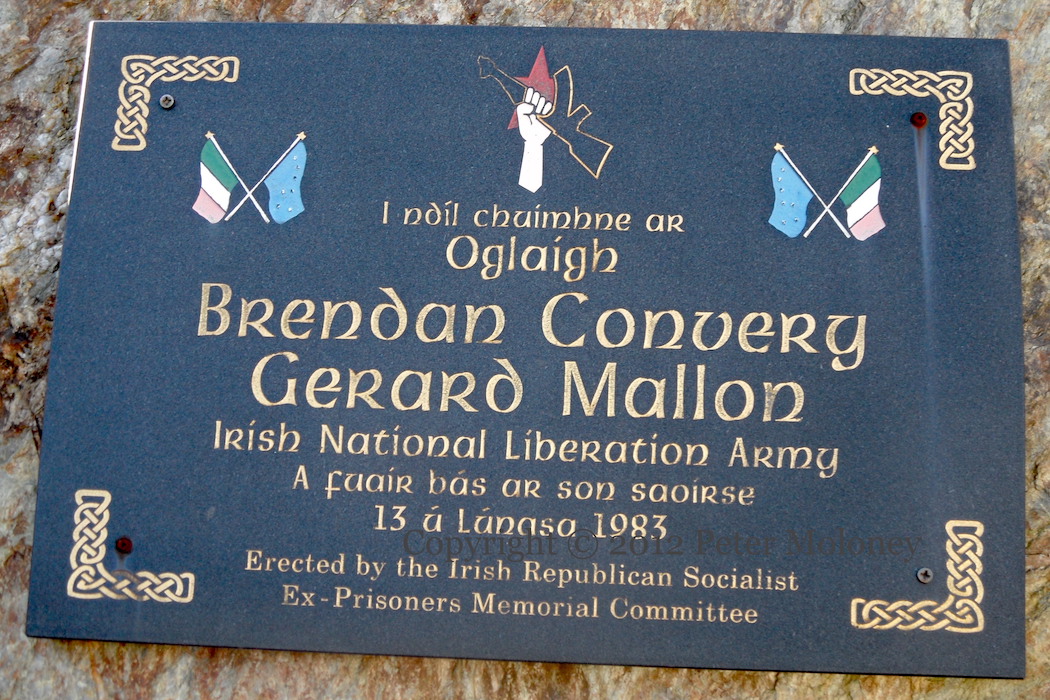
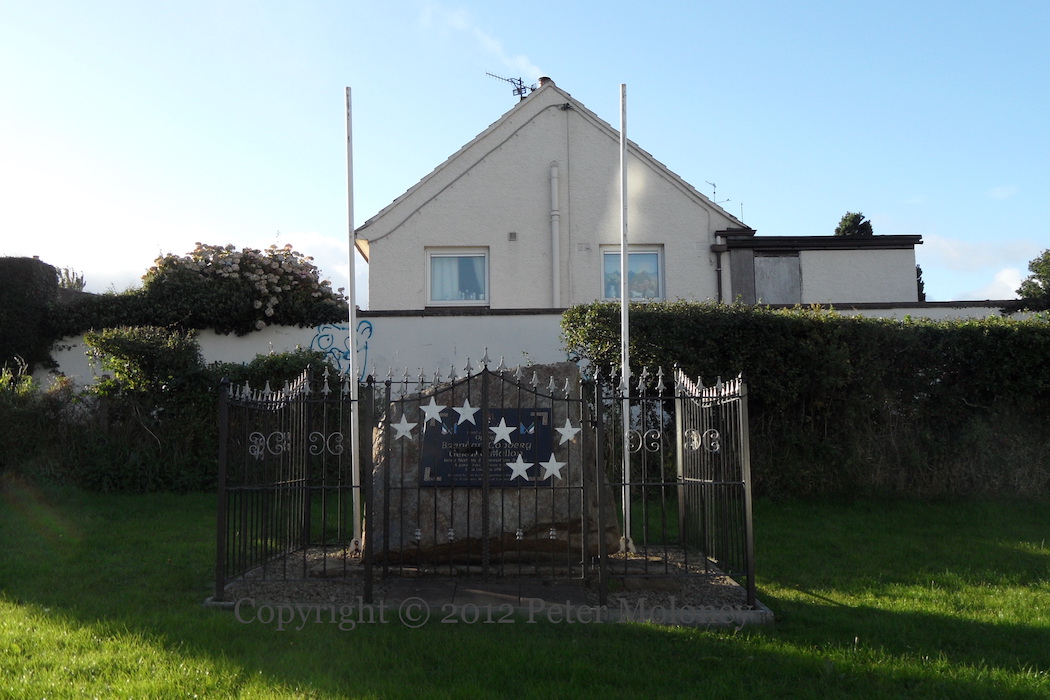
“I ndıl chuımhne ar óglaıgh Brendan Convery [agus] Gerard Mallon, Irish National Liberation Army, a fuaır bás ar son saoırse 13ú Lúnasa 1983. Erected by the Irish Republican Socialist Ex-Prisoners Memorial Committee.” The pair were shot during an attack on an RUC checkpoint in Dungannon (Sutton | IRSP).
The Ulster Volunteers of 1912 joined the 36th Division of WWI. After the war, many of them joined the B Specials, which was disbanded in 1970 and the UDR created. The modern UVF was formed in 1965. There is a Willowfield UVF memorial garden in Cherryville St (M04070).
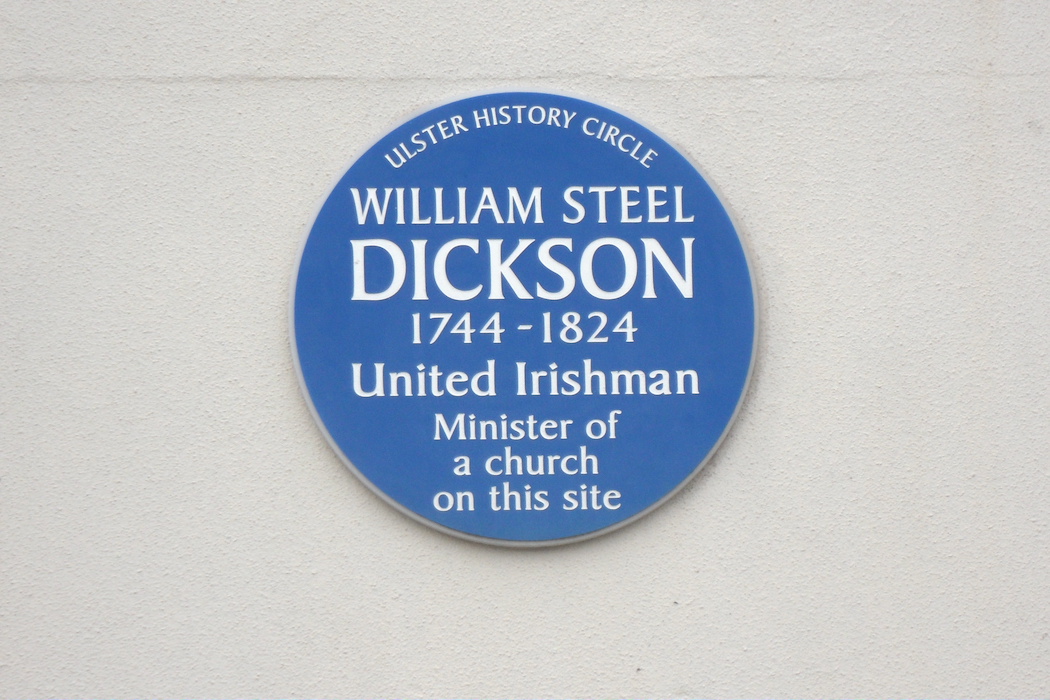
“William Steel Dickson 1744-1824 United Irishman. Minister of a church on this site.” Dickson was adjutant-general of the County Down Irishmen and was arrested a few days before the insurrection (WP). Like Henry Joy and Mary Ann McCracken and William Drennan, Dickson is buried in Clifton Street Cemetery and was commemorated by a mural on the New Lodge Road in Belfast.
The plaque is on the Portico in Steel Dickson Ave, Portaferry
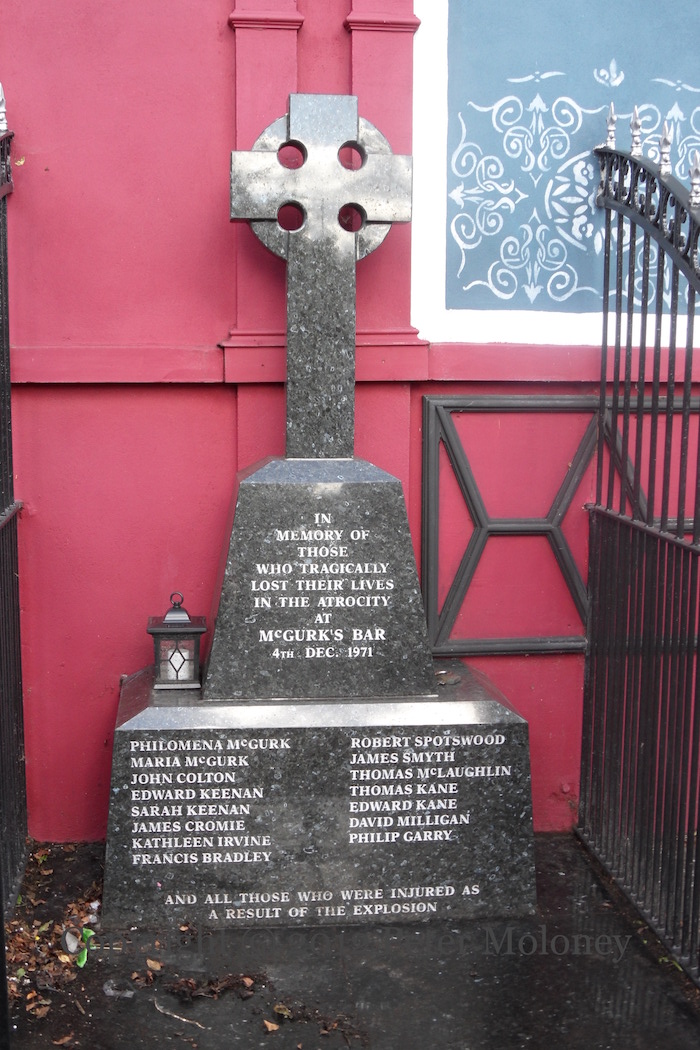
“To the memory of fifteen innocent civilians murdered by a pro-British loyalist gang in a no warning bomb attack on McGurk’s bar, Dec. 4th 1971. Philomena McGurk, Marie McGurk, James Cromie, John Colton, Thomas McLaughlin, David Milligan, James Smyth, Francis Bradley, Thomas Kane, Kathleen Irvine, Philip Garry, Edward Kane, Edward Keenan, Sarah, Keenan, Robert Spotswood.”
For the 40th anniversary, a painted shopfront and plaques to the victims of the McGurk’s Bar Bombing were added last December (2011) to the Celtic Cross and plaque already at the site. The text on the info board to the right is ad follows: “At 8.48 pm on Saturday 4th December 1971, a no-warning bomb, planted by British terrorists, exploded on the doorstep of family-run McGurk’s Bar. Fifteen innocent men, women and children perished. Those who were not crushed or slowly asphyxiated by masonry where [sic] horrifically burned to death when shattered gas mains burst into flames beneath the rubble. Nearly the same again were dragged from the debris alive. In the aftermath of the atrocity, the British and Unionist Governments, RUC police force and British military disseminated disinformation that the bomb was in-transit and that the innocent civilians were guilty by association, if not complicit in this act of terrorism. This is despite a mountain of forensic evidence and a witness who saw the bomb being planted and lit before watching the British terrorists escape into the night. From the moment the bomb exploded, and for 40 years since, the families and friends of those murdered have campaigned constitutionally and with great dignity to clear the names of their loved ones. It is a Campaign for Truth that continues to this day. Join us at www.themcgurksbar.com.”







 Peter Moloney Collection