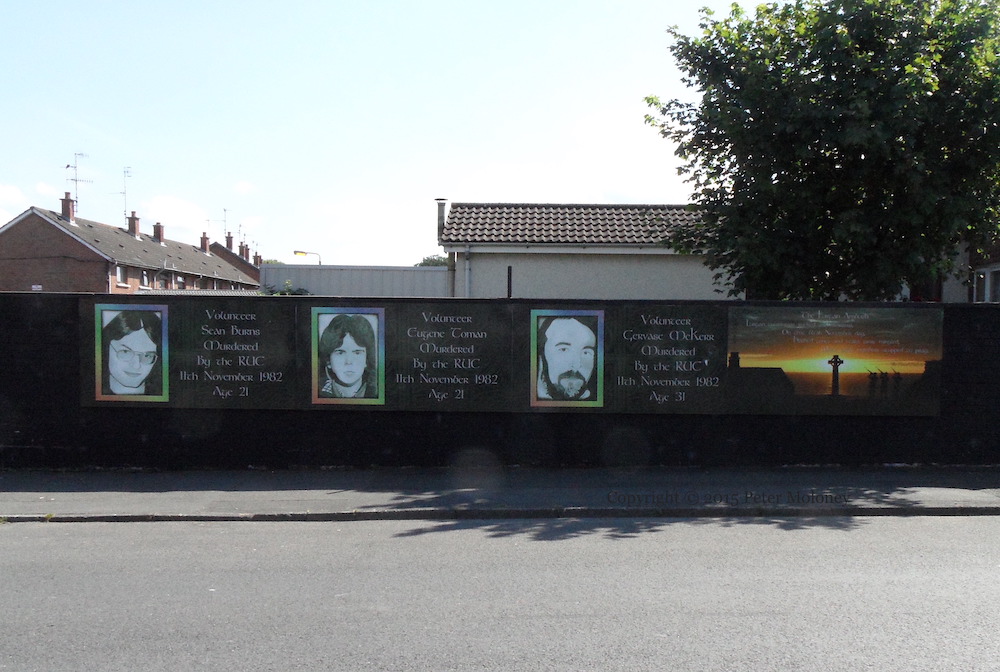
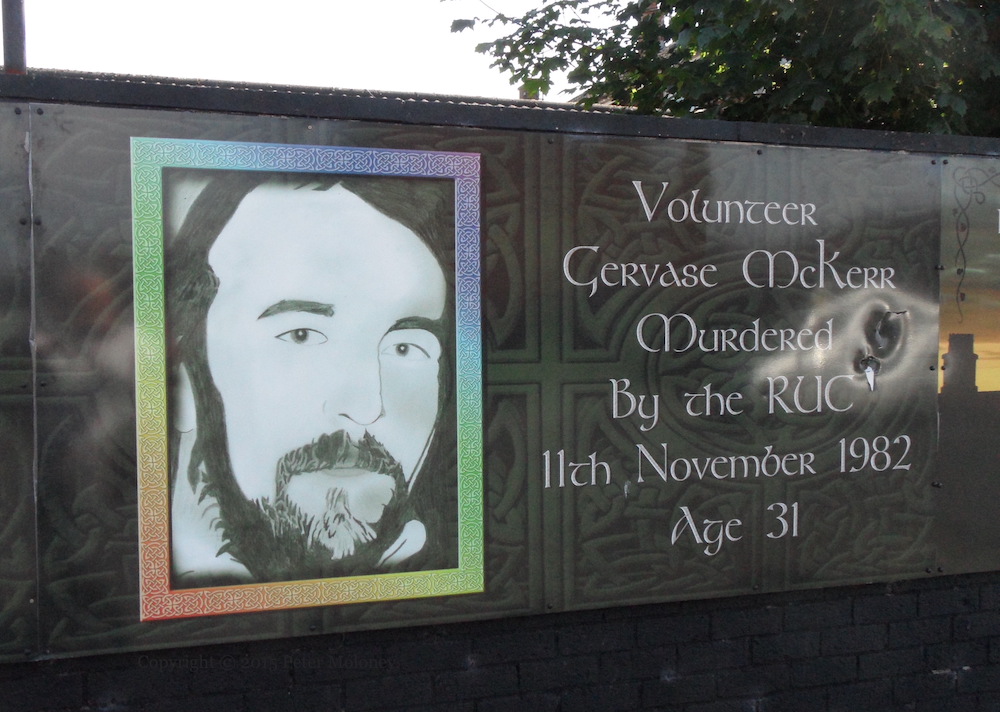
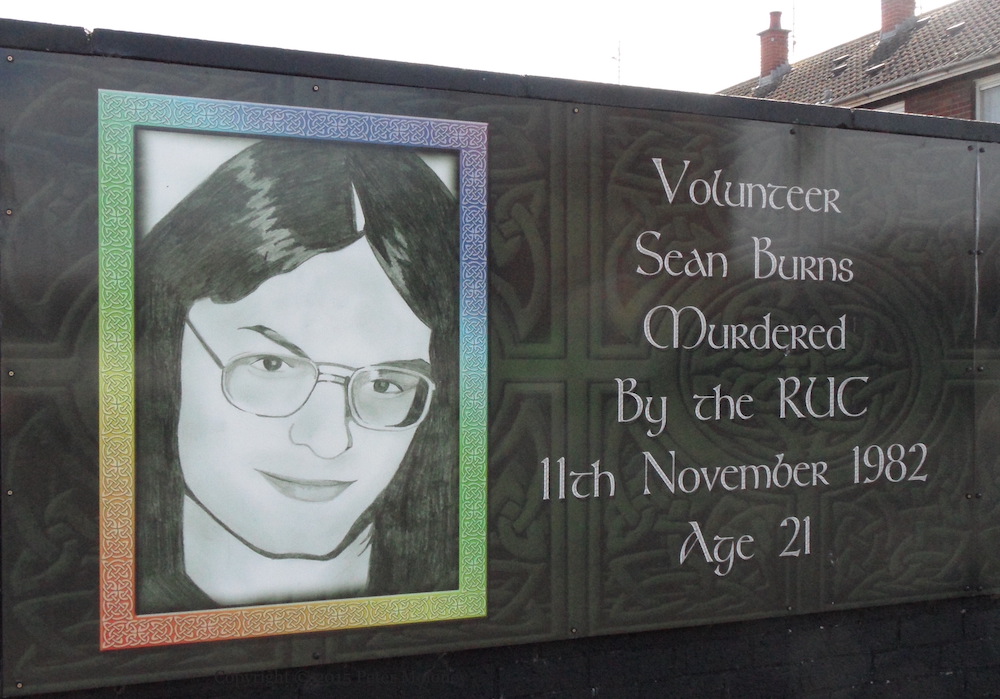
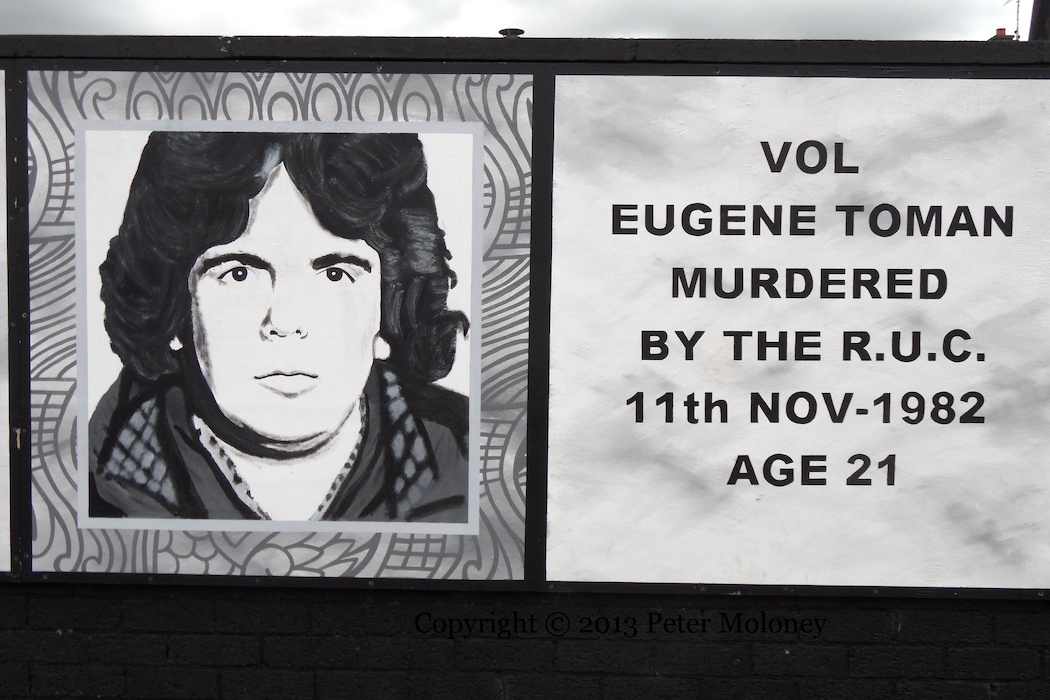
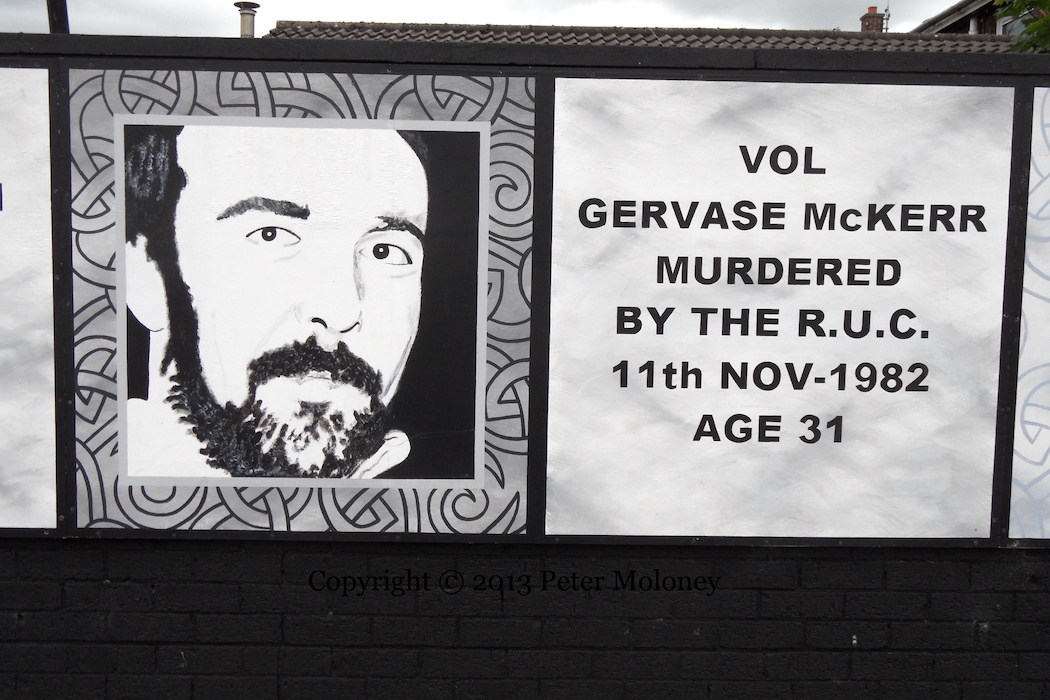
On the evening of November 21, 1982, the car in which IRA volunteers Eugene Toman, Sean Burns, and Gervaise [here spelled “Gervase” and elsewhere “Gervais”] McKerr were travelling was hit by 109 bullets and all three were killed. They were perhaps the first victims of the “shoot to kill” policy. (An Phoblacht)
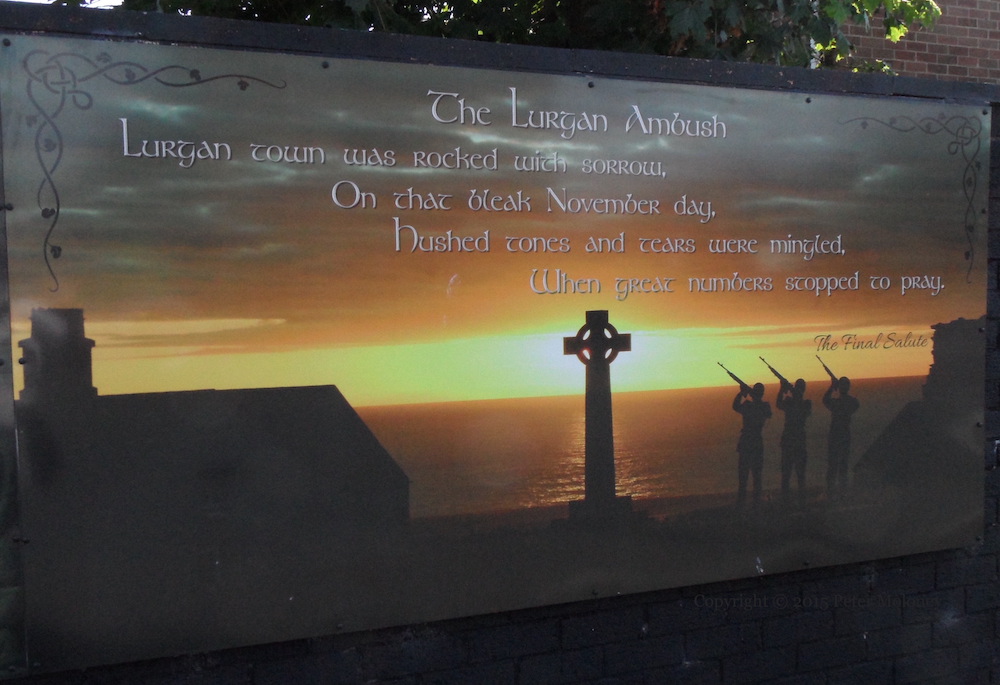
“Lurgan town was rocked with sorrow/On that bleak November day/Hushed tones and tears were mingled/When great numbers stopped to pray” – these are the opening lines of Ida Green’s poem ‘The Lurgan Ambush’, a poem by Ita Green [set to music at Irish Folk Songs | sung by Bo Loughran on youtube].
1ú Caṫlán Oırṫear Tıreoın Óglaıġ Na hÉıreann [more typically “Tír Eoghaın”; 1st battalion east Tyrone IRA]
“Beannaımıs spıorad do-ċlaoıte na laoċra atá ına luı ıns na huıgheanna seo.” [We bless the indomitable spirit of the heroes who are buried in these graves.] “do-ċlaoıte” appears to be a Connacht form of “do-ċloíte”, meaning “indomitable”, “indefatigable” (Focaıl Fholaıthe).
The volunteers named on the various stones are Patrick Kelly, Patrick Vincent, Kevin Murray, Patrick Quinn, Patrick Carty, Seán Loughan, Patrick McDonald.
Murray and McDonald were “killed in action” in 1974 (Fb).
Quinn was “killed in action” in 1973, along with Daniel McAnallen (Fb).
Loughan and Carty were “killed in action”, along with Dermot Crowley, in June 1973 (An Phoblacht).
The flat stone with the phoenix reads: “Romantic Ireland never dies!/O’Leary lies in fertile ground./And songs and spears throughout the years/Rise up where patriot graves are found.”
St Malachy’s churchyard, Coalisland Road, Edendork.
On the evening of November 21, 1982, the car in which IRA volunteers Eugene Toman, Sean Burns, and Gervaise [also spelled “Gervase” and “Gervais”] McKerr were travelling was hit by 109 bullets and all three were killed. They were perhaps the first victims of the “shoot to kill” policy. The first of the five panels in this Kilwilkie mural shows the bullet-holes in the driver’s side of the car, pointing out an inconsistency with the RUC’s statement that the car had run an RUC checkpoint and was fired at only from behind. (An Phoblacht)
“Lurgan town was rocked with sorrow/On that bleak November day/Hushed tones and tears were mingled/When great numbers stopped to pray” – these are the opening lines of Ida Green’s poem ‘The Lurgan Ambush’ (sung by Bo Loughran on youtube)
“Cumann Thomáıs Uí Chléırıgh, An Lorgaın” – Clarke was raised in Dungannon, where is a cumann and GAA club in his name.
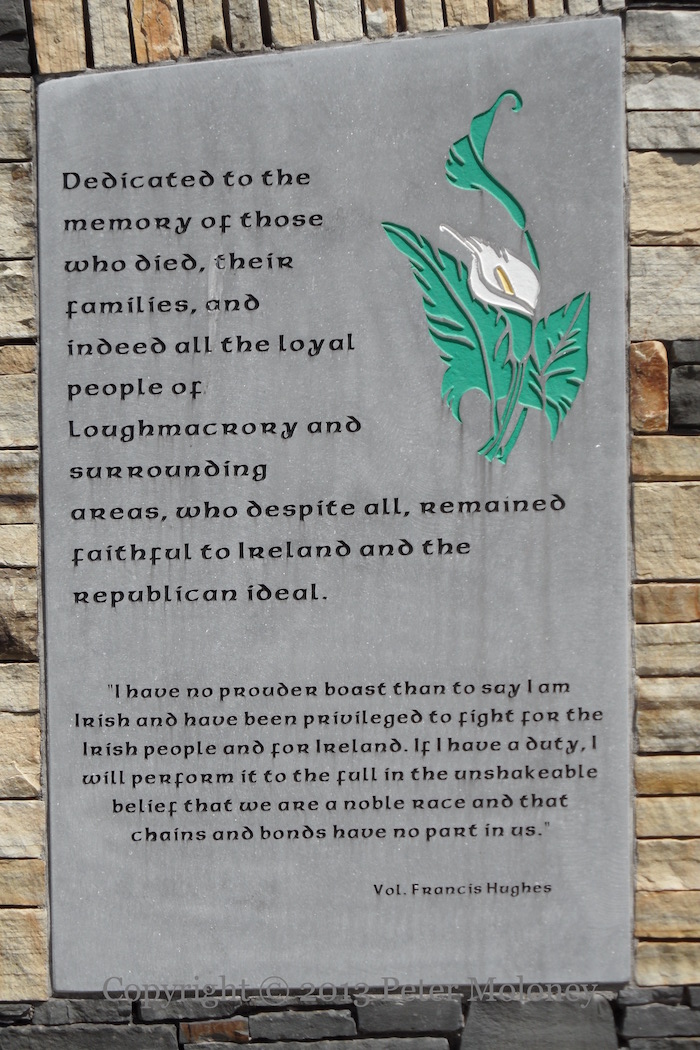
“Dedicated to the memory of those who died, their families, and indeed all the loyal people of Loughmacrory and surrounding areas, who despite all, remained faithful to Ireland and the republican ideal. ‘I have no prouder boast than to say I am Irish and have been privileged to fight for the Irish people and for Ireland. If I have a duty, I will perform it to the full in the unshakeable belief that we are a noble race and that chains and bonds have no part in us.’ Vol. Francis Hughes.”
“Comrádaıthe na n-arm. This plaque is dedicated to IRA volunteers Gerard Harte, Martin Harte, Brian Mullin who were killed in action at Drumnakilty on Tuesday 30th August 1988. Go luı cré arsa Thír Eoghaın go héadrom ar láthaır scíthe ár laochra uaısle. [May the ancient Tyrone clay lie lightly on the resting place of our noble heroes]”
“The Story Of The Murder Of Volunteer Seamus Bradley On The 31st Of July 1972, Operation Motorman.
On the 4th of July 1972, the British government met with army intelligence and army personnel, between them they created a blue print which was first called operation carcan to later be changed to operation motorman. In this secret meeting that place on the 4th of July, the army were to take 20,000 troops from the UN forces, and the government gave orders on a shoot to kill policy and confirmed that no soldier would be held accountable for their actions on that day. Over 1,500 of these soldiers and 300 centurion tanks were sent to free Derry to tear down the barricades and cause havoc, but the provisional IRA intercepted their blue print and decided to step down to protect the innocent people of Northern Ireland. It was 4:10am, there were 25 – 30 people at the Creggan shops when there was gunfire heard, Vol. Seamus Bradley unarmed drew attention to himself to save others.
He ran down Bishop field where a soldier was to get out of a saracen, take aim in a kneeling position and fire two shots hitting him in the back, Vol. Seamus Bradley fell. Then the saracen drove down the field to where he lay, they put him in the saracen and took him away to St. Peter’s school, no one knew what happened after that. All they know is that he was interrogated, the pictures tell their own story. He was shot again three more times at close range, he was tortured and beaten and left to bleed to death at the hands of the British army. Afterwards it was confirmed by a doctor that none of Seamus Bradley’s injuries had been life threatening and had he received medical aid he would have lived.
This memorial is to commemorate Vol. Seamus Bradley just yards from where he fell. Vol. Seamus Bradley on the 2nd Battalion of B company Oglaigh Na H-Eireann, even though he was shot five times and beaten they could not make him betray his comrades.
I lived and loved and laboured with a patriot’s heart and will that the dawning years might make you fearless and unfettered still. When a future age shall find thee free men stand by thy side Mother Ireland o” remember me.
They may kill our bodies and take our blood but they will never break our spirits. Vol. Seamus Bradley. The war is not over until Ireland is free.”
“H-Block 1981, Maghaberry 2012”, “End forced strip searches”, “End controlled movement”, “Stop the torture of Irish political prisoners.”
The “August 2010 Agreement” is an agreement reached between prisoners and authorities about treatment in Roe House, an exclusively republican wing in Maghaberry. The tower beyond is the Springfield Rd police station.
“This plaque is dedicated to the memory of those murdered on 9th July 1972 by the British army. Fr Noel Fitzpatrick, Paddy Butler, Margaret Gargan, David McCafferty, Fıan John Dougal, and to all those murdered in Springhill, Whiterock, and Westrock area.” This is the new plaque to the five people killed in the Springhill-Westrock Massacre, and is on the house extension that the previous plaque. (See chapter 2 of An Pobal A Pheınteáıl.)
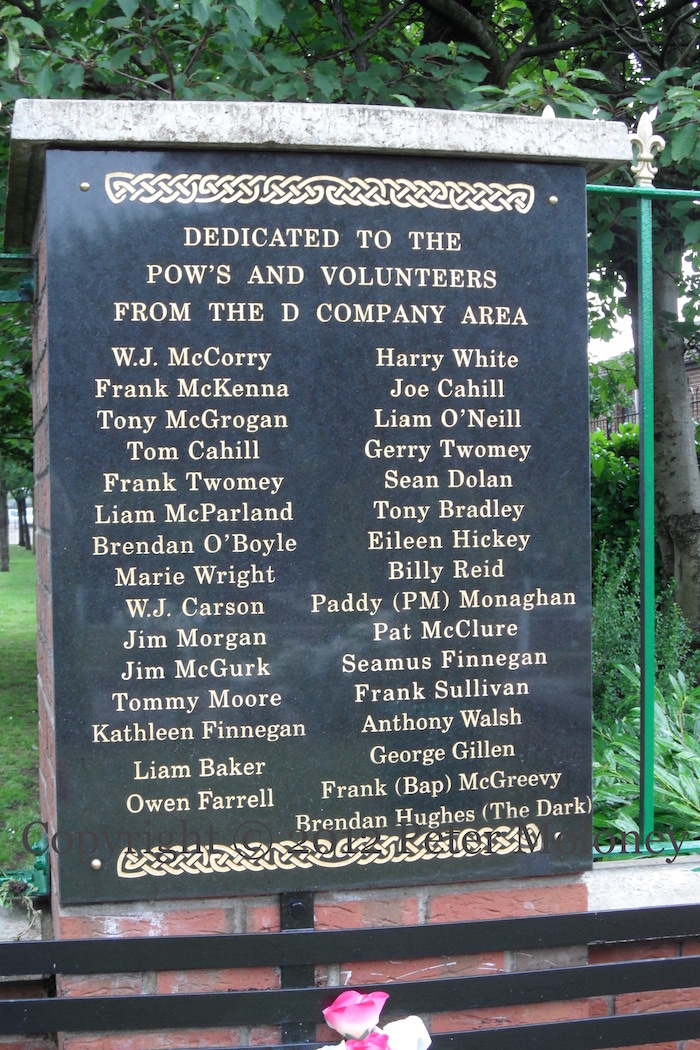
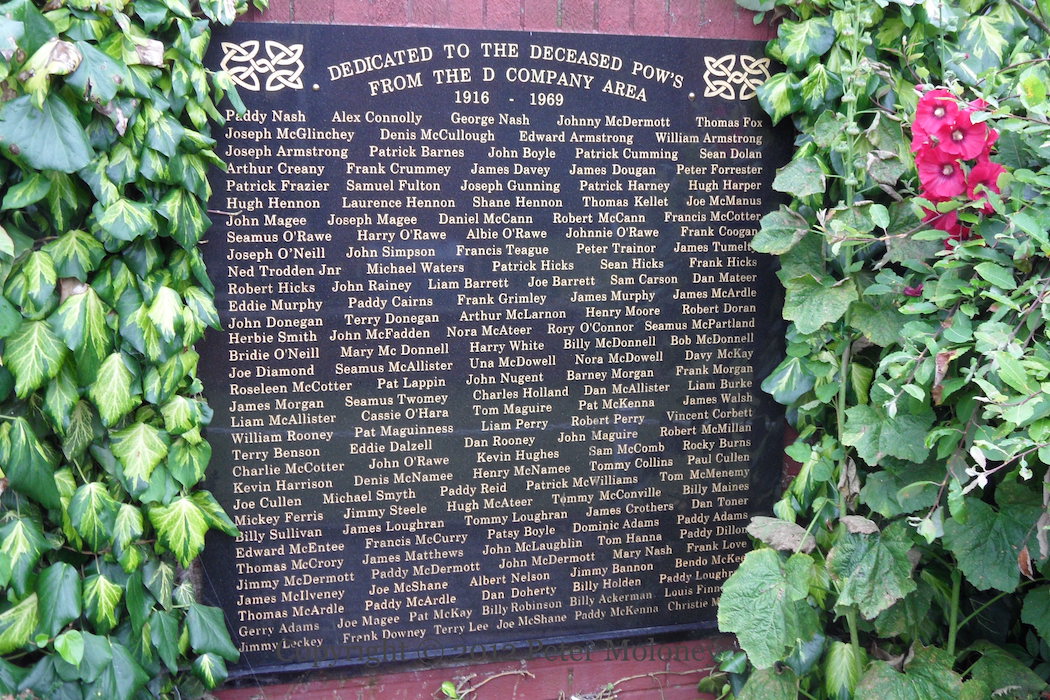
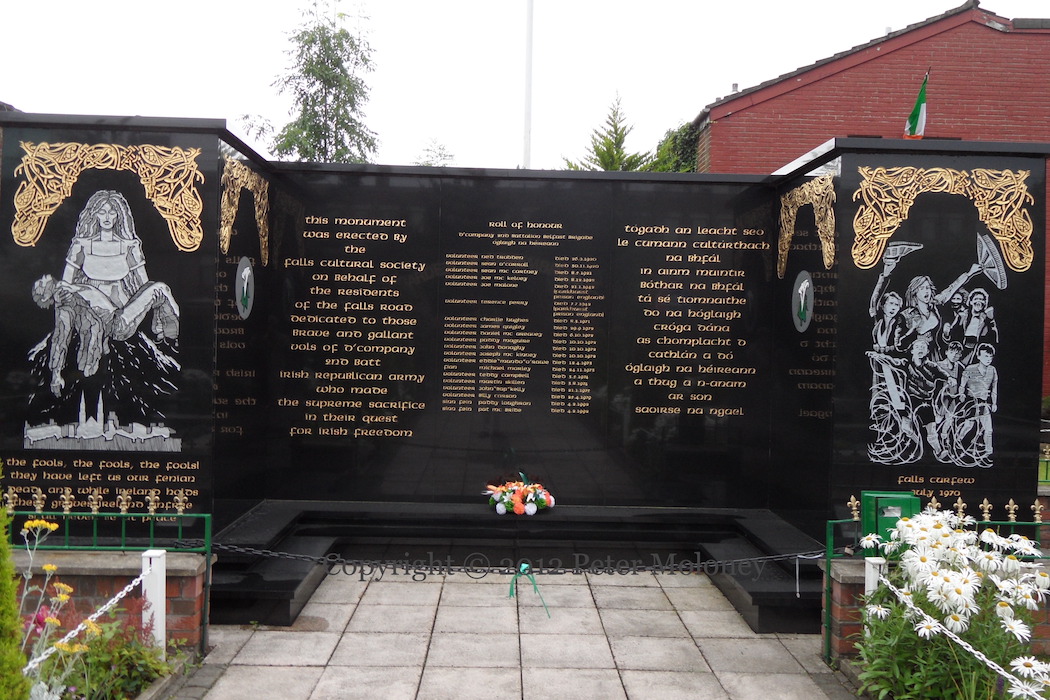
“Those brave and gallant vols of D Company IRA”, “POWs and volunteers”, “deceased POWs”, the D company volunteers who have “died of natural causes”, and the “civilians” who lost their lives. Some of these were seen before, in 2005’s Lower Falls Memorial Garden; the main addition is the large memorial with the illustrations, shown in the final image.
These are images from 2012 of the ‘My brother is not a criminal’ memorial in Ford’s Cross/Silverbridge, seen previously in 2006.
As the second image shows, earlier hunger strikers are also remembered: Thomas Ashe 1917, Michael Fitzgerald, Joseph Murphy, Terence McSwiney 1920, Joseph Whitty, Denis Barry, Andy Sullivan 1923, Tony Darcy, Sean McNeela 1940, Sean McCaughey 1946, Michael Gaughan 1974, Frank Stagg 1976.
The gallery of twelve hunger strikers in ‘Remember the hunger strikers’ is further up the road, towards Cullyhanna.
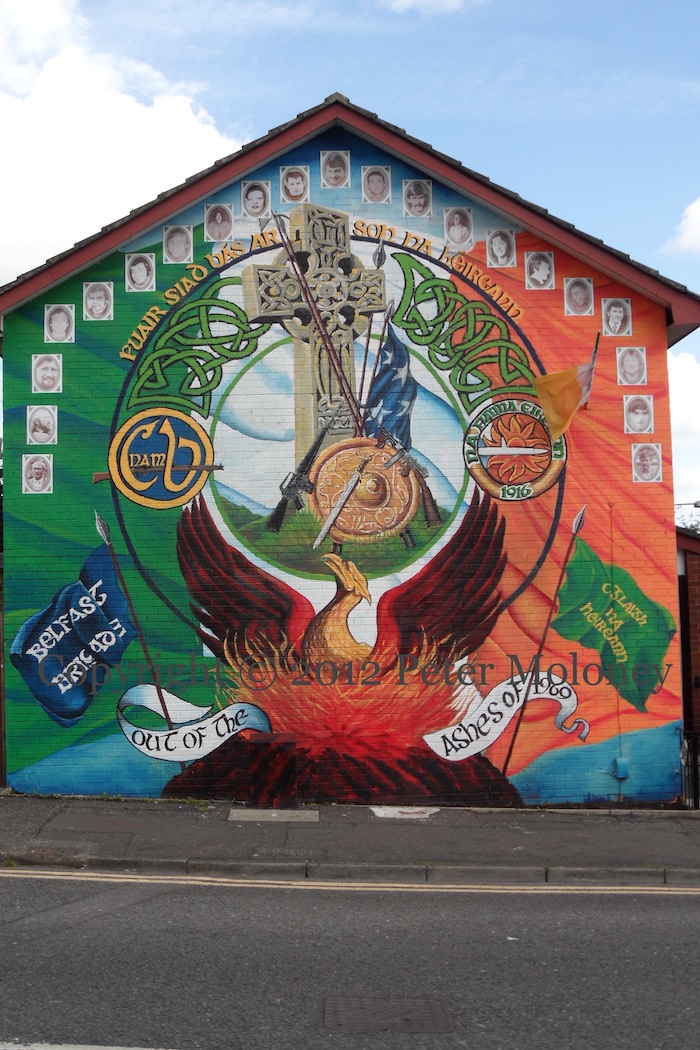
The scroll reads “Out of the ashes of 1969” arose the Provisional IRA, but the lineage is a long one and all but one of the organisations, events, and arms depicted here precede 1969: Cumann Na mBan, Na Fıanna Éıreann, Óglaıgh Na hÉıreann, a Celtic shield and sword, a pike (from the 1798 Rebellion), a Thompson gun, the Tricolour; only the assault rifle is modern and perhaps also is meant to indicate the Provisionals, Belfast Brigade. “Fuaır sıad bás as son saoırse na hÉıreann.”












 Peter Moloney Collection