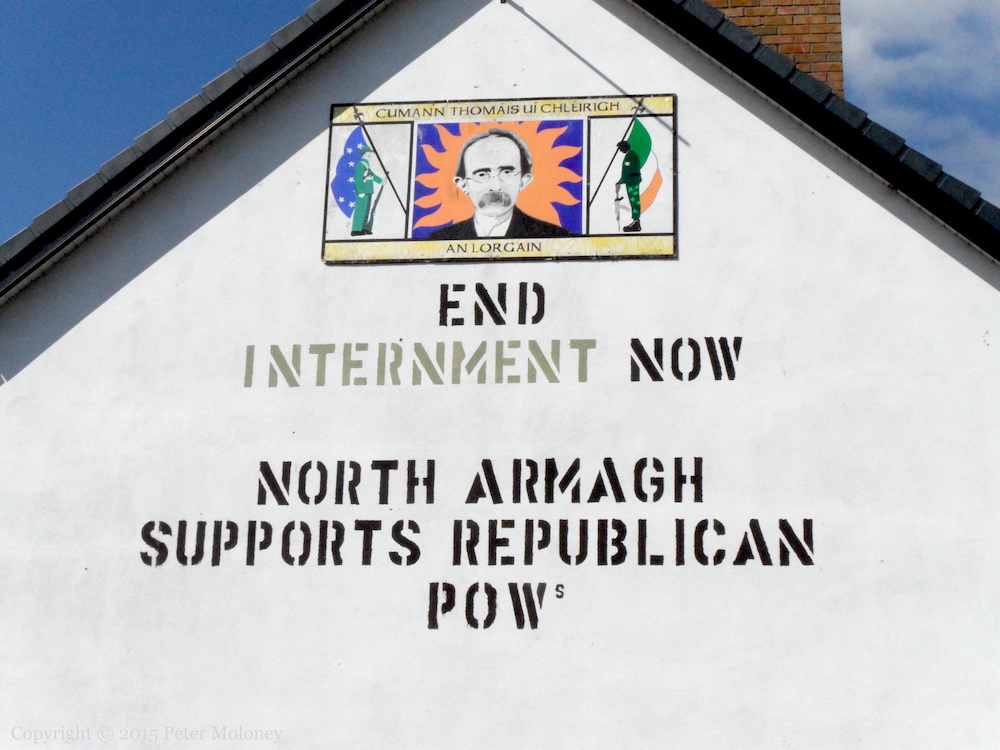
“Cumann Thomáıs Uí Chléırıgh, An Lorgaın. End internment now. North Armagh supports republican POWs”.
Clarke grew up in nearby Dungannon and there is a cumann of the 1916 Societies in Dungannon (Fb) and, according to this board, in Lurgan. (A statue to Clarke was later mounted in Dungannon – see Gaırdín Thomaıs Uí Chléırıgh.)
Lake Street, Lurgan. The board was perhaps previously in Levin Rd – see The Lurgan Ambush.
This is a new info board at the bottom of the steps leading up to the IRA memorial dolmen first seen in 1999. It features portraits of 16 volunteers from Derry’s 1st battalion and a quotation from Pearse at the funeral of O’Donovan Rossa in 1915: “Life springs from death, and from the graves of patriot men and women spring living nations. The Defenders of this Realm have worked well in secret and in the open. They think that they have pacified Ireland. They think that they have foreseen everything, think that they have provided against everything; but the fools, the fools, the fools! They have left us our Fenian dead, and while Ireland holds these graves, Ireland unfree shall never be at peace.”
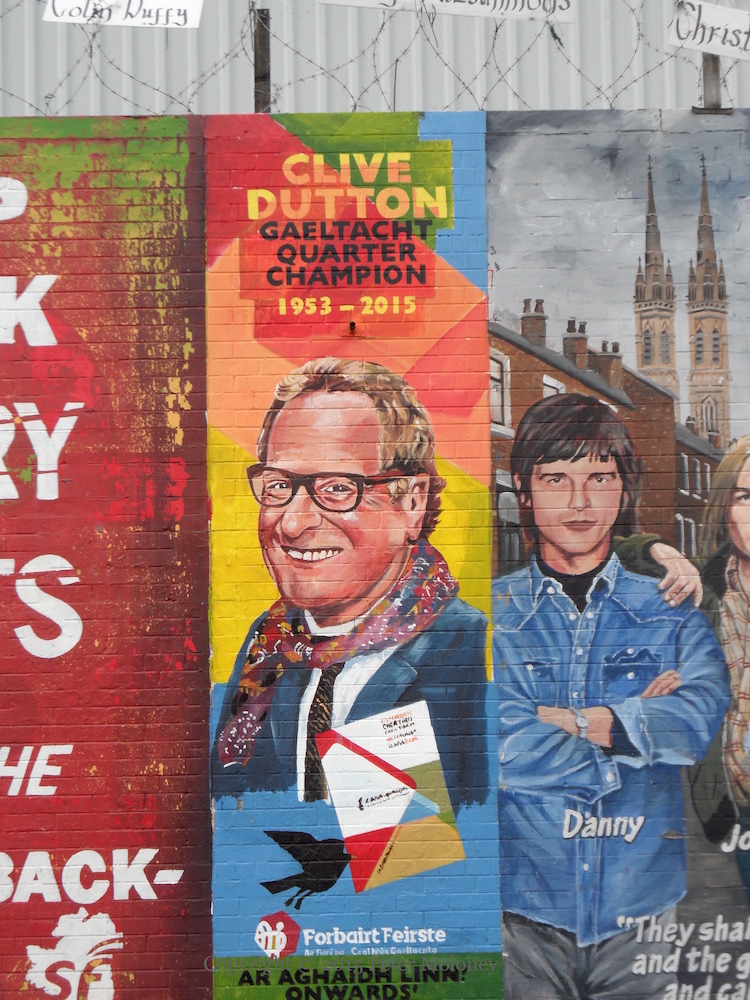
Englishman Clive Dutton was an urban planner who was best known for work in Birmingham, London (Newham), and Belfast. He produced “The Dutton Report” (pdf) in 2004 and “The Big Plan” (pdf) (the cover of which is pictured in the mural) in 2013. In them, he proposed and then updated a plan to tackle economic deprivation in west Belfast by the creation of a ‘Gaeltacht Quarter’ or ‘Ceathrú Gaeltachta’. He died on June 8th at the age of 62 and the mural above has been painted in remembrance.
“Fıann [sic] Robert Allsopp lived at this address. Died on active service March 3rd 1975. Fuaır sé bás ar son na hÉıreann. 1959-1975” Allsopp died at the family home (on the New Lodge Road) from the accidental discharge of a gun. The O’Neill-Allsopp flute band is named in his honour (and in honour of Jim O’Neill) and the band has a mural in Donore Court.
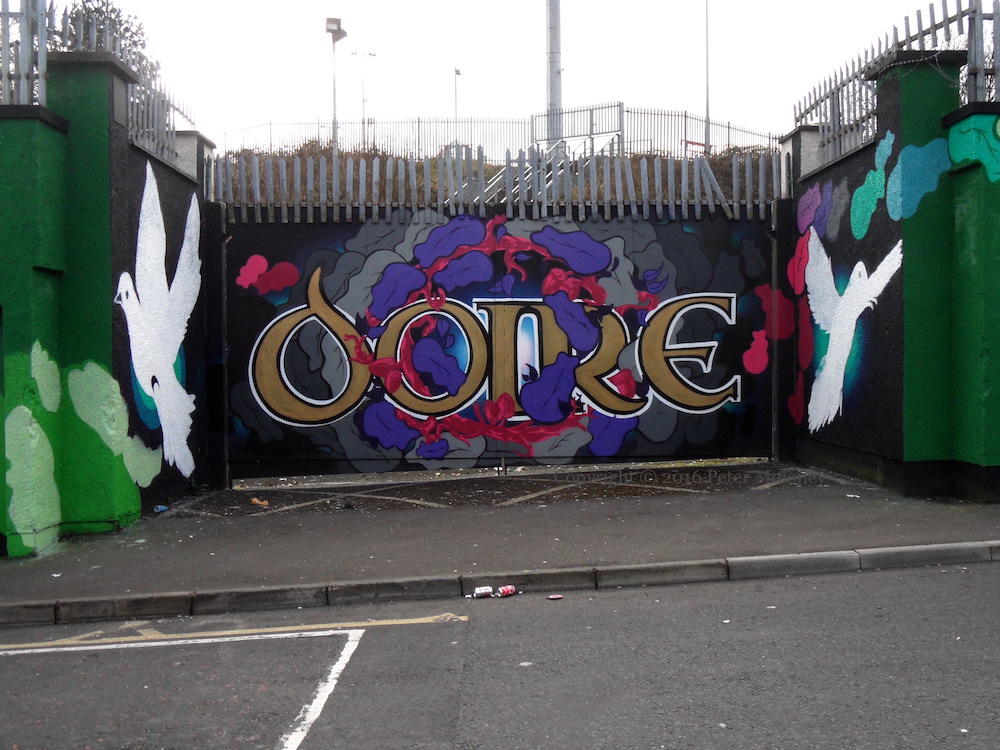
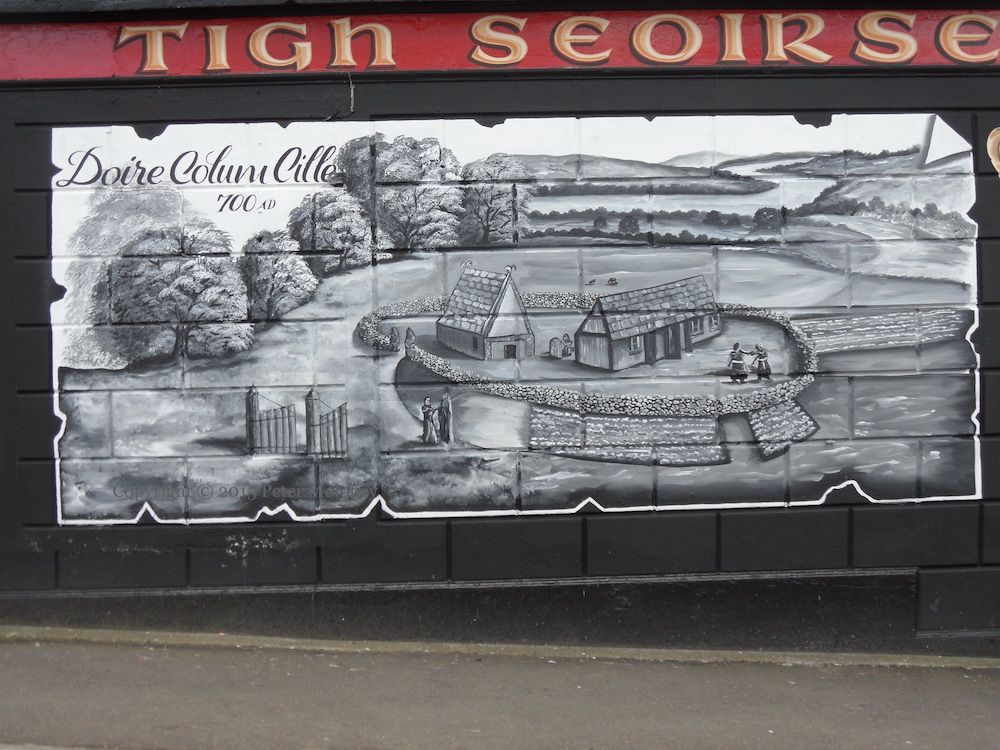
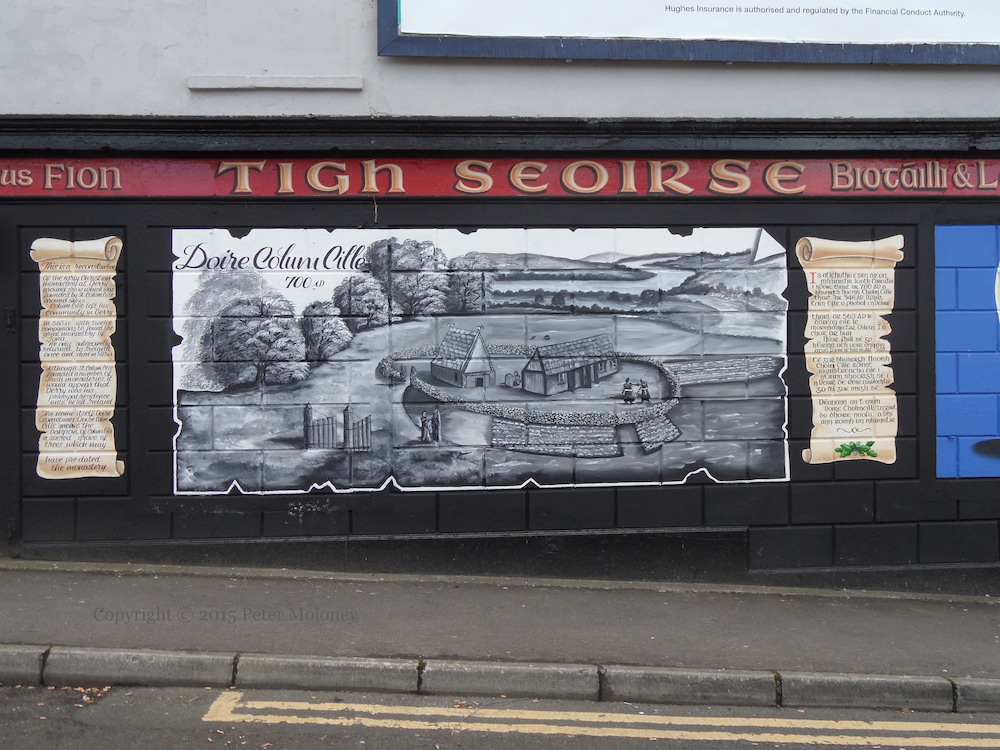
The Christian missionary Colm Cılle (in Latin, Columba), born in Donegal, founded a monastic settlement on the banks of the Foyle (then still part of Donegal) around 540 AD. The “Doıre” part of the name means “oak grove” and perhaps refers (as the information panel suggests) to “a sacred grove of trees, which may have pre-dated the monastery.” The mural above shows a reconstruction of the Derry monastery c. 700 AD. The name “Londonderry” dates to 1662.
Columba moved on to Scotland circa 563 and founded an abbey on the island of Iona. Among his reputed miracles is the banishment of a great water beast from the River Ness in 565.
“This is a reconstruction of the early Christian monastery at Derry around 700 AD which was founded by St Colum Cille around 546 AD. Colum Cille left his community in Derry in 563 AD with twelve companions to found the great monastery of Iona. He only subsequently returned to Ireland once and died in 593 AD. Although St Colum Cille founded a number of Irish monasteries, it would appear that Derry was his principal residence until he left Ireland. The name itself, Doıre, (sometimes Doıre Colum Cılle) means ‘the oakgrove of Colum Cille’ a sacred grove of trees, which may have pre-dated the monastery.”
“Is athchuthú é seo ar an mhainistir luath-Chríostaí i nDoıre thart ar 700 AD a bhunaigh Naomh Cholm Cıille thart ar 546 AD. D’fhág Colm Cille a phobal ı nDoıre thart ar 563 AD le dáréag eıle le mómhaınıstır oıleán Í a chur ar bun. Níor fhill sé go hÉıreann ach uaır amháın agus fuaır sé bás in AD 593. Cé gur bhunaigh Naomh Cholm Cille roınnt maınıstreacha eıle ı nÉırınn, shocrıgh sé ı nDoıre de réır cosúlachta go dtí gut ımıgh sé. Déanann an t-aınm ‘Doıre Cholmcılle’ tagaırt do dhoıre naofa, a bhí ann roımh an mhaınıstir.”
U Bennett Street, Derry, on the side wall of Tıgh Seoırse.
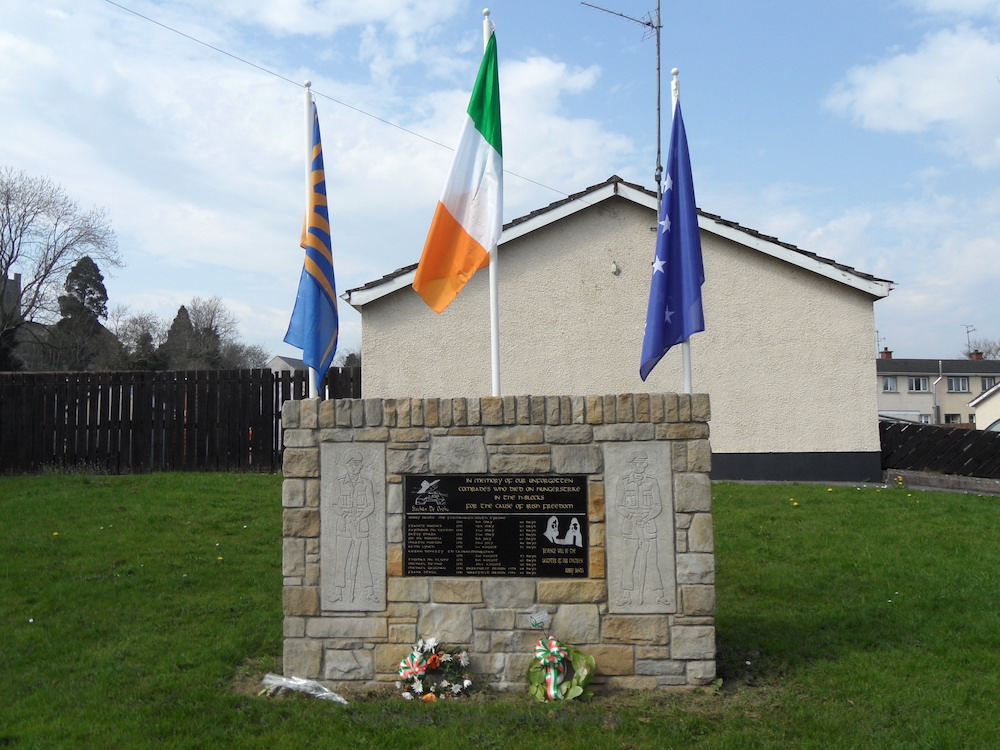
“In memory of the unforgotten comrades who died on hungerstrike in the H-Blocks for the cause of Irish freedom. Síochá[ı]n Dé orthu. [Our] revenge will be the laughter of our children – Bobby Sands”.
Michael Gaughan and Frank Stagg, who died in English prisons in the 1970s, are included below the ten deceased 1981 hunger-strikers.
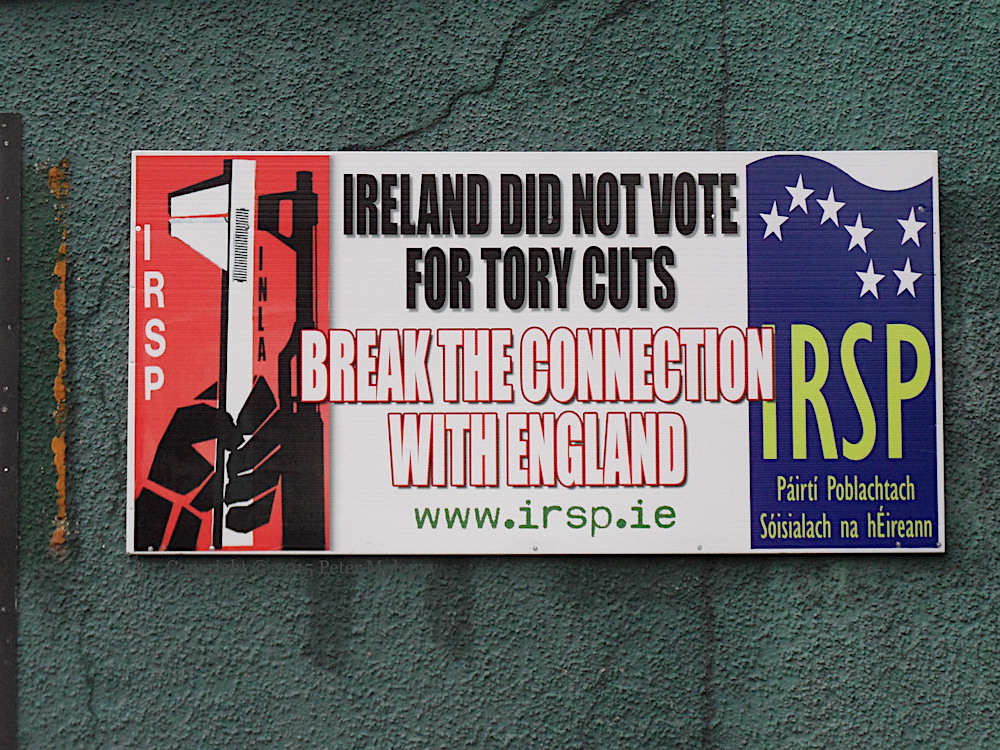
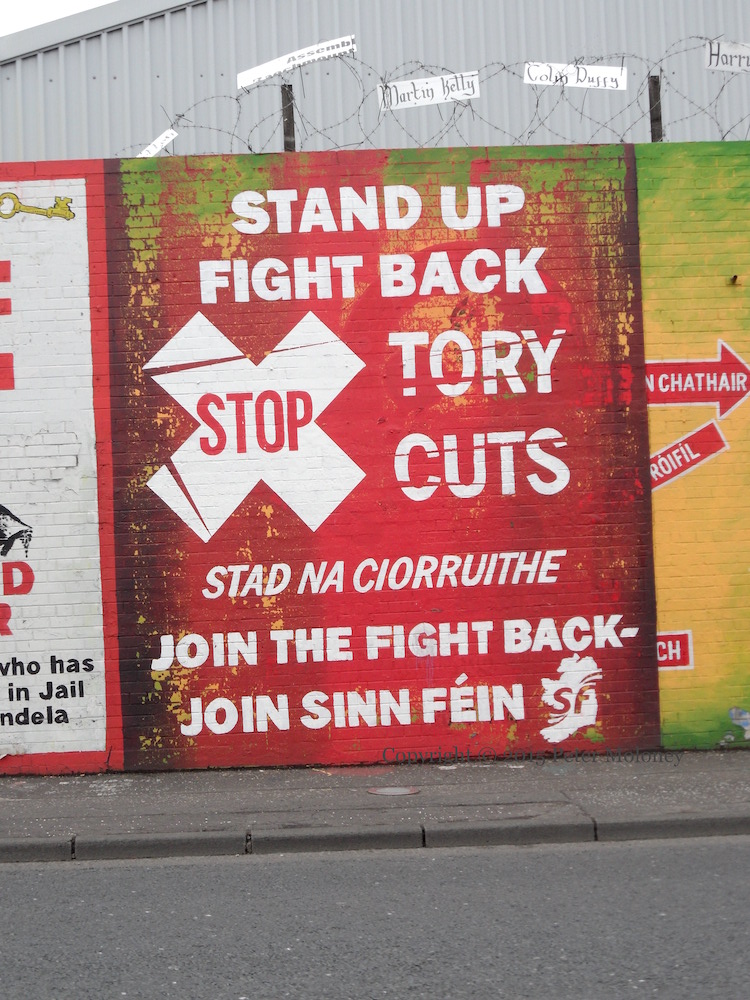
“Stad na cıorruıthe. Stand up, fight back.” The (UK) Conservative Party has proposed a series of cuts, including a freeze of child benefit, income support, tax credits, dole, and housing benefit. These are opposed by various parties and advocacy groups in both Great Britain and Northern Ireland. Protest rallies were held in both Belfast and Dublin in October last year (2014-10-11).
The mural above is on the Divis Street international wall (Visual History).
Keiran Nugent (and Brendan Hughes) has been returned to the left-most spot on the International Wall.
This new board is closely based on the mural which was painted over in October in advance of the November 9th non-binding referendum in Catalonia (see Votes About Votes; the yellow background and some of the lettering from the Catalonia mural can still be seen in the image above).
Nugent and Maıréad Farrell were then included in the hunger-strikers mural further down the wall: see I’ll Wear No Convict’s Uniform.
Two IRA memorial plaques have been mounted on a wall in Herbert Street, Ardoyne, close to the Sammy McLarnon plaque:
“Óglach James McDade 24 July 1946 – 14 Nov 1974 died on active service, England; Óglach Gerard McDade 22 Nov 1950 – 21 Dec 1971 murdered by British Crown Forces. A Mháthaır na hÉıreann, fáısc [strain, draw tight] do bhéırt mhac, Séamus agus Geraóıd, le do chroí. Throıd sıad agus fuaır sıad bás. Mother Ireland, hold your sons, James and Gerard, close to your heart. They fought and they died.”
The McDade family lived in Ardoyne. James died while planting a bomb in Birmingham, England; Gerard was shot by a British Army soldier – there is a plaque to his memory in Beechmount. (Sutton)
“Óglach Frankie Donnelly 26 Aug 1954 – 5 Jan 1979 died on active service; Óglach Laurence Montgomery 12 June 1954 – 5 Jan 1979 died on active service. Níl sa saol seo ach tréımhse gaırıd ar an bhóthaır fada chun na saoırse [in this life there is only a short period on the long road to freedom] – life is but a short part on the long journey to freedom”
Donnelly and Montgomery were killed in Northwick Drive, Ardoyne, by the premature detonation of a car-bomb. (Sutton)