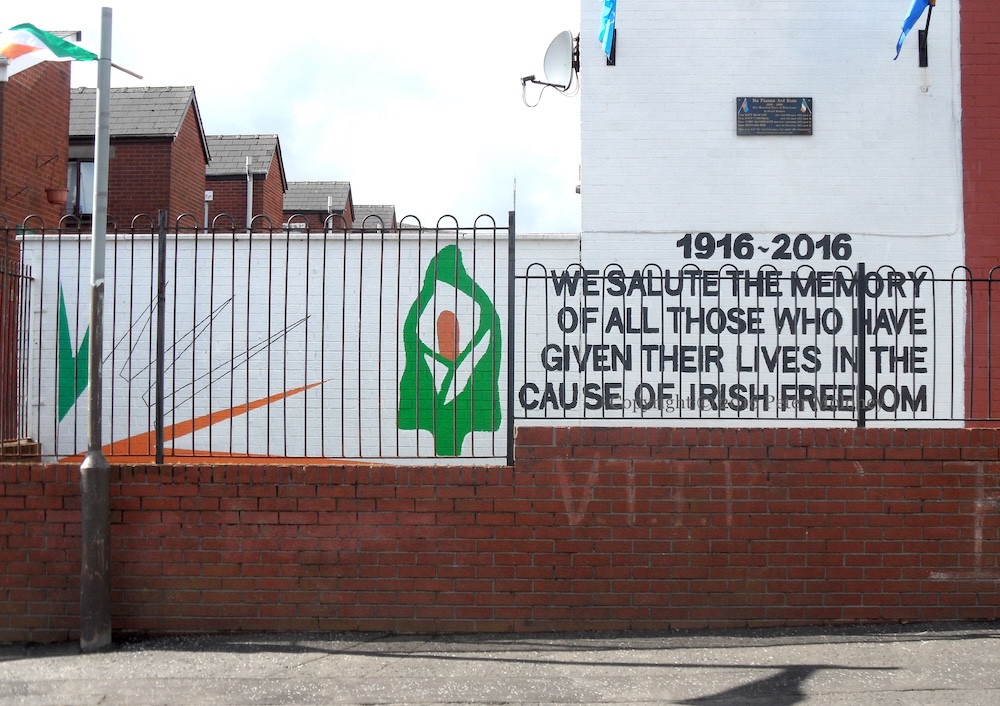
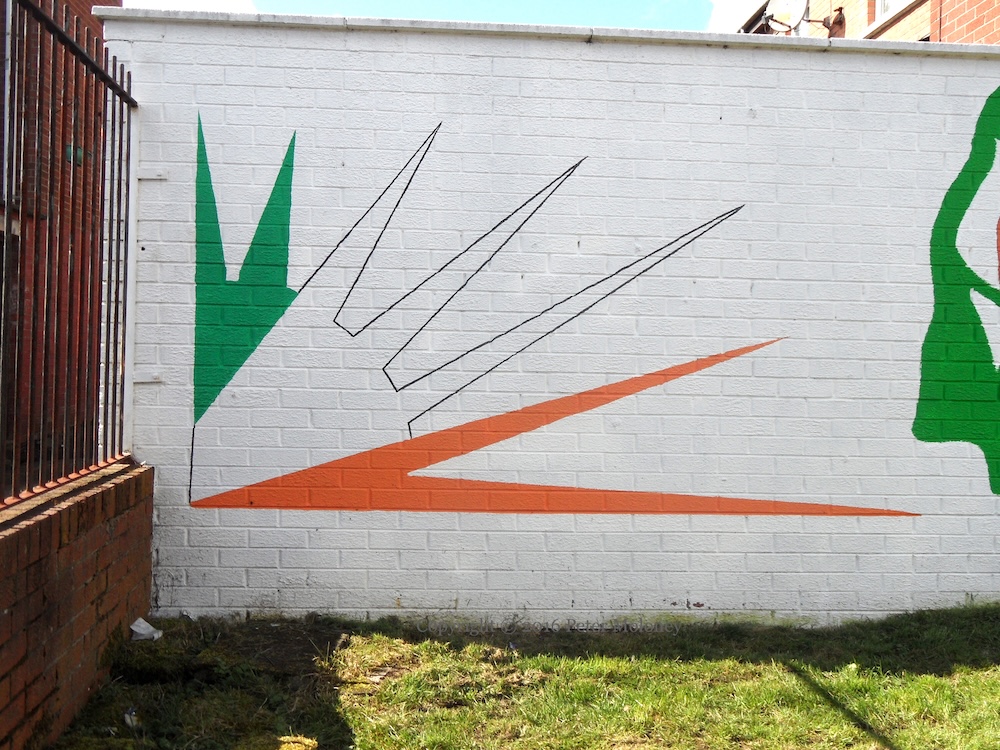
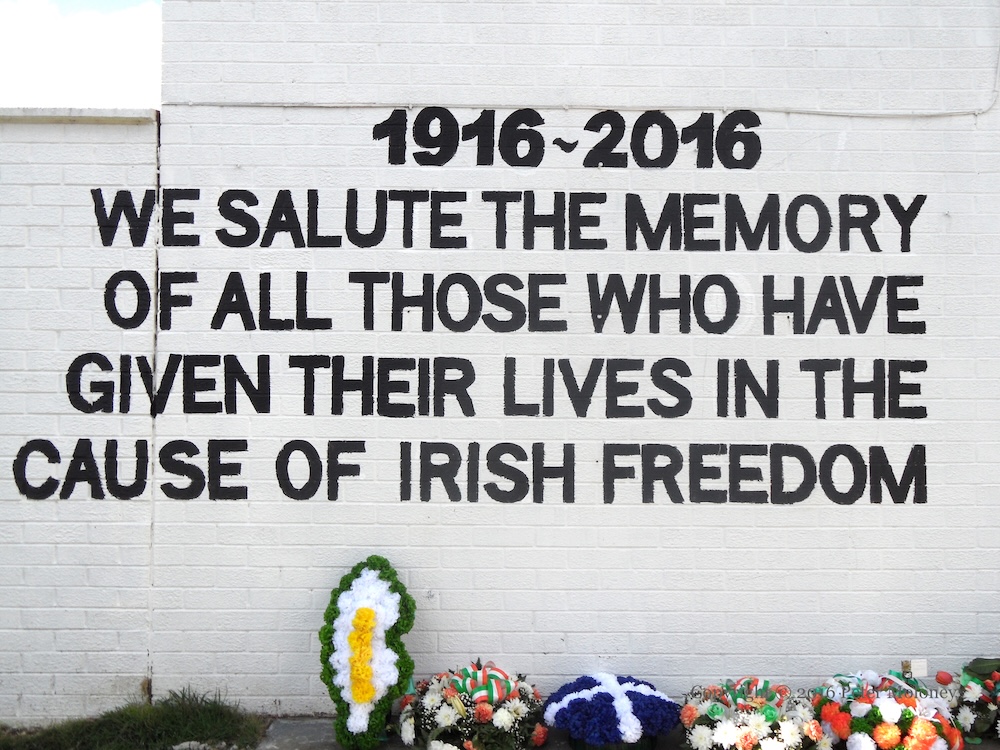
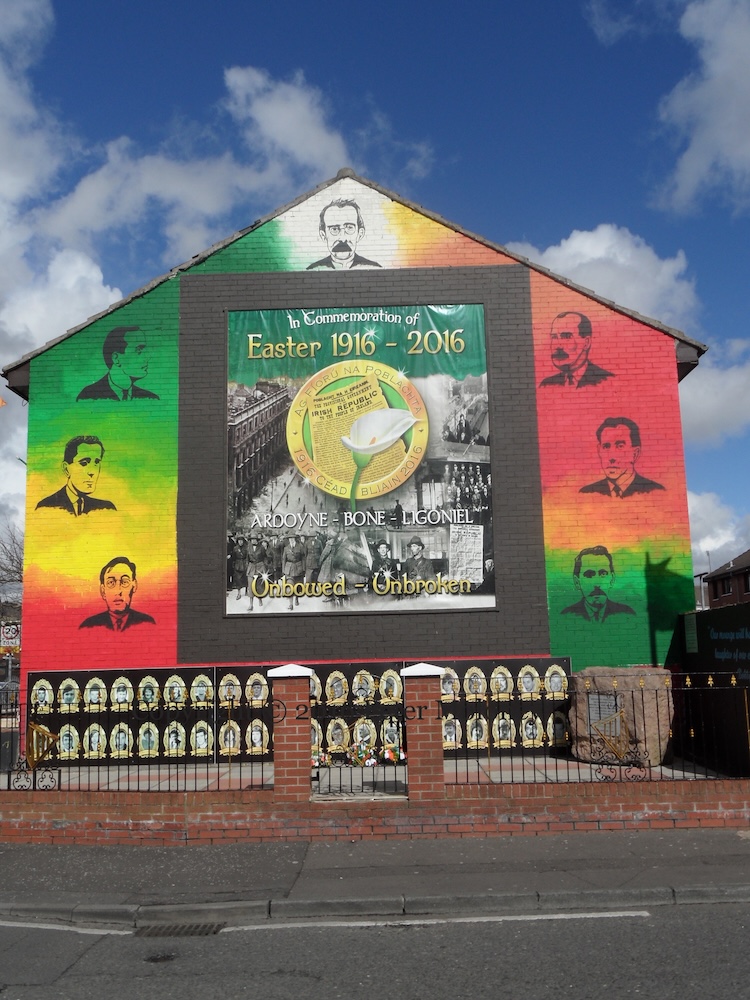
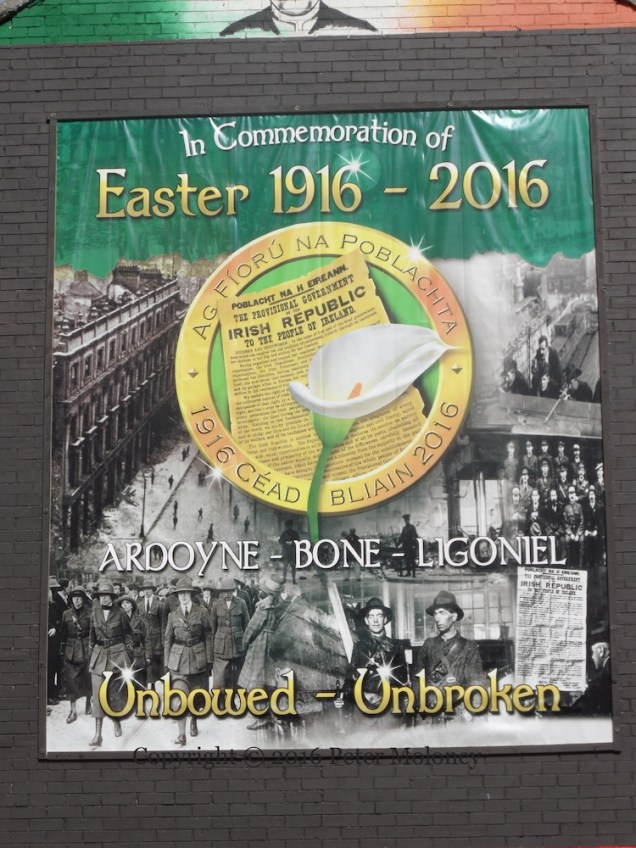
“1916 – 2016. We salute the memory of all those who have given their lives in the cause of Irish freedom.” This is an extension by the RNU (web), on the centenary of the Easter Rising, to the large tarp seen in Ardoyne’s Fallen Fıanna. The plaque was recorded in 2011.
“In commemoration of Easter 1916 – 2016. Ardoyne – Bone – Ligoniel. Unbowed – unbroken.”
Tom Clarke is at the head of his fellow signatories as he looks down over a printed tarp reproducing photographs of events surrounding the Easter Rising of 1916, including soldiers from the Irish Citizen Army on a rooftop (see the original in this Spectator article) and members of Cumann Na mBan on parade. For the photo of the building in the top left, see this Irish Times article.
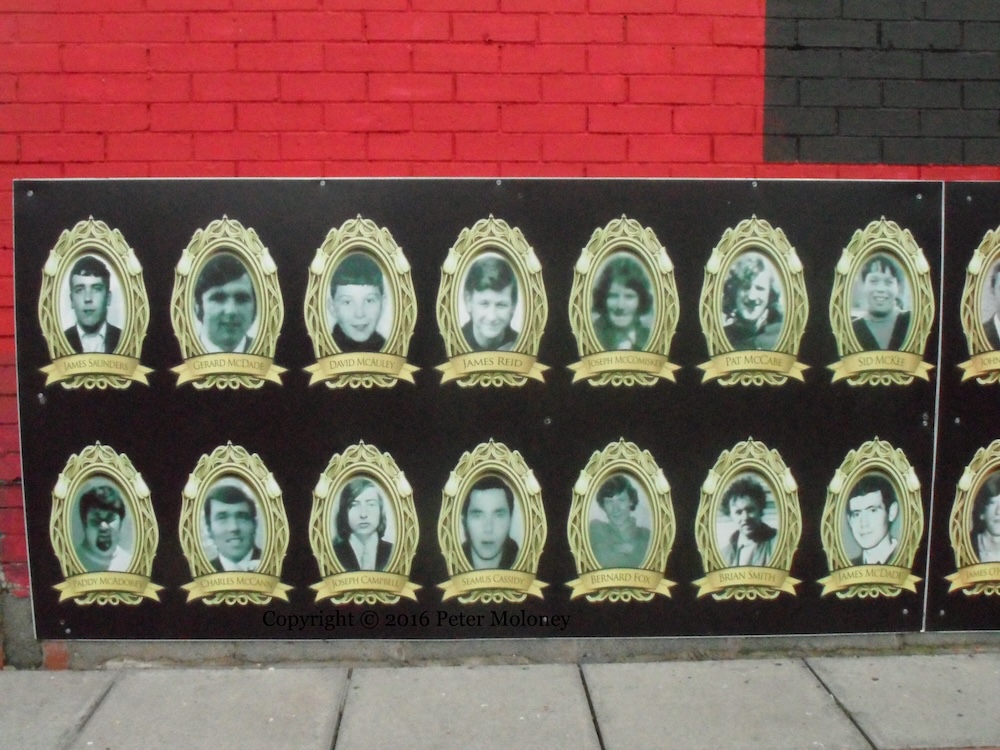
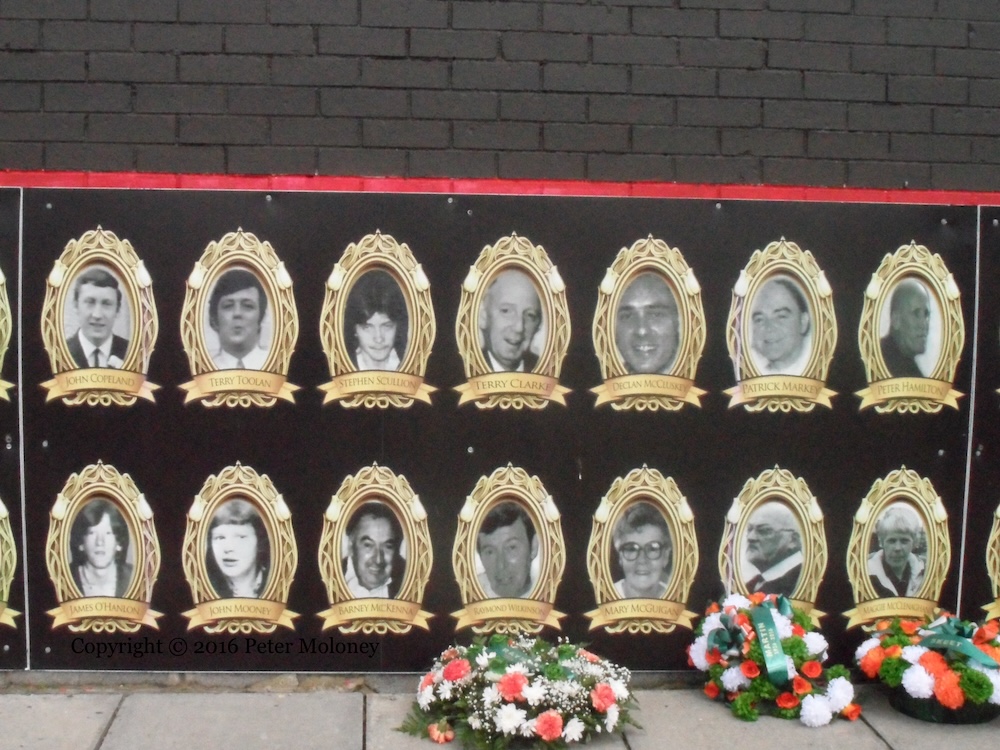
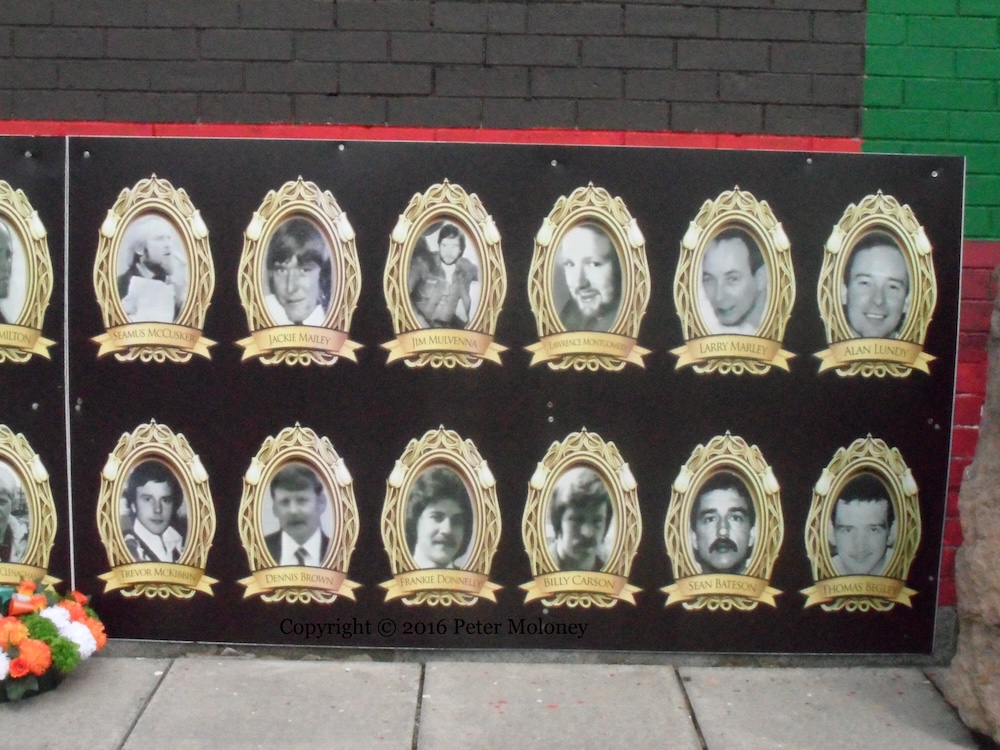
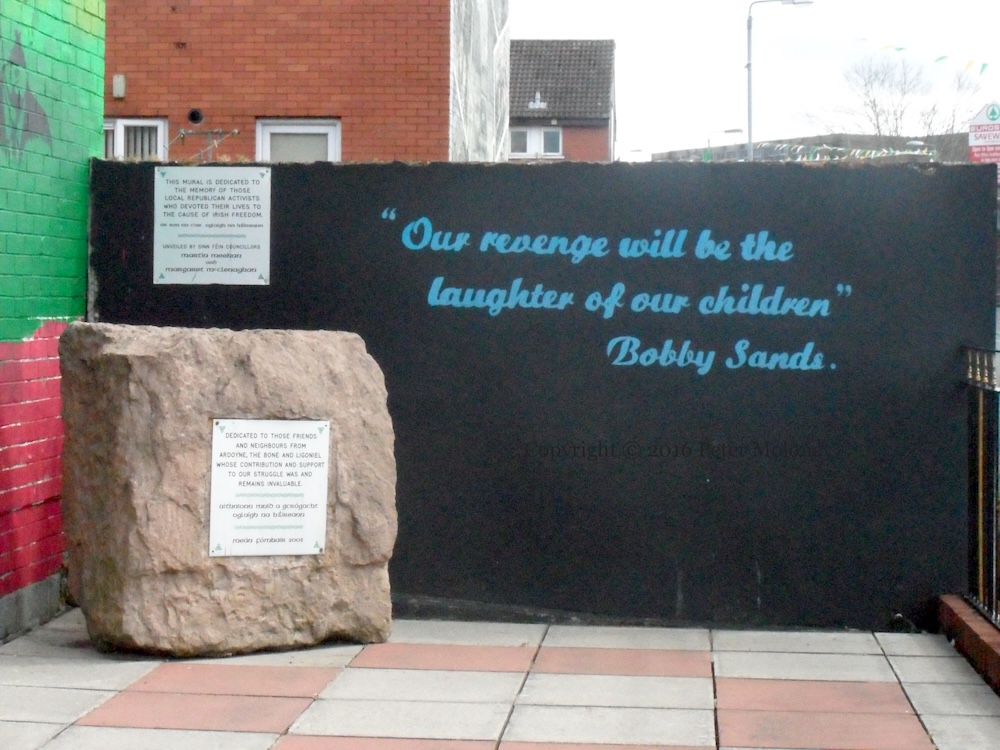
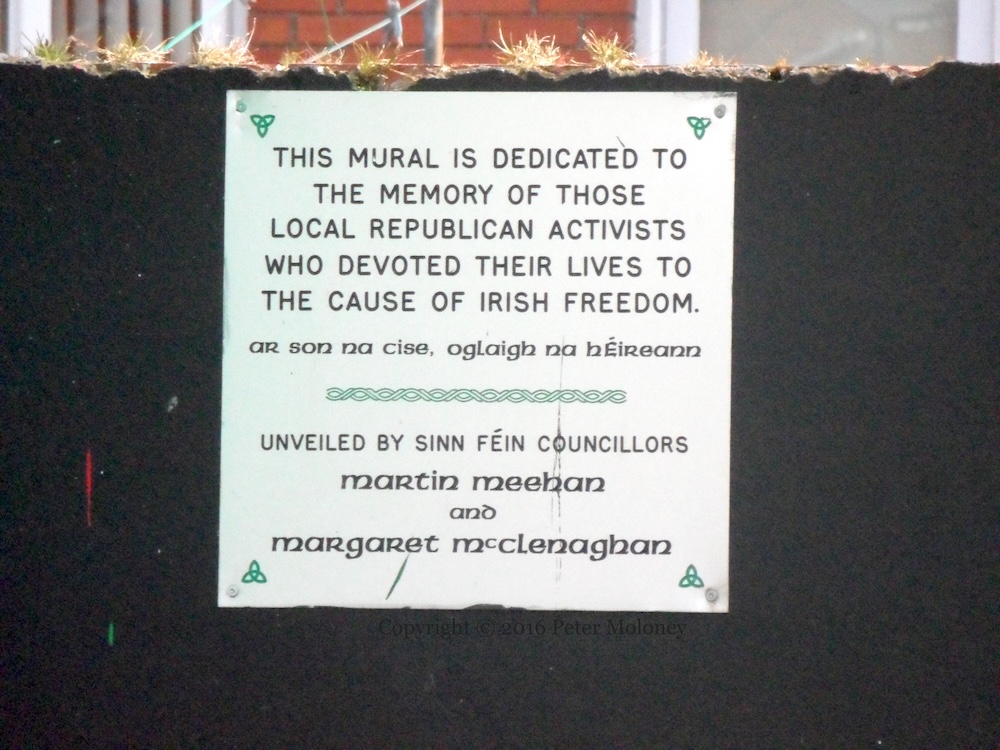
The previous Ardoyne – Bone – Ligoniel mural fell down almost as soon as it was completed, leaving only the boards with portraits of locals killed during the troubles. The stone and plaque (in the final images) go back to the mural before that.
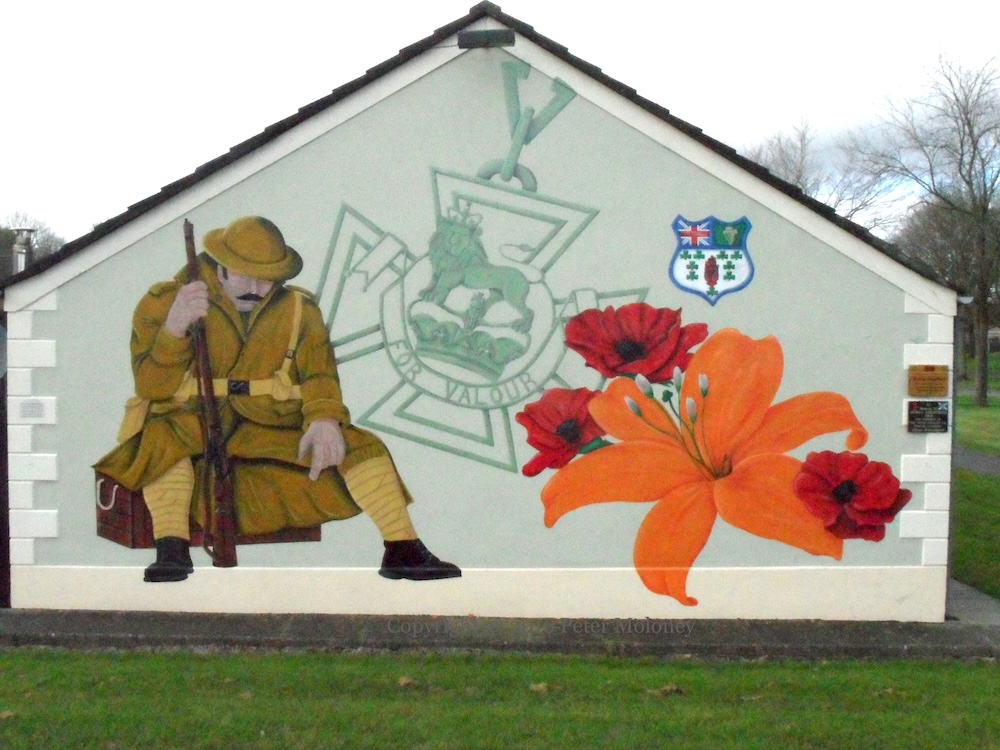
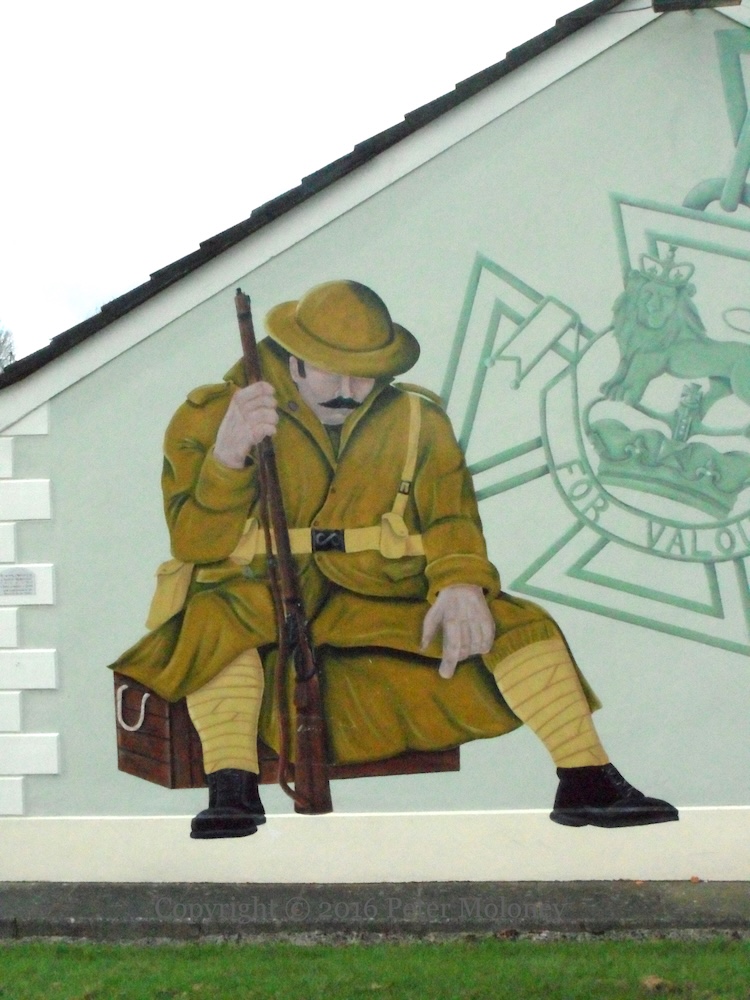
This WWI Victoria Cross mural was launched in December, 2014 (NI World), replacing Fight To A Finish. The soldier doesn’t appear to be anyone in particular; the only VC winner from Ballymena was from the Boer War (VC Online).
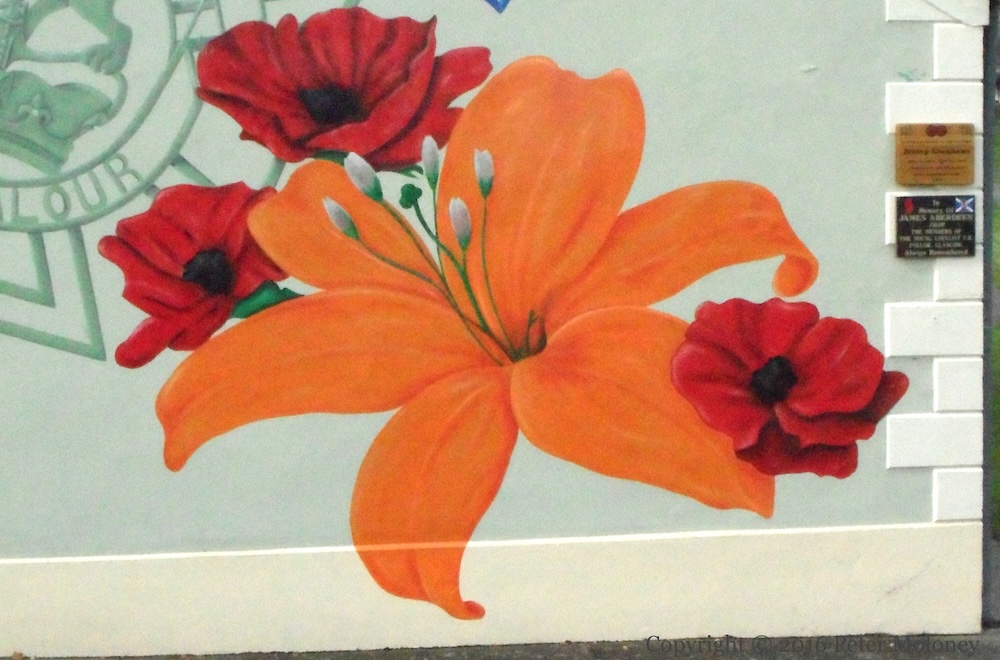
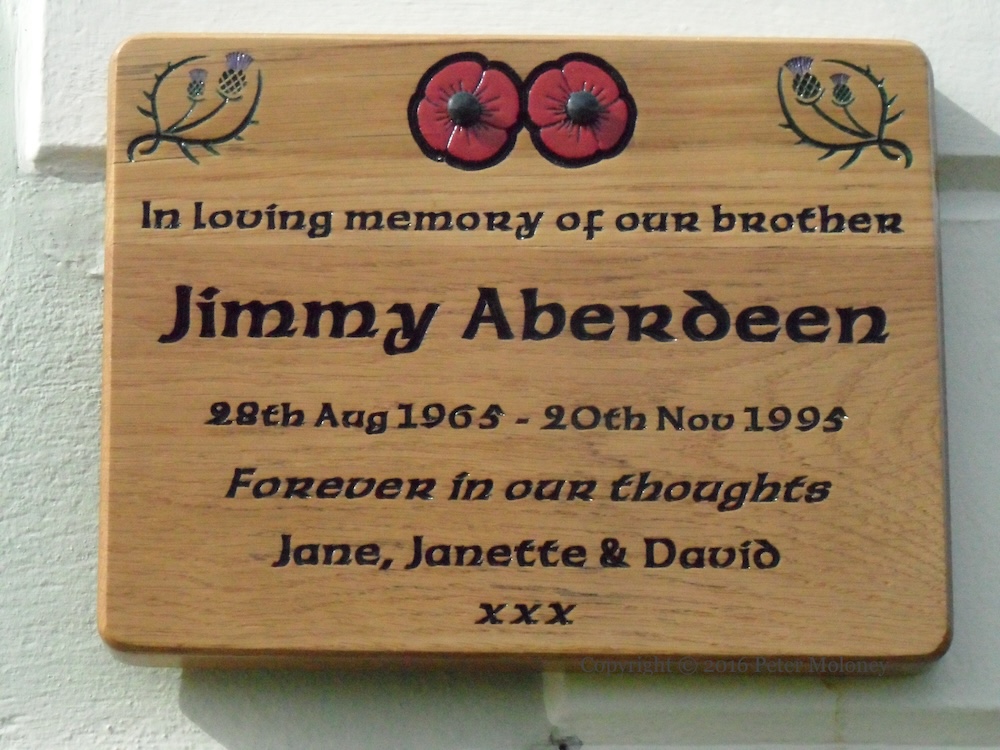
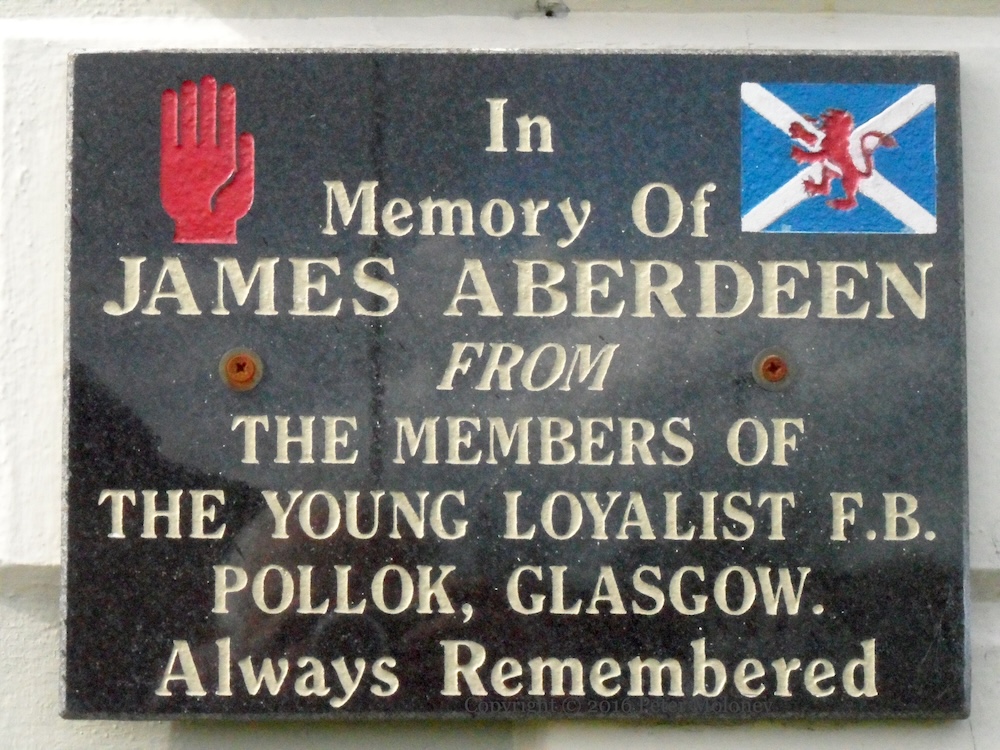
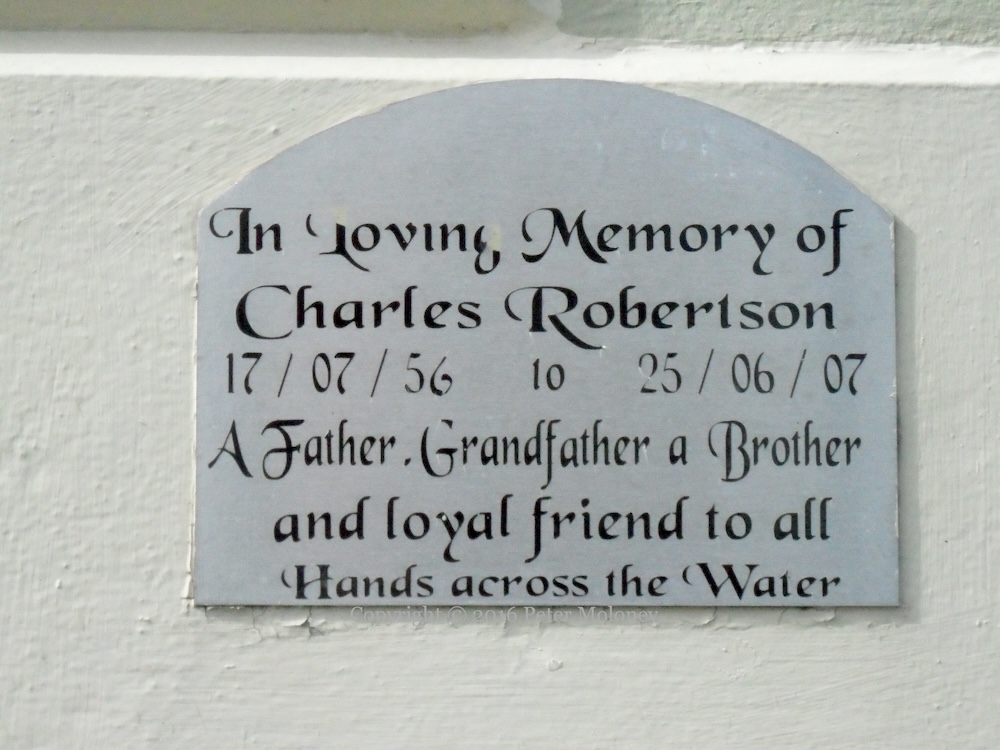
There are three plaques on the sides, added at various times over the years. On the right, two to James Aberdeen: “In loving memory of our brother Jimmy Aberdeen 28th Aug 1965 – 20th Nov 1995. Forever in our thoughts.” “In memory of James Aberdeen from the members of the Young Loyalist F.B. Pollok, Glasgow. Always remembered.” And on the left: “In loving memory of Charles Robertson 17/07/56 to 25/06/07. A father, grandfather a brother and loyal friend to all hands across the water.”
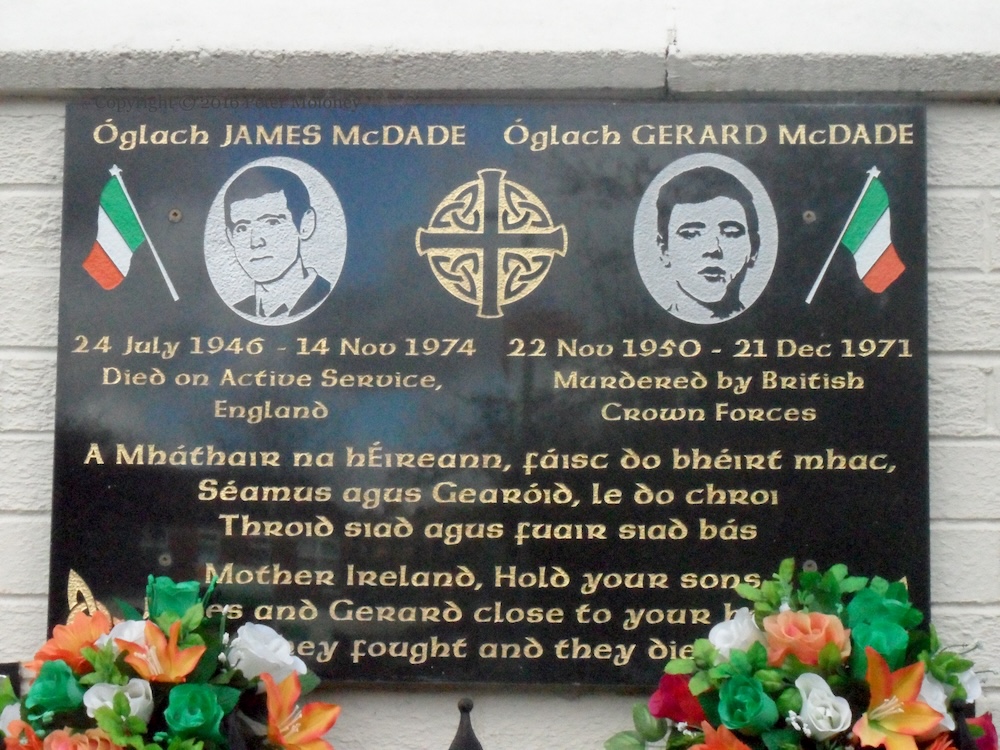
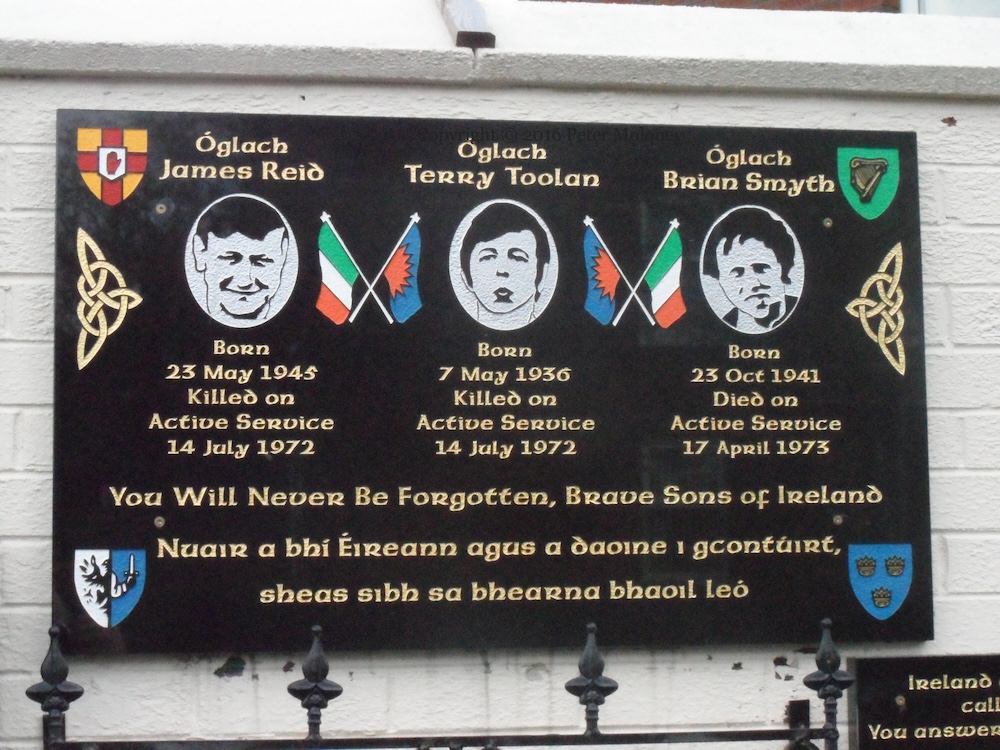
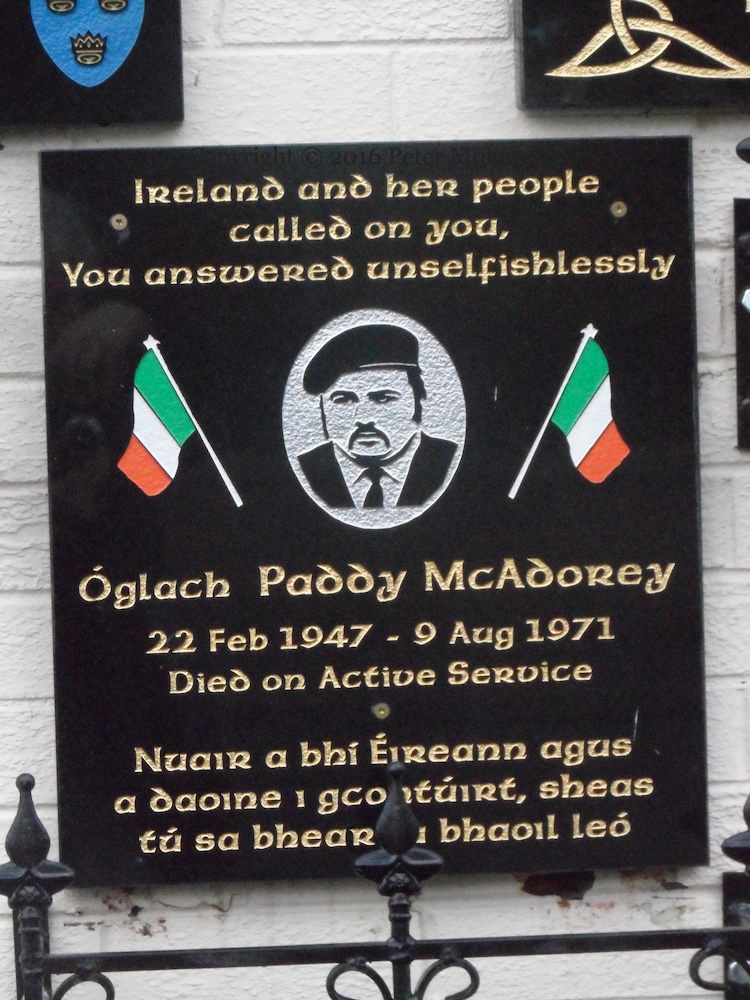
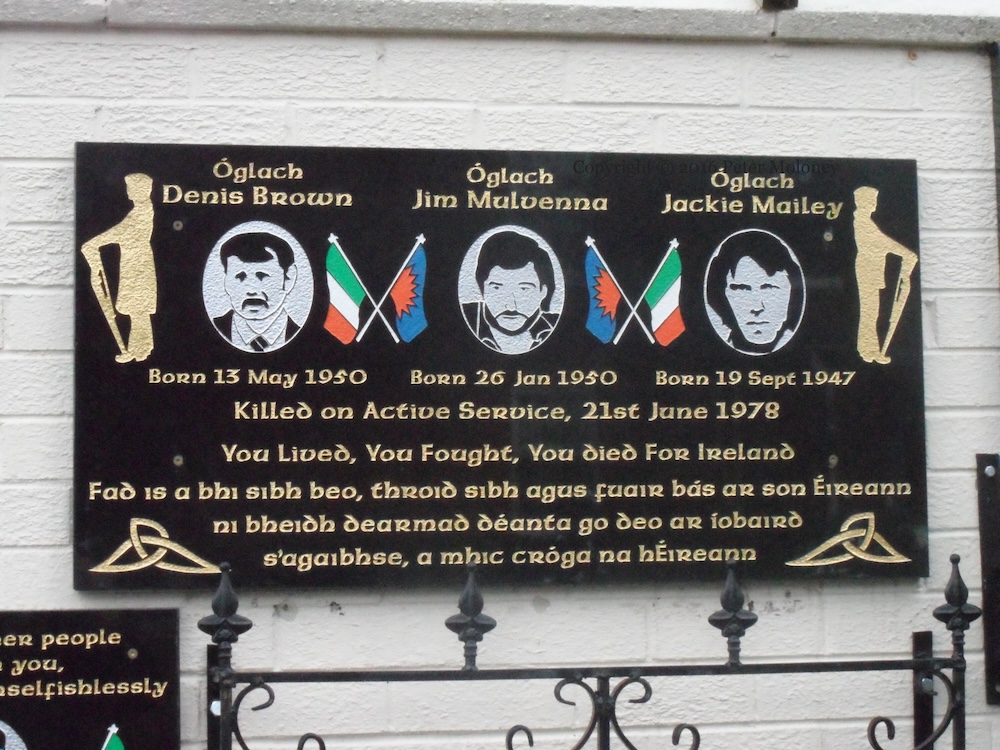
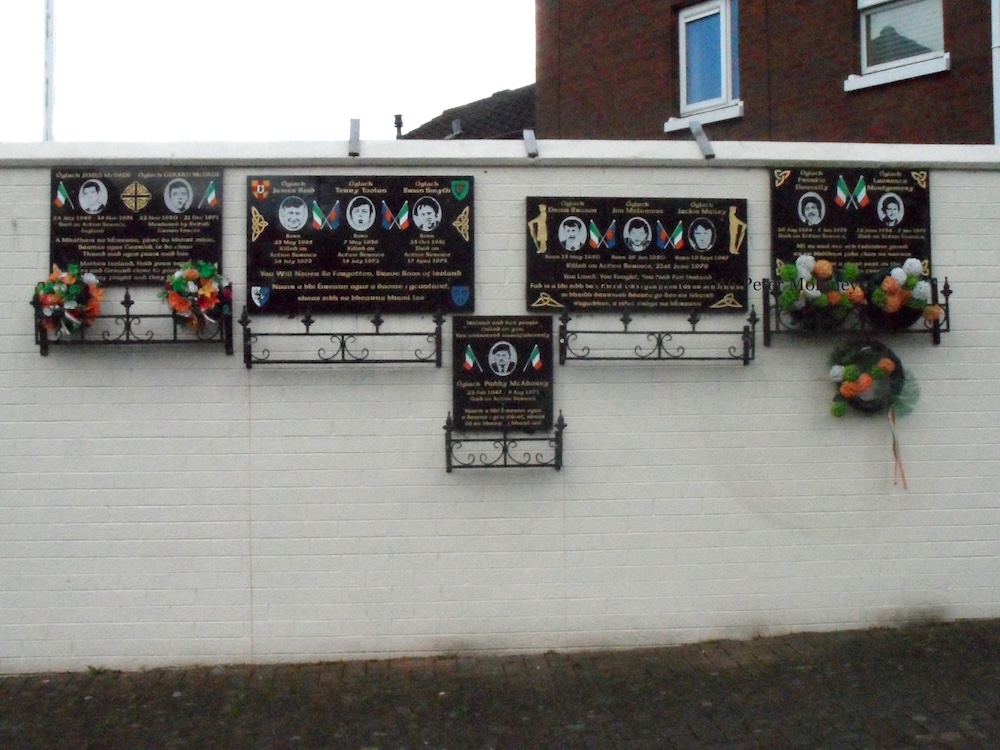
Three plaques have been added to the two seen previously, the McDade and Donnelly-Montgomery plaques.
“Óglach James McDade 24 July 1946 – 14 Nov 1974 died on active service, England; Óglach Gerard McDade 22 Nov 1950 – 21 Dec 1971 murdered by British Crown Forces. A Mháthaır na hÉıreann, fáısc do bhéırt mhac, Séamus agus Geraóıd, le do chroí. Throıd sıad agus fuaır sıad bás. Mother Ireland, hold your sons, James and Gerard, close to your heart. They fought and they died.”
“Óglach James Reid born 23 May 1945 killed on active service 14 July 1972. Óglach Terry Toolan born 7 May 1936 killed on active service 14 July 1972. Óglach Brian Smyth born 23 Oct 1941 died on active service 17 April 1973. You will never be forgotten, brave sons of Ireland. Nuaır a bhí Éıreann agus a daoıne ı gcontúırt, sheas sıbh sa bhearna bhaoıl leó [sic leo].”
“Ireland and her people called on you, you answered unselfishlessly. Óglach Paddy McAdorey 22 Feb 1947 – 9 Aug 1971 died on active service. Nuaır a bhí Éıreann agus a daoıne ı gcontúırt, sheas sıbh sa bhearna bhaoıl leó.”
“Óglach Denis Brown born 13 May 1950, Óglach Jim Mulvenna born 26 Jan 1950, Óglach Jackie Mailey born 19 Sept 1947 – killed on active service, 21st June 1978. You lived, you fought, you died for Ireland. Fad ıs a bhí sibh beo, throıd sıbh agus fuaır bás ar son Éıreann ní bheidh dearmad déanta go deo ar íobaırd s’agaıbhse, a mhıc cróga na hÉıreann.”
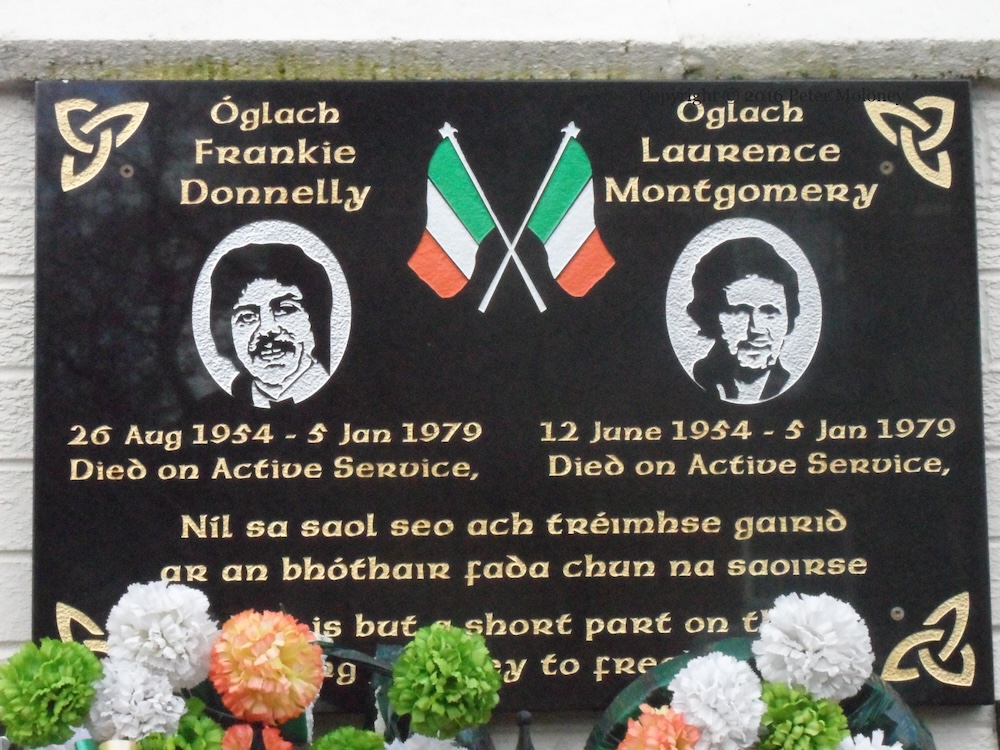
“Óglach Frankie Donnelly 26 Aug 1954 – 5 Jan 1979 died on active service; Óglach Laurence Montgomery 12 June 1954 – 5 Jan 1979 died on active service. Níl sa saol seo ach tréımhse gaırıd ar an bhóthaır fada chun na saoırse – life is but a short part on the long journey to freedom.”
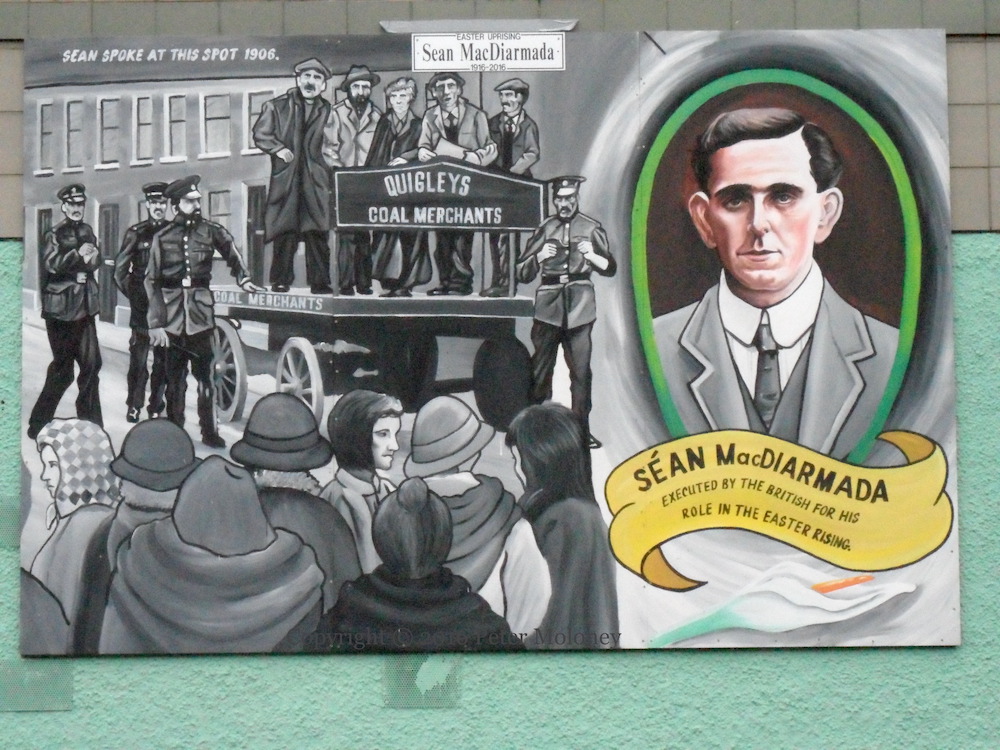
Seán Mac Dıarmada was born in Leitrim, left for Glasgow at age 15, and after two years returned to Belfast in 1905 and – according to the new mural above – spoke from the back of a coal lorry in Clonard Street, outside the Clonard branch of the Ancient Order Of Hibernians. Mac Dıarmada was for a short time an AOH member, before moving on to the Irish Republican Brotherhood and Irish Volunteers, which led to his participation in the 1916 Easter Rising and execution on May 12th of that year.
The title of today’s post is historian F.X. Martin’s assessment of Mac Dıarmada, quoted in a pamphlet on Mac Dıarmada from the National Library Of Ireland. The NLI made many letters from and to Mac Dıarmada available in 2016. (See also this Irish Times write-up).
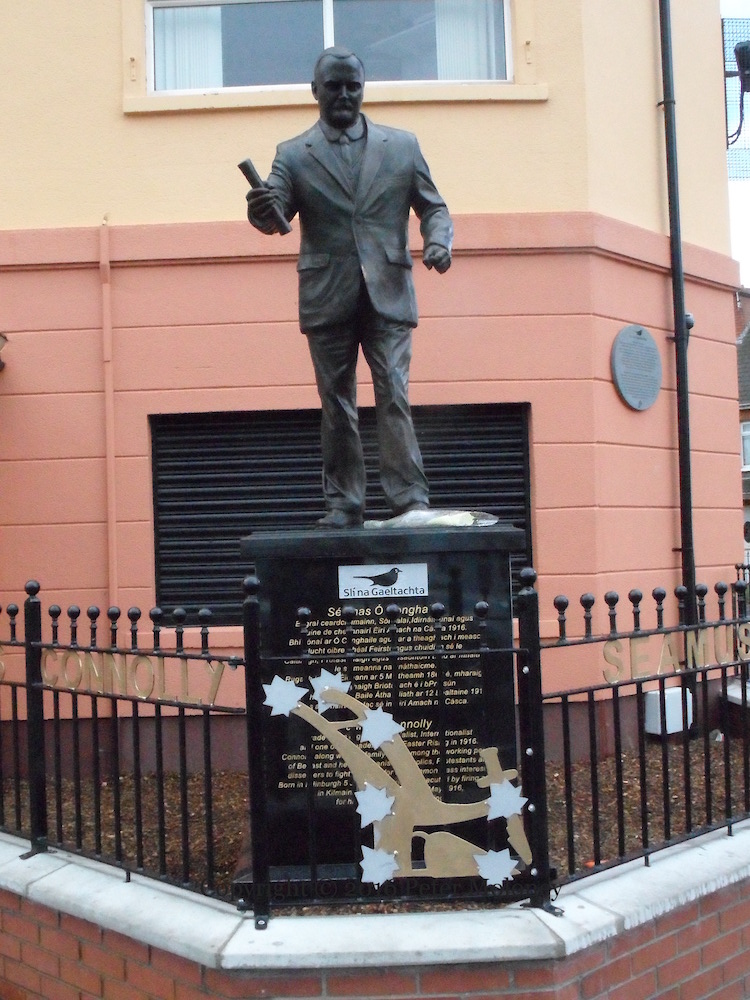
A statue of James Connolly was unveiled in the grounds of Comhaırle Phobaıl Na bhFál on March 25th (An Phoblacht). The statue is part of Slí Na Gaeltachta.
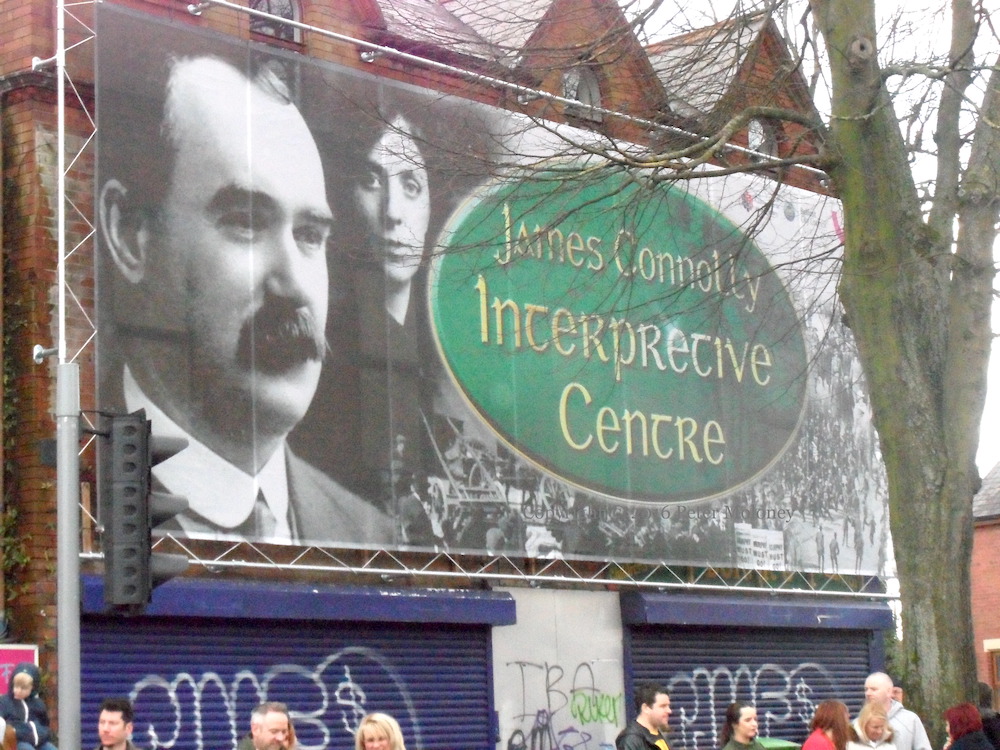
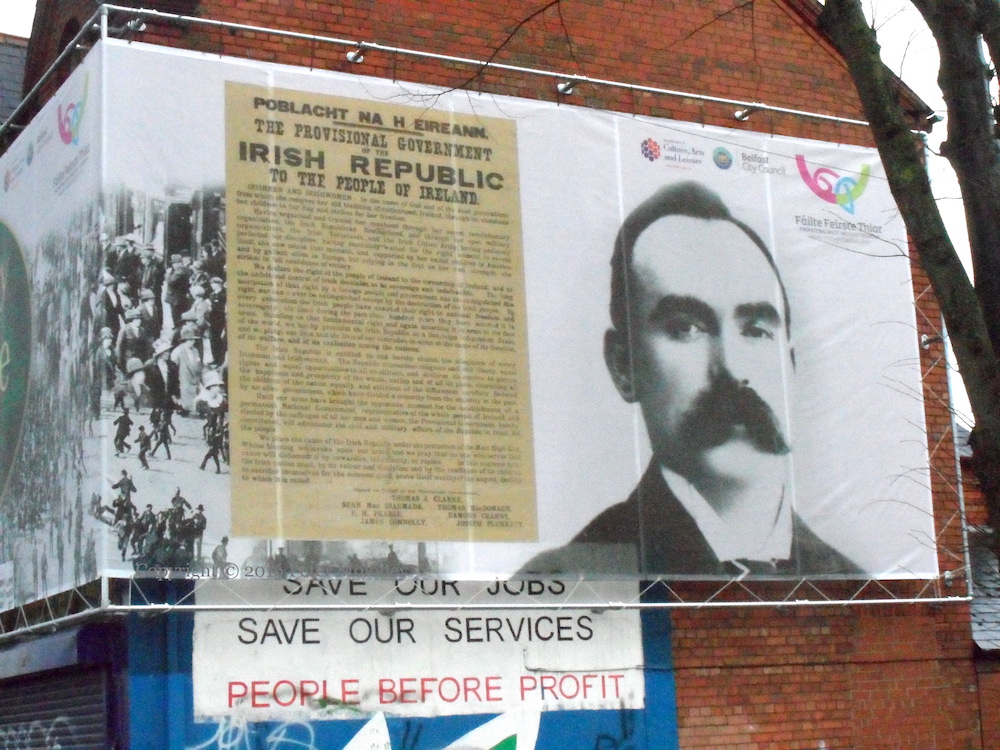
A little further long the road, tarps announce plans for a “James Connolly Interpretive Centre” (eventually opened in 2019 as “James Connolly Visitor Centre”).
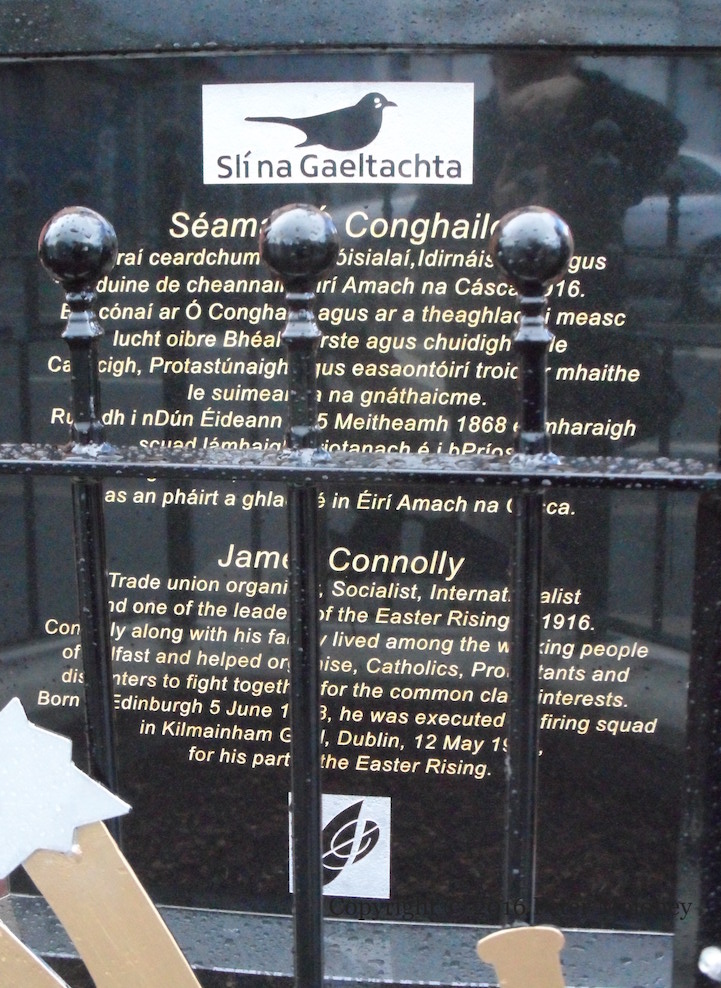
“Eagraí ceardchumaınn, Sóısıalaí, Idırnáısıúnaí agus duıne de cheannaırí Éırí Amach na Cásca 1916. Bhí cónaí ar Ó Conghaıle agus ar a theaghlach ı measc lucht oıbre Bhéal Feırste agus chuıdıgh sé le Caıtıicıgh, Protastúnaıgh agus easaontóırí troıd ar mhaıthe le suımeanna na gnáthaıcme. Rugadh ı nDún Éıdeann ar 5 Meıtheamh 1868 é, mharaıgh scuad lámhaıgh Brıotanach é ı bPríosún Chıll Mhaıghneann, Baıle Átha Clıath ar 12 Bealtaıne 1916 as an pháırt a ghlac sé ın Éırí Amach na Cásca. / Trade union organiser, Socialist, Internationalist and one of the leaders of the Easter Rising 1916. Connolly along with his family lived among the working people of Belfast and helped organise, Catholics, Protestants and dissenters to fight together for the common class interests. Born in Edinburgh 5 June 1868, he was executed by firing squad in Kilmainham Gaol, Dublin, 12 May 1916 for his part in the Easter Rising.”
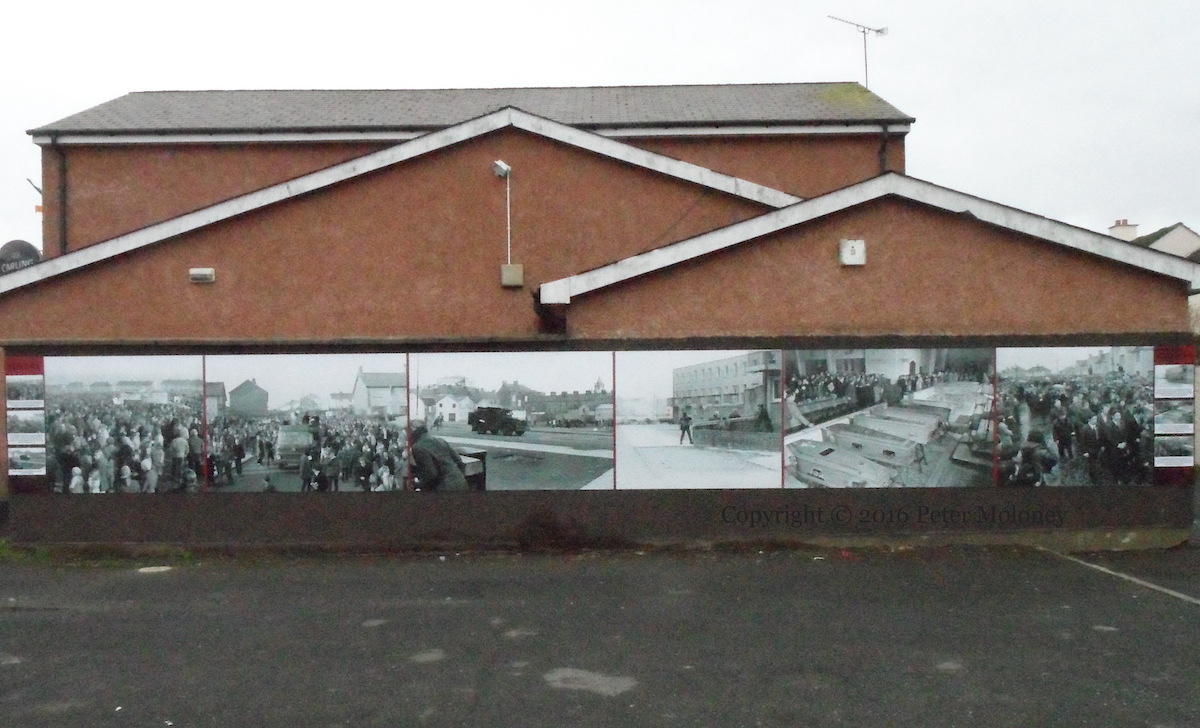
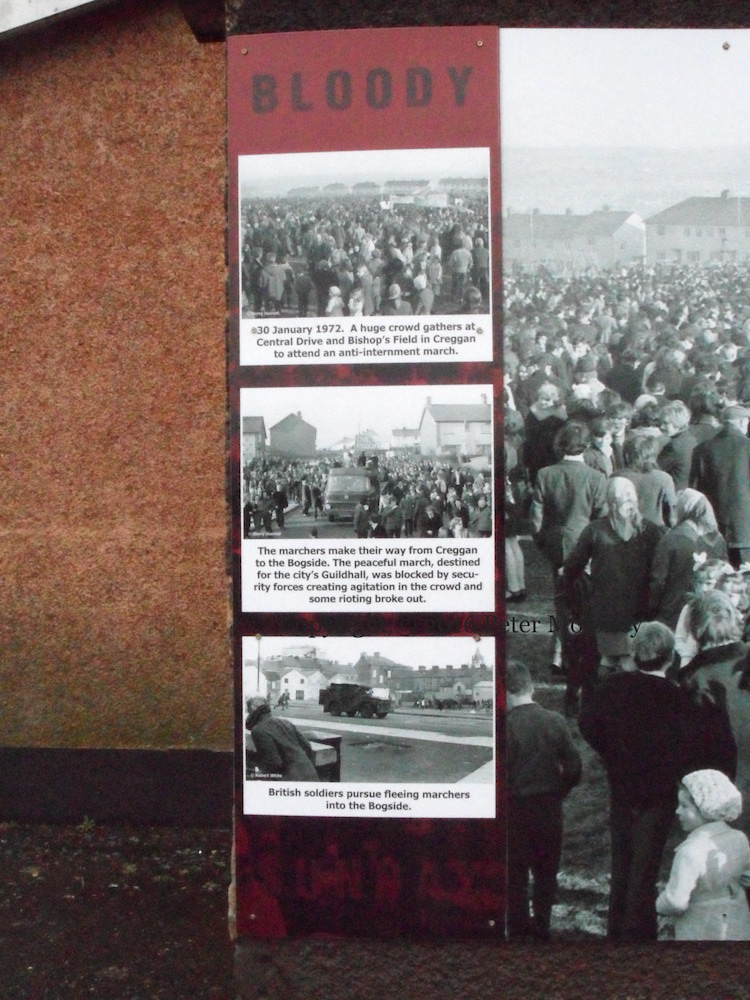
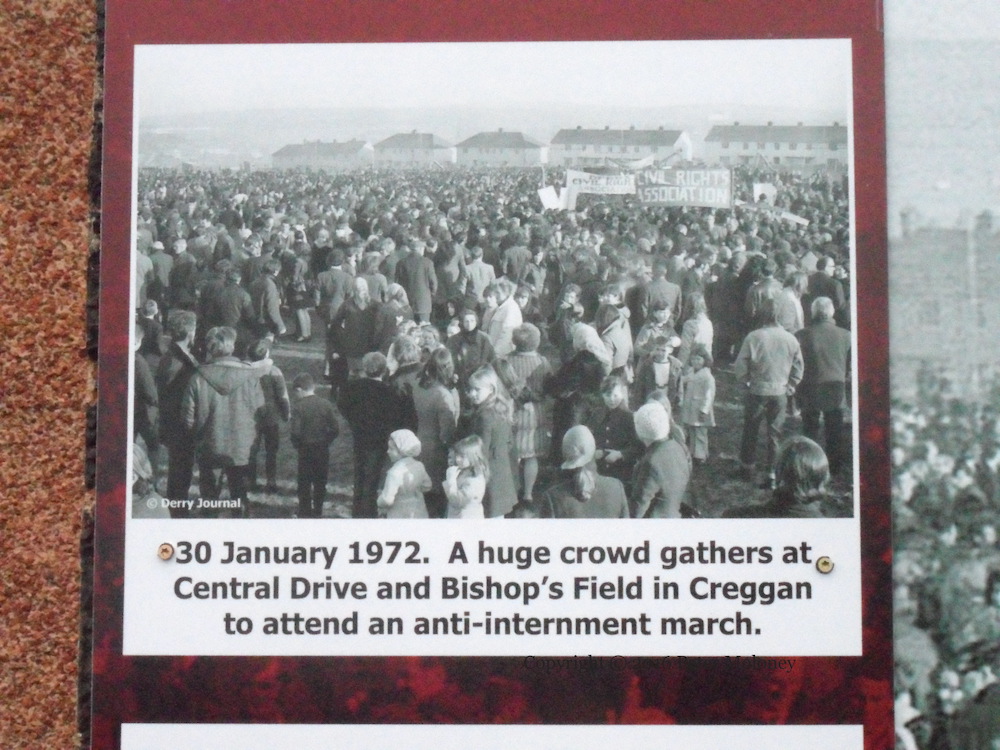
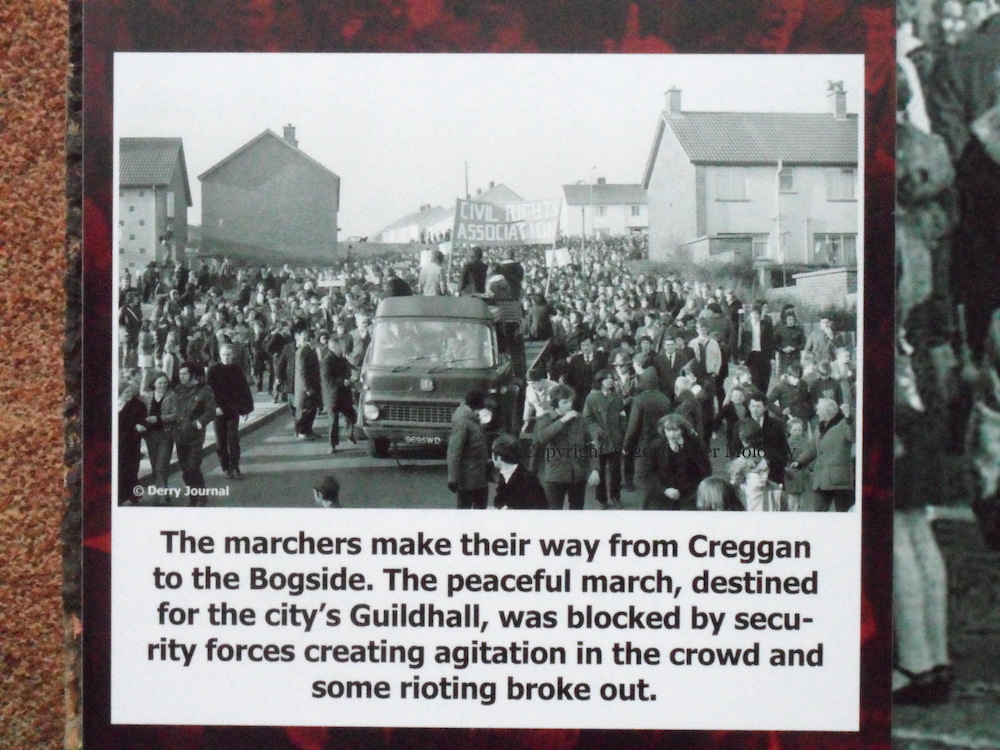
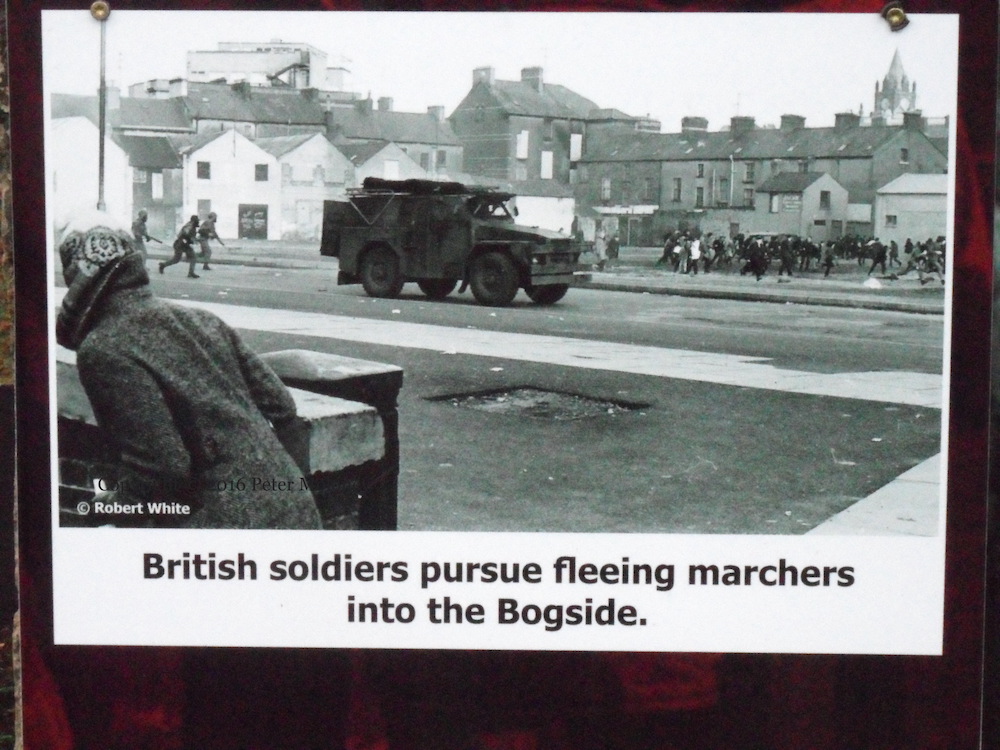
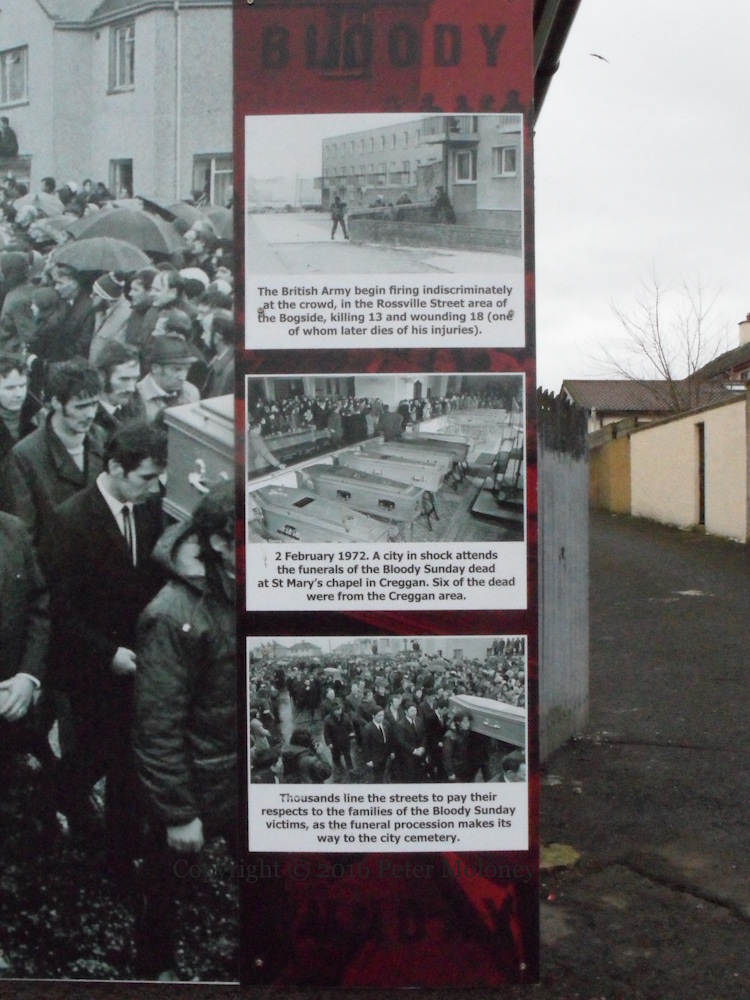
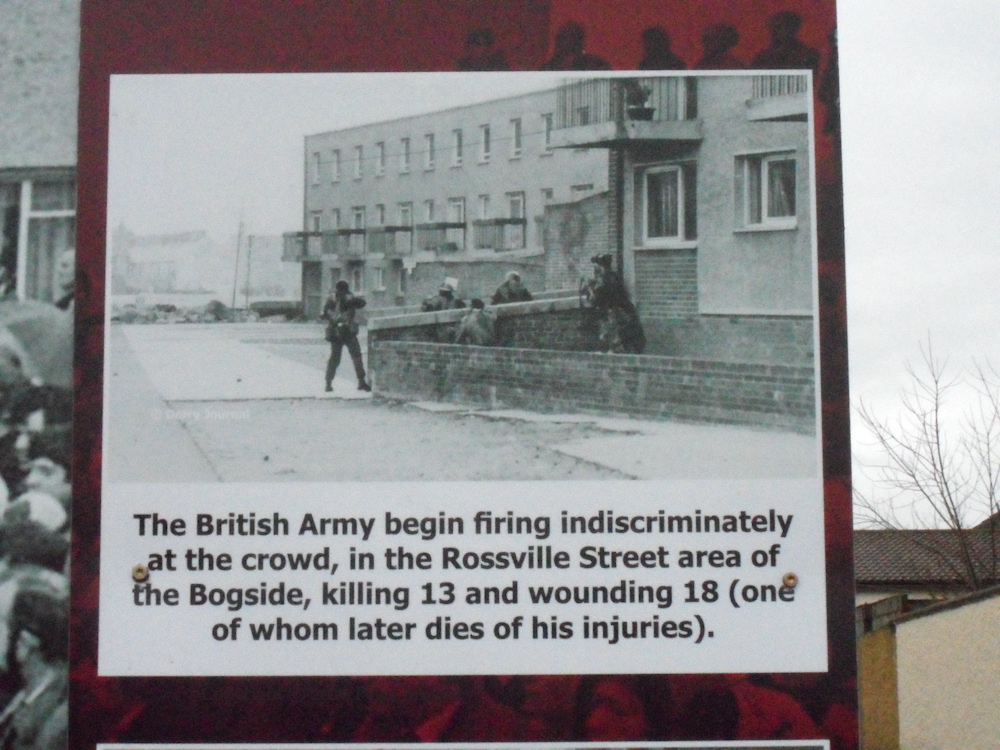
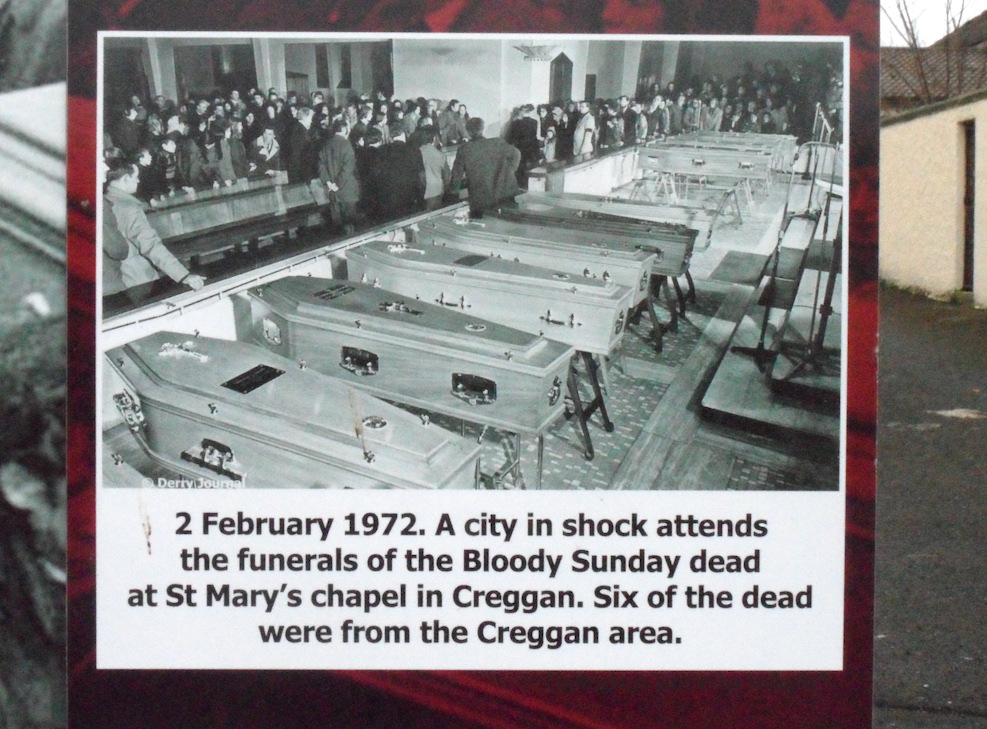
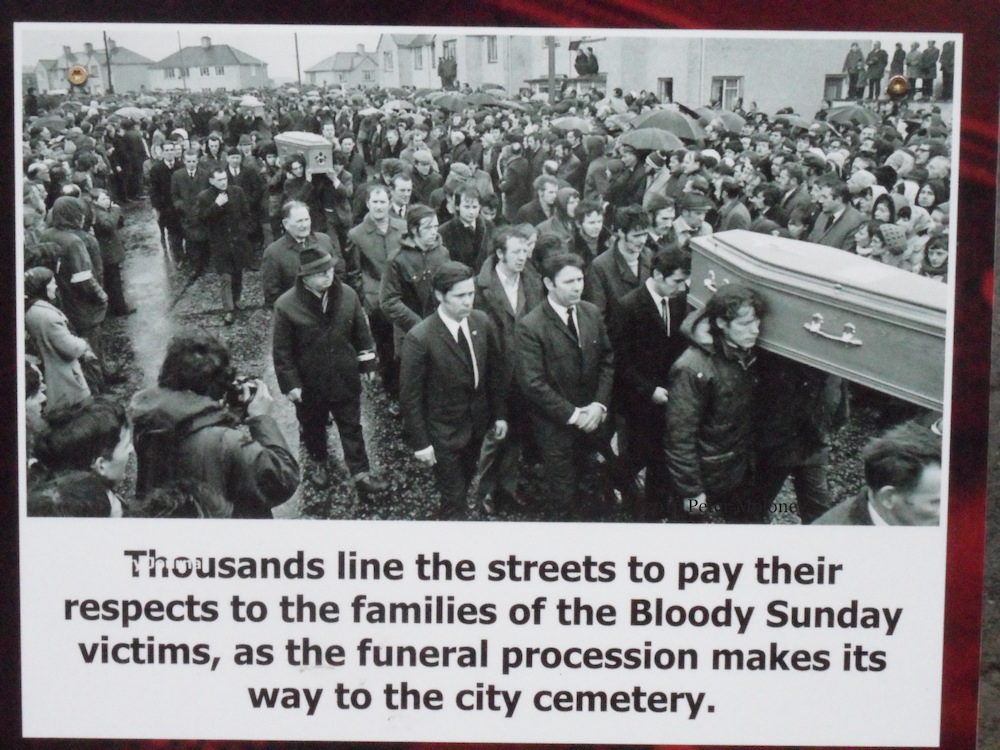
Six photographs tell the story of Bloody Sunday (January 30th, 1972) and its aftermath:
“30 January 1972. A huge crowd gathers at Central Drive and Bishop’s Field in Creggan to attend an anti-internment march.” “The marchers make their way from Creggan to the Bogside. The peaceful march, destined for the city’s Guildhall, was blocked by security forces creating agitation in the crowd and some rioting broke out.” “British soldiers pursue fleeing marchers into the Bogside.” “The British Army begin firing indiscriminately at the crowd, in the Rossville Street area of the Bogside, killing 13 and wounding 18 (one of whom later dies of his injuries.” “2 February 1972. A city in shock attends the funerals of the Bloody Sunday dead at St Mary’s chapel in Creggan. Six of the dead were from the Creggan area.” “Thousands line the streets to pay their respects to the families of the Bloody Sunday victims, as the funeral procession makes its way to the city cemetery.”
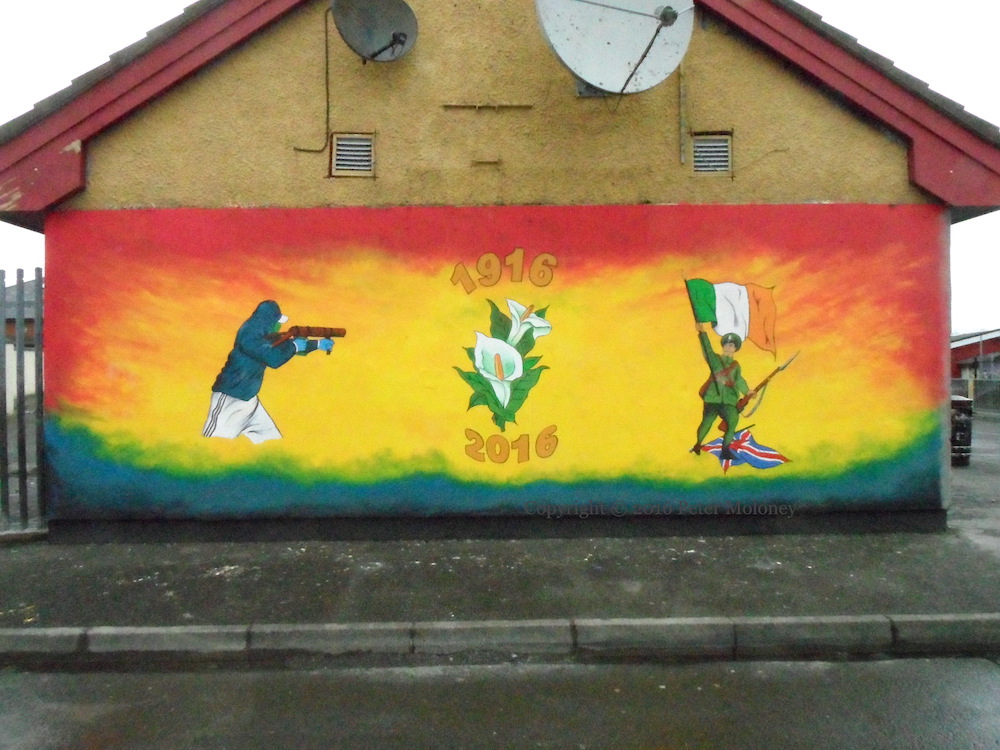
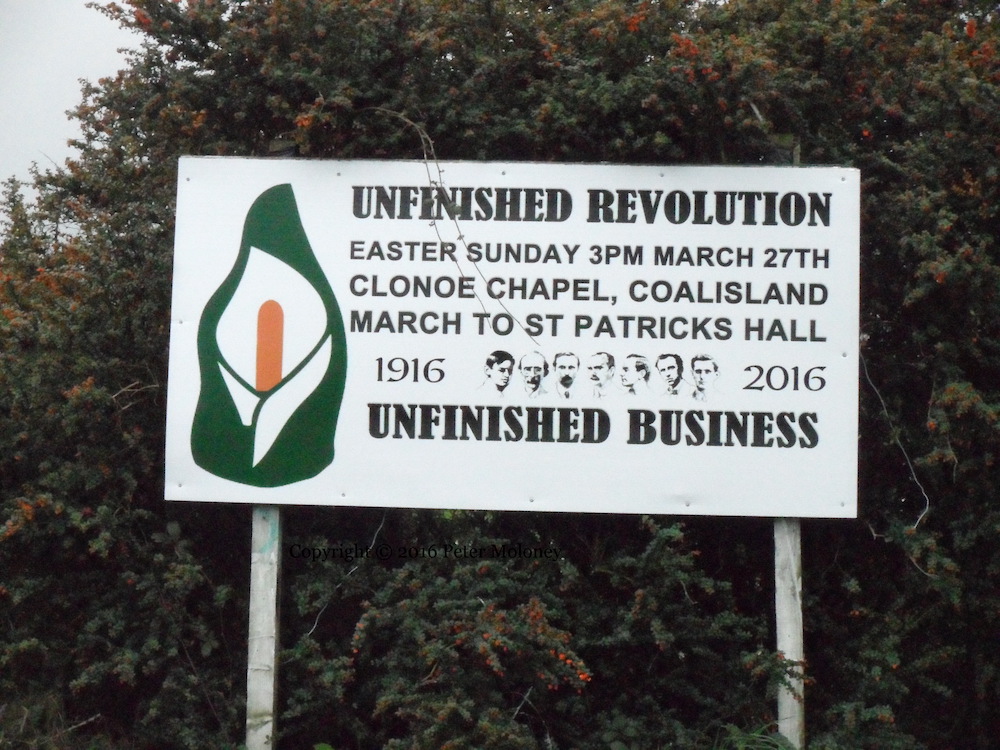
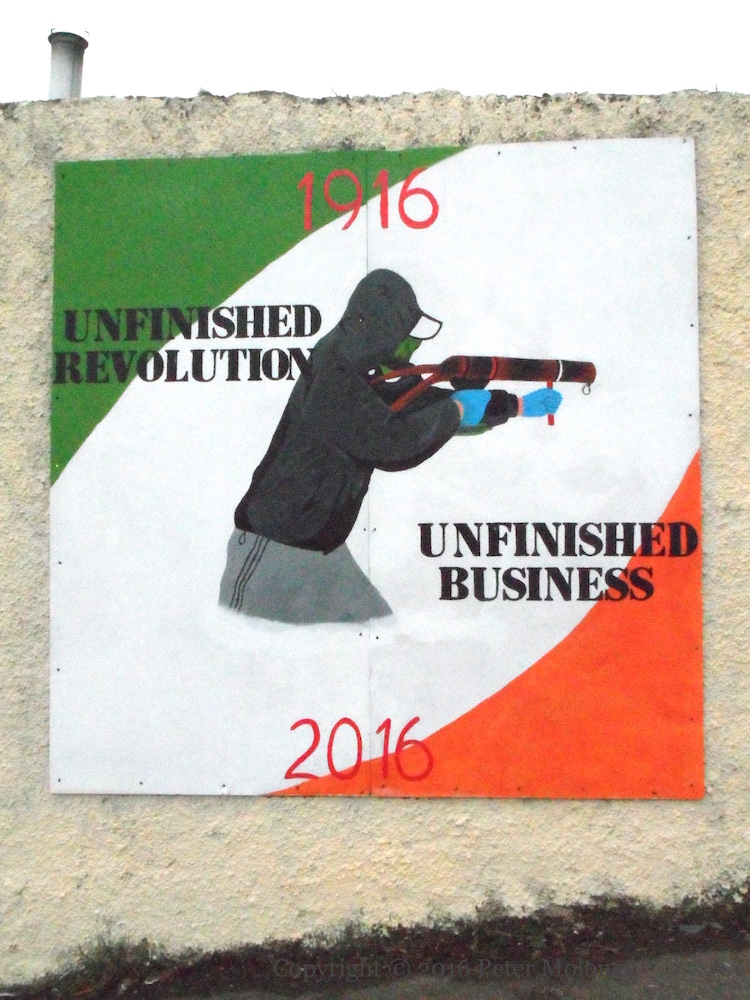
There are currently three uses of the “Unfinished revolution, unfinished business” slogan in Derry.
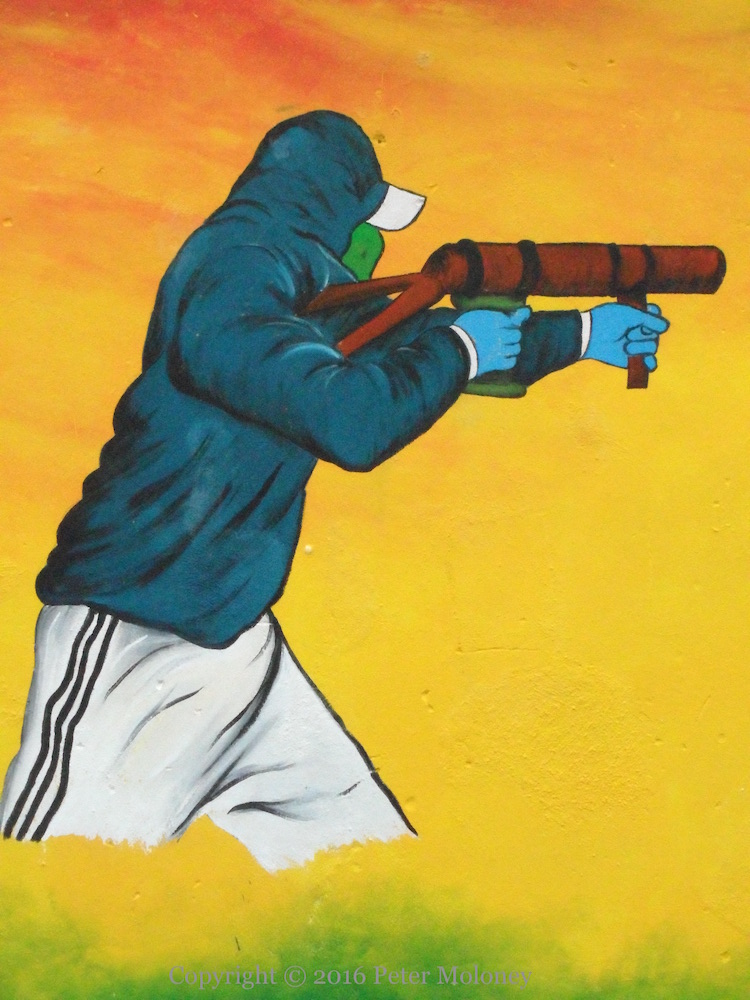
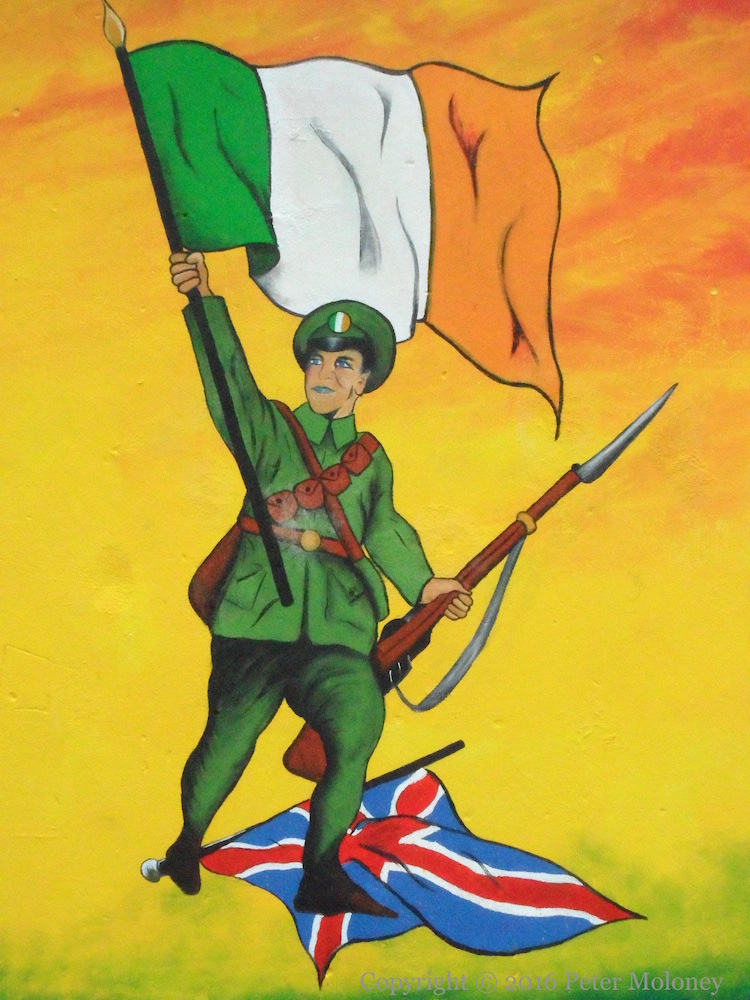
First, a new mural is currently in progress in Creggan. On the right, a soldier raises the Irish Tricolour while trampling on Britain’s Union Flag and the “unfinished revolution” of 1916’s Easter Rising (reproducing a postcard of the era). The modern-day figure on the left is wielding a home-made rocket-launcher used in a 2014 attack on police. It also appears in the board immediately above, and in 2015’s Resistance in Ardoyne, north Belfast.
(The finished piece can be seen in the Seosamh Mac Coılle collection, with verbiage above and below reading, “Unfinished revolution, unfinished business” and “Resistance!”)
Central Drive, Eastway, and Westland Street, Derry.