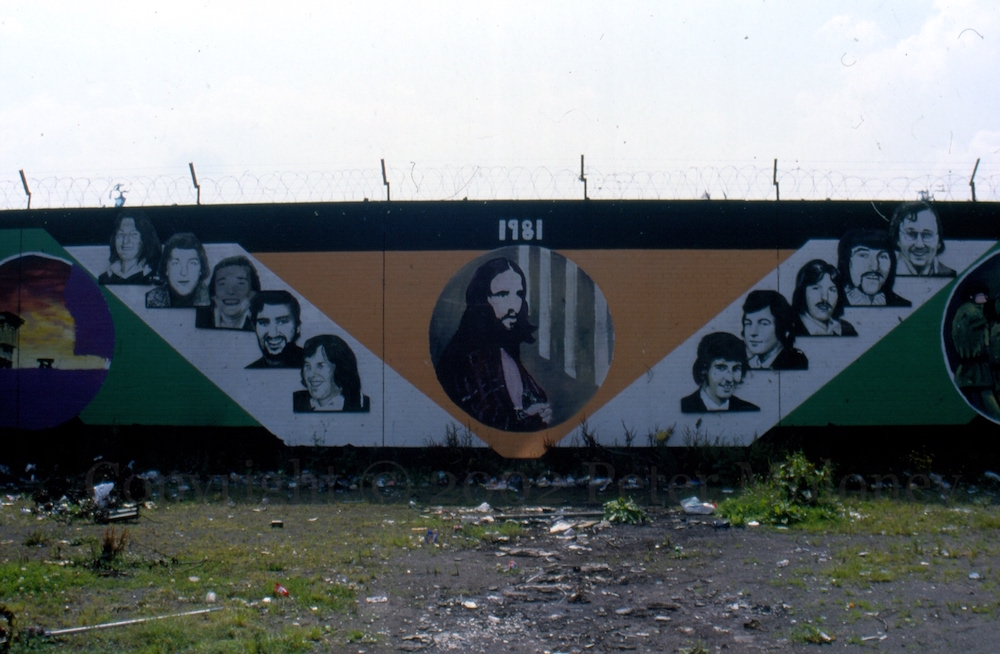
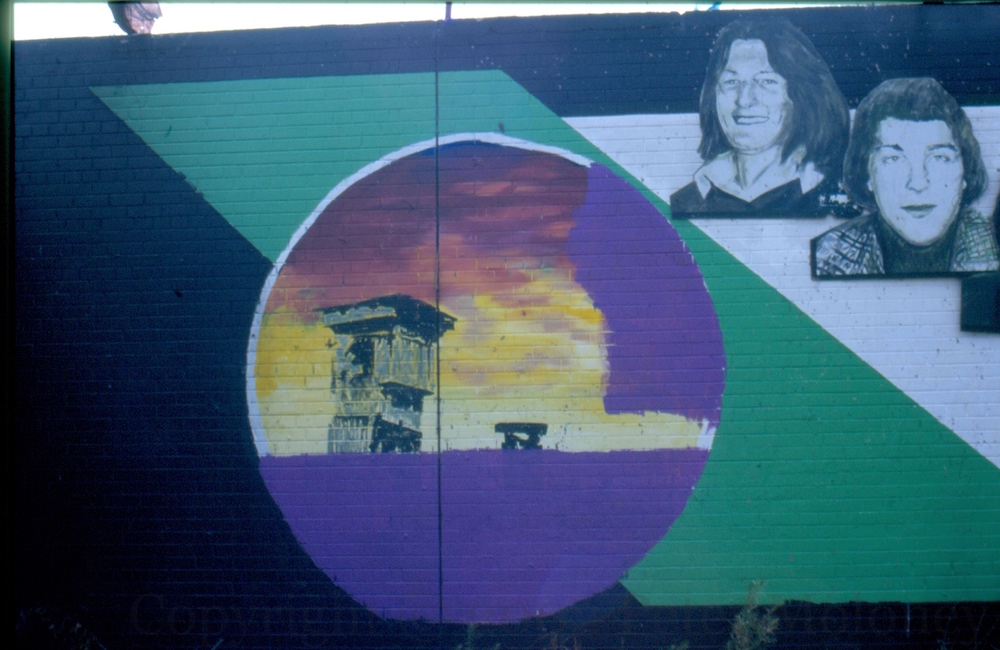
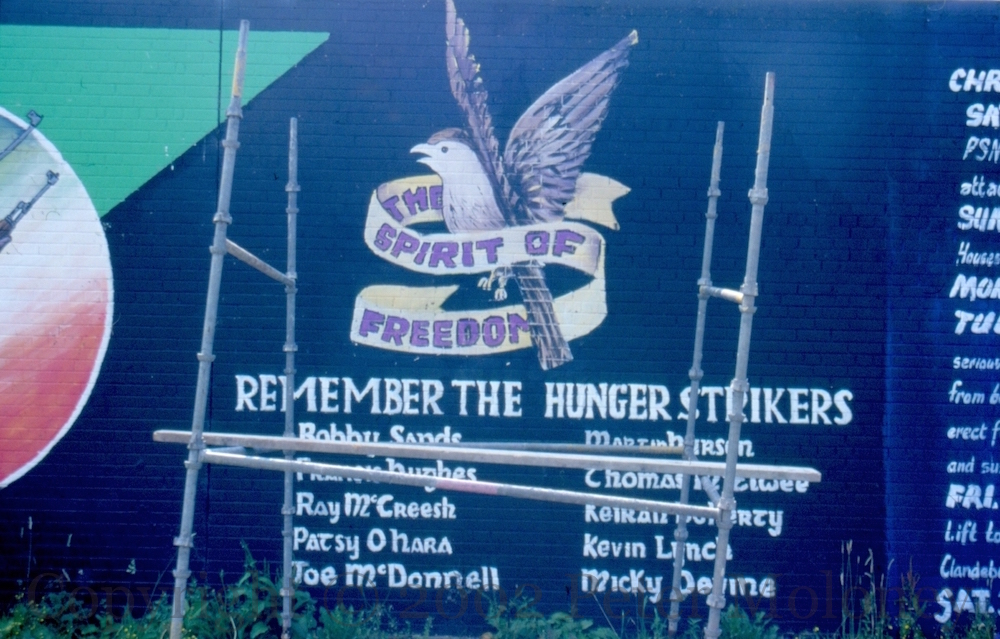
Here are six images of the hunger strikers mural in Mountpottinger Road, Belfast. The ten portraits are on cut wooden boards while the rest is painted. On the far right (image 5) is a “spirit of freedom” lark and the names of the ten deceased 1981 strikers. In the centre (image 3) is blanket man Hugh Rooney.
By 2002, the “Time for peace, time to go” mural in Beechfield Street, Belfast, painted in 1997, was beginning to show its age. The image is based on a photograph of British forces in the Falklands.
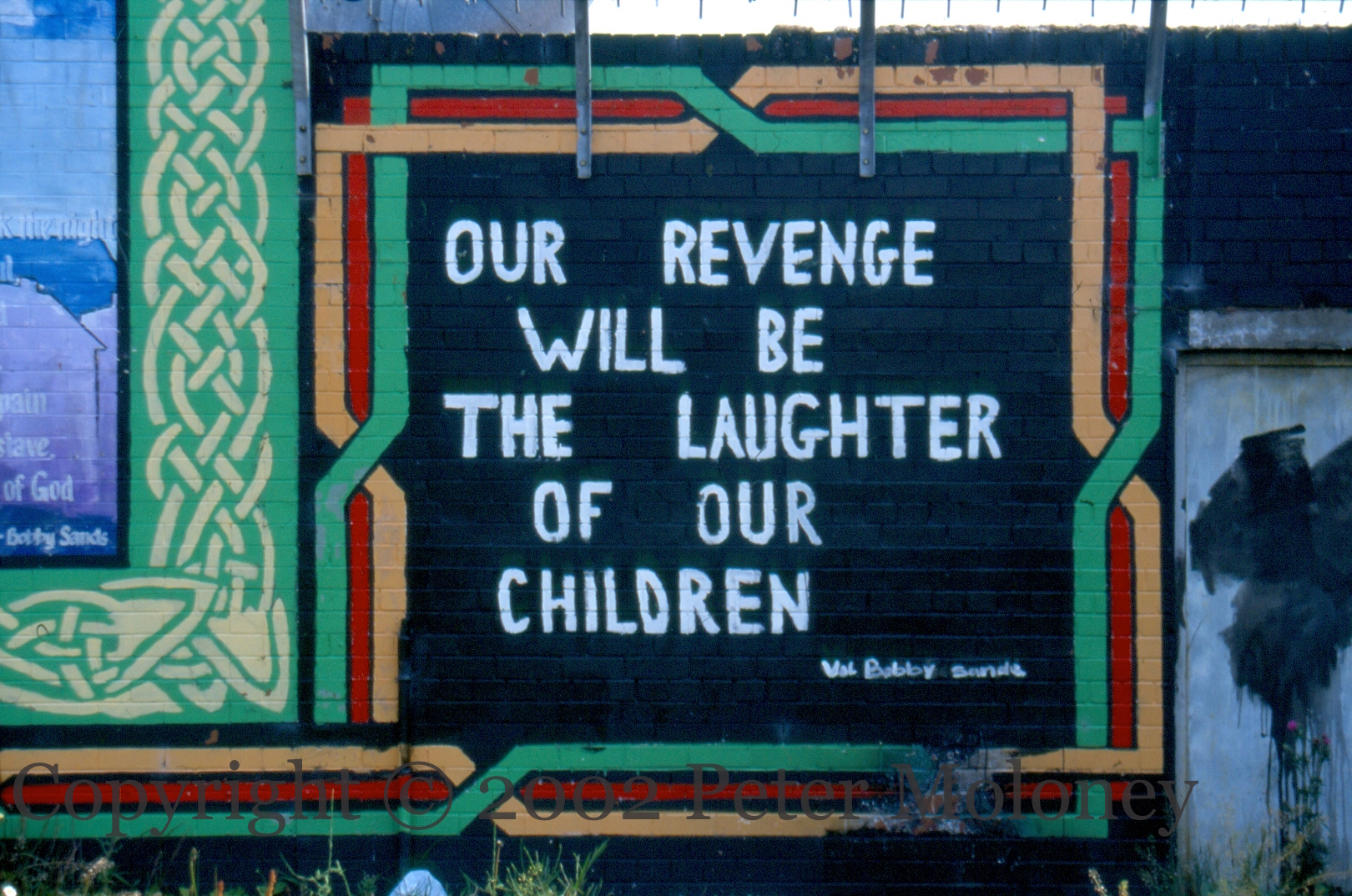
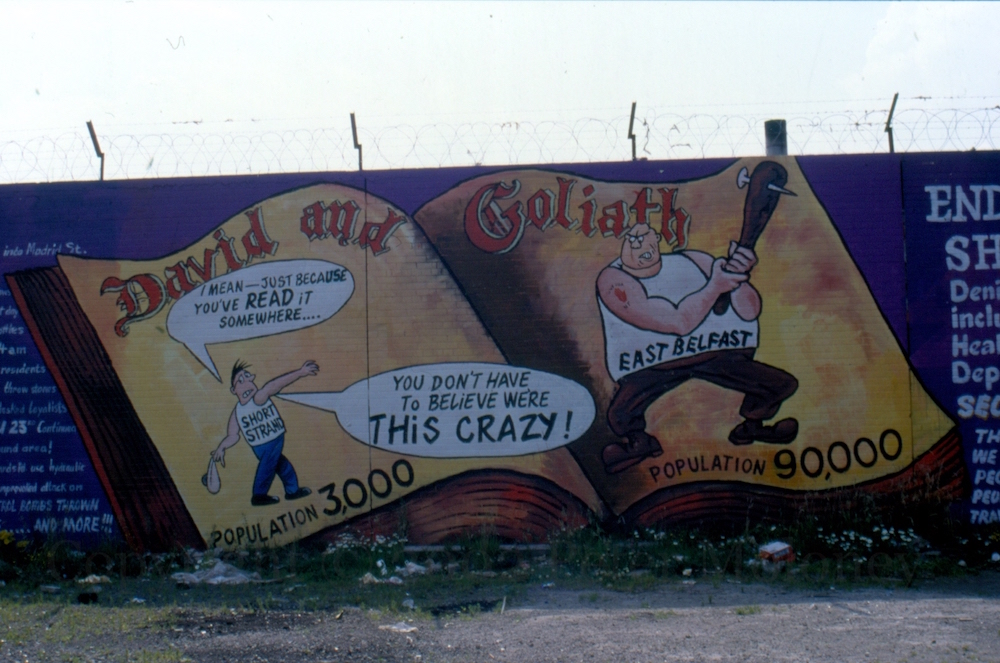
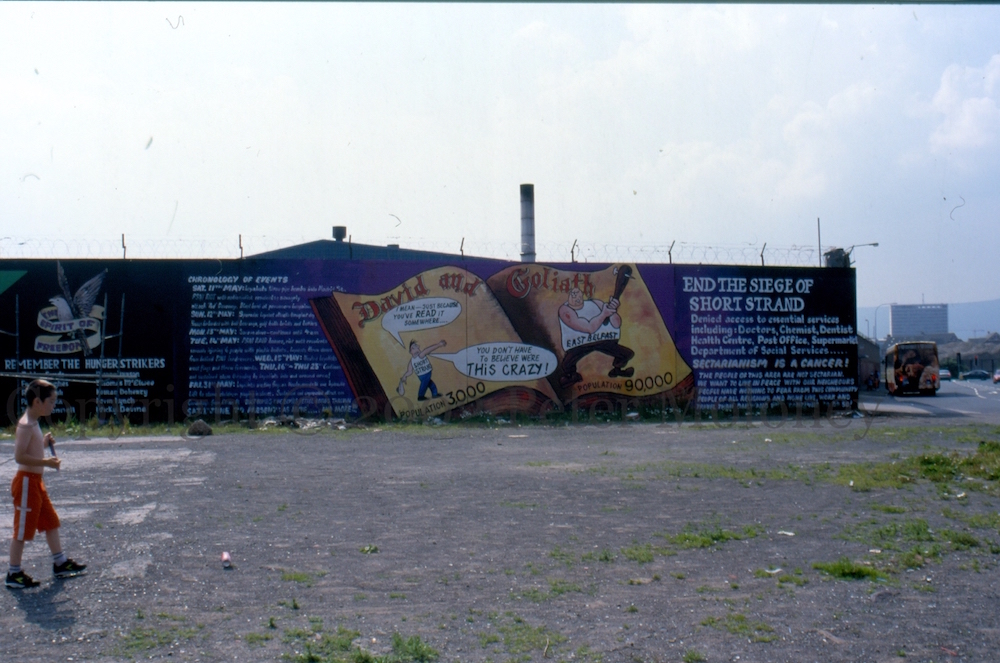
This Short Strand mural packs a lot in, beginning with both ancient Éıre and a celtic cross. Its main panels commemorate 25 years of resistance in east Belfast (probably dating to the Battle Of St Matthew’s in 1970) with portraits of 16 deceased locals (“I measc laochra na nGael go raıbh a naınmeacha”) and two verses from Bobby Sands’s poem Weeping Winds(see below). On the right (in the second image) is a quote from Bobby Sands: “Our revenge will be the laughter of our children”.
Oh, whistling winds why do you weep/When roaming free you are, Oh! Is it that your poor heart’s broke/And scattered off afar? Or is it that you bear the cries/Of people born unfree, Who like your way have no control/Or sovereign destiny?
Oh! Lonely winds that walk the night/To haunt the sinner’s soul/ Pray pity me a wretched lad/Who never will grow old. Pray pity those who lie in pain/The bondsman and the slave And whisper sweet the breath of God/Upon my humble grave.
“End the siege of Short Strand. Denied access to essential services including: doctors, chemist, dentist, health centre, post office, supermarket, Department of Social Services …… sectarianism is a cancer! The people of this area are not sectarian. We want to live in peace with our neighbours. People have nothing to fear from this community. People of all religions and none live, work and travel thru daily and will continue to do so!”
On the other side of the main panel is a list of events from May 2002, describing attacks on nationalist residents and homes in the small nationalist enclave, with “ball bearings, golf balls, bricks and bottles” and “blast bombs, pipe bombs, petrol bombs”. The Andersonstown News gives an account of the initial disturbances and beating of Patrick ‘Pod’ Devenny. The Guardian called the area “Riot City“.
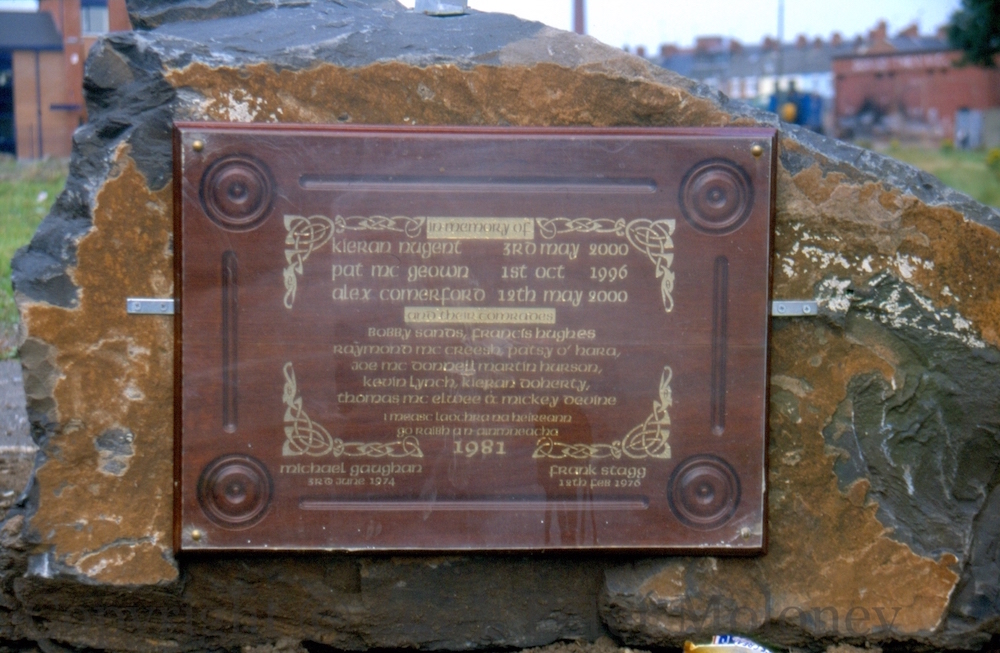
Kieran Nugent, Pat McGeown, and Clonard blanket man Alex Comerford are the lead names on this plaque in Beechmount Grove, joined by the deceased 1981 hunger strikers as well as Gaughan and Stagg.
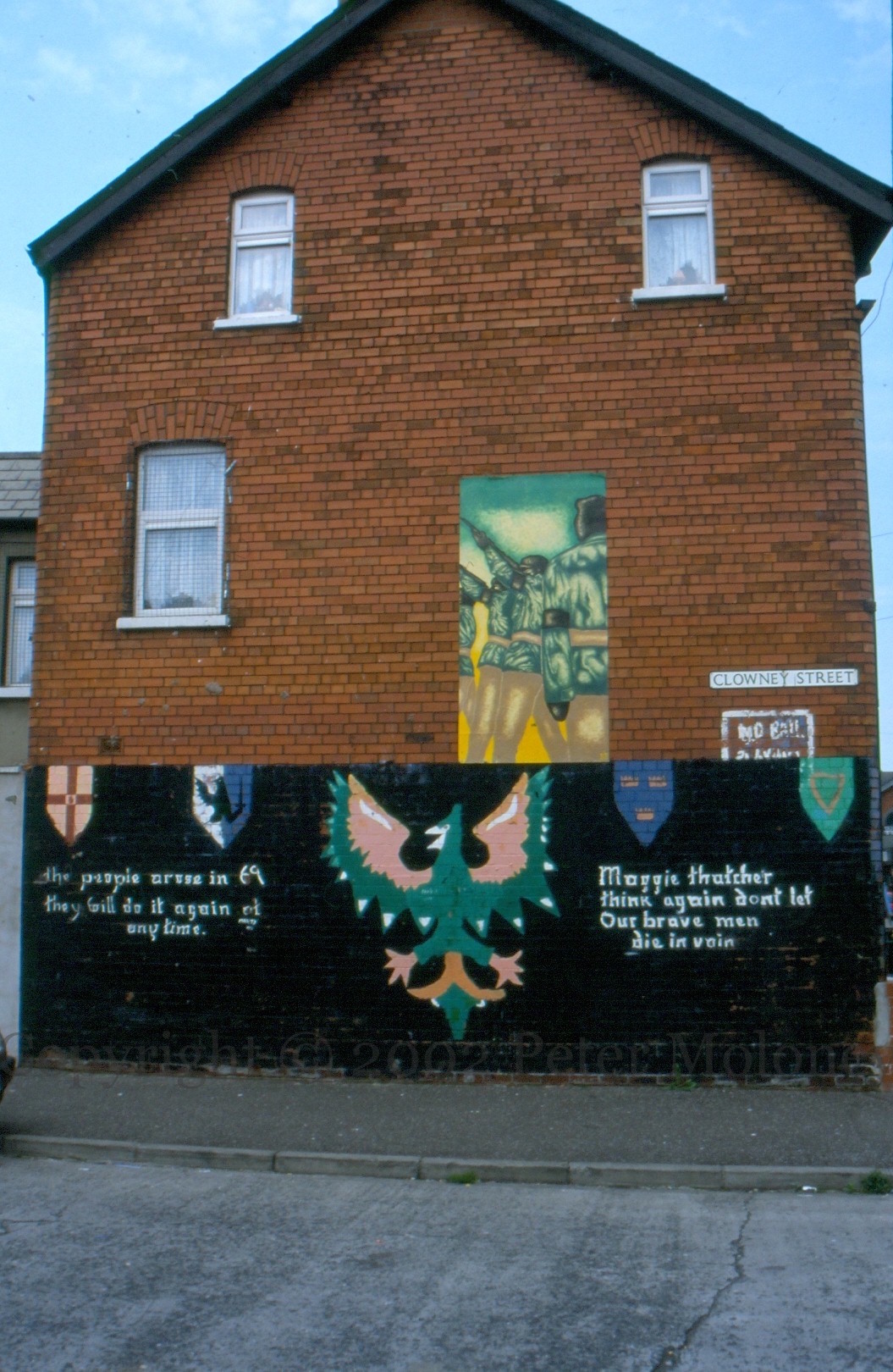
Here is the scene in Clowney Street, Belfast, in 2002: the (third? version of the) phoenix mural is 12 years old, and the funeral volley mural above it (seen in 2001) has lost one of its boards.
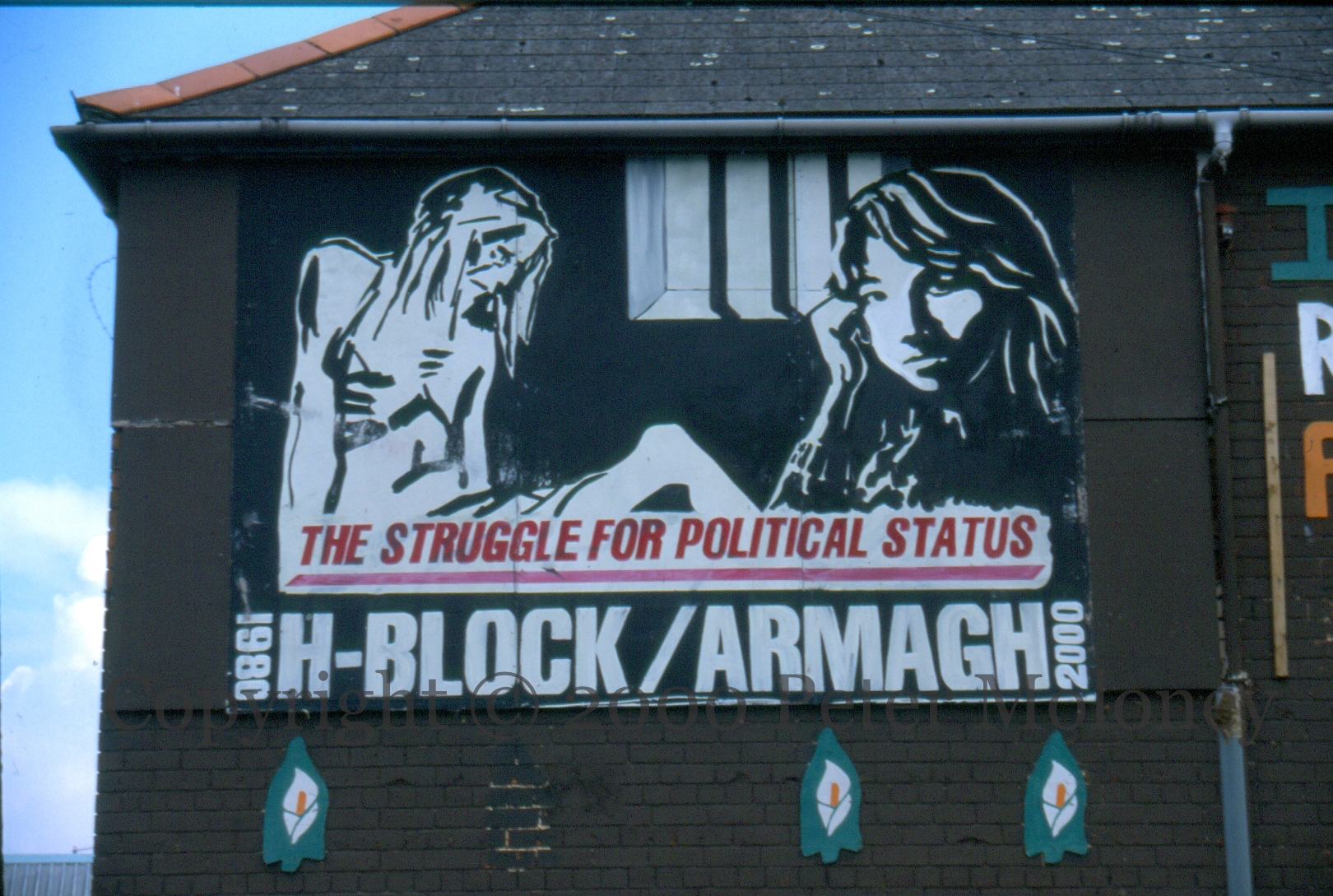
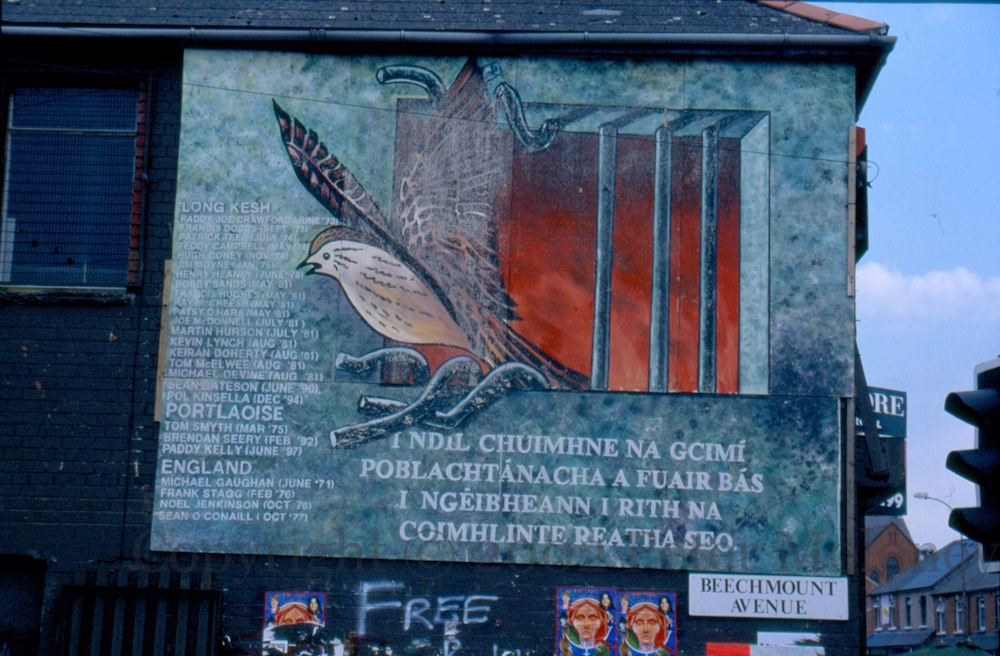
This is a 2002 image of the board in Beechmount Avenue, Belfast, for the 20th anniversary of the (1980) hunger strikes in Long Kesh and Armagh Women’s prison. Previously seen in 2001.
2002 image of the republican prisoners board in Beechmount Avenue, Belfast. In addition to the 1981 hunger strikers and Stagg and Gaughan, the mural mentions Paddy Joe Crawford, Francis Dodds, Patrick Teer, Teddy Campbell, Hugh Coney, Jim Moyne, Henry Henry, Sean Bateson, Pol Kinsella (all from Long Kesh), Tom Smyth, Brendan Seery, Paddy Kelly (Portlaoise), Noel Jenkinson and Sean O’Conaill (who died in English prisons).
“I ndıl chuımhne na gcımí poblachtánacha a fuaır bás ı ngéıbheann ı rıth na coımhlınte reatha seo.” [In memory of the republican prisoners who died in captivity in the course of this ongoing (lit. running) contest.]







 Peter Moloney Collection