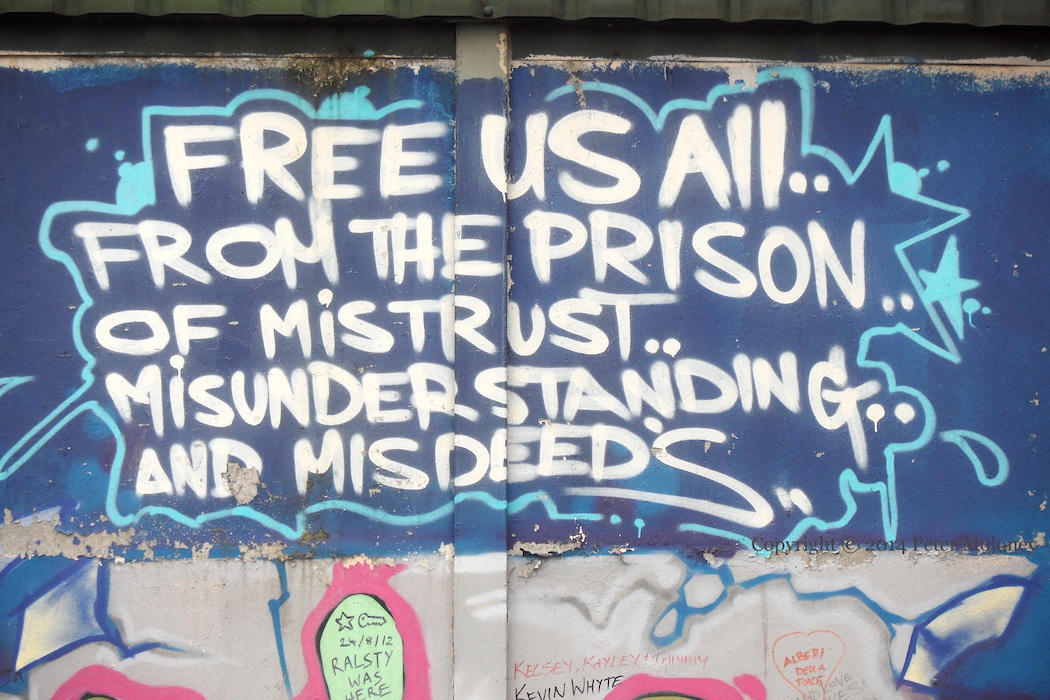
This piece of aspirational graffiti is on the Cupar Way “peace” line. “Free us all .. from the prison .. of mistrust .. misunderstanding .. and misdeeds.” It goes back to the the very first wild-style writing jam on the wall, in April 2009.
“… fight for a better future. It is your choice.” On the darker left-hand side of the board are rioters throwing Molotov cocktails at RUC/PSNI vehicles and the very “peace” wall upon which this board is mounted; on the more colourful right-hand side of the board houses are being built, a student is graduating, children are happy, and workers are taking sledge-hammers to the wall.
With sponsorship from PCSP (Policing & Community Safety Partnership) (web) and Alternatives (web).
Painted by Daniela Balmaverde (web). Cupar Way, west Belfast.
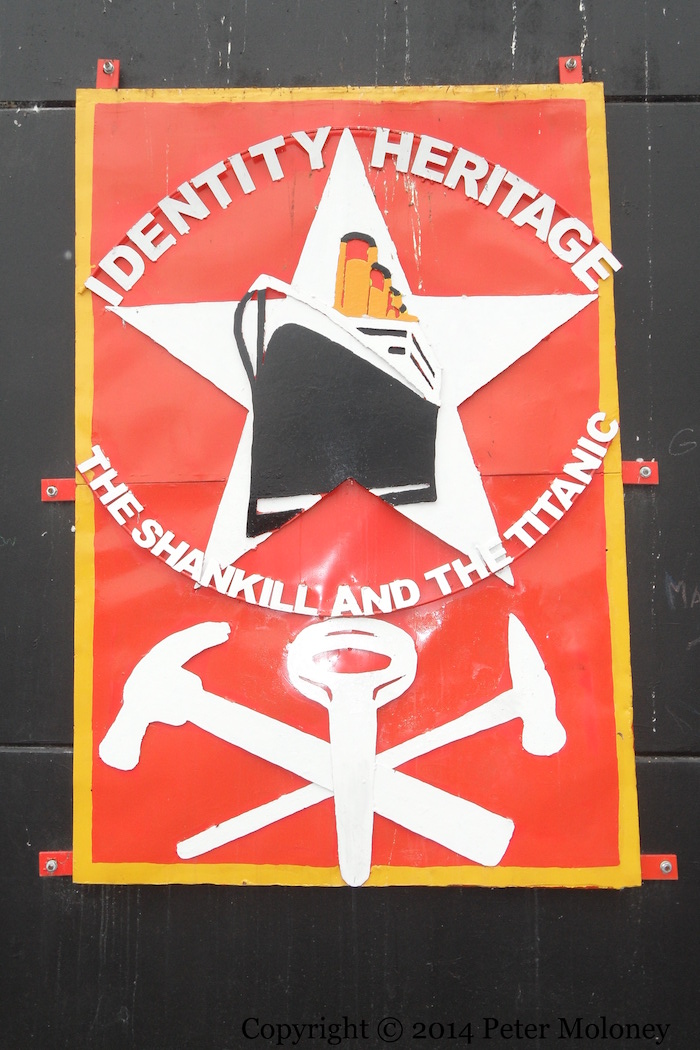
These are two painted metal-worked pieces bolted to the “peace” line on Cupar Way, celebrating “Shankill Ingenuity” and “Identity, Heritage”, while commemorating the lives lost on Titanic.
“1140” p.m. local time, April 14th, 1912, was when the ship hit an iceberg and began sinking. At about 2:20 a.m., in the early hours of the 15th, it went under.
“RNU in west Belfast are today leading the way in combating anti-social behavior [sic], reclaiming republican values, fighting the benefits cuts, tackling the increased drug problem, exposing the slum landlords, rebuilding community pride.” RNU [Republican Network for Unity (Xitter)] stencil on Northumberland Street. Tommy Doherty (leaflet) is running in the local council elections taking place on May 22nd.
“Cuts: made in Britain [by the Conservative-Liberal Democrat coalition led by Cameron and Clegg government], sold by Stormont!” éırígí (web) stencil on Northumberland Street.
The words “Rise up!” were later added to the banner being carried by the protesters on the right – see X02681.
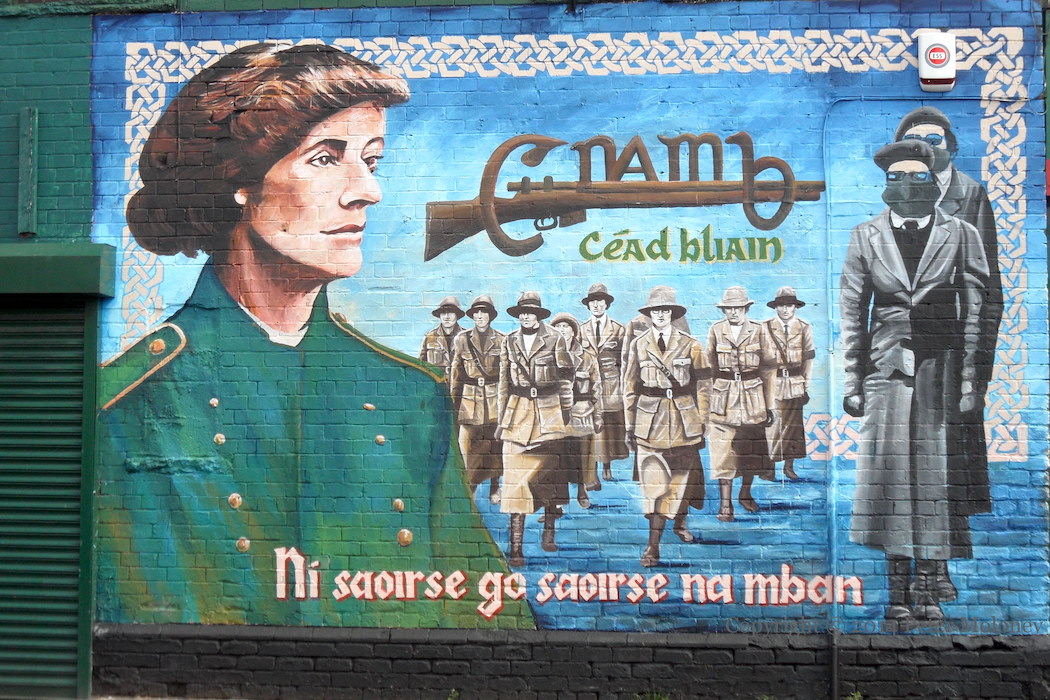
Cumann Na mBan was founded on April 2nd, 1914, and it is being commemorated in various ways, including a mural on Ascaıll Ard na bhFeá/Beechmount Avenue.
Cumann Na mBan was the women’s division of the Irish Volunteers and is best remembered for its role in the Easter Rising of 1916. Its members were involved in the occupation of many locations. Some, including (non-combatant) Winifred Carney, were in the GPO, while Countess Markievicz, the main figure of the mural, was in St. Stephen’s Green. (Here is an RTÉ gallery of vintage photographs, including one of Markievicz surrendering.)
The letters “Cnamb” on a rifle formed the badge of Cumann Na mBan. The Irish “Ní saoırse go saoırse na mban” means “[There is] No freedom until the freedom of women”.
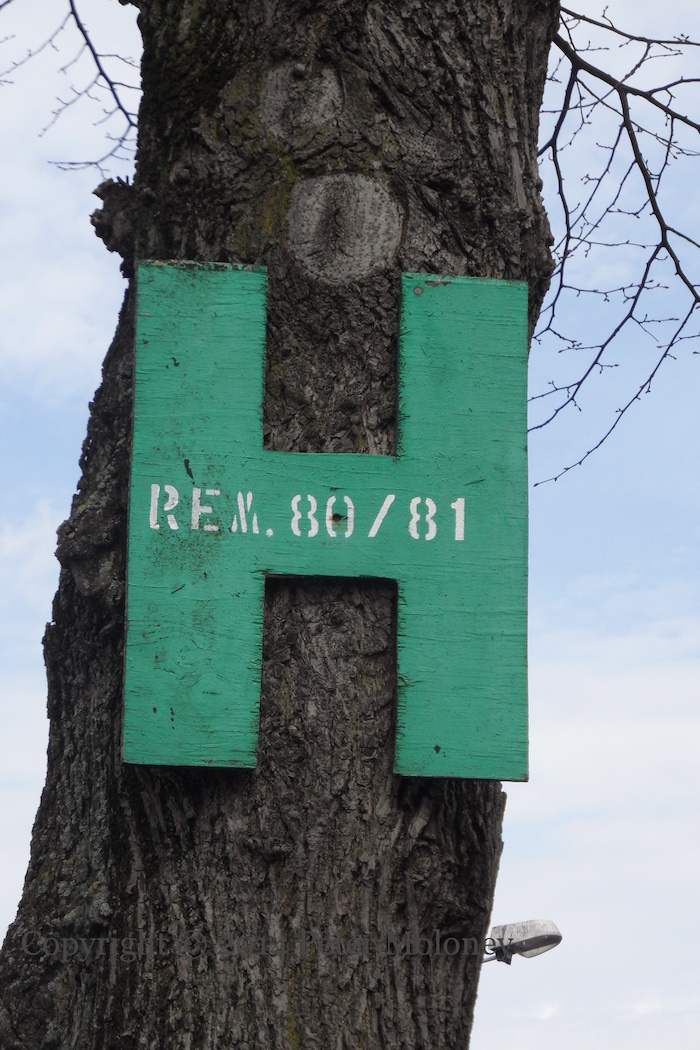
“Rem[ember] 80/81”. Here is a vintage nail-up on the Falls Road (at the Rock streets). It’s at least eight years old, and perhaps more. It notably includes the 1980 hunger strike.
Electioneering is under way in Northern Ireland, ahead of the local and European parliament elections on May 22nd.
“Vótáıl Éırígí #1 Pádraıc Mac Coıtır, Máıre Drumm”. This “Máıre Drumm” is the daughter of Sınn Féın vice-president and 1976 RHC victim Máıre Drumm.
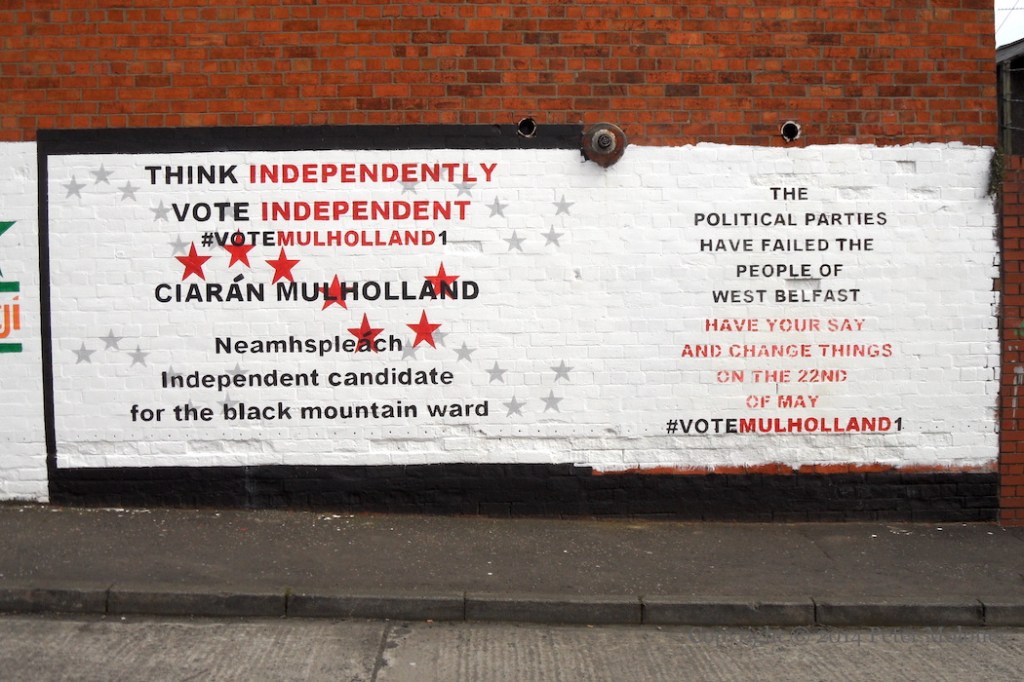
“Think Independently, Vote Independent #VoteMulholland1 Cıarán Mulholland. Neamhspleách/Independent candidate for the Black Mountain ward. The political parties have failed the people of west Belfast. Have your say and change things on the 22nd of May #VoteMulholland1”. Mulholland is an independent (socialist).
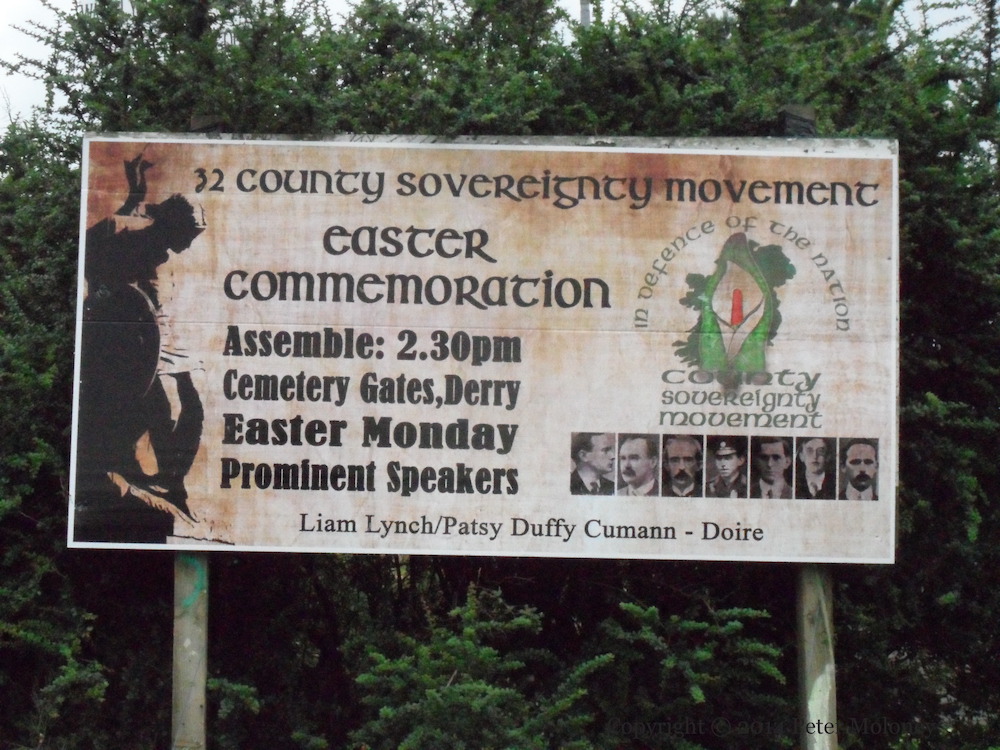
Top is a 1916 Societies board (in Rossville Street) announcing a commemoration for Richard Quigley on Easter Saturday; below is a 32 County Sovereignty Movement board (in Eastway) for an Easter Rising commemoration on Easter Monday.
Richie Quigley died on “active service” on April 21st, 1984 when he was hit by debris from a van-bomb that exploded prematurely (UPI). 2014 is the thirtieth anniversary of his death.






 Peter Moloney Collection