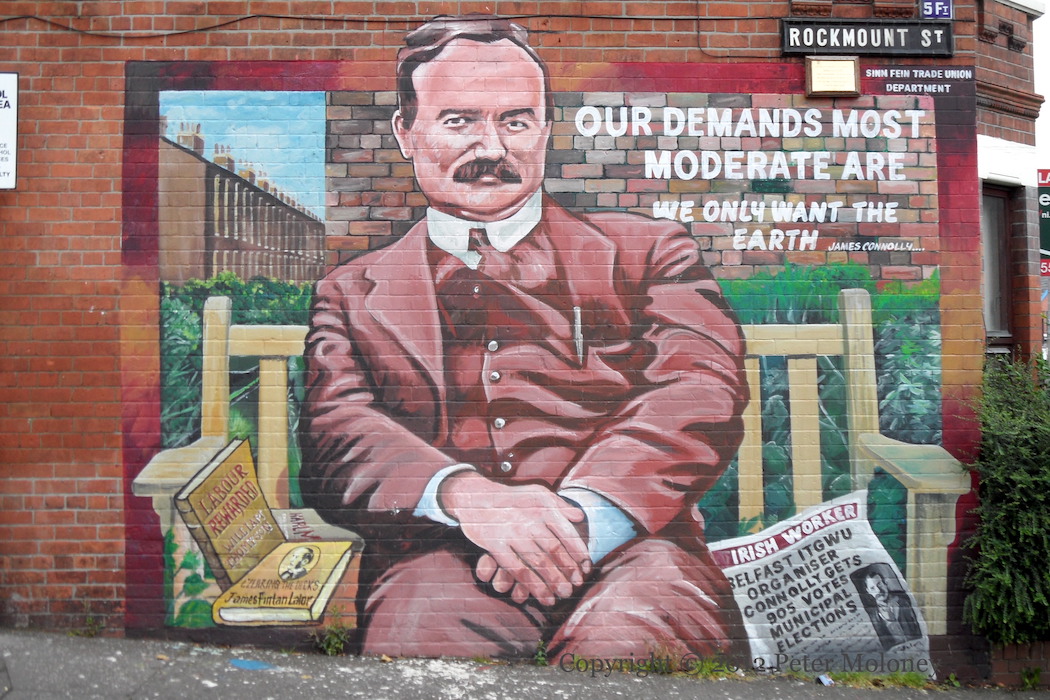
The sixteen-year old Sınn Féın Trade Union Dept mural has been replaced (though the plaque remains in the top right-hand corner) with another mural featuring James Connolly but with a new quote, from his 1907 poem: “Our demands most moderate are/We only want the earth.” The Irish Worker headline reads “Belfast ITGWU organiser Connolly gets 905 votes municipal elections”, referring to the municipal elections of 1913 – Connolly stood in the Dock Ward (SIPTU).
Purloined pieces decorating this year’s Relief Of Derry bonfire in the Fountain: a hand-painted “Free Marian Price now!” board, a 32CSM flag, and (flying) flags of Che Guevara on a Tricolour, the IRSP, and a Starry Plough, as well as tricolours, an FAI flag, and an … Argentinian? flag.
“Forever the town hereafter be and shall be named and called the city of Londonderry”, with the motto “Life, Truth, Victory”.
The city’s coat of arms is featured in the centre – there are various interpretations of its elements, including the skeleton (WP). In the top right is the coat of arms of the city of London (whose flag is the top part of the coat of arms) – “Domine dirige nos” [Lord, Direct Us].
St. Columb’s cathedral (WP) is top left and a map of the walls bottom right. For the dedication stone from St Columb’s (bottom left), see If Stones Could Speak.
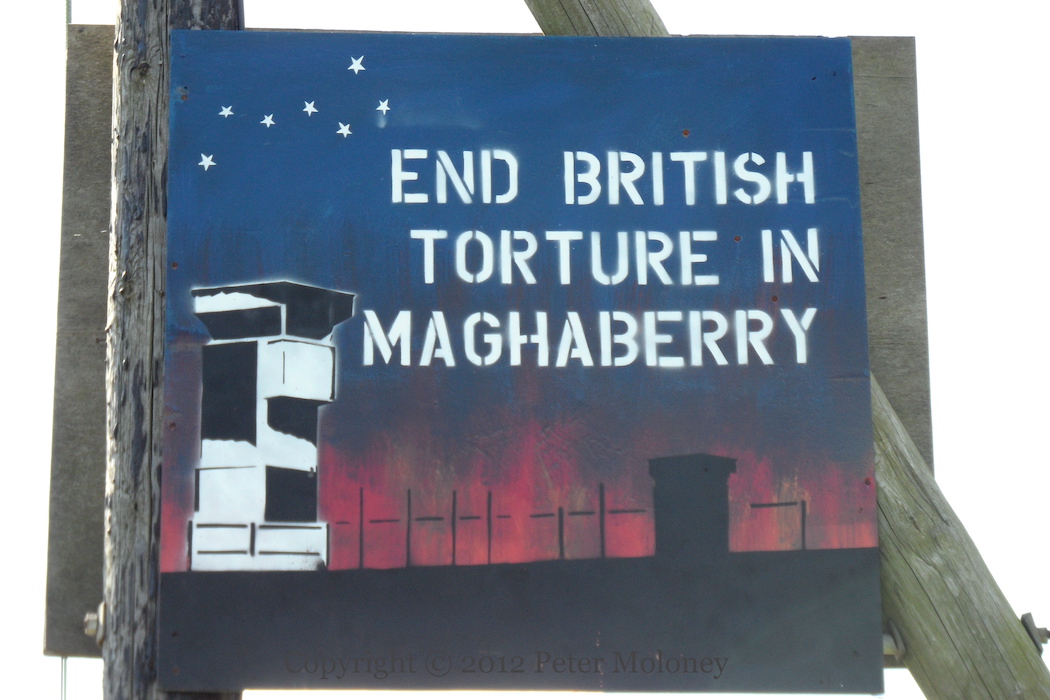
Two pieces from anti-Agreement republicans in Camlough protesting the treatment of prisoners: above, end British torture in Maghaberry; below, stop the Maghaberry strip searches.
Four images from around Silverbridge, Co Armagh. First, a vintage “RUC Out” on a traffic sign; second, “No absentee landlord repossessor’s or their agents wanted in south Armagh” (for some background, see No Grabbers Here); third, an anti-Agreement stencil protesting the treatment of republicans in Maghaberry; fourth, “IRA” nail-up on a power-line pole near lower Cashel Lough.
These are images from 2012 of the ‘My brother is not a criminal’ memorial in Ford’s Cross/Silverbridge, seen previously in 2006.
As the second image shows, earlier hunger strikers are also remembered: Thomas Ashe 1917, Michael Fitzgerald, Joseph Murphy, Terence McSwiney 1920, Joseph Whitty, Denis Barry, Andy Sullivan 1923, Tony Darcy, Sean McNeela 1940, Sean McCaughey 1946, Michael Gaughan 1974, Frank Stagg 1976.
The gallery of twelve hunger strikers in ‘Remember the hunger strikers’ is further up the road, towards Cullyhanna.
Top: “During the hunger-strike of 1981, in which ten men died, the Holy Rosary was recited here [on Freeduff Road], daily, by the community of Cullyhanna, to highlight the suffering of all the women and men in Armagh Gaol and Long Kesh, described by the late Cardinal Tomás Ó Fiach, a native of Cullyhanna, as being “worse than the sewers of Calcutta”. Go ndéana Dıa trócaıre ar a n-anam. Unveiled on the 8th July, 2001 by former hunger-striker, Paddy Quinn.”
Middle: The central panel is to Brendan Moley, Kevin Caherty, Michael McVerry, Brendan Burns, Fergal Caraher. Flanking this is a a longer list of volunteers, in English (left) and Irish (right). McVerry, Boyle, Jordan, McKiernan, Lochrie, Campbell, Cleary, Harvey, McElvanna, Caherty, McCreesh, Moley, Burns, Caraher, Duffy, Martin, Daly, Watters, Toner, Rogers. With smaller plaques to Tom Rooney & John Caraher, and to Brian Keenan.
Bottom: An individual memorial to “Vol Francis Caraher, Óglaıgh Na hÉıreann, murdered by British soldiers at this spot [on Tullyvallen Road] on 30th December 1990, aged 20 years.”
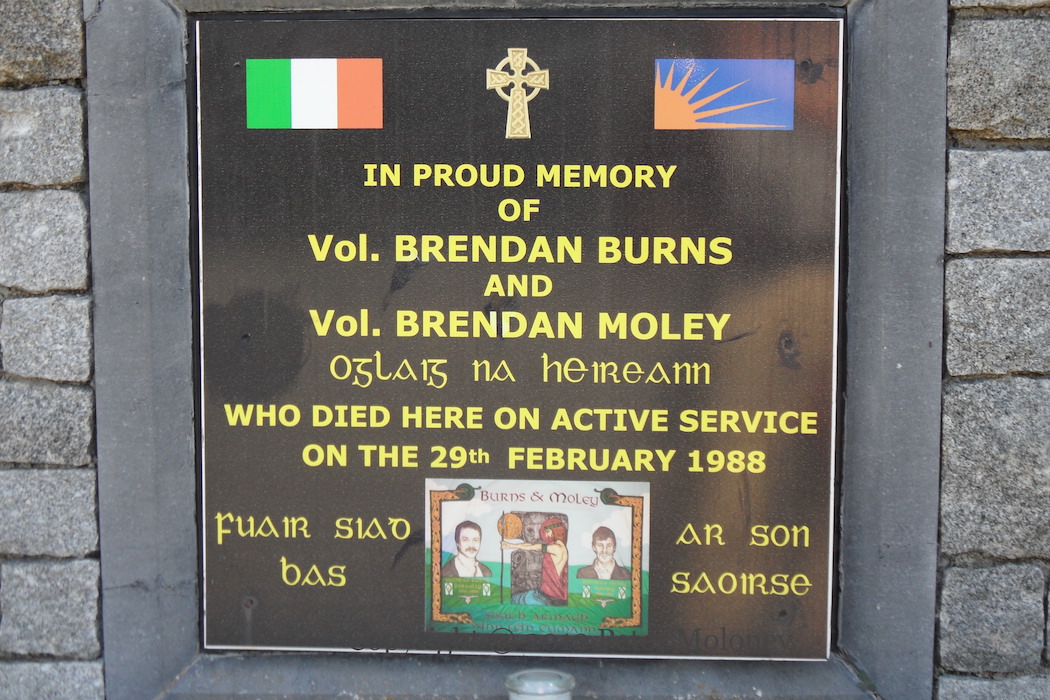
Two images from Creggan, Co. Armagh (near Crossmaglen). First, the memorial to “Brendan Burns, Carnally, 1958-1988” and “Brendan Moley, Dorsey, 1958-1998” “who died here on active service on the 29th February 1988 – fuaır sıad bás ar son na saoırse.” (Tribute from RN.) A Celtic warrior with a spear stands in front of a Janus statue. “South Armagh Sınn Féın Cumann.”
Below, “restore political status”. Both are on Donaldson’s Road.





 Peter Moloney Collection