A new (photographic) portrait and large “UFF” and “UDA” side-walls have been added to the 2011 version (which contains links to prior versions) of the Stevie McKeag mural in the lower Shankill estate.
Here are two new boards in the courtyard of the Rex Bar on the Shankill Road, describing the formation of the Ulster Volunteers (‘A Force For Ulster’) and commemorating the losses suffered by the 36th (Ulster) Division of the British Army, which the Volunteers became, at the Somme and in other battles, mowed down by “the Hun machine guns” (‘The Great War’).
‘A Force For Ulster’ includes photographs of the recent centenary re-enactments of the Balmoral Review, the Ulster Covenant, the formation of the Volunteers (“east” and “west”) and “Operation Lion” – more commonly known as the Larne Gun-Running.
According to the ‘The Great War’ board, 32,186 men from west Belfast were killed, wounded, or missing in the effort to “restore peace in Europe”. “To them bravery was without limit, to us memory is without end”. The board shows the Thiepval Memorial To The Missing Of The Somme against a background of portraits.
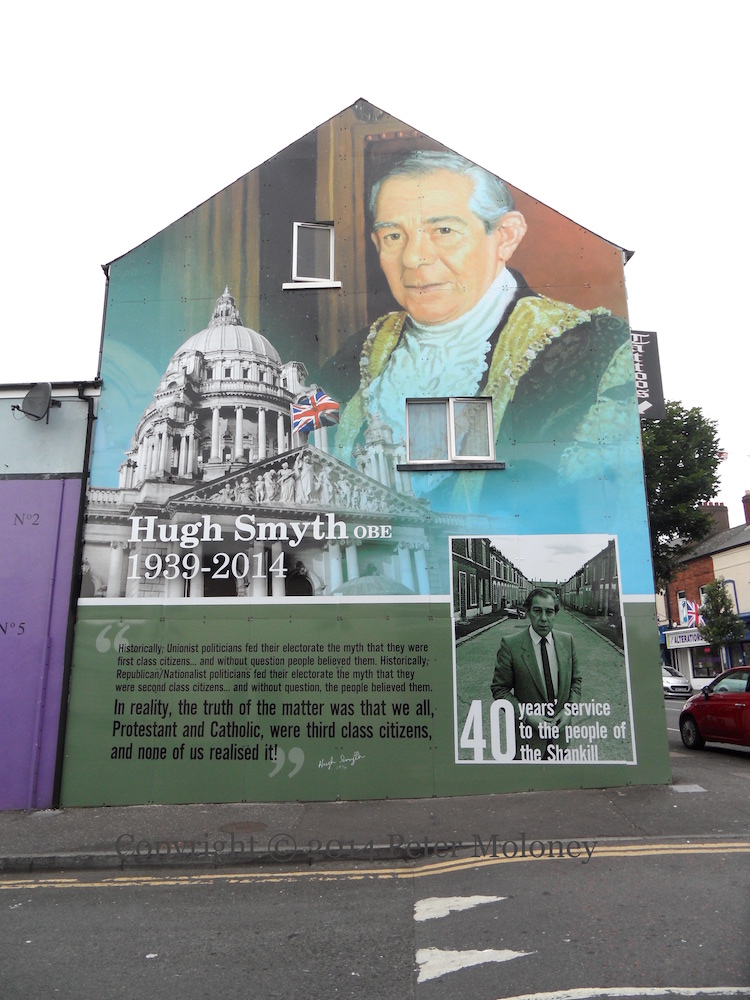
Hugh Smyth OBE was born in the Woodvale area and represented the upper Shankill as an Independent Unionist and then a Progressive Unionist in Belfast City Council for forty-one years, until the year before his death in May 2014, including a term as Lord mayor in 1994-1995 – he is pictured in his mayoral robes.
The portrait on the right was taken by Bobbie Hanvey and is kept in a Boston College archive; more from the archive can be seen at BC.edu.
As the quote indicates, his politics were oriented towards the working class: “Historically, Unionist politicians fed their electorate the myth that they were first class citizens … and without question people believed them. Historically, Republican/Nationalist politicians fed their electorate the myth that they were second class citizens… and without question the people believed them. In reality, the truth of the matter was that we all, Protestant and Catholic, were third class citizens, and none of us realised it!”
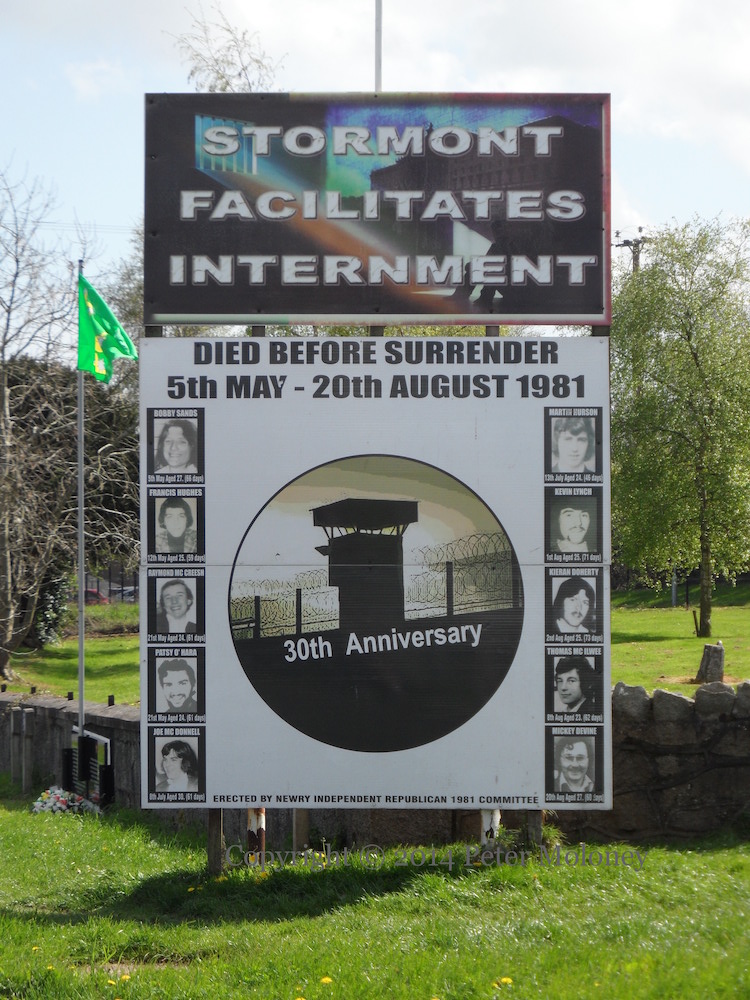
“Died before surrender – 5th May – 20th August 1981. 30th anniversary. Erected by Newry Independent Republican 1981 Committee.”
“Stormont facilitates internment” replaces “End Israeli terror in Palestine” on top of the hunger striker commemoration board (erected in 2011) at the junction of Camlough and Carnagat roads at Derrybeg.
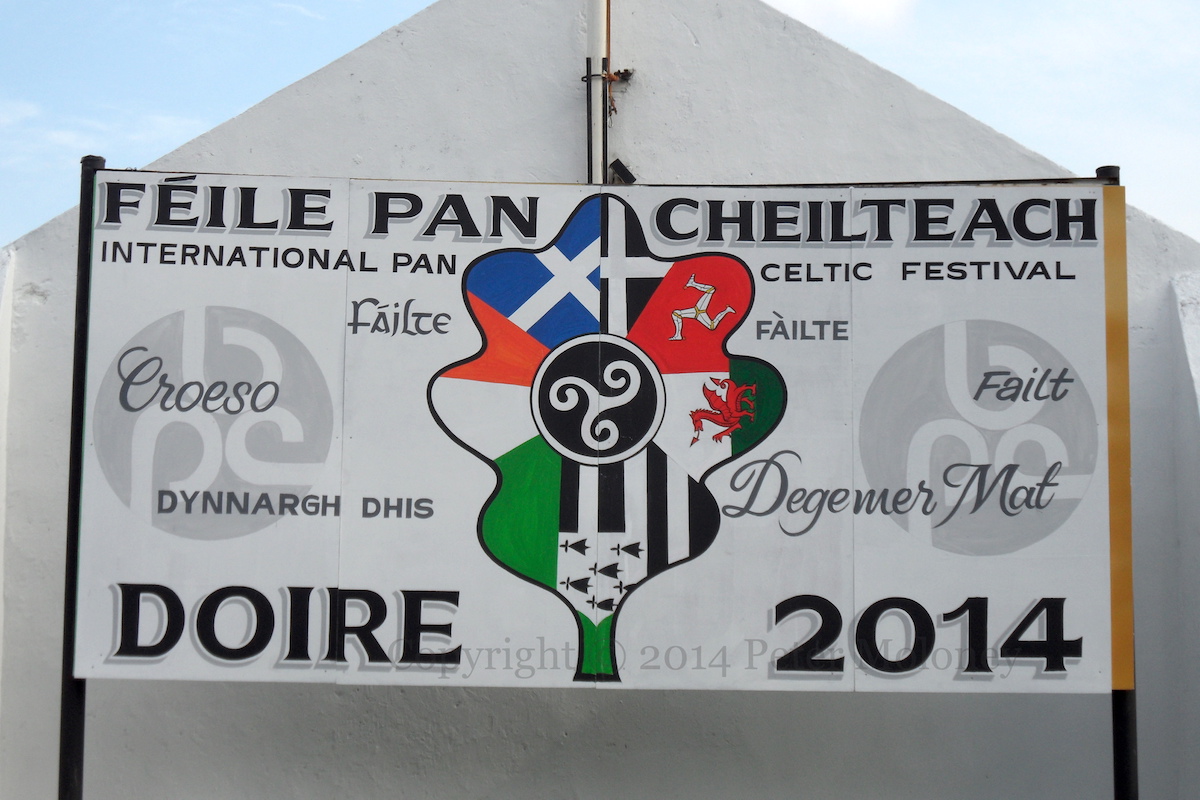
“International pan-Celtic festival – Doıre”. The festival (web) is in its 43rd year and will be held in Derry from April 22nd to 27th (Transceltic).
in the centre, the Derry oak-leaf is painted in the flags of the six Celtic-language nations with “welcome” in the six languages: (by flag, clockwise from left) Irish (Fáılte), Scots Gaelic (Fàılte), Cornish (Dynnargh Dhis), Manx (Failt), Welsh (Croeso), and Breton (Degemer Mat).
“Sınn Féın – putting Ireland first / Éıre chun cınn. Vótáıl Mary McConville, Jim McVeigh, toghcheantar na Cuırte / Court”. Local elections will be held on May 22nd, for the newly amalgamated councils (11 rather than 26); the Court district has also changed somewhat – it now includes the [CNR] areas of Clonard and Falls as well as [PUL] Ballygomartin, Forth River, Shankill, and Woodvale (WP).
“Belfast Easter Commemoration 1916 – Sunday 20th April. Assemble Beechmount Ave 1pm, parade leave 1.30 pm sharp. Speaker: Martina Anderson MEP. Honour Ireland’s patriot dead, wear an Easter lily. Cumann Uaıgheann[a] Na Laochra Gael – National Graves Association”
“On behalf of the officers and members of the Whiterock flute band we would like to thank all our past members, families, loyal orders and community for your support.”
“A brief history: On the 21st February 1962 there was a new flute band established. This band was to be named the Whiterock flute band. It all began during the monthly meeting of Whiterock Temperance LOL 974 when Brother Andrew Johnston (Snr) backed by Bro. Jack King proposed that a junior band be formed. Little did they know that the band would be celebrating 50 glorious years in 2012.
The band’s first chairperson was Andrew Johnston (Snr), the role which has been filled by many after him. The original committee members were Billy Simpson and Joe Proctor. The initial band membership came mainly from the mixed area of the Upper Springfield Road namely New Barnsley, Moyard and the adjoining Highfield area. However over the years the ranks of the Whiterock have been filled with folk from all over Belfast. With a new band comes the need for instruments, the ‘John Brown’ flutes were purchased for a small fee of thirty bob (£1.50) whilst the side drums were kindly donated by the Springfield Methodist church and accompanying bands associated with the church obtained through Jimmy McClean.
With practices taking place in Whiterock Orange Hall and the band building a repertoire of music containing Blackboard of my Heart, Abide with Me and the national anthem all they needed now was a parade to get the show on the road. The first parade for the band was on the 29th June 1962 accompanying the Whiterock Temperance LOL 974 on their annual Whiterock parade, a parade which today still plays a large part in the band’s activities.
Two years later in 1964, the band was well establish and looked towards a uniform re-design; they opted for bright orange sashes, white shirts and the Balmoral Hat with the distinctive orange plume. The hat is still part of the Whiterock uniform today and in fact has become somewhat a trade mark of the band.
As well as the uniform, the band instruments also changed slightly in that they obtained ‘Big Bertha’ which is a half Lambeg rope drum and is still beaten by the band today, alongside this they began purchasing the Hawkes and Sons Crown AZ Bb flute which is also still played by the band. The Crown AZ flutes are a highly sought after instrument and are a lot more expensive than the John Browns purchased for £1.50.
The band had engaged with many organisations throughout their history, some of which have maintained long term relationships. On the band’s 50th anniversary 2012, we enjoyed the company of Ulster Convention LOL 242 for (37 years), alongside Britannia Junior LOL 32 (36 years). Other notable relationships are Beaconsfield RBP 224 (34 years) and ABOD Campsie Club (12 years) all presently engaged to date 2014.
Membership of the band remains consistent with many members having an impressive number of years service under their belt, in particular Alex Thompson (AT), who has a staggering 50 years marked in 2013. Looking towards the future, the band will stay committed to providing opportunities for our younger generations, to participate in the art of flute and drum, therefore keeping our glorious tradition alive.”
The memorial gallery on the right-hand side of Ardilea Close has been expanded from three panels to five (compared to last year/2013) and the first new face is “Charlie Wilson – age 66”.
“Easter Sunday commemoration march. Assemble 2.00 pm Westland Street. Tírghrá.” The sign is the same as in 2013 (M09214), which was a modified version of the 2011 board (M06631).