“Easter Sunday commemoration march. Assemble 2.00 pm Westland Street. Tírghrá.” The sign is the same as in 2013 (M09214), which was a modified version of the 2011 board (M06631).
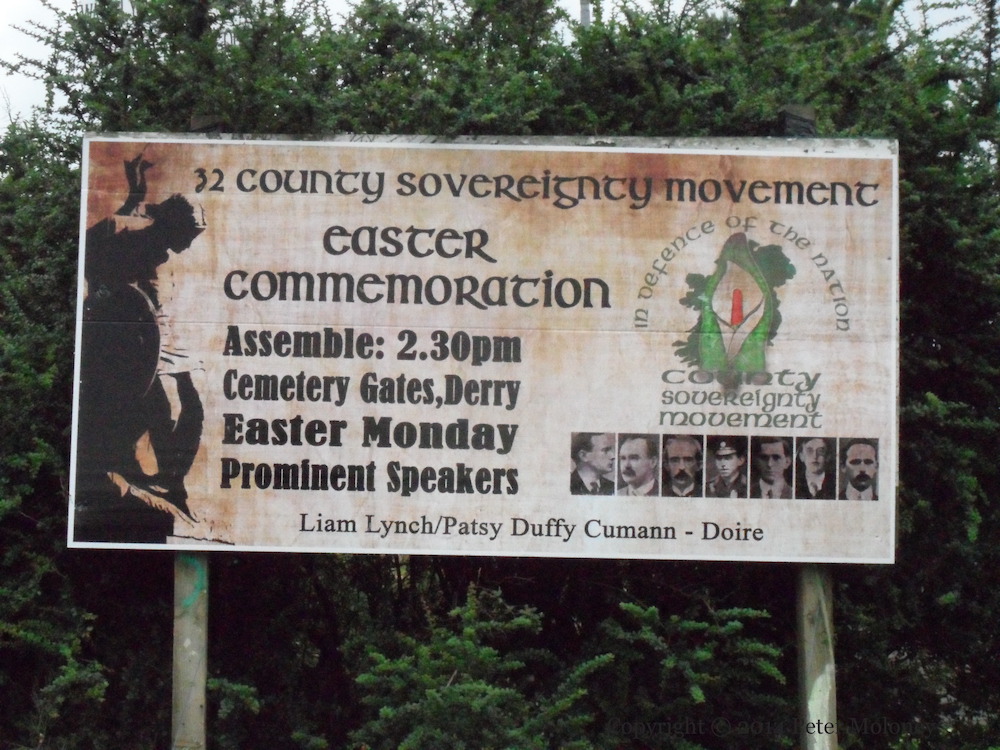
Top is a 1916 Societies board (in Rossville Street) announcing a commemoration for Richard Quigley on Easter Saturday; below is a 32 County Sovereignty Movement board (in Eastway) for an Easter Rising commemoration on Easter Monday.
Richie Quigley died on “active service” on April 21st, 1984 when he was hit by debris from a van-bomb that exploded prematurely (UPI). 2014 is the thirtieth anniversary of his death.
Above is a local interpretation of Robert Ballagh’s 1970 rendering of Goya’s The Third Of May 1808 in Glenfada Park, Derry/Doıre, site of four deaths on Bloody Sunday, 1972.
The original commemorates Spanish resistance to the forces of Napoleon (WP). For this Derry version, features from the city’s skyline – the Guildhall, St. Columb’s Cathedral, and an intact Governor Walker column – have replaced the original’s outline of Madrid, and an insignia of the Paras appears on the arm of a soldier.
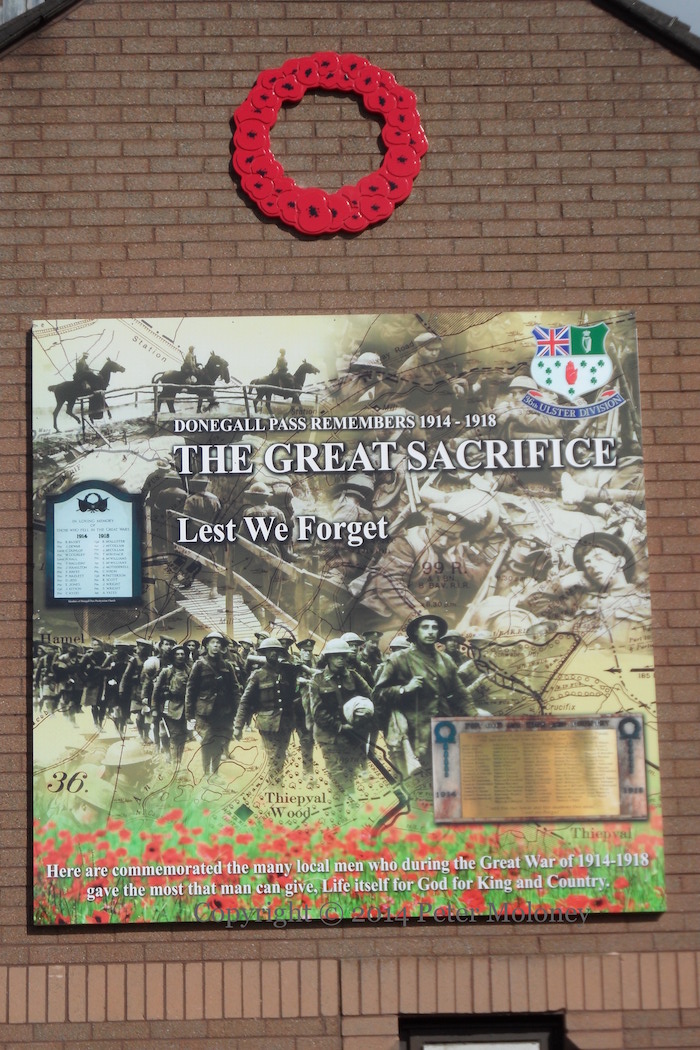
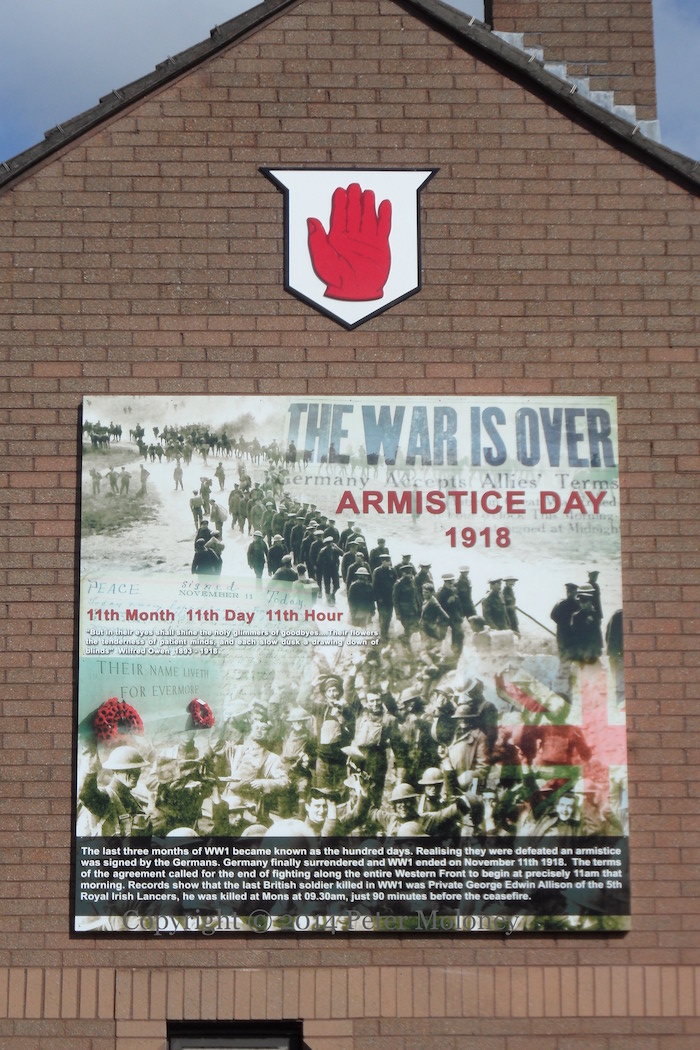
Here are three boards in Lindsay Street, south Belfast, chronicling the 1912 Covenant and the lives lost (by the 36th Division) in the Great War 1914-1918.
“It is needful that we knit together as one man, each strengthening the other, and not holding back of counting the cost” – Ulster [Unionist] Council Resolution 1912.” “Ulster’s solemn league and covenant. Ulster Day 28th September 1912.” The Council met on September 23rd and 471,000 people signed the covenant (figures here) on or around the 28th – Ulster Day – led by Sir Edward Carson.
“Donegall Pass remembers 1914-1918 – the great sacrifice. Lest we forget. Here are commemorated the many local men who during the Great War of 1914-1918 gave the most that man can give: life itself for God for King and Country.” With a map of the northern end of the Western Front and images of soldiers marching, on horseback, and in the trenches.
“The war is over. Armistice Day 1918. 11th month, 11th day, 11th, hour.” “But in their eyes shall shine the holy glimmers of goodbyes … Their flower the tenderness of patient minds, and each slow dusk a drawing down of blinds.” Lines from Wilfred Owens’ (1893-1918) ‘Anthem For Doomed Youth‘.
At the bottom: “The last three months of WWI became known as the hundred days. Realising they were defeated an armistice was signed by the Germans. Germany finally surrendered and WWI ended on November 11th 1918. The terms of the agreement called for the end of fighting along the entire Western Front to begin a precisely 11 am that morning. Records show that the last British soldier killed in WWI was Private George Edwin Allison of the 5th Royal Irish Lancers. He was killed at Mons at 09:30 am, just 90 minutes before the ceasefire.”
These Kilburn Street boards commemorate the “Young Citizen Volunteers Of Ireland” and the battle of the Somme. The text in the side-wall board (shown below) is from the diary of a Somme soldier: “We surge forward. Bayonets sparkle and glint. Cries and curses rent the air. Chums fall, some without a word … and others … Oh, my God! May I never hear such cries again! There goes the YCV flag tied to the muzzle of a rifle. That man had nerve! Through the road just ahead of us we had crossed the sunken road. We could see khaki figures rushing the German front line. The Inniskillings had got at them.”
The larger board, on the right, describes the transition from rebels in 1912 to British Army soldiers in 1914: “On the 17th May 1914 the Young Citizen Volunteers became a battalion of the Belfast regiment of the Ulster Volunteer Force. This formed part of the Ulster Division authorised on 28th October 1914 which officially became the 14th battalion of the Royal Irish Rifles, part of the 109th brigade. The 14th saw action throughout the First World War.”
It includes a quote from Edward Carson, “You will find in your ranks men with the same ideals, men with the same loyalty and the same determination to uphold the rights of their country”, and a quote from VC winner William Fredrick McFadzean, “You people at home make me feel quite proud when you tell me I am the soldier boy of the McFadzeans. I hope to play the game and if I don’t add much lustre to it I certainly will not tarnish it.”
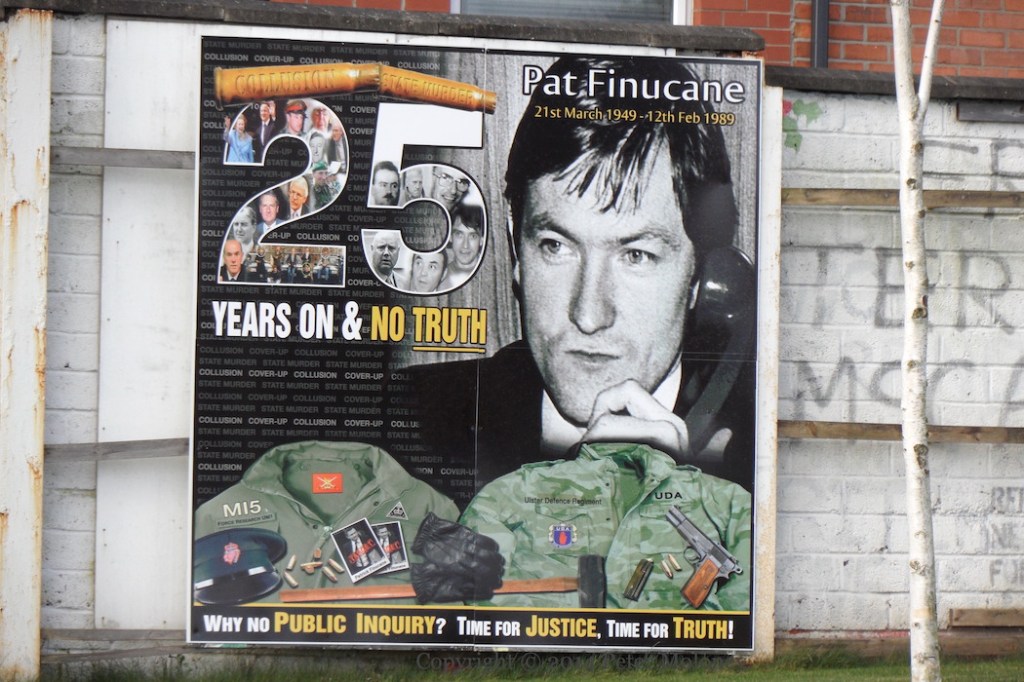
This board at the junction of the Falls and Glen roads (on the site of the former Andersonstown RUC station) commemorates the death of Pat Finucane (on February 12th, 1989), alleging collusion between the MI5, the UDA, the UDR, and the RUC, and asking for an inquiry.
“25 years on & no truth. Why no public inquiry? Time for justice, time for truth!”
“Progression requires inclusion” of UVF paramilitary gangs.
The painting of King Billy is by John Darren Sutton and was produced on a grand scale in Tavanagh Street, Village, south Belfast – see Hang Out Our Banners.
“It’s dangerous to be right when the government is wrong.” “Loyal Carrickfergus – then, now and always!”
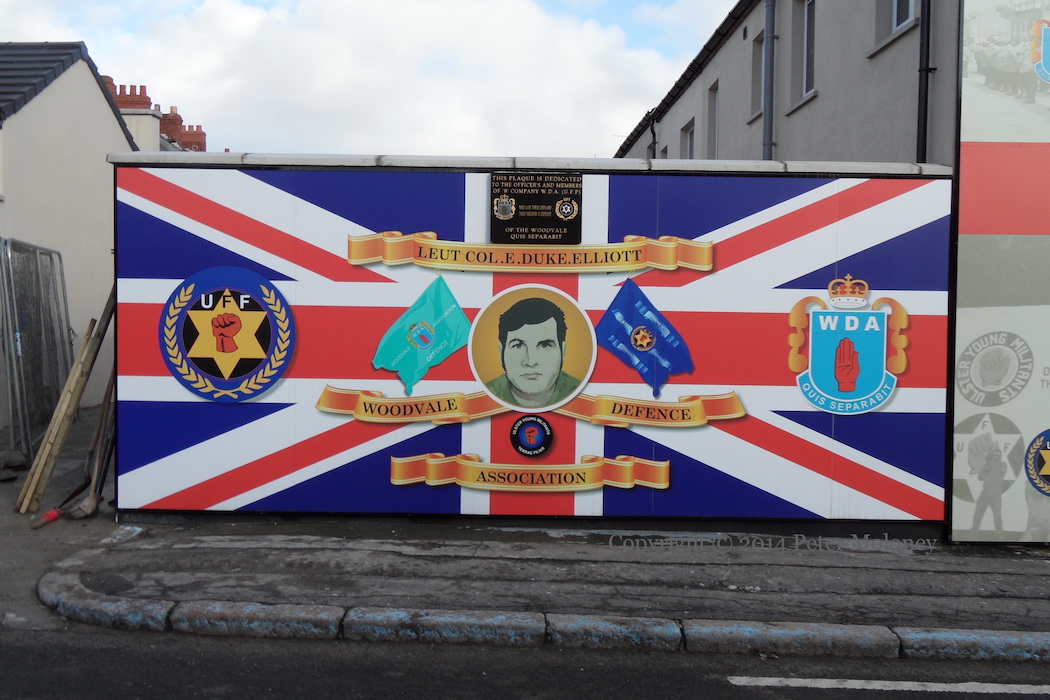
The gable wall at the end of Columbia Street (on Ohio Street) has been rebuilt and the old WDA/Duke Elliott mural has been replaced. The right side of the piece describes the transition from the Woodvale Defence Association to the Ulster Defence Association to the Ulster Freedom Fighters, and grounds all three in the Ulster Defence union of 1893. Ernie “Duke” Elliott was killed in 1972, at age 28, in a dispute with other UDA members; he lived one street over from the site of these new boards, in Leopold Street (WP).









 Peter Moloney Collection