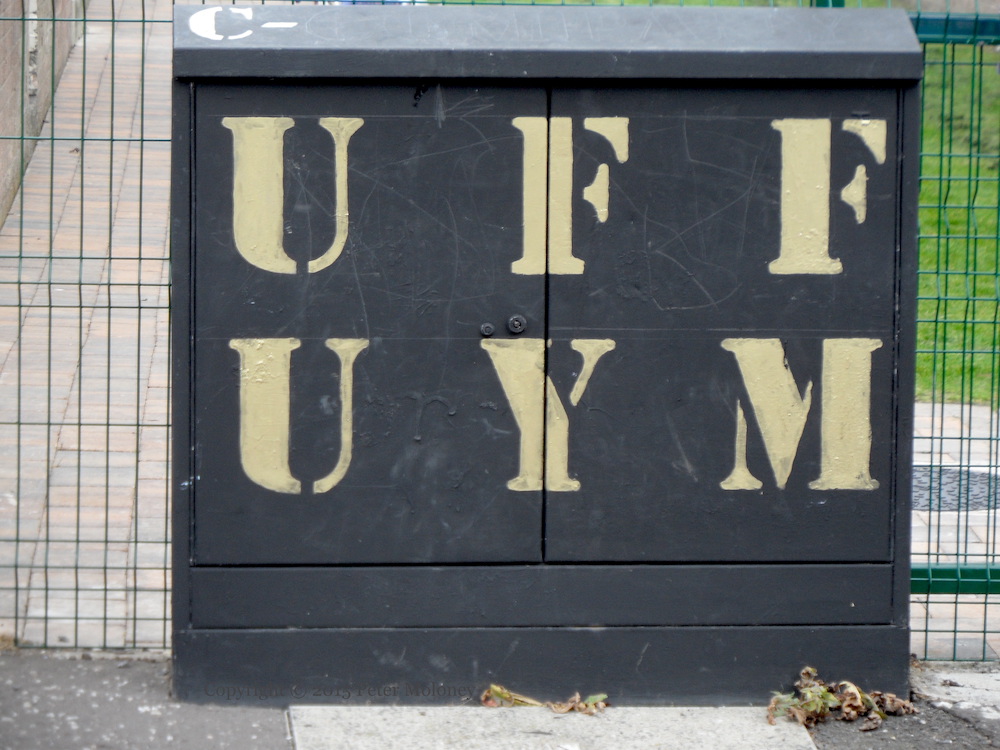
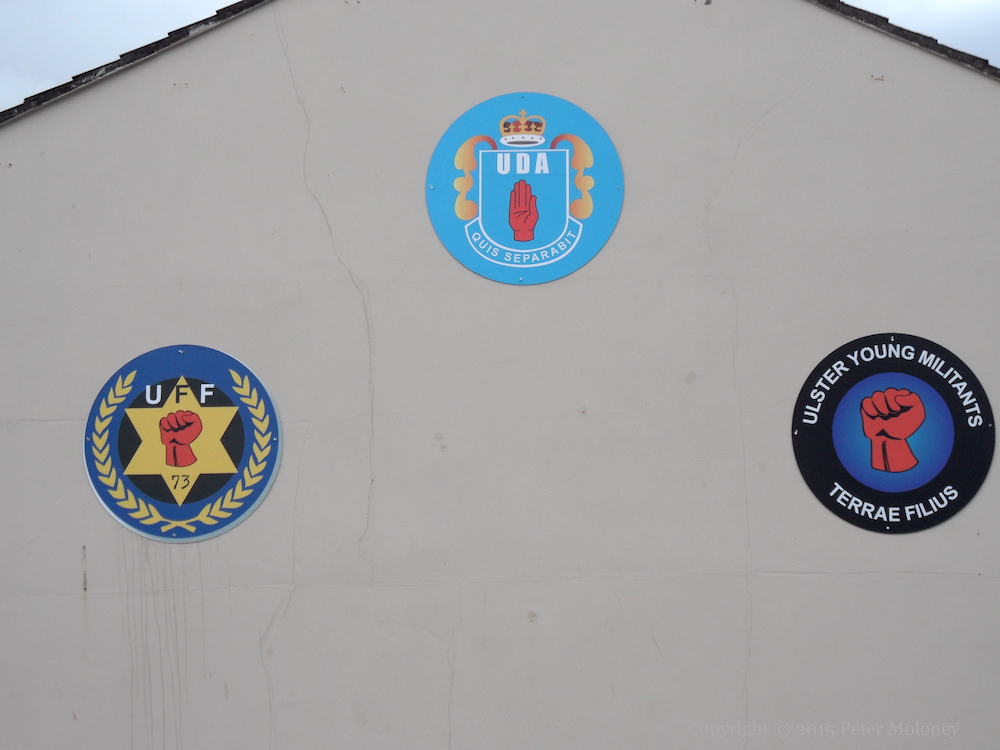
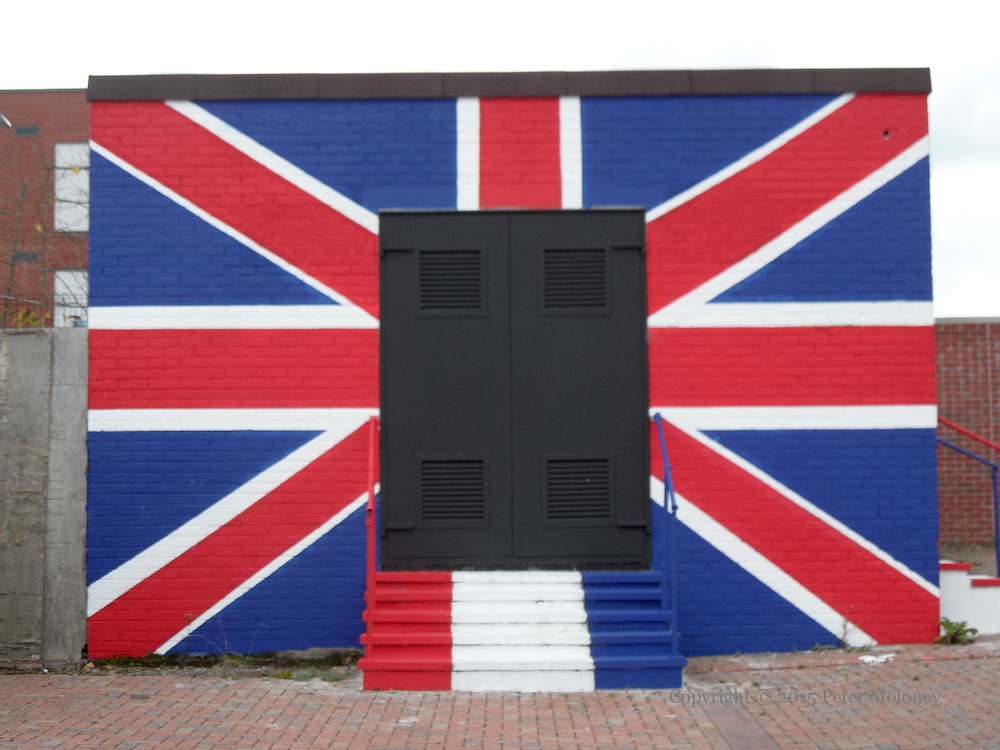
Welcome to the loyalist lower Shankill, and specifically the UDA (2nd battalion, C company) lower Shankill.
However, these are somewhat peripheral locations, in California Close, Boundary Way, and Hopewell Crescent. The centre of the estate has been re-imaged a second time – see Lower Shankill Angels.
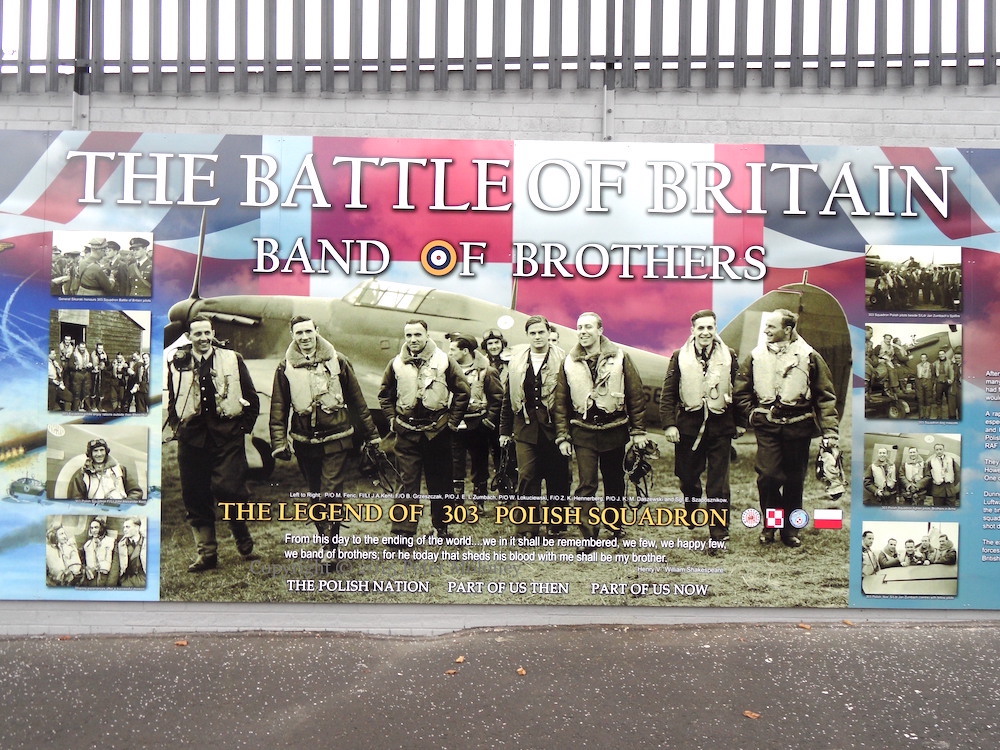
“Love demands sacrifice”. “‘From this day to the ending of the world … we in it shall be remembered, we few, we happy few, we band of brothers’ for he today that sheds his blood with me shall be my brother’ – Henry V, William Shakespeare”
2015 marks the 75th anniversary of the Battle Of Britain, which was waged from July to October in 1940. This large board is part of an anti-racism project, celebrating the contributions to the Battle made by roughly 145 Polish aviators (WP) and especially the 303 squadron, which was stationed in Northern Ireland for a time (BBC-NI). “The Polish nation – part of us then, part of us now”.
The artist is Ross Wilson. Belfast Live has a report on the launch.
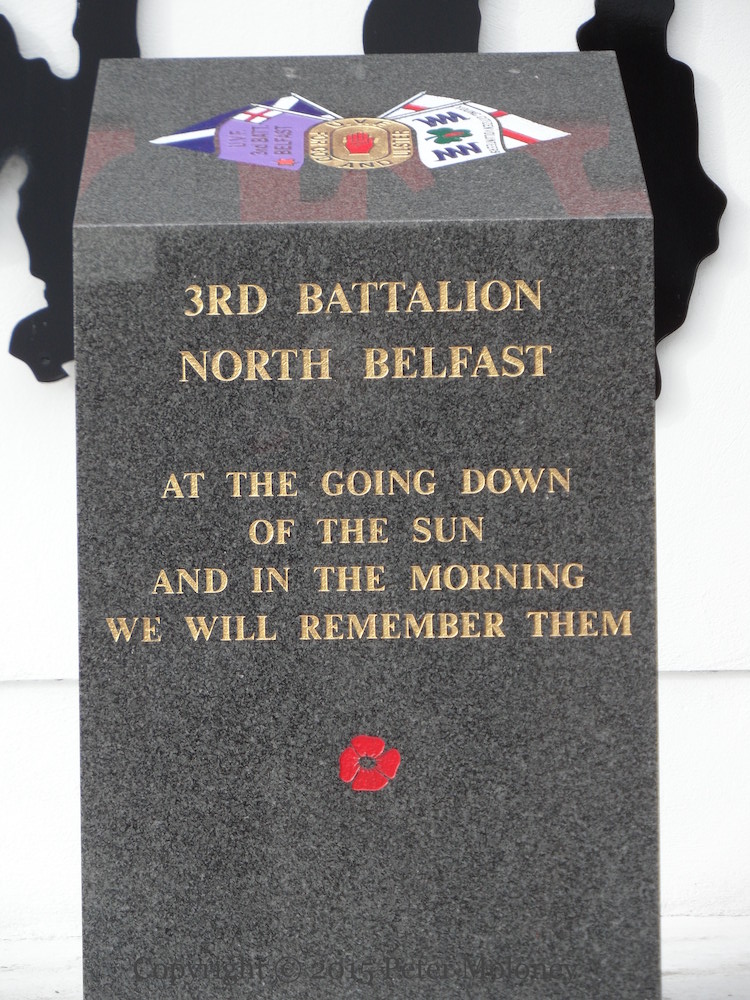
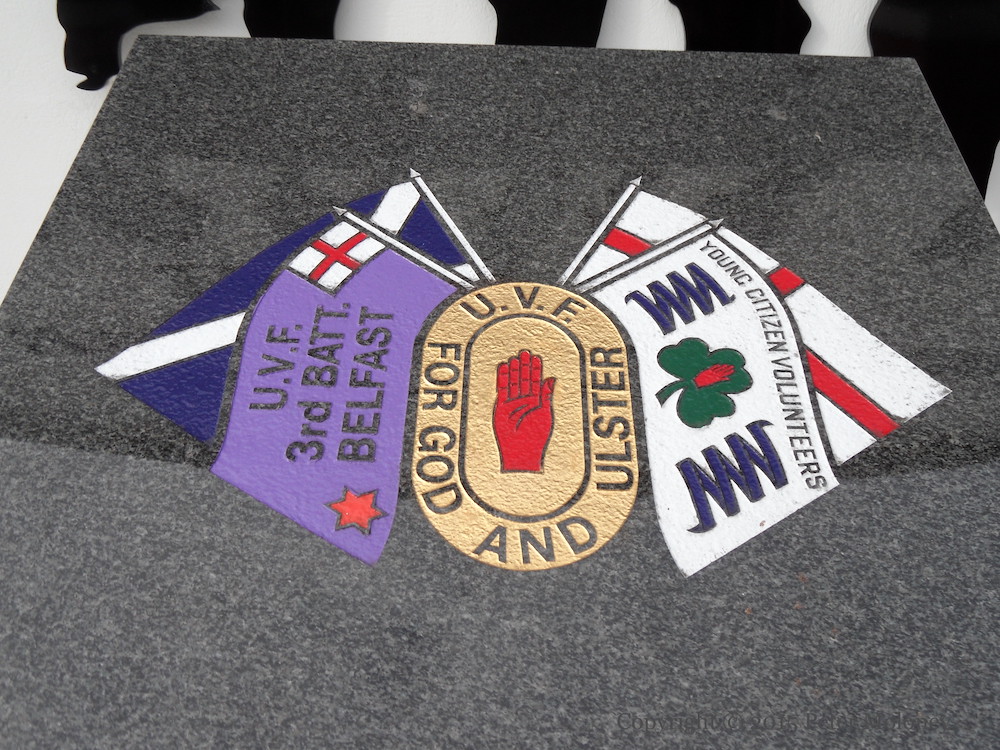
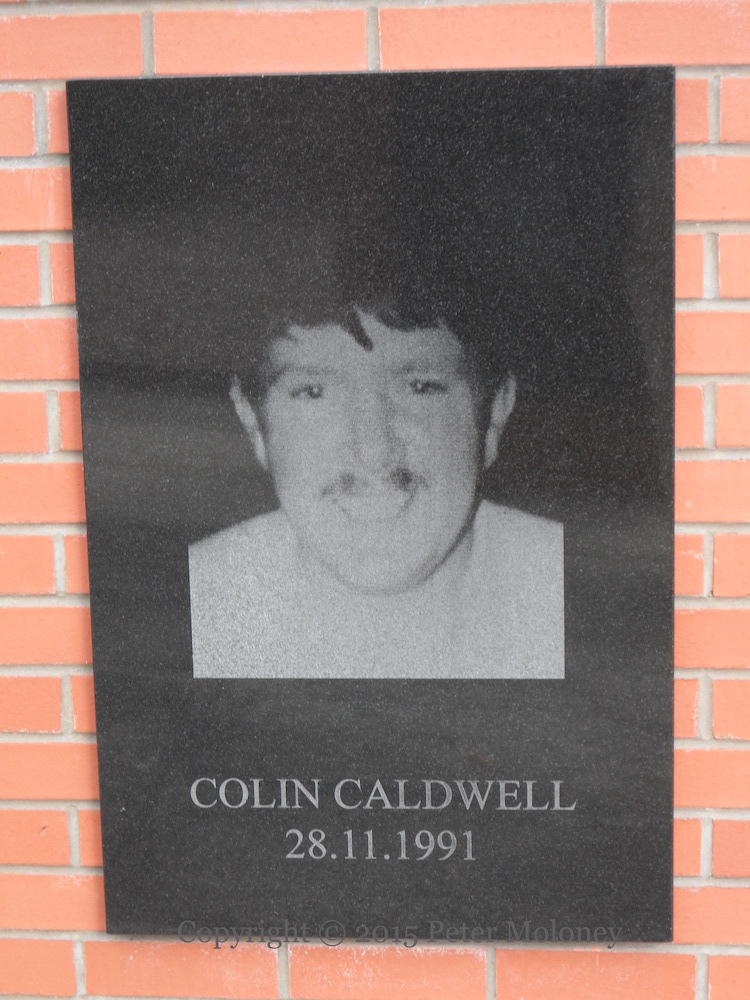
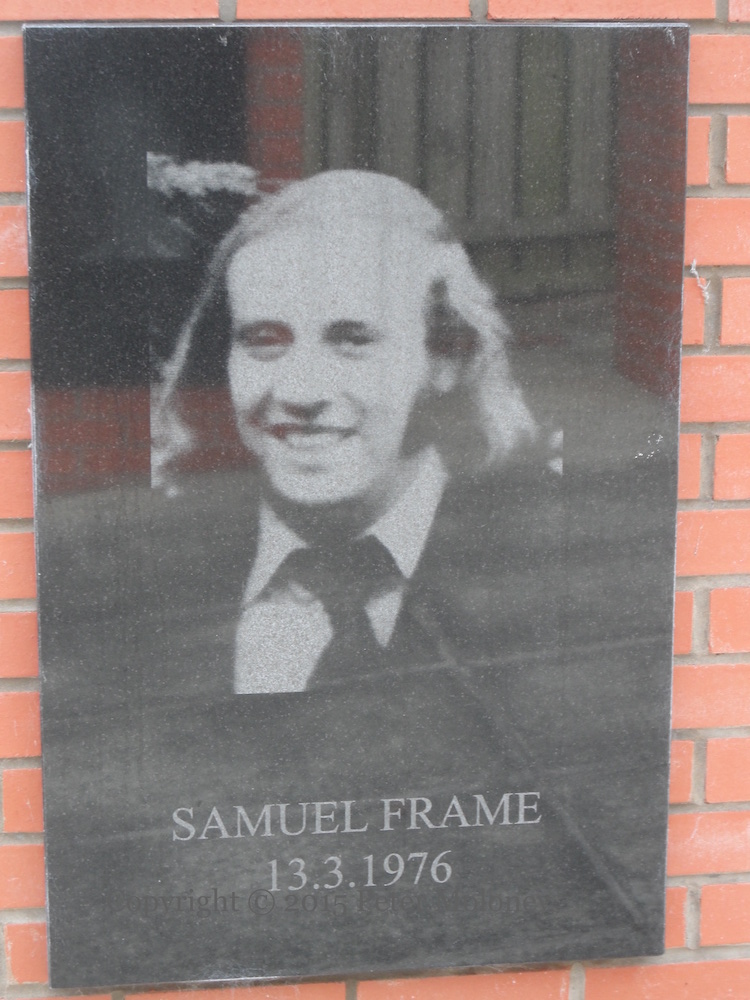
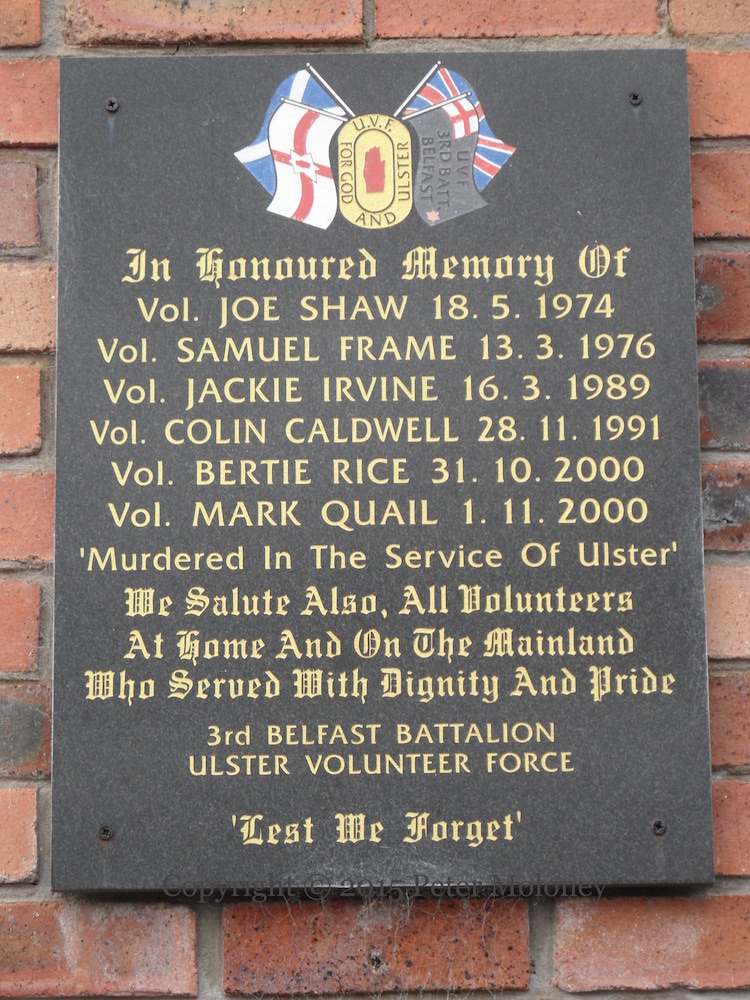
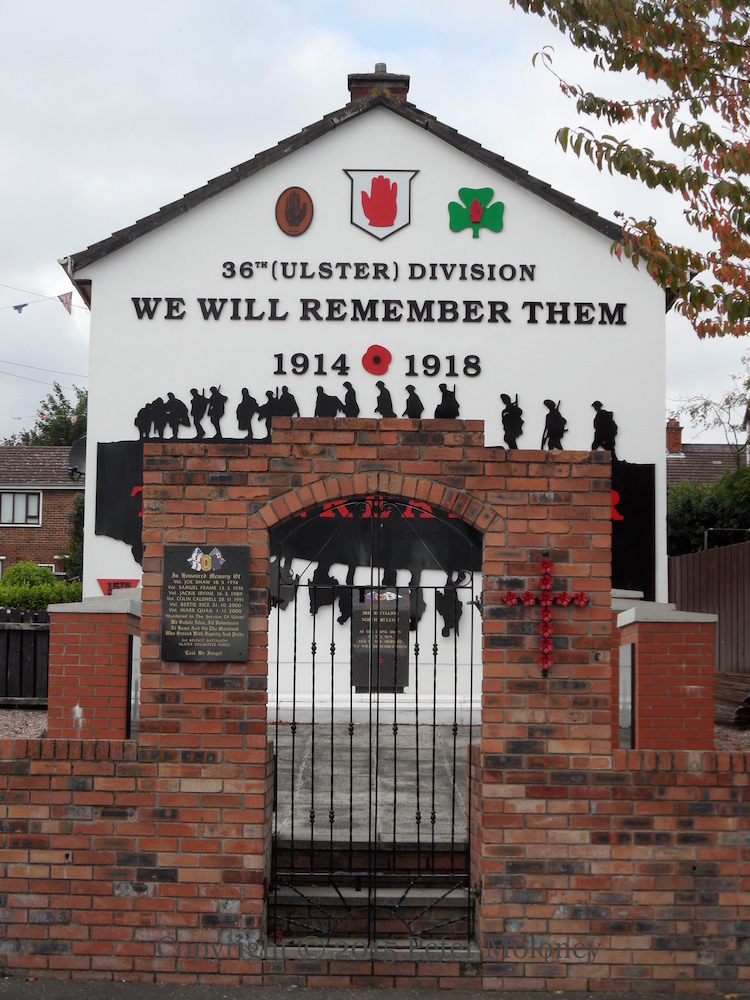
The memorial garden in Mount Vernon, which previously had and Ulster Volunteers mural and UVF stone, has undergone a major redevelopment this year (2015) with a new “cut-out” mural to the 36th (Ulster) Division and stand-alone memorial plaques to six UVF (3rd Belfast Battalion) members who were listed the plaque on the outside wall of the garden. “Murdered in the service of Ulster: Joe Shaw 18-5-1974, Samuel Frame 13-3-1976, Jackie Irvine 16-3-1989. Colin Caldwell 28-11-1991, Bertie Rice 31-10-2000, Mark Quail 1-11-2000.”
“We salute also all volunteers at home and on the mainland who served with dignity and pride.”
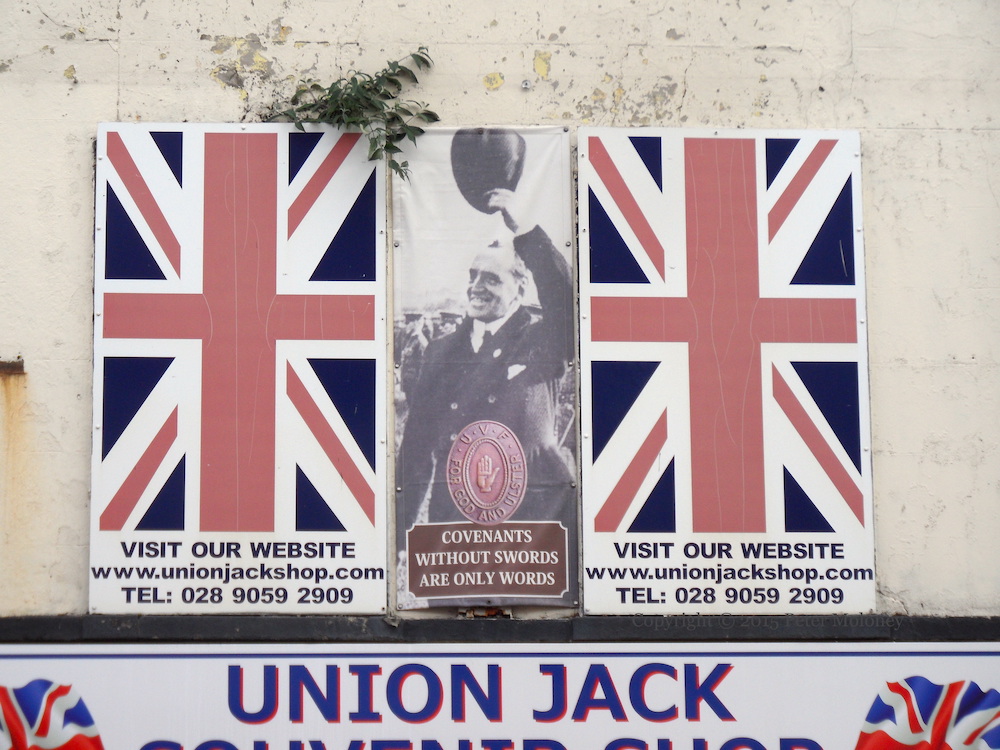
“Covenants without swords are only words” is a slight emendation of a line from Chapter 17 of Thomas Hobbes’s The Leviathan: “And covenants, without the sword, are but words and of no strength to secure a man at all.”
It is applied here to the 1912 Ulster Covenant being backed up by the 1914 gun-running. Edward Carson is shown acknowledging the cheers of the Ulster Volunteers, who have been drilling at Glencairn (as seen in this Shankill mural).
Above the Unionist souvenir shop on the Newtownards Road, east Belfast. Seen previously in 2012: Where Ulstermen Shop.
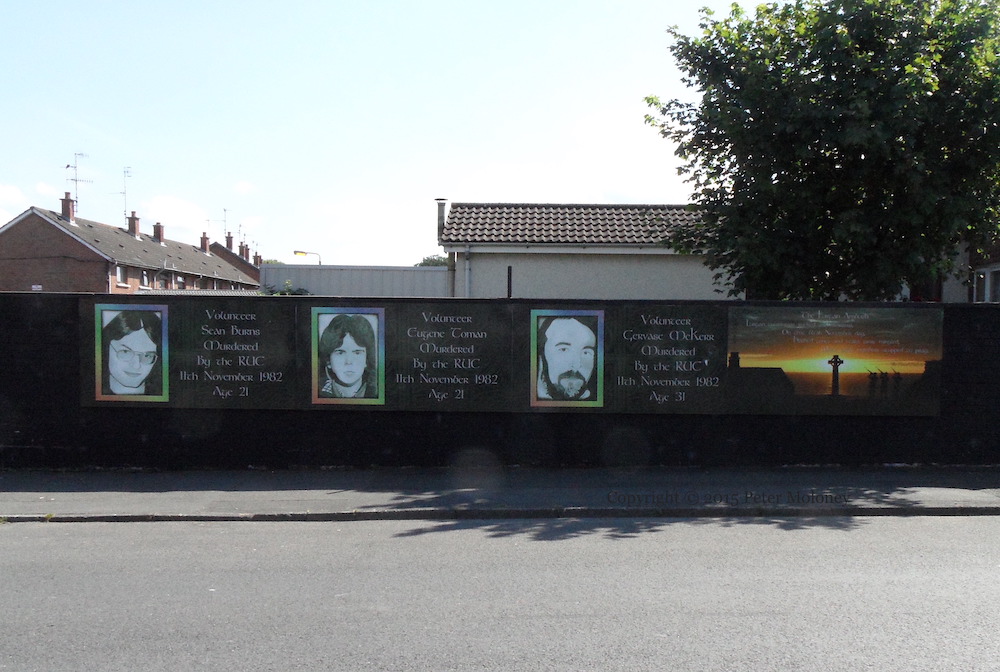
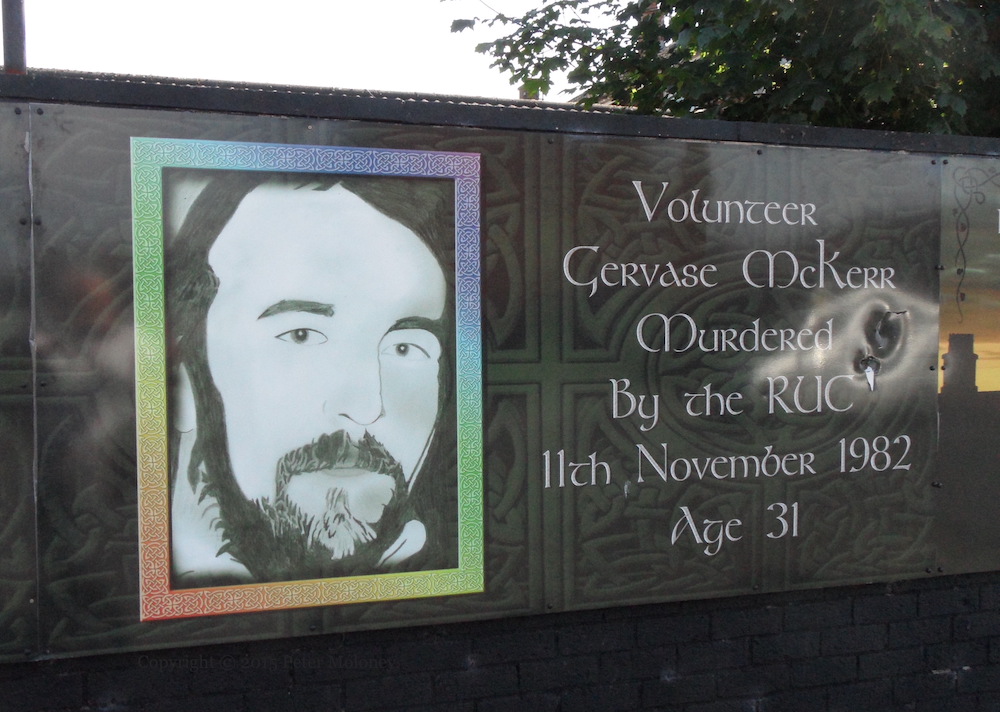
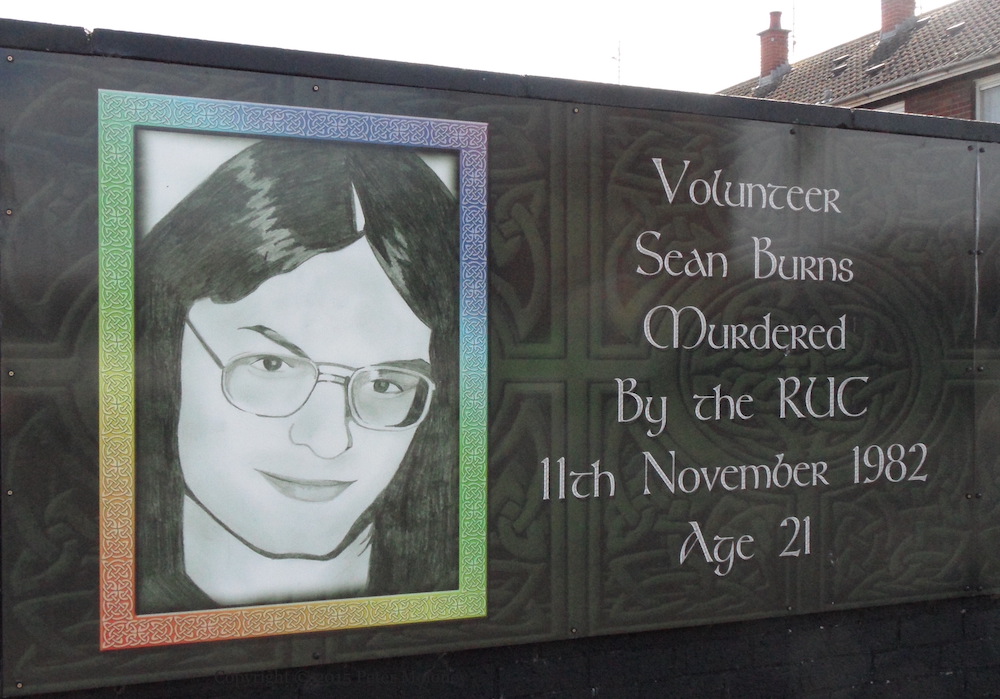
On the evening of November 21, 1982, the car in which IRA volunteers Eugene Toman, Sean Burns, and Gervaise [here spelled “Gervase” and elsewhere “Gervais”] McKerr were travelling was hit by 109 bullets and all three were killed. They were perhaps the first victims of the “shoot to kill” policy. (An Phoblacht)
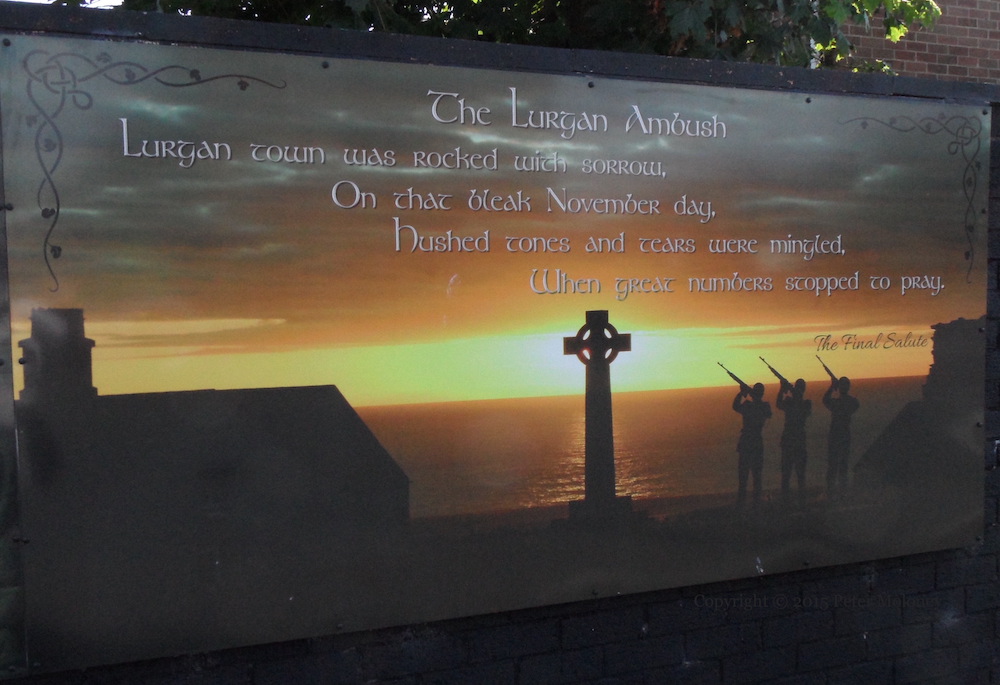
“Lurgan town was rocked with sorrow/On that bleak November day/Hushed tones and tears were mingled/When great numbers stopped to pray” – these are the opening lines of Ida Green’s poem ‘The Lurgan Ambush’, a poem by Ita Green [set to music at Irish Folk Songs | sung by Bo Loughran on youtube].
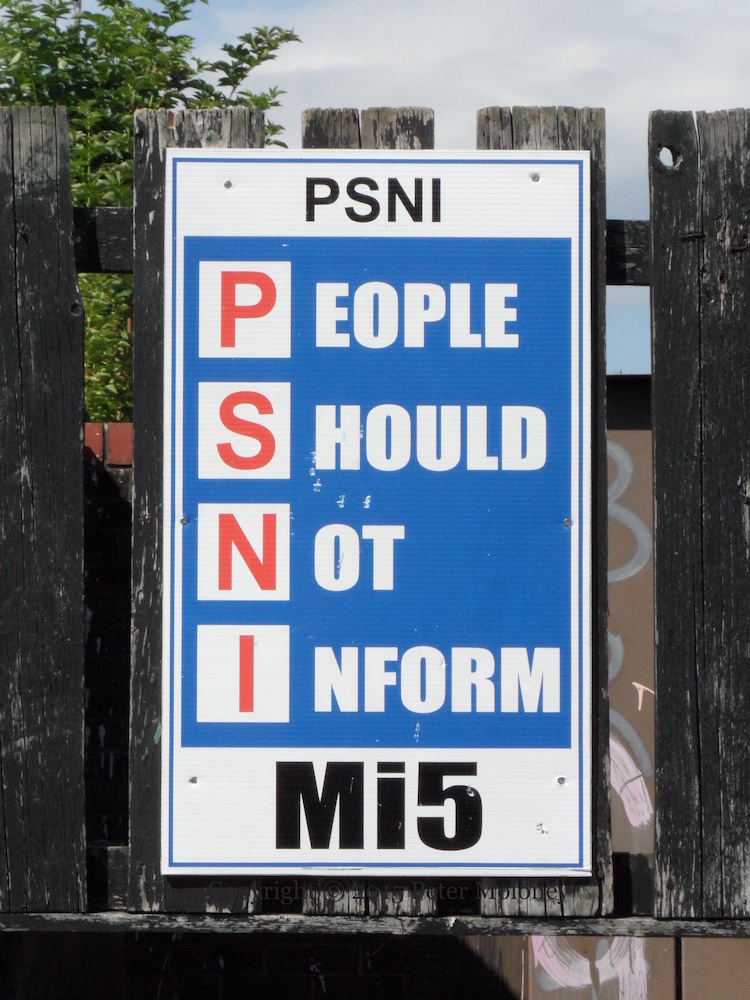
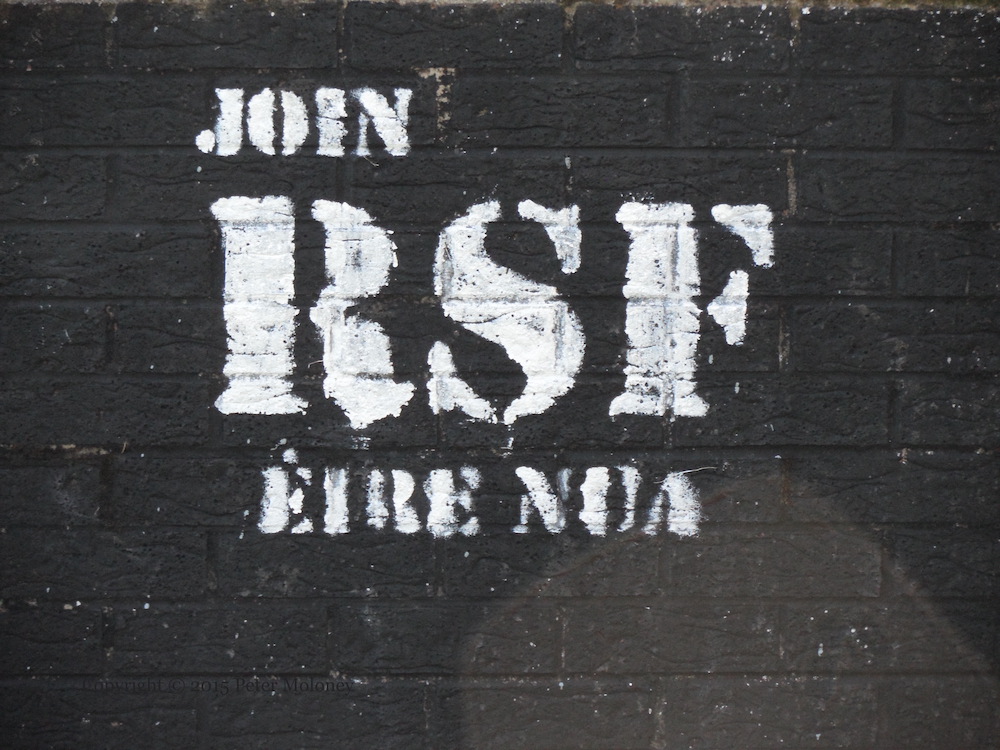
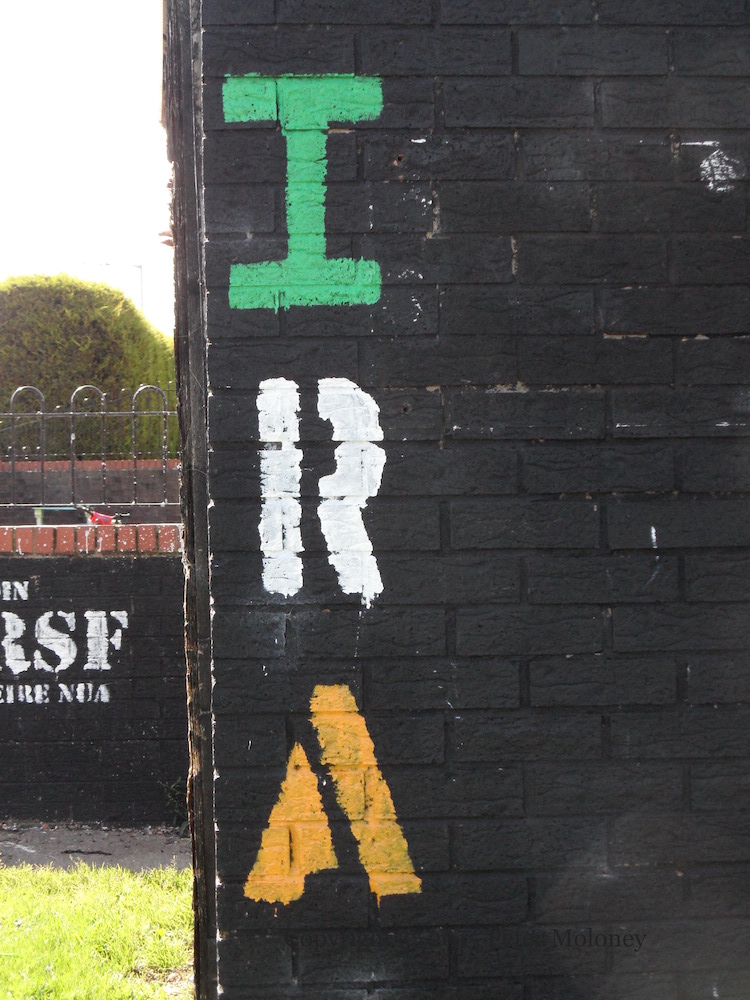
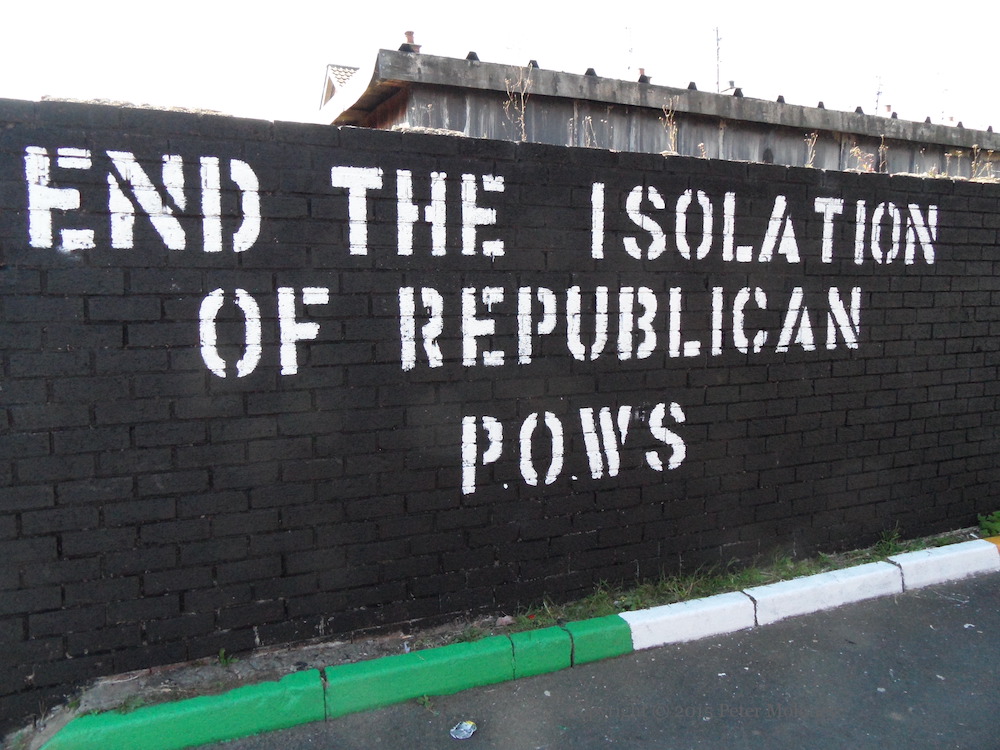
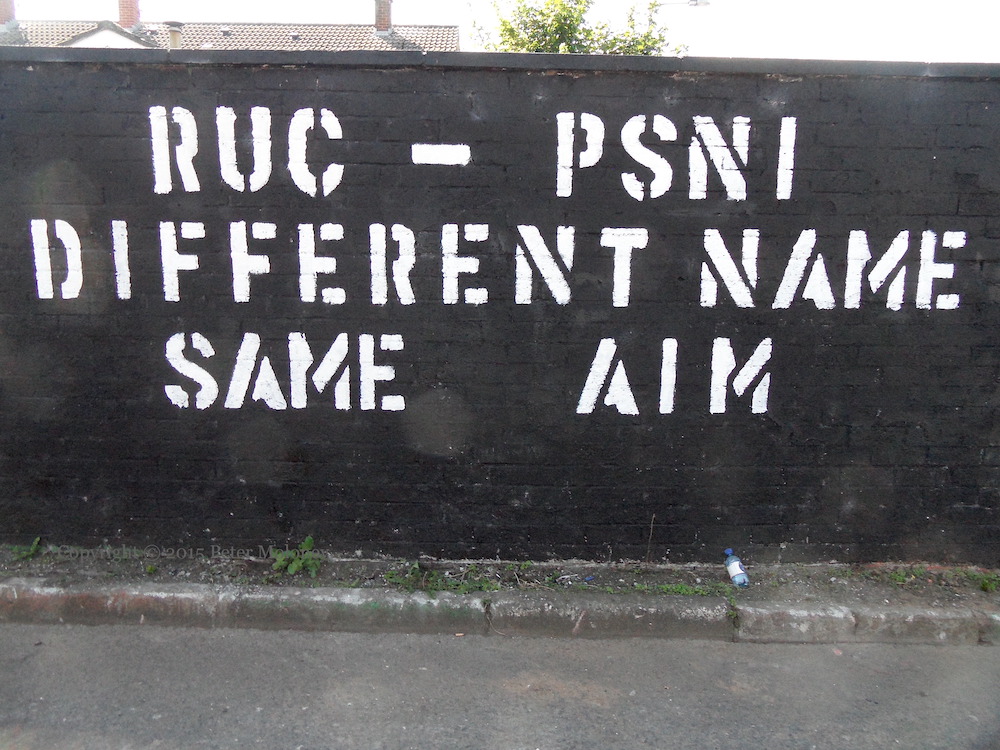
Here is a gallery of images from Levin Road in Kilwilkie, Lurgan, including “One Ireland, one vote – 1916 Societies [web]”, “People Should Not Inform”, “RUC – PSNI not welcome”, “Join RSF [web] – Éıre Nua”, “IRA”, “IRPWA” [web], “End internment now”, “End the isolation of republican POWs”, “RUC – PSNI different name, same aim”, and “Ka-boom” from an RPG slamming into the side of the post office.
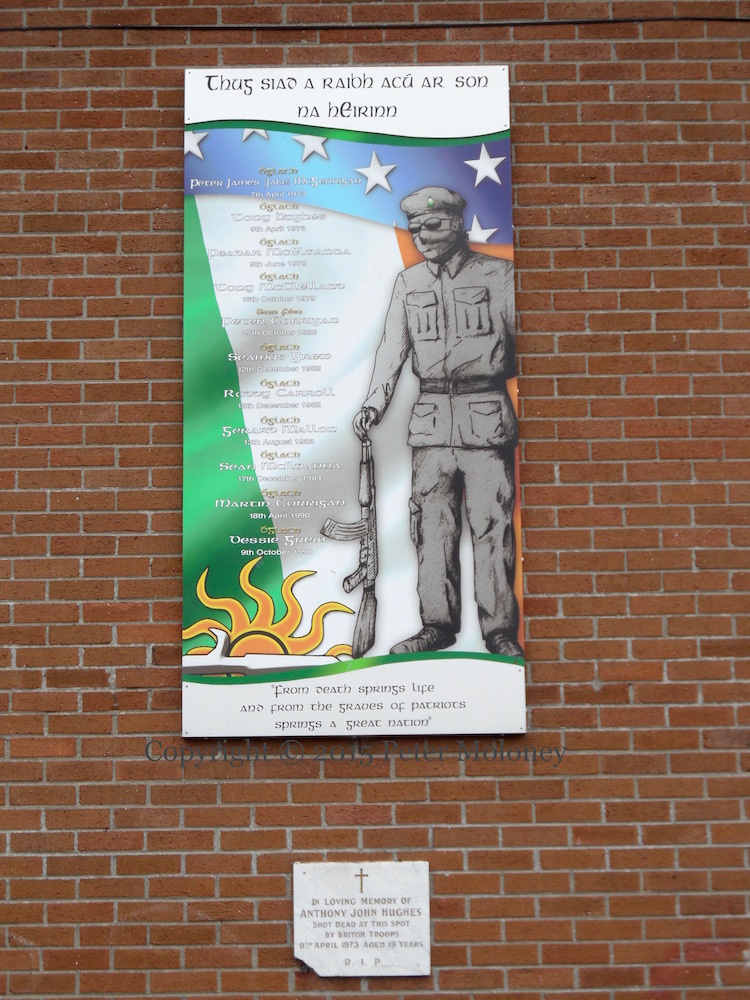
“1973-2013” Jake McGerrigan and Tony Hughes of the OIRA were both shot and killed by British forces in the Windmill Hill area of Armagh in a 48-hour period spanning April 7th and 9th, 1973. (Lost Lives #791 incorrectly gives March 7th for McGerrigan.) The board shown above was mounted in Navan Street for the 40th anniversary of their deaths, in 2013. The larger portraits on either side are of McGerrigan and Hughes; between them are (left) Peadar McElvanna, Roddy Carroll, Gerard Mallon, Martin Corrigan, (middle) Peter Corrigan, (right) Tony McClelland, Seamus Grew, Sean McIlvanna [McIlvenna], Dessie Grew.
There is an individual plaque to Hughes at the spot where he was shot, at the bottom of the second image below a board listing the same names (seen previously in 2012). “Thug sıad a raıbh acú [sic] ar son saoırse na hEırınn [sic].” “From death springs life and from the graves of patriots springs a great nation. [from Pearse’s oration at O’Donovan Rossa’s funeral].” There is stone to both McGerrigan and Hughes in the same alley (see McGerrigan – Hughes); there is also a stone to McGerrigan in Windmill Avenue.
Navan Street/Ogle Street, and Emania Terrace, Armagh
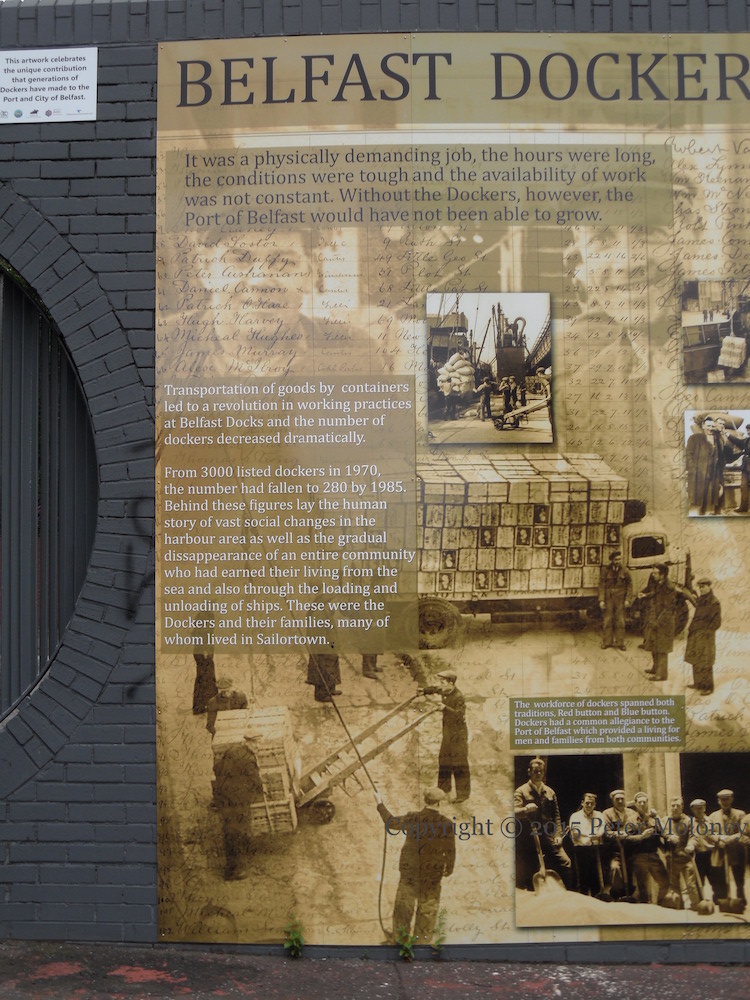
Every day, men would line up in schooling pens on the various docks of the port of Belfast to be hired by foremen. As mentioned on the left-hand side of the board above (recently erected on the New Lodge side of the Duncairn “peace” line) the rise of the shipping container in the 1970s spelled the end of the docker: “from 3000 listed dockers in 1970, the number had fallen to 280 by 1985.” Author and poet John Campbell recalls his first day on the docks in 1952, unloading cement, in this NVTv video.
“This artwork celebrates the unique contribution that generations of dockers have made to the port and City of Belfast.”
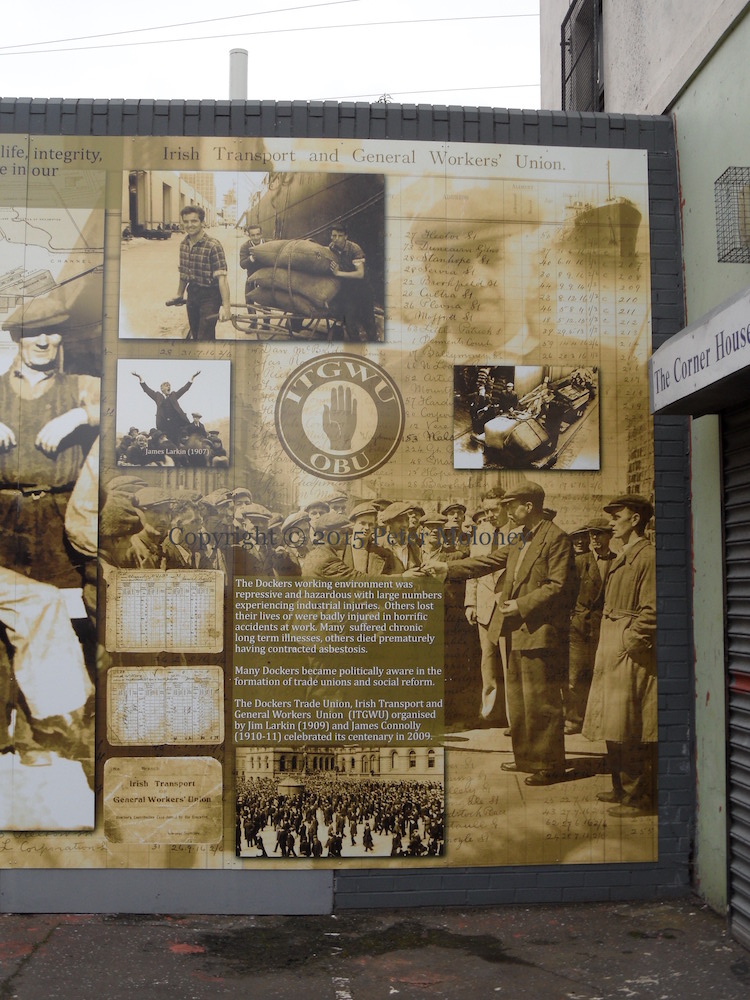
“It was a physically demanding job, the hours were long, the conditions were tough and the availability of work was not constant. Without the Dockers, however, the Port of Belfast would not have been able to grow. / Transportation of goods by containers led to a revolution in working practices at Belfast Docks and the number of dockers decreased dramatically. From 3000 listed dockers in 1970, the number had fallen to 280 by 1985. Behind these figures lay the human story of vast social changes in the harbour area as well as the gradual dissappearance [sic] of an entire community who had earned their living from the sea and also through the loading and unloading of ships. These were the Dockers and their families, many of whom lived in Sailortown. / The workforce of dockers spanned both traditions. Red button and Blue button. Dockers had a common allegiance to the Port of Belfast which provided a living for men and families from both communities. / The work was backbreaking, yet the Docks educated us about life, integrity, discipline, about standing up for our rights, about having pride in our identity as working men, as Dockers. / The Dockers[‘] working environment was repressive and hazardous with large numbers experiencing industrial injuries. Others lost their lives or were badly injured in horrific accidents at work. Many suffered chronic long term illnesses, others died prematurely having contracted asbestosis. Many Dockers became politically aware in the formation of trade unions and social reforms. The Dockers Trade Union, Irish Transport and General Workers[‘] Union (ITGWU) organised by Jim Larkin (1909) and James Connolly (1910-11) celebrated its centenary in 2009.”
The QR code in the second image takes one to an interactive walking tour (“Walk Of Truth”) of sites associated with the Ballymurphy Massacre; the walk was launched on August 8th, one of a number of Féile 2015 events (web) which included a photographic exhibition in St Mary’s and the march announced in the first image, from Springfield Park to O’Donnell’s GAA club.