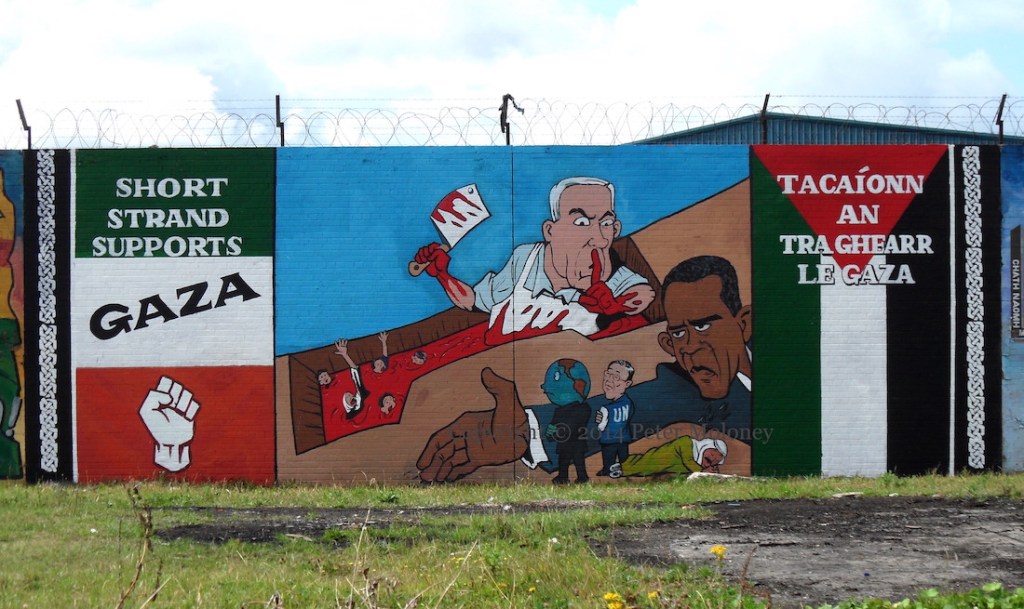
“Short Strand supports Gaza – tacaíonn An Trá Ghearr le Gaza”. The centre of this mural is Carlos Latuff’s cartoon Do Not Disturb – War Criminals Working. Israel, in the form of an aproned Benjamin Netanyahu, is butchering the people of Gaza. The world watches with some concern, Ban Ki-Moon and the UN look away, and the Arab League is asleep. The United States, in the form of Barack Obama, prevents any intervention.
The second image gives a wide shot of the long wall on Mountpottinger Road, which has its own Visual History page.
“Óglach Joe McDonnell died on hunger strike in the H Blocks of Long Kesh July/ 8th/ 1981. ‘You dare to call me a terrorist while you look down your gun.’ [youtube]”
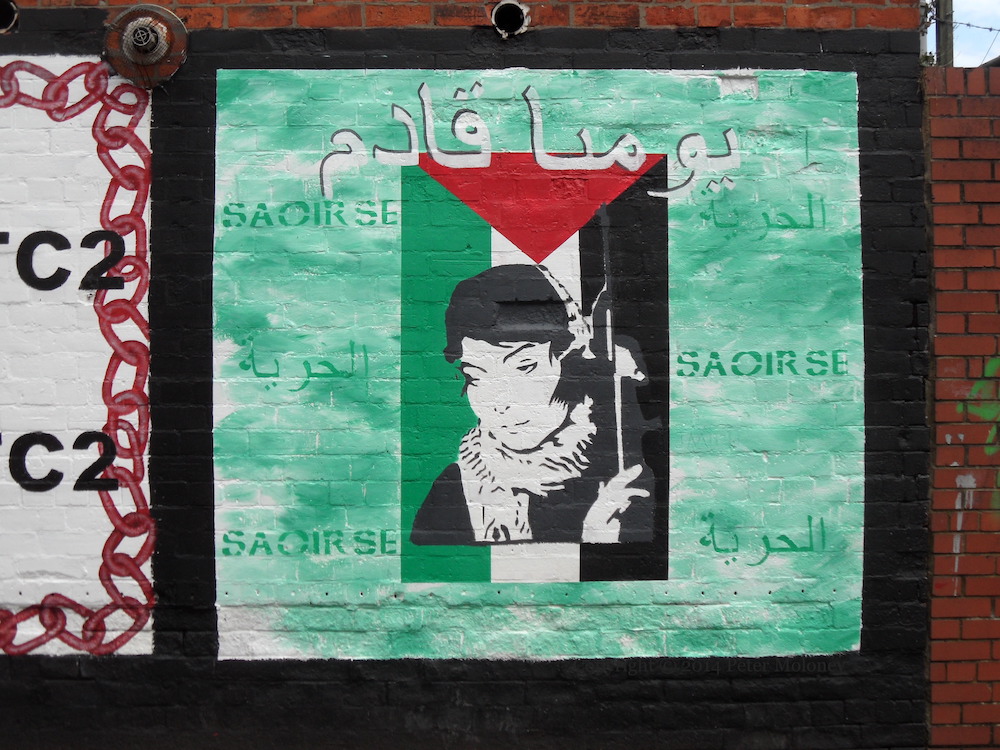
Palestinian icon Leila Khaled, who took part in aeroplane hijackings in 1969 and 1970, is featured in this new mural pro-Gaza mural in Hugo Street. The central portrait is a replication of a famous photo by Eddie Adams (WP), taken after her first skyjacking; she then underwent plastic surgery to disguise her identity prior to the 1970 attempt (WP).
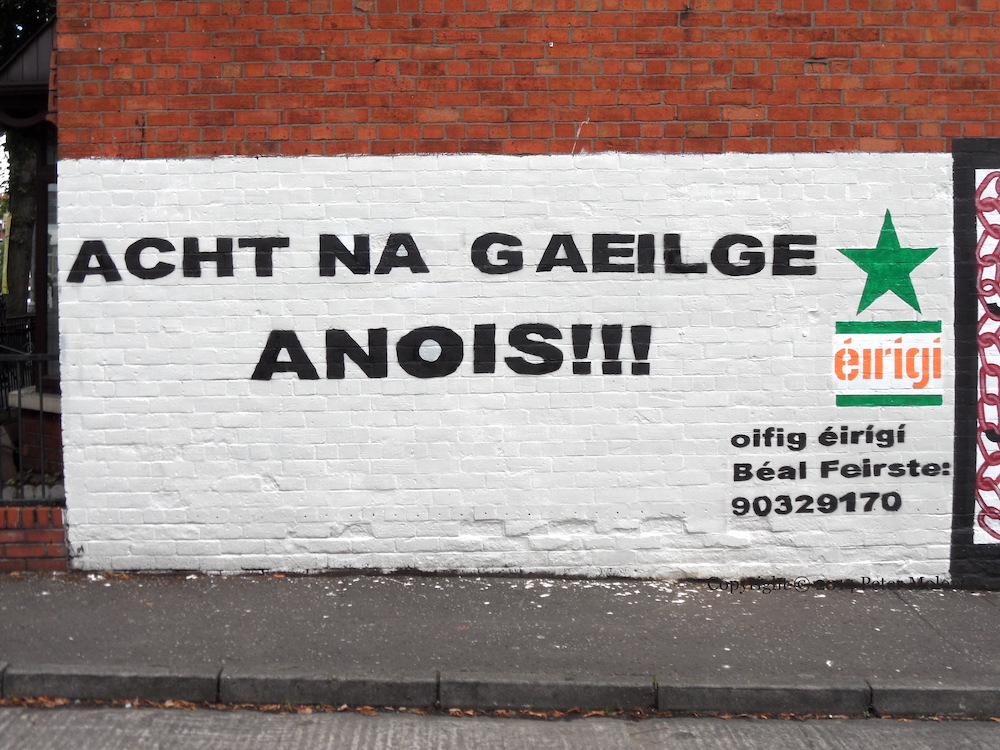
On the left is an éirígí stencil calling for “Acht Na Gaeılge Anoıs!!!” – “An Irish Language Act Now!!!” The Belfast Telegraph reports that an Irish language bill will be published in the near future, though the DUP have already rejected such an Act. (For more background and discussion see Brian Walker’s post on Slugger.)
Kieran Doherty died on August 2nd, 1981, after 73 days on hunger-strike. The (repainted – compare to 2001 | 2004 | 2011) mural in his memory depicts scenes from his funeral on 1981-08-04.
The photograph on which the central panel is based is by Derek Spiers; see also this set at hungerstrikes.org. The volley took place outside the Doherty family home in nearby Commedagh Drive (Belfast Media).
The portrait of Doherty in the top left replaces a similar one in the same location; the plaque at the portrait’s top-right corner remains from before. The angled panel shows Doherty’s parents, Alfie and Margaret.
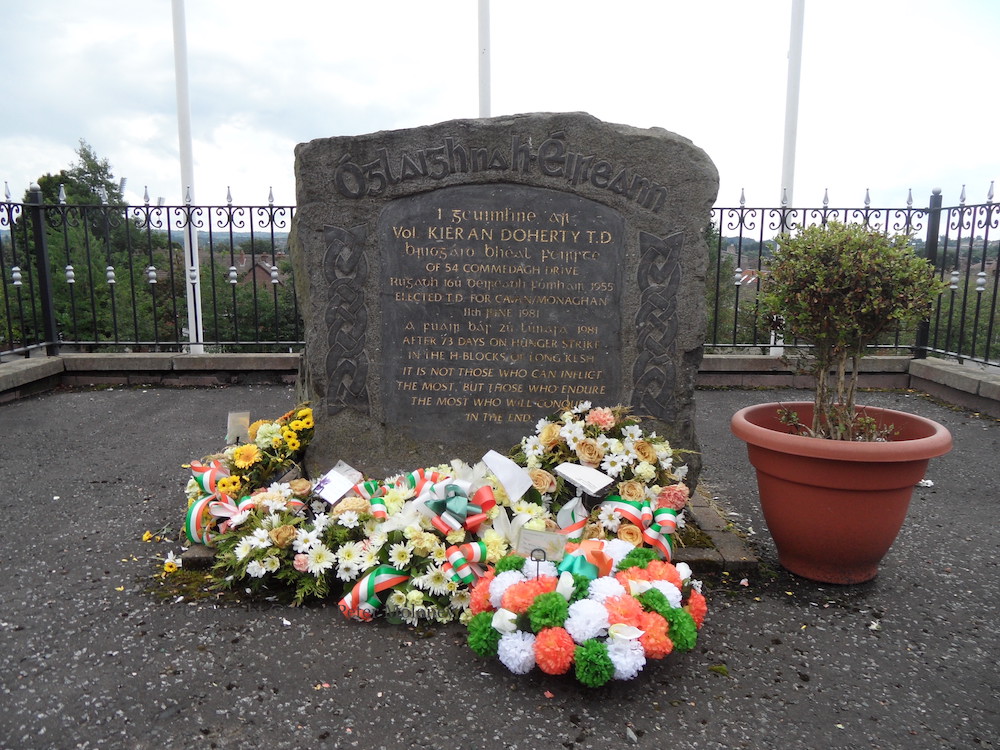
The (actual) memorial stone, which is here reproduced on the perpendicuar joining wall, was also seen in 2007.
A Claddagh ring connotes friendship (caırdeas – sadaaka (صدقة)), love, and loyalty, here between Ireland and Palestine. The ring’s band is composed of their two flags.
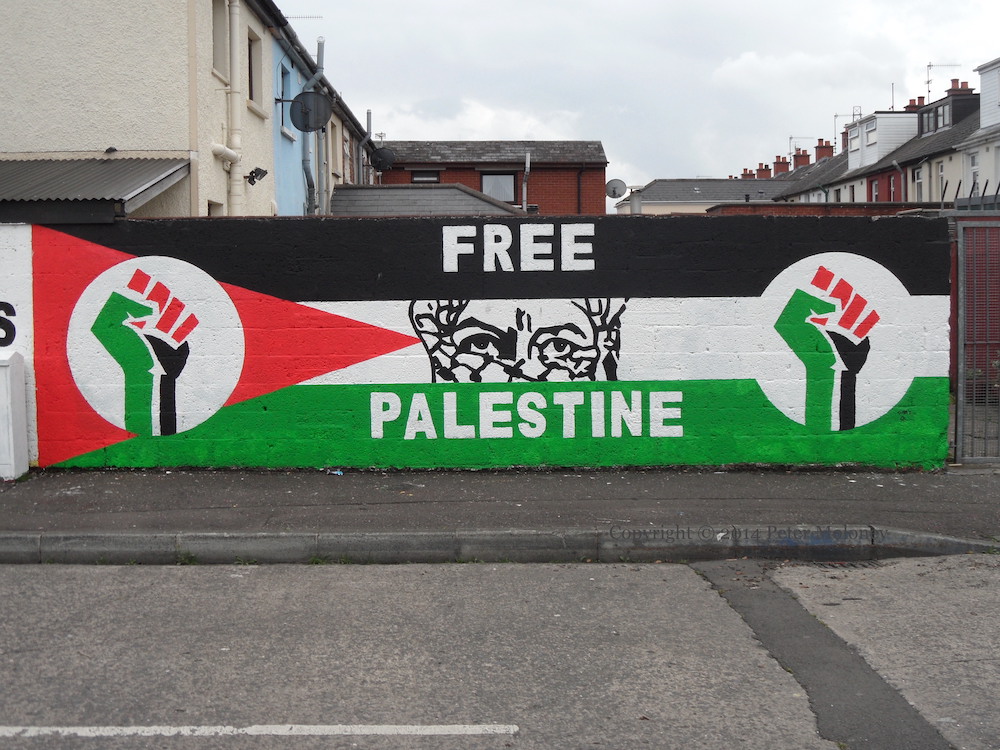
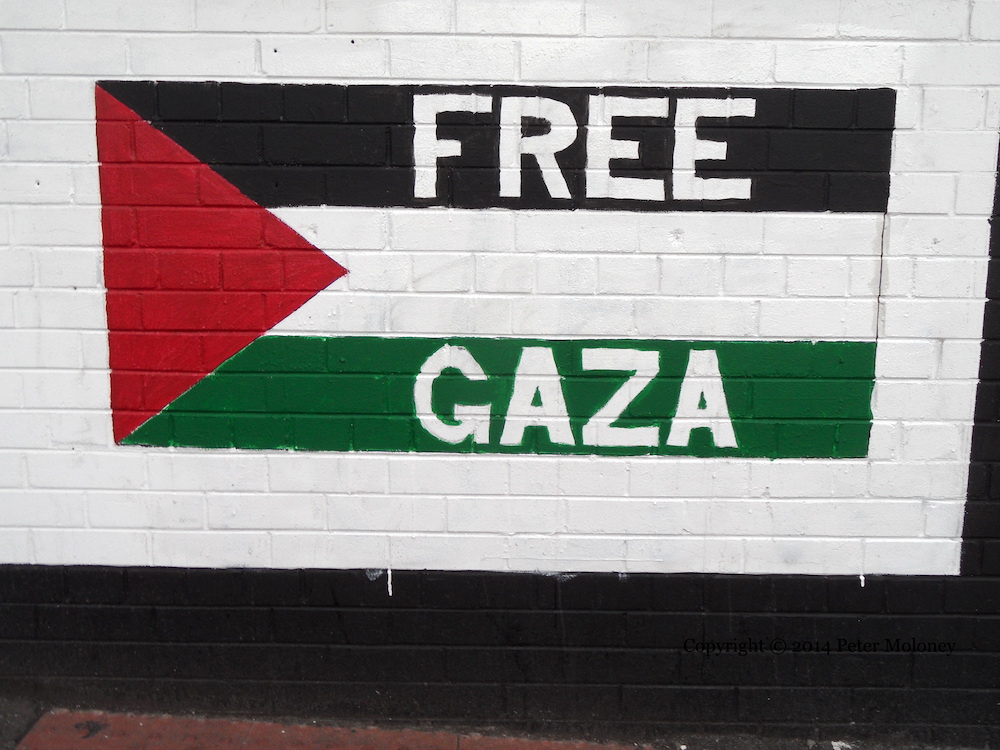
The wide shot shows the adjacent “Free Palestine” mural, also featuring the Palestinian flag.
“South Belfast Ulster Volunteer Force 2nd battalion, A company, Donegall Pass.” The flag of England (St. George’s Cross) is in one corner and in the other is an orange star with “1912” written below, the year the Ulster Volunteers were founded. The colour-scheme is the reverse of the Orange Order’s: its flag has the purple star of the Williamites on an orange field.
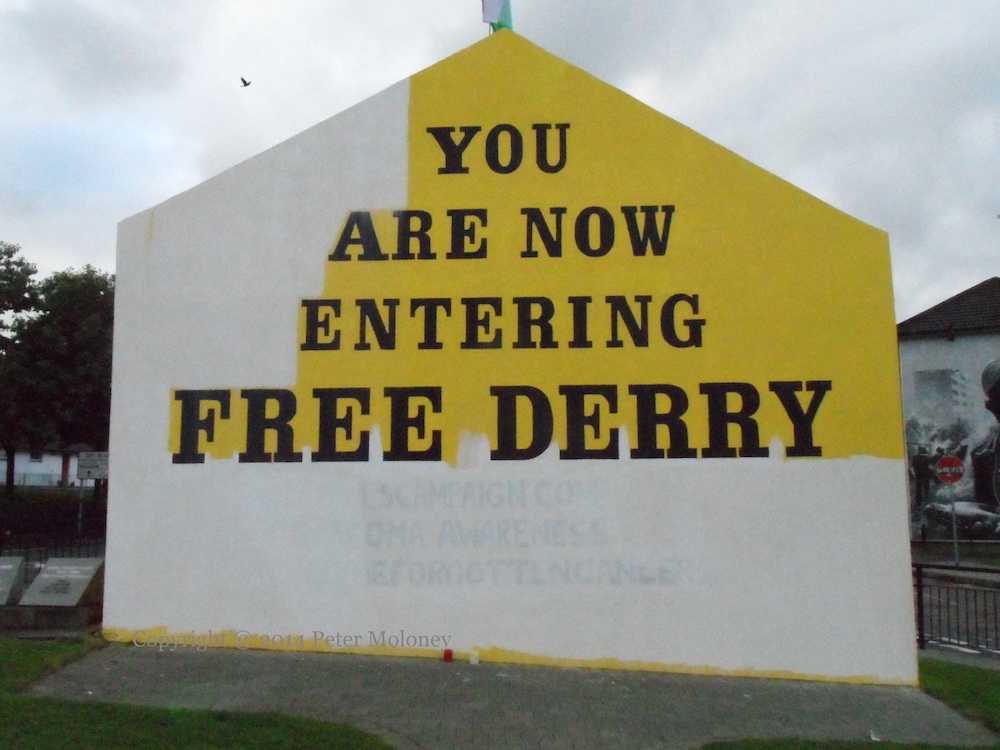
Whitewashing of the previous ‘Sarcoma yellow’, July 28th:
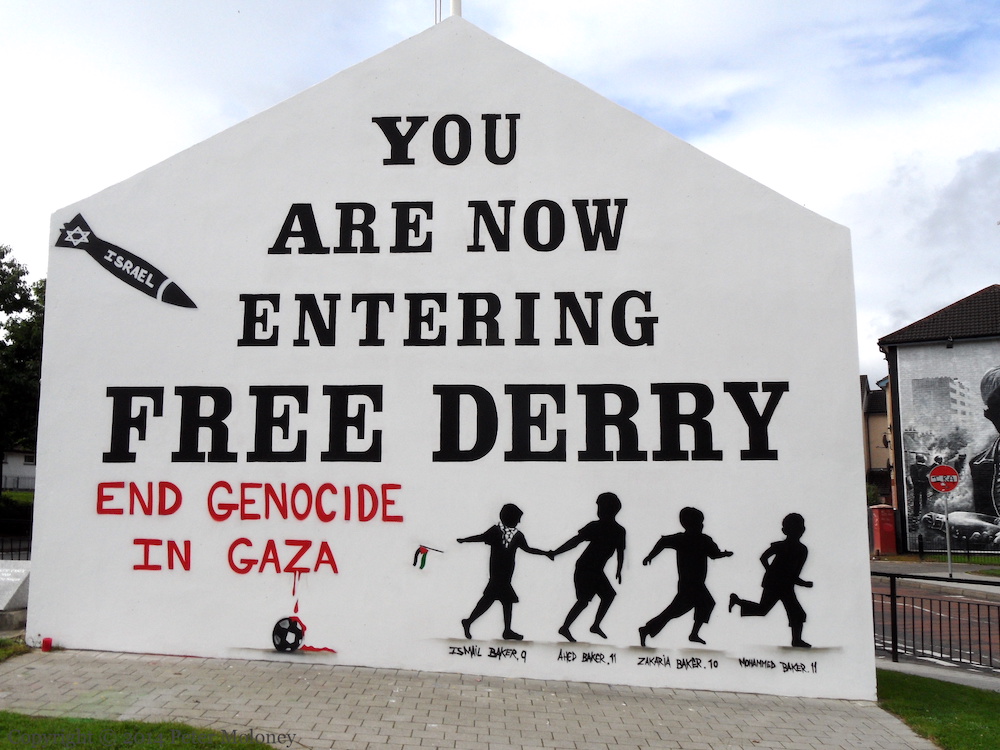
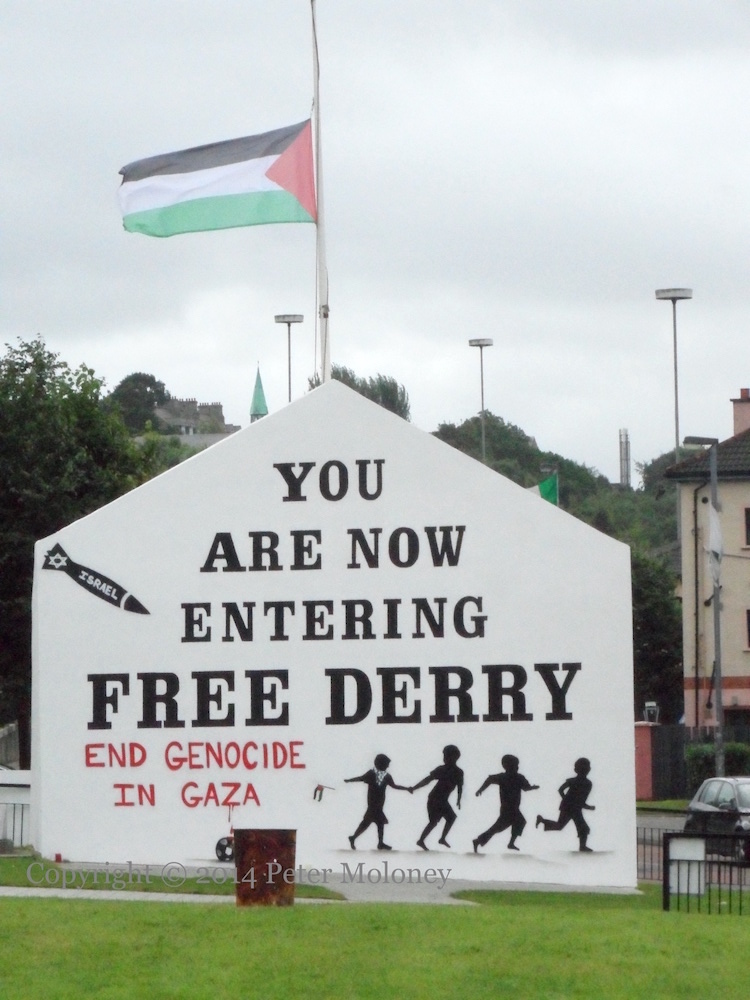
Four children from the Baker (or: Bakr) clan run from an Israeli rocket bearing the Star of David, leaving behind their football on the beach at the port of Gaza. Ismael Mohamed Bakr (9), Ahed Atef Bakr (10), Zakaria Ahed Bakr (10), and Mohamed Ramez Bakr (11) all died; three other children and one adult were wounded. (For more background, see Stad An Slad/Stop The Slaughter).
The two versions shown here – from July 29th and August 1st – differ only in the later inclusion of the names and ages of the children along the bottom.
“Immediate expulsion of all Israeli diplomats from Éıre”. Gazans flee ahead of smiling soldiers from homes set ablaze by a tank flying the Israeli flag. This new mural on the international wall associates the current Israeli invasion of Gaza (which the Israelis call “Operation Protective Edge“) with the US/South Vietnamese attack on the village of Trang Bang during the Vietnam war by modelling itself on Nick Út’s 1972 Pulitzer prize-winning photograph for the Associated Press of villagers fleeing a napalm bombing (the photo can be seen at Wikipedia).
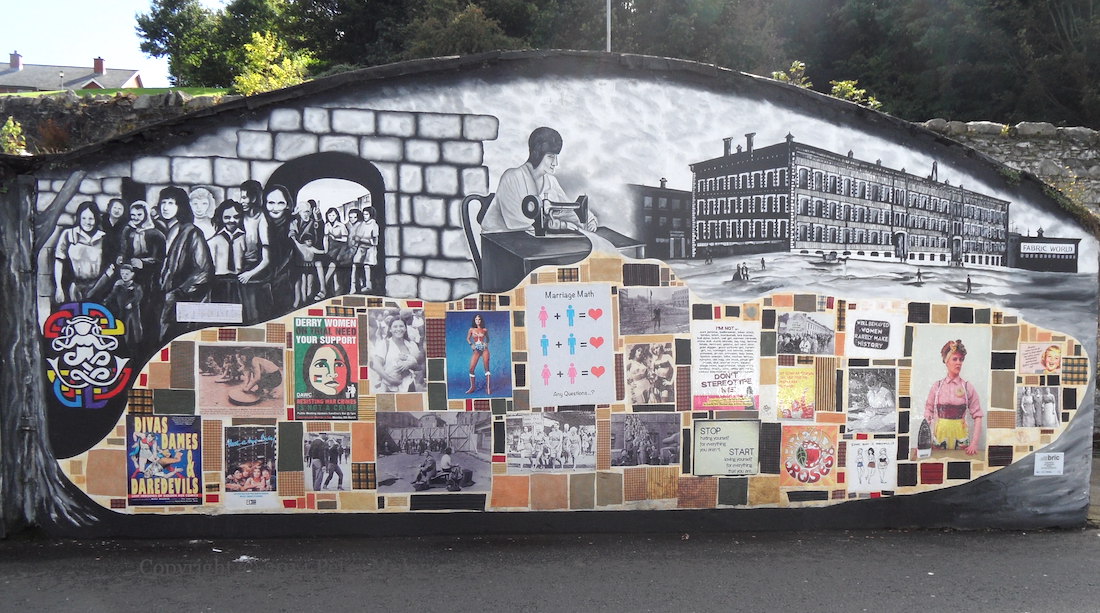
“Derry women made more than shirts – they made communities”.
Here is a Derry mural celebrating the role of women in society, both locally and world-wide.
On the left of the main panel, women march out of one of the city’s gates. The information sheet reads as follows: “On International Women’s Day, March 8th [1991, not 1981 as the hand-written addition suggests], the first ever women’s mural in Derry was unveiled on the back of Free Derry Wall. It was designed and painted by Patricia Hegarty and Joe Coyle, and helpers, both men and women. The mural takes its inspiration from a march in November 1968, after Minister for Home Affairs Bill Craig banned all civil rights marches in the walled city. Women factory workers walked out and spent the afternoon marching in and out of every gate in the city, deliberately “breaking the ban”. Men marched in from DuPont to join them, and a rally was held in the Diamond. In the mural you can find the faces of some of those marching on that historic day, as well as other women who played their part in the ongoing struggle for justice. Civil rights workers Bridget Bond and Women’s Aid refuge founder Cathy Harkin march alongside republicans such as Ethel Lynch, Bridget Sheils, Peggy Derry, prisoners’ rights activists Susie Coyle, and many others. You may find images of your granny, sister or aunt. The mural is dedicated to all those women whose energy and determination have changed their lives and the world about them.”
The board on FDC can be seen in Woods’s Seeing Is Believing?, plate 19.
In the centre of the main panel, a tapestry of images and posters is being sewn by a woman at a sewing-machine in one of Derry’s large shirt- and collar-making factories (one of which, attached to “Fabric World”, is shown on the right).
The tapestry includes flyers/posters of local women banging bin lids at the death of Tom McElwee, marching past the ‘Free Derry’ slogan on Free Derry corner, striking, and protesting; there are also posters supporting Palestine and gay rights, celebrating femininity, and one of Wonder Woman.
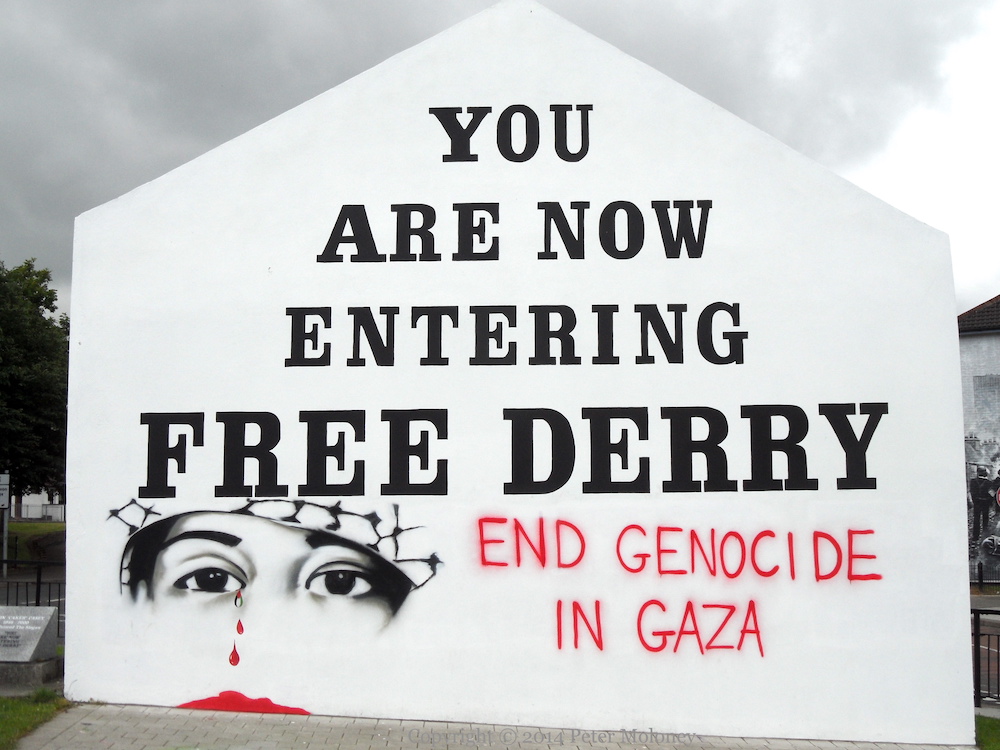
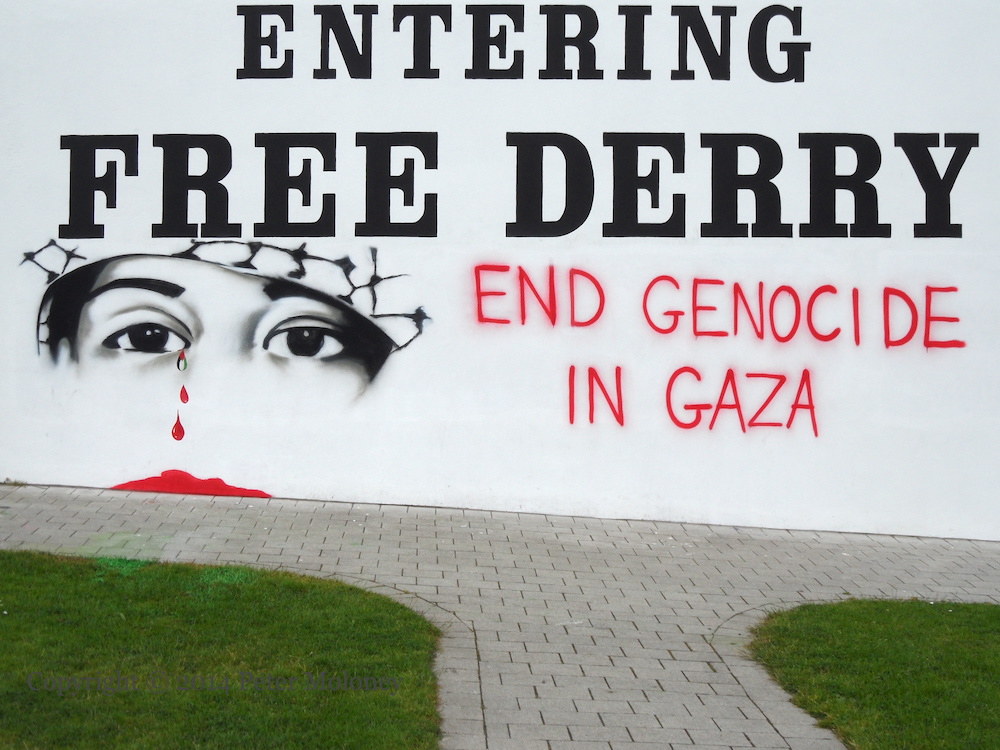
A Palestinian wearing a keffiyeh sheds a tear in the colours of the Palestinian flag, along with additional tears of blood, over the “genocide” in Gaza due to the long-running Israeli blockade of Gaza, forbidding movement by air and sea and controlling what enters and exits via the three (land) border-crossings, and sanctioning the Palestinian Authority (led by Hamas). The mural has perhaps been prompted more specifically by the recent Israeli airstrikes on Gaza and arrests of Palestinians in the West Bank – see the WP page on the 2014 Gaza War.














 Peter Moloney Collection