The fairy-tale covering painted over an LVF “North Belfast Rat Pack” mural is fading away to reveal the previous work. For the original LVF mural, see D01199.
The graffiti on the wall – Welcome to LVF Land – has itself been scored out, and there is also a piece of anti-LVF graffiti in the street.
The local New Lodge GAA club Cumman An Phıarsaıgh is named in honour of Patrick Pearse, executed after the 1916 rising. The club’s new mural features footballers contesting a ball and Pearse’s image appears at the centre of a Celtic cross along with part of his 1912 poem Mıse Éıre in the bottom corner (shown in the close-up).
Painted by Lucas Quigley and Michael Doherty. Replaces ‘New Lodge 2000‘.
Mıse Éıre: Sıne mé na an Chaılleach Bhéarra. Mór mo ghlóır: Mé a rug Cú Chulaınn croga. Mór mo náır: Mo chlann féın a dhíol a máthaır. [Mór mo phıan: Bıthnaımhde do mo shíorchıapadh. Mór mo bhrón: D’éag an dream ınar chuıreas dóchas.] Mıse Éıre: Uaıgní mé ná an Chaılleach Bhéarra.
I am Ireland: I am older than the old woman of Beare. Great my glory: I who bore Cuchulainn, the brave. Great my shame: My own children who sold their mother. [Great my pain: My irreconcilable enemy who harasses me continually. Great my sorrow: That crowd, in whom I placed my trust, died.] I am Ireland: I am lonelier than the old woman of Beare.
“The Market community supports Palestine – End the siege on Gaza – Free Palestine”. Tears of blood flow from a boy’s face, shrouded by a Palestinian flag and behind barbed wire. Along the bottom, in red lettering, is a quote from Malcolm X’s autobiography: “If you’re not careful, the newspapers will have you hating the [people who are being] oppressed and loving the oppressor [the people who are doing the oppressing].”
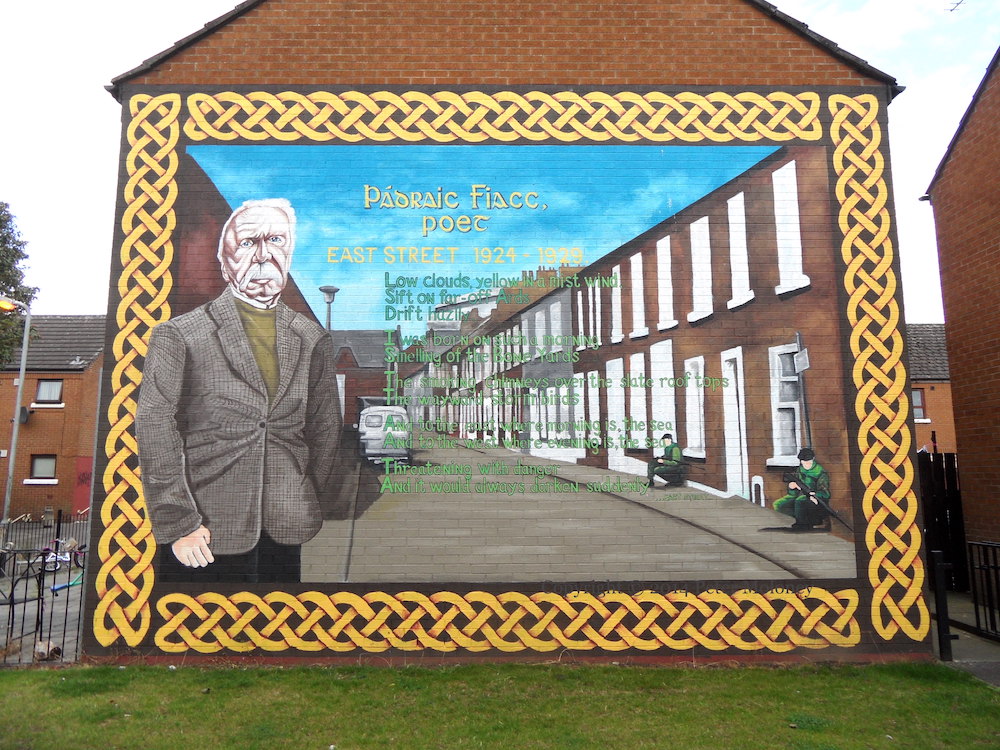
Patrick O’Connor was born on April 15th, 1924, on the lower Falls but after his father emigrated he spent his early years – until age 5 – with his grandparents in East Street in the Markets. It was as a high-schooler in New York that he adopted the name Pádraıc Fıacc (“fıach dubh” is “raven”) and began writing poetry. He settled in Glengormley upon his second and final return; it is not clear that he ever saw East Street lined with British Army soldiers, as shown in the mural above. He wrote of his early life in ‘First Movement’:
Low clouds, yellow in a mist wind Sift on far-off Ards Drift hazily … I was born on such a morning Smelling of the bone yards The smoking chimneys over the slate top roofs The wayward storm birds And to the east where morning is, the sea And to the west where evening is, the sea Threatening with danger And it would always darken suddenly
Some of Fıacc’s poems are in the TroublesArchive. There are two videos below. The first is an interview with NVTv’s Bernard Conlon; the second is of a reception in Belfast City Hall.
This is a mural in support of travellers’ right, featuring horseshoes, musical notation, and a child looking out of a vintage caravan. Sponsored by West Against Racism Network (WARN) and Springfield Charitable Association (SCA – web)
The image that the artists were working from for central portion of the mural – a 2009 photograph by Mark Stedman – can be seen still taped to the wall.
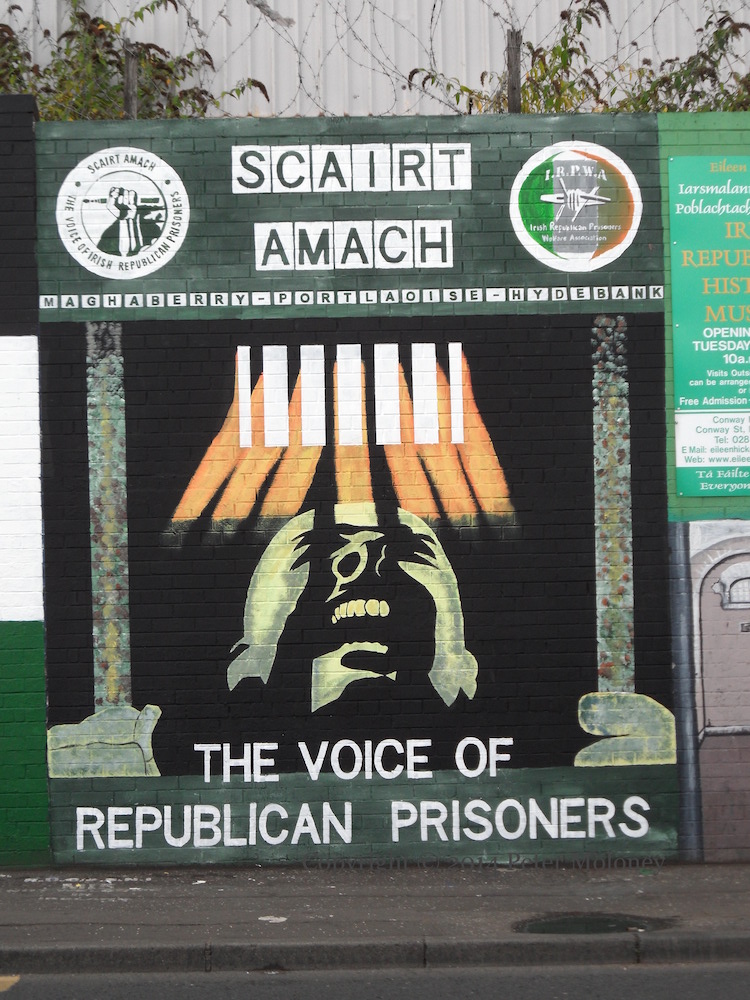
“Scaırt Amach – the voice of Irish republican prisoners – Maghaberry, Portlaoise, Hydebank”. Scaırt Amach (“Shout Out”) is a magazine containing articles by republican prisoners in the three prisons.
This IRPWA (web) mural reproduces the cover of the magazine, on the International Wall, Divis Street (Visual History), west Belfast.
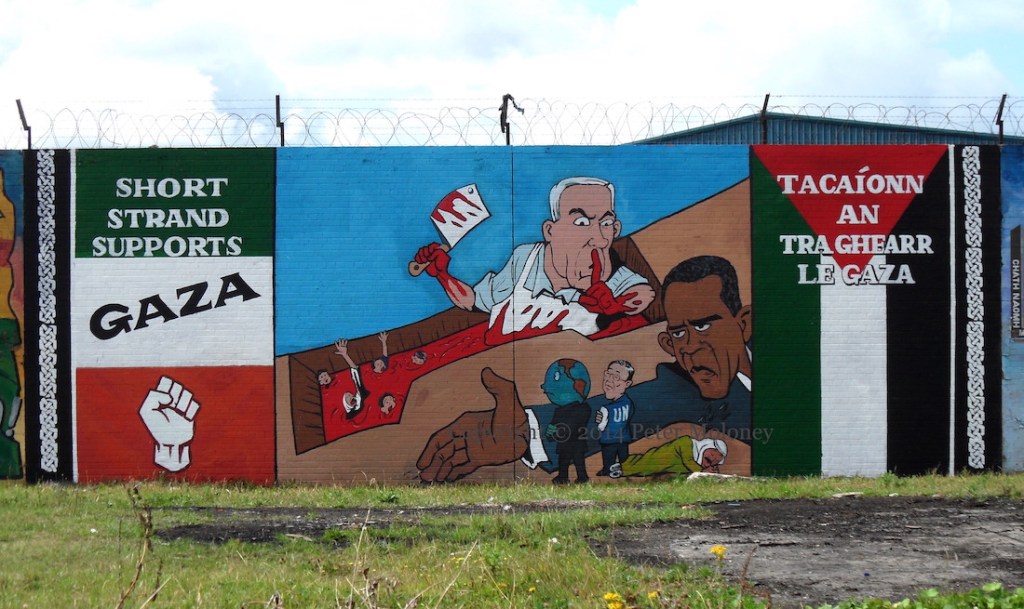
“Short Strand supports Gaza – tacaíonn An Trá Ghearr le Gaza”. The centre of this mural is Carlos Latuff’s cartoon Do Not Disturb – War Criminals Working. Israel, in the form of an aproned Benjamin Netanyahu, is butchering the people of Gaza. The world watches with some concern, Ban Ki-Moon and the UN look away, and the Arab League is asleep. The United States, in the form of Barack Obama, prevents any intervention.
The second image gives a wide shot of the long wall on Mountpottinger Road, which has its own Visual History page.
“Óglach Joe McDonnell died on hunger strike in the H Blocks of Long Kesh July/ 8th/ 1981. ‘You dare to call me a terrorist while you look down your gun.’ [youtube]”
Palestinian icon Leila Khaled, who took part in aeroplane hijackings in 1969 and 1970, is featured in this new mural pro-Gaza mural in Hugo Street. The central portrait is a replication of a famous photo by Eddie Adams (WP), taken after her first skyjacking; she then underwent plastic surgery to disguise her identity prior to the 1970 attempt (WP).
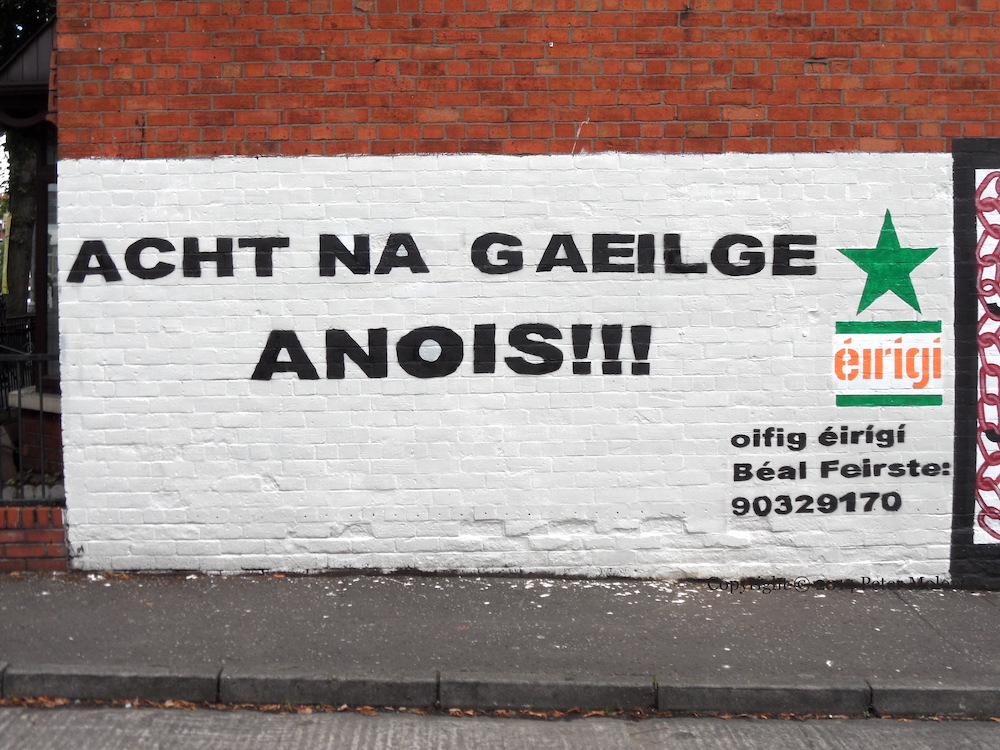
On the left is an éirígí stencil calling for “Acht Na Gaeılge Anoıs!!!” – “An Irish Language Act Now!!!” The Belfast Telegraph reports that an Irish language bill will be published in the near future, though the DUP have already rejected such an Act. (For more background and discussion see Brian Walker’s post on Slugger.)
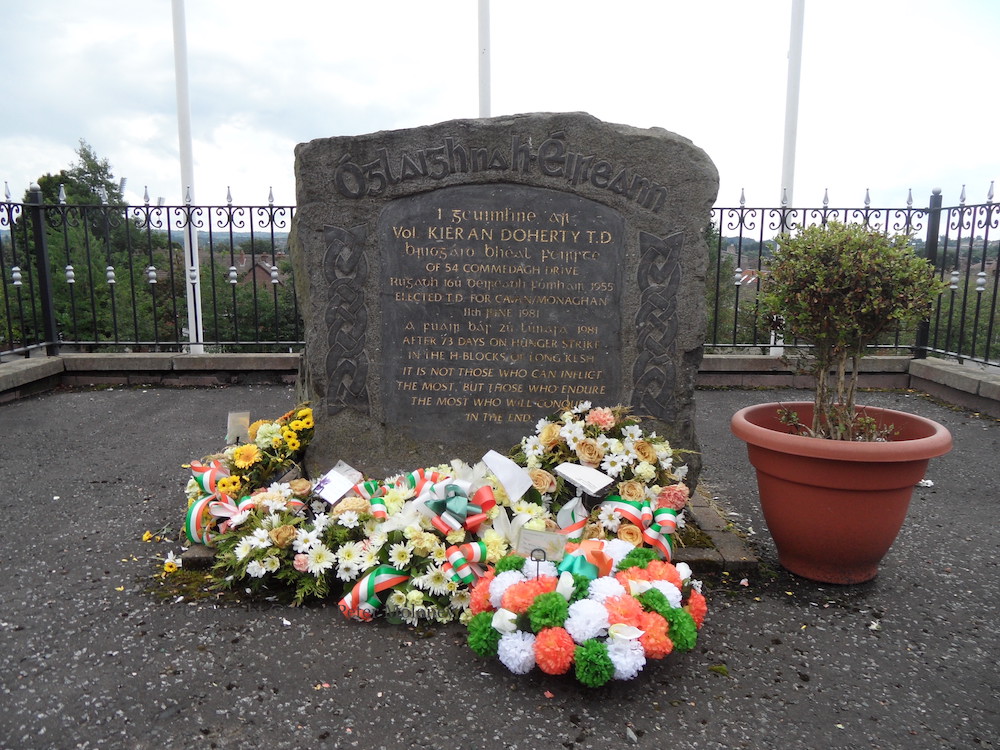
Kieran Doherty died on August 2nd, 1981, after 73 days on hunger-strike. The (repainted – compare to 2001 | 2004 | 2011) mural in his memory depicts scenes from his funeral on 1981-08-04.
The photograph on which the central panel is based is by Derek Spiers; see also this set at hungerstrikes.org. The volley took place outside the Doherty family home in nearby Commedagh Drive (Belfast Media).
The portrait of Doherty in the top left replaces a similar one in the same location; the plaque at the portrait’s top-right corner remains from before. The angled panel shows Doherty’s parents, Alfie and Margaret.
The (actual) memorial stone, which is here reproduced on the perpendicuar joining wall, was also seen in 2007.