“I don’t mind being called a dissenter, I’ve been a dissenter all my life.” An anti-Agreement tribute to “The Dark” (Brendan Hughes), IRA commander, blanketman, and 1980 hunger striker, on the Springfield Road.
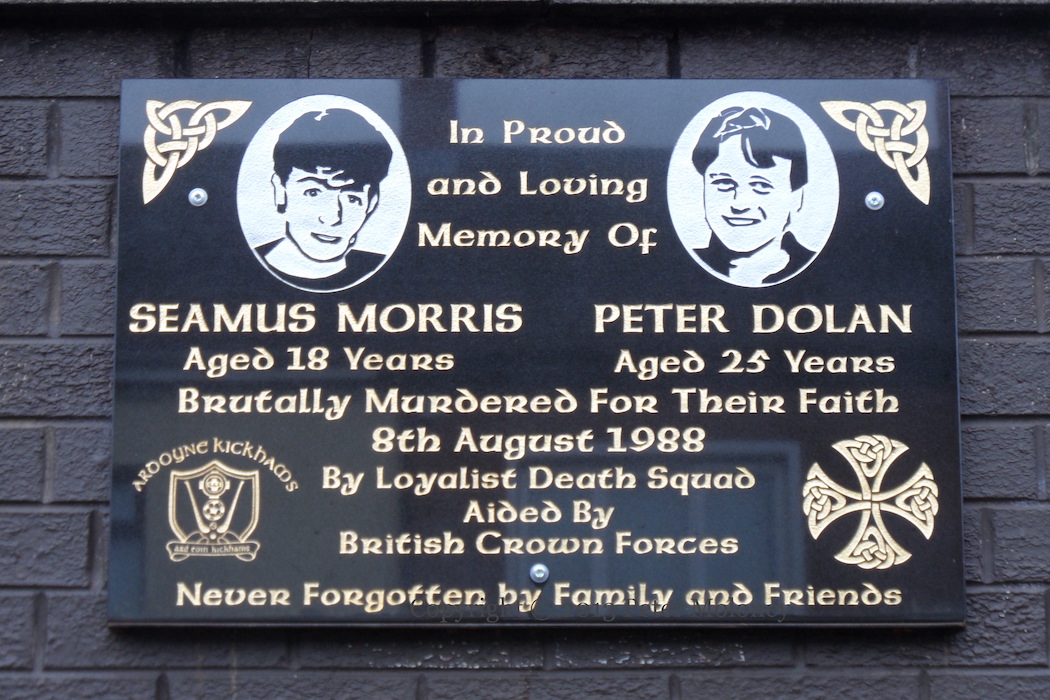
Memorials in Ardoyne Martin Meehan, Sammy McLarnon, Thomas ‘Bootsey’ Begley, Seamus Morris and Peter Dolan.
Martin Meehan joined the IRA in 1966 and was one of a few IRA volunteers defending Catholics in Ardoyne (Ard Eoın) in August 1969. Rioting did not cease there until the 16th, when British troops were finally deployed to the Crumlin Road to block mobs coming from the Woodvale and Shankill. Meehan resigned after the failure of the IRA to defend Ardoyne, Clonard, and Divis. This Magill article from the time summarises the IRA’s actions as “late, amateur and uncertain”. (Meehan would later rejoin the IRA and PIRA.)
“This memorable [sic] plague [sic] is dedicated to the 1st victim of the present troubles, Sammy McLarnon, RIP, who was brutally murdered in his own home at 37 Herbert St by the RUC on 15th Aug., 1969.” For more, see this Irish Times article about a 1999 community inquest.
Thomas “Bootsey” Begley died when a bomb he was carrying into a fish shop on the Shankill Road exploded. The bomb killed Begley and nine others [plaque]. The plaque above was unveiled in Ardoyne on October 20th, 2013 – twenty years after the event – to protests from relatives of the deceased (BBC-NI).
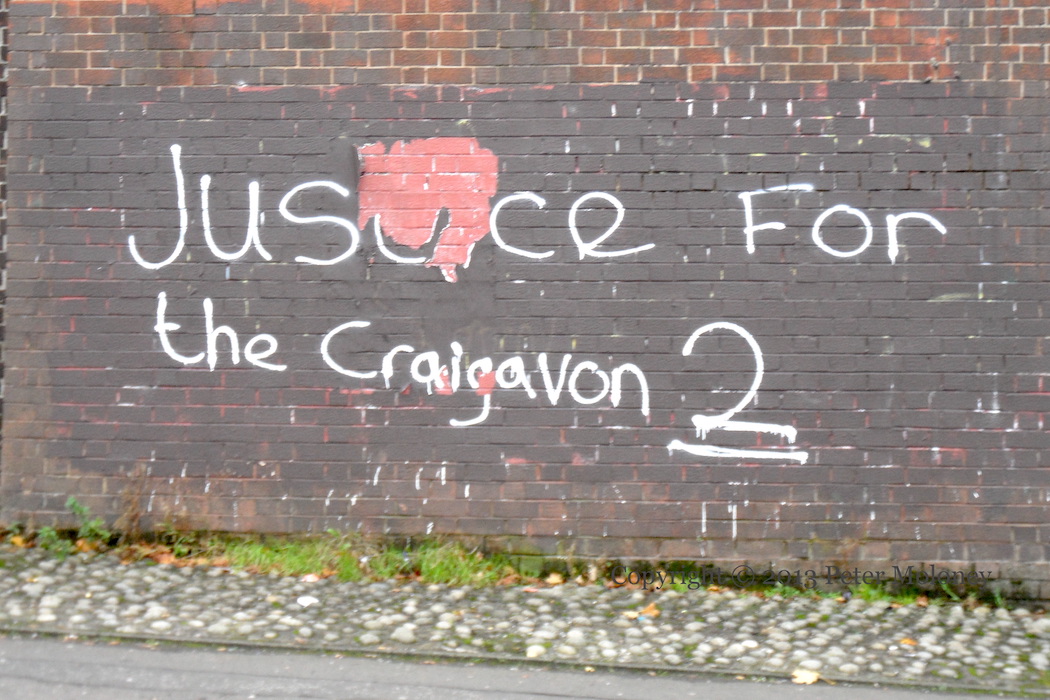
“Justice for the Craigavon 2” – this is the first piece in the Peter Moloney Collection about the campaign to release the pair convicted for their part in the murder of Stephen Carroll (BBC).
Finally, the Morris-Dolan plaque is brand new, unveiled August 11, 2013, in Etna Drive/Corán An Ardghleanna (in Ard Eoın). Seamus Morris and Peter Nolan were shot by the Protestant Action Force (UVF) twenty-five years ago, in August 1988. It reads “Brutally murdered for their faith … by loyalist death squad aided by British crown forces. Never forgotten by family and friends.”
“They may have stole our banner but they will never steal our culture.” The banner in question was on the fencing in the street (see Welcome To Loyalist Linfield Road) but wound up on a CNR bonfire in Divis; the wider context is the on-going disputes over the routes established by the Parades Commission for Orange Order marches.
The red hand in Fountain Street – seen previously with “PSNI scum” and “IRA” graffiti – is somewhat repaired – “PSNI scum” is still faintly visible across the top and the “IRA” at the base of the hand has been blacked out. “WBE” has been added; the “E” in “WBE” is unknown – compare with WBLY.
These republican graffiti (and one 1916 Societies board) come from Creggan, Derry. From top to bottom: “UK no way”, “Join police, face death”, “PSNI/RUC not welcome”, “Join [New] IRA”.
Above is a new board (on painted background) at the Falls Road Garden of Remembrance for IRA volunteers in D company (the ‘Dogs’) of the 2nd battalion Belfast Brigade and local civilians from the lower Falls who died in the 20s, 70s and 90s. The main board shows a map of the area from Dunville Park to the Divis flats with lilies marking the spots of various deaths. Surrounding it are the portraits of fourteen of the volunteers listed on the marble – Maguire, O’Rawe, McKelney, Donaghy, Quigley, McAreavey, Hughes, Loughran, MacBride, Kelly, Carson, Campbell, Skillen, Marley.
The text in the close-up gives a history of the birth of the Provisionals and D company’s defense of the area in the Falls Curfew of 1970. Also mentioned is the 1972 hunger strike by Billy McKee and others in the Crumlin Road Gaol (NYTimes).
“Donegall Pass UVF 1913-2013” Visible from the Ormeau Road, this large union flag greets visitors to Donegall Pass in the south of the city. It asserts the presence of the UVF and connects the original Ulster Volunteers of 1913 to the present-day Ulster Volunteer Force one hundred years later: the aim of the original Ulster Volunteers was to resist the impending rule by Catholics under Home Rule.
South Belfast MP Robert Bradford was assassinated by the Provisional IRA in Finaghy at a meeting with constituents; the caretaker of the community centre, Ken Campbell, was also killed by the fleeing attackers. Taking place in late 1981, with the hunger strikes having ended only a month before, the killing was noted around the world and raised fears of broad civil unrest (BBC | NYTimes). The board immediately above replaces an earlier mural to Bradford on the gable wall that now hosts the large board shown above, commemorating the Siege Of Derry and specifically the “Apprentice Boys Of Derry No Surrender Club” of south Belfast.
The first panel of “Freedom Corner” on the Newtownards Road, is repainted for the 40th anniversary of the UFF [Ulster Freedom Fighters], 1973-2013. For the previous (or at least, a 2005) version, see M02370. “Feriens tego” is Latin for “In striking, I defend”.