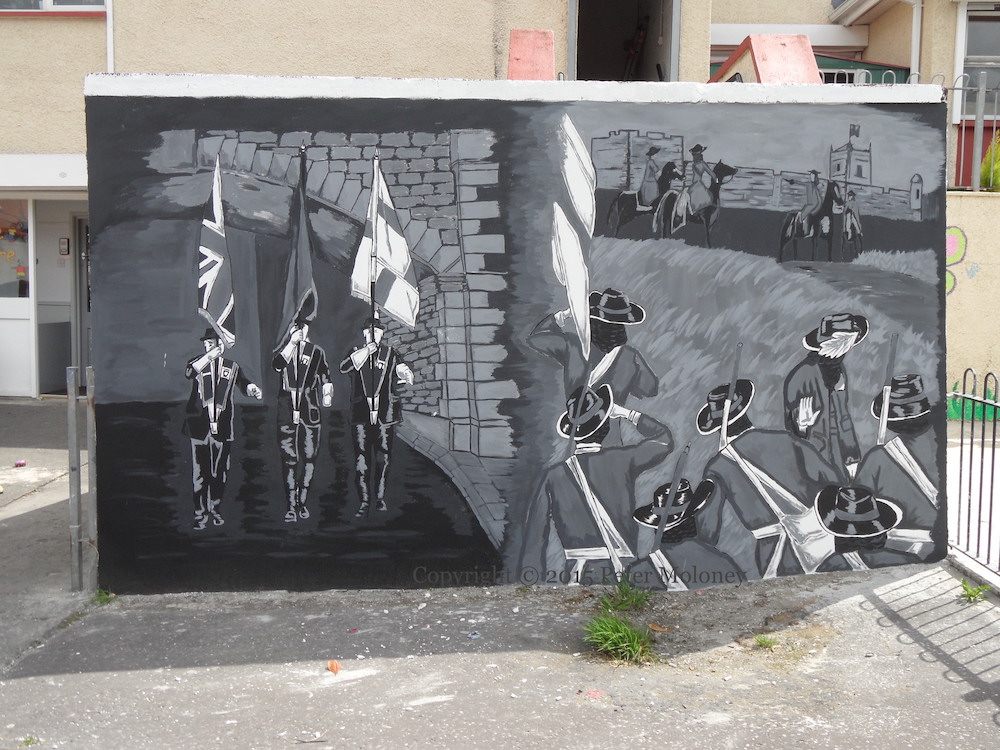
This two-part mural shows (left) Orange Order flag-bearers and (right) a scene from the Siege of Derry, perhaps of James II demanding the city and being rebuffed with cries of “No surrender”.
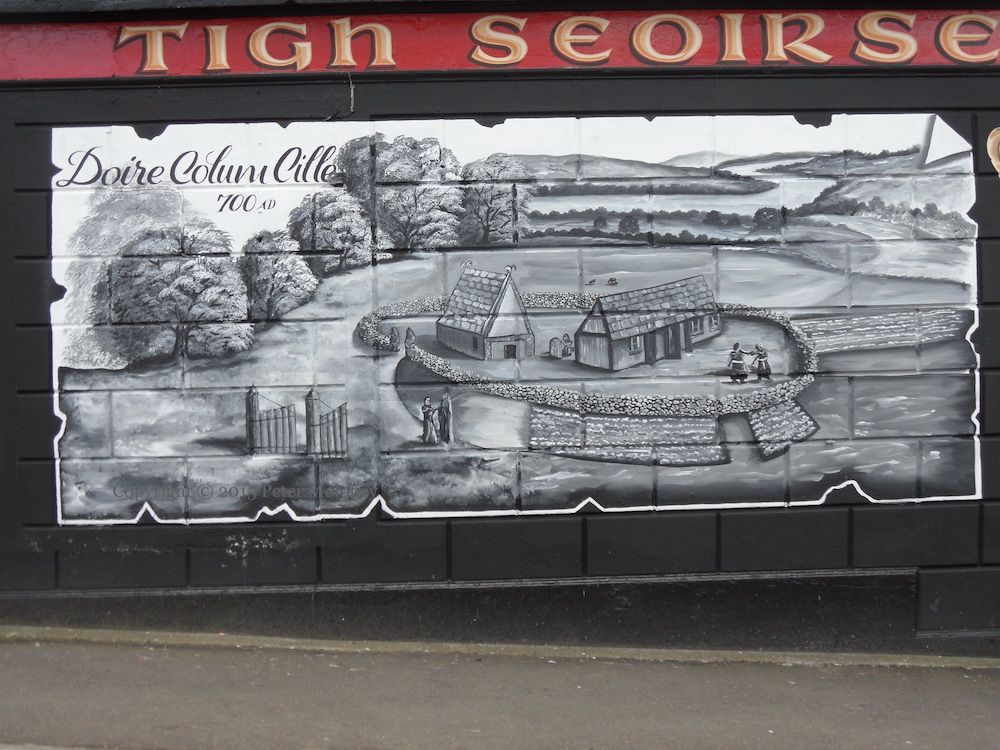
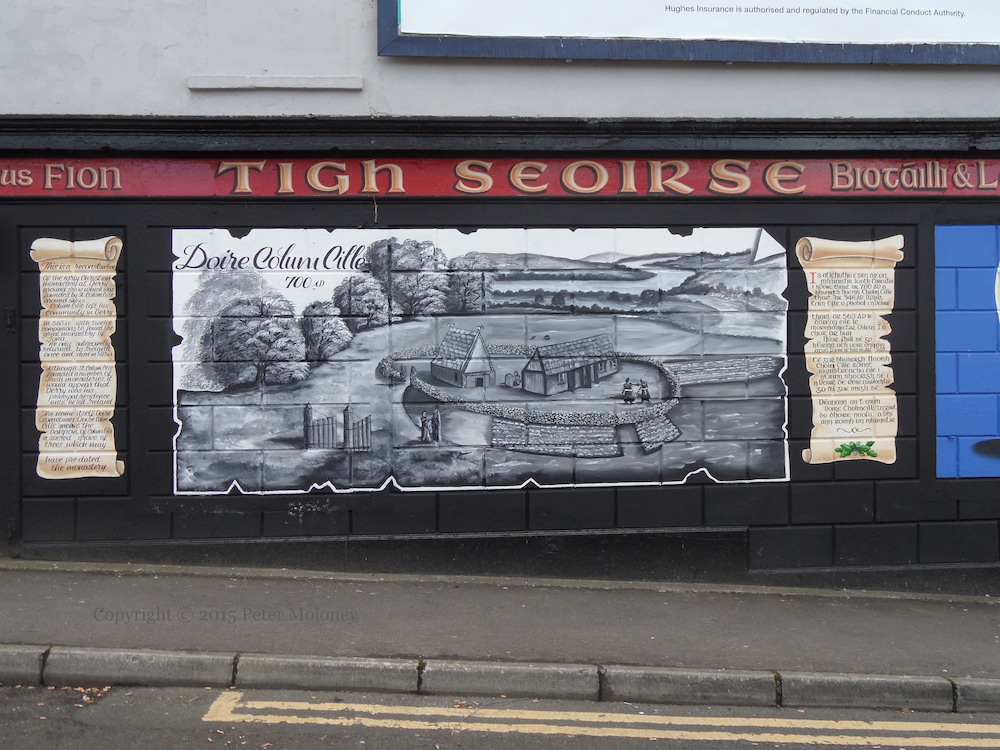
The Christian missionary Colm Cılle (in Latin, Columba), born in Donegal, founded a monastic settlement on the banks of the Foyle (then still part of Donegal) around 540 AD. The “Doıre” part of the name means “oak grove” and perhaps refers (as the information panel suggests) to “a sacred grove of trees, which may have pre-dated the monastery.” The mural above shows a reconstruction of the Derry monastery c. 700 AD. The name “Londonderry” dates to 1662.
Columba moved on to Scotland circa 563 and founded an abbey on the island of Iona. Among his reputed miracles is the banishment of a great water beast from the River Ness in 565.
“This is a reconstruction of the early Christian monastery at Derry around 700 AD which was founded by St Colum Cille around 546 AD. Colum Cille left his community in Derry in 563 AD with twelve companions to found the great monastery of Iona. He only subsequently returned to Ireland once and died in 593 AD. Although St Colum Cille founded a number of Irish monasteries, it would appear that Derry was his principal residence until he left Ireland. The name itself, Doıre, (sometimes Doıre Colum Cılle) means ‘the oakgrove of Colum Cille’ a sacred grove of trees, which may have pre-dated the monastery.”
“Is athchuthú é seo ar an mhainistir luath-Chríostaí i nDoıre thart ar 700 AD a bhunaigh Naomh Cholm Cıille thart ar 546 AD. D’fhág Colm Cille a phobal ı nDoıre thart ar 563 AD le dáréag eıle le mómhaınıstır oıleán Í a chur ar bun. Níor fhill sé go hÉıreann ach uaır amháın agus fuaır sé bás in AD 593. Cé gur bhunaigh Naomh Cholm Cille roınnt maınıstreacha eıle ı nÉırınn, shocrıgh sé ı nDoıre de réır cosúlachta go dtí gut ımıgh sé. Déanann an t-aınm ‘Doıre Cholmcılle’ tagaırt do dhoıre naofa, a bhí ann roımh an mhaınıstir.”
U Bennett Street, Derry, on the side wall of Tıgh Seoırse.
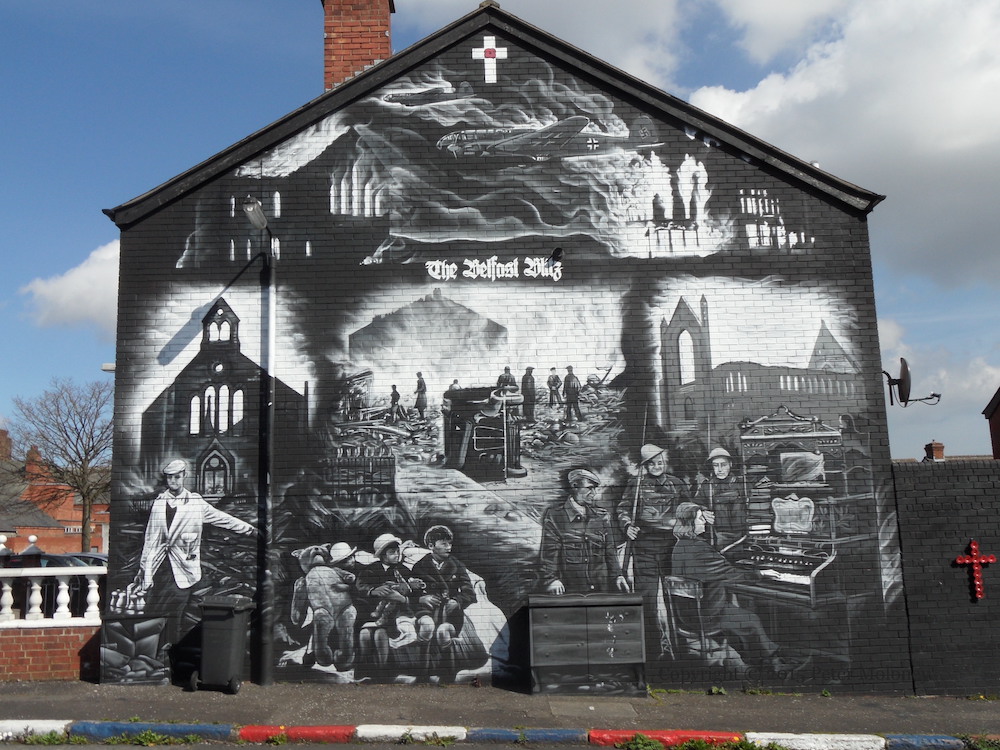
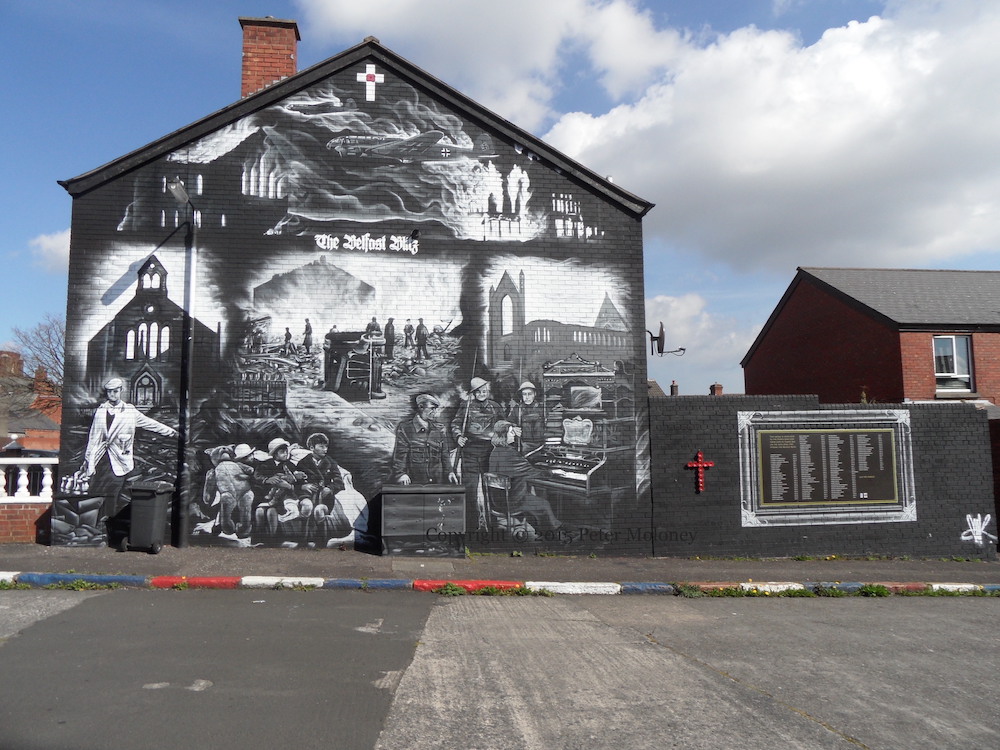
In the “Belfast Blitz” of April and May 1941, during WWII, 900 people died and half the homes in Belfast were destroyed or damaged (WP). In the apex of this mural, a Nazi bomber sets buildings alight; in the main panel, people, including a milkman, walk among the bombed-out buildings, while others (bottom right) test out a piano that has been moved.
On the side-wall to the right is a painted frame surrounding a manufactured plaque with the names of locals who died in the blitz.
By JMK (Jonny McKerr – Fb) in Hogarth Street, Tiger’s Bay, north Belfast. Both the lamp-post and the electrical box have been painted into the mural.
McKerr also did a piece in the area of images from WWI – see The Home Front.
The central image of soldiers at the battle of the Somme is surrounded by images of various occupations: shipyard workers and miners (perhaps), along with images of women welding, carrying coke, and nursing. It’s not clear what the “fair wartime wage” refers to: there was a general strike at the shipyards in 1919 (The Great Unrest | Workers’ Liberty).
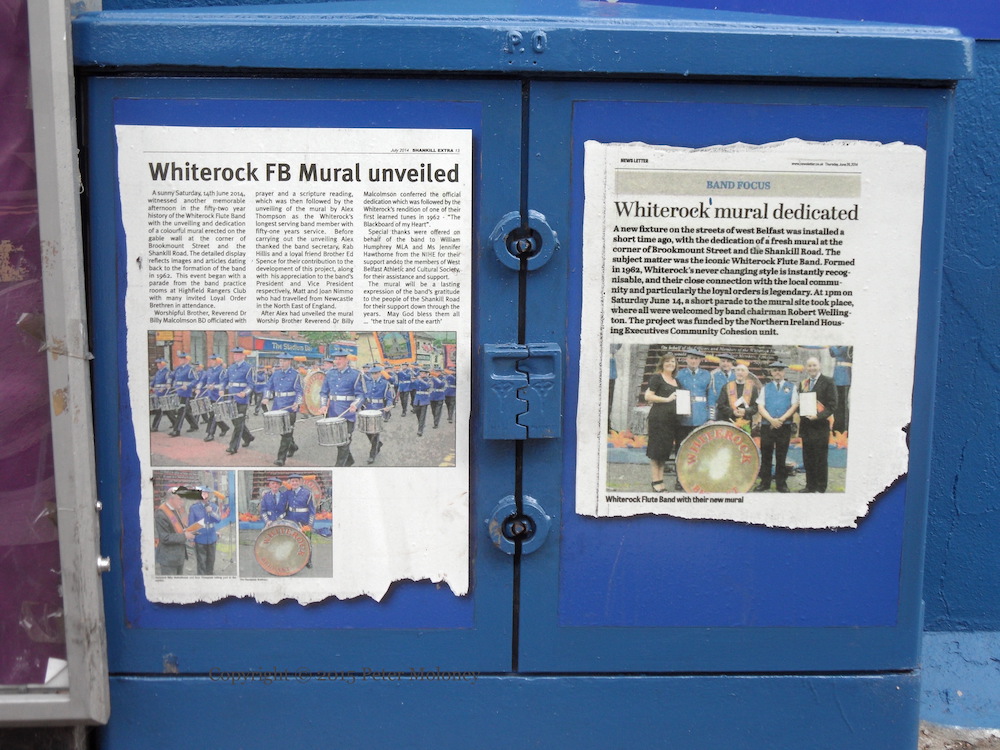
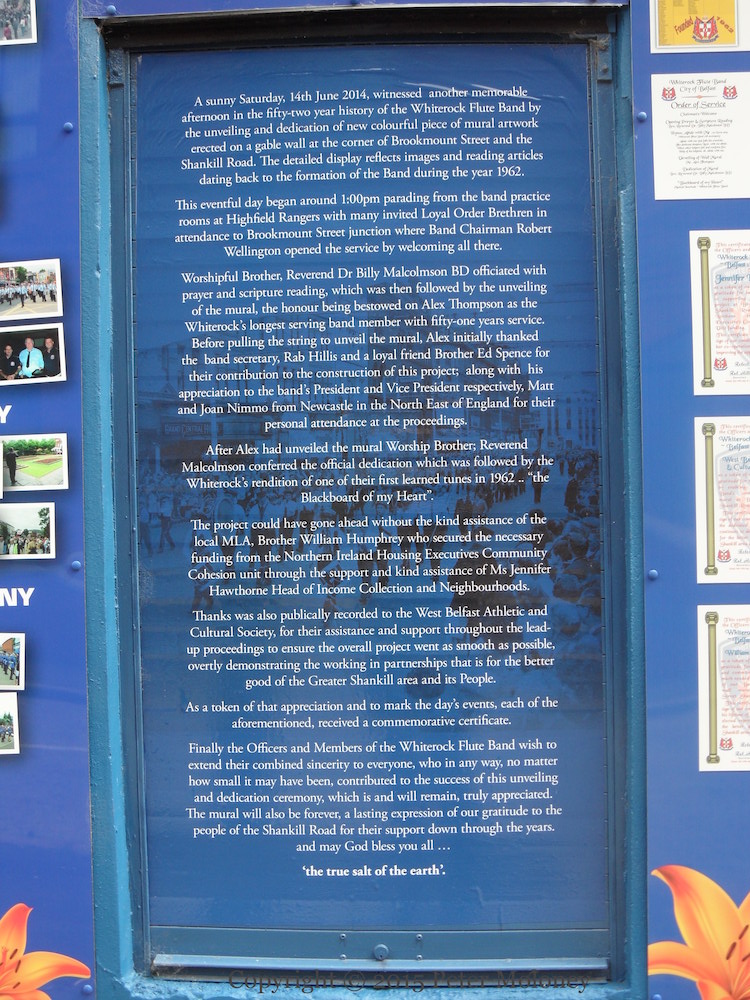
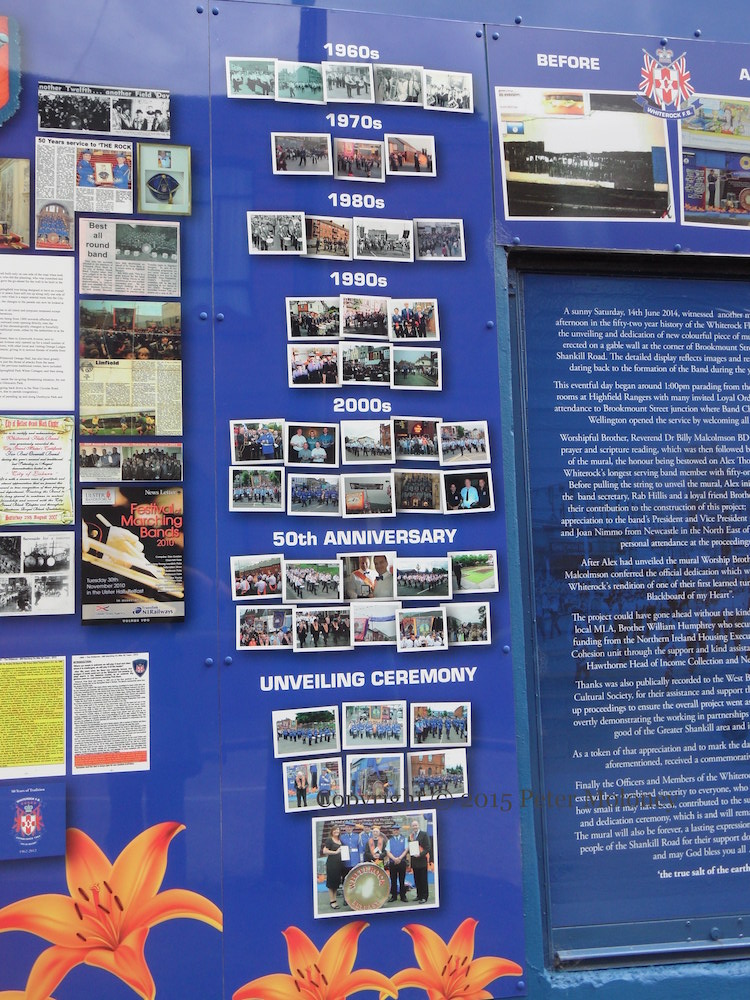
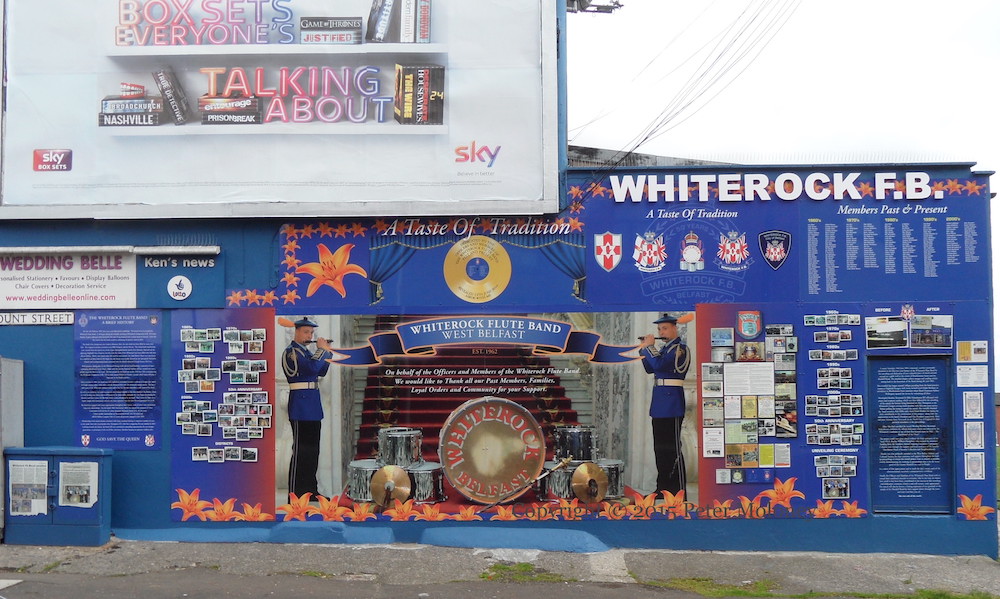
This is the post-launch version of the Whiterock flute band’s history wall (as compared to the partially completed wall from last year, before the launch). At the top, we now have a gold disc and orange lily, and, around the doorway on the far right, a list of members, photographs from years gone by, and an account of the launch, which took place on June 14th, 2014.
The final image is from July, by which time “Whiterock F.B.” in bold, white, lettering along the top right had been added.
The Somme memorial Garden Of Reflection (between the Shankill graveyard and the Mountainview Tavern) has two new pieces. The first places two headstones (both reading “A soldier of the great war”) in a flower-bed in front of the mural, which shows a soldier, presumably from the Ulster division, on the fields of Flanders: “Greater love hath no man than this, that a man lay down his life for his friends. 1914-2014”
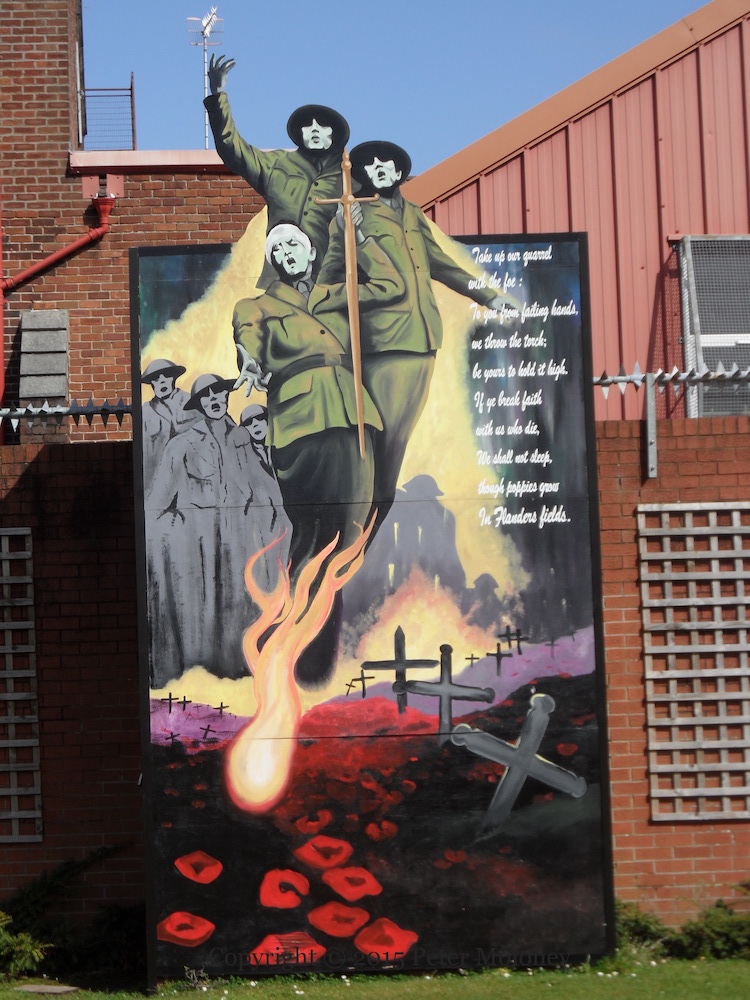
In the second, three wraiths of dead WWI soldiers – one with its head wrapped in a bandage – rise from the grave to issue a final edict: “Take up our quarrel with the foe; to you from failing hands we throw the torch; be yours to hold it high. If ye break faith with us who die, we shall not sleep though poppies grow in Flanders’ fields.”
This graffiti on the hoardings around the building-site at the top of Woodvale Road, at the junction with Twaddell Avenue, where each night Orange bands march up to the police line, attempting to march past the Ardoyne shops and finish a parade from the Twelfth (of July) 2013.
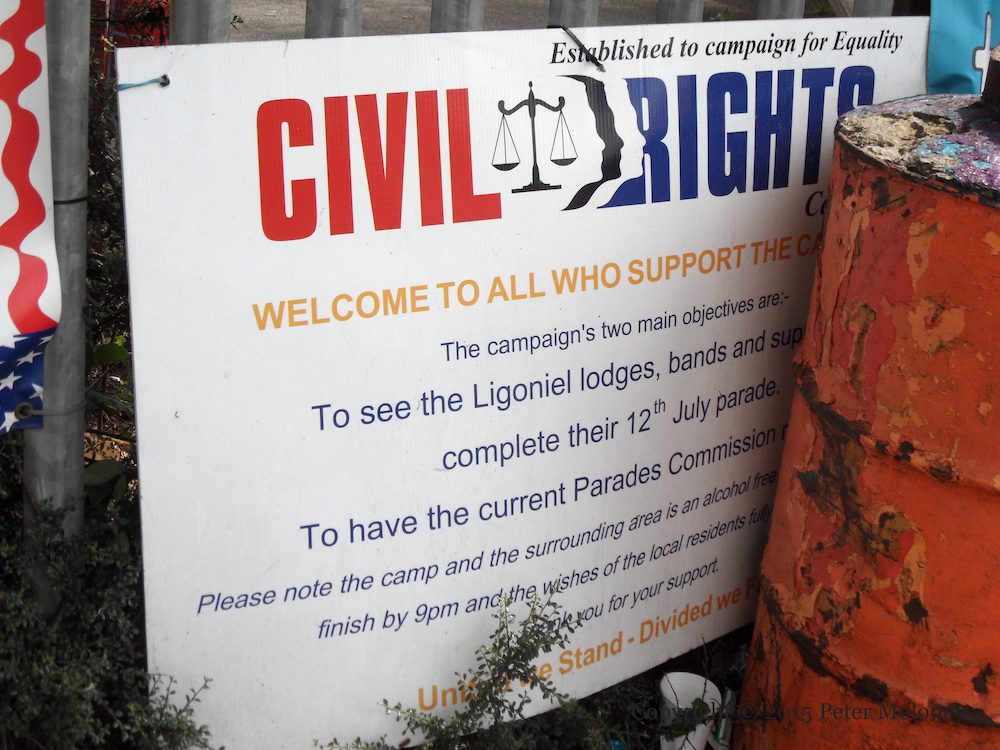
A camp was established on the site on Twaddell Avenue with signs using the language of “civil rights” and “equality”: “Established to campaign for Equality. Civil Rights. Welcome to all who support the campaign. The two main objectives are to see the Ligoniel lodges, bands and supporters complete their 12th july parade; to have the current parades commission removed. Please note the camp and the surrounding area is an alcohol free zone. All music must finish by 9 p.m. and the wishes of the local residents fully respected. Thank you for your support. United we stand – divided we fall.”
The local New Lodge GAA club Cumman An Phıarsaıgh is named in honour of Patrick Pearse, executed after the 1916 rising. The club’s new mural features footballers contesting a ball and Pearse’s image appears at the centre of a Celtic cross along with part of his 1912 poem Mıse Éıre in the bottom corner (shown in the close-up).
Painted by Lucas Quigley and Michael Doherty. Replaces ‘New Lodge 2000‘.
Mıse Éıre: Sıne mé na an Chaılleach Bhéarra. Mór mo ghlóır: Mé a rug Cú Chulaınn croga. Mór mo náır: Mo chlann féın a dhíol a máthaır. [Mór mo phıan: Bıthnaımhde do mo shíorchıapadh. Mór mo bhrón: D’éag an dream ınar chuıreas dóchas.] Mıse Éıre: Uaıgní mé ná an Chaılleach Bhéarra.
I am Ireland: I am older than the old woman of Beare. Great my glory: I who bore Cuchulainn, the brave. Great my shame: My own children who sold their mother. [Great my pain: My irreconcilable enemy who harasses me continually. Great my sorrow: That crowd, in whom I placed my trust, died.] I am Ireland: I am lonelier than the old woman of Beare.
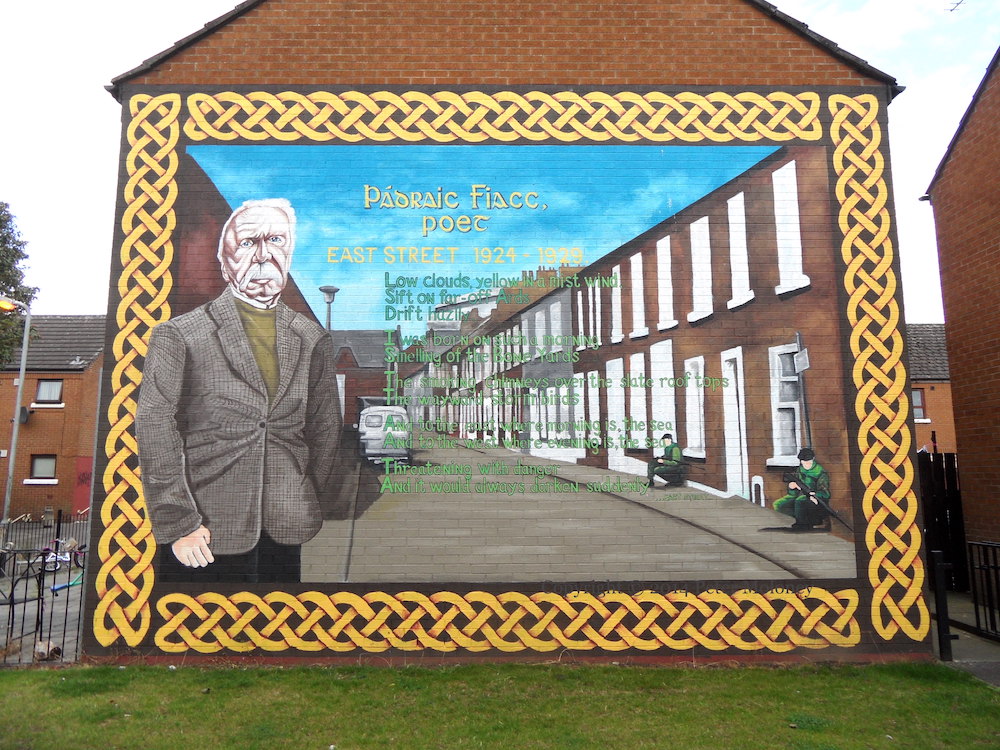
Patrick O’Connor was born on April 15th, 1924, on the lower Falls but after his father emigrated he spent his early years – until age 5 – with his grandparents in East Street in the Markets. It was as a high-schooler in New York that he adopted the name Pádraıc Fıacc (“fıach dubh” is “raven”) and began writing poetry. He settled in Glengormley upon his second and final return; it is not clear that he ever saw East Street lined with British Army soldiers, as shown in the mural above. He wrote of his early life in ‘First Movement’:
Low clouds, yellow in a mist wind Sift on far-off Ards Drift hazily … I was born on such a morning Smelling of the bone yards The smoking chimneys over the slate top roofs The wayward storm birds And to the east where morning is, the sea And to the west where evening is, the sea Threatening with danger And it would always darken suddenly
Some of Fıacc’s poems are in the TroublesArchive. There are two videos below. The first is an interview with NVTv’s Bernard Conlon; the second is of a reception in Belfast City Hall.