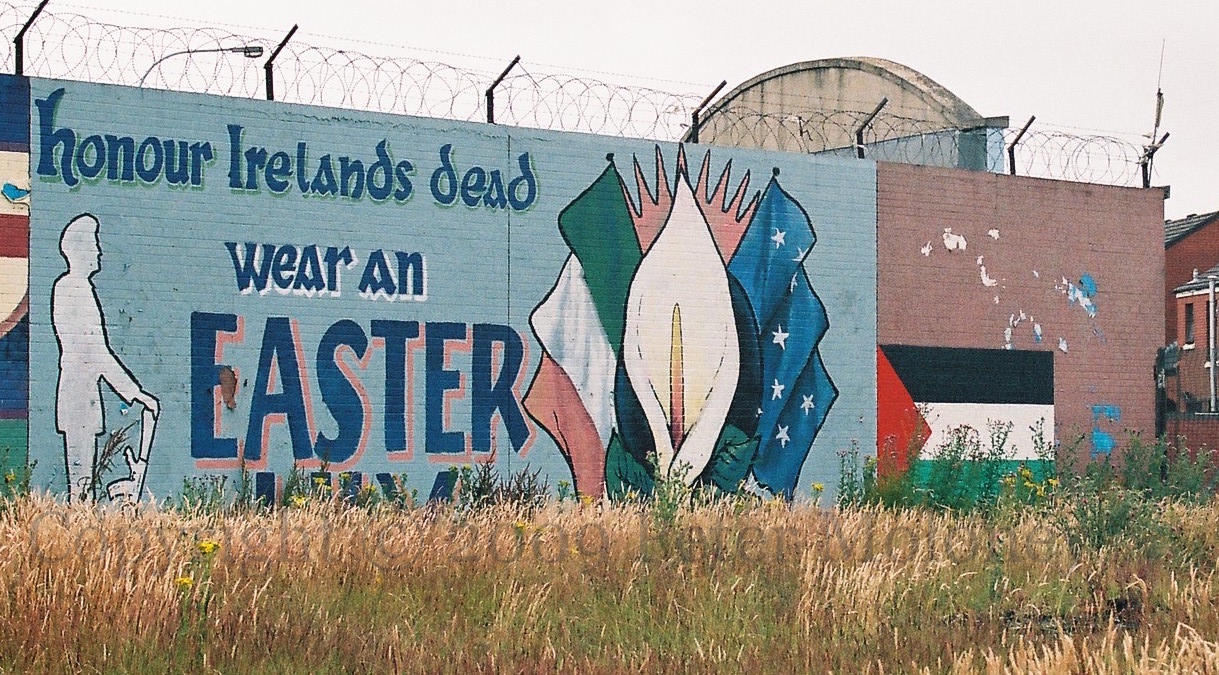
A Palestinian flag is added to the end of the Mountpottinger wall, next to Honour Ireland’s Dead.
Click image to enlarge
Copyright © 2009 Peter Moloney
M04918
A Palestinian flag is added to the end of the Mountpottinger wall, next to Honour Ireland’s Dead.
Click image to enlarge
Copyright © 2009 Peter Moloney
M04918

“Seán Mac Dıarmada 1883-1916 a bhí ına chónaí ı Sráıd de Buıtléır sa bhlıaın 1905.” [who was living in Butler Street in the year 1905].
Seán Mac Dıarmada was born in Leitrim, left for Glasgow at age 15, but after two years returned to Belfast in 1905 (working on the trams) and – according to the new mural above – spoke from the back of a coal lorry in Clonard Street, outside the Clonard branch of the Ancient Order Of Hibernians. Mac Dıarmada was for a short time an AOH member, before moving on to the Irish Republican Brotherhood and Irish Volunteers, which led to his participation in the 1916 Easter Rising and execution on May 12th of that year.
Havana Way, north Belfast
Click image to enlarge
Copyright © 2009 Peter Moloney
M04780

Twelve hunger strikers prior to the 1981 strike are included in this Shaws Road board: on the left: Thomas Ashe, Mountjoy 1917; Michael Fitzgerald, Cork 1920; Terence McSwiney, Brixton 1920; Joseph Murphy, Cork 1920; Joseph Witty, Curragh 1923; Denis Barry, Newbridge 1923; Andrew Sullivan, Newbridge 1923; Tony D’Arcy, Arbour Hill 1940; Jack McNeela, Arbour Hill 1940; Seán McCaughey, Portlaoise 1946; Michael Gaughan, Parkhurst 1974; plus on the right: Frank Stagg, Wakefield 1976.
Click image to enlarge
Copyright © 2008 Peter Moloney
M04541
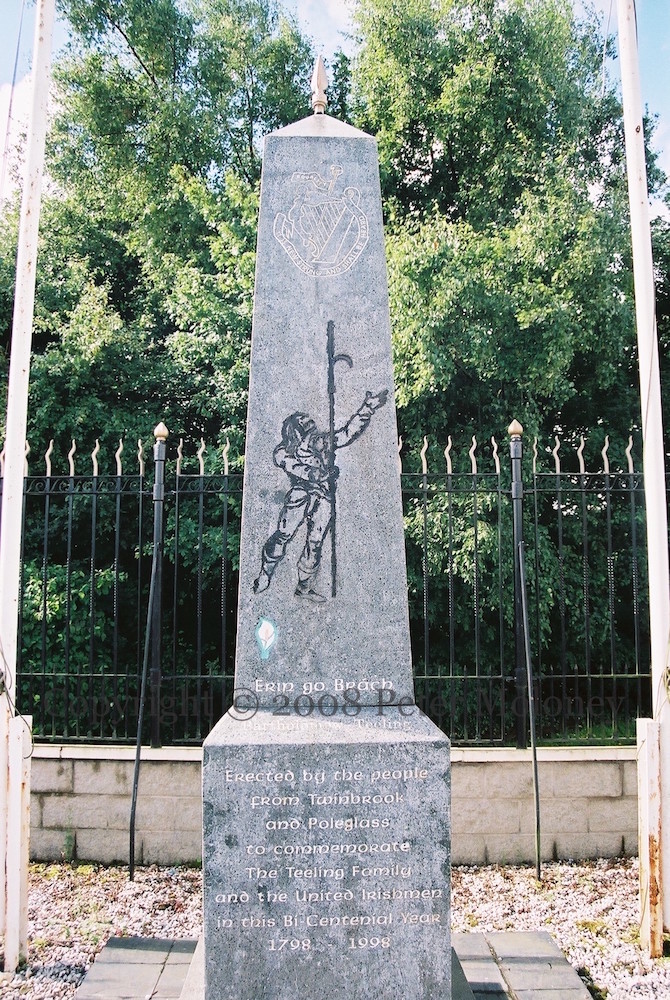

This monument is between Pantridge Road and Stewartstown Road on the Michael Ferguson Roundabout (Ferguson was a Protestant republican and MLA for West Belfast (An Phoblacht)). From top to bottom: the harp of the United Irishmen with the slogan “Equality. It is new strung and shall be heard”; a pikeman; an Easter lily; “Erin go brách.” and finally the dedication: “Erected by the people of Twinbrook and Poleglass to commemorate the Teeling family and the United Irishmen in this Bi-Centennial Year. 1798-1998.” Bartholomew Teeling is included in a Twinbrook mural alongside modern-day IRA volunteers (Twinbrook Final Salute); he was a United Irishman from Lisburn (Rebel Breeze has a full account of his deeds). Charles Teeling was a journalist and founder of the Northern Herald, among others (WP).
Click image to enlarge
Copyright © 2008 Peter Moloney
M04528 M04529 [M04530] [M04531] [M04532]
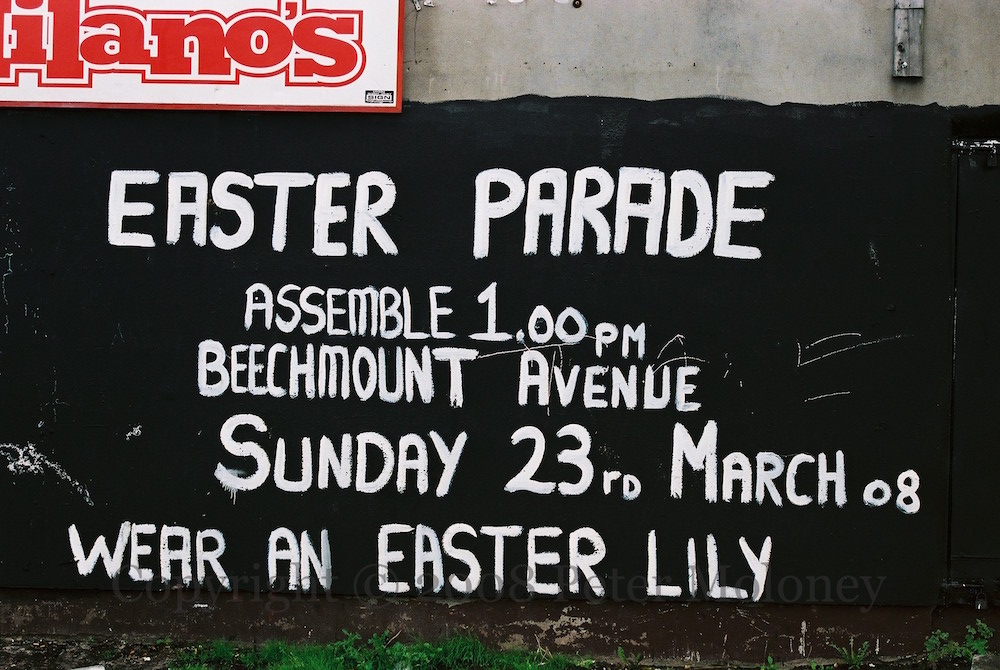
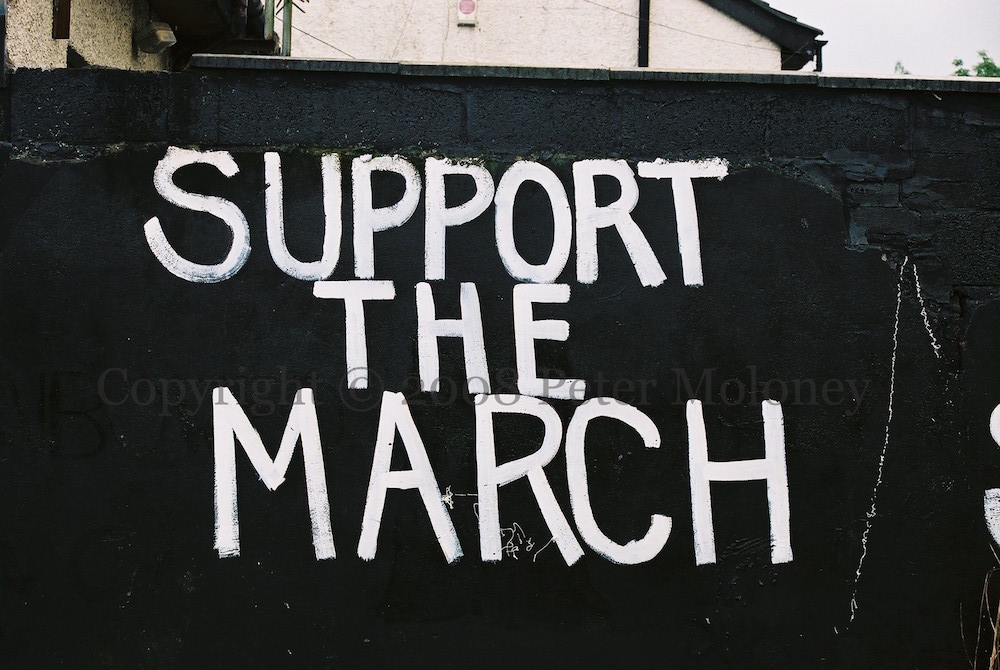

A call in Twinbrook to march in the 2008 Easter [Rising] Parade. “Assemble 1.00 pm Beechmount Avenue, Sunday 23rd March 08. Wear an Easter lily. Support the march. Join Sinn Féin”.
Off Stewartstown Road, Belfast
Click image to enlarge
Copyright © 2008 Peter Moloney
M04523 M04522 M04521

Above: “Cáısc [Easter] 1916”, dating back to at least 1990. Below: “Santa is a British agent” (perhaps because of spying concerns or perhaps because of the blizzard that dropped 15 cm of snow in early January, 2008 – get in touch if you know what prompted this graffiti) with “Join Sınn Féın” stencils underneath.
Click image to enlarge
Copyright © 2008 Peter Moloney
M04486
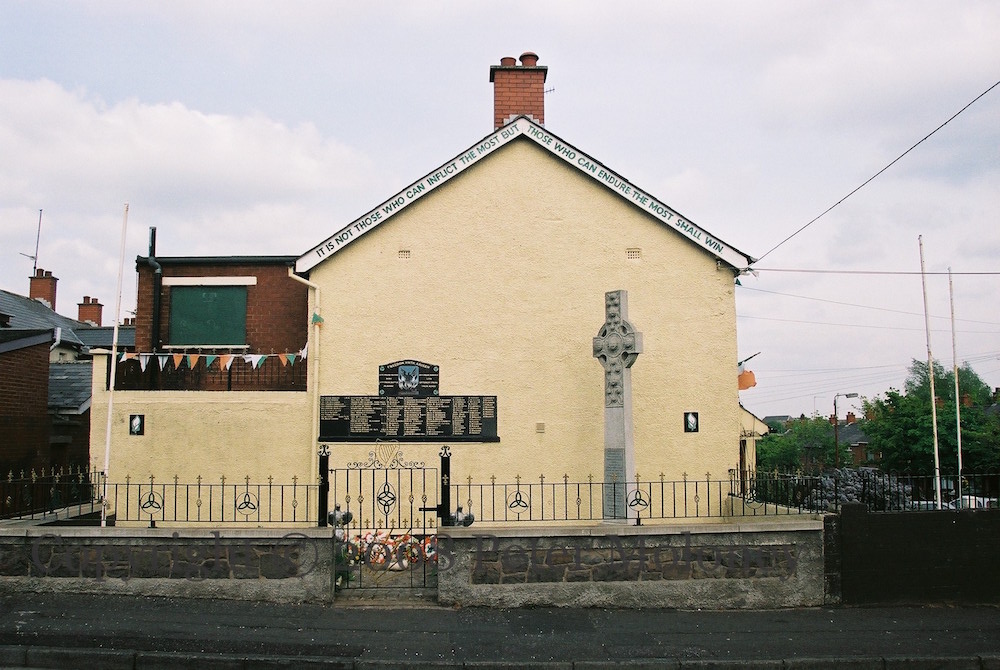
2008 view of the IRA/Fıanna memorial garden in Berwick Road, Belfast. The pieces remain as before (see 2002).
Click image to enlarge
Copyright © 2008 Peter Moloney
M04327 [M04325] [M04326] [M04327] [M04328]
2011 [M06725]
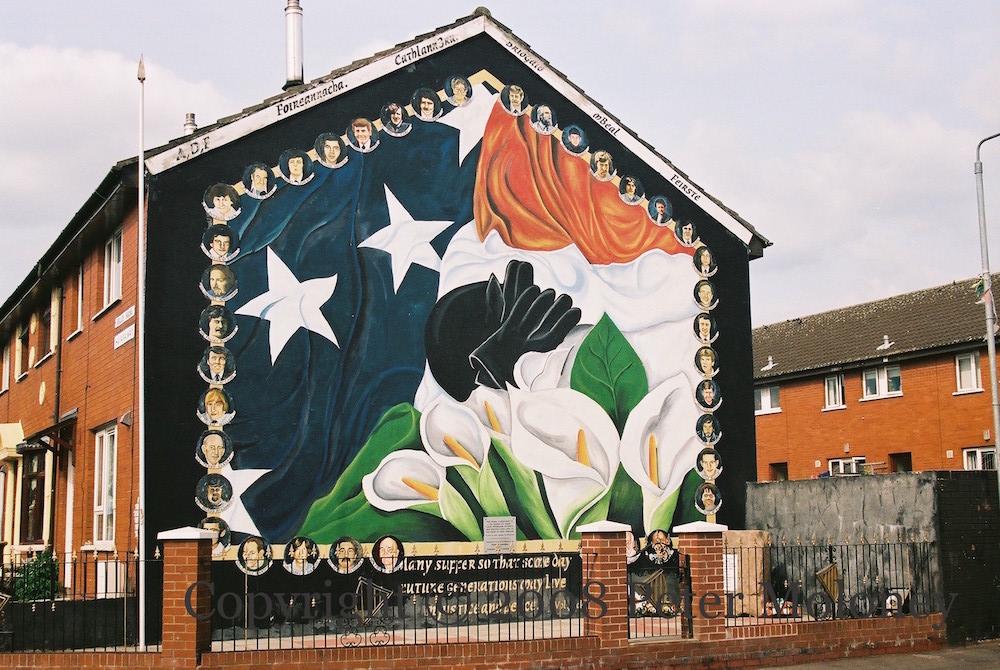
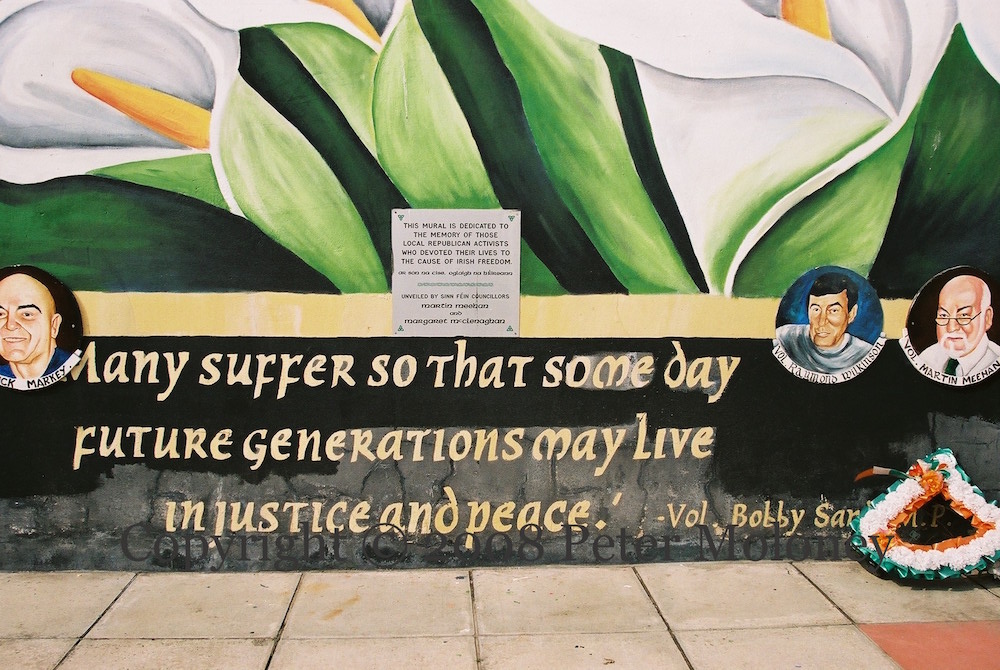
“This mural is dedicated to the memory of those local republican activists who devoted their lives to the cause of Irish freedom. Ar son na cıse [sic]. Oglaıgh [sic] na hÉıreann. Unveiled by Sınn Féın councillors Martin Meehan and Margaret McClenaghan.”
“A, D, F foıreannacha, cathlann 3ru [sic], brıogaıd [sic] mBeal [sic] Feırste.
“‘Many suffer so that some day future generations may live in justice and peace’ – Vol Bobby Sands.”
Click image to enlarge
Copyright © 2008 Peter Moloney
M04307 [M04308][M04309] [M04310] [M04311] [M04312] [M04313] [M04314] [M04315] M04316
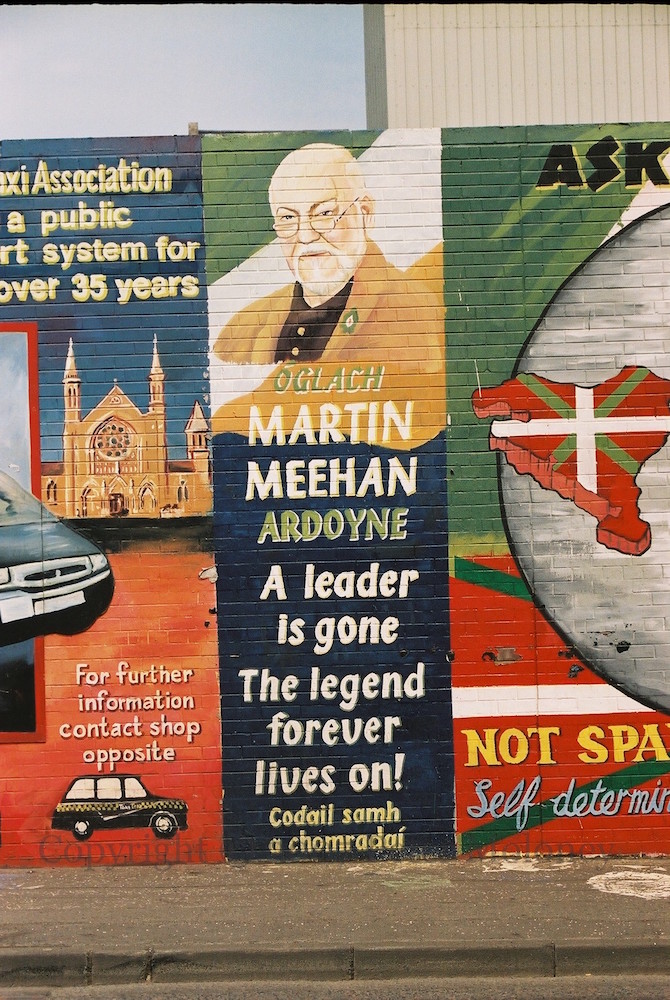
“A leader is gone – the legend forever lives on! Codaıl samh a chomradaí.” Long-time IRA volunteer Martin Meehan, who went with the Provisionals in the split, spent 18 years in prison during the Troubles, and stood in various elections for Sınn Féın, died of a heart attack in November 2007. Divis Street, Belfast.
Click image to enlarge
Copyright © 2008 Peter Moloney
M03983

“In proud and loving memory of Vol. Kevin Lynch and his comrades who gave their lives on hunger strike … and all those who fought in the cause of Irish freedom. Ar dheıs Dé go raıbh a n-anam uasal.”
Main Street, Dungiven
Click image to enlarge
Copyright © 2007 Peter Moloney
M03621 [M03619] [M03620]

