
Érıu cherishes the children of all races. “Teens for justice Summer School 2004”, “Relatives for justice”. Clonard and Divis are portrayed in the background.
Divis Street, west Belfast
Click image to enlarge
Copyright © 2004 Peter Moloney
M02221
Érıu cherishes the children of all races. “Teens for justice Summer School 2004”, “Relatives for justice”. Clonard and Divis are portrayed in the background.
Divis Street, west Belfast
Click image to enlarge
Copyright © 2004 Peter Moloney
M02221


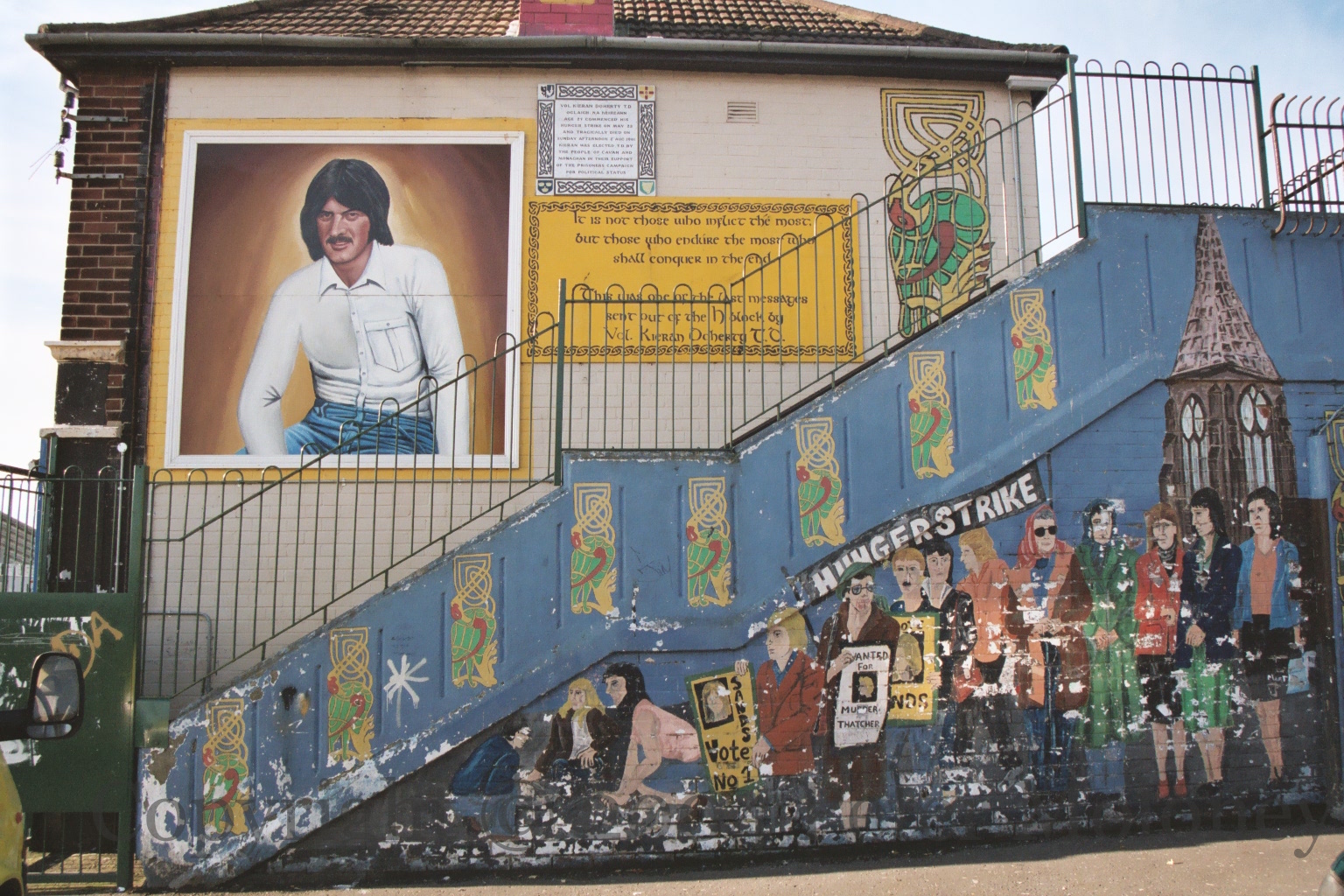
Kieran Doherty was elected TD (Teachta Dála) for Cavan-Monaghan three weeks into his 1981 hunger strike. He held the position for two months, until he died on August 2nd. The portraits, plaques, and mural of marchers are in his home area of Andersonstown. The words “It is not those who inflict the most, but those that can endure who shall conquer in the end” are an echo of Terence MacSwiney, whose hunger strike in 1920 lasted 74 days, one more than Doherty’s.
(2004 images of 2001 M01476)
Slemish Way, Andersonstown, west Belfast
Click image to enlarge
Copyright © 2004 Peter Moloney
M02192
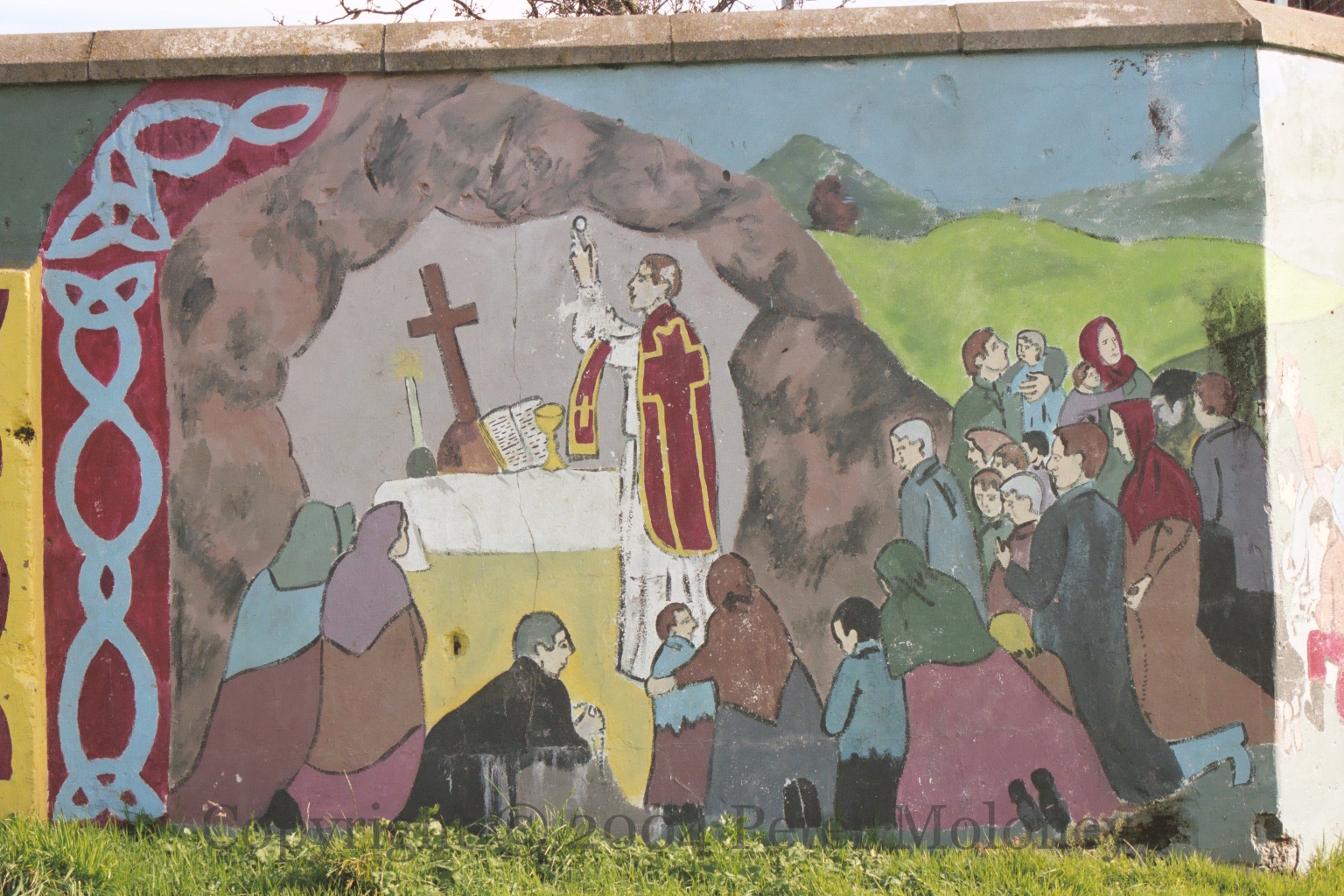

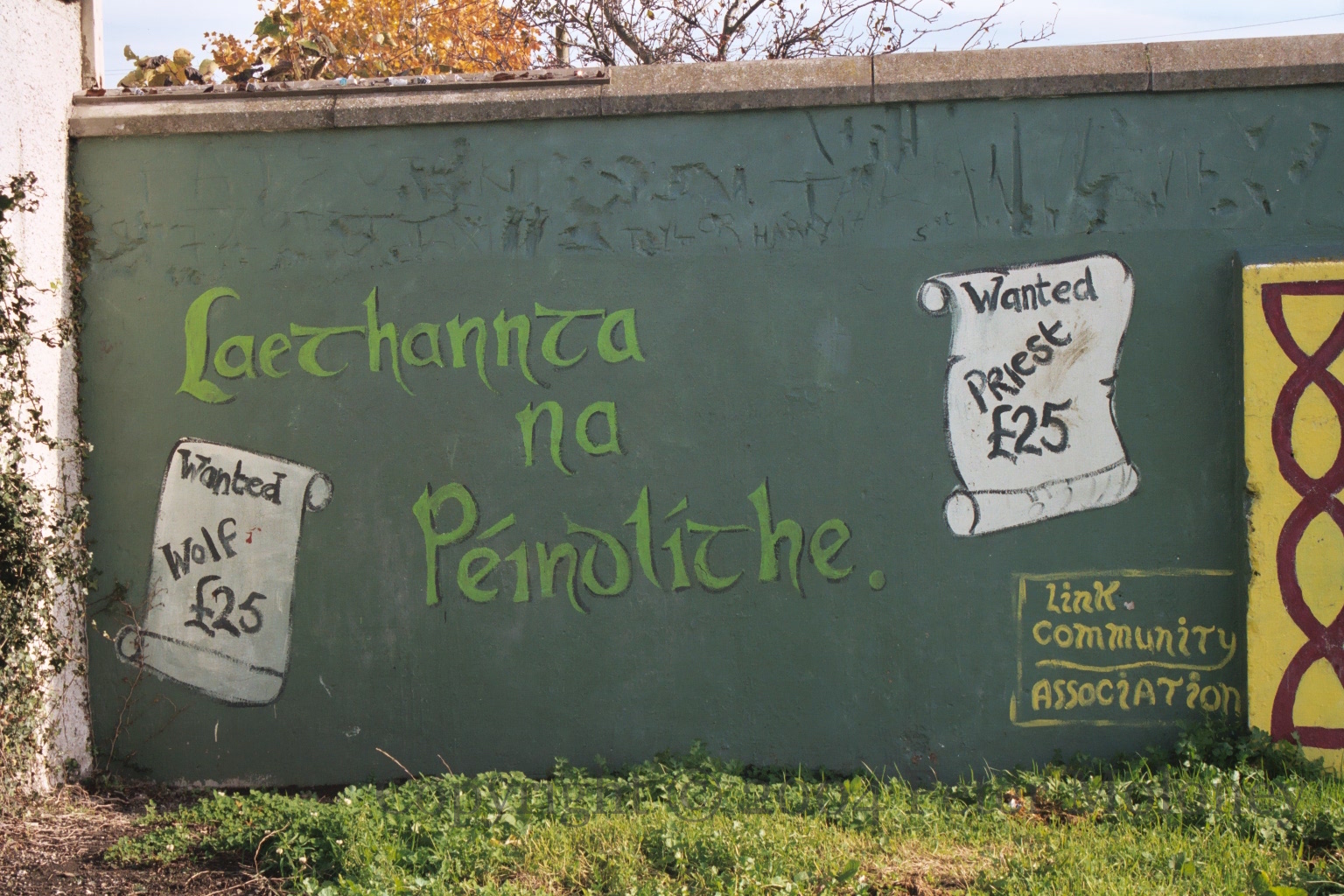
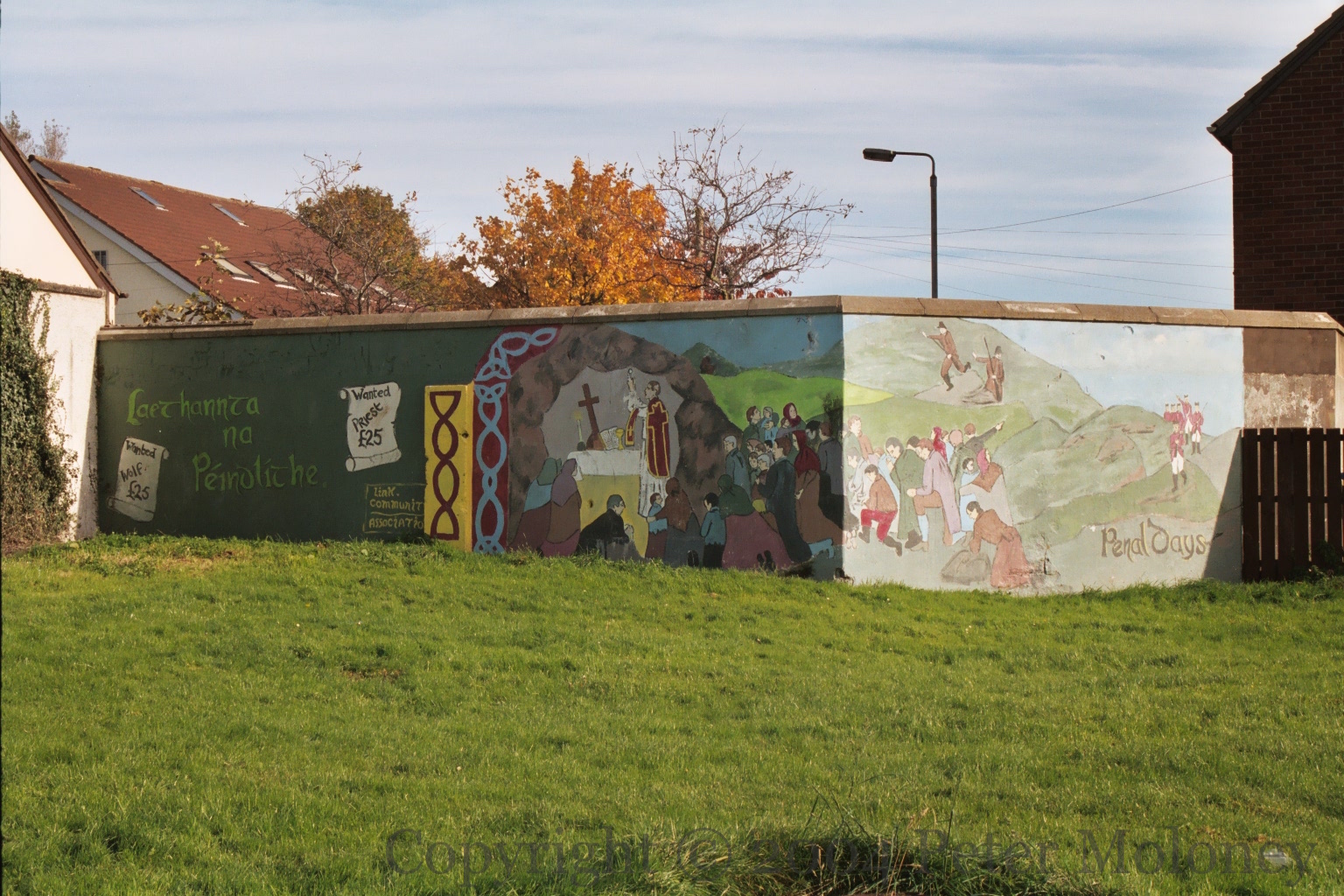
25 pounds is offered as the bounty for a priest, the same as for a wolf. The priest is conducting a Catholic mass but clergy were banned from Ireland under the 1652 Act Of Settlement, the Penal Laws (Na Péındlíthe).
South Link, Andersonstown, west Belfast
Click image to enlarge
Copyright © 2004 Peter Moloney
M02189 M02188 M02190
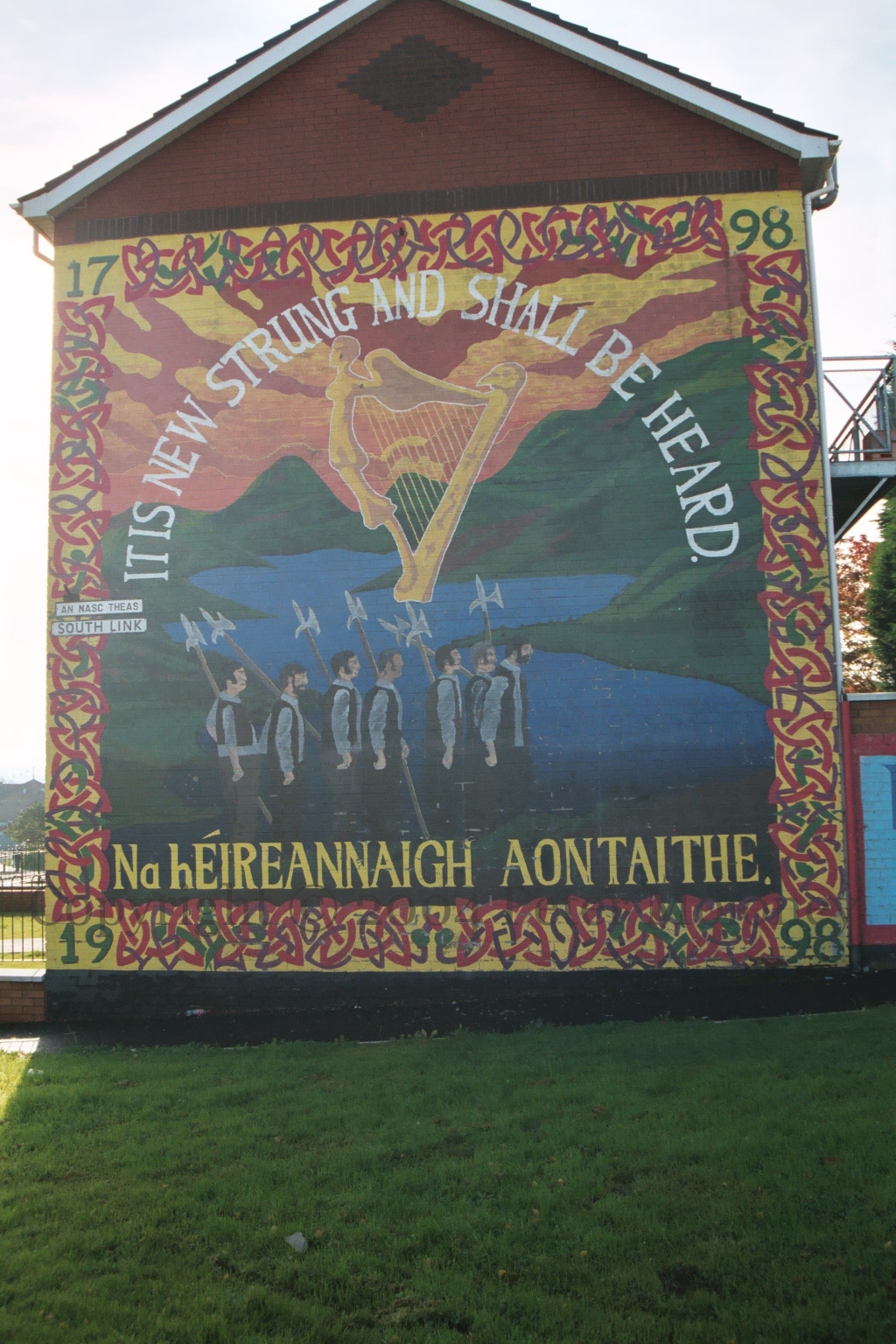
Andrea Redmond painted this mural in South Link, Andersonstown, Belfast, for the 200th anniversary of the 1798 rebellion by Na hÉıreannaıgh Aontaıthe (the United Irishmen). This style of harp is called a Maid Of Erin harp.
Click image to enlarge
Copyright © 2004 Peter Moloney
M02183


Ornately-worked Celtic crosses between pikes are added to the Derry Brigade memorial in Racecourse Road, Shantallow, Derry. For the three black plaques, see Brıogáıd Dhoıre.
Click image to enlarge
Copyright © 2004 Peter Moloney
M02168 M02169
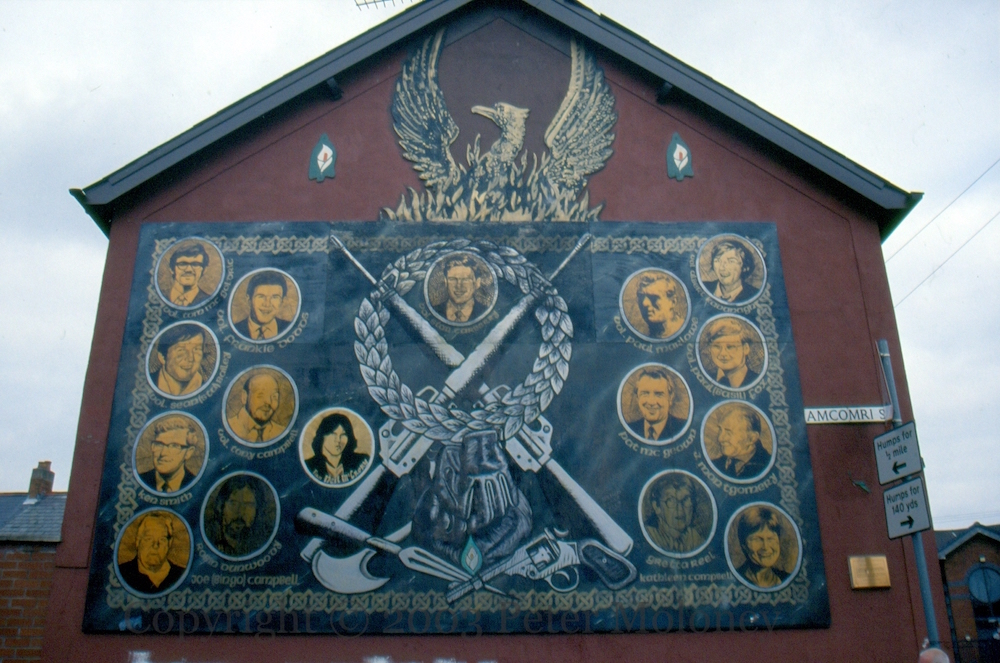
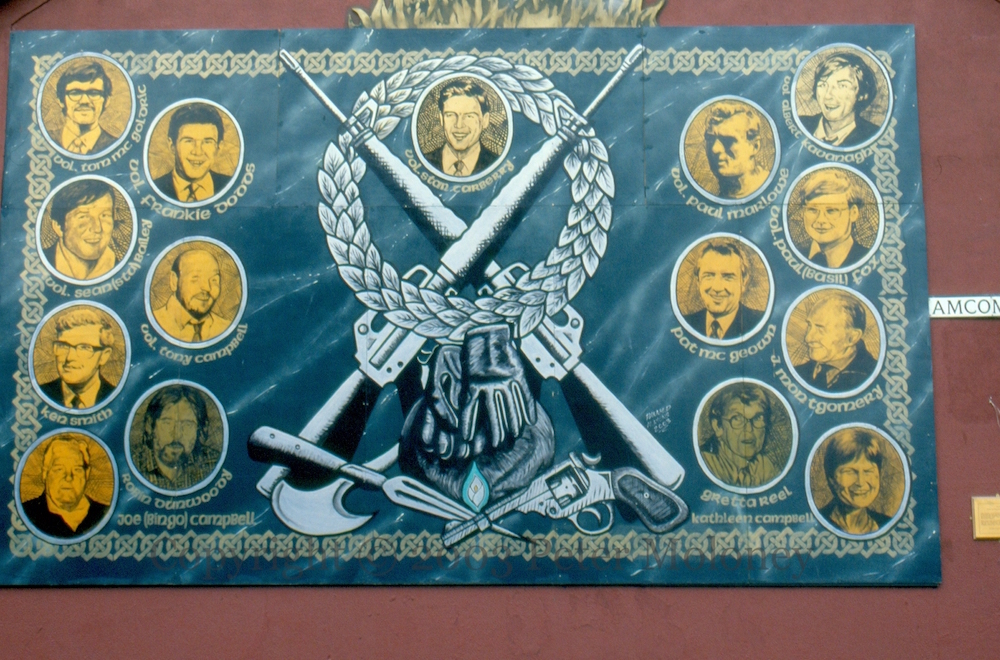
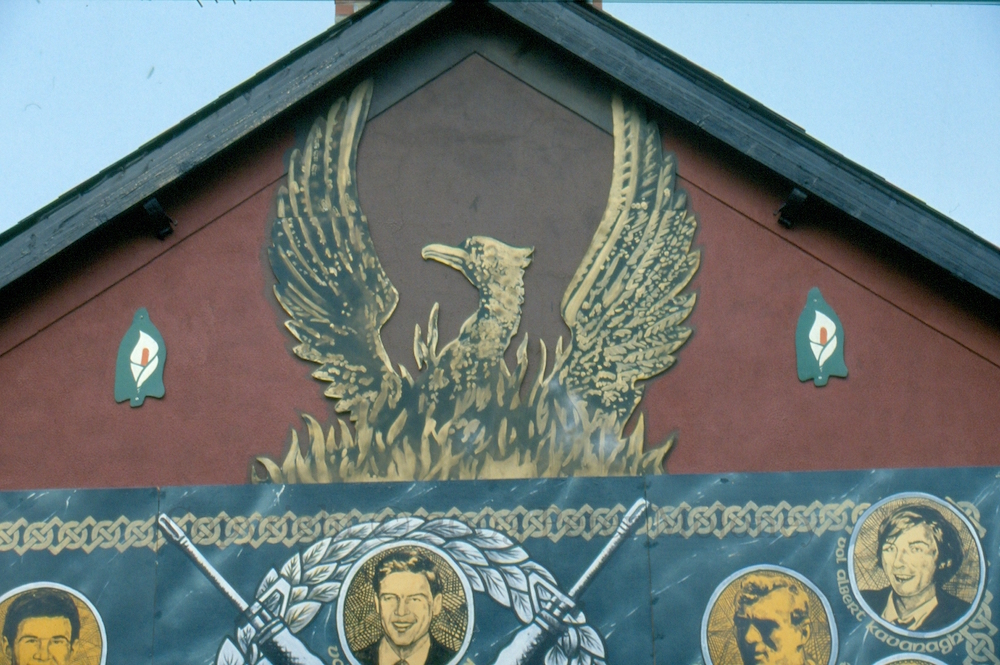
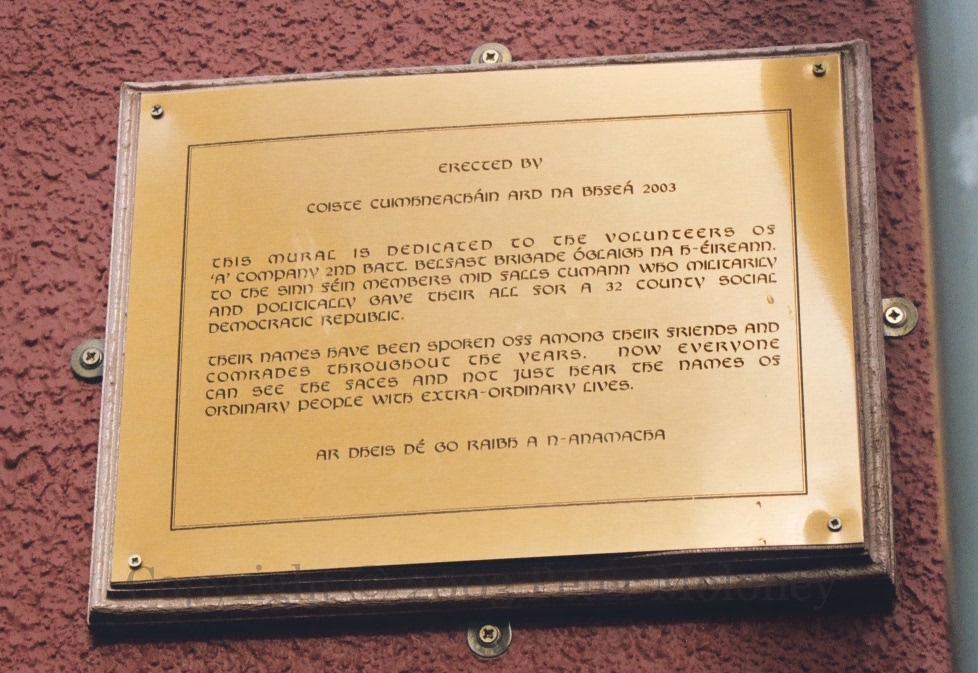
Pike, pistol, and assault rifles — a brief history of republican weaponry in remembrance of local volunteers and activists. At the centre, below the phoenix, is Stan Carberry, included on a Falls Road plaque.
AMCOMRI Street, Beechmount, west Belfast
“Erected by Coıste Cuımhneacháın Ard Na bhFeá 2003.” The plaque reads, “This mural is dedicated to the volunteers of ‘A’ company 2nd batt. Belfast Brigade Óglaıgh na hÉıreann, to the Sınn Féın members Mid Falls cumann, who militarily and politically gave their all for a 32 county social democratic republic. Their names have been spoken off [sic] among their friends and comrades throughout the years. Now everyone can see the faces and not just hear the names of the ordinary people with extra-ordinary lives.”
Click image to enlarge
Copyright © 2003 Peter Moloney
M01984 M01985 M01986 M01987
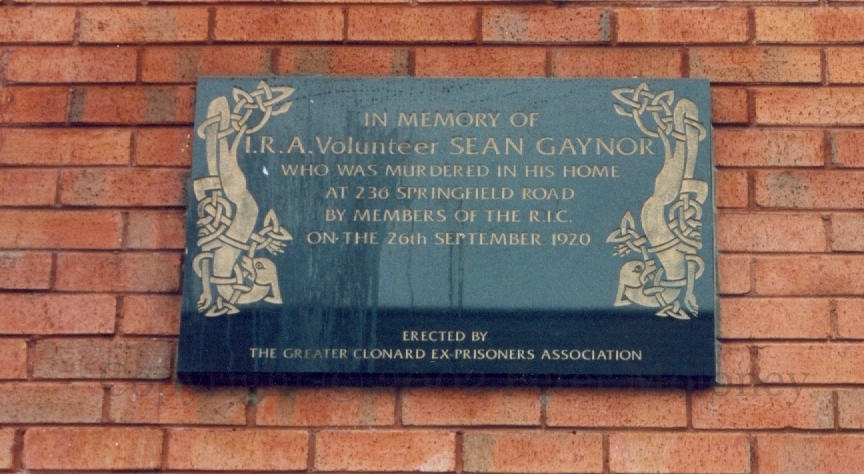
“In memory of IRA Volunteer Sean Gaynor who was murdered in his home at 236 Springfield Road by members of the RIC on the 26th September 1920. Erected by the greater Clonard ex-prisoners association.” Gaynor was one of three victims of an RIC murder gang that night (See ROM’s account.)
Colinview Street, Belfast
Click image to enlarge
Copyright © 2002 Peter Moloney
M03947


This is a 20′ x 20′ tarp of an 8′ x 8′ painting done by Mo Chara, shipped over from New York and placed on the side of the Falls library, Belfast. It honours the ten deceased 1981 hunger strikers with a verse from a Bobby Sands poem and a border of celtic knotwork, the crests of the four provinces, and other revolutionary and civil rights heroes, include Gandhi, MLK, Gaughan & Stagg, Leonard Peltier/the AIM, Nelson Mandela, Maıréad Farrell, and Nora Connolly.
Click image to enlarge
Copyright © 2002 Peter Moloney
M03966 M03965

A dove/lark in celtic style and the oak-leaf representing the city of Derry comprise the emblem of Bloody Sunday, January 30th, 1972. See previously: Bloody Sunday ’72 | Domhnach Na Fola
Rossville Street, Derry
Click image to enlarge
Copyright © 2002 Peter Moloney
M02495

“Sean [aka John] Downes, age 22, murdered at this location by the RUC on the 12/8/84. Victim of state violence.” Downes was hit at close range by a plastic bullet outside Connolly House on the Andersonstown Road, Belfast during an attempt by police to arrest NORAID‘s Martin Galvin. Reserve Constable Nigel Hegarty was charged with manslaughter but was cleared.
Click image to enlarge
Copyright © 2002 Peter Moloney
M01946

