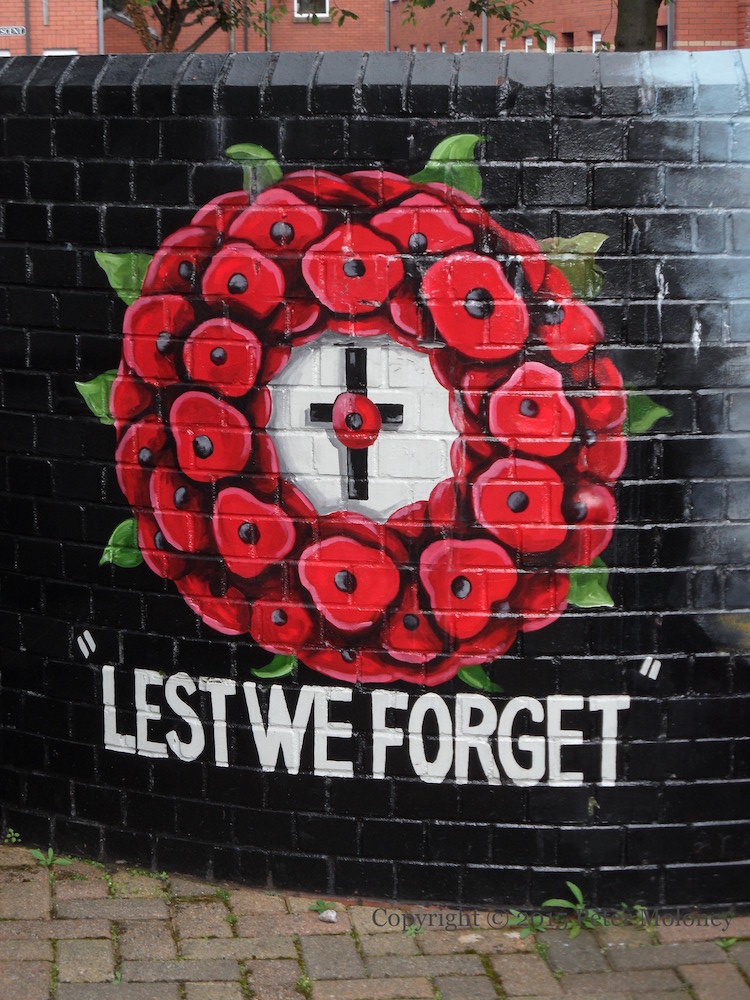
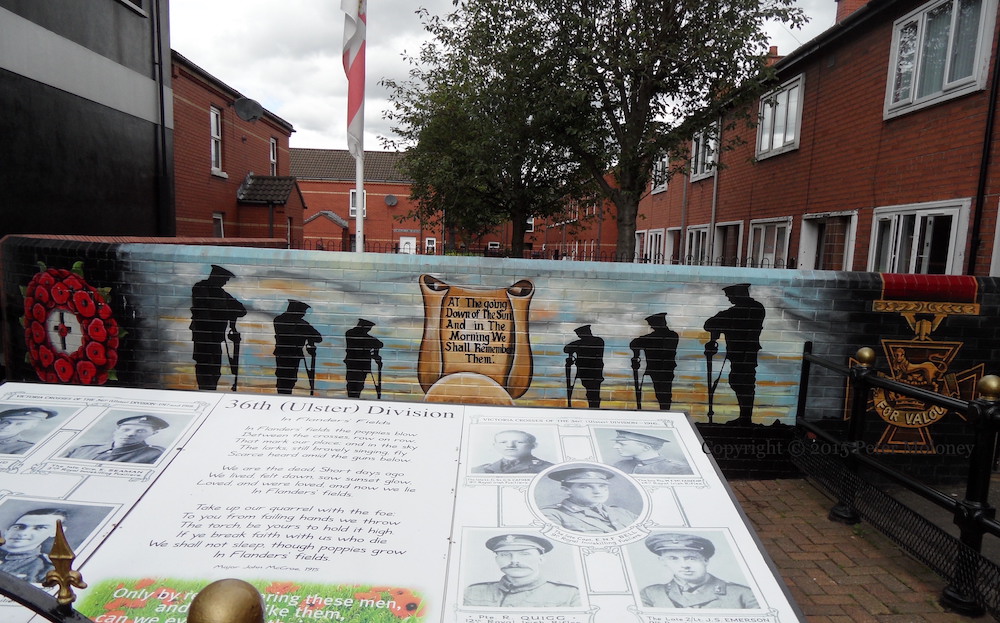
“At the going down of the sun and in the morning, we shall remember them.” The fence at the back of the Belvoir Somme Association’s Victoria Cross memorial garden on along the Newtownards (at the old Newcastle Street) has been replaced with a wall and the poppy wreath on the left (above) has been joined by a mural in memory of the Somme dead and the Victoria Crosses awarded to the 36th Division “For Valour”.
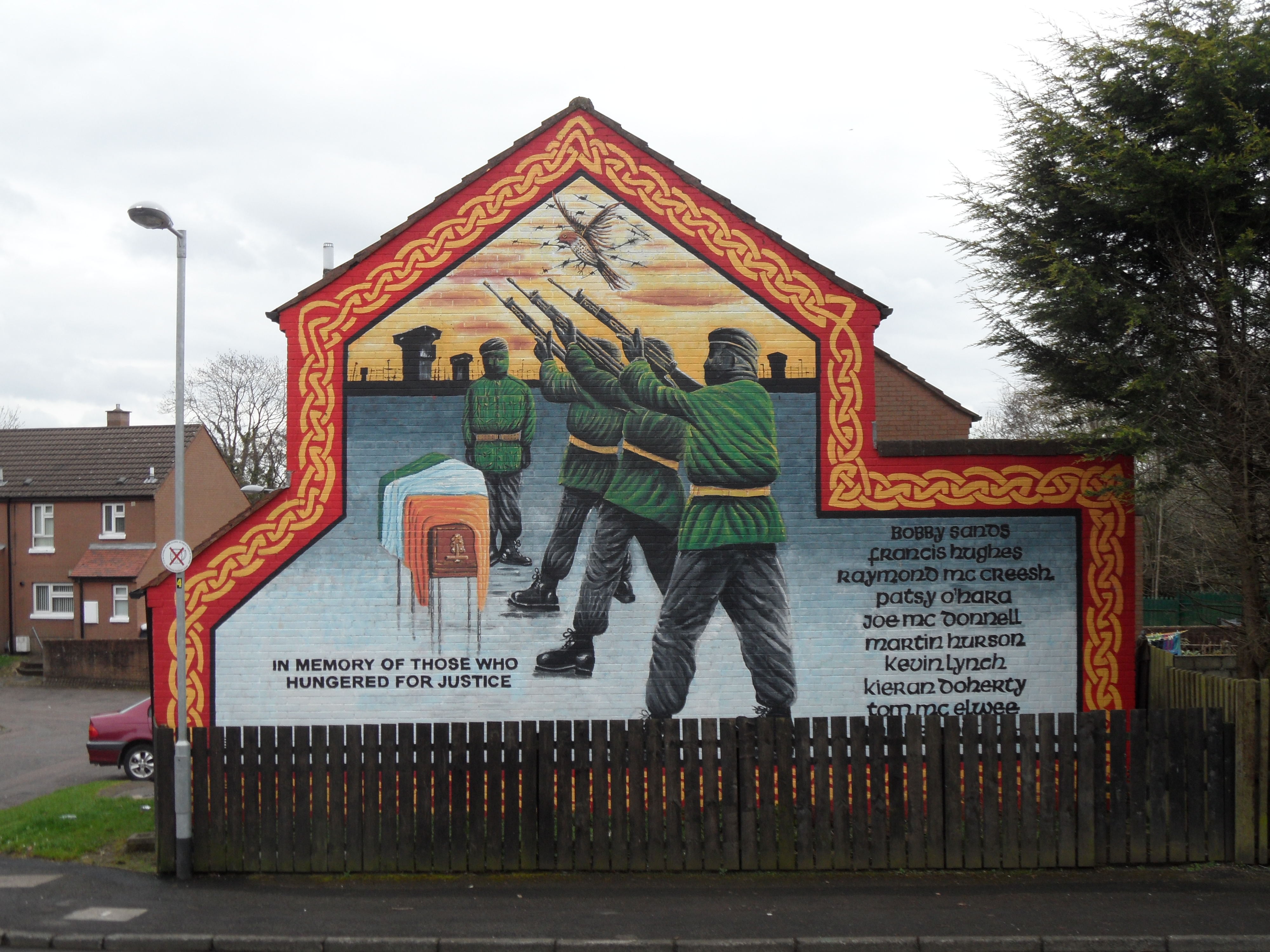
This is a 2015 repainting of a 2001 mural in Glenwood. The ten deceased hunger-strikers of 1981 are listed in the bottom right: Bobby Sands, Francis Hughes, Raymond McCreesh, Patsy O’Hara, Joe McDonnell, Martin Hurson, Kevin Lynch, Kieran Doherty, Tom McElwee, Mickey Devine. In the main panel, a lark in barbed wire flies over the H-blocks of Long Kesh and a funeral volley being fired over a Tricolour-draped coffin.
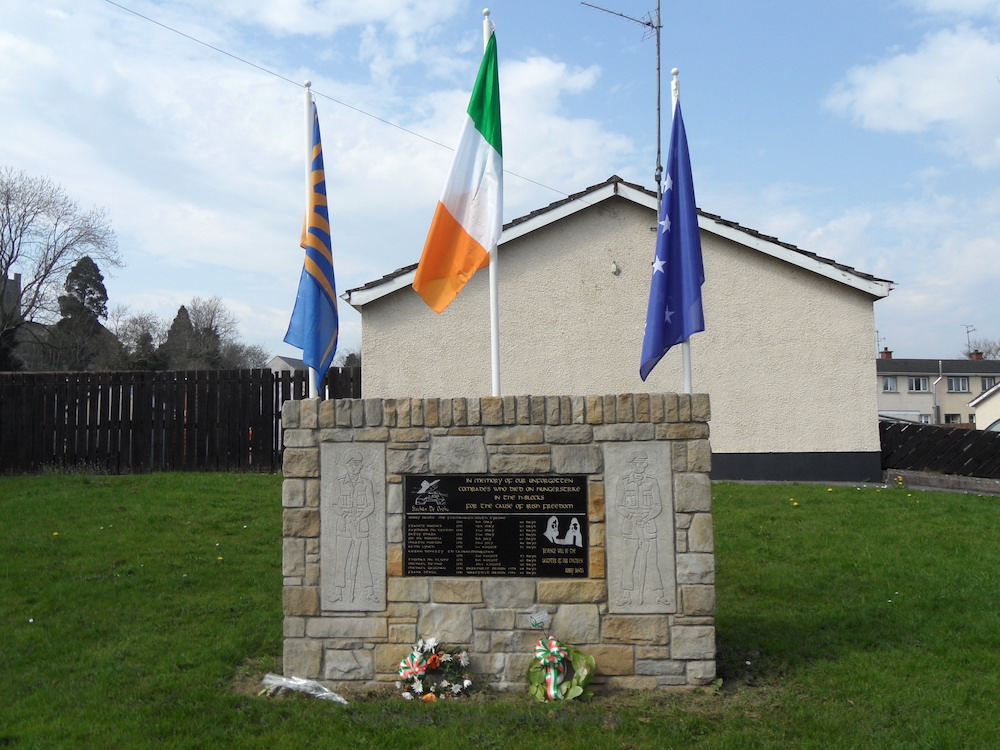
“In memory of the unforgotten comrades who died on hungerstrike in the H-Blocks for the cause of Irish freedom. Síochá[ı]n Dé orthu. [Our] revenge will be the laughter of our children – Bobby Sands”.
Michael Gaughan and Frank Stagg, who died in English prisons in the 1970s, are included below the ten deceased 1981 hunger-strikers.
A Che Guevara quote – “I don’t care if I fall as long as someone else picks up my gun and keeps on shooting” – unifies two panels bearing masked men firing funeral volleys, Irish and Palestinian shields, and “Our day will come” and “freedom” in both Irish and Arabic.
Carlisle Road/Queen’s Parade, below Teach Chú Chulaınn in the New Lodge flats
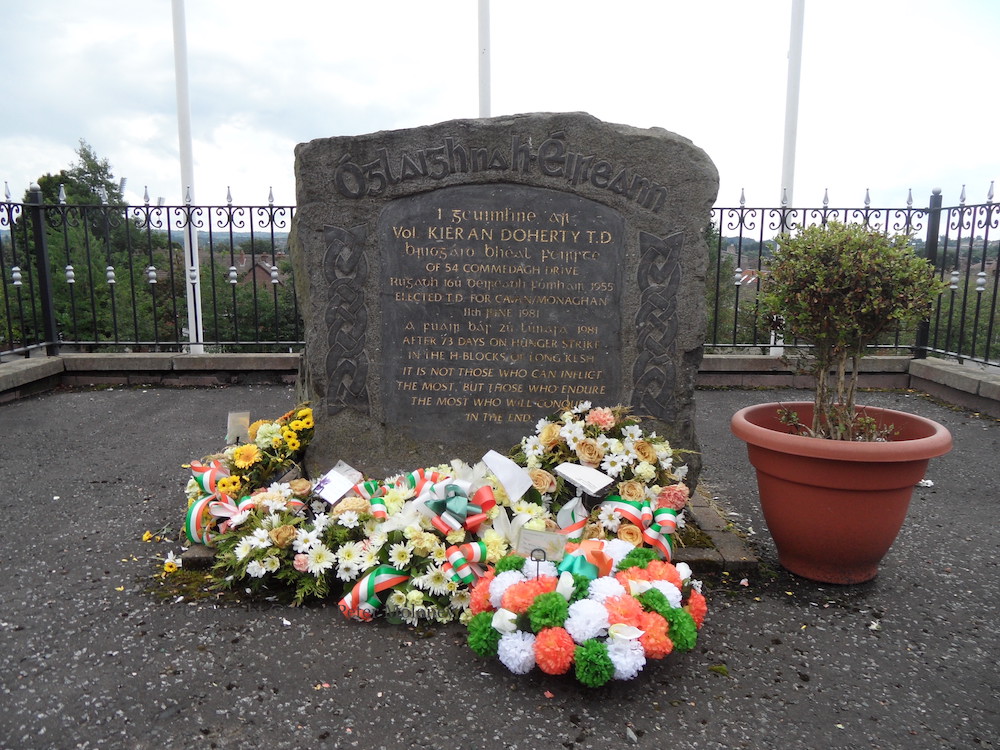
Kieran Doherty died on August 2nd, 1981, after 73 days on hunger-strike. The (repainted – compare to 2001 | 2004 | 2011) mural in his memory depicts scenes from his funeral on 1981-08-04.
The photograph on which the central panel is based is by Derek Spiers; see also this set at hungerstrikes.org. The volley took place outside the Doherty family home in nearby Commedagh Drive (Belfast Media).
The portrait of Doherty in the top left replaces a similar one in the same location; the plaque at the portrait’s top-right corner remains from before. The angled panel shows Doherty’s parents, Alfie and Margaret.
The (actual) memorial stone, which is here reproduced on the perpendicuar joining wall, was also seen in 2007.
Four deaths have been added to the memorial plaque in St James’s Road, west Belfast, which commemorates locals from the area who died at the hands of the police and army.
The plaque dates back to (at least) 1986, and originally named Rooney (civilian), Liggett (IRA), Waterson, McDonald (civilian), McGrady (civilian), Larmour (civilian), Burns (IRA), and Brady (SF).
To these have been added McAllister (civilian), Devine (civilian), O’Dwyer (civilian), and Burns (IRA).
See also: The area’s main memorial garden also includes O’Callaghan (d. 1977 IRA) and Lenaghan (d. 1991 civilian). Next to it is a mural to Liggett And Brady.
This is an interesting set of images from Main Road, Moygashel.
The first three employ familiar imagery of the UVF and the 36th Division (the Home-Rule era “Deserted! Well – I Can Stand Alone” is less familiar but goes back to at least 1988; the UVF flag also references the anti-Home Rule movement in the “1912” date of the founding of the Ulster Volunteers).
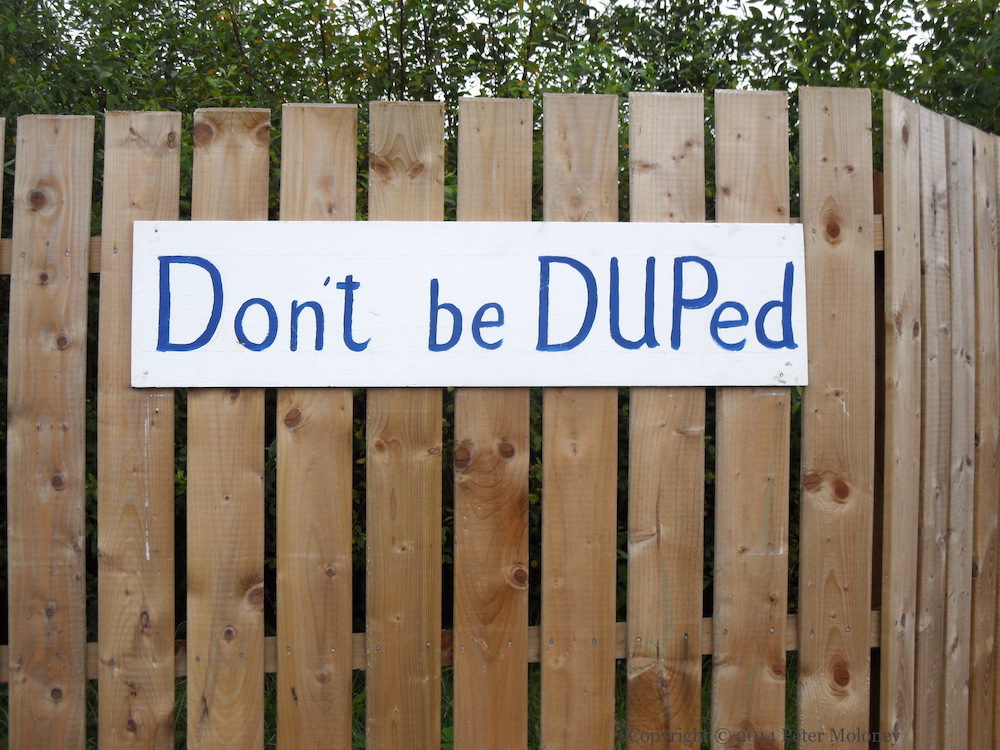
The stencil (“It is not racist to protect your own community”) and hand-painted board (“Don’t be DUPed”) indicate a recent change in attitudes.
In the May elections for the European Parliament, UKIP received the most votes and the most seats (24), campaigning on an anti-immigrant and Euro-skeptical message; this is its best electoral performance to date (WP). Perhaps in response to UKIP’s increasing popularity, Conservative leader David Cameron last year (2013) promised (gov.uk) a referendum on EU membership, should the Conservatives be elected in next year’s (2015) general election.
The source of dissatisfaction with the DUP is less clear. The party won the largest number of seats in the local elections in May (WP).
These are perhaps the first appearance in the Peter Moloney Collection of both sentiments.
Here are two new boards in the courtyard of the Rex Bar on the Shankill Road, describing the formation of the Ulster Volunteers (‘A Force For Ulster’) and commemorating the losses suffered by the 36th (Ulster) Division of the British Army, which the Volunteers became, at the Somme and in other battles, mowed down by “the Hun machine guns” (‘The Great War’).
‘A Force For Ulster’ includes photographs of the recent centenary re-enactments of the Balmoral Review, the Ulster Covenant, the formation of the Volunteers (“east” and “west”) and “Operation Lion” – more commonly known as the Larne Gun-Running.
According to the ‘The Great War’ board, 32,186 men from west Belfast were killed, wounded, or missing in the effort to “restore peace in Europe”. “To them bravery was without limit, to us memory is without end”. The board shows the Thiepval Memorial To The Missing Of The Somme against a background of portraits.
The memorial gallery on the right-hand side of Ardilea Close has been expanded from three panels to five (compared to last year/2013) and the first new face is “Charlie Wilson – age 66”.
1ú Caṫlán Oırṫear Tıreoın Óglaıġ Na hÉıreann [more typically “Tír Eoghaın”; 1st battalion east Tyrone IRA]
“Beannaımıs spıorad do-ċlaoıte na laoċra atá ına luı ıns na huıgheanna seo.” [We bless the indomitable spirit of the heroes who are buried in these graves.] “do-ċlaoıte” appears to be a Connacht form of “do-ċloíte”, meaning “indomitable”, “indefatigable” (Focaıl Fholaıthe).
The volunteers named on the various stones are Patrick Kelly, Patrick Vincent, Kevin Murray, Patrick Quinn, Patrick Carty, Seán Loughan, Patrick McDonald.
Murray and McDonald were “killed in action” in 1974 (Fb).
Quinn was “killed in action” in 1973, along with Daniel McAnallen (Fb).
Loughan and Carty were “killed in action”, along with Dermot Crowley, in June 1973 (An Phoblacht).
The flat stone with the phoenix reads: “Romantic Ireland never dies!/O’Leary lies in fertile ground./And songs and spears throughout the years/Rise up where patriot graves are found.”
St Malachy’s churchyard, Coalisland Road, Edendork.










 Peter Moloney Collection