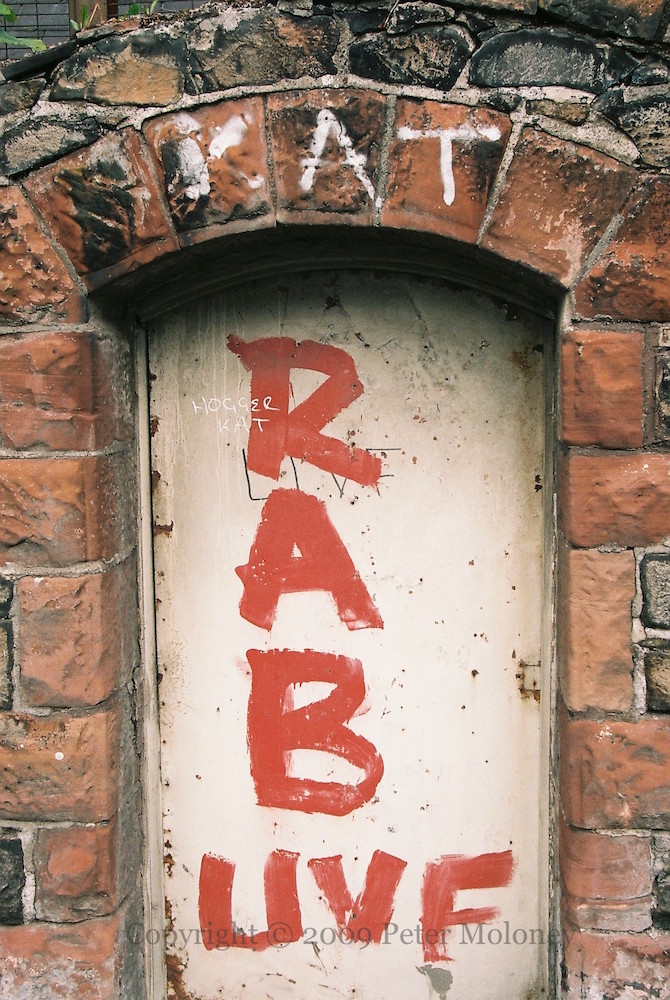
“KAT” [kill all Taigs], “Rab” (wee Rab?), “UVF” [Ulster Volunteer Force] on Woodvale Road, Belfast.
Click image to enlarge
Copyright © 2009 Peter Moloney
M04779
“KAT” [kill all Taigs], “Rab” (wee Rab?), “UVF” [Ulster Volunteer Force] on Woodvale Road, Belfast.
Click image to enlarge
Copyright © 2009 Peter Moloney
M04779

“RIRA 2 – PSNI 0” [perhaps a reference to attacks on two officers in November, 2007], is over-written with “CIRA Scum” and “Join your local ONH [Óglaıgh Na hÉıreann, a RIRA offshoot] unit”. Iris Link, Twinbrook.
Click image to enlarge
Copyright © 2009 Peter Moloney
M04762

A swastika and “white power” graffiti next to the children’s mural in Boyne Court, off Sandy Row.
Click image to enlarge
Copyright © 2009 Peter Moloney
M04755

The 2009 Sandy Row bonfire in progress in Wellwood Street, with an Irish Tricolour on its side. The balconies at right are on the ‘Victoria Place’ apartment building. For the finished construction, see Sandy Row Bonfire.
Click image to enlarge
Copyright © 2009 Peter Moloney
M04756

Fulfilling all your marching band and Orange Order needs: the One Stop Ulster Shop in its former location half-way down Sandy Row (before becoming Living Tradition and then Sandy Row Marching Band Supplies). The Royal Banner of Scotland is included alongside St Andrew’s Saltire. Bands included along the awning for the shutters are Clydevalley Volunteers Glasgow, Millar Memorial Belfast, Ballynahinch Young Loyalists, MYC Newtownards, Skeogh Flute Band, ? Liverpool, Clydevalley Volunteers Larne, Crumlin Young Loyalists, Steeple Defenders Antrim, Ballee Blues And Royals, Pride of the Shore North Belfast, Ballysillan Volunteers, Pride of Shankill, Somme Volunteers Flute Band, Glenhugh Flute Band Ahoghill, Bridgeton Loyalists, Lower Ards Volunteers, Rising Sons East Belfast, Rising Sons Of The Somme Carrickfergus.
Click image to enlarge
Copyright © 2009 Peter Moloney
M04748 [M04753] [M04752] [M04751] [M04750] [M04749]


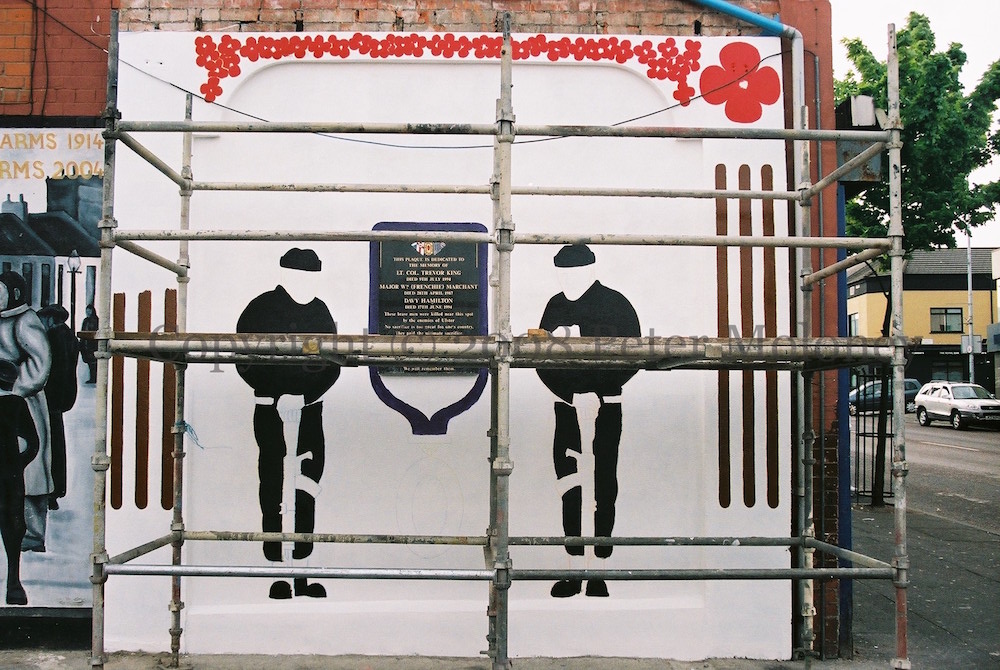
“This plaque is dedicated to the memory of Lt. Col. Trevor King died 9th July 1994, Major Wm (Frenchie) Marchant died 28th April 1987, Davy Hamilton died 17th June 1994. These brave men were killed near this spot by the enemies of Ulster. No sacrifice is too great for one’s country. They paid the ultimate sacrifice. ‘They shall grow not old/as we that are left grow old/Age shall not weary them nor the years condemn/At the going down of the sun and in the morning/We will remember them.'”
The plaque is old (see They Paid The Ultimate Sacrifice, which shows that the graveside mourners were previously hooded) but the mural is new. All three men – Marchant, King, Hamilton (and Craig) – were shot near the mural/plaque in Spier’s Place – for information, see Ordinary People, Extraordinary Roles.
Click image to enlarge
Copyright © 2008 Peter Moloney
M04553 M04552 [M04286] M04285 [M04284]

The regiments of the Ulster Volunteers were based on the electoral map (History Ireland), and hence they were North, South, East, and West, despite the fact that this led to uneven numbers of battalions in the regiments. Next to the Rex Bar on the Shankill Road. See previously the South Belfast Regiment.
Click image to enlarge
Copyright © 2008 Peter Moloney
M04551

This hunger strikers plaque (including Frank Stagg and Michael Gaughan in the 1970s) is in the D Company IRA garden of remembrance on the Falls Road.
Click image to enlarge
Copyright © 2008 Peter Moloney
M04544
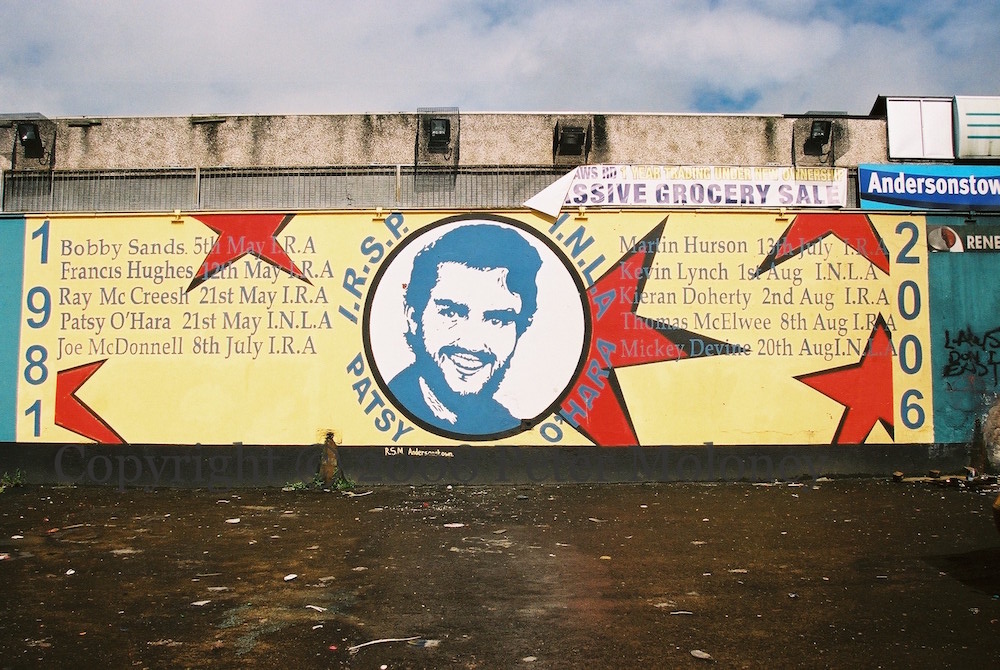
Patsy O’Hara of the INLA (the IRSP is its political wing) died on hunger strike on May 21st, 1981. This Shaws Road mural was painted for the 25th anniversary of his death. There is a signature of sorts at the bottom: “RSM [Republican Socialist Movement] Andersonstown”.
Click image to enlarge
Copyright © 2008 Peter Moloney
M04543