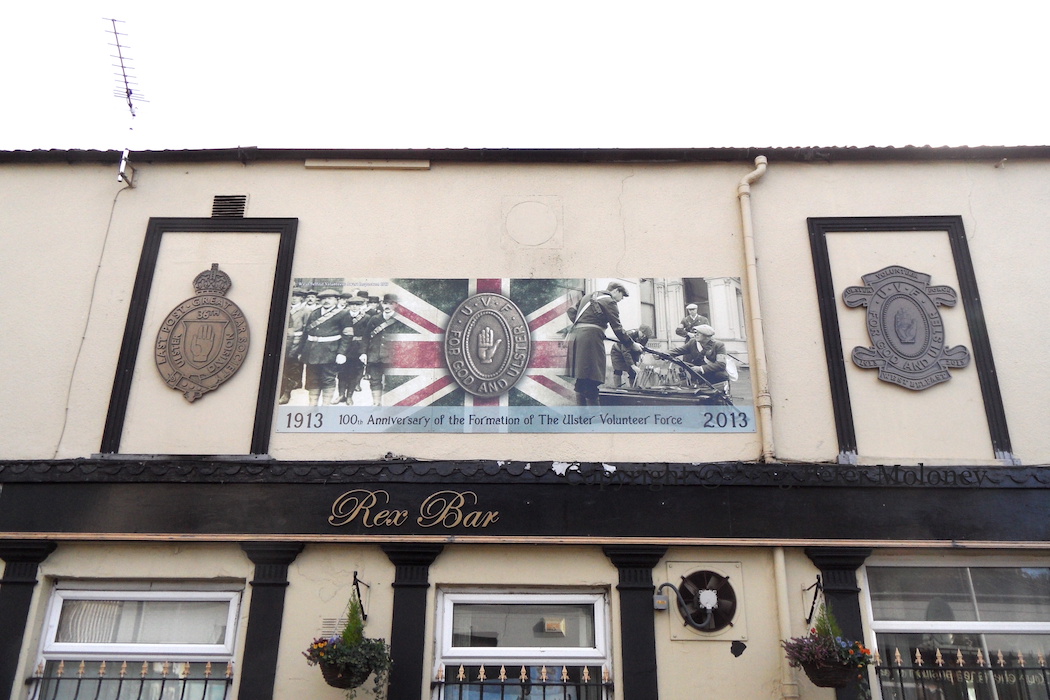
“100th Anniversary Of The Formation Of The Ulster Volunteer Force 1913-2013”, flanked by two large emblems, reading “Last Post Great War Society – 36th (Ulster) Division” and “Ulster Volunteer Force, west Belfast”.
Above the courtyard of the Rex Bar, Moscow Street, west Belfast.
“They may have stole our banner but they will never steal our culture.” The banner in question was on the fencing in the street (see Welcome To Loyalist Linfield Road) but wound up on a CNR bonfire in Divis; the wider context is the on-going disputes over the routes established by the Parades Commission for Orange Order marches.
The red hand in Fountain Street – seen previously with “PSNI scum” and “IRA” graffiti – is somewhat repaired – “PSNI scum” is still faintly visible across the top and the “IRA” at the base of the hand has been blacked out. “WBE” has been added; the “E” in “WBE” is unknown – compare with WBLY.
These three pairs of UK shields (Ulster Banner, St Andrew’s Saltire, Union Flag) are in Lindsay Street, south Belfast. There was also a fourth one, with the shield of the 36th Division. The were mounted in the four spaces (and in two cases, on the backing boards) used for a set of older boards, and the old title strip is still visible in the first two images: “Relief Of Londonderry” can be seen in the first image, while “Williamite cavalry charge, Aughrim” is visible in the second.
(The other two were “Jacobites fleeing at Enniskillen” and “Battle Of The Boyne”. For the four previous pieces, from left to right, see D00353, D00355, D00354, and D00356.)
“Donegall Pass UVF 1913-2013” Visible from the Ormeau Road, this large union flag greets visitors to Donegall Pass in the south of the city. It asserts the presence of the UVF and connects the original Ulster Volunteers of 1913 to the present-day Ulster Volunteer Force one hundred years later: the aim of the original Ulster Volunteers was to resist the impending rule by Catholics under Home Rule.
South Belfast MP Robert Bradford was assassinated by the Provisional IRA in Finaghy at a meeting with constituents; the caretaker of the community centre, Ken Campbell, was also killed by the fleeing attackers. Taking place in late 1981, with the hunger strikes having ended only a month before, the killing was noted around the world and raised fears of broad civil unrest (BBC | NYTimes). The board immediately above replaces an earlier mural to Bradford on the gable wall that now hosts the large board shown above, commemorating the Siege Of Derry and specifically the “Apprentice Boys Of Derry No Surrender Club” of south Belfast.
“The Ulster conflict is about nationality. This we shall maintain” with the red hand for “Ulster”, the thistle for Scotland, the Union Flag for the UK, the rose for England, and – new to this version of the mural – the daffodil for Wales. For the previous version of the mural, which uses the dragon for Wales, see M02376.
The first panel of “Freedom Corner” on the Newtownards Road, is repainted for the 40th anniversary of the UFF [Ulster Freedom Fighters], 1973-2013. For the previous (or at least, a 2005) version, see M02370. “Feriens tego” is Latin for “In striking, I defend”.