Peace Bridge

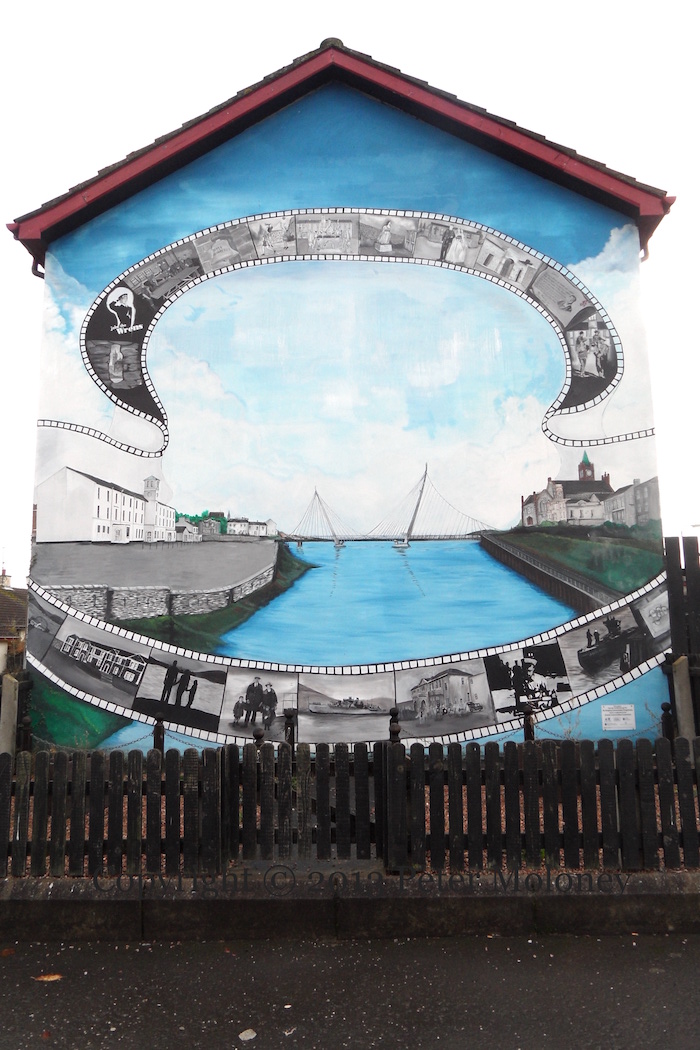
In this Caw mural the Peace Bridge is shown spanning the Foyle between (the former) Ebrington barracks and the Guildhall, with a film-strip of images, many depicting naval and military scenes, above and below. Second from left in the upper ribbon, a poster encourages people to “Join the Wrens [and free a man for the fleet]” (the Women’s Royal Naval Service; see the poster at IWM); there are also soldiers playing ping-pong in their barracks, and the ship’s bell of the HMS Londonderry (which served as a training ship during the Falkland War — WP).

Sperrin Park, Caw, Londonderry

Click image to enlarge
Copyright © 2013 Peter Moloney
M10541 [M10541a]

The Derrys

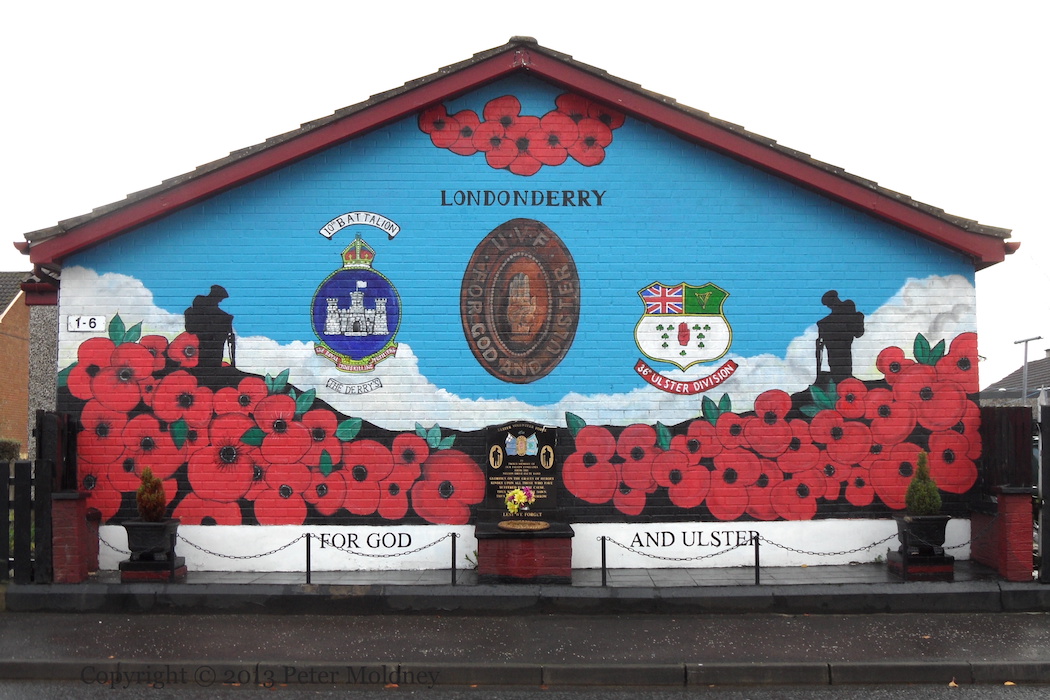
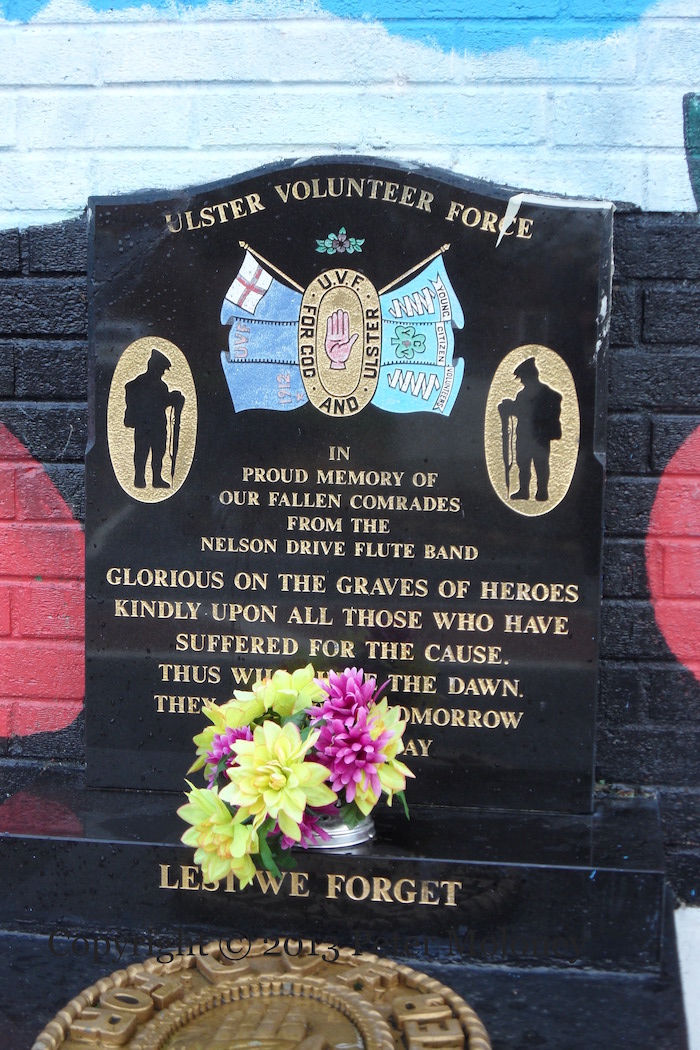
“In proud memory of our fallen comrades from the Nelson Drive flute band. Glorious on the graves of heroes, kindly upon all those who have suffered for the cause. Thus will shine the dawn. They gave their tomorrow for our today.” The words in italics are from a Winston Churchill radio broadcast on October 21, 1940, entitled Dieu Protège La France. The final, more familiar, phrase is John Maxwell Edmonds’s memorial epitaph. The 10th battalion of the Inniskilling Fusiliers, in the 109th brigade of the 36th (Ulster) Division, was called “The Derrys” (web).

Kinsale Park, Caw, Londonderry

Click image to enlarge
Copyright © 2013 Peter Moloney
M10534 [M10535] [M10536] [M10537] M10538 [M10539] [M10540]

For Me There Will Be No More War

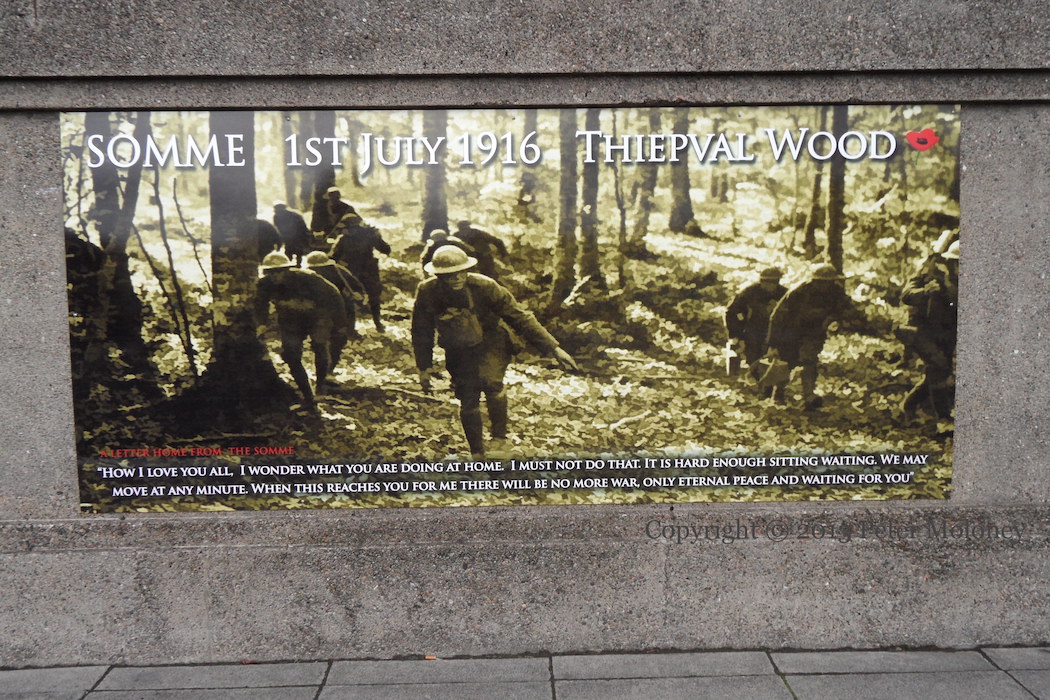
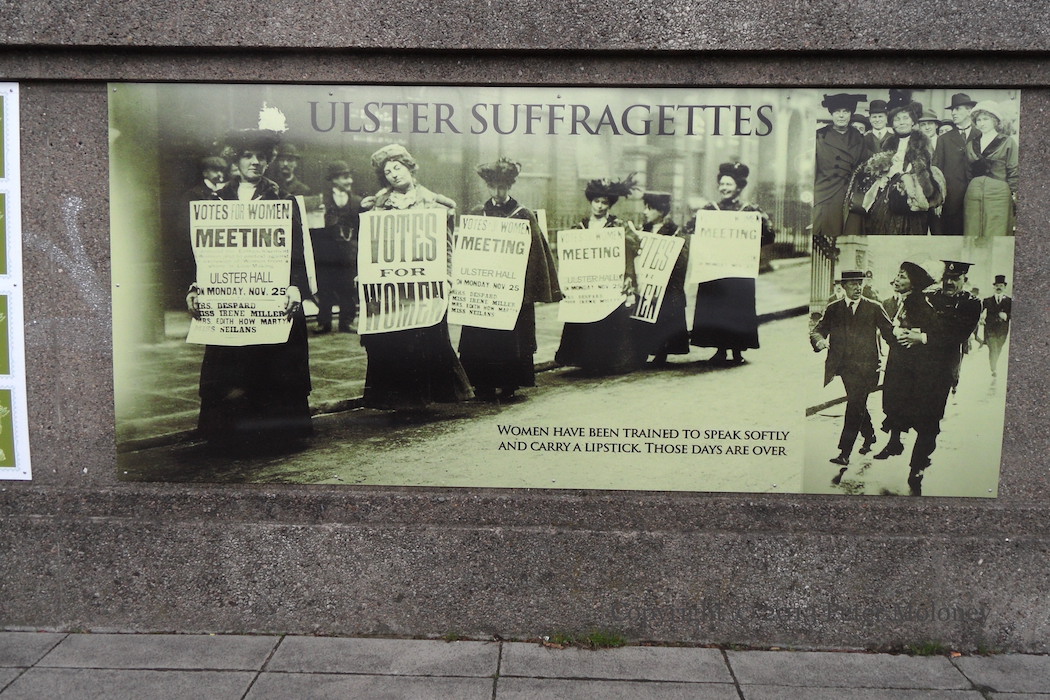
Here are three of twenty new panels on the Donegall Road bridge over the railway.

The post on the mural to James Magennis in Tullycarnet provides background information on him.

A letter home from the Somme: “How I love you all. I wonder what you are doing at home. I must not do that. It is hard enough sitting waiting. We may move at any minute. When this reaches you for me there will be no more war, only eternal peace and waiting for you.” July 1st, 1916 saw the start of the Battle Of The Somme. The 36th (Ulster) division lost over 5,000 men in an initial successful attack near Thiepval Wood, but were driven back that evening.

Ulster suffragettes: “Women have been trained to speak softly and carry a lipstick. Those days are over.” (Bella Abzug). The board shows a picture of women drumming up an audience for a suffragette meeting in the Ulster Hall in November 1912. The image in the bottom right is of Emmeline Pankhurst being arrested in London in 1914; the top image is of Pankhurst on tour in the US in 1913 (LoC; see Pieces Of History for a description of the tour; she gave a speech entitled ‘Freedom Or Death’). Pankhurst spoke in Belfast at the 1912 meeting, though the speakers advertised on the placards are “Mrs Charlotte Despard, Miss Irene Miller, Mrs Edith How-Martyn, Miss Alison Neilans“. The first suffrage group in Ireland was the North Of Ireland Women’s Suffrage Society, founded in Belfast in 1872 by Isabella Tod. See also Belfast’s Infamous Prison for information about suffragettes held in Crumlin Road Gaol.

For a complete set of panels, see north side and south side.

Click image to enlarge
Copyright © 2013 Peter Moloney
M10517 M10516 M10515

100th Anniversary Of The Formation Of The Ulster Volunteer Force

“100th Anniversary Of The Formation Of The Ulster Volunteer Force 1913-2013”, flanked by two large emblems, reading “Last Post Great War Society – 36th (Ulster) Division” and “Ulster Volunteer Force, west Belfast”.

Above the courtyard of the Rex Bar, Moscow Street, west Belfast.

Click image to enlarge
Copyright © 2013 Peter Moloney
M10487 M10488 M10489 M10486

They Will Never Steal Our Culture

“They may have stole our banner but they will never steal our culture.” The banner in question was on the fencing in the street (see Welcome To Loyalist Linfield Road) but wound up on a CNR bonfire in Divis; the wider context is the on-going disputes over the routes established by the Parades Commission for Orange Order marches.

Linfield Gardens, south Belfast.

Click image to enlarge
Copyright © 2013 Peter Moloney
M10509

West Bank Estate

The red hand in Fountain Street – seen previously with “PSNI scum” and “IRA” graffiti – is somewhat repaired – “PSNI scum” is still faintly visible across the top and the “IRA” at the base of the hand has been blacked out. “WBE” has been added; the “E” in “WBE” is unknown – compare with WBLY.

Click image to enlarge
Copyright © 2013 Peter Moloney
M10481

Faded Glory

These three pairs of UK shields (Ulster Banner, St Andrew’s Saltire, Union Flag) are in Lindsay Street, south Belfast. There was also a fourth one, with the shield of the 36th Division. The were mounted in the four spaces (and in two cases, on the backing boards) used for a set of older boards, and the old title strip is still visible in the first two images: “Relief Of Londonderry” can be seen in the first image, while “Williamite cavalry charge, Aughrim” is visible in the second.

(The other two were “Jacobites fleeing at Enniskillen” and “Battle Of The Boyne”. For the four previous pieces, from left to right, see D00353, D00355, D00354, and D00356.)

Click image to enlarge
Copyright © 2013 Peter Moloney
M10438 M10437 M10436

Donegall Pass UVF

“Donegall Pass UVF 1913-2013” Visible from the Ormeau Road, this large union flag greets visitors to Donegall Pass in the south of the city. It asserts the presence of the UVF and connects the original Ulster Volunteers of 1913 to the present-day Ulster Volunteer Force one hundred years later: the aim of the original Ulster Volunteers was to resist the impending rule by Catholics under Home Rule.

Charlotte Street, Belfast.

Click image to enlarge
Copyright © 2013 Peter Moloney
M10434 [M10435]