“This window on the theme PEACE was given to mark the sacrifices and honour the achievements of the Royal Ulster Constabulary George Cross [foundation website] 1922-2001. Dedicated by The Most Reverend Lord Eames of Armagh 12th October, 2008. Houston McKelvey, dean [dedication text], Kenneth Patterson, warden, Phyllis Foster, warden.”
St Anne’s Cathedral, Donegall Street, Belfast city centre. Designed by Ann Smyth (web).
“This memorial is dedicated to the memory of the fallen Officers, NCOs and Volunteers of Number 4 Platoon, A Company, 1st Belfast Battalion, Ulster Volunteer Force. It serves as a tribute to those who fell while actively engaging the enemy from service having fulfilled their duties to the end. Their names and deeds are eternally venerated by their comrades in arms who continue to serve humbly in their honour. ‘They went with songs to battle, they were young,/Straight of limb, true of eyes, steady and aglow,/They remained staunch to the end against odds uncounted,/They fell with their faces to the foe.’ [Binyon’s ‘For The Fallen’]”
“Glencairn demands civil rights for all Protestants now!” and “RIP Maggie Thatcher, the Iron Lady – true legend.” Thatcher died on April 8th, 2013. The specific reason for the tarp, if any, is unknown; it might be the ban on marching past the Ardoyne shops (CSMonitor).
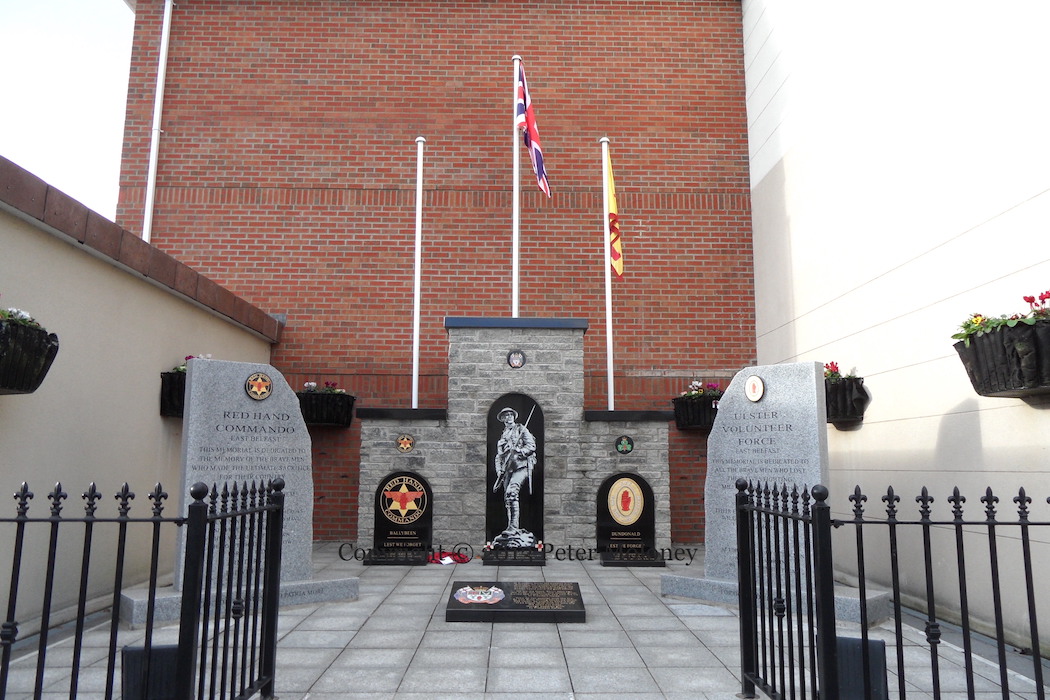
The Ballybeen memorial garden contains stones/plaques to 36th (Ulster) Division (WWI), Ballybeen Red Hand Commando, Dundonald UVF, East Belfast UVF, East Belfast Red Hand Commando.
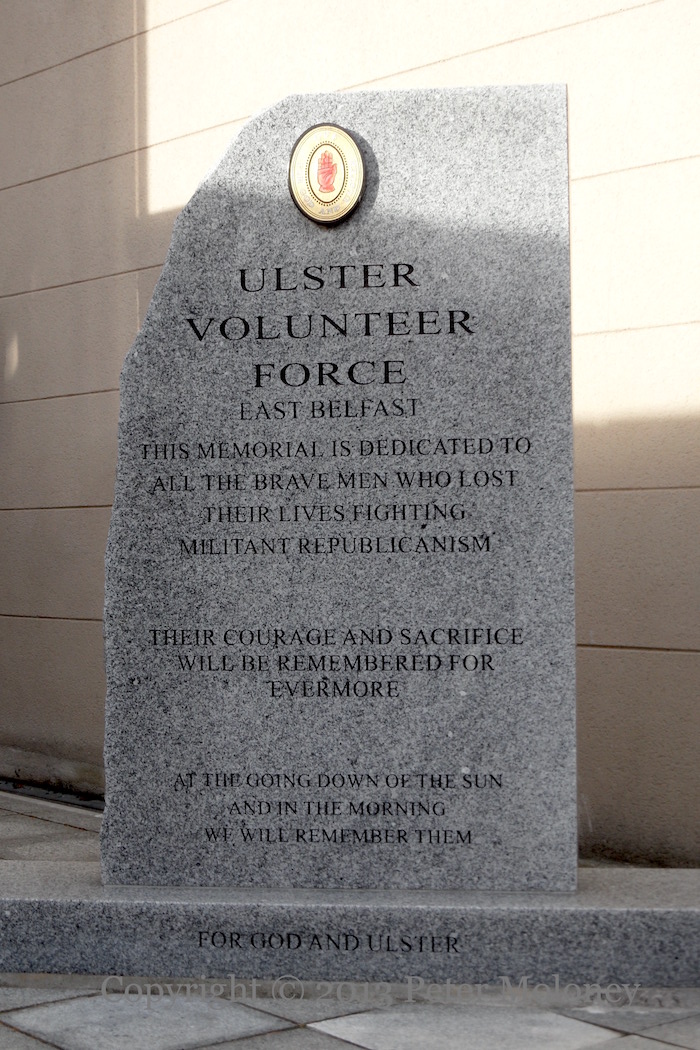
UVF: “This memorial is dedicated to all the brave men who lost their lives fighting militant republicanism. Their courage and sacrifice will be remembered for evermore. ‘At the going down of the sun/And in the morning/We will remember them’ For God and Ulster.”
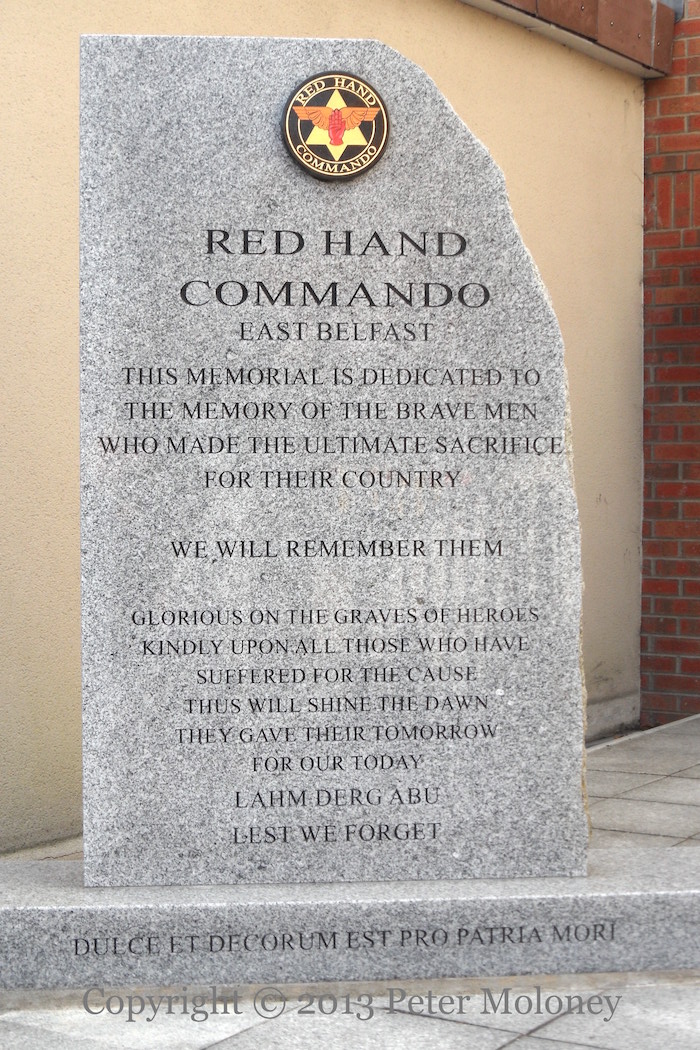
RHC: “This memorial is dedicated to the memory of the brave men who made the ultimate sacrifice for their country. We will remember them. ‘Glorious on the graves of heroes/Kindly upon all those who have suffered for the cause/Thus will shine the dawn.’ [Winston Churchill, radio broadcast on October 21, 1940, entitled Dieu Protège La France.] ‘They gave their tomorrow for our today.’ [John Maxwell Edmonds’s memorial epitaph] Lahm [sic] derg [sic] abu [sic]. Lest we forget. Dulce et decorum est pro patria mori.” (Wilfred Owen)
Edward Carson with the emblem of the 36th Division and James Craig with the Ulster Banner. Both were founders of the Ulster Volunteers and leaders of the Ulster Unionist Party.
This is a refreshed Eddie The Trooper in Ebrington Terrace, Waterside, Londonderry, with solid black border and UFF red fist in yellow six-pointed star above. Here is the previous version.
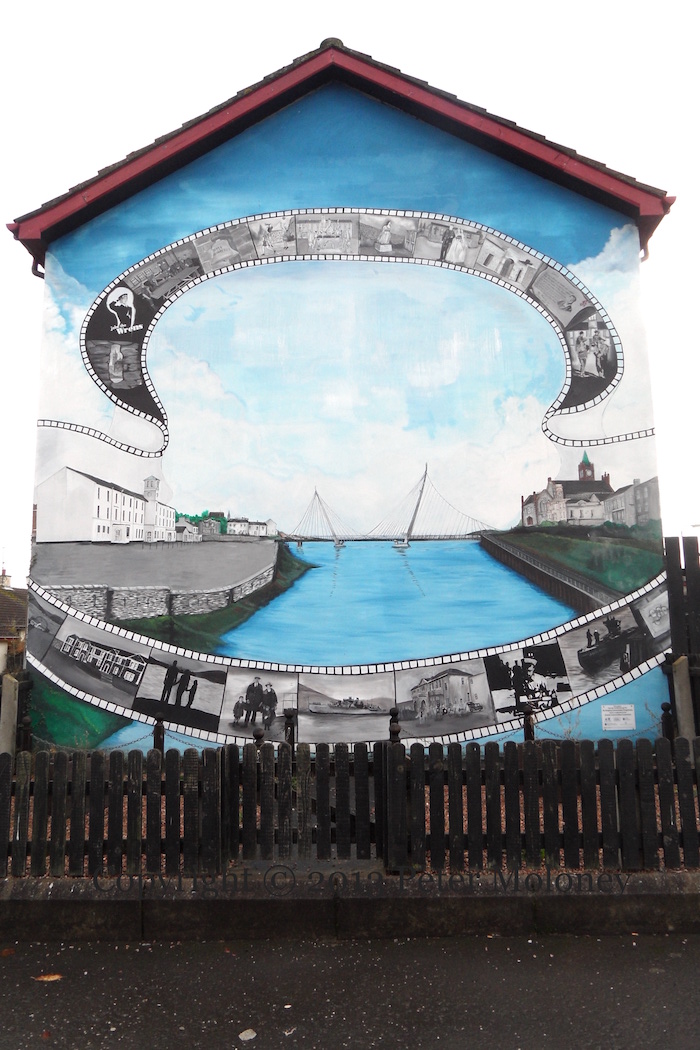
In this Caw mural the Peace Bridge is shown spanning the Foyle between (the former) Ebrington barracks and the Guildhall, with a film-strip of images, many depicting naval and military scenes, above and below. Second from left in the upper ribbon, a poster encourages people to “Join the Wrens [and free a man for the fleet]” (the Women’s Royal Naval Service; see the poster at IWM); there are also soldiers playing ping-pong in their barracks, and the ship’s bell of the HMS Londonderry (which served as a training ship during the Falkland War — WP).
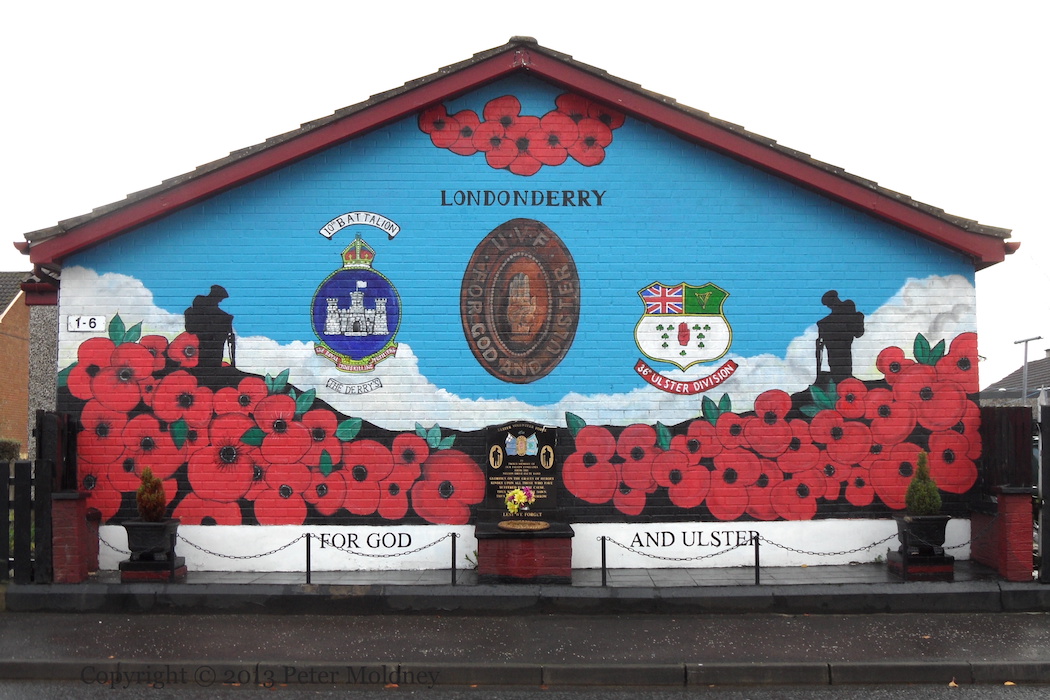
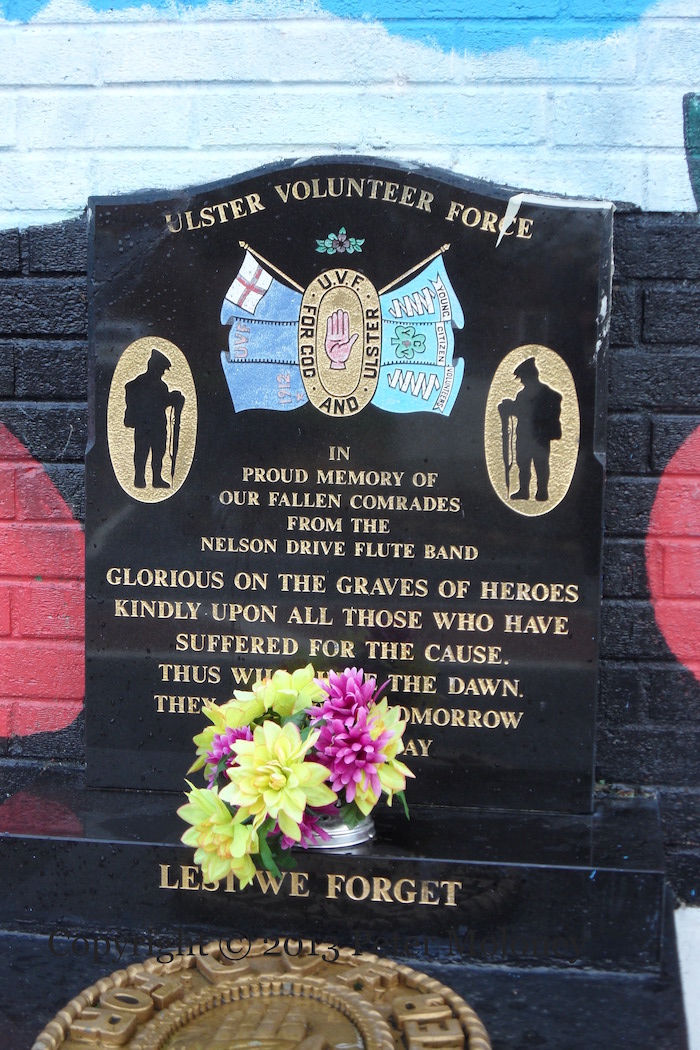
“In proud memory of our fallen comrades from the Nelson Drive flute band. Glorious on the graves of heroes, kindly upon all those who have suffered for the cause. Thus will shine the dawn. They gave their tomorrow for our today.” The words in italics are from a Winston Churchill radio broadcast on October 21, 1940, entitled Dieu Protège La France. The final, more familiar, phrase is John Maxwell Edmonds’s memorial epitaph. The 10th battalion of the Inniskilling Fusiliers, in the 109th brigade of the 36th (Ulster) Division, was called “The Derrys” (web).
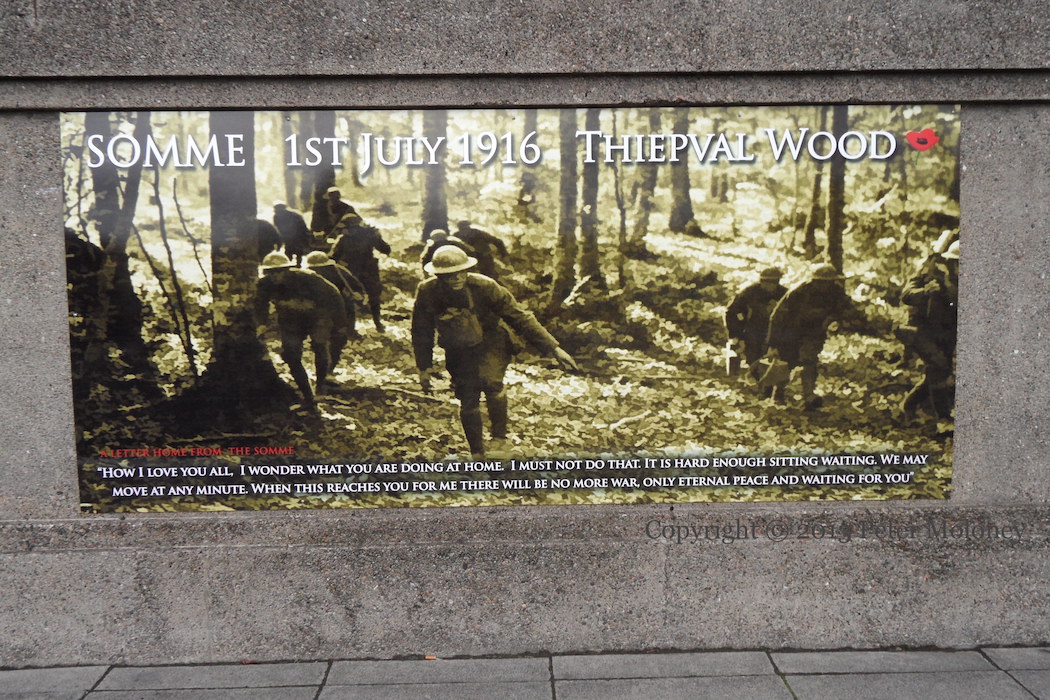
A letter home from the Somme: “How I love you all. I wonder what you are doing at home. I must not do that. It is hard enough sitting waiting. We may move at any minute. When this reaches you for me there will be no more war, only eternal peace and waiting for you.” July 1st, 1916 saw the start of the Battle Of The Somme. The 36th (Ulster) division lost over 5,000 men in an initial successful attack near Thiepval Wood, but were driven back that evening.
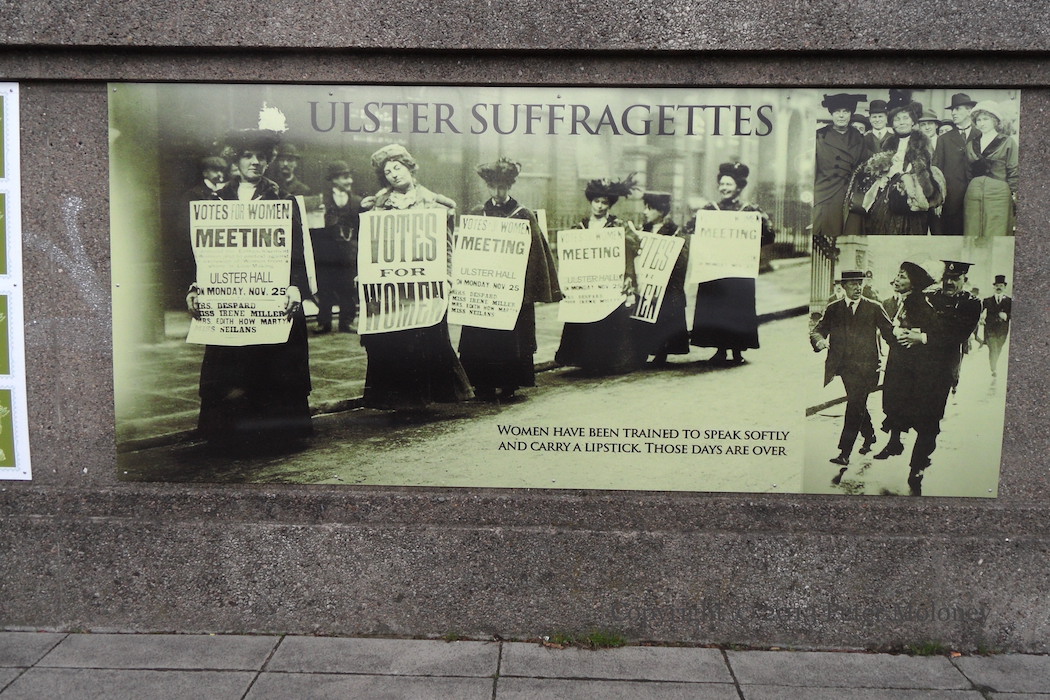
Ulster suffragettes: “Women have been trained to speak softly and carry a lipstick. Those days are over.” (Bella Abzug). The board shows a picture of women drumming up an audience for a suffragette meeting in the Ulster Hall in November 1912. The image in the bottom right is of Emmeline Pankhurst being arrested in London in 1914; the top image is of Pankhurst on tour in the US in 1913 (LoC; see Pieces Of History for a description of the tour; she gave a speech entitled ‘Freedom Or Death’). Pankhurst spoke in Belfast at the 1912 meeting, though the speakers advertised on the placards are “Mrs Charlotte Despard, Miss Irene Miller, Mrs Edith How-Martyn, Miss Alison Neilans“. The first suffrage group in Ireland was the North Of Ireland Women’s Suffrage Society, founded in Belfast in 1872 by Isabella Tod. See also Belfast’s Infamous Prison for information about suffragettes held in Crumlin Road Gaol.
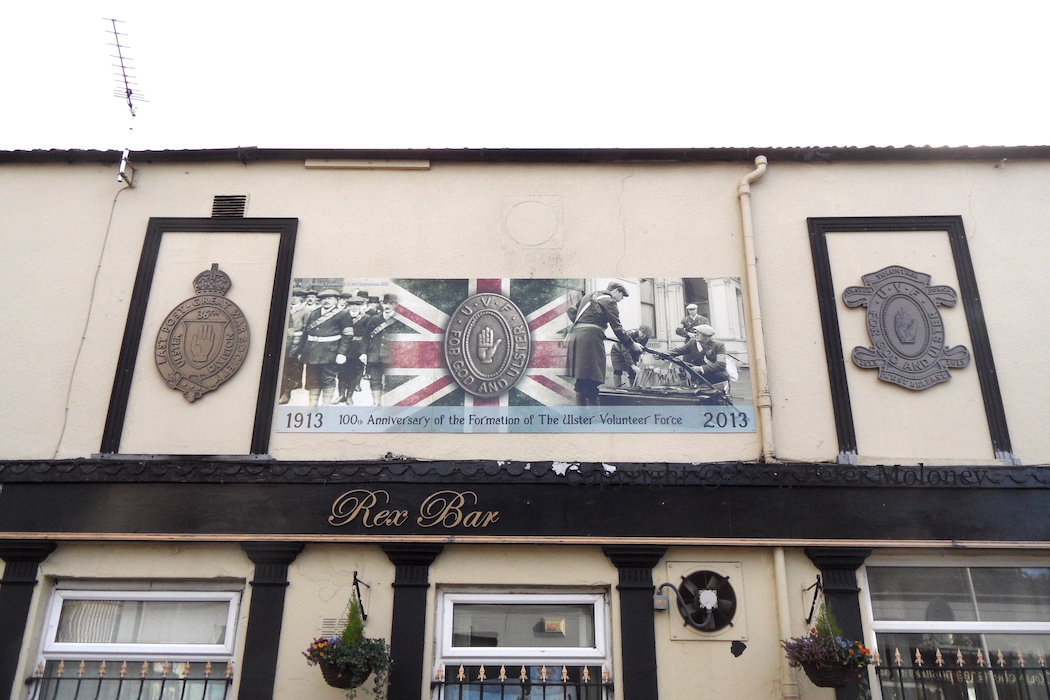
“100th Anniversary Of The Formation Of The Ulster Volunteer Force 1913-2013”, flanked by two large emblems, reading “Last Post Great War Society – 36th (Ulster) Division” and “Ulster Volunteer Force, west Belfast”.
Above the courtyard of the Rex Bar, Moscow Street, west Belfast.







 Peter Moloney Collection