The Parades Commission (web) ruled in 2013 – and in 2014 and now again in 2015 – that the Orange Order could not parade past the Ardoyne shops. A legal bid to reverse the decision was rejected by.a High Court judge (BBC).
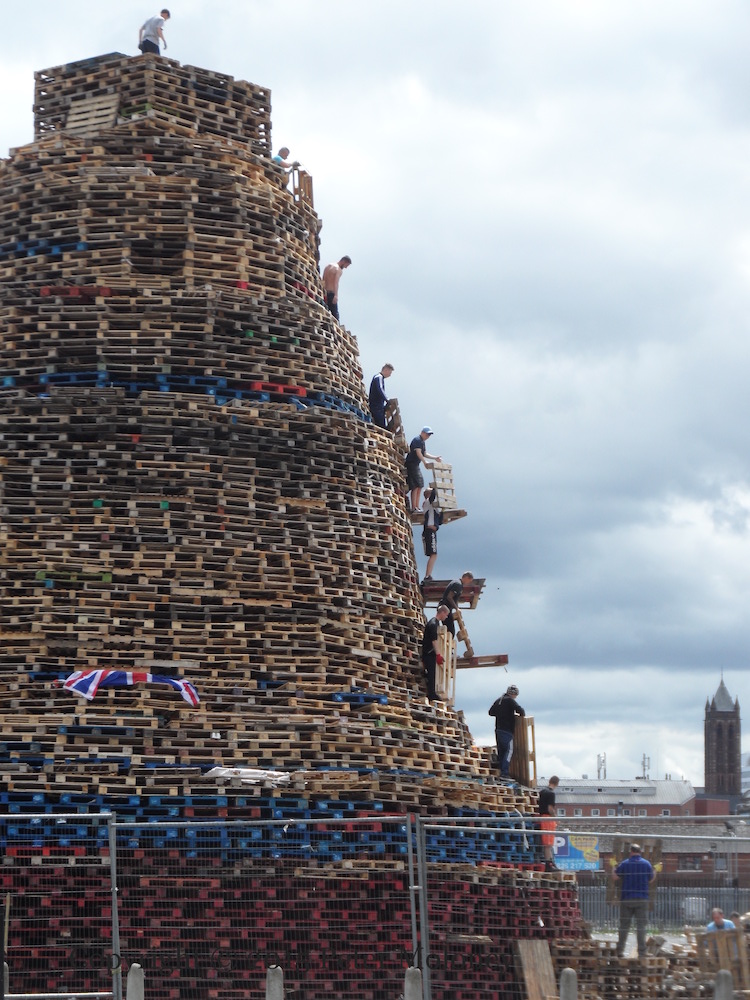
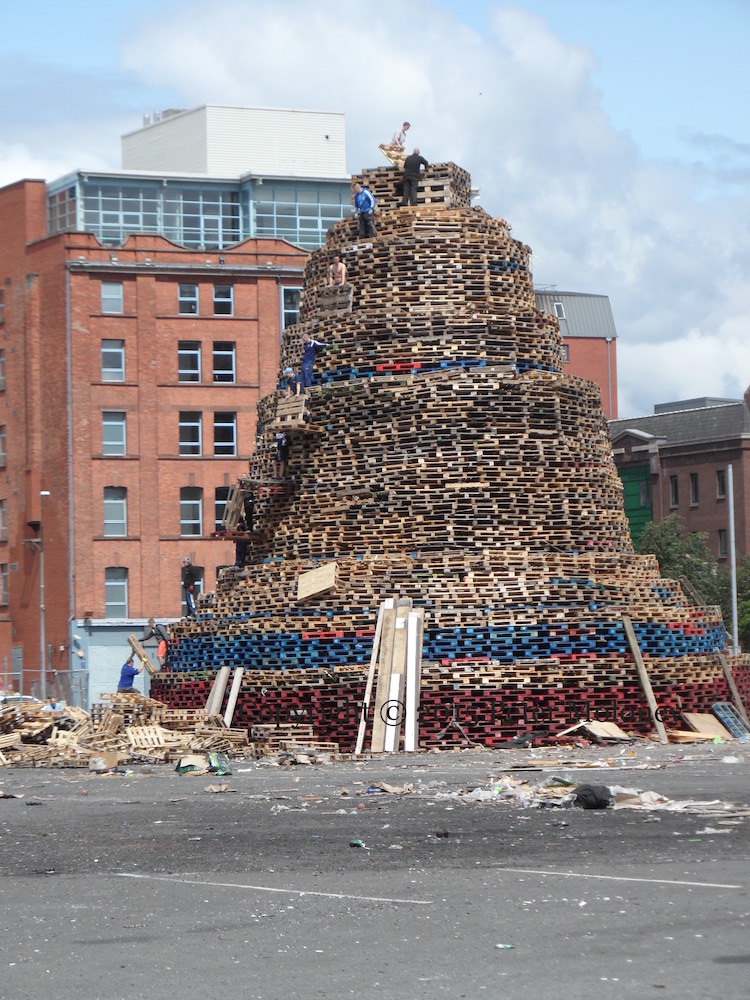
In protest, a giant Tricolour with the words “These are the colours of the Parades Commission” have been added to the side of the Sandy Row bonfire (in the Days Hotel car-park) that is due to be lit this evening – Eleventh Night.
The new Museum of Orange Heritage in Schomberg House opened at the end of June. It features a stained glass window with the words “faithful unto death”, commemorating the 330+ (countsdiffer) members of the Orange Order who were killed during the Troubles.
The museum is at the south end of Cregagh Road; the advertising hoarding is on the Upper Newtownards Road, east Belfast
The Pride Of Ballybeen is a flute band formed in 2014. Their band mural features the Union Flag and Ulster Banner flanking the red hand of Ulster on a six-pointed star against an orange field, surrounded by a crown and a garland pinned by a rose; the titular banner, below, is supported by shamrock and thistle.
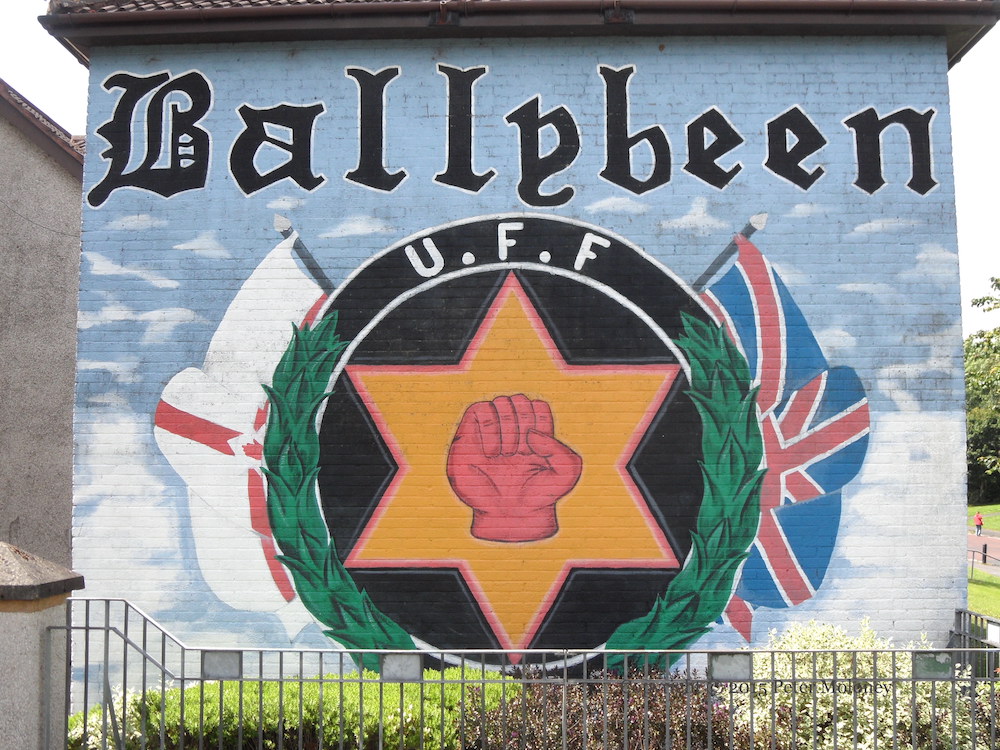
The hedge at the corner of Strone Park and Craigleith Drive in Ballybeen has been cut down (compared to 2007) to give a better view of the UFF mural beyond.
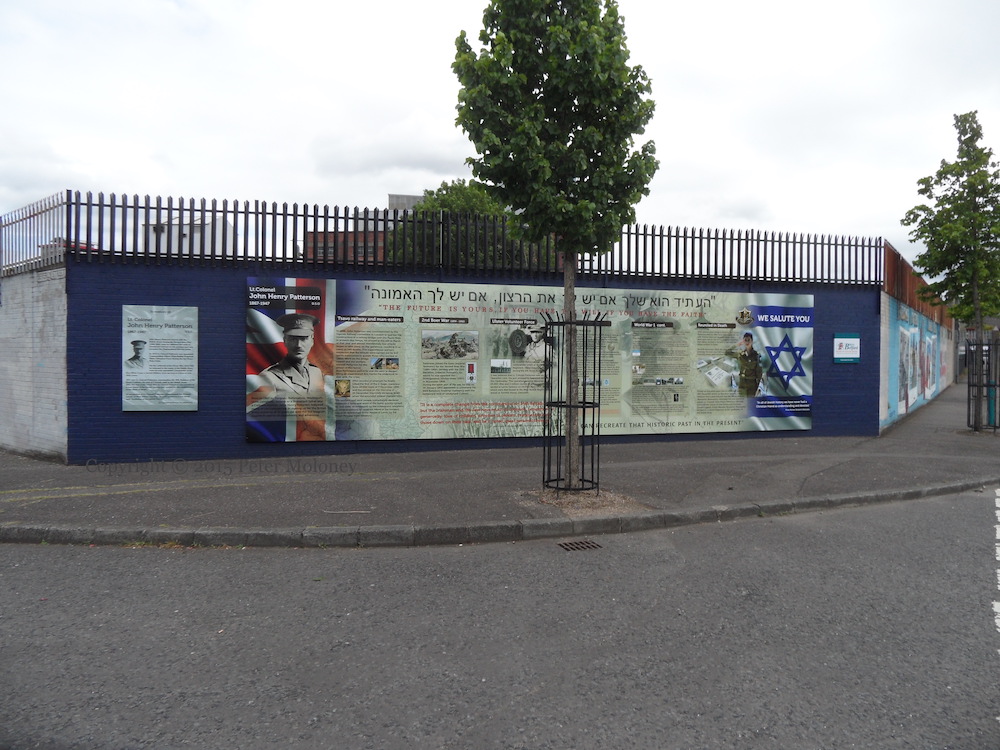
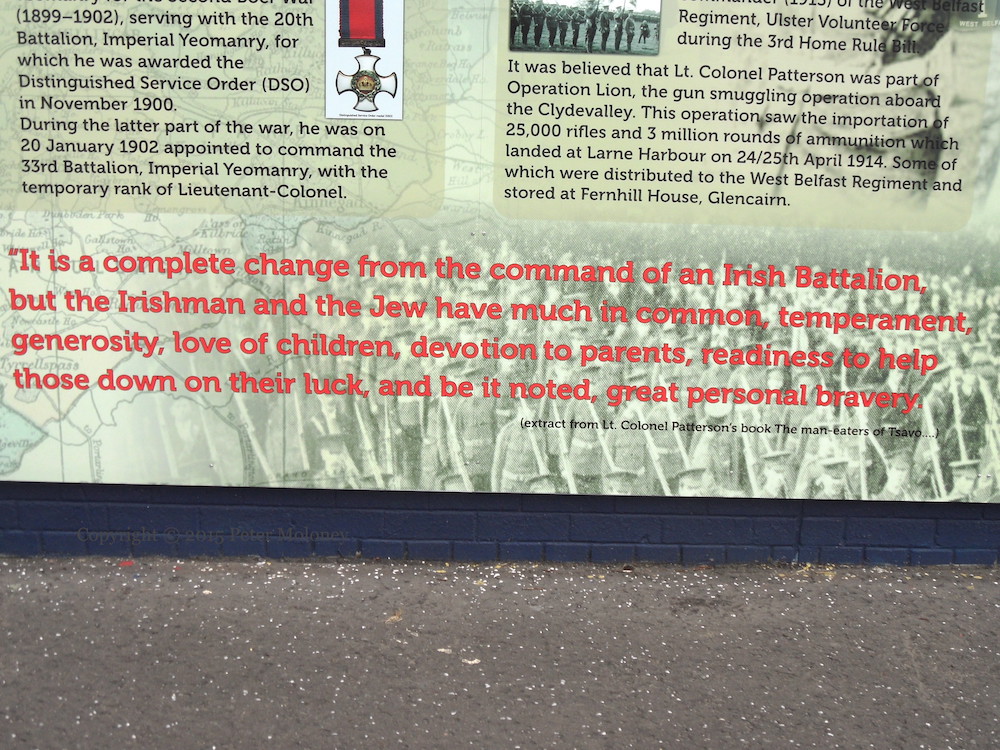
John Henry Patterson went from Ireland to Kenya, where he killed several lions after months of hunting. He wrote an account of the hunt ‘The Man-Eaters of Tsavo’ which has inspired three movies. The lions, named The Ghost and The Darkness, were both over nine feet in length. Back in Ireland he commanded a battalion of the UVF and was involved in the Larne gun-running of 1914: Operation Lion.
The final panel shows the star of David and a quote from Prime Minister Benjamin Netanyahu: “In all of Jewish history we have never had a Christian friend as understanding and devoted.” The interim panels described Patterson’s raising and leading of the Jewish battalions of the Royal Fusiliers in WWI. After dying in obscurity in Los Angeles in 1947, his remains were transported to Israel in December 2014 and reinterred (video). For more, including a recording of Patterson’s voice, see this BBC Magazine article.
“John Henry Patterson DSO 1867-1947. Born in 1867 in Forgney, Ballymahon, Westmeath (now Longford), Ireland to a Protestant father and a Catholic mother, John Henry Patterson followed many of his compatriots in signing up for the British Army enlisting at 17 years old with the 3rd Dragoon Guards in search of opportunity and adventure.” “In 1898, John Patterson was commissioned by the Uganda Railway committee in London to oversee the construction of a railway bridge of the Tsavo River in present-day Kenya. He arrived at the site in March of that year and almost immediately lion attacks began to take place on the workforce, resulting in as many as 140 deaths. The superstitious workers suspected that the attacks were carried out by evil spirits summoned to punish those who worked at Tsavo. Work on the bridge ceased and the workers blamed Patterson for the arrival of this terror. Now Patterson’s authority and life were in danger, being an experienced lion hunter he undertook to deal with the crisis. After months of attempts he finally killed the first of the 2 huge, maneless lions on the night of 9 December 1898 and the second on the morning of 29 December (narrowly escaping death when the wounded animal charged him). The workers and local people immediately declared Patterson a hero, and word of the event quickly spread far and wide, as evidenced by the subsequent telegrams of congratulations he received. Word of the incident was even mentioned in the House of Lords, by the Prime Minister Lord Salisbury.” “Patterson joined the Essex Imperial Yeomanry for the Second Boer War (1899-1902), serving with the 20th Battalion, Imperial Yeomanry, for which he was awarded the Distinguished Service Order (DSO) in November 1900. During the latter part of the war, he was on 20 January 1902 appointed to command the 33rd Battalion, Imperial Yeomanry, with the temporary rank of Lieutenant-Colonel. Lt. Colonel Patterson was appointed commander (1913) of the West Belfast Regiment, Ulster Volunteer Force during the 3rd Home Rule Bill. It was believed that Lt. Colonel Patterson was part of Operation Lion, the gun smuggling operation aboard the Clydevalley. This operation saw the importation of 25,000 rifles and 3 million rounds of ammunition which landed at Larne Harbour on 24/25th April 1914. Some of which were distributed to the West Belfast Regiment and stored at Fernhill House, Glencairn.” “The Zion Mule Corps. Lt. Colonel Patterson rejoined the British Army in 1914, upon the outbreak of World War I, and saw service in Flander[s] before being sent to Egypt. In Alexandria he met Joseph Trumpeldor and Zeev Jabotinsky who were attempting to form a Jewish military force. By the end March 1915, Jewish volunteers from among deportees in Egypt had started training. The British military command opposed to participation of Jewish volunteers on the Palestinian front and suggested the volunteers serve as a detachment for mule transport. In 1915, Lt. Colonel Patterson was made commander of the approximately 750 man Zion Mule Corps, organized in Egypt in March, with a rank of “honorary Lieutenant Colonel.” Swearing in the new volunteers on March 31, 1915. Patterson wrote in his diary “never since the days of Judah Maccabee had such sights and sounds been seen and heard in a military camp – with the drilling of uniformed soldiers in the Hebrew language”. In April of 1915, after the Mule Corps had been in training for just 3 weeks, Lt. Colonel Patterson landed with the corps at V Beach, Gallipoli. About half of the corps were seconded to the Anzacs, who treated them discourteously and had them shipped back to Alexandria, the rest under Lt. Colonel Patterson then landed at Cape Helles on April 27th where they saw action for the very first time, there the corps served with distinction out of the 300 men that landed, 14 were killed.” “The Mule Corps disbanded in early 1916, Lt. Colonel Patterson returned to Ireland where he commanded the 4th Royal Irish Fusiliers and 5th Royal Dublin Fusiliers. In 1917, after 3 years of lobbying by the British Jewish community, and the likes Jabotinsky the British government finally agreed to the raising of a specifically Jewish unit to fight in the British Army in World War One against the Turks in Palestine/Israel. The force was to be part of the Royal Fusiliers and were given the battalion numbers 38th-42nd. The whole force became known as the Jewish Legion or colloquially as “The First Judeans” The most famous photograph of the men on their march shows Lt. Colonel Patterson clearly and proudly at the head of his men on his horse with one of his offices mounted behind him though the image is blurred has the Lt. Colonel clearly with a broad smile on his face. Indeed every man was smiling as they were lionised by the crowds before embarking on their journey to the Jordan Valley. In June 1918 38th Battalion began engaging the Ottomans some twenty miles north of Jerusalem the Legion also participated in the Battle of Megiddo in mid-September 1918 widely considered to have been one of the final and decisive victories of the Ottoman front. The legion’s mission was to cross the Jordan river. Jabotinsky led the effort. Later he was decorated and Major General Chaytor told the Jewish troops “By forcing the Jordan fords, you helped in no small measure to win the great victory gained at Damascus. During his time in command Lt. Colonel Patterson faced ongoing anti-semitism from superiors, peers and subordinates. His reaction to this engendered much respect from his men, who believed he had sacrificed promotion and position in his quest to ensure fair treatment of them.” “After several years living in American Lt Colonel Patterson died on 18th June 1947 (aged 79), his wife Frances died just six short weeks later. Both were laid to rest in Los Angeles. Patterson had always wished to be laid to rest with his with fellow soldiers in Israel. On 10th November 2014, the date of his actual birthday, his wish was fulfilled, when his and Frances’s ashes were reunited with Israel. Finally as the ashes were laid to rest once again (4th December 2014); as the choir and the Israeli Defence Force paid tributes and the Prime Minister (Benjamin Netanyahu) extended his own personal salute, Lt. Colonel John Henry Patterson officially achieved the status of time honoured Christian Zionist Legend. Prime Minister Benjamin Netanyahu termed Lt. Colonel Patterson as the ‘godfather of the Israeli army’. historic past in the present future is yours if you have the will faith david ben-gurion we salute you
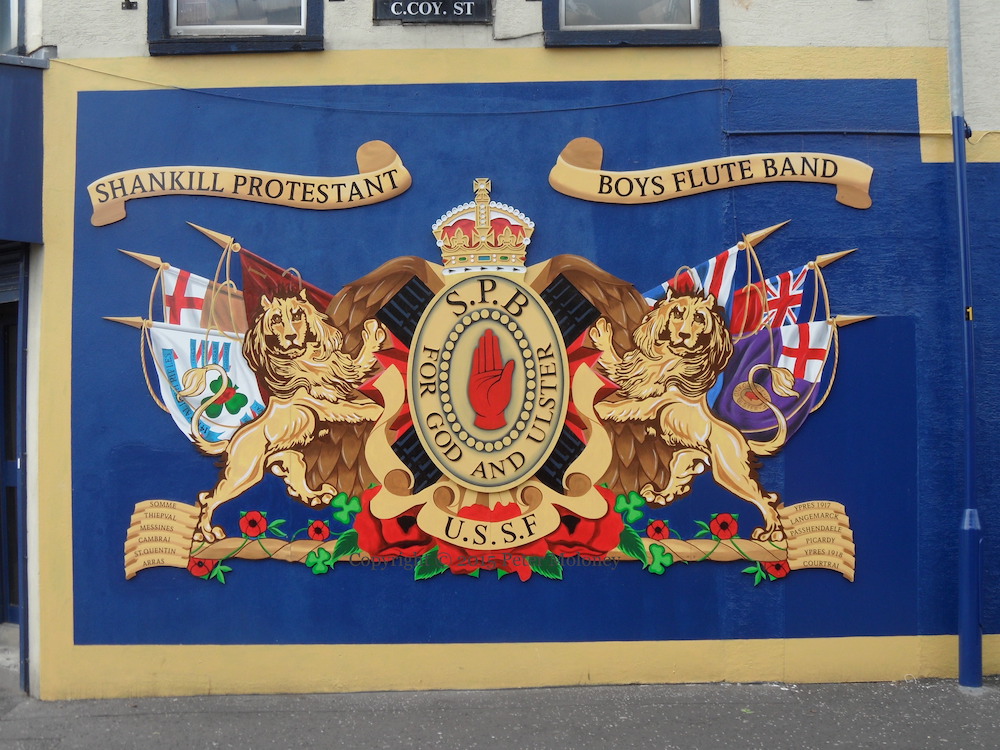
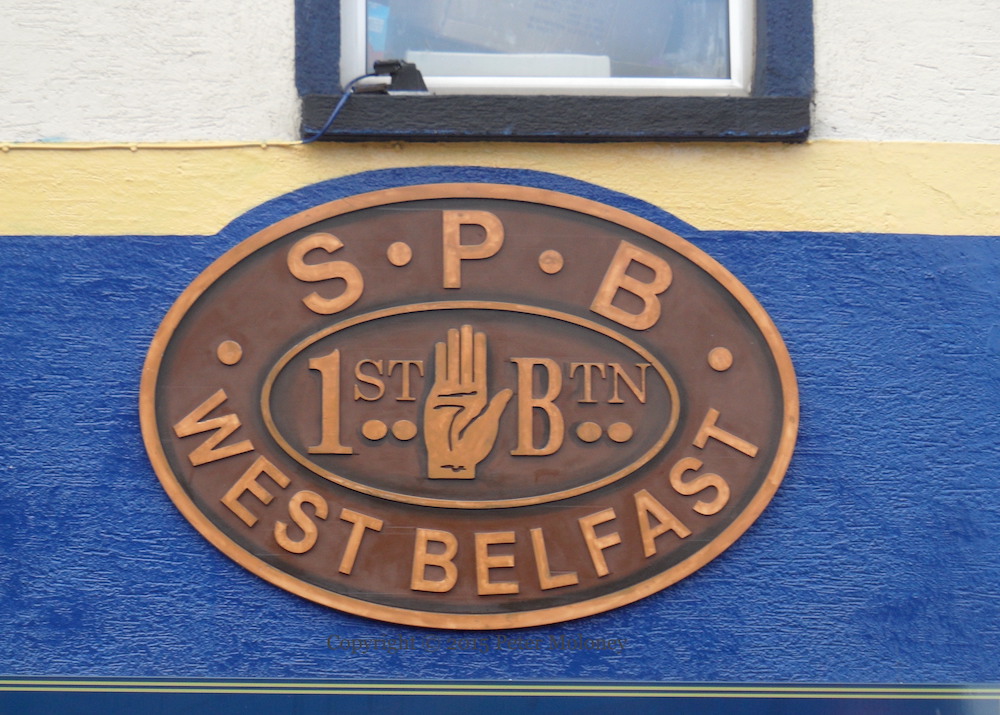
The main part of this installation is a large painted carving of lions rampant on either side of the emblem of the Shankill Protestant Boys flute band (Fb), named for the Shankill Boys of the original Ulster Volunteers and the Ulster Special Service Force unit within it which was designed to be a unit of “first responders”, ready to react at short notice to action by republicans or British forces anywhere in northern Ireland (historyireland).
With the outbreak of World War I, the Ulster Volunteers joined the RIR and the 36th (Ulster) Division and fought at the Battle Of The Somme in 1916: “’The Ulster Division has lost more than half the men who attacked and in doing so has sacrificed it for the Empire which has treated them none too well. The much derided Ulster Volunteer Force has won a name which equals any in history. Their devotion, which no doubt has helped the advance elsewhere, deserved the gratitude of the British Empire. It is due to the memory of these brave fellows that their beloved Province shall be fairly treated.’ Captain Wilfred [sic] Spender HQ staff 2nd July 1916″
This pair of boards is outside the Ulster Rangers Supporters Club (Fb) on the Shankill Road.
Above: The painting features a tram going under an Orange arch between the public baths on one side an Spin-A-Disc records on the other, surrounded by notable figures from the Shankill area. (Many thanks to Johnny Dougan of Shankill Area Social History (Fb) for the information below.)
Front, from left to right: Manchester United and Northern Ireland Soccer player Norman Whiteside (WP) and behind him boxer Davy Larmour and community worker Saidie Patterson (see WRDA), boxer Sammy (Cisco) Cosgrove, Senator Charlie McCullough (WP), Tommy Henderson, boxer Jimmy Warnock (original photograph here), Hugh Smyth (see previously Third Class Citizens), artist William Conor (see previously Conor’s Corner, Jack Henning (running), musician Belter Bell, writer Albert Haslett (Northern Visions interview).
Atop the tram: on the left is Jackie Redpath of the Save the Shankill Campaign (note other members of the group with placard on right; Northern Visions has a documentary about the Save The Shankill campaign) and Jack Higgins holding his book The Eagle Has Landed (WP). Up there too is Miss Sands, the music teacher in the Girls Model School, and historian Bobby Foster (Northern Visions interview). On the stairs are May Blood MBE and above her D.I. Nixon.
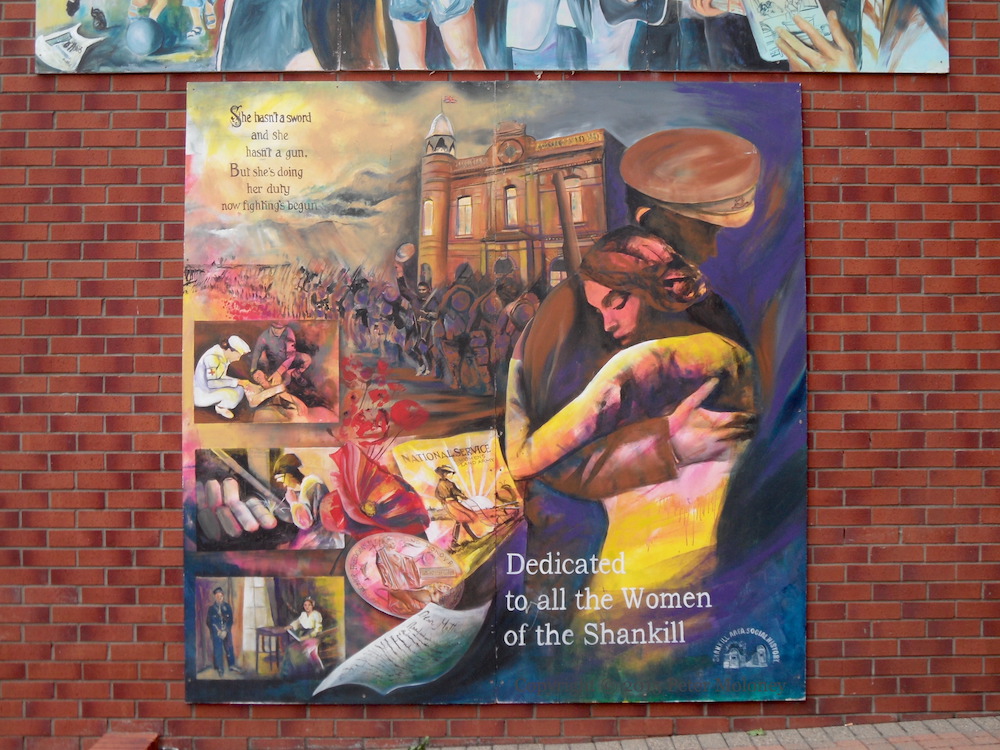
Below is a board highlighting the roles played by women during WWI as nurses and welders and in the Land Army. “She hasn’t a sword and she hasn’t a gun. But she’s doing her duty now fighting’s begun.”
This is a second repainting of the King Billy mural in Donegall Pass. The note in the corner says that this and the 2002 repainting (which added the painting of the Lindsay Street arch) were by “MW”, and the original mural painted in 1989 by “H. Gibson”.
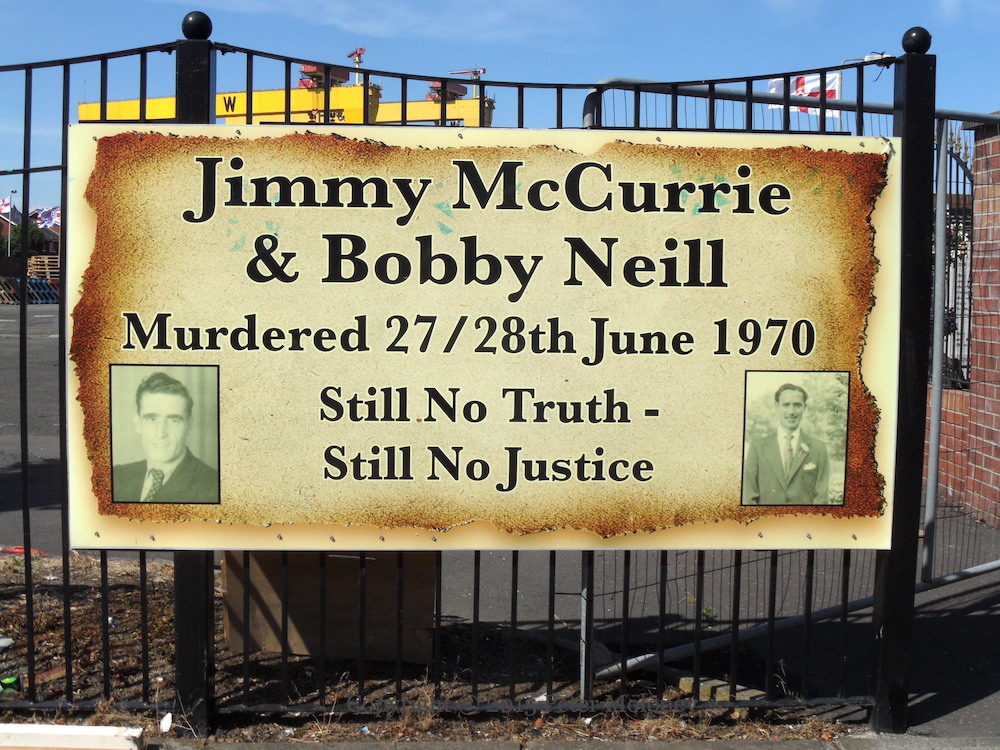
“Jimmy McCurrie & Bobby Neill, murdered 27/28th June 1970. Still no truth – still no justice.”
The two civilians died in the course of rioting and a gun battle around St. Matthew’s that was “the first major confrontation to occur in east Belfast during the troubles” (McKittrick et al., Lost Lives, p. 50). It is not clear at what time each died. McKittrick gives the death of both as the 27th, but puts Neill’s death at 2 a.m. (and so strictly speaking on the 28th?).











 Peter Moloney Collection