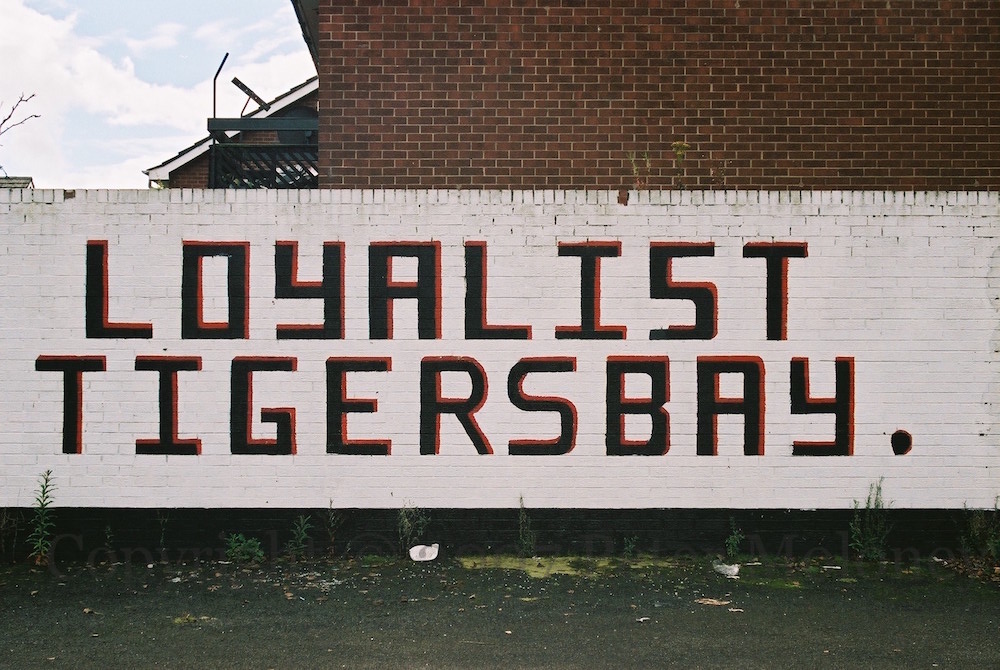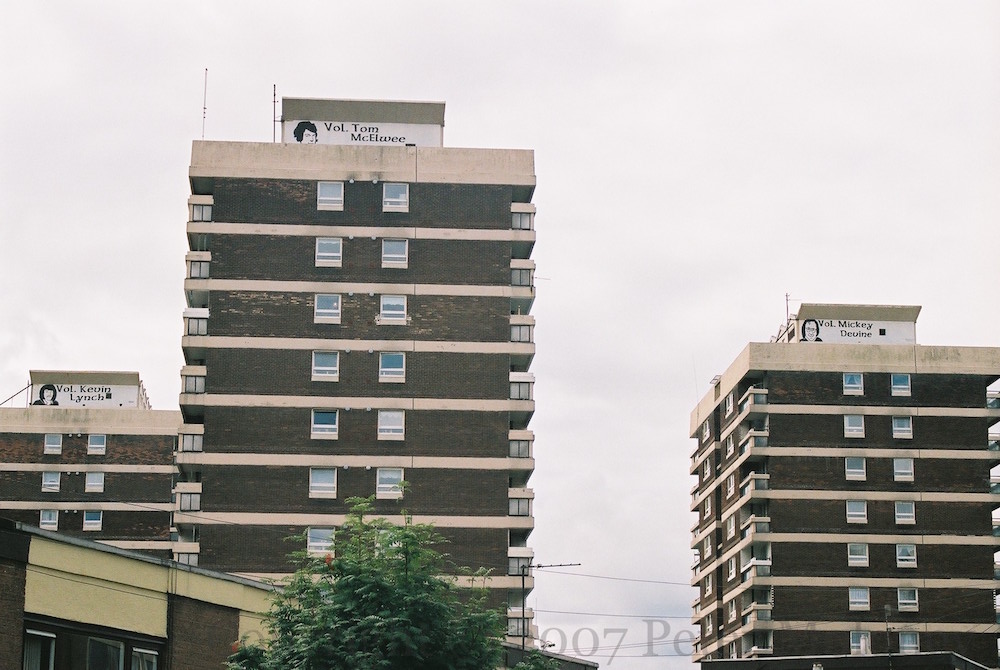
“In loving memory of military commander Stevie ‘Top Gun’ McKeag. Born 1970, died 2000. Sleeping where no shadows fall.” McKeag was the top assassin in the UDA during the 1990s, claiming at least 12 victims. Both his WP page and this Guardian article describe his career and his – sometimes contentious – preeminent standing within the UDA.
On the side wall: “This mural portrays Protestant men defending their community which was subjected to constant attempts of ethnic cleansing with petrol bombing attacks of their homes on a day to day basis. Eventually vigillanty [sic] groups were formed to secure these areas.”
From the Belfast Telegraph: “Several hundred familys [sic] were forced to flee their homes last night as homes came under attack from republicans. The number homeless is running into several thousand, more people were moving out of riot areas today. The women and children have been offered shelter in cities across the sea. Security forces moved in to bring calm into riot areas.”
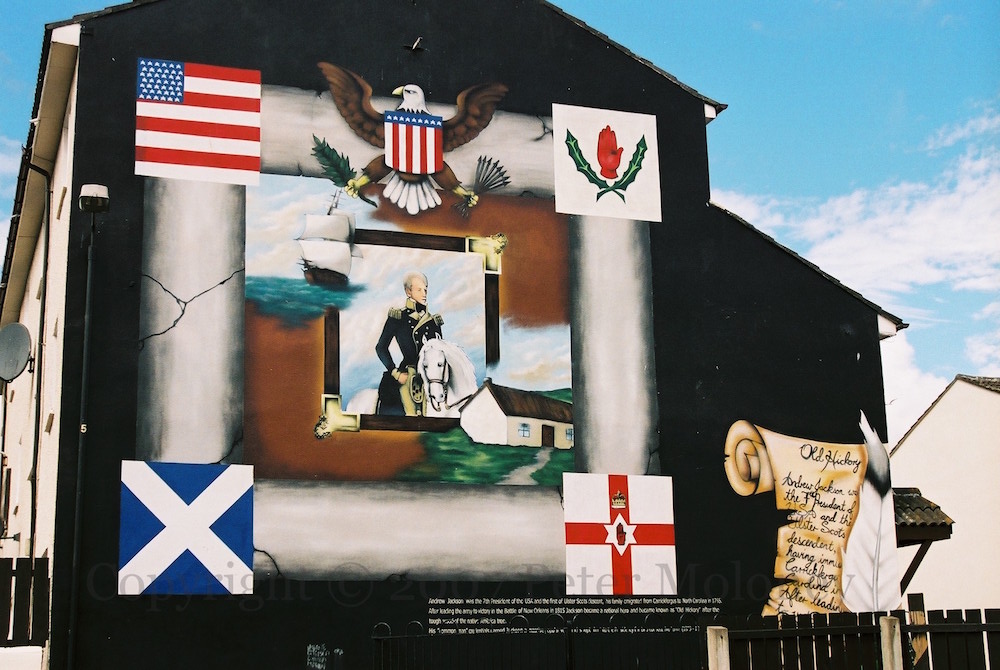
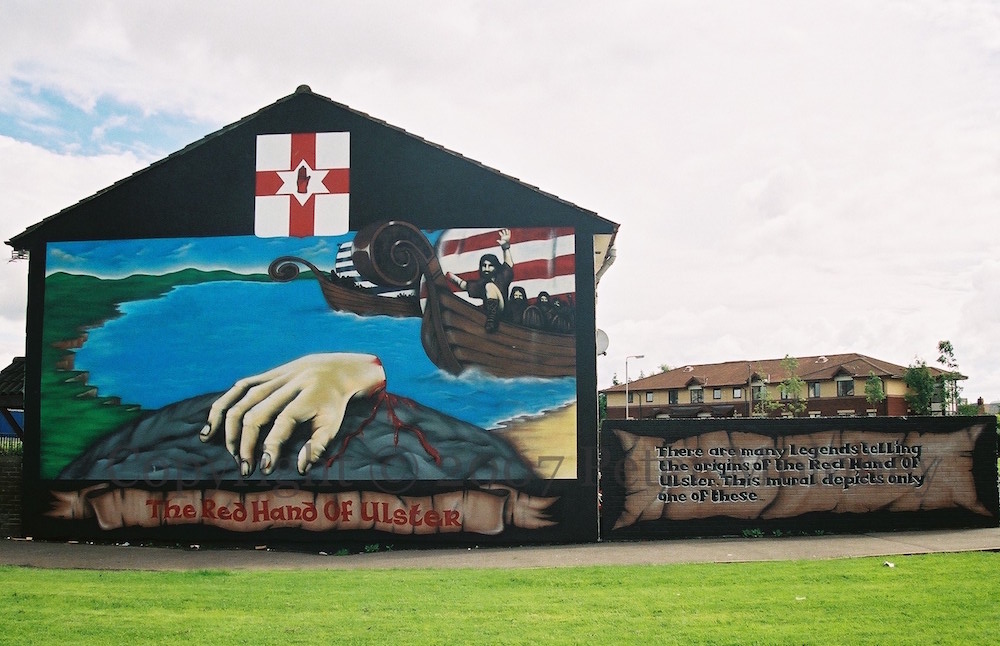
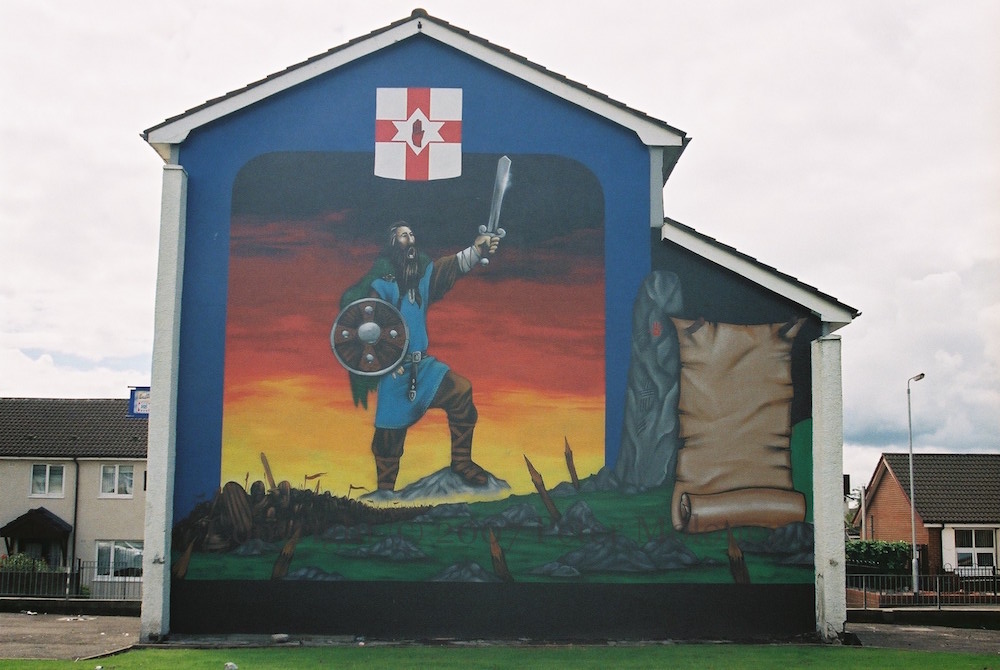
The Ulster Banner – the flag of the Northern Ireland government from 1924 to 1973 – is taken from the arms, shown here. The supporters are a lion – for the Ulster-Scots – and an elk – for the Irish (WP).
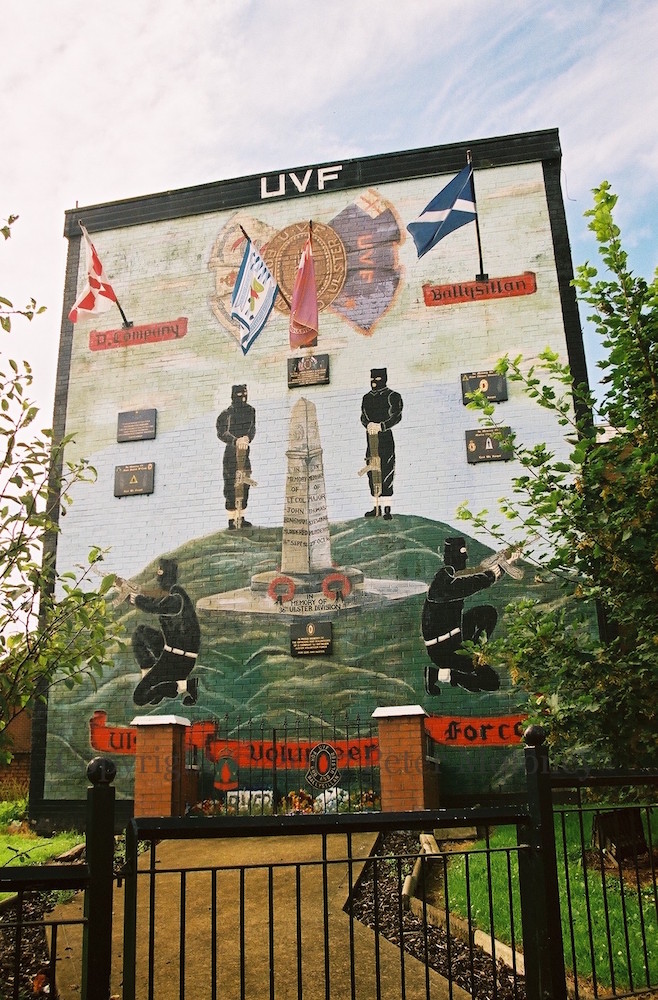
These three are all from Carlow Street. In the first image, the “UFF” lettering has been over-painted with “UVF”. This is a vintage “bare background” (the wall is not completely painted) mural, dating back perhaps to 1994.
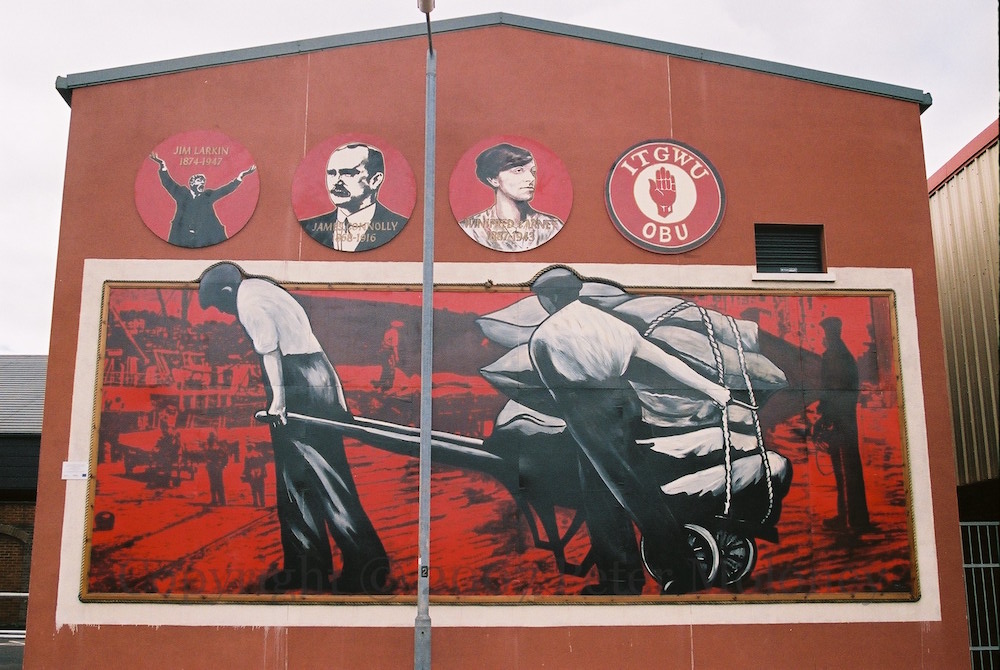
“Not as Catholics or Protestants, not as nationalists or unionists, but as Belfast workers standing together.” For the 100th anniversary of the strike by dockers and carters in Belfast, this large board was painted by Fra Maher and Rısteard Ó Murchú. It was launched on August 11th without the title across the top (youtube). See X00166 and X00167 for the finished product.
Leaders Boyd and Larkin are portrayed in the middle. The second panel shows speakers (including Larkin) on a platform (O’Hare); the third shows an RIC guard of blackleg workers – about 70% of the force mutinied and the fifth panel shows dismissed RIC constable William Barrett being carried through Belfast; the sixth shows the Cameron Highlanders being stoned by picketers (History Ireland). Margaret Lennon and Charles McMullan, two Catholic victims of British soldiers, shot during protests, are portrayed in the bottom right.
“Not Spain, not France – self-determination for the Basque country”, “700 political prisoners! Political parties banned! Incidents of torture! Civil rights abused!”
About 250 Communist brigadiers from Ireland went to Spain to fight for the Republicans against Franco’s Nationalists in the Spanish Civil War. “Por vuestra Libertad y la nuestra.”
The information board for this reproduction of Guernica is in Basque, Irish, and (lastly) English: “This mural of Picasso masterpiece Guernica was created by Danny Devenny and Mark Ervine, muralists from the two main communities in Belfast, in August 2007. Picasso painted Guernica over a period of three weeks in 1937 during the Spanish Civil War to protest the Nazi bombing of the Basque capital of Gernika (at the request of Franco’s forces) on April 26 that year which resulted in hundreds of deaths. Gernika was viewed as (and remains today) the town symbolising the Basque desire for freedom. Viewed as one of the 20th century’s greatest anti-war works of art. This work was sponsored by gasta.com and the newspaper publishers in Ireland and the Basque Country Belfast Media Group and Berria. 12 Lúnasa 2007.”
“End political policing: agents exposed – shoot-to-kill – spying – cover-ups –collusion – plastic bullets – sectarian policing – poisoning peace process”. Helmets with visors were used by the RUC during the 1980s, most memorably at the killing of Sean Downes (see Who Next?).
“I gcuımhne na maırbh dílıs” [“In memory of the faithful dead”] “Clonard martyrs C coy 2nd battalion Belfast Brigade Óglaıgh na hÉıreann roll of honour.” The right-hand plaque commemorates “civilians murdered by loyalists and British forces during the course of the conflict”. “I measc laochra na nGaedheal go raıbh sıad – go ndeana Dıa trócaıre ar a nanamacha”.