In February (2015) the SDLP changed its position on the National Crime Agency (NCA) and the Assembly voted to allow it to operate (beyond ‘customs and borders’ functions) in Northern Ireland – it has been operating in Britain since 2013 (BBC | Irish Times). Sınn Féın continues to oppose the NCA (BBC).
“On May 7th vótáıl Gearóıd Ó hEára. Leading positive change” – Sınn Féın electoral billboard for the 2015 UK elections, on the back of Free Derry Corner.
Ó hEára would go on to take second place, behind the SDLP’s Mark Durkan (WP).
A Christian cross was added (in early 2015?) to the dove and oak leaf on Rossville Street, Derry. For a 2013 image of the previous version, see Dove Of Peace.
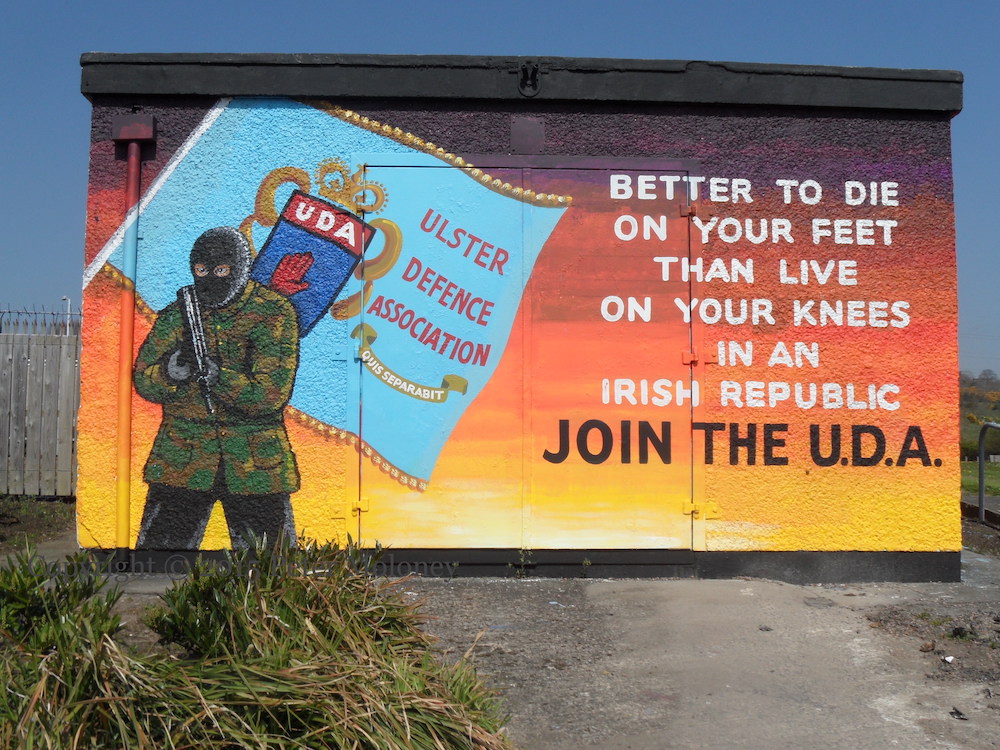
This Castlemara (Carrickfergus) has been criticized by both DUP and Alliance councillors (Newsletter). The final words – “Join the UDA” – have drawn particular ire, as in other respects it is similar to other murals in featuring hooded gunmen, such as these two other Carrickfergus murals: Inclusion | Eternal Vigilance. (Nolan Show discussion of the mural on 2015-02-11: Part 1 | Part 2)
The mural sports a hooded gunman facing the viewer with a slogan borrowed from Mexican revolutionary Emiliano Zapata: “Better to die on your feet than live on your knees in an Irish republic. Join the UDA.”
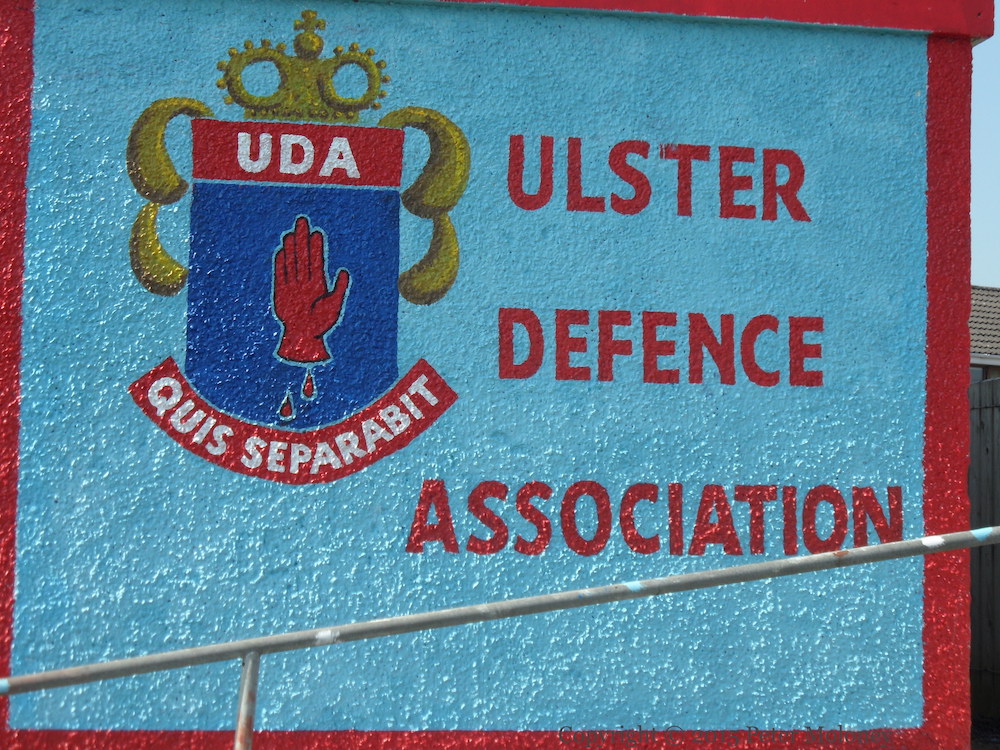
“South East Antrim Ulster Defence Association” with shamrock, thistle, and rose, but not the daffodil – though the Welsh “Red Dragon” is included alongside the Scottish Saltire, the flag of Northern Ireland, and Queen Elizabeth II’s royal standard.
The mural originally read “Ulster Defence Union” rather than “Ulster Defense Association” – see X01208.
This is a vintage cut-out in the Sunnylands estate (visible in 2008 Google Street View). The central board – a RHC emblem – had a plastic or paper layer between the star/wings and the circular back-board with red-white-and-blue colours and the words “Red Hand Commando” in a circle. The hooded gunmen on either side each appear to be a single, painted, carving.
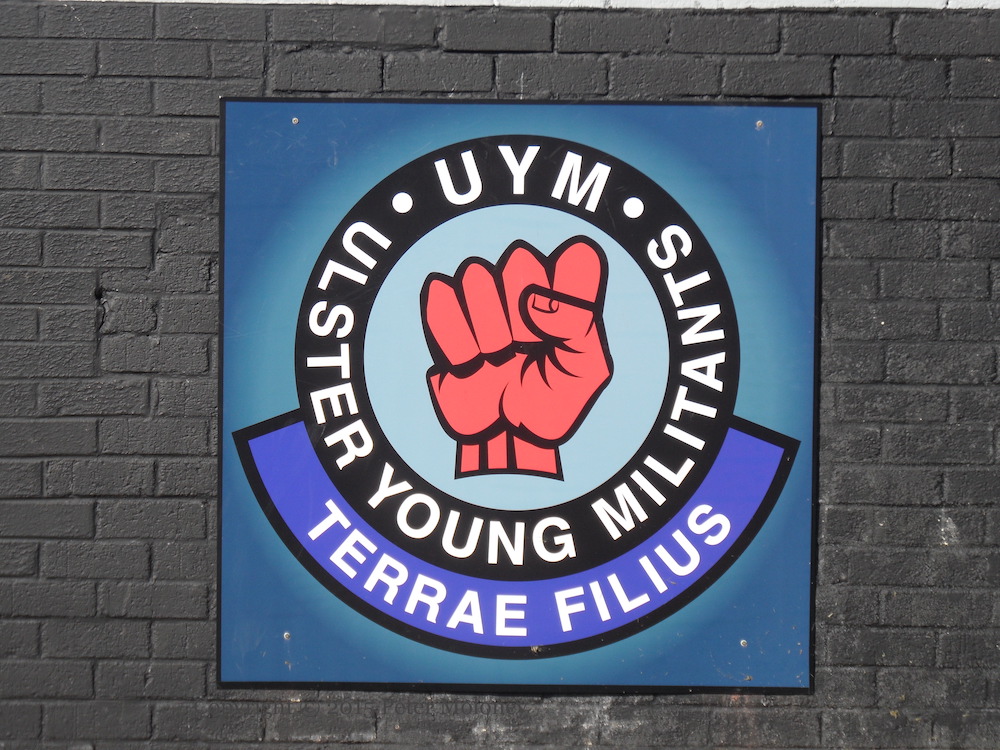
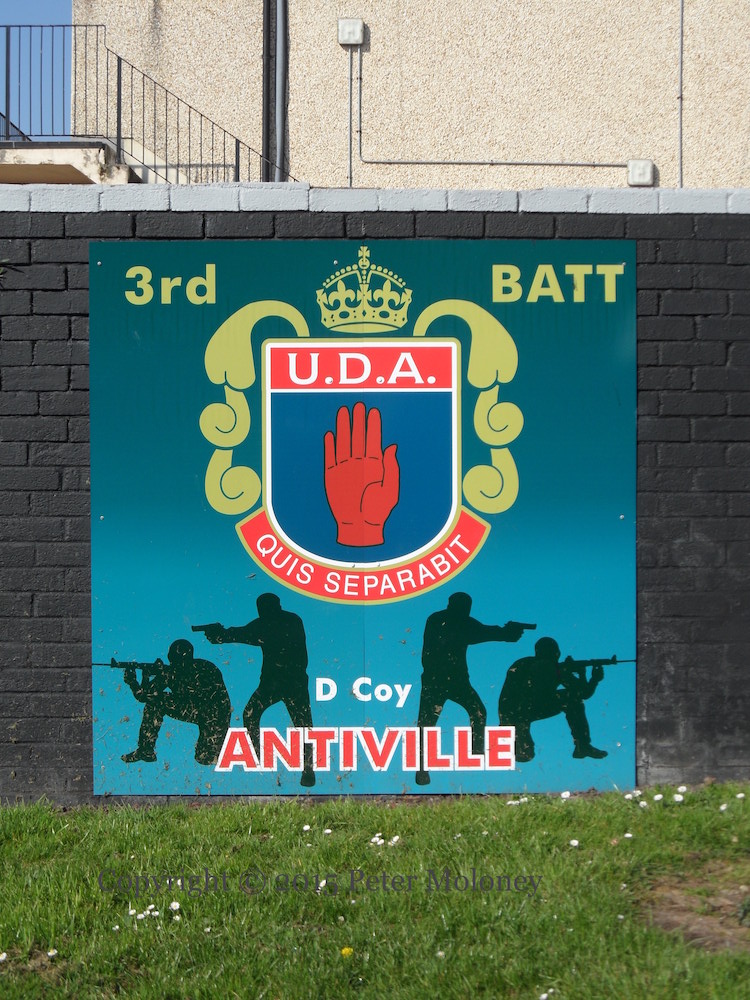
This is a very aggressive set of boards, in Hampton Crescent behind the Antiville (Larne) community centre: two of them show silhouetted UDA (3rd battalion, D company) gunmen in active poses, and another deploys the fearsome figure of Eddie The Head. Rather than the Union flag that he carries in other murals and on the original Iron Maiden album cover (see Eddie’s Visual History page), in this version “The Trooper” carries a UDA flag (with the UFF symbol also shown). “AYM” is presumably “Antiville Young Militants”.
“Remember those not here today, And those unwell or far away, And those who never lived to see the end of the War & Victory, And every friend who’ve lost [or: passed] our way, Remember as of yesterday, It’s absent friends we miss the most, To ALL, Let’s drink a loving toast.”
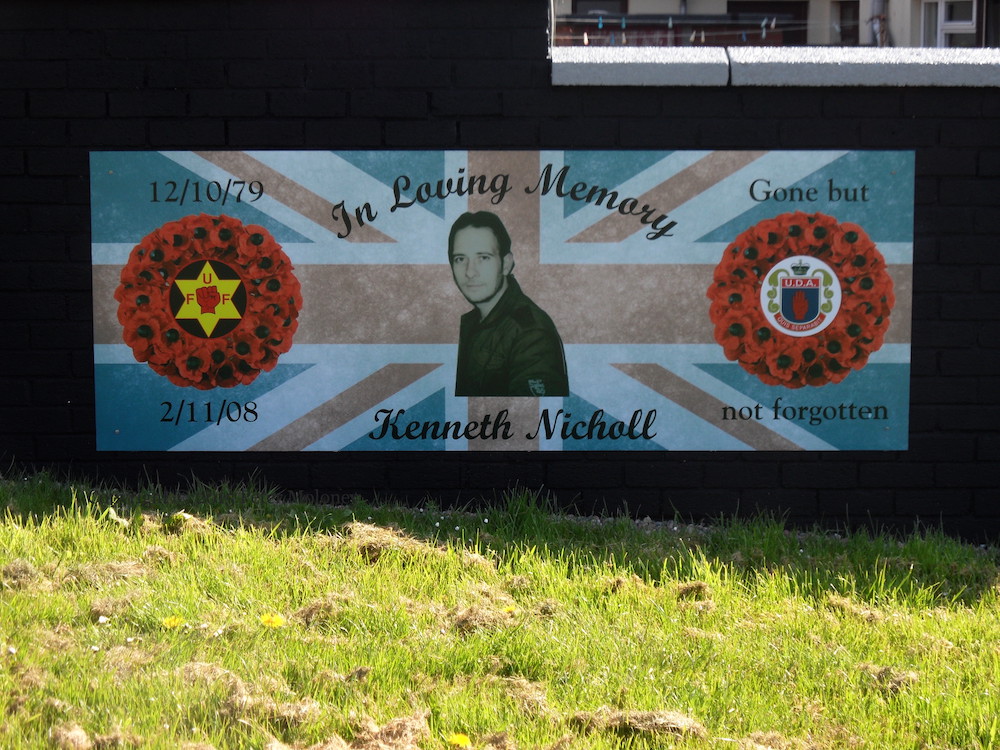
William Walker’s poem Absent Friends is used as a part of UDA/UFF commemoration of various Larne men: “Ewan ‘Shug’ McPherson, Raymond ‘Toby’ Sloan, Kenneth ‘Kenny’ Nicholl (who is featured in a separate board; BBC-NI report of his killing), Ian ‘Big Ian’ Hamilton. Walker was a pilot during WWII who wrote poetry and returned to the brewing trade after the war; he died at age 99 in 2012 (Guardian).
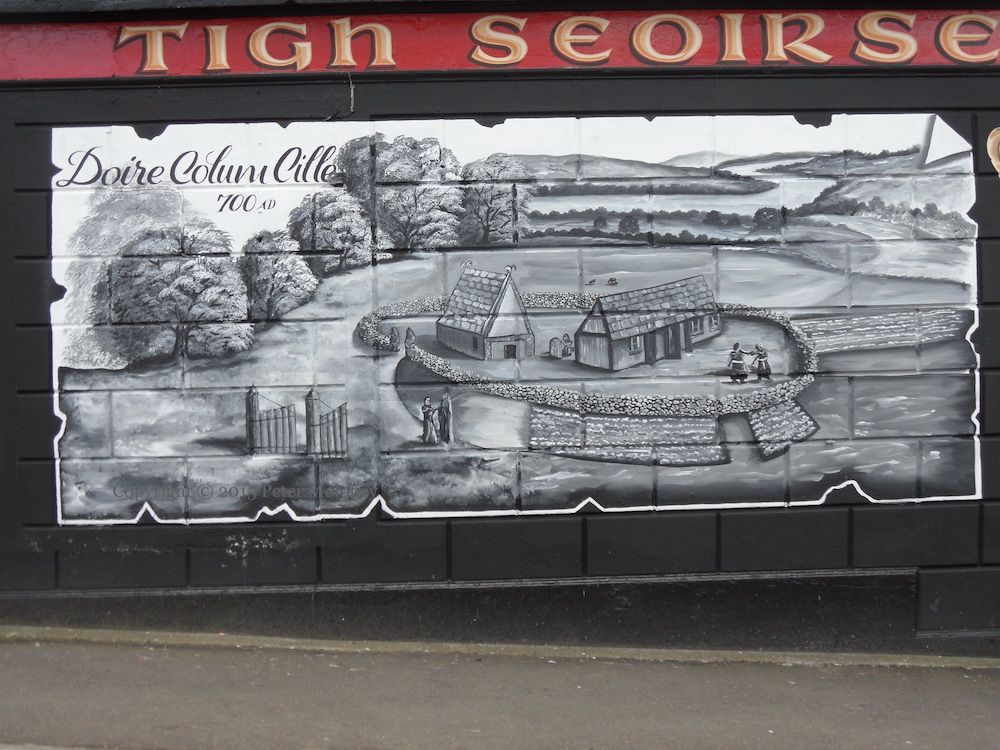
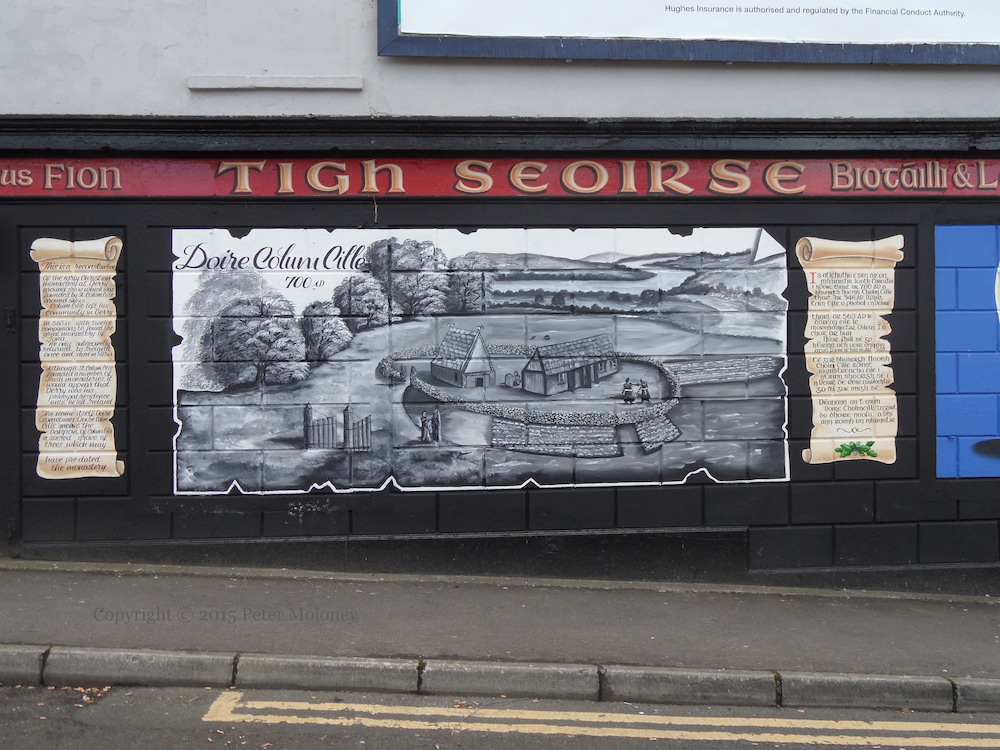
The Christian missionary Colm Cılle (in Latin, Columba), born in Donegal, founded a monastic settlement on the banks of the Foyle (then still part of Donegal) around 540 AD. The “Doıre” part of the name means “oak grove” and perhaps refers (as the information panel suggests) to “a sacred grove of trees, which may have pre-dated the monastery.” The mural above shows a reconstruction of the Derry monastery c. 700 AD. The name “Londonderry” dates to 1662.
Columba moved on to Scotland circa 563 and founded an abbey on the island of Iona. Among his reputed miracles is the banishment of a great water beast from the River Ness in 565.
“This is a reconstruction of the early Christian monastery at Derry around 700 AD which was founded by St Colum Cille around 546 AD. Colum Cille left his community in Derry in 563 AD with twelve companions to found the great monastery of Iona. He only subsequently returned to Ireland once and died in 593 AD. Although St Colum Cille founded a number of Irish monasteries, it would appear that Derry was his principal residence until he left Ireland. The name itself, Doıre, (sometimes Doıre Colum Cılle) means ‘the oakgrove of Colum Cille’ a sacred grove of trees, which may have pre-dated the monastery.”
“Is athchuthú é seo ar an mhainistir luath-Chríostaí i nDoıre thart ar 700 AD a bhunaigh Naomh Cholm Cıille thart ar 546 AD. D’fhág Colm Cille a phobal ı nDoıre thart ar 563 AD le dáréag eıle le mómhaınıstır oıleán Í a chur ar bun. Níor fhill sé go hÉıreann ach uaır amháın agus fuaır sé bás in AD 593. Cé gur bhunaigh Naomh Cholm Cille roınnt maınıstreacha eıle ı nÉırınn, shocrıgh sé ı nDoıre de réır cosúlachta go dtí gut ımıgh sé. Déanann an t-aınm ‘Doıre Cholmcılle’ tagaırt do dhoıre naofa, a bhí ann roımh an mhaınıstir.”
U Bennett Street, Derry, on the side wall of Tıgh Seoırse.











 Peter Moloney Collection