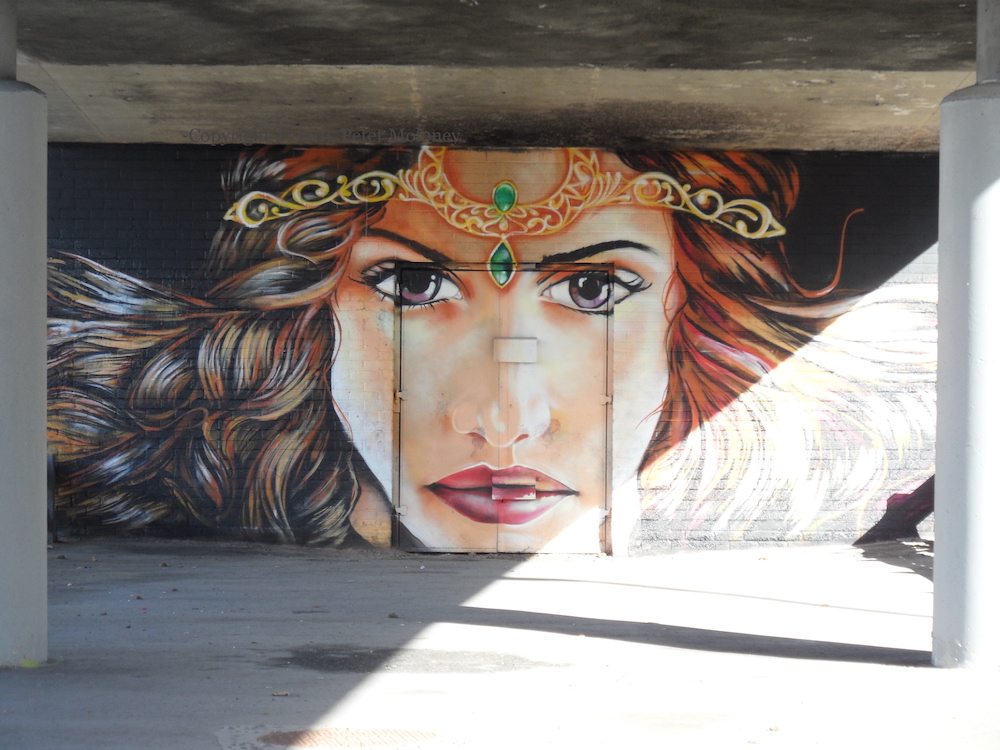
A mythological Celtic queen under the Lecky Road/Barrack Street flyover. Painted by RAZER (ig).
Click image to enlarge
Copyright © 2015 Peter Moloney
M12834
A mythological Celtic queen under the Lecky Road/Barrack Street flyover. Painted by RAZER (ig).
Click image to enlarge
Copyright © 2015 Peter Moloney
M12834

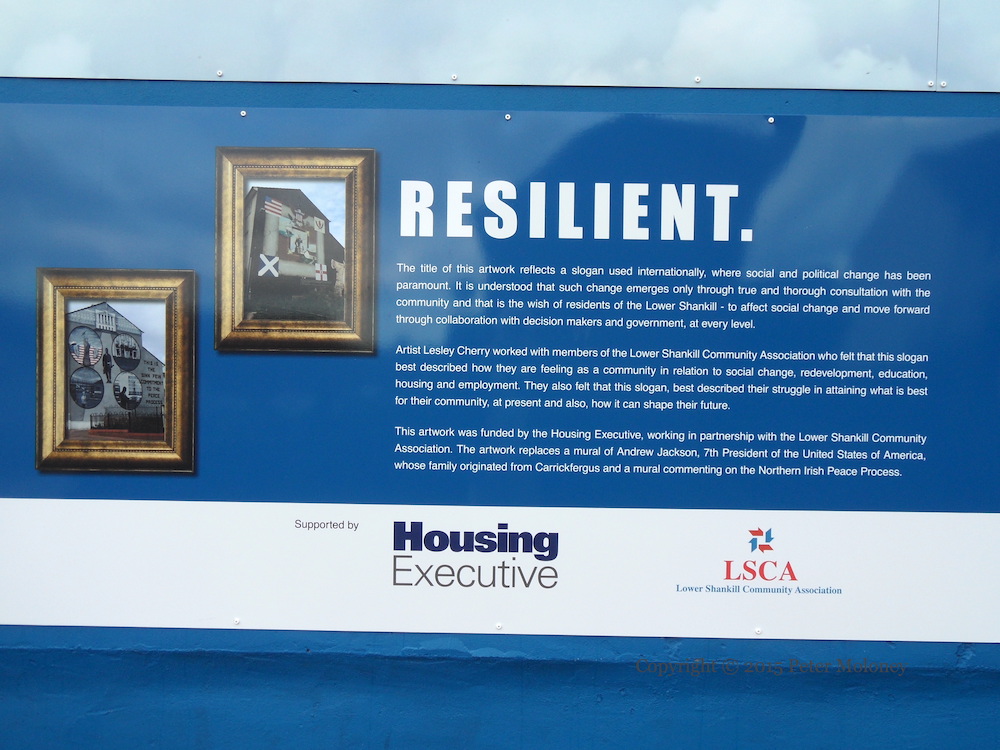

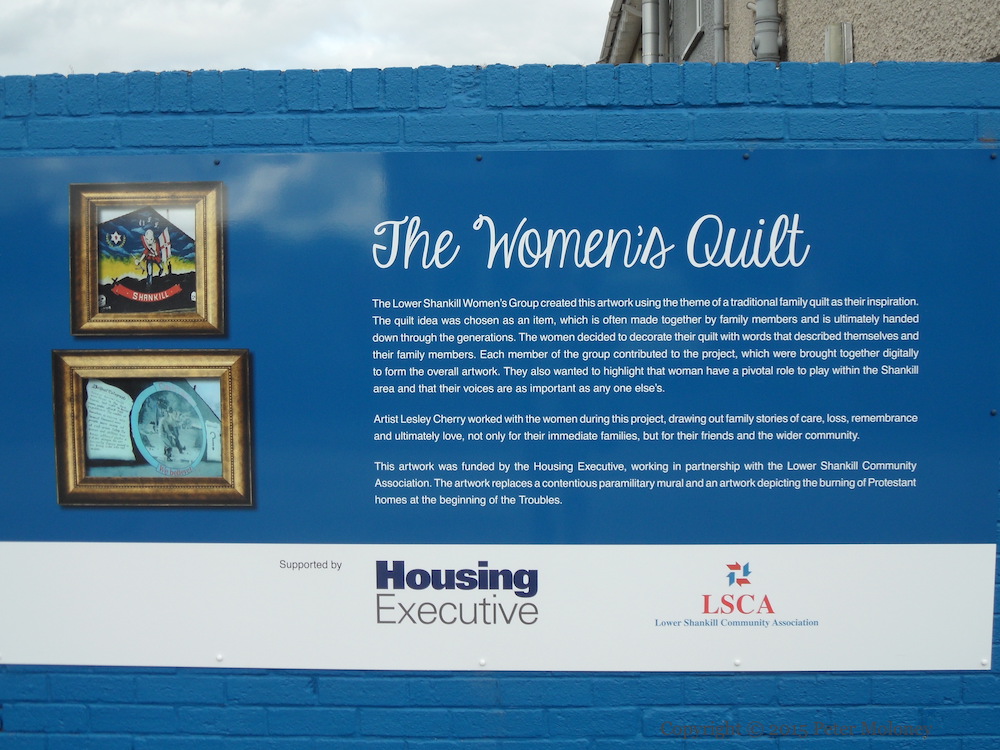
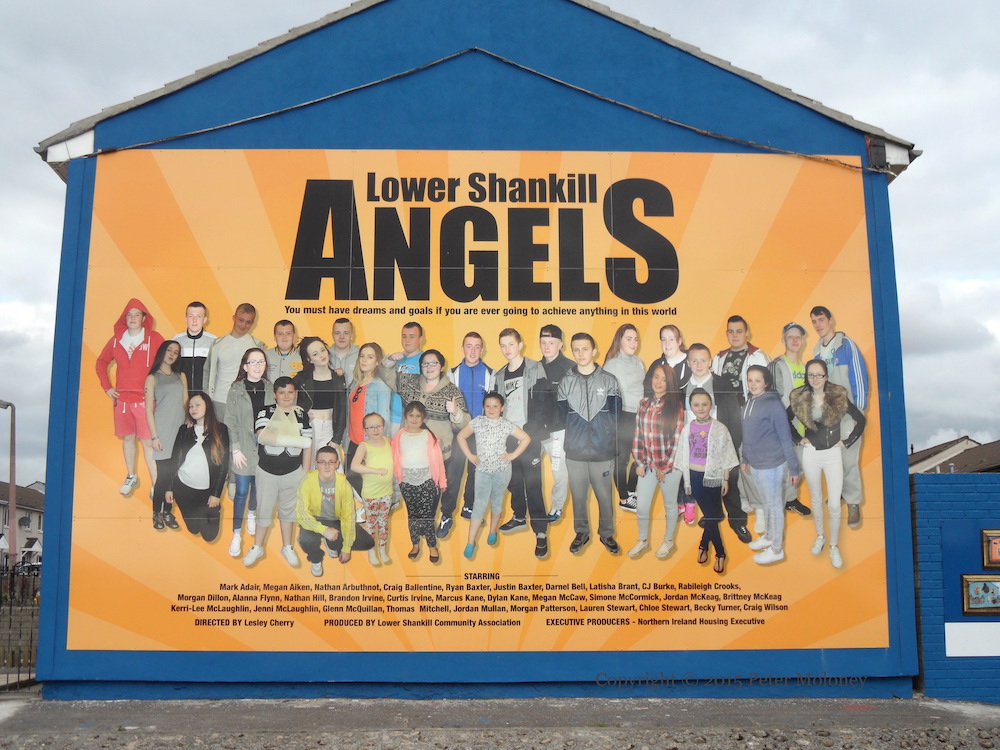


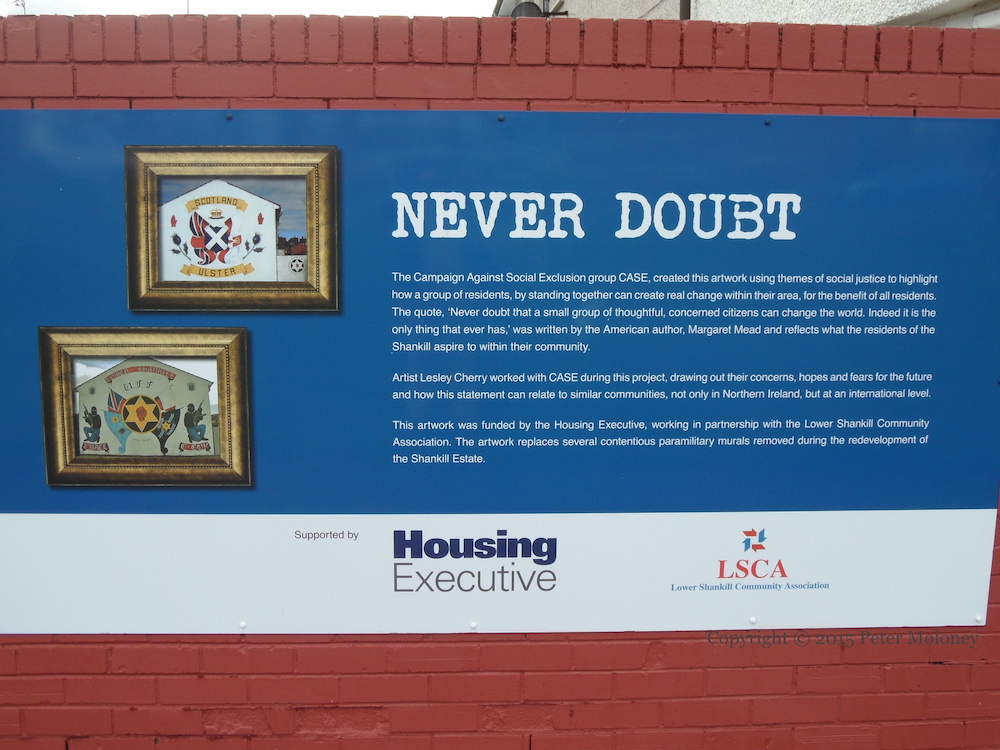
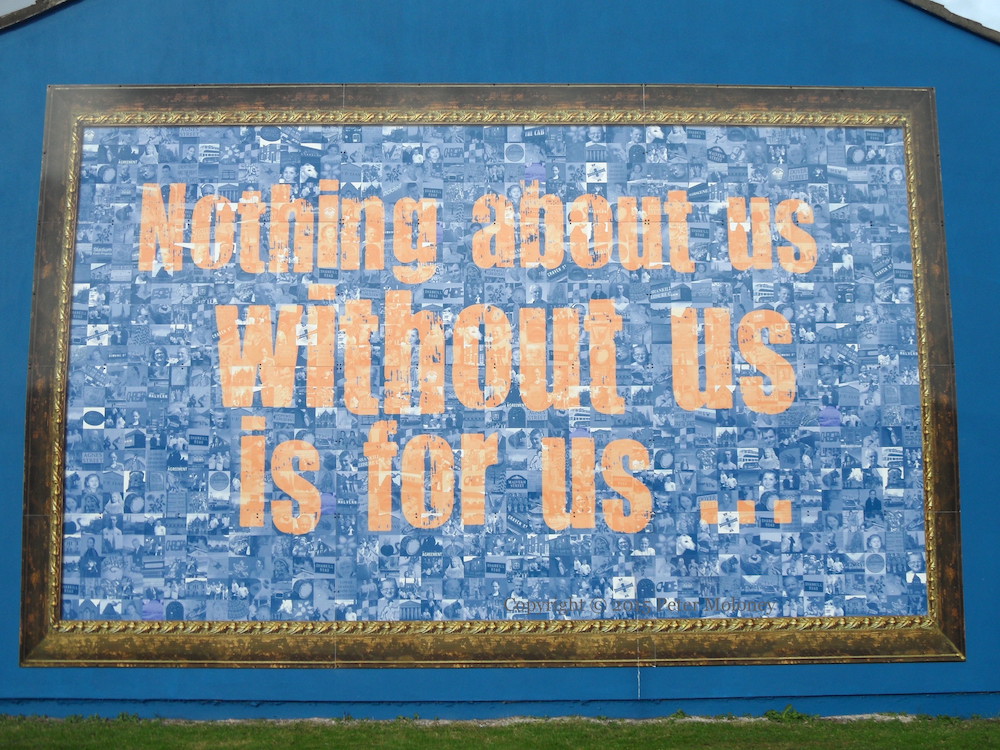

As can be seen from the images of the information boards that accompany them, these pieces are part of a second wave of re-imaging (Visual History 10) in the lower Shankill estate. Compared to the pieces they replace, these are even more neutral in theme, replacing cultural themes with community (and also all printed rather than painted).
Most of these are in the centre of the estate, alongside various UDA murals. There has also been a small wave of UDA stencilling and signage on the periphery of the estate – see Loyalist Lower Shankill.
I Am Not Resilent replaces the Andrew Jackson Ulster-Scots mural in Boundary Way.
Women’s Voices is on the wall formerly home to Play from 2009 (and not, as the info board suggests, either the Can It Change? or the Shankill Eddie).
Lower Shankill Angels replaces the long-standing LPOW mural.
Never Doubt is on a previously unused wall, at the top of the estate, on Hopewell Avenue.
Nothing About Us is a piece from the first wave of re-imaging that was moved to Malvern Way due to the new construction taking place on the estate.
For background on the individual pieces, see the individual entries in the Seosamh Mac Coılle collection: I Am Not Resilient | Women’s Voices | Lower Shankill Angels | Never Doubt | Nothing About Us.
Click image to enlarge
Copyright © 2015 Peter Moloney
M12191 [M12192] M12193 [M12194]
M12195 M12196 [M12197]
M12198 M12199 M12200
M12201 M12202 [M12203] [M12204]
M12210 M12211 [M12212]

May 8th:
March 28th:
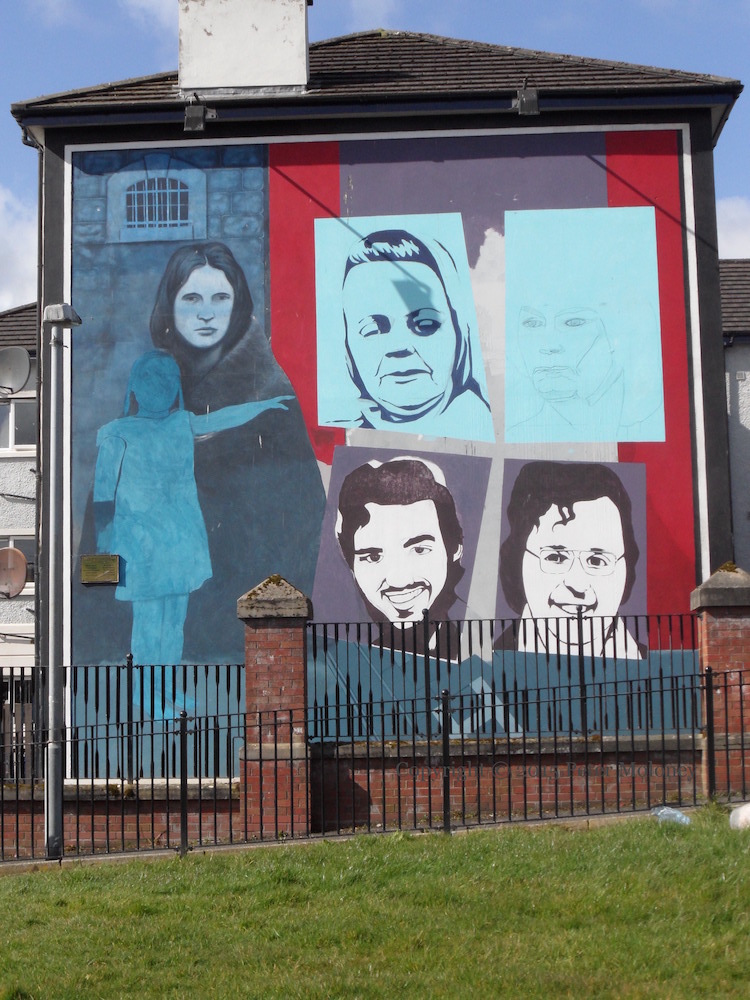
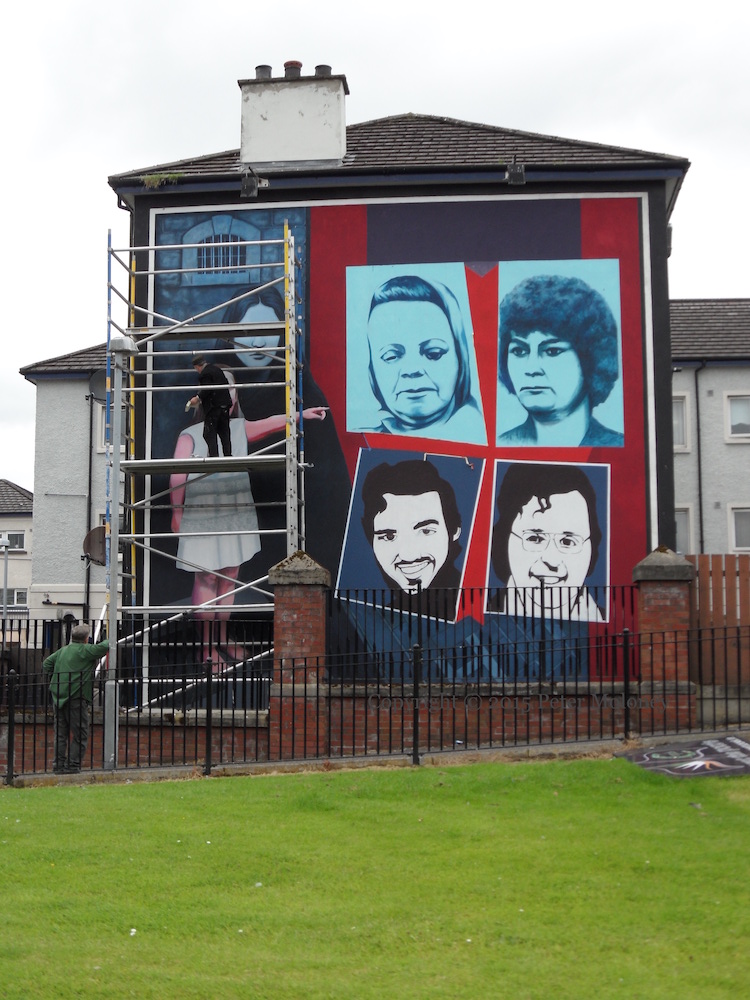
The figure in the centre of the mural above is Peggy O’Hara, mother of INLA hunger striker Patsy O’Hara, who remained active in socialist and republican circles and stood in the assembly elections in 2007 as an independent. She died in 2015 and was given a paramilitary funeral, including a volley of shots fired over the coffin (BBC | Irish Times | An Phoblacht).
The female figure above Mickey Devine (in the bottom right) is his sister Margaret, from whose house his coffin processed after his death in 1981. (See the plaque in Breaking The Chains.) The girl on the left is pointing towards another mural, a dove of peace.
The standing figure, and the plaque, are retained from the previous mural.
Part of The People’s Gallery by the Bogside Artists.
Click image to enlarge
Copyright © 2015 Peter Moloney
M12753 M12593 [M12527] M11704 [M11705] [M11706]

This pair of boards is outside the Ulster Rangers Supporters Club (Fb) on the Shankill Road.
Above: The painting features a tram going under an Orange arch between the public baths on one side an Spin-A-Disc records on the other, surrounded by notable figures from the Shankill area. (Many thanks to Johnny Dougan of Shankill Area Social History (Fb) for the information below.)
Front, from left to right: Manchester United and Northern Ireland Soccer player Norman Whiteside (WP) and behind him boxer Davy Larmour and community worker Saidie Patterson (see WRDA), boxer Sammy (Cisco) Cosgrove, Senator Charlie McCullough (WP), Tommy Henderson, boxer Jimmy Warnock (original photograph here), Hugh Smyth (see previously Third Class Citizens), artist William Conor (see previously Conor’s Corner, Jack Henning (running), musician Belter Bell, writer Albert Haslett (Northern Visions interview).
Atop the tram: on the left is Jackie Redpath of the Save the Shankill Campaign (note other members of the group with placard on right; Northern Visions has a documentary about the Save The Shankill campaign) and Jack Higgins holding his book The Eagle Has Landed (WP). Up there too is Miss Sands, the music teacher in the Girls Model School, and historian Bobby Foster (Northern Visions interview). On the stairs are May Blood MBE and above her D.I. Nixon.
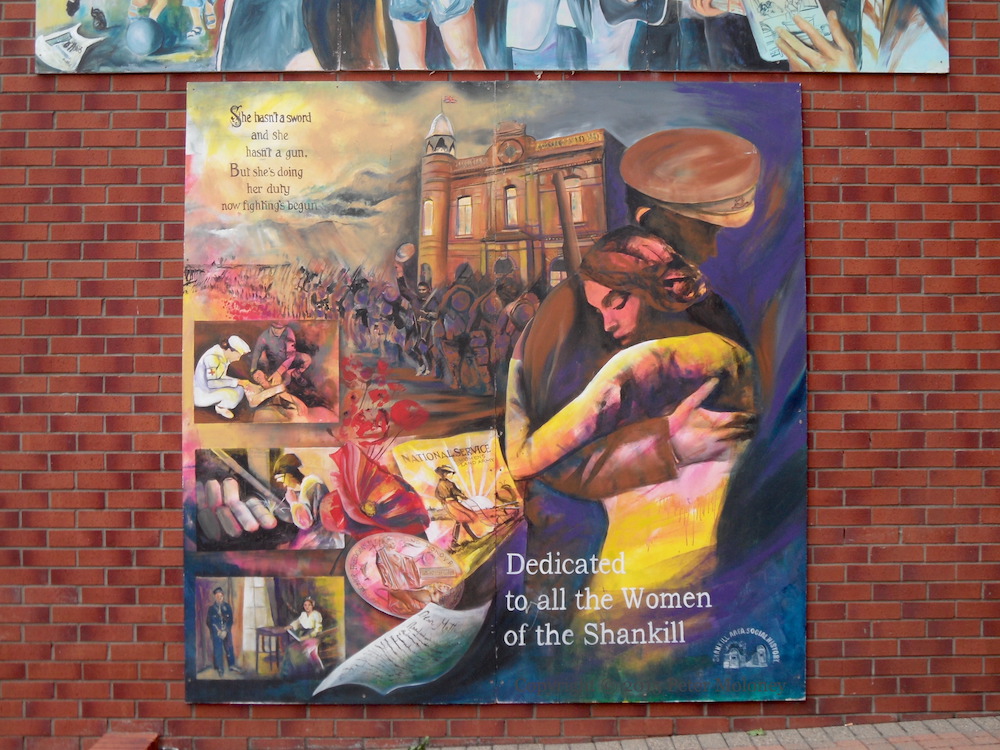
Below is a board highlighting the roles played by women during WWI as nurses and welders and in the Land Army. “She hasn’t a sword and she hasn’t a gun. But she’s doing her duty now fighting’s begun.”
Click image to enlarge
Copyright © 2015 Peter Moloney
M11939 M11940



The central image of soldiers at the battle of the Somme is surrounded by images of various occupations: shipyard workers and miners (perhaps), along with images of women welding, carrying coke, and nursing. It’s not clear what the “fair wartime wage” refers to: there was a general strike at the shipyards in 1919 (The Great Unrest | Workers’ Liberty).
The nurse is apparently the Grand Duchess Olga Nikolaevna of Russia (WP). The image of a person carrying a sack of coke is from the Imperial War Museum’s collection.
The lower wall is intended to be full, but painting has ceased indefinitely.
Artist Jonny McKerr (Fb) also did a similarly-styled piece on The Belfast Blitz.
Edlingham Street, Tiger’s Bay, north Belfast
Click image to enlarge
Copyright © 2015 Peter Moloney
M11773 M11774 M11775 M11772

“Viva Palestine”. This pro-Palestine mural features sky-jacker Leila Khaled (also seen in in Hugo Street) and the emblem of the Popular Front For The Liberation Of Palestine (WP). The Arabic on the right is an equivalent of “Tıocfaıdh ár lá” on the left.
See also: The same elements used in another mural Oppression Breeds Resistance | The Popular Front in Northumberland Street | “Viva Palestine” in Ardoyne and on Black Mountain/Slıabh Dubh
AMCOMRI Street, off Beechmount Avenue/Ascaıll Ard na bhFeá, west Belfast.
Click image to enlarge
Copyright © 2015 Peter Moloney
M11766 [M11767] [M11768] [M11769]

“Cumann Na mBan” in Irish is “the women’s organization/council/society” in English. The organization in question is the republican paramilitary group which was founded on April 2, 1914 and celebrated its 100th anniversary in 2014.
The mural is at the bottom of Teach Na bhFıann/Fianna House (formerly Dill House) in the New Lodge.
Click image to enlarge
Copyright © 2015 Peter Moloney
M12418 [M12419] [M12420] [M12421]
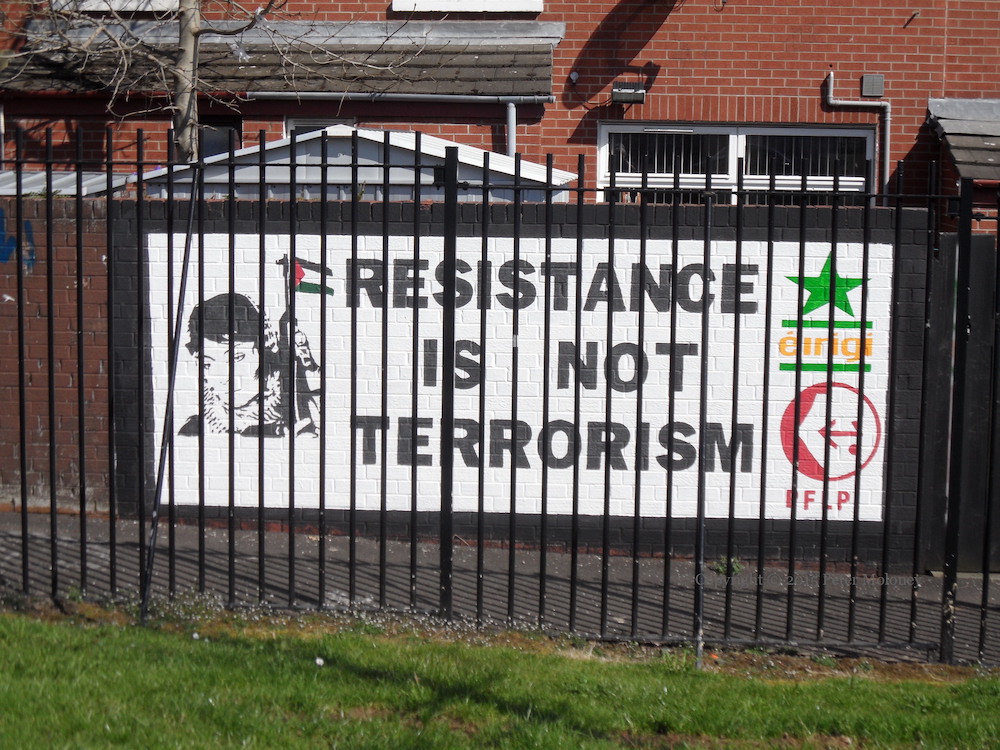
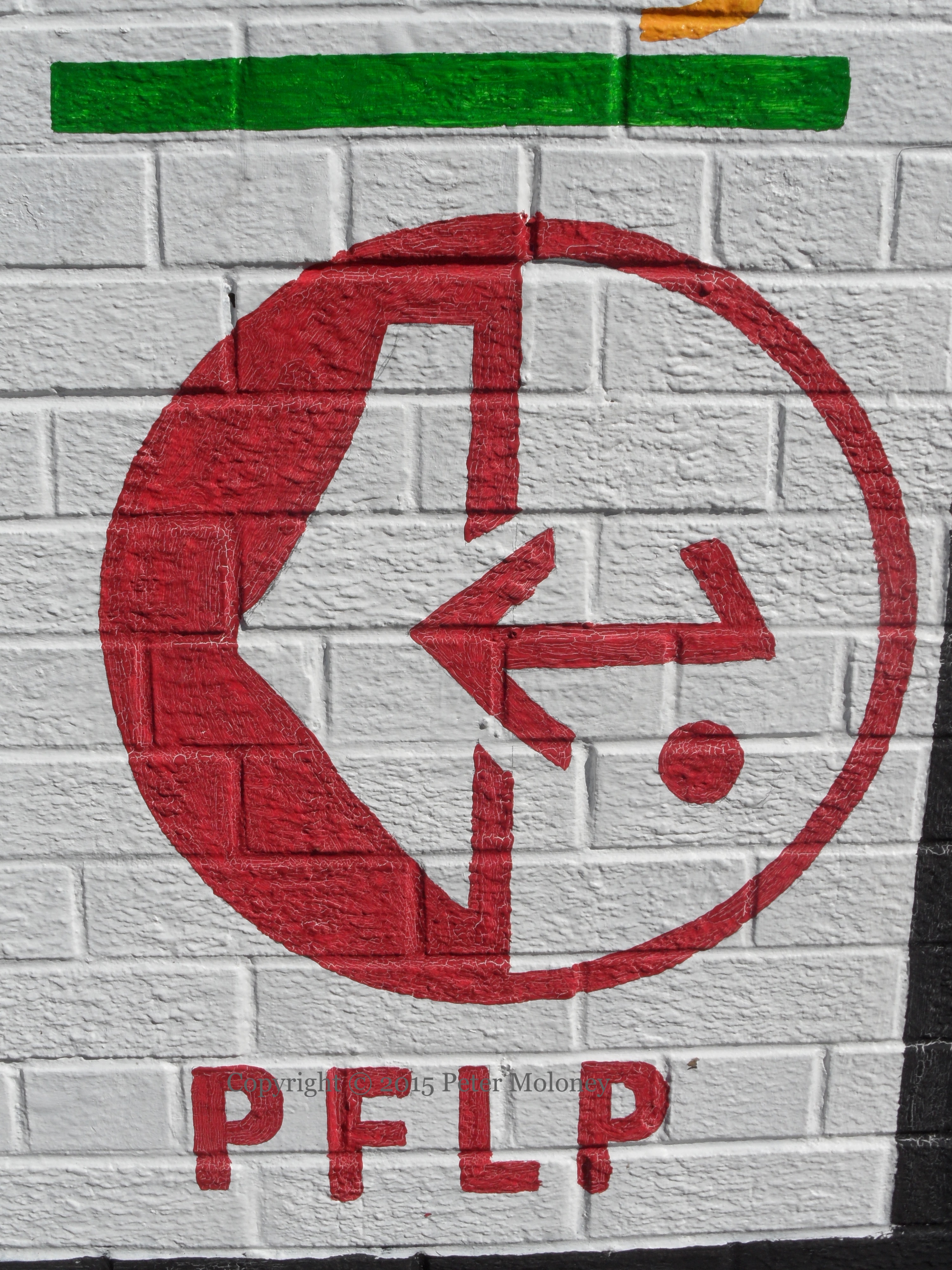
Éırígí (web) support for the PFLP (Popular Front For The Liberation Of Palestine – WP). For more on the “skyjacker” Leila Khaled, see the mural featuring her in Hugo Street.
Ludlow Square, New Lodge, north Belfast

Click image to enlarge
Copyright © 2015 Peter Moloney
M12400 M12401 [M12402] M12403


Countess Markievicz, carrying a flag of Cumann Na mBan, and Ethel Lynch, carrying a flag of the Derry IRA, take centre stage in the Mná Na hÉıreann mural in London-/Derry/Doıre’s bogside. Markievicz is famous for her role in the Easter Rising of 1916 (WP); Lynch died in December 1974 of injuries sustained when a bomb exploded prematurely. Between them, “Liberty leads the people” waving an Irish Tricolour.
To their left are three Derry women protesting the conditions in Armagh Women’s Prison and in the H-Blocks. This article on Mary Nelis (the protester on the right, with Kathleen Deeny and Theresa Deery) describes the photograph on which this part of the mural is based. The women in Armagh prison were allowed to wear their own clothes and so were not ‘on the blanket’ as their male counterparts in the H-Blocks of Long Kesh were. However, they did engage in a “no wash” protest, which lasted from February 1980 until March 1981, and three of them – Maıréad Farrell, Mary Doyle, and Margaret Nugent – joined the 1980 hunger strike.
To their right (beyond the coffin scene) members of Cumann Na mBan are on parade; the photo of on which this is based can be seen in Mothering Sunday In Beechmount, though the faces have been changed here, presumably to those of more contemporary volunteers.
The figure wearing a cloth cap and holding a rifle is Eithne Coyle, a leader and later president of Cumann Na mBan, imprisoned both by the Black and Tans before the treaty and after it by the Provisional Irish government (WP). For the photograph on which her pose here is based, see An Phoblacht‘s History Of Cumann Na mBan.
In the four corners are circles of Betsy Gray, Anne Devlin, Mary Ann McCracken, and Máıre Drumm. Gray and McCracken were Presbyterians; Gray fought (or at least, was killed) in the 1798 rebellion, as did McCracken’s brother Henry Joy; Mary Ann went on to work for the poor of Belfast and lobby against slavery. Anne Devlin assisted in Robert Emmet’s 1803 rising. (National Graves Assoc) Máıre Drumm was vice-president of Sınn Féın and commander of Cumann Na mBan, who are shown marching on the right-hand side.
Click image to enlarge
Copyright © 2015 Peter Moloney
M11686 [M11687] [M11688] [M11689] M11690 [M11691] [M11692] [M11693] M11694 [M11695] M11696 [M11697] [M11698] M11685
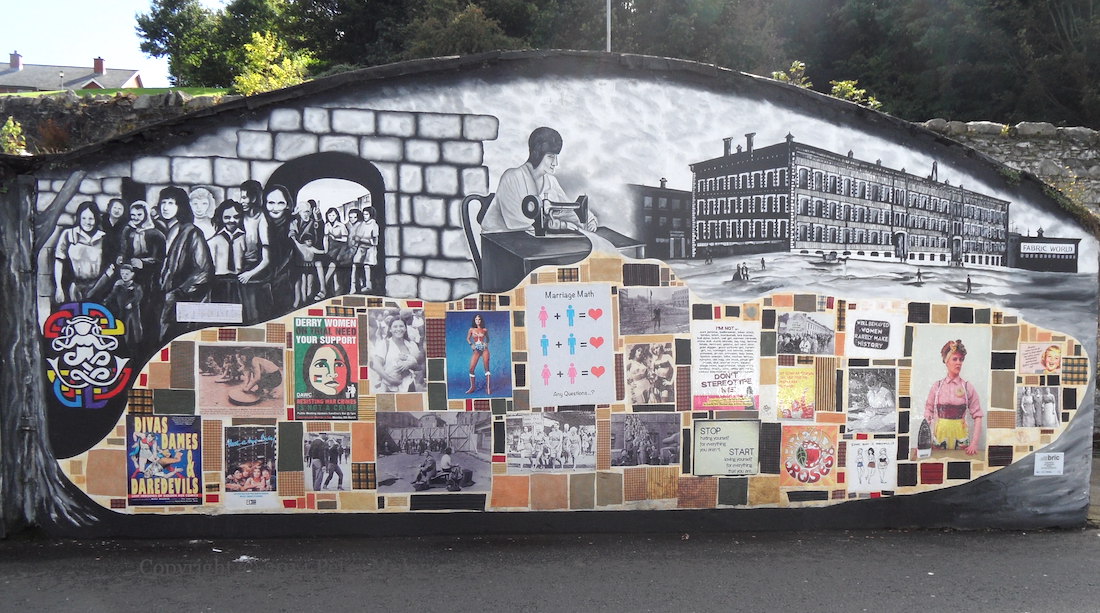


“Derry women made more than shirts – they made communities”.
Here is a Derry mural celebrating the role of women in society, both locally and world-wide.
On the left of the main panel, women march out of one of the city’s gates. The information sheet reads as follows: “On International Women’s Day, March 8th [1991, not 1981 as the hand-written addition suggests], the first ever women’s mural in Derry was unveiled on the back of Free Derry Wall. It was designed and painted by Patricia Hegarty and Joe Coyle, and helpers, both men and women. The mural takes its inspiration from a march in November 1968, after Minister for Home Affairs Bill Craig banned all civil rights marches in the walled city. Women factory workers walked out and spent the afternoon marching in and out of every gate in the city, deliberately “breaking the ban”. Men marched in from DuPont to join them, and a rally was held in the Diamond. In the mural you can find the faces of some of those marching on that historic day, as well as other women who played their part in the ongoing struggle for justice. Civil rights workers Bridget Bond and Women’s Aid refuge founder Cathy Harkin march alongside republicans such as Ethel Lynch, Bridget Sheils, Peggy Derry, prisoners’ rights activists Susie Coyle, and many others. You may find images of your granny, sister or aunt. The mural is dedicated to all those women whose energy and determination have changed their lives and the world about them.”
The board on FDC can be seen in Woods’s Seeing Is Believing?, plate 19.
In the centre of the main panel, a tapestry of images and posters is being sewn by a woman at a sewing-machine in one of Derry’s large shirt- and collar-making factories (one of which, attached to “Fabric World”, is shown on the right).
The tapestry includes flyers/posters of local women banging bin lids at the death of Tom McElwee, marching past the ‘Free Derry’ slogan on Free Derry corner, striking, and protesting; there are also posters supporting Palestine and gay rights, celebrating femininity, and one of Wonder Woman.
Lecky Road, Brandywell, Derry
Click an image to enlarge
Copyright © 2014 Peter Moloney
M11610 [M11302] M11301 [M11267] [M11268]
M11303
M11269 M11270
[M11271] [M11272] [M11273] [M11274] [M11275] [M11276] [M11277] [M11278] [M11279]
M11611
 Peter Moloney Collection