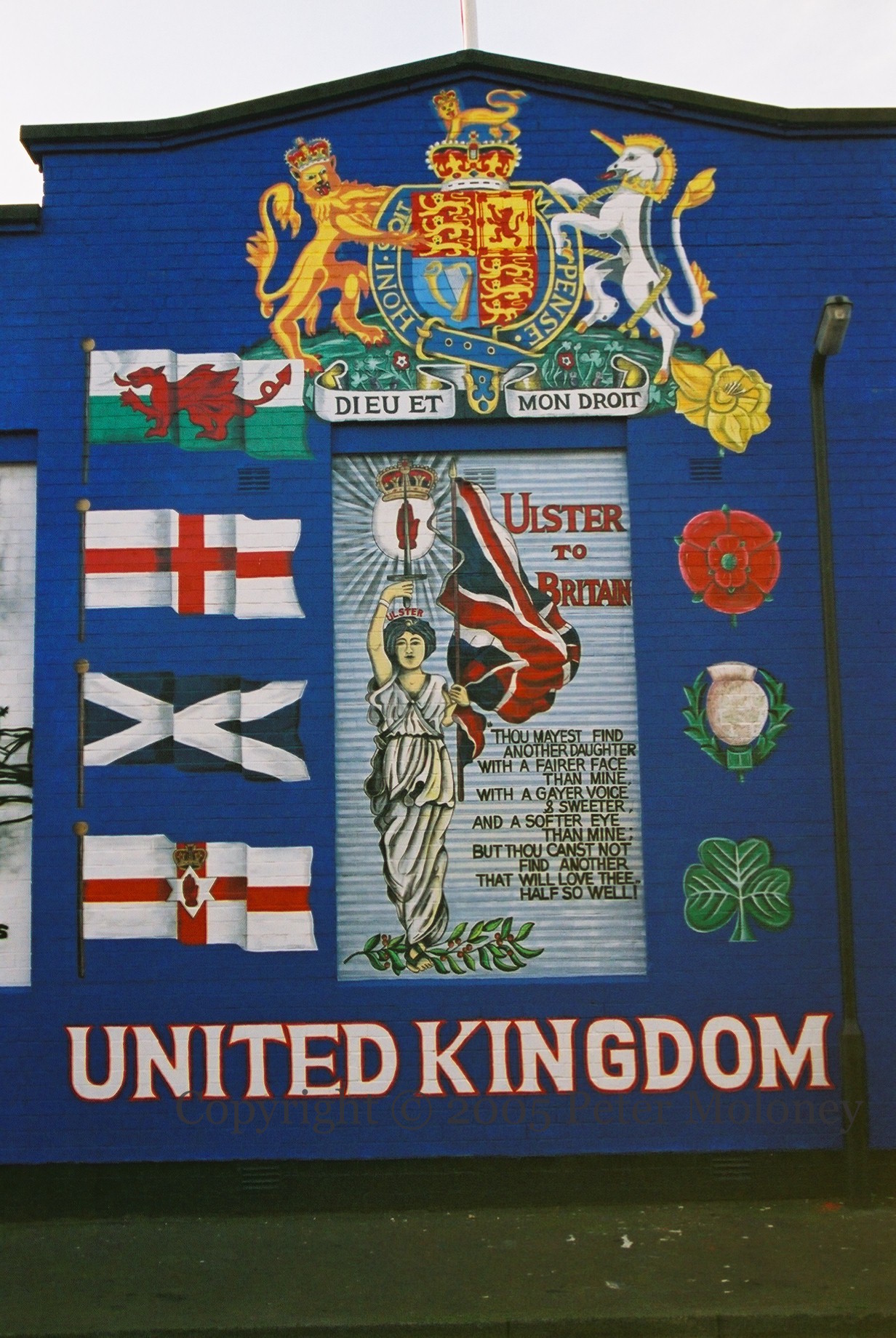
The central panel in Thorndyke Street, Belfast, reproduces a postcard from during the Home Rule debate: “Ulster to Britain: thou mayest find another daughter with a fairer face than mine, with a gayer voice and sweeter and a softer eye than mine; but thou canst not find another that will love thee half so well!” The Ulster Banner (a flag of Northern Ireland) is used to represent Ireland in the quartet of flags while the shamrock stands alongside daffodil, rose, and thistle. For the Anglo-Norman French around the crown’s coat of arms, see Honi Soit Qui Mal Y Pense.
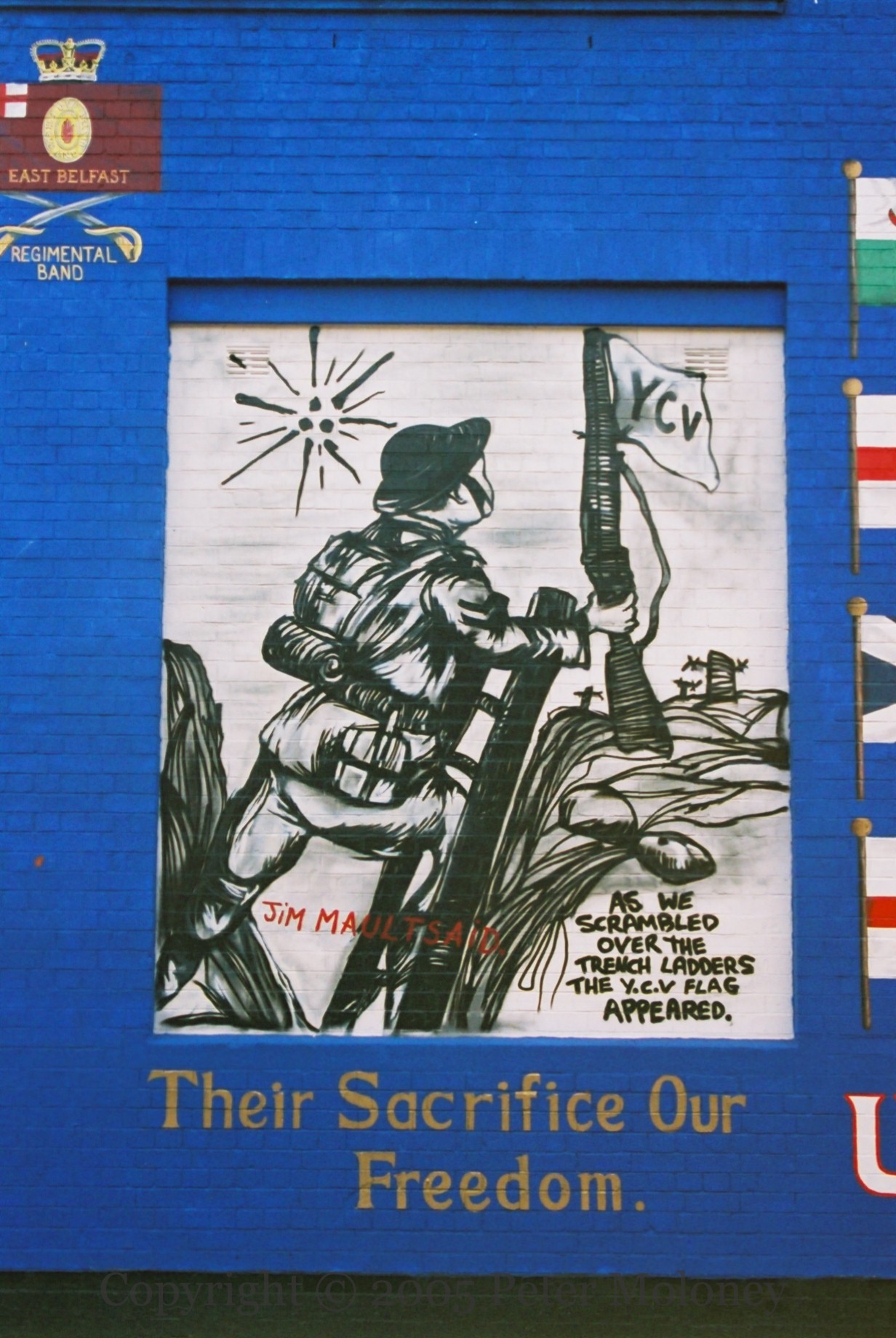
“At the outbreak of the Great War in August 1914, when Lord Kitchener, the War Minister, was desperately looking for men, he had asked Sir Edward Carson for a brigade consisting of four battalions. Carson offered him a division consisting of twelve battalions, uniformed and equipped at Ulster’s expense. The UVF was transformed rapidly into the 36th (Ulster) Division. On the 1st July 1916 the 36 (Ulster) Division took part in the Somme Offensive. Nine Victoria Crosses were awarded for acts of valour on that day. Men of the 36th (Ulster) Division won four of these. Of those, three were awarded posthumously. Of the 9,000 men of the Division who took part in the attack scarcely 2,500 answered roll call on the 3 July; while of 400 officers, more than 250 were killed or wounded. The Division lost 5,500 officers and other ranks killed, wounded and missing as a result of the first two days of the Somme offensive. The illustration depicted is derived from a drawing by Jim Maultsaid, an American citizen. He joined the 14th Royal Irish Rifles, which was drawn from members of an organisation called the Young Citizens Volunteers.” “As we scrambled over the trench the YCV flag appeared.” Thorndyke Street, Belfast. For more, see the Extramural Activity post on this panel.
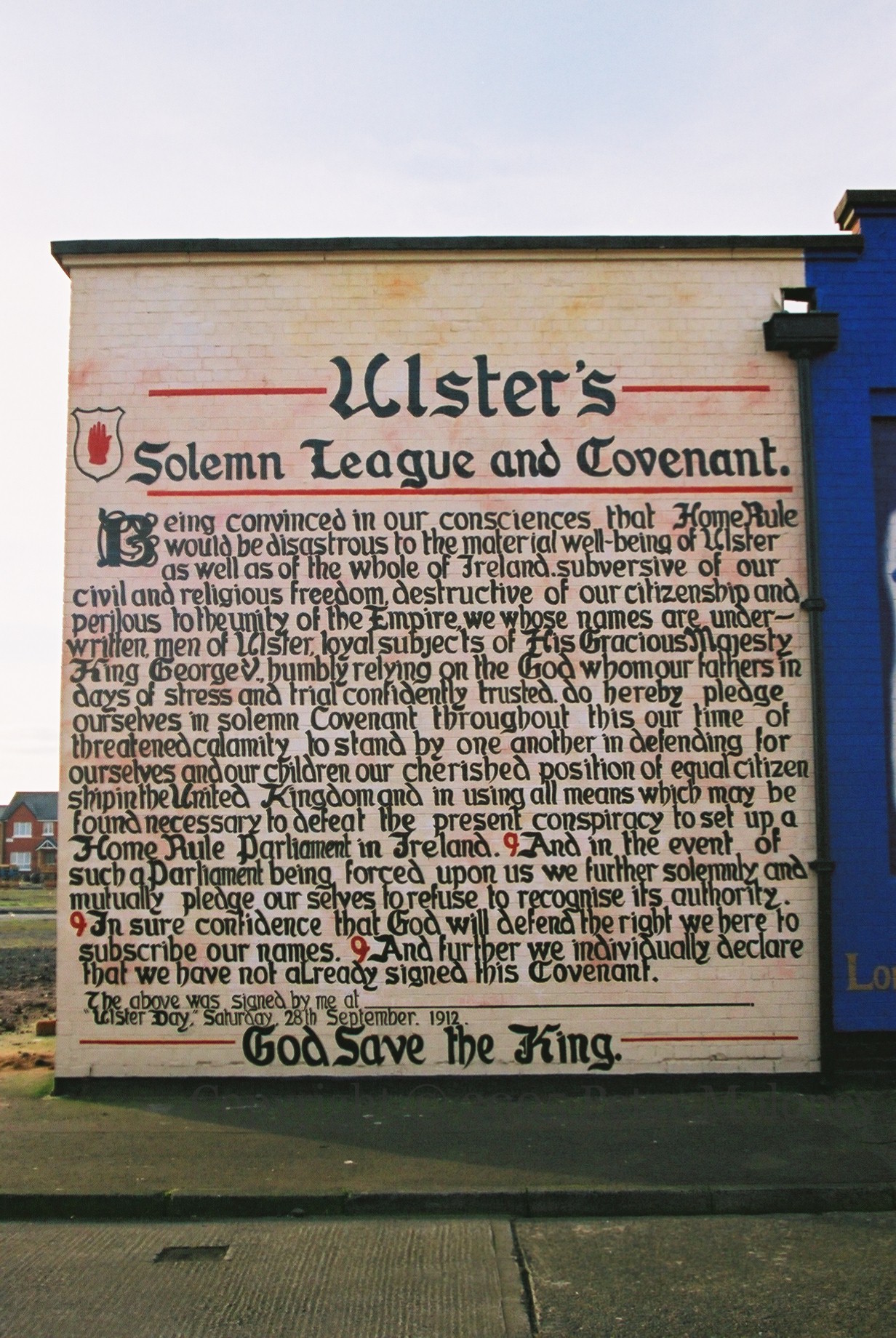
“Being convinced in our consciences that Home Rule would be disastrous to the material well-being of Ulster as well as of the whole of Ireland, subversive of our civil and religious freedom, destructive of our citizenship, and perilous to the unity of the Empire, we, whose names are underwritten, men of Ulster, loyal subjects of His Gracious Majesty King George V., humbly relying on the God whom our fathers in days of stress and trial confidently trusted, do hereby pledge ourselves in solemn Covenant, throughout this our time of threatened calamity, to stand by one another in defending, for ourselves and our children, our cherished position of equal citizenship in the United Kingdom, and in using all means which may be found necessary to defeat the present conspiracy to set up a Home Rule Parliament in Ireland. And in the event of such a Parliament being forced upon us, we further solemnly and mutually pledge ourselves to refuse to recognise its authority. In sure confidence that God will defend the right, we hereto subscribe our names. And further we individually declare that we have not already signed this covenant.” “The above was signed by me at ______ “Ulster Day”, Saturday, 28th September, 1912. God save the King.” The covenant was signed by almost half a million people in anticipation of the (third) Home Rule Bill. This is the first in a series of murals from the East Belfast Historical And Cultural Society in Thorndyke Street, Belfast.
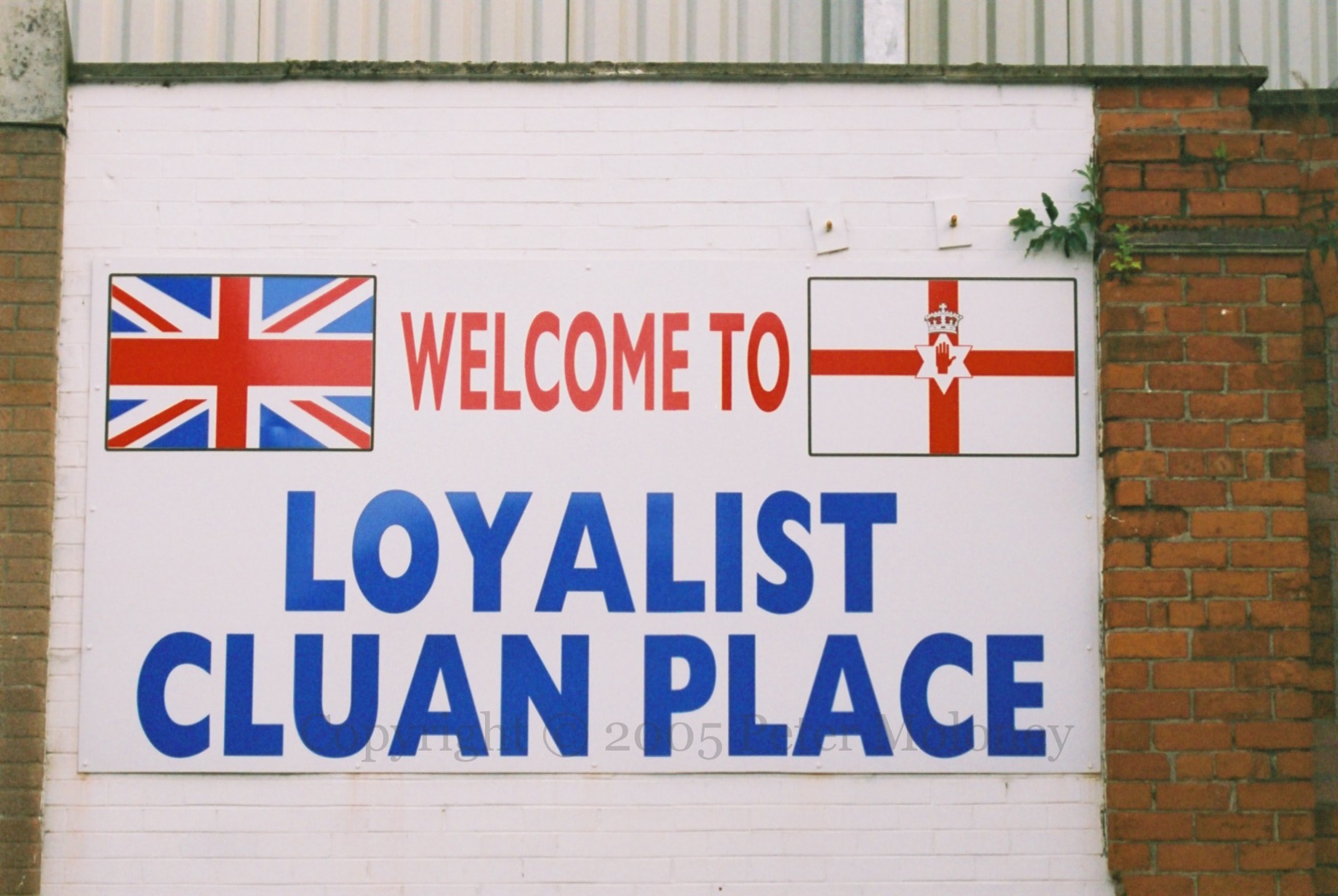
Cluan Place is a single street of 25 houses in east Belfast, hemmed in by the shops on the Albertbridge Road and by a “peace” line separating it from the (nationalist) Short Strand. Tensions between the two areas were particularly high in the early 2000s – see this Guardian article from 2002.
20th anniversary tarp on the side of the Falls Road Library, Belfast. Originally an 8 x 8 canvas, from which a 30 x 30 tarp was printed and hung in Harlem (see J0886) and this 20 x 20 version printed and brought to Belfast. For info on the faces in the corners, see the 2002 post.
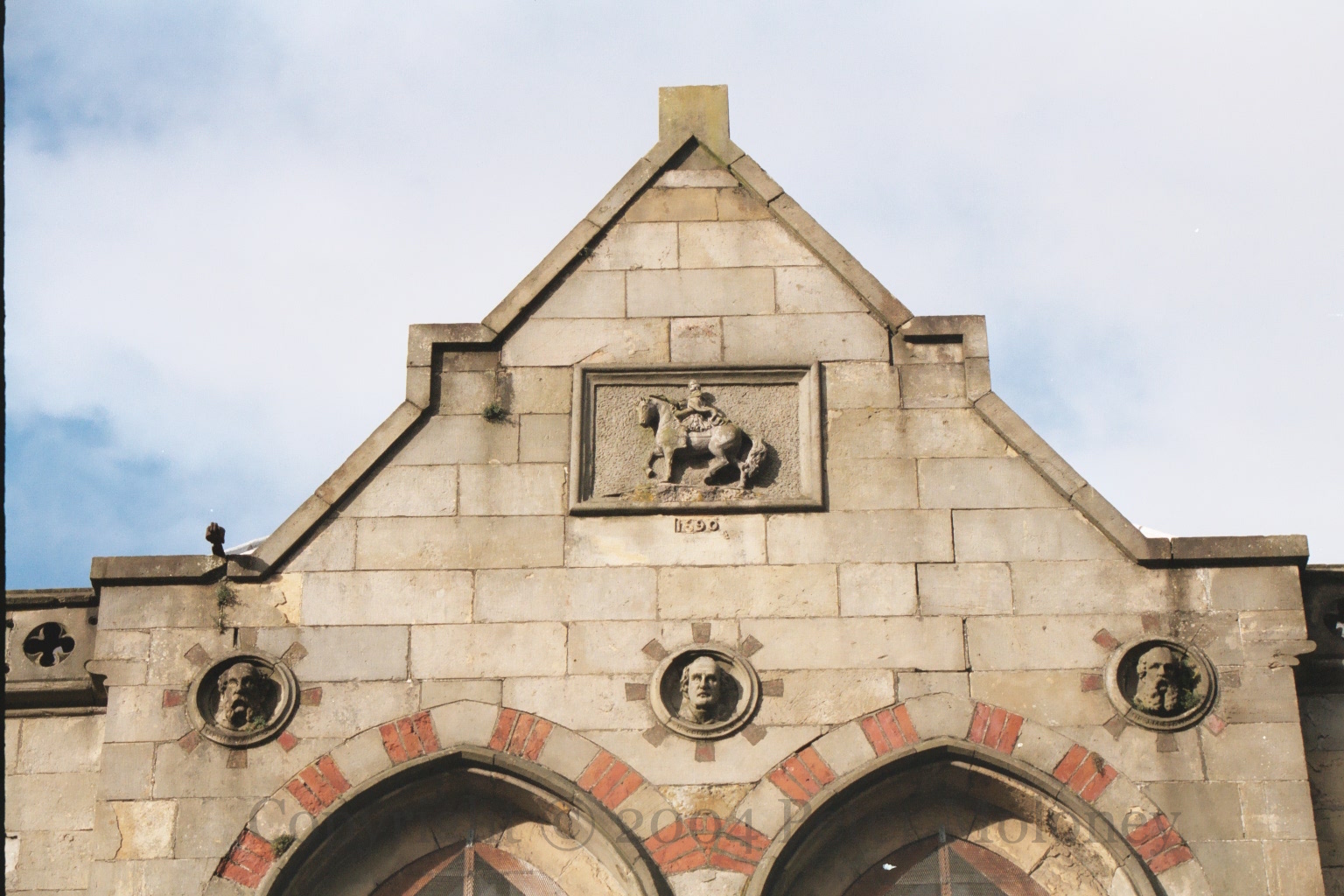
This is the top of the 1869 Orange Hall in Mountjoy Road, Omagh. For architectural information, see Archiseek. The three gentlemen below King Billy are Capt. M. Stewart G.M., H Cooke LLD, and Sir J.M. Stewart.
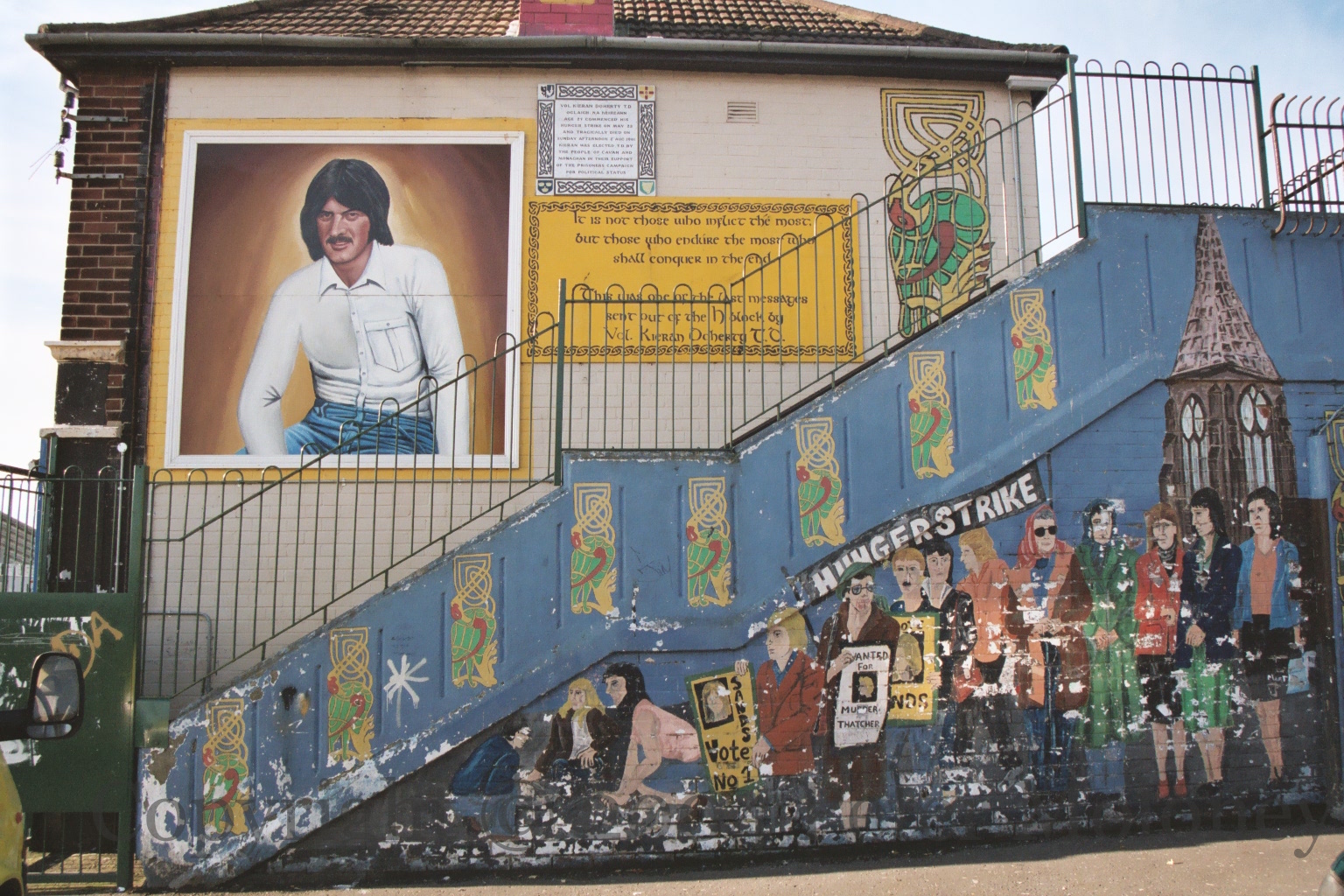
Kieran Doherty was elected TD (Teachta Dála) for Cavan-Monaghan three weeks into his 1981 hunger strike. He held the position for two months, until he died on August 2nd. The portraits, plaques, and mural of marchers are in his home area of Andersonstown. The words “It is not those who inflict the most, but those that can endure who shall conquer in the end” are an echo of Terence MacSwiney, whose hunger strike in 1920 lasted 74 days, one more than Doherty’s.
Maurice Harron (WP) is a Dery sculptor. The piece ‘Reconciliation/Hands Across The Divide’ sits at the end of Craigavon Bridge in London-/Derry and shows two bronze figures reaching towards one another as they pass.







 Peter Moloney Collection