Armed Resistance Was The Only Resort

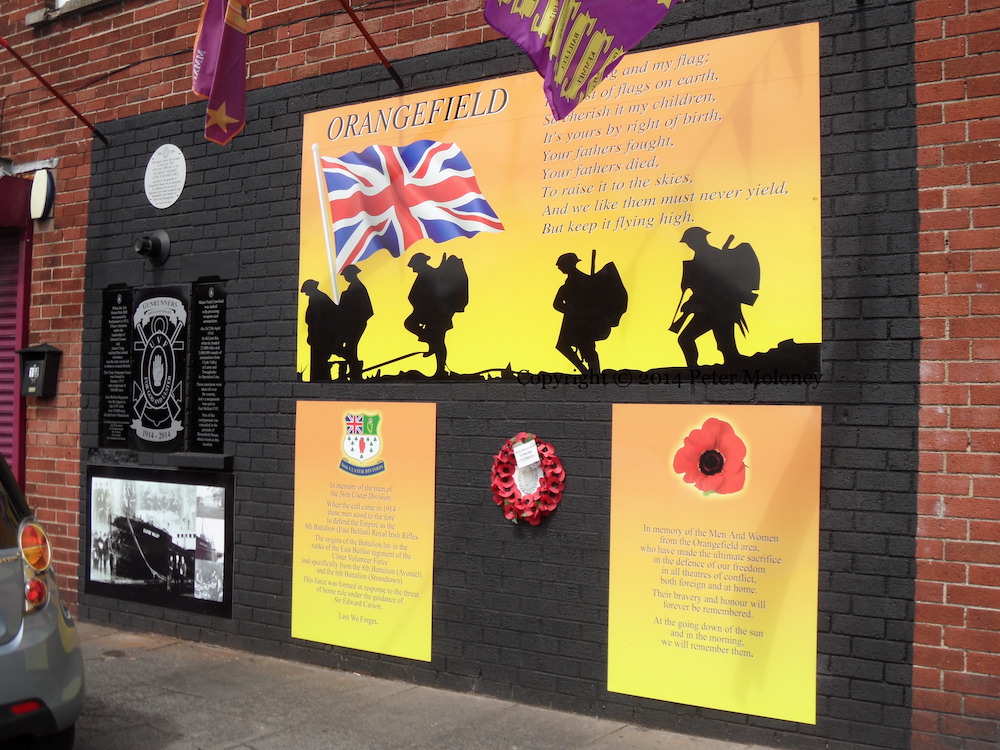
The boards on the left celebrate the 100th anniversary of the 1914 Clyde Valley gun-running; material from the operation was held for the East Belfast battalion of the Ulster Volunteers at Bloomfield House (web), site of these boards. See also: John Henry Patterson’s involvement in Operation Lion.

“When the 3rd Home Rule Bill was passed by Parliament in 1912, Ulster Unionists under the leadership of Edward Carson and James Craig realised that armed resistance was the only resort left to them to remain British. The Ulster Volunteer Force was formed in January 1913 and comprised of 100,000 men. East Belfast Regiment was the largest in the UVF with over 10,000 men divided into 6 Battalions: 1st. Ballynafeigh & Newtownbreda, 2nd. Willowfield, 3rd. Mountpottinger, 4th. Victoria, 5th. Avoniel, 6th. Strandtown & Knock. Major Fred Crawford was tasked with procuring weapons and ammunition. On 24/25th April 1914 he did just this when landed 25,000 rifles and 3,000,000 rounds of ammunition from Clyde Valley at Larne and Donaghadee in Operation Lion. These munitions were taken all over the country, and a consignment was sent to East Belfast UVF. Part of this consignment was concealed in the grounds of Bloomfield House, which stood on this location.”

“This plaque marks the occasion in early May 1914 when over 2,000 men of the East Belfast Regiment, Ulster Volunteer Force paraded to the grounds of Orangefield House for an inspection to celebrate the success of Operation Lion when weapons and ammunition were landed at Larne and Donaghadee. For God and Ulster.”

The boards on the right read: “‘Tis thy flag and my flag;/The best of flags on Earth,/So cherish it my children,/It’s yours by right of birth.//Your fathers fought,/Your fathers died,/To raise it to the skies,/And we like them must never yield,/But keep it flying high.” from The Union Jack, by Edward Shirley, in Little Poems For Little People, and “In memory of the men and women from the Orangefield area, who have made the ultimate sacrifice in the defence of our freedom in all theatres of conflict, both foreign and at home.” These memorial boards are to local men who “stood to the fore to defend the Empire as the 8th Battalion (East Belfast) Royal Irish Rifles” in the 36th division, formed from formed from the “8th Battalion (Avoniel) and the 6th Battalion (Strandtown)” of the Ulster Volunteers.

Grand Parade, east Belfast.

Click image to enlarge
Copyright © 2014 Peter Moloney
M11207 M11208 [M11209] [M11210] [M11211] M11212 M11213c

HMS Caroline

HMS Caroline’s connection to Belfast is that she served as the headquarters for the Royal Naval Reserve in Alexandra Dock. Originally built in 1914, she served in the Grand Fleet and took part in the battle of Jutland on May 31st, 1916, as shown in the image above. She was decommissioned in 2011; it is hoped to open her as a museum and visitor attraction by the time of the centenary of the battle (WP). The Daily Mail has a gallery of images of the ship in its current state. Also present at the battle of Jutland, as captain of HMS Nestor, was Commander (later Sir) Edward Bingham.

By Jim Russell in St. Aubyn’s Street, north Belfast

Click image to enlarge
Copyright © 2014 Peter Moloney
M11200

Footsteps Through Our History

Footsteps through the history of Coleraine, from top to bottom: Martin Luther (c. 1521); John Knox, who led the reformation in Scotland (c. 1560); the plan of Coleraine (c. 1611); the relief of Derry (1689); the Williamite campaign (1690); (and then a jump to) WWI (“Christmas truce, western front”); WWII (“War on the home front”).

These boards replaced a UDA mural in March, 2014 (see Loyalist Ballysally).

Daneshill Road, Coleraine.

Click image to enlarge
Copyright © 2014 Peter Moloney
M11152 M11153 [M11154] [M11155] [M11156] [M11157] [M11158] [M11159] [M11160]

A Force For Ulster

Here are two new boards in the courtyard of the Rex Bar on the Shankill Road, describing the formation of the Ulster Volunteers (‘A Force For Ulster’) and commemorating the losses suffered by the 36th (Ulster) Division of the British Army, which the Volunteers became, at the Somme and in other battles, mowed down by “the Hun machine guns” (‘The Great War’).

‘A Force For Ulster’ includes photographs of the recent centenary re-enactments of the Balmoral Review, the Ulster Covenant, the formation of the Volunteers (“east” and “west”) and “Operation Lion” – more commonly known as the Larne Gun-Running.

According to the ‘The Great War’ board, 32,186 men from west Belfast were killed, wounded, or missing in the effort to “restore peace in Europe”. “To them bravery was without limit, to us memory is without end”. The board shows the Thiepval Memorial To The Missing Of The Somme against a background of portraits.

Click image to enlarge
Copyright © 2014 Peter Moloney
M11093 [M11094] [M11095] [M11096] [M11097] [M11098] [M11099] [M11100] [M11101] [M11102] [M11103] [M11104] [M11105] [M11106] [M11008] [M11009] [M11010] [M11011] [M11012] [M11013] [M11014] [M11015] [M11016] [M11017] [M11118]
M11007 [M11317] [M11318]

Secundus Ad Nullam

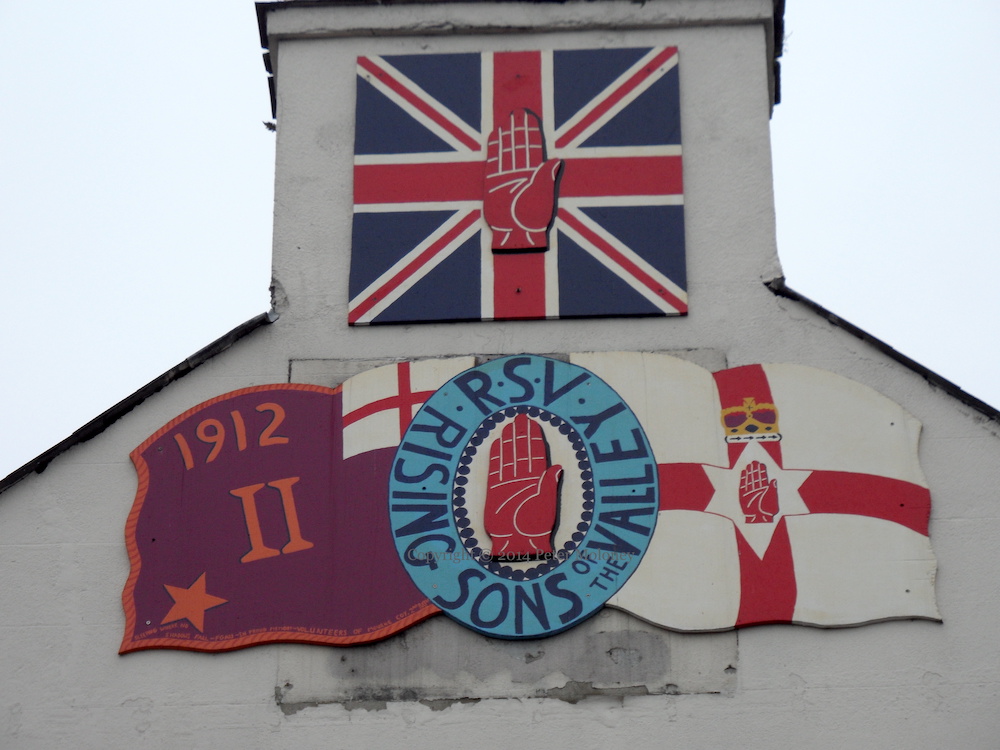
Boards of the Rising Sons Of The Valley (Fb), Mourne Young Defenders (Fb), and Pride Of Ballinran (Fb) flute bands in Kilkeel, County Down.

The left part of the RSV board shows the numeral “II” on a “1912” Ulster Volunteers flag. The 2nd County Down battalion of the 1912 Ulster Volunteers became (in 1914) the 16th RIR, the pioneer (engineering) battalion for the 36th Division (Long Long Trail).

The motto on the Ballinran board is “Secundus ad nullam”, which is a word-for-word mis-translation of “second to none”; properly it would simply be “nulli secundus”.

Harbour Road, Kilkeel

Click image to enlarge
Copyright © 2014 Peter Moloney
M10947 [M10948] [M10949]
M10944 [M10945] [M10946]
M10951 [M10943]

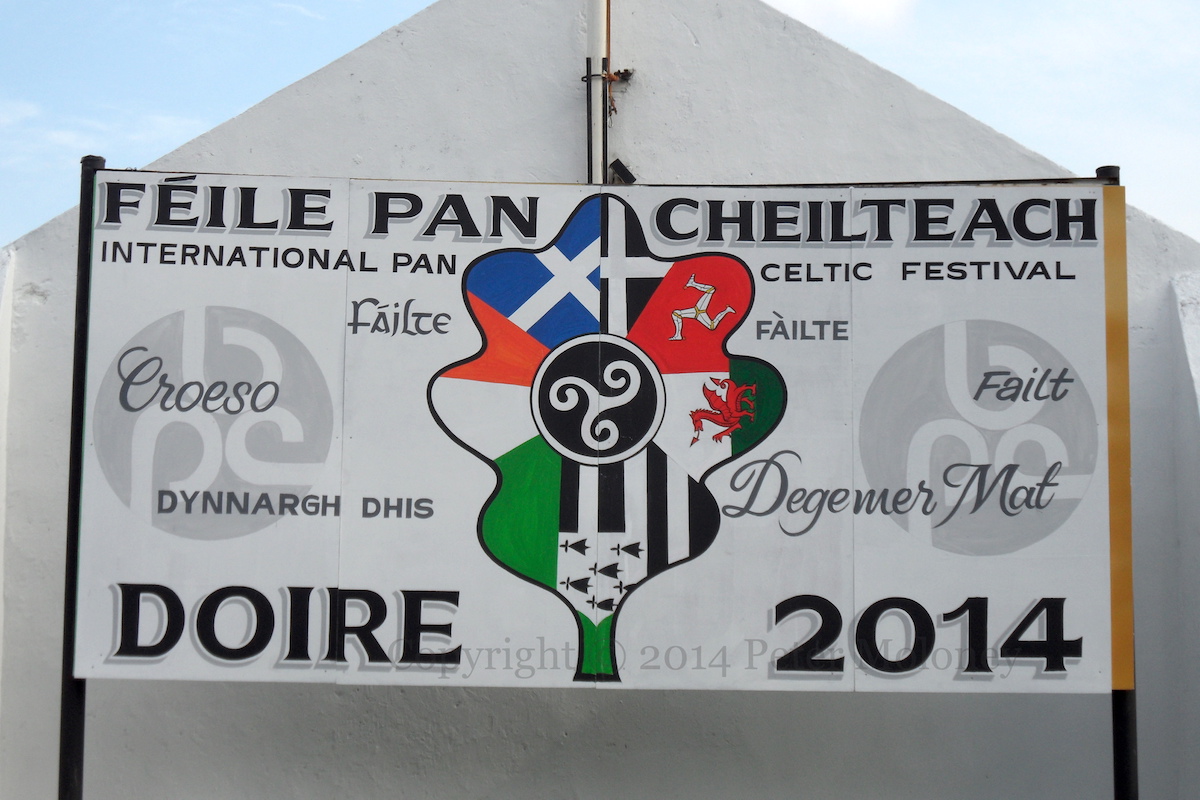
Féıle Pan Cheılteach

“International pan-Celtic festival – Doıre”. The festival (web) is in its 43rd year and will be held in Derry from April 22nd to 27th (Transceltic).

in the centre, the Derry oak-leaf is painted in the flags of the six Celtic-language nations with “welcome” in the six languages: (by flag, clockwise from left) Irish (Fáılte), Scots Gaelic (Fàılte), Cornish (Dynnargh Dhis), Manx (Failt), Welsh (Croeso), and Breton (Degemer Mat).

Free Derry Corner, Lecky Road, Derry. There is a Visual History page for the rear of Free Derry Corner.

Click image to enlarge
Copyright © 2014 Peter Moloney
M10935

Come On The Mac

On the left, “Divis Youth Project” [Fb], side: “30th anniversary Frank Gillen Centre 1984-2014”, “Providing a range of programmes both educational and recreational which meet the needs of young people within the Falls area”.

On the right, “Come on the Mac”, side: “70th anniversary Immaculata football club [Fb] 1944-2014″.

And between the spires of St Peter’s: “Fáılte go Bóthar Na bhFál”.

Albert Street, Divis, west Belfast

Click image to enlarge
Copyright © 2014 Peter Moloney
M10928 [M10929]

Whiterock Flute Band

“On behalf of the officers and members of the Whiterock flute band we would like to thank all our past members, families, loyal orders and community for your support.”

“A brief history: On the 21st February 1962 there was a new flute band established. This band was to be named the Whiterock flute band. It all began during the monthly meeting of Whiterock Temperance LOL 974 when Brother Andrew Johnston (Snr) backed by Bro. Jack King proposed that a junior band be formed. Little did they know that the band would be celebrating 50 glorious years in 2012.

The band’s first chairperson was Andrew Johnston (Snr), the role which has been filled by many after him. The original committee members were Billy Simpson and Joe Proctor. The initial band membership came mainly from the mixed area of the Upper Springfield Road namely New Barnsley, Moyard and the adjoining Highfield area. However over the years the ranks of the Whiterock have been filled with folk from all over Belfast. With a new band comes the need for instruments, the ‘John Brown’ flutes were purchased for a small fee of thirty bob (£1.50) whilst the side drums were kindly donated by the Springfield Methodist church and accompanying bands associated with the church obtained through Jimmy McClean.

With practices taking place in Whiterock Orange Hall and the band building a repertoire of music containing Blackboard of my Heart, Abide with Me and the national anthem all they needed now was a parade to get the show on the road. The first parade for the band was on the 29th June 1962 accompanying the Whiterock Temperance LOL 974 on their annual Whiterock parade, a parade which today still plays a large part in the band’s activities.

Two years later in 1964, the band was well establish and looked towards a uniform re-design; they opted for bright orange sashes, white shirts and the Balmoral Hat with the distinctive orange plume. The hat is still part of the Whiterock uniform today and in fact has become somewhat a trade mark of the band.

As well as the uniform, the band instruments also changed slightly in that they obtained ‘Big Bertha’ which is a half Lambeg rope drum and is still beaten by the band today, alongside this they began purchasing the Hawkes and Sons Crown AZ Bb flute which is also still played by the band. The Crown AZ flutes are a highly sought after instrument and are a lot more expensive than the John Browns purchased for £1.50.

The band had engaged with many organisations throughout their history, some of which have maintained long term relationships. On the band’s 50th anniversary 2012, we enjoyed the company of Ulster Convention LOL 242 for (37 years), alongside Britannia Junior LOL 32 (36 years). Other notable relationships are Beaconsfield RBP 224 (34 years) and ABOD Campsie Club (12 years) all presently engaged to date 2014.

Membership of the band remains consistent with many members having an impressive number of years service under their belt, in particular Alex Thompson (AT), who has a staggering 50 years marked in 2013. Looking towards the future, the band will stay committed to providing opportunities for our younger generations, to participate in the art of flute and drum, therefore keeping our glorious tradition alive.”

Click image to enlarge
Copyright © 2014 Peter Moloney
M10915 M10914 [M10916] [M10917] M10918 [M10919] [M10920] [M10921] [M10922] [M10923]

Young Citizen Volunteers

These Kilburn Street boards commemorate the “Young Citizen Volunteers Of Ireland” and the battle of the Somme. The text in the side-wall board (shown below) is from the diary of a Somme soldier: “We surge forward. Bayonets sparkle and glint. Cries and curses rent the air. Chums fall, some without a word … and others … Oh, my God! May I never hear such cries again! There goes the YCV flag tied to the muzzle of a rifle. That man had nerve! Through the road just ahead of us we had crossed the sunken road. We could see khaki figures rushing the German front line. The Inniskillings had got at them.”

The larger board, on the right, describes the transition from rebels in 1912 to British Army soldiers in 1914: “On the 17th May 1914 the Young Citizen Volunteers became a battalion of the Belfast regiment of the Ulster Volunteer Force. This formed part of the Ulster Division authorised on 28th October 1914 which officially became the 14th battalion of the Royal Irish Rifles, part of the 109th brigade. The 14th saw action throughout the First World War.”

It includes a quote from Edward Carson, “You will find in your ranks men with the same ideals, men with the same loyalty and the same determination to uphold the rights of their country”, and a quote from VC winner William Fredrick McFadzean, “You people at home make me feel quite proud when you tell me I am the soldier boy of the McFadzeans. I hope to play the game and if I don’t add much lustre to it I certainly will not tarnish it.”

Click image to enlarge
Copyright © 2014 Peter Moloney
M10804 M10803 M10802
[M10805] [M10806] [M10807] [M10808] [M10809] [M10810] [M10811] [M10812]

East Belfast Volunteers

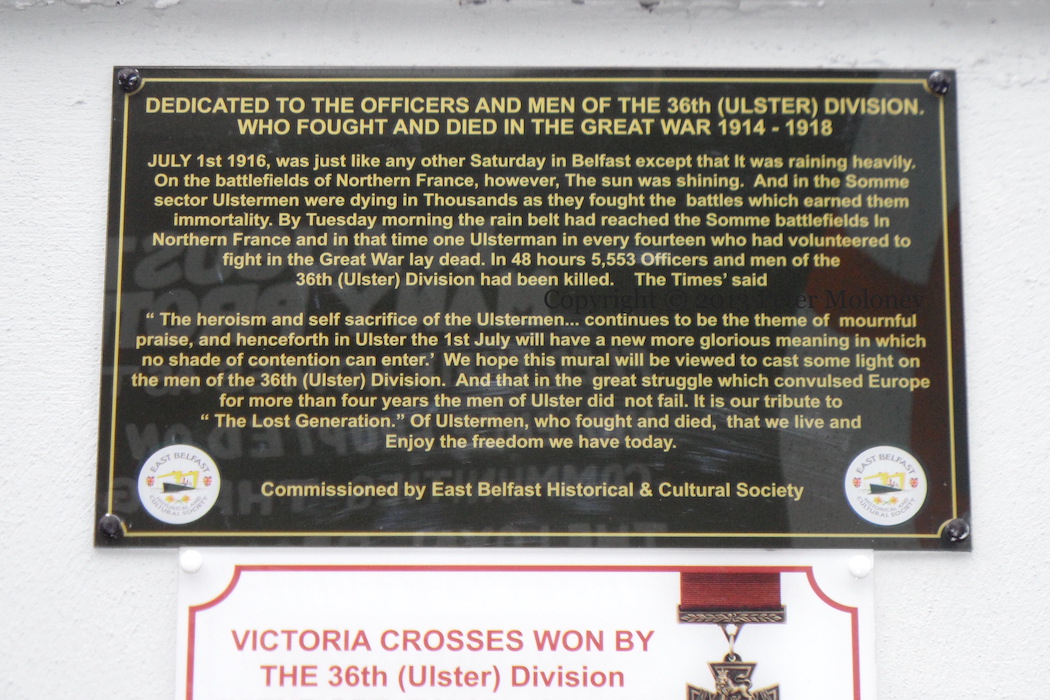
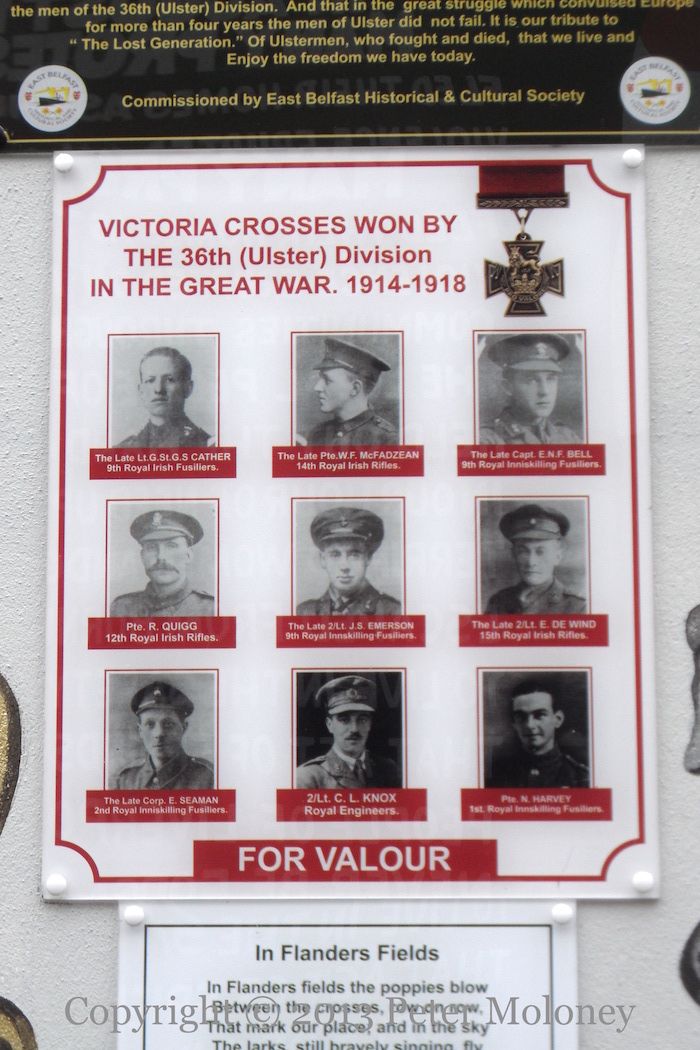
This is a repainted version of the mural of ‘insignia’ of units of the eighth battalion of the Royal Irish Rifles. This new mural includes a background of silhouetted soldiers and additional poppies on the right of the main gable and along the bottom of the side wall; the units included remain the same as before.

The plaques on the side wall have changed slightly: the information plaque remains from before but the plaque of VC winners now includes photographs, and the words of Moina Michael’s ‘We Shall Keep The Faith’ are now included in addition to McCrae’s ‘In Flanders Fields’.

Canada Street, east Belfast

Click image to enlarge
Copyright © 2013 Peter Moloney
M10633 [M10634] [M10626] M10627 M10628 [M10629] M10630