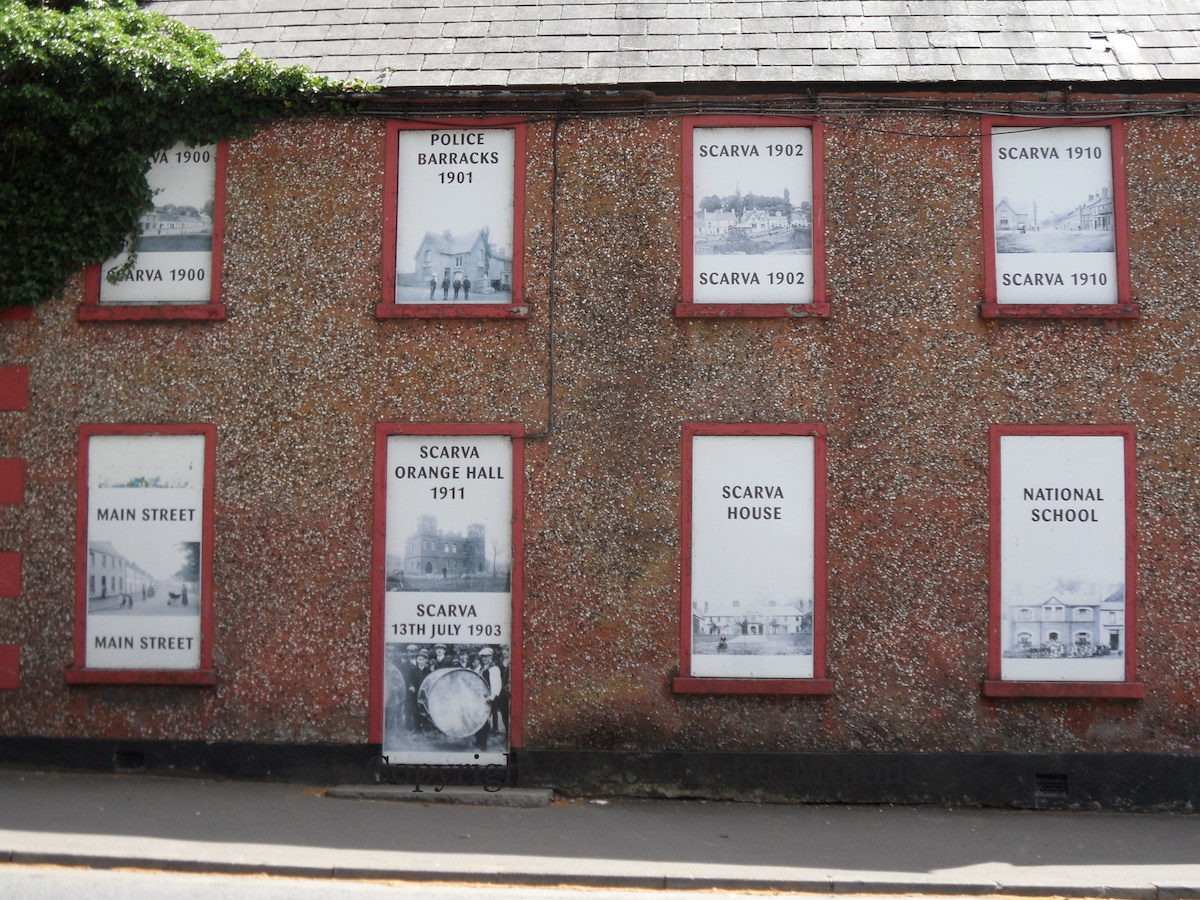
A derelict building in Scarva is used to display images of the village from 1900-1911, including specific buildings such as the police barracks, Scarva House, the National School, and Scarva Orange Hall.
This new board is on the side of Cathedral Youth Club, in the Fountain in Londonderry. From bottom left, clockwise, it shows: St Columb’s cathedral, the old Gaol Tower, Hands Across The Divide (though holding a scroll with a bearded figure with “1690” on his forehead), the Guild Hall, the city crest (Vita, Veritas, Victoria), the peace bridge, the walled city of Derry, Roaring Meg (cannon).
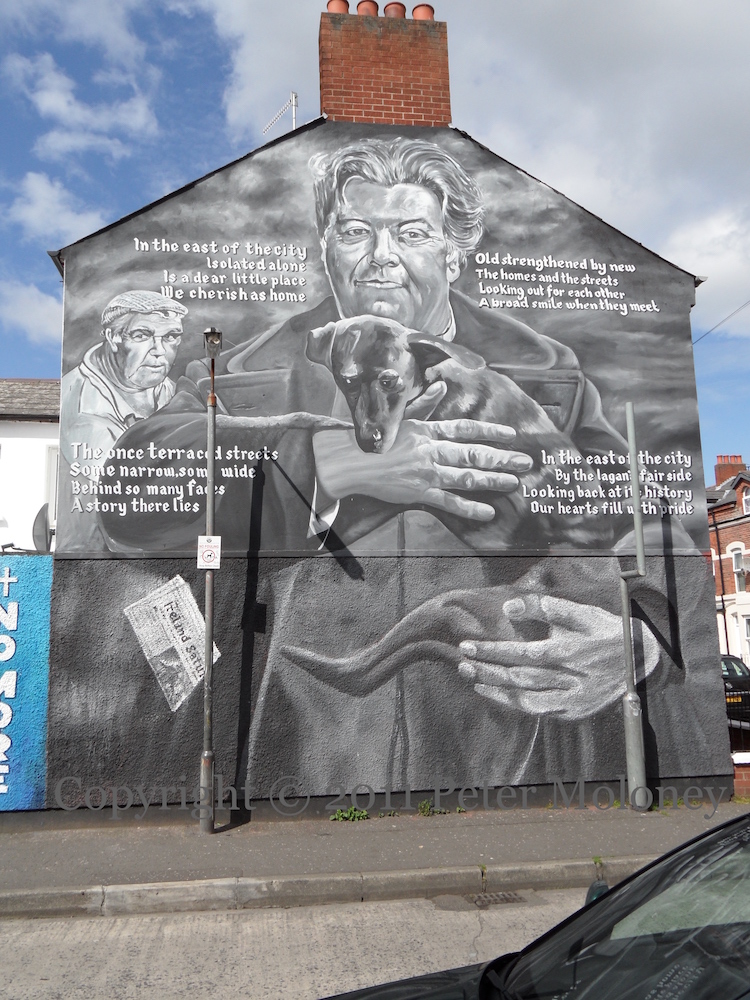
An owner, with Ireland’s Saturday Night (which ceased publication in 2008) tucked in his coat pocket, shows off his greyhound.
The words of the poem – author unknown – read “In the east of the city, isolated alone, is a dear little place we like to call home. / Old strengthened by new, the homes and the streets, looking out for each other, a broad smile when they meet / The once terraced streets, some narrow, some wide, behind so many faces a story there lies / In the east of the city by the lagan’s fair side, looking back at its history our hearts fill with pride.”
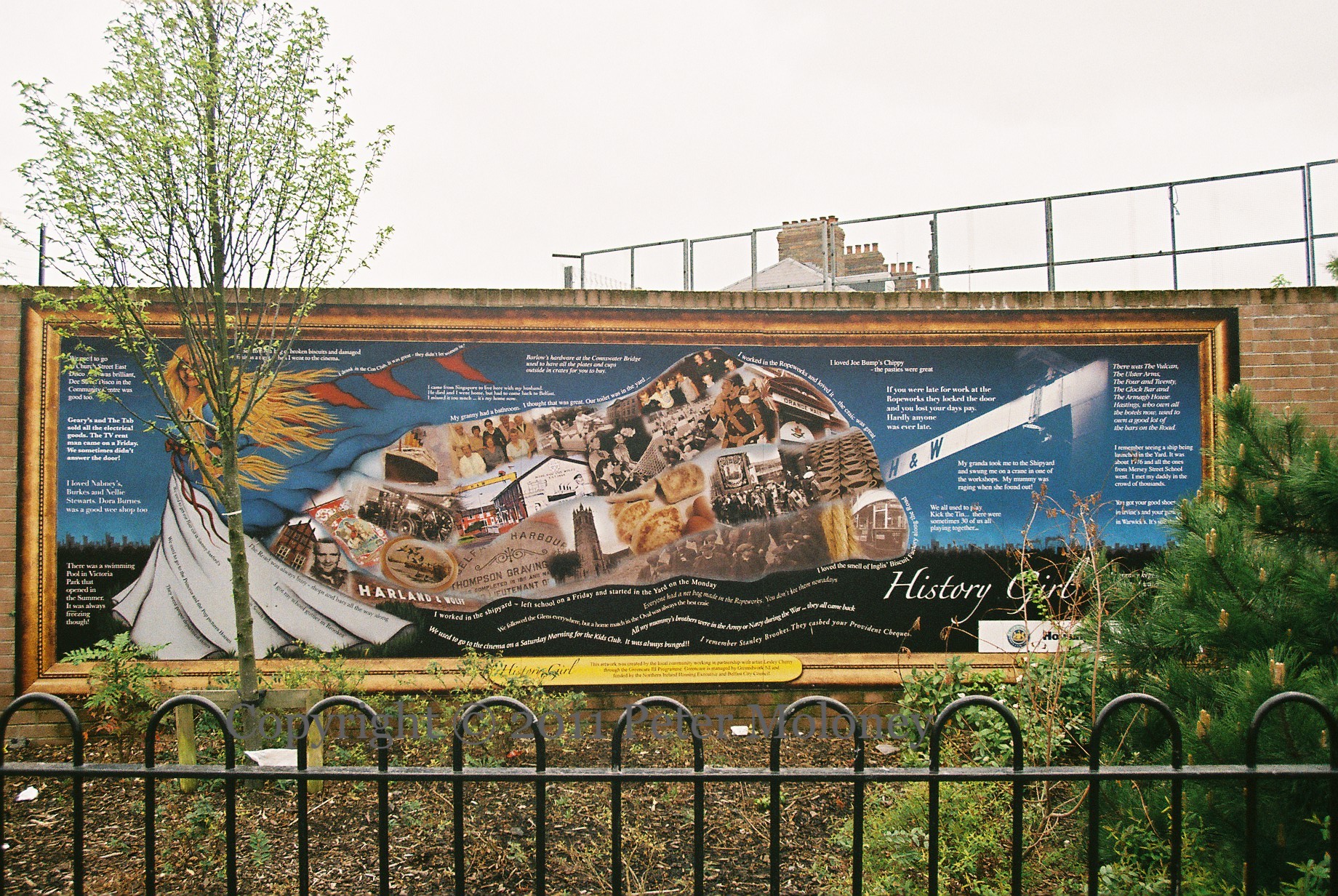
Memories from the History Girl mural in east Belfast’s Thistle Court. (By Lesley Cherry, and with support from the Housing Executive.)
We used to go to Church Street East Disco … It was brilliant. Dee Street Disco in the Community Centre was good too.
Geary’s and The Tab sold all the electrical goods. The TV rent man came on a Friday. We sometimes didn’t answer the door!
I loved Nabney’s, Burkes and Nellie Stewarts. Dora Burnes was a good wee shop too.
There was a swimming pool in Victoria Park that opened in the summer. It was always freezing though!
I used to buy a bag of broken biscuits and and damaged fruit as a treat, when I went to the cinema.
We used to get our hair cut in Sammy Sanford’s.
The Road was always busy – shops and bars all the way along.
Barlow’s hardware at the Conswater Bridge used to have all the plates and cups outside in crates for you to buy.
I drank in the Con Club. It was great – they didn’t let women in!
I came from Singapore to live here with my husband. He died and I went home, but had to come back to Belfast. I missed it too much … it’s my home now.
My granny had a bathroom. I thought that was great. Our toilet was in the yard …
I worked in the Ropeworks and love it … the craic was great.
I loved Joe Bump’s chippy – the pasties were great.
If you were late for work at the Ropeworks they locked the door and you lost your pay. Hardly anyone was ever late.
My grandpa took me to the shipyard and swung me on a crane in one of the workshops. My mummy was raging when she found out!
We used to play Kick the Tin … there were sometimes 30 of us all playing together …
I loved the smell of Inglis’ Biscuit Factory along the Road.
The was The Vulcan, The Ulster Arms, The Four and Twenty, The Clock Bar and The Armagh House. Hastings, who own all the hotels now, used to own a good lot of the bars on the Road.
I remember seeing a ship being launched in the yard. It was about 1976 and all the ones from Mersey Street School went. I met my daddy in the crowd of thousands.
You got your good shoes in Irvine’s and your gutties in Warwick’s. It’s still there.
My granny kept her milk in a bucket of water because she had no fridge.
I worked in the shipyard – left school on a Friday and started in the Yard on Monday.
Everyone had a net bag made in the Ropeworks. You don’t see them nowadays.
We followed the Glens everywhere, but a home match in the Oval was always the best craic.
All my mummy’s brothers were in the Army or Navy during the War … they all came back.
I remember Stanley Brookes. They cashed your Providence Cheques.
We used to go to the cinema on a Saturday morning for the Kids Club. It was always bunged!!
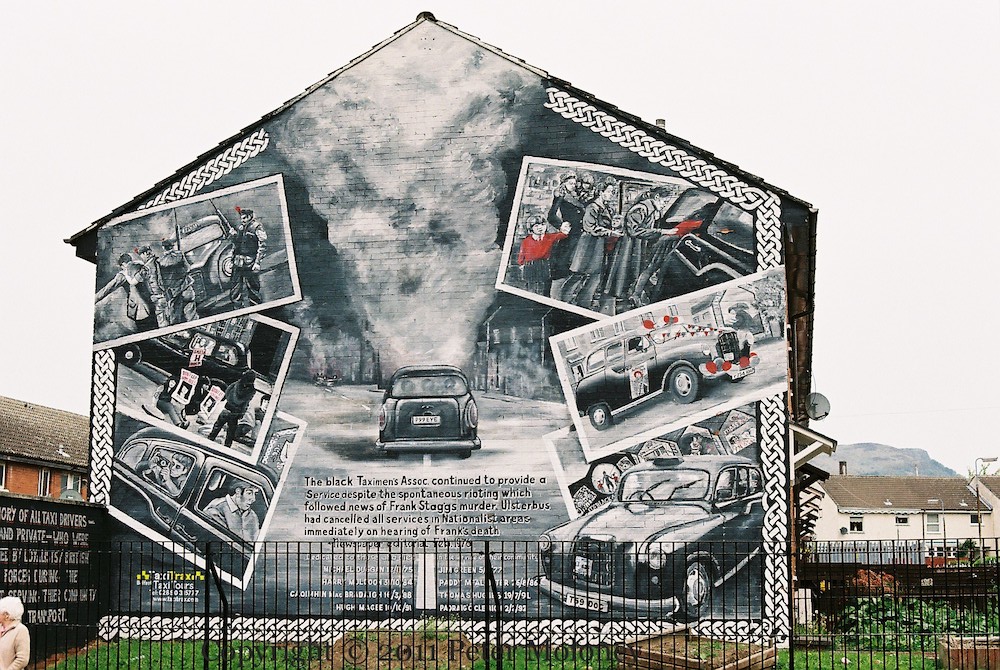
This is the new black taxi mural in Ardoyne Avenue, replacing the original painted in 2001. “‘The black Taximen’s Assoc. continued to provide a Service despite the spontaneous rioting which followed news of Frank Stagg‘s murder. Ulsterbus had cancelled all services in Nationalist areas immediately on hearing of Frank’s death’ – Newspaper editorial Feb. 1976. Dedicated to those who died in the service of their community: Michael Duggan, Jim Green, Harry Muldoon, Paddy McAllister, Caoımhın Mac Bradaıgh, Thomas Hughes, Hugh Magee, Padraıg Ó Cleırıgh. [on the side wall:] In memory of all taxi drivers – public and private – who were murdered by loyalists/British crown forces during the conflict serving their community through transport.”
The “photos” in the lower left and right include various Ardoyne murals that can be seen as part of a black taxi tour (taxitrax.com): Ard Eoın Kickhams, It’s Black And White, GPO 1916, The Blind Piper, The Mass Rock. This mural uses the same device as It’s Black And White, of painting in black and white with occasional use of red (originally for the sweaters of the children, à la Schindler’s List).
“Remembering the past … striving for a better future.” A UFF mural in Lincoln Court is re-imaged. The four boards show … 1970s: “Defence” UDA volunteers outside Lincoln Court Community Association 1980s: “Culture” Flute band drums 1990s: “Tradition” Bonfire 2000s: “Future” Kids’ playground
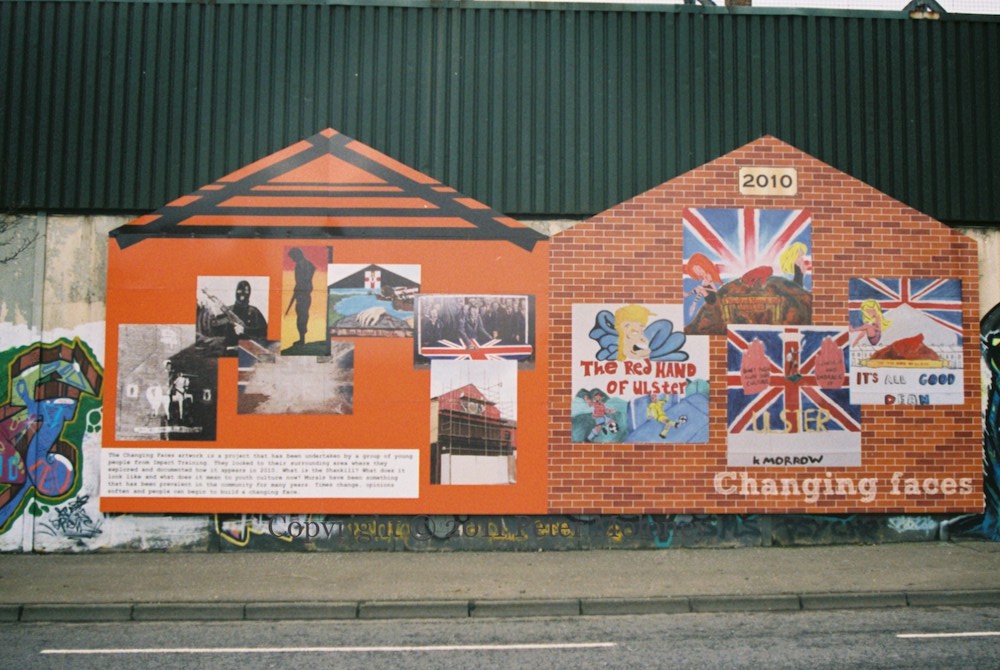
“The Changing Faces artwork is a project that has been undertaken by a group of young people from Impact Training. They looked to their surrounding area where they explored and documented how it appears in 2010. What is the Shankill? What does it look like and what does it mean to youth culture now? Murals have been something that has been prevalent in the community for many years. Times change, opinions soften and people can begin to build a changing face.” On the left is a selection of details from murals with familiar subjects: King Billy, hooded gunmen, the red hand of Ulster, Carson, the Queen Mother; on the right are four panels on the theme of the red hand of Ulster in youth culture (clockwise from left): with wild-style writing from the Cupar Way “peace” line and soccer, with pop music, with It’s All Good by Dublin artist Maser, and with a (two-handed) warrior. “Don’t push away our culture … learn it and embrace it.”
For more on the attempt to put community art on the Cupar Way “peace” line, see Visual History 10.
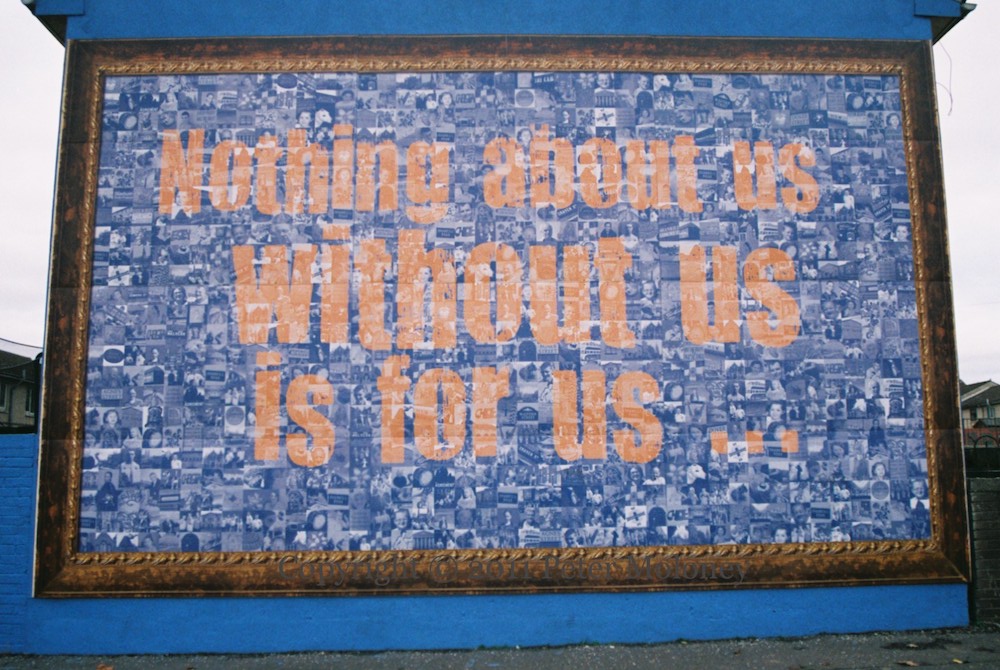
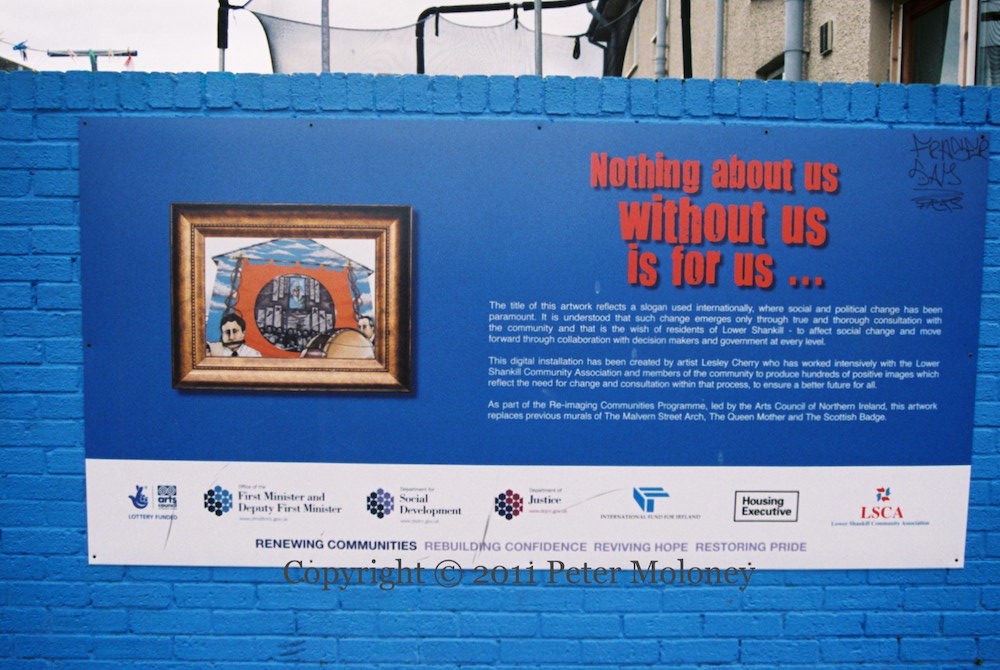
“The title of this artwork reflects a slogan used internationally, where social and political change has been paramount. It is understood that such change emerges only through true and thorough consultation with the community and that is the wish of residents of Lower Shankill – the affect [sic] social change move forward through collaboration with decision makers and government at every level. This digital installation has been created by artist Lesley Cherry who has worked intensively with the Lower Shankill Community Association and members of the community to produce hundreds of positive images which reflect the need for change and consultation within that process, the ensure a better future for all. As part of the Re-Imaging Communities Programme, led by the Arts Council of Northern Ireland, this artwork replaces previous murals of The Malvern Street Arch, [and before that] The Queen Mother [probably intended is the QEII golden jubilee mural] and [before that] The Scottish Brigade [this mural was three walls to the right; prior to the QEII mural was a UFF mural].” Hopewell Crescent.
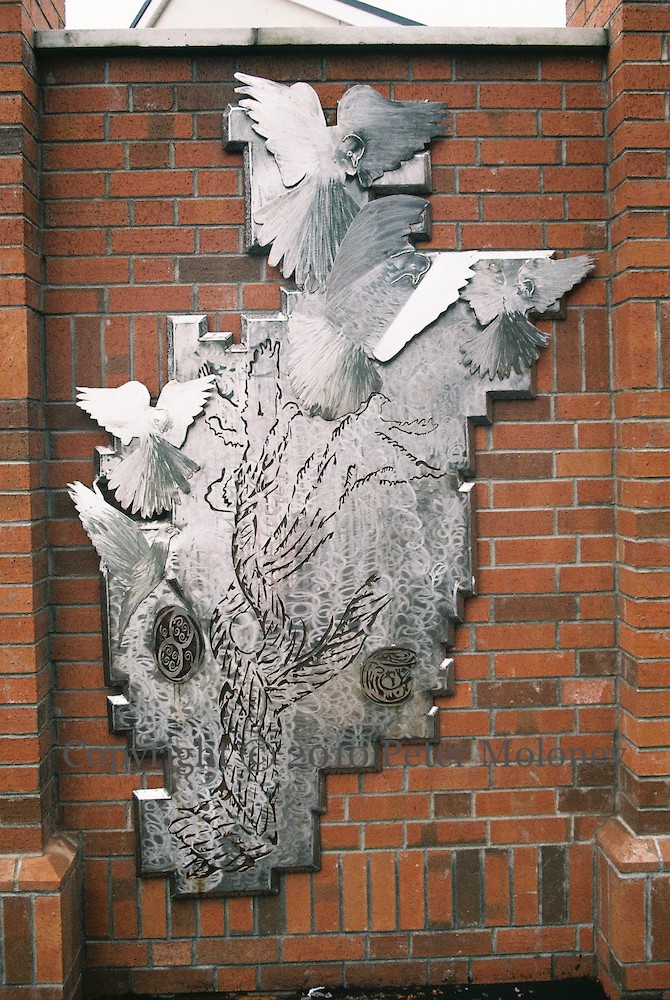
These two artworks are on opposite sides of the new entrance to Dove Gardens adjacent to the gasyard (now a heritage site) on Lecky Road, Derry, after the area was rebuilt. If you know more about them, including the artist(s), please get in touch. There is another copy of the metal piece at Stanley’s Walk at Cable Street.
Derry City is the largest and most famous soccer club in Derry, but this mural mentions four other minor teams: senior league (first division) team Ballymoor, Northwest premier division team Brandywell Celtic, senior league (premier division) teams Brandywell Harps and Bluebell Celtic.







 Peter Moloney Collection