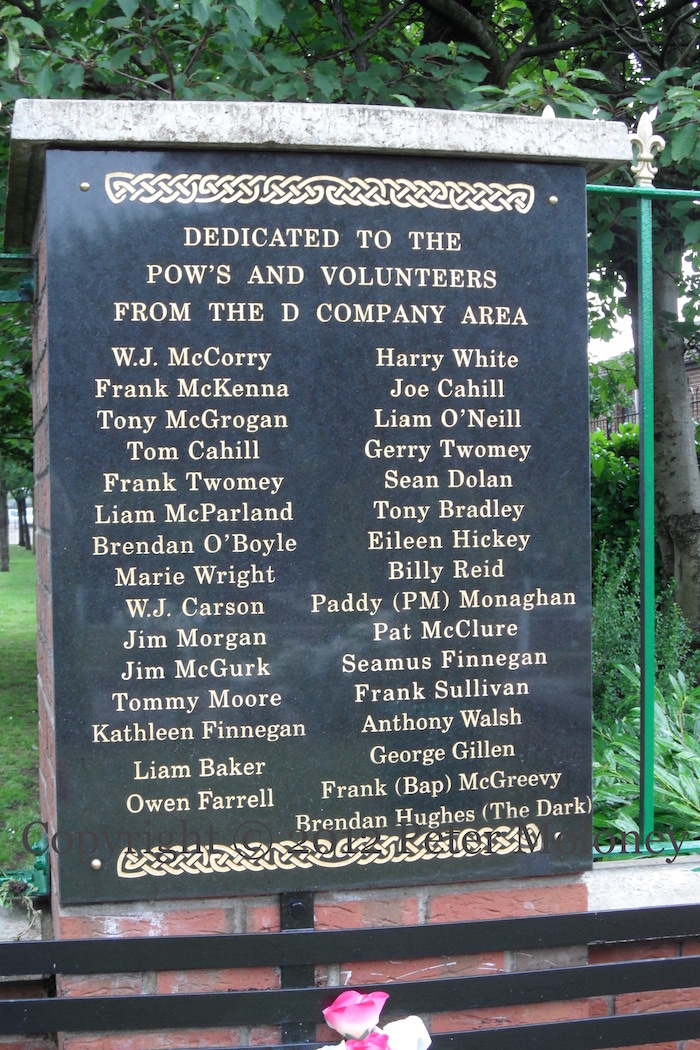
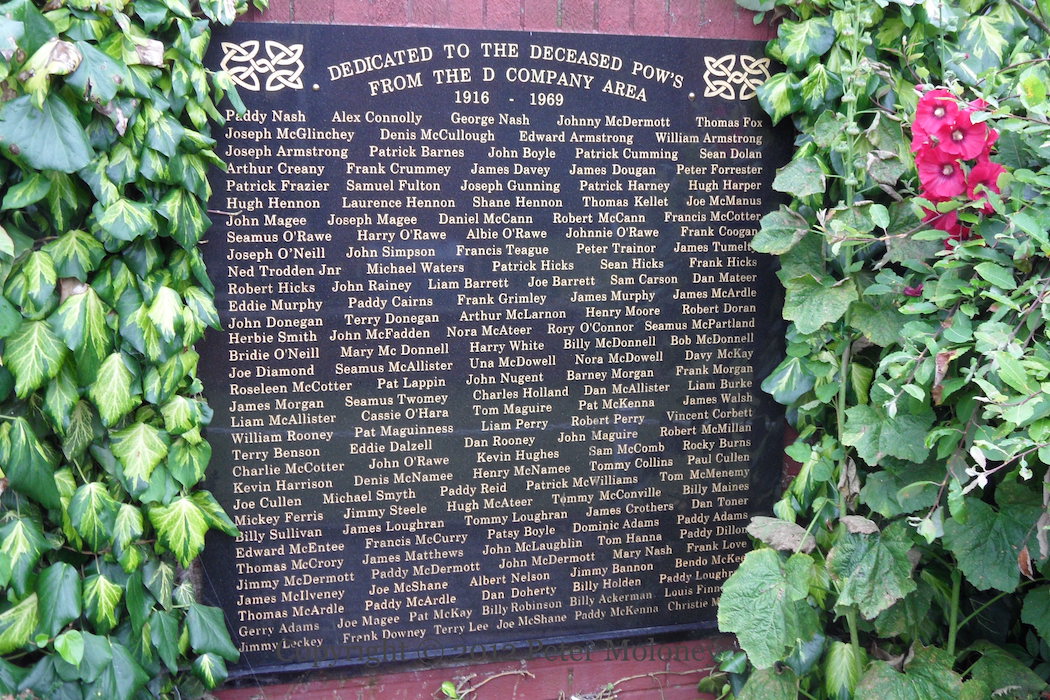
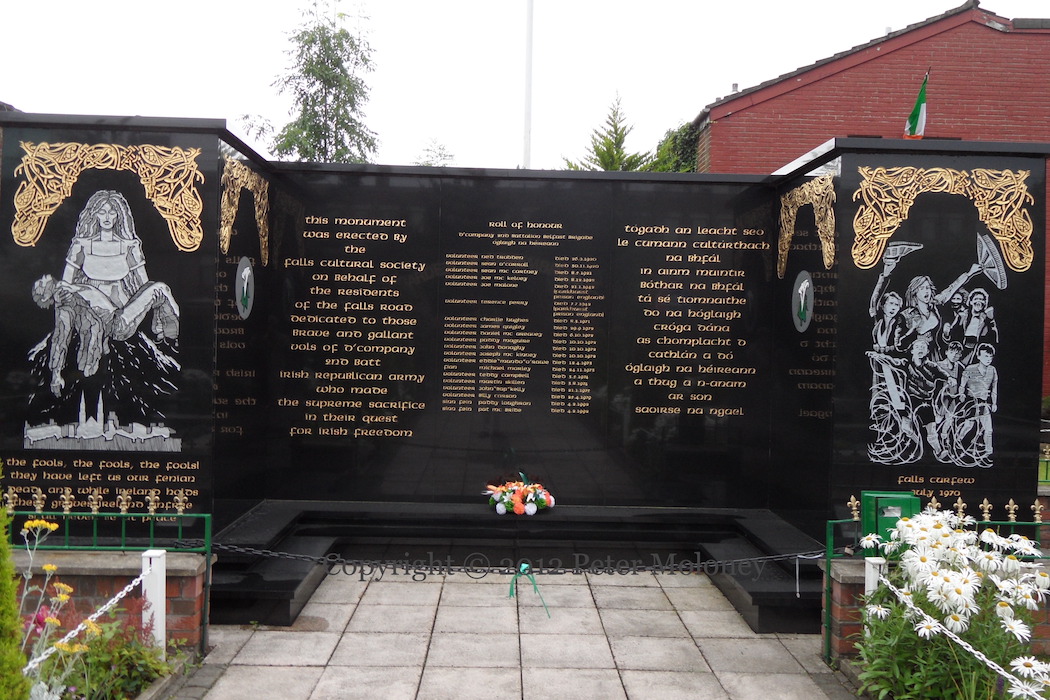
“Those brave and gallant vols of D Company IRA”, “POWs and volunteers”, “deceased POWs”, the D company volunteers who have “died of natural causes”, and the “civilians” who lost their lives. Some of these were seen before, in 2005’s Lower Falls Memorial Garden; the main addition is the large memorial with the illustrations, shown in the final image.
Four images from around Silverbridge, Co Armagh. First, a vintage “RUC Out” on a traffic sign; second, “No absentee landlord repossessor’s or their agents wanted in south Armagh” (for some background, see No Grabbers Here); third, an anti-Agreement stencil protesting the treatment of republicans in Maghaberry; fourth, “IRA” nail-up on a power-line pole near lower Cashel Lough.
Top: “During the hunger-strike of 1981, in which ten men died, the Holy Rosary was recited here [on Freeduff Road], daily, by the community of Cullyhanna, to highlight the suffering of all the women and men in Armagh Gaol and Long Kesh, described by the late Cardinal Tomás Ó Fiach, a native of Cullyhanna, as being “worse than the sewers of Calcutta”. Go ndéana Dıa trócaıre ar a n-anam. Unveiled on the 8th July, 2001 by former hunger-striker, Paddy Quinn.”
Middle: The central panel is to Brendan Moley, Kevin Caherty, Michael McVerry, Brendan Burns, Fergal Caraher. Flanking this is a a longer list of volunteers, in English (left) and Irish (right). McVerry, Boyle, Jordan, McKiernan, Lochrie, Campbell, Cleary, Harvey, McElvanna, Caherty, McCreesh, Moley, Burns, Caraher, Duffy, Martin, Daly, Watters, Toner, Rogers. With smaller plaques to Tom Rooney & John Caraher, and to Brian Keenan.
Bottom: An individual memorial to “Vol Francis Caraher, Óglaıgh Na hÉıreann, murdered by British soldiers at this spot [on Tullyvallen Road] on 30th December 1990, aged 20 years.”
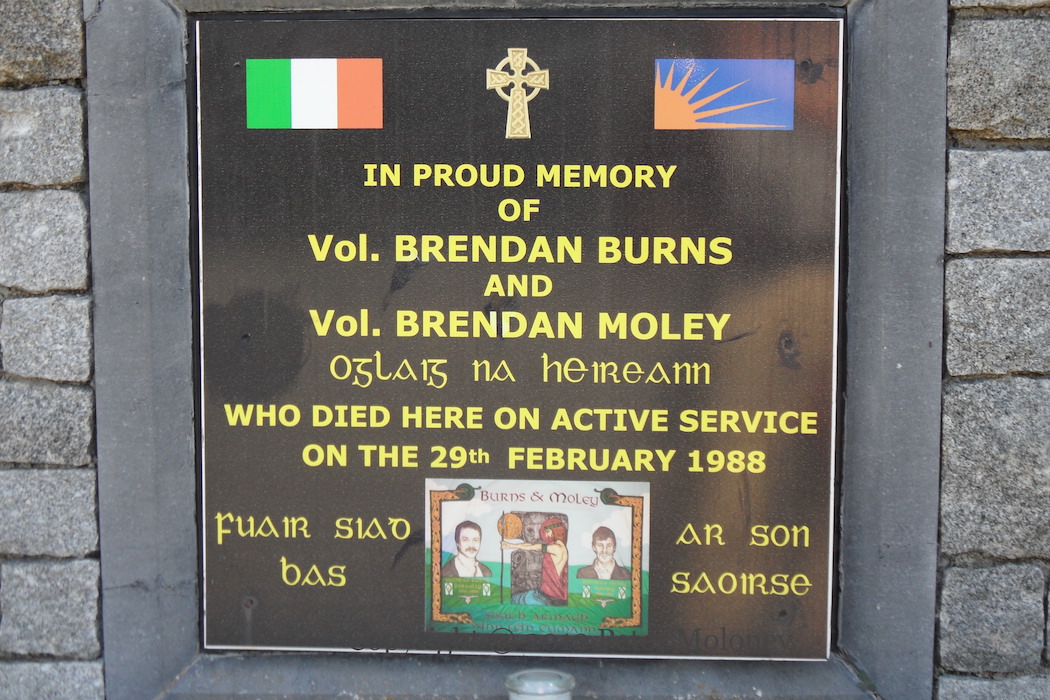
Two images from Creggan, Co. Armagh (near Crossmaglen). First, the memorial to “Brendan Burns, Carnally, 1958-1988” and “Brendan Moley, Dorsey, 1958-1998” “who died here on active service on the 29th February 1988 – fuaır sıad bás ar son na saoırse.” (Tribute from RN.) A Celtic warrior with a spear stands in front of a Janus statue. “South Armagh Sınn Féın Cumann.”
Below, “restore political status”. Both are on Donaldson’s Road.
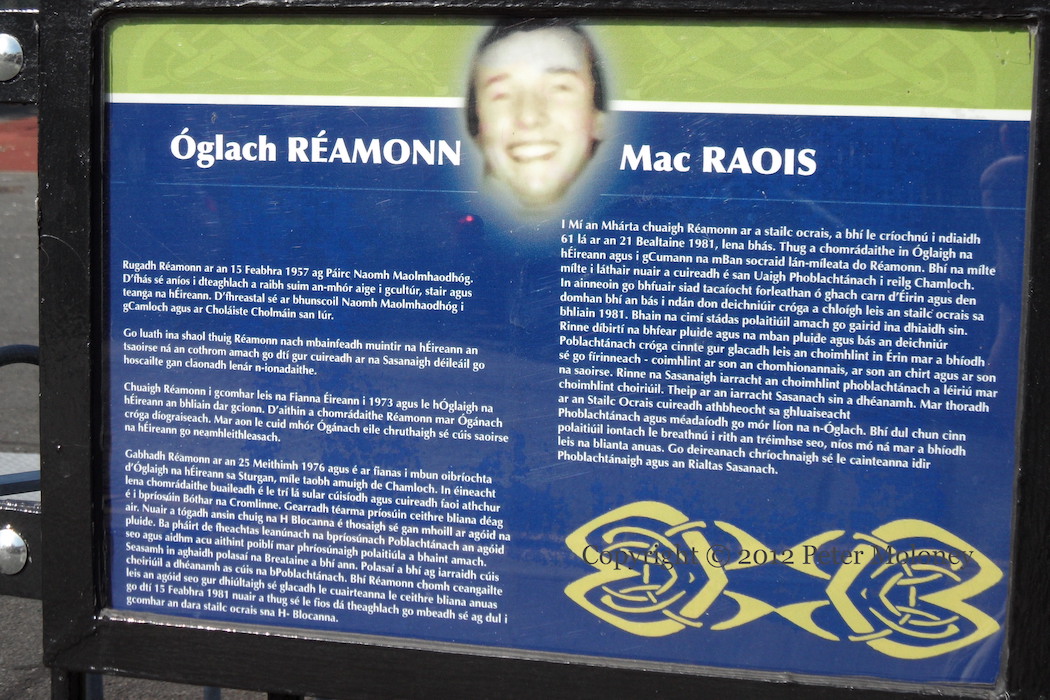
“Go luath ına shaol thuıg Réamonn nach mbaınfeadh muıntır na hÉıreann an tsaoırse ná an cothrom amach go dtí gur cuıreadh ar na Sasanaıgh déıleáıl go hoscaılte gan claonadh lenár n-ıonadaıthe. Chuaıgh Réamonn ı gcomhar leıs na Fıanna Éıreann in 1973 …”
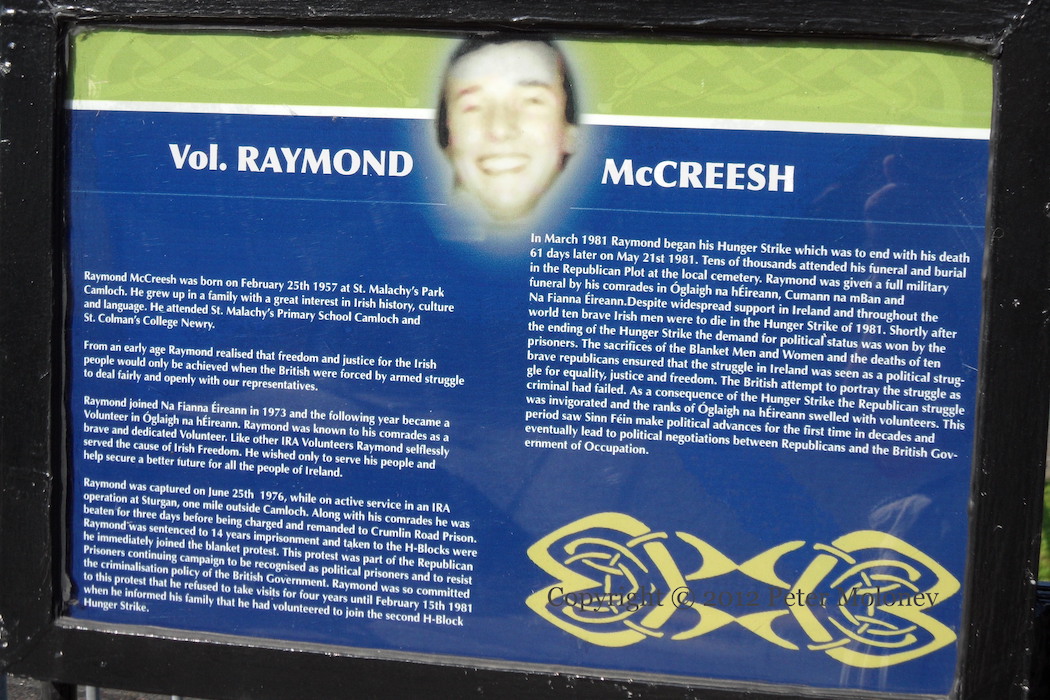
A pair of boards describing the life of IRA volunteer and 1981 hunger striker Raymond McCreesh in both English and Irish are mounted on the railings at Raymond McCreesh Park, in Patrick Street, Newry.
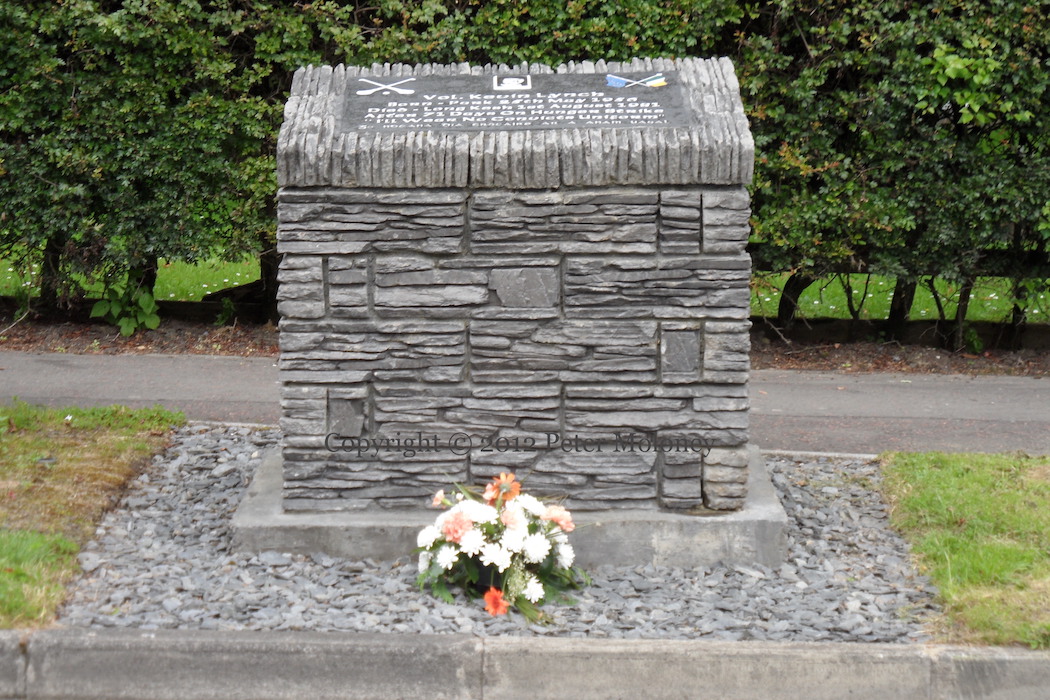
“Vol. Kevin Lynch, born Park 25rg May 1956, died – Long Kesh 1st August 1981 after 71 days on hunger strike “I’ll wear no convicts uniform” Go ndéana Dıa trócaıre ar a anam uasal.”
“Erected by Counties Derry & Antrim Commemorative Committee. Unveiled by Raymond McCartney MLA on 24th May 2009.”
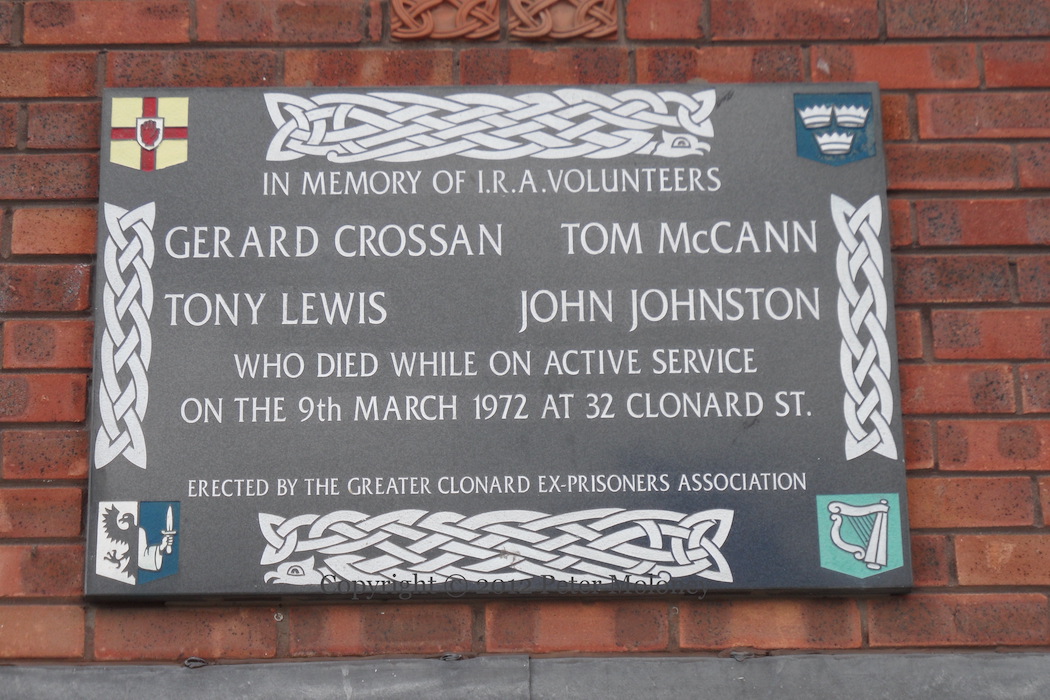
“In memory of IRA volunteers Gerard Crossan, Tom McCann, Tony Lewis, John [Sean] Johnston, who died while on active service on the 9th March 1972 at 32 Clonard St. Erected by the Greater Clonard Ex-Prisoners Association.” The four died in a premature explosion (“active service”) presumably at the home of Lewis, who lived in Clonard Street. Crossan and Johnston were 19, McCann and Lewis were 20 (The Troubles 11).
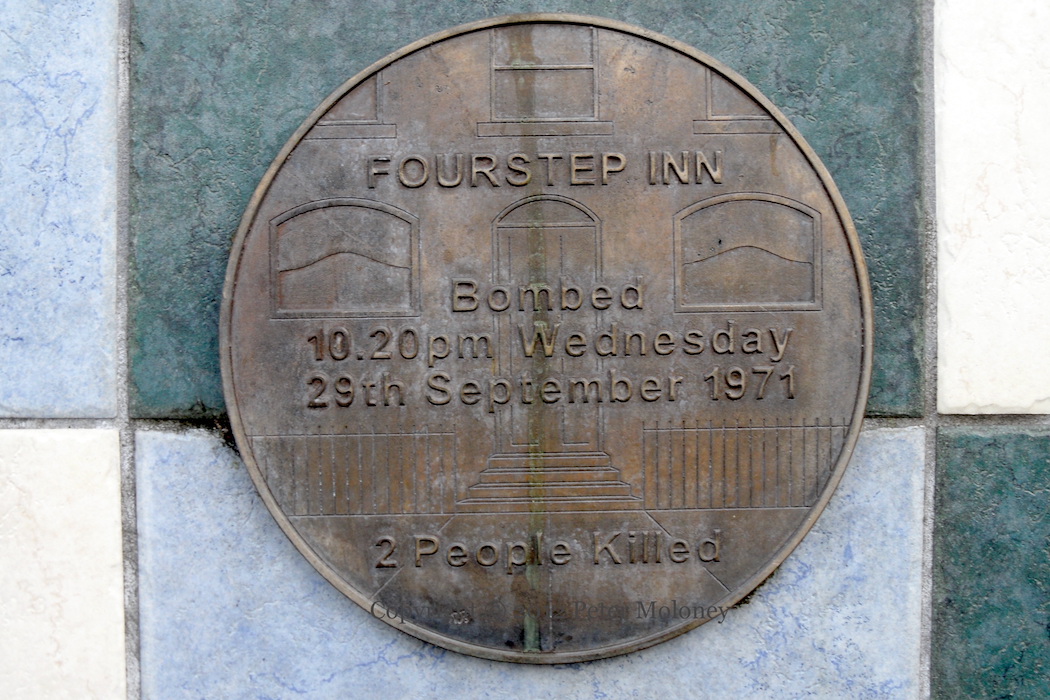
“Fourstep Inn, bombed 10.20 pm Wednesday 29th September 1971, 2 people [Alexander Andrews and Ernest Bates] killed”,
The plaque is on what is now the Northern Ireland Supporters Club, on the Shankill Road at Lanark Way. The pub was full of Linfield supporters watching the 2nd leg of the match against Standard Liège – 27 more people were injured in the blast (Irish Times).
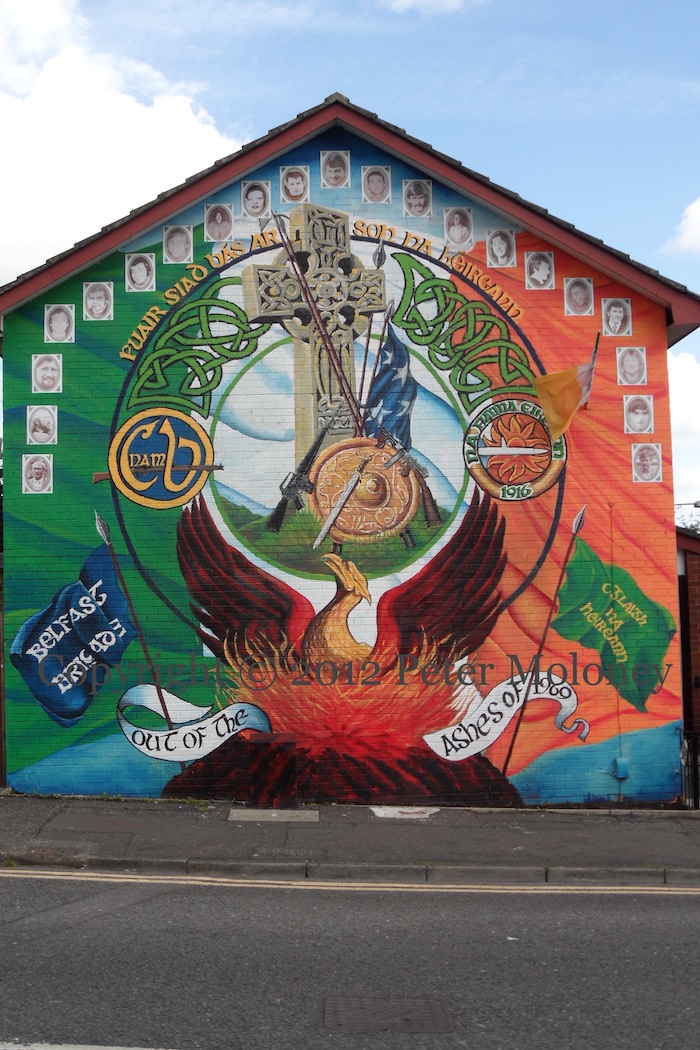
The scroll reads “Out of the ashes of 1969” arose the Provisional IRA, but the lineage is a long one and all but one of the organisations, events, and arms depicted here precede 1969: Cumann Na mBan, Na Fıanna Éıreann, Óglaıgh Na hÉıreann, a Celtic shield and sword, a pike (from the 1798 Rebellion), a Thompson gun, the Tricolour; only the assault rifle is modern and perhaps also is meant to indicate the Provisionals, Belfast Brigade. “Fuaır sıad bás as son saoırse na hÉıreann.”
“I ndıl chuımhne ar Mhıcheál Ó hAodha, Óglach na hÉıreann, a dunmharaíodh anseo ag Arm na Breataıne ar 18 Deıreadh Fómhaır 1974. I meas laochra na nGael go raıbh sé. In proud and loving memory of Vol. Michael Hughes, Irish Republican Army, who was murdered at this spot by The British Army on the 18th October 1974.” According to Sutton, Hughes was shot while attempting to hijack a bus.