“In proud and loving memory of Vol, Jimmy Quigley, Belfast Brigade, Óglaıgh Na hÉıreann, killed in action 29th September 1972 by Crown forces. Ní dhéanfaıdh muıd dearmad [gur] fuaır sé bás ar son saoırse na hÉıreann.”
Quigley was shot by the British Army on Albert Street; the plaque is outside the family home in Brittons Parade, Belfast. Two profiles by Danny Morrison at Saoırse32.
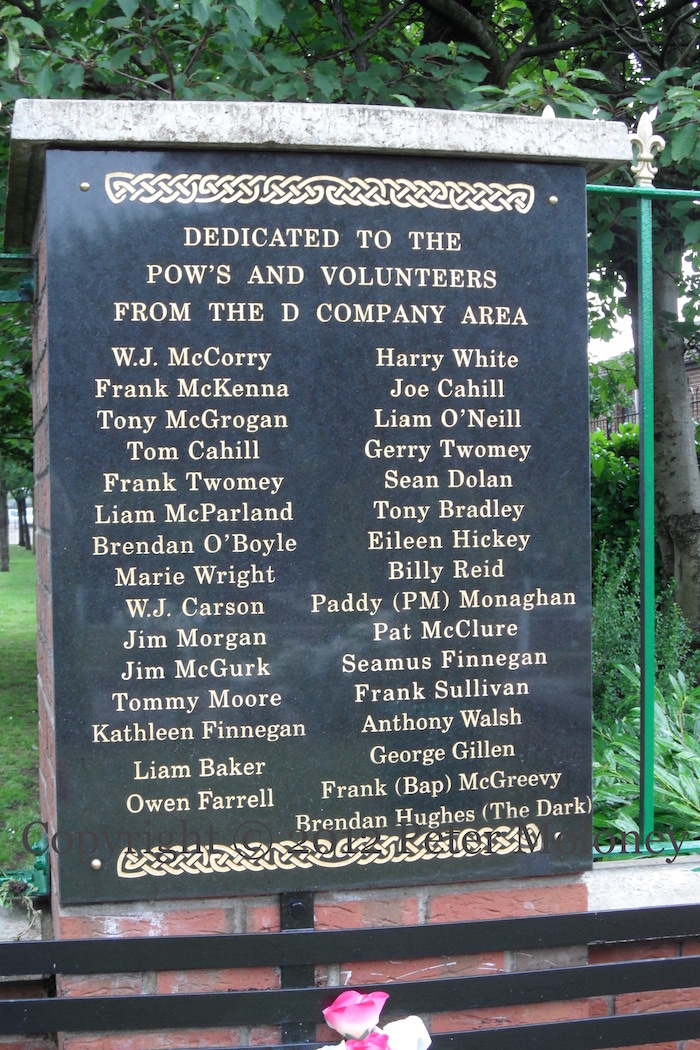
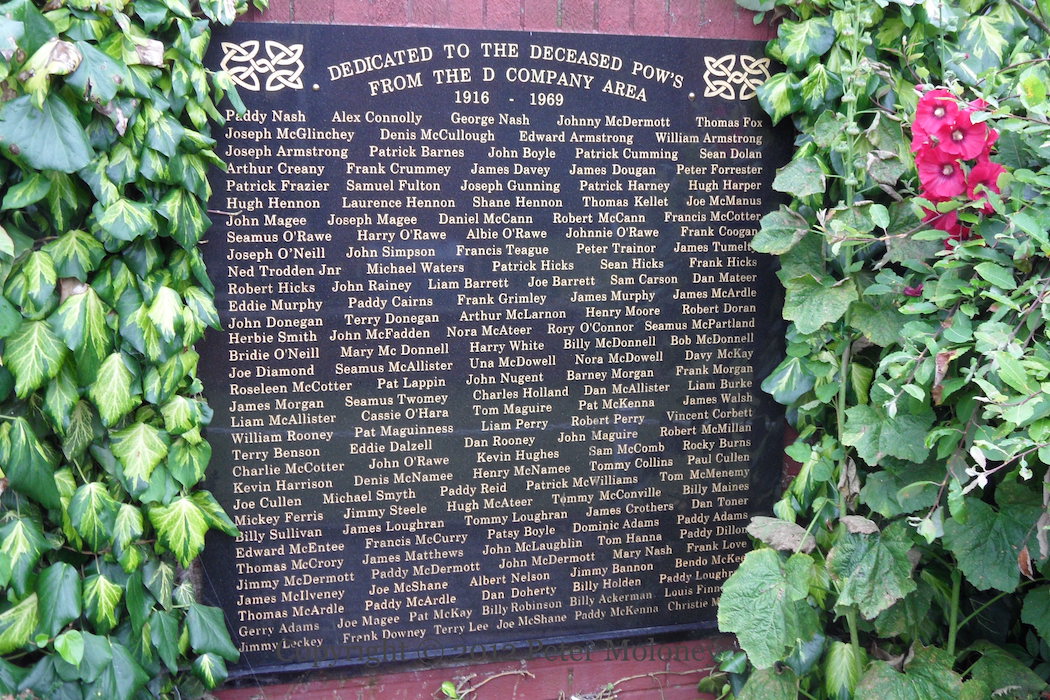
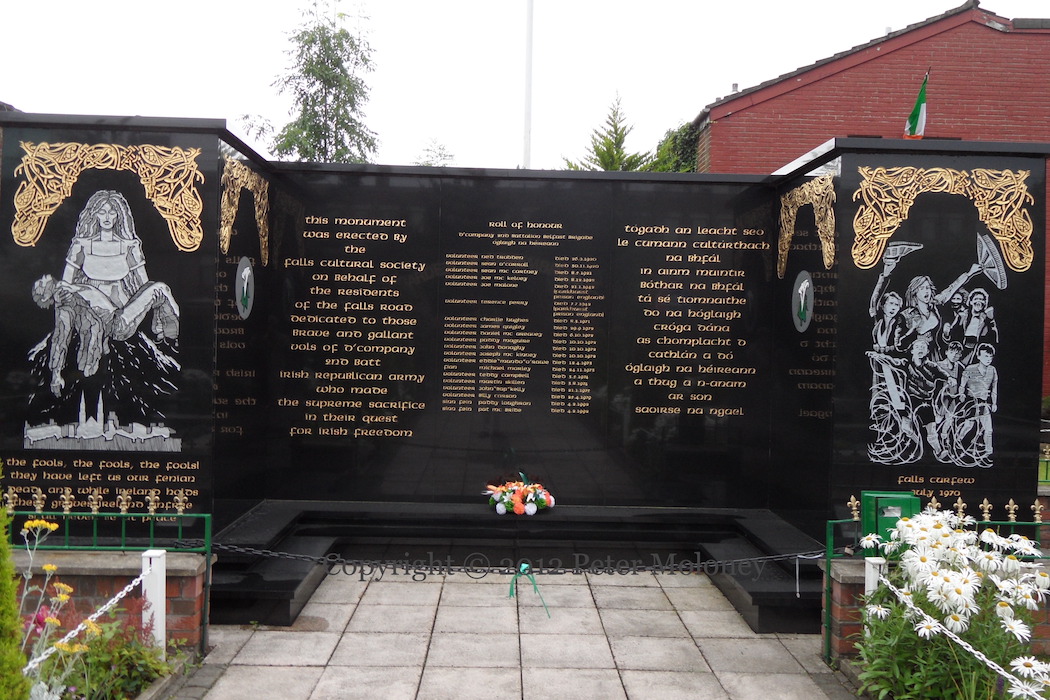
“Those brave and gallant vols of D Company IRA”, “POWs and volunteers”, “deceased POWs”, the D company volunteers who have “died of natural causes”, and the “civilians” who lost their lives. Some of these were seen before, in 2005’s Lower Falls Memorial Garden; the main addition is the large memorial with the illustrations, shown in the final image.
Top: “During the hunger-strike of 1981, in which ten men died, the Holy Rosary was recited here [on Freeduff Road], daily, by the community of Cullyhanna, to highlight the suffering of all the women and men in Armagh Gaol and Long Kesh, described by the late Cardinal Tomás Ó Fiach, a native of Cullyhanna, as being “worse than the sewers of Calcutta”. Go ndéana Dıa trócaıre ar a n-anam. Unveiled on the 8th July, 2001 by former hunger-striker, Paddy Quinn.”
Middle: The central panel is to Brendan Moley, Kevin Caherty, Michael McVerry, Brendan Burns, Fergal Caraher. Flanking this is a a longer list of volunteers, in English (left) and Irish (right). McVerry, Boyle, Jordan, McKiernan, Lochrie, Campbell, Cleary, Harvey, McElvanna, Caherty, McCreesh, Moley, Burns, Caraher, Duffy, Martin, Daly, Watters, Toner, Rogers. With smaller plaques to Tom Rooney & John Caraher, and to Brian Keenan.
Bottom: An individual memorial to “Vol Francis Caraher, Óglaıgh Na hÉıreann, murdered by British soldiers at this spot [on Tullyvallen Road] on 30th December 1990, aged 20 years.”
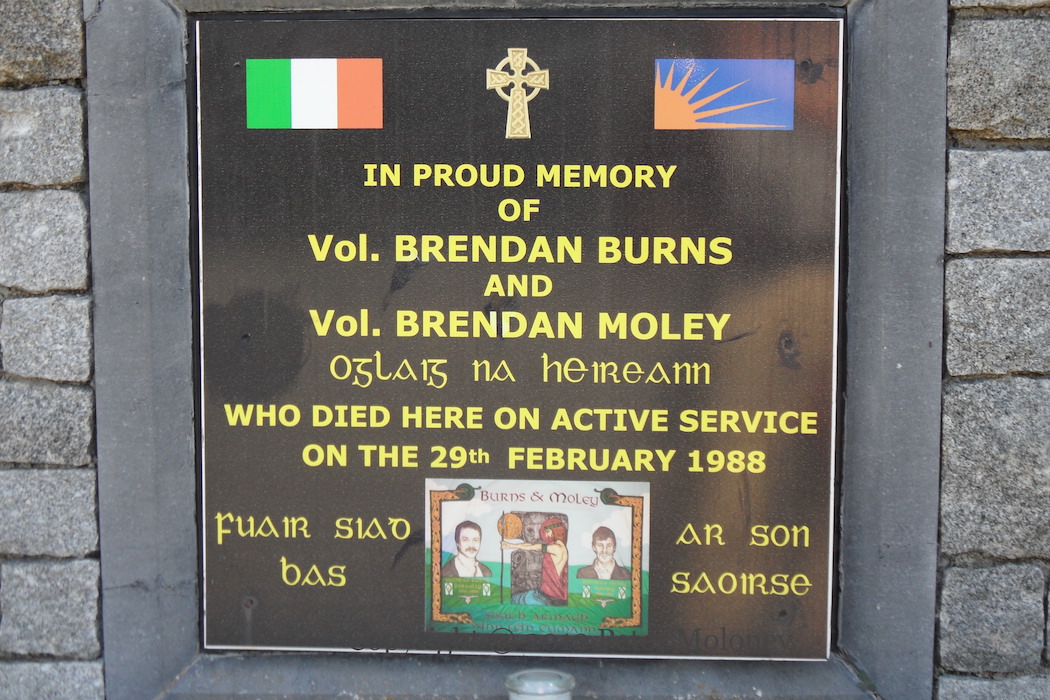
Two images from Creggan, Co. Armagh (near Crossmaglen). First, the memorial to “Brendan Burns, Carnally, 1958-1988” and “Brendan Moley, Dorsey, 1958-1998” “who died here on active service on the 29th February 1988 – fuaır sıad bás ar son na saoırse.” (Tribute from RN.) A Celtic warrior with a spear stands in front of a Janus statue. “South Armagh Sınn Féın Cumann.”
Below, “restore political status”. Both are on Donaldson’s Road.
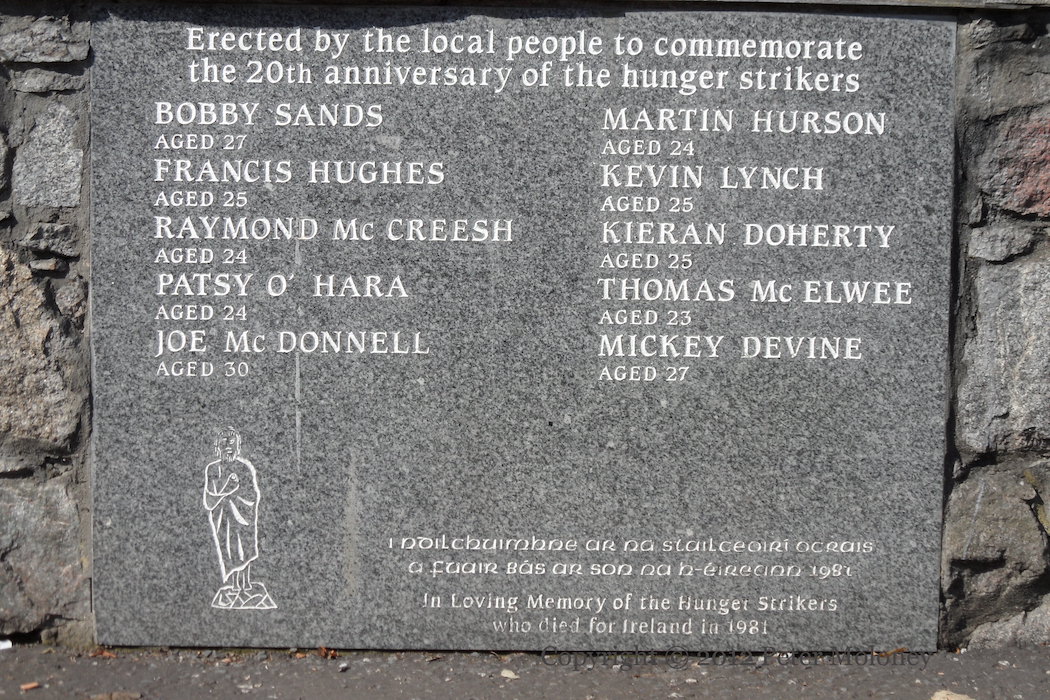
“Erected by the local people to commemorate the 20th anniversary of the hunger strikers. I ndıl chuımhne ar na staılceoırí ocraıs a fuaır bás ar son na h-Éıreann 1981. In loving memory of the hunger strikers who died for Ireland in 1981.” With a small blanketman illustration.
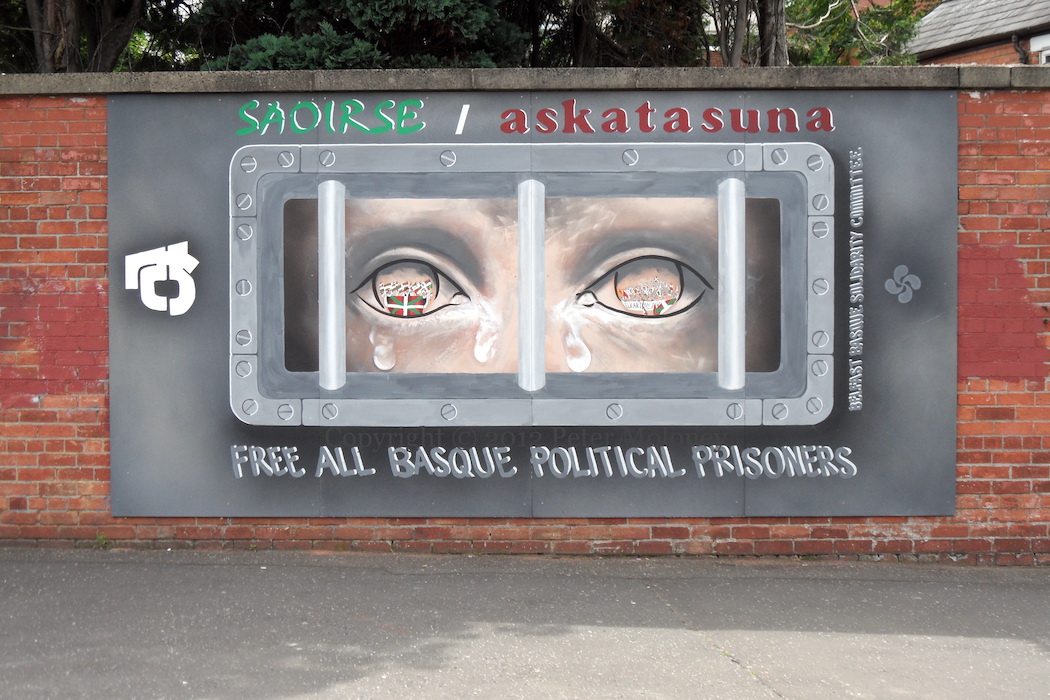
“Free all Basque political prisoners” – a new mural launched during Féıle 2012 in Beechmount Avenue, Belfast.
The symbol on the left represents amnesty for Basque prisoners (BasqueMurals). On the right, next to “Basque Belfast Solidarity Committee” (Fb) is the Basque cross of Lauburu (WP).
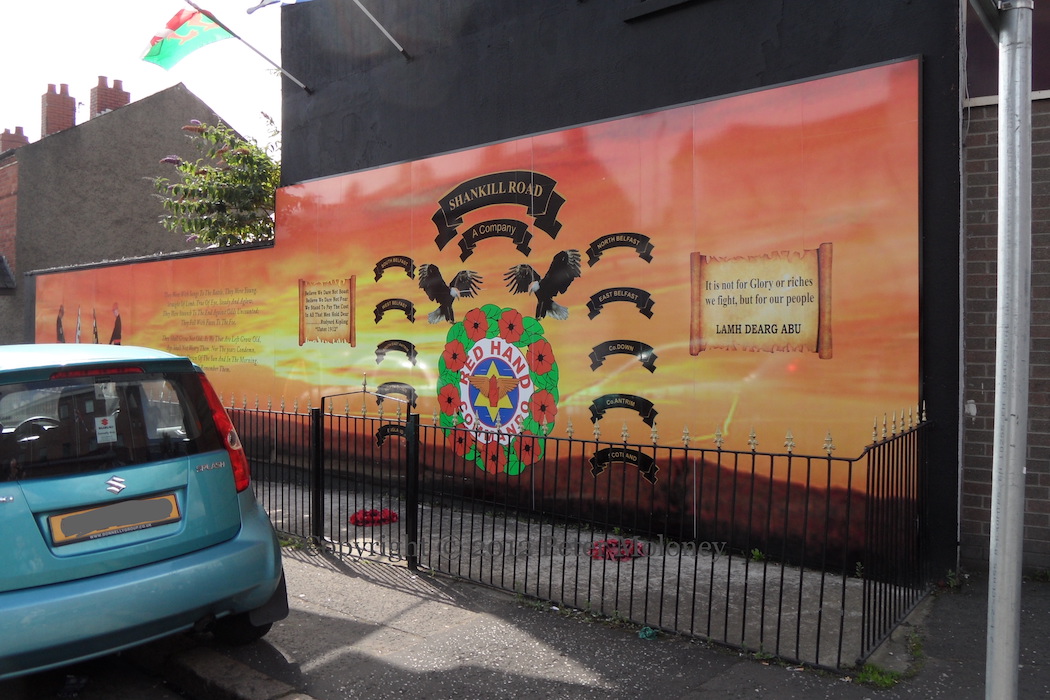
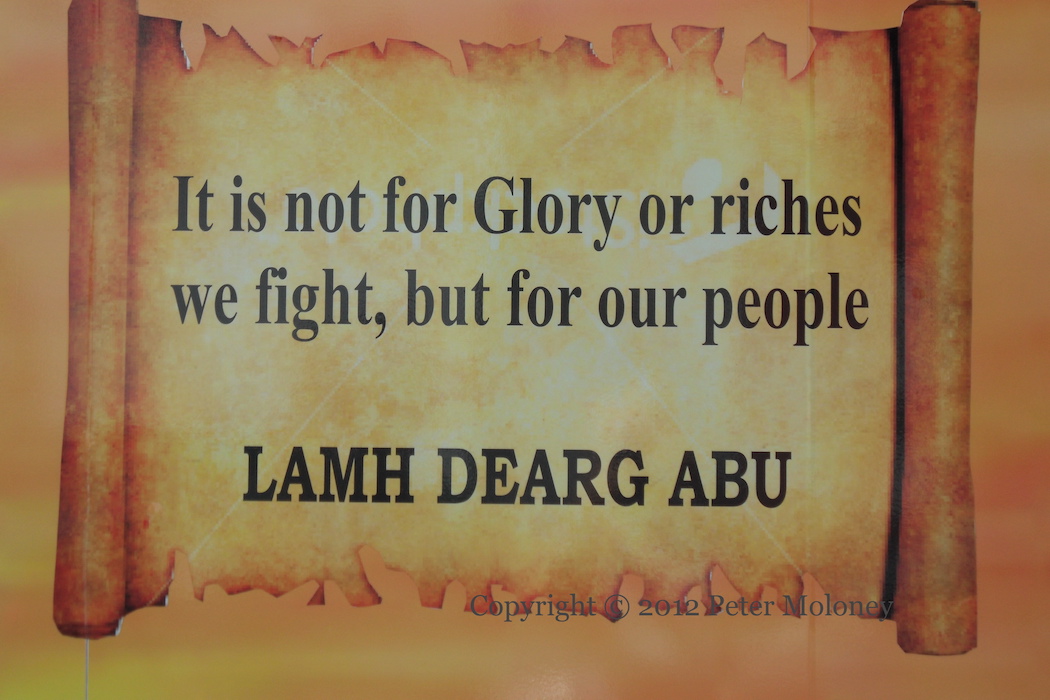
A few words of Irish – “Lamh Dearg Abu” – in a loyalist mural in Glenwood Street, just off the Shankill Road, through strictly it should be “Lámh Dhearg Abú”. “Lámh dhearg” means “red hand”, and this is a Red Hand Commandos’ mural.
The same motto was on the mural that this one replaced, which can be seen at M02433.
The scrolls name ten RHC units, including “North Down” as distinct from “Co. Down”, “South East Antrim” as distinct from “Co Antrim”, and England and Scotland.
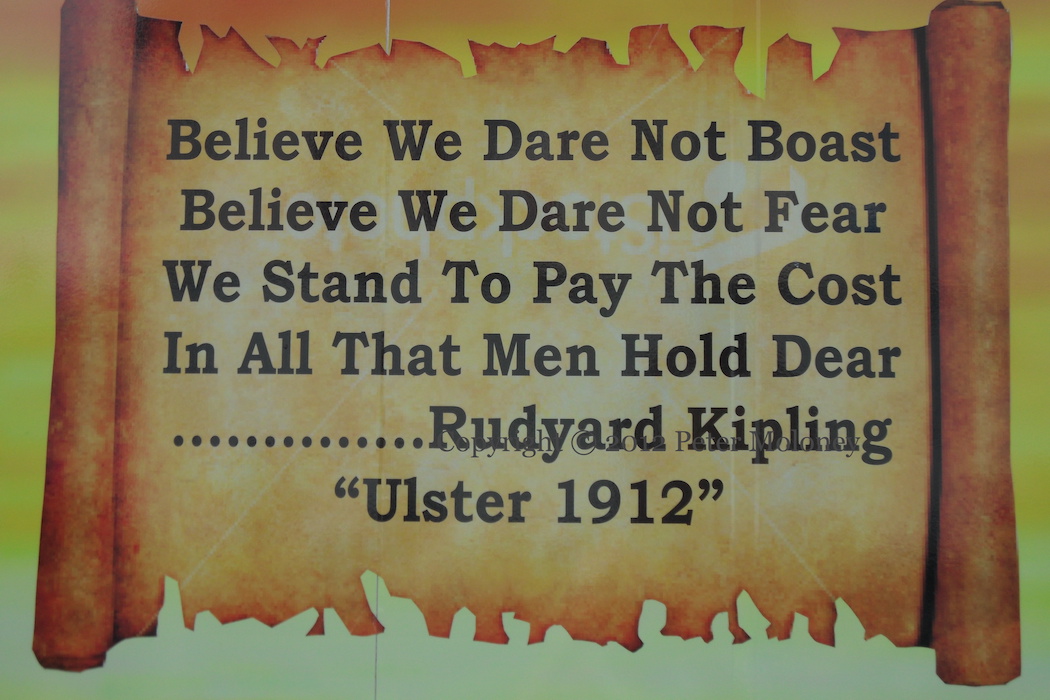
The panels of text are two verses from Robert Laurence Binyon’s For The Fallen and some lines from Rudyard Kipling’s Ulster (here given as “Ulster 1912”: “Believe we dare not boast/Believe we dare not fear/We stand to pay the cost/In all that men hold dear”
“Praise youth and it will respond – the laughter of our children – the joy of our hearts.” A young Bobby Sands is shown in the front right, part of the Stella Maris soccer squad for 1967; he would later “respond” by becoming an IRA volunteer and hunger striker.
The hunger strikers plaque was previously to the left of the (previous) mural; out of picture is another plaque, to the deceased from the “greater Newington area” – see Out Of The Ashes Of 1798.
This group portrait hangs in the lobby of Cultúrlann Uí Chıanáın in Great James Street, Derry, paying tribute to members of Craobh Cholm Cılle, a local Conradh Na Gaeılge group in the Bogside that began life in Dove House before moving to a succession of houses in Great James Street – and finally the Cultúrlann – as An Gaeláras (Cultúrlann).
Please get in touch if you confirm or add to the information below. L-R:
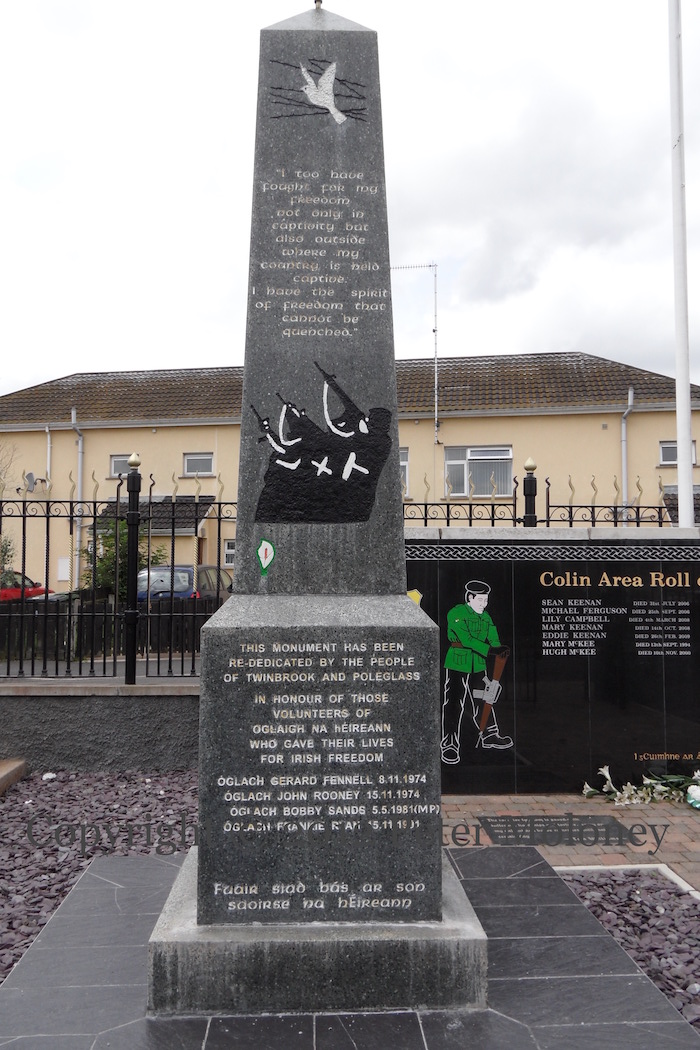
Local IRA volunteers are commemorated in multiple stones in the Twinbrook memorial garden. On the main wall – which is a new addition – are listed Sean Keenan, Michael Ferguson, Lily Campbell, Mary Keenan, Eddie Keenan, Mary McKee, Hugh McKee. On the obelisk on the left (see previously Twinbrook & Poleglass IRA) are Gerard Fennell, John Rooney, Bobby Sands, Frankie Ryan. On the stone to the right – which was previously outside the railings (see M03008) – are the twelve deceased Troubles-era hunger strikers.
“The day will dawn when the people of Ireland will show this desire for freedom. It’s then we will see the rising of the moon. [– Bobby Sands’s prison diary]”
“I have sacrificed for the republic all that man holds dear – my wife, my children, my liberty, my life. – Wolfe Tone”
“The road for suffering is paved with suffering, hardships and torture, carry on my gallant and brave comrades until that certain day. – Tom Williams”
“I too have fought for my freedom not only in captivity but also outside where my country is held captive. I have the spirit of freedom that cannot be quenched. [– Bobby Sands]”
“This monument has been re-dedicated by the people of Twinbrook and Poleglass in honour of those volunteers of Óglaıgh Na hÉıreann who gave their lives for Irish freedom.”