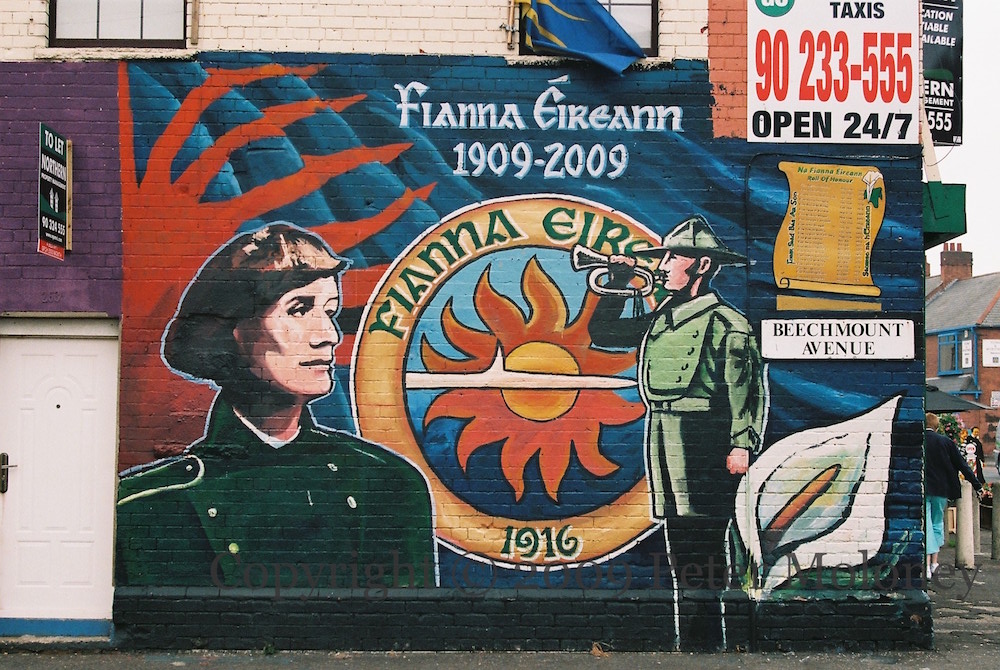
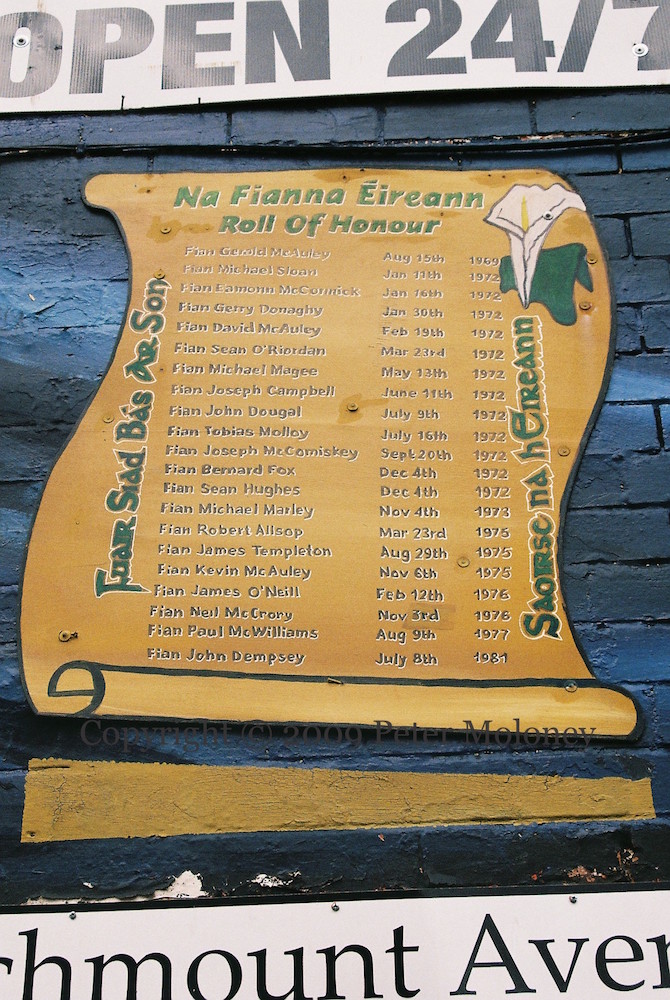
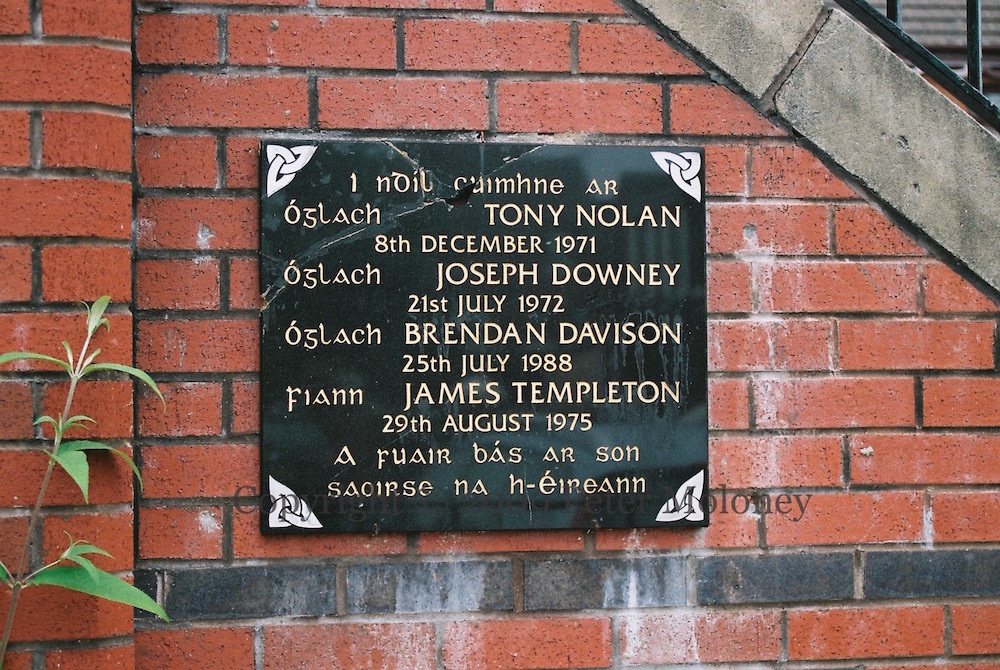
“Fuaır sıad bás ar son saoırse na hÉıreann” [they died for the freedom of Ireland]. Na Fıanna Éıreann [warriors of Ireland; IRA youth] were begun in 1909 by Countess Markievicz and Belfast man Bulmer Hobson (WP). They took part in the Easter Rising of 1916. The role of honour lists deaths from 1969 to 1984 – the Troubles. After the Agreement, the Fıanna are affiliated with Republican Sınn Féın and the Continuity IRA. At the corner of Beechmount Avenue and the Falls Road – see the Visual History of this wall.
The Éırí Amach Na Cásca 1916 [Easter Rising 1916] mural in Beechmount Avenue/Ascaıll Ard Na bhFeá/RPG Avenue is repainted (by DD and Seany McVeigh) due to the new doorway. Compare to the previous version. (See also the IRA plaque.)
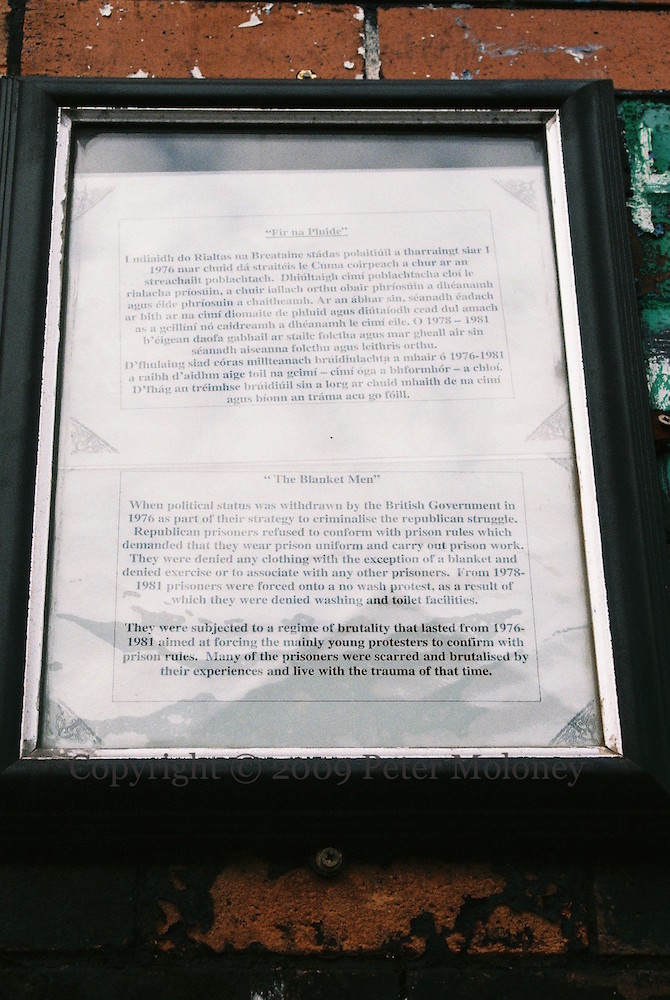
“Fır na Pluıde: ı ndıaıdh do Rıaltas na Breataıne stadás polaıtıúıl a tharraıngt sıar ı 1976 mar chuıd dá straıtéıs le Cuma coırpeach a chur ar an streachaılt poblachtach. Dhıúltaıgh cımí poblachtacha cloí de rıalacha príosıún, a chur ıallach orthu obaır phríosúın a dhéaneamh agus éıde phríosúın a chaıtheamh. Ar an ábhar sın, séanach éadach ar bıth ar na cımí dıomaıte de phluıd agus dıútaíodh cead dul amach as a gcıllıní nó caıdreamh a dhéanamh le cımí eıle. Ó 1978-1981 b’éıgean daofa gabhal ar staılc folchta agus mar gheall aır sın séanadh aıseanna folctha agus leıthreas orthu. D’fhulaıng sıad córas mıllteanach brúıdıulachta a mhaır ó 1976-1981 a raıbh d’aıdhm aıge toıl na gcımí – cımí óga a bhformhór – a chloí. D’fhag an tréımhse brúıdıúıl sın a lorg ar chuıd mhaıth de na cımí agus bíonn an tráma acu go fóıll.”
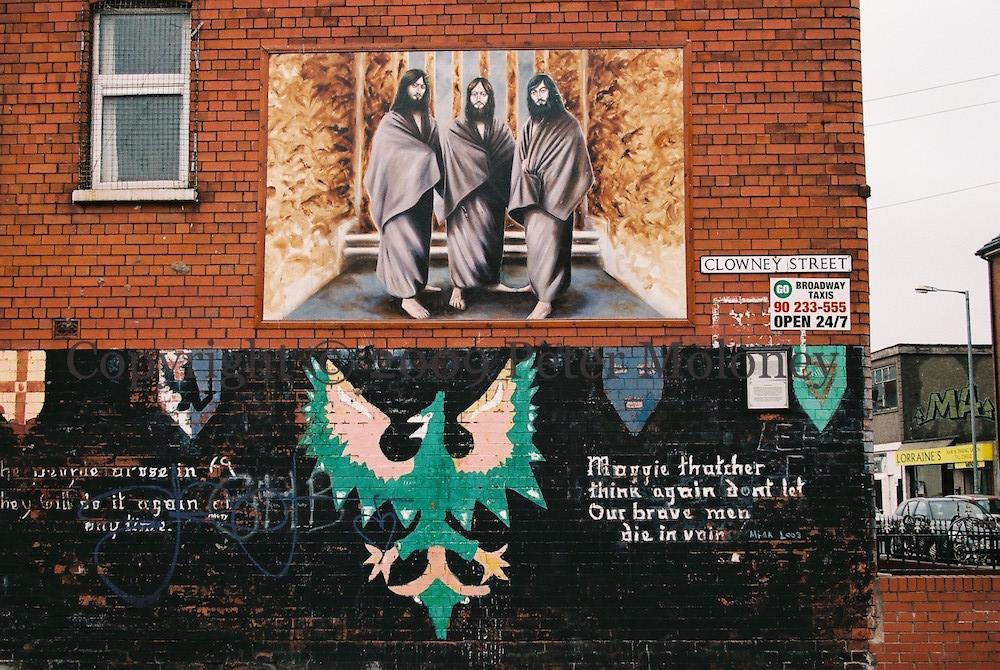
“The Blanket Men: When political status was withdrawn by the British Government in 1976 as part of their strategy to criminalise the republican struggle, Republican prisoners refused to conform with prison rules which demanded that they wear prison uniform and carry out prison work. They were denied any clothing with the exception of a blanket and denied exercise or to associate with any other prisoners. From 1978-1981 prisoners were forced onto a no wash protest, as a result of which they were denied washing and toilet facilities. They were subjected to a regime of brutality that lasted from 1976-1981 aimed at forcing the mainly young protesters to confirm [sic] with prison rules. Many of the prisoners were scarred and brutalised by their experiences and live with the trauma of that time.”
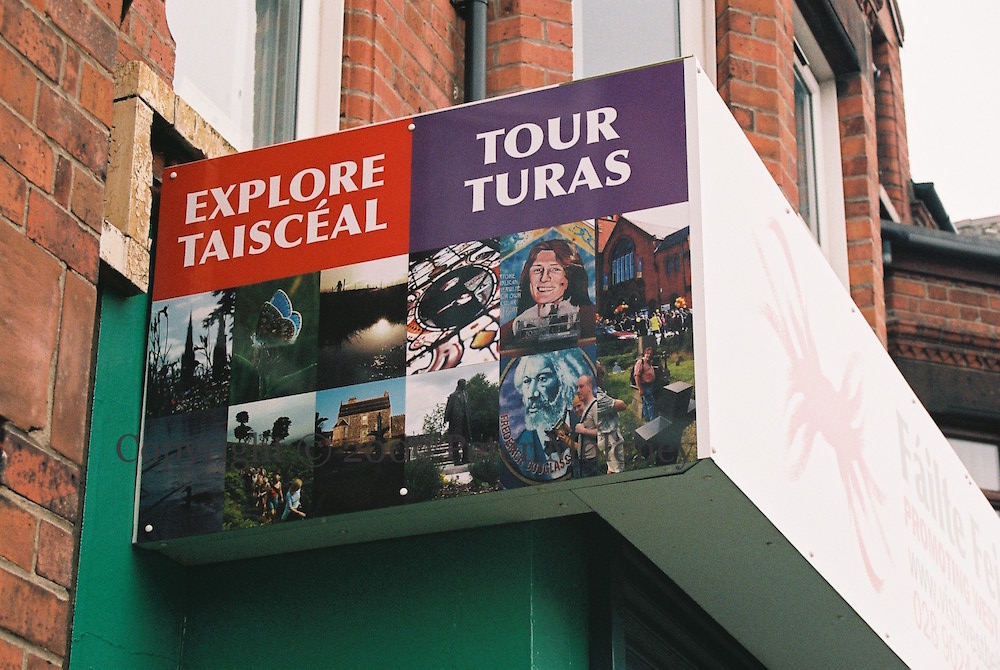
Murals are featured as part of an invitation to explore/taiscéal and take a tour/turas of west Belfast, on the office of Fáılte Feırste Thıar (in its second location: moved from 221 Falls Road to 243 Falls Road – and later again to 217 Falls Road). This BBC article describes a 1999 Fáılte map to help tourists get around.
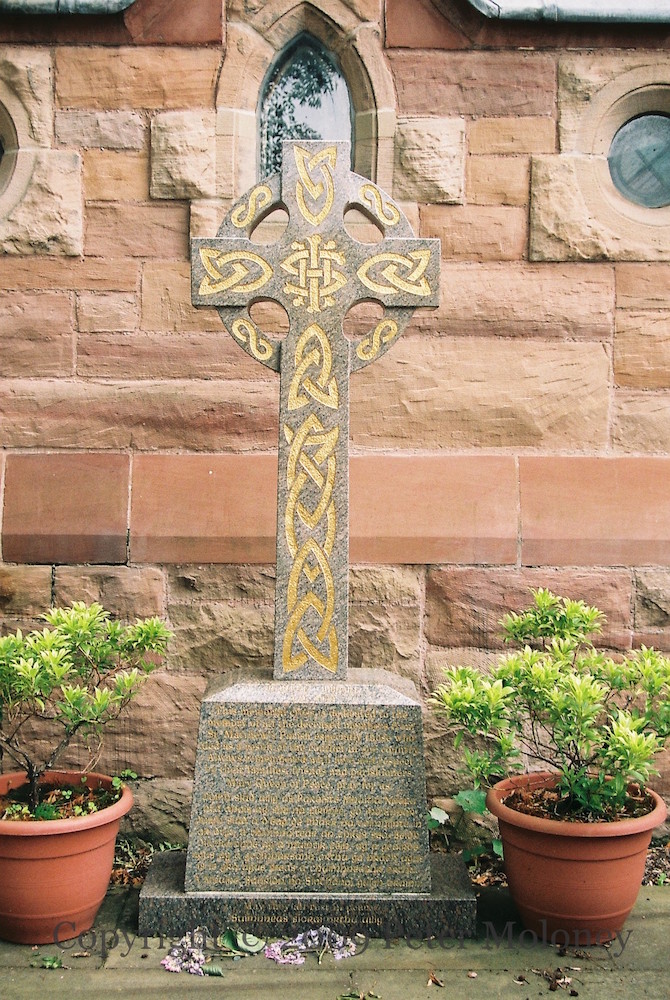
“This memorial cross is dedicated to the memory of all the deceased members from St Matthew’s Parish especially those who died as a result of the conflict in our country. Always remembered with love and respect by their families, friends and parishioners. Mary, queen of peace, pray for us. Dóıbh sıad uılıg as Paraıste Mhaıtıú Naofa atá anoıs ar shlí na fırınne go mórmhór dóıbh sıad a d’éag da bharr na comhlınte in ár dtír, a thıomnaıntear an chros seo. Beıdh dılchuımhne ag a muıntır féın, ag a gcaırde agus ag a gcomhrarsana orthu go brách agus is le grá agus meas a chuımhneofar orthu. A Mhuıre, banríon na Síochána, guıgh oraınn. May they all rest in peace. Suımhneas síoraí othru uılıg.”
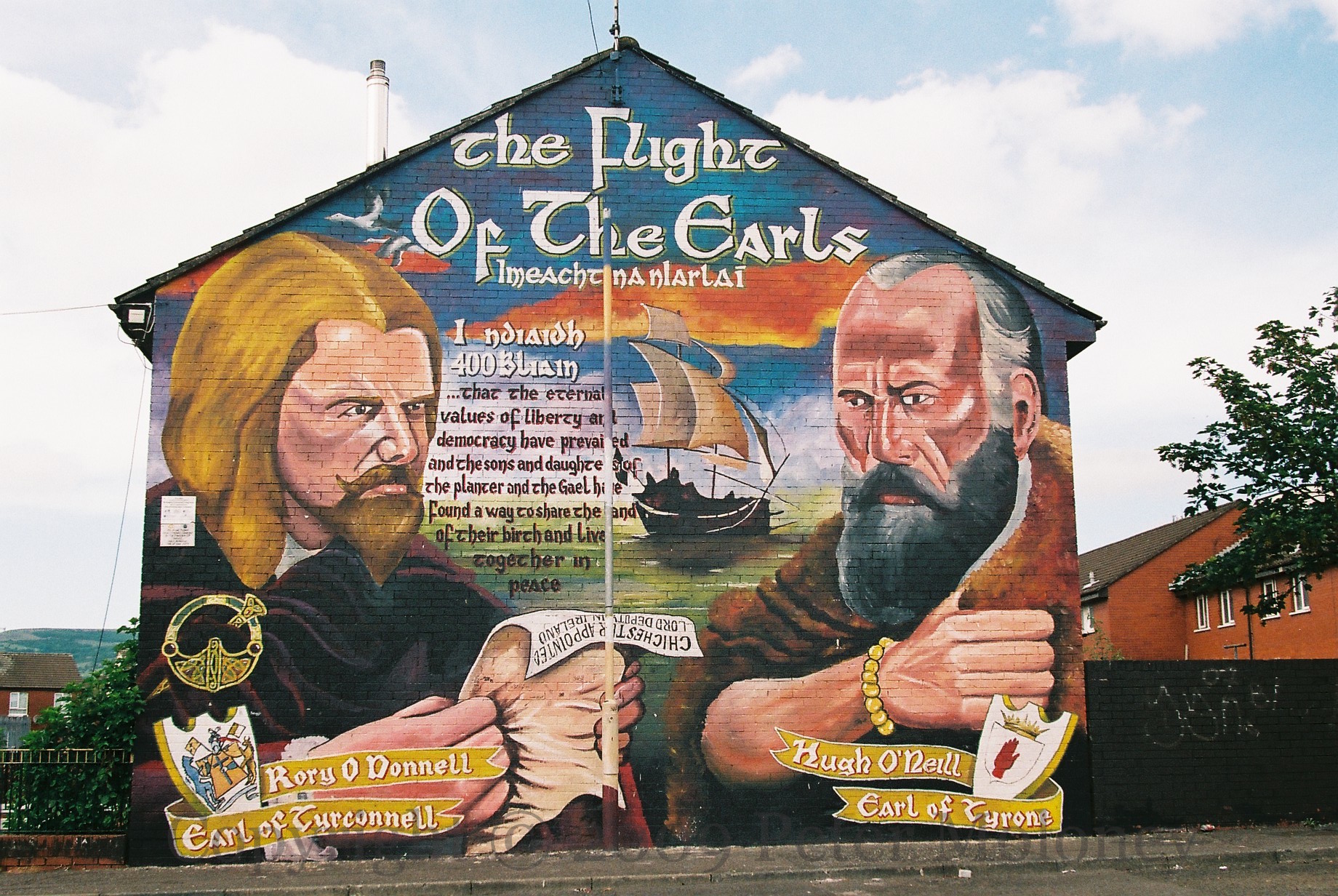
In 1607 – “400 blıaın” after the Anglo-Norman invasion of Ireland – 50 years of newly-asserted English control, most recently at the hands of Charles Blount – who defeated the pair in the Nine Years’ War – and Arthur Chichester – who, as O’Donnell is shown reading, was “appointed Lord Deputy in Ireland” in 1605 – compelled Earls Hugh O’Neill of Tyrone and Rory O’Donnell of Tyrconnell to depart Ireland on a ship bound for Spain in order to petition for Spanish support in reclaiming the lands and status they were losing under English rule. They ended up in Rome instead and never returned, ending the period of Gaelic chiefs rule in Ireland and making way for the plantation of Ulster.
The pair of plaques on the left indicate that the mural was painted as part of the Re-Imaging Communities Programme’ (top) and launched by President Mary McAleese on June 19th (bottom). Even though the subject was historical, the state funding for the project required the removal of a sword from O’Neill’s right hand; he is shown instead clutching the collar of his cloak. For more on the re-imaging programme, see Visual History 10.
“Imeacht na nIarlaí. I ndıadh 400 blıaın … that the eternal values of liberty and democracy have prevailed and the sons and daughters of the planter and the Gael have found a way to share the land of their birth and live together in peace.”
“Seán Mac Dıarmada 1883-1916 a bhí ına chónaí ı Sráıd de Buıtléır sa bhlıaın 1905.” [who was living in Butler Street in the year 1905].
Seán Mac Dıarmada was born in Leitrim, left for Glasgow at age 15, but after two years returned to Belfast in 1905 (working on the trams) and – according to the new mural above – spoke from the back of a coal lorry in Clonard Street, outside the Clonard branch of the Ancient Order Of Hibernians. Mac Dıarmada was for a short time an AOH member, before moving on to the Irish Republican Brotherhood and Irish Volunteers, which led to his participation in the 1916 Easter Rising and execution on May 12th of that year.
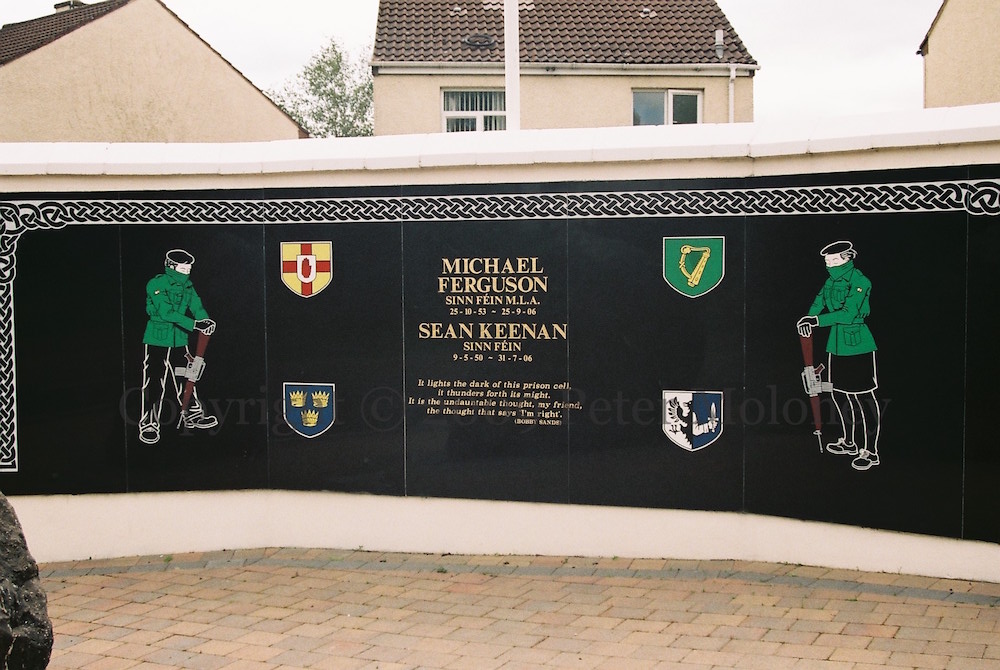
“Michael Ferguson Sınn Féın MLA 25-10-53–25-9-06. Sean Keenan Sınn Féın 9-5-50–31-7-06. “It lights the dark of this prison cell/it thunders forth its might/it is the undauntable thought, my friend/the thought that says ‘I’m right'” – Bobby Sands”. Keenan was son of Derry republican Seán Keenan.
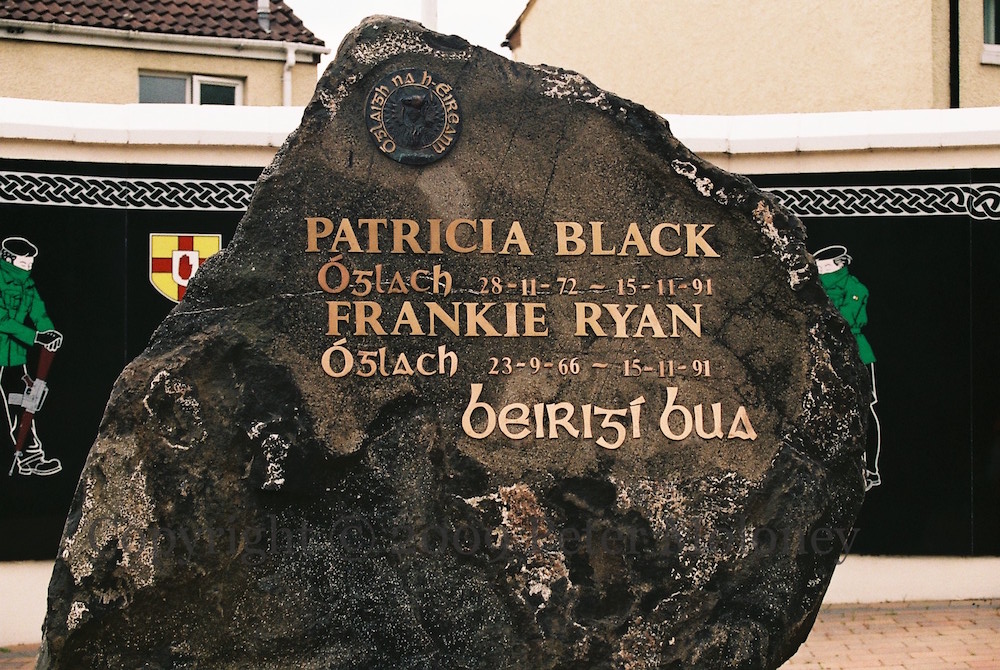
“Óglaıgh Na hÉıreann. Óglach Patricia Black 28-11-71–15-11-91. Óglach Frankie Ryan 23-9-66–15-11-91. Beırıgí bua.” The pair died near London when a bomb exploded prematurely.
On Pantridge Road, which runs into Michael Ferguson Roundabout at its eastern end. (See Teeling Family.)
Black and Ryan are also remembered by a plaque in nearby Woodside (M08902).