“Smash fortress Europe – no one is illegal.” Two-year-old Alan (or Aylan) Kurdi and his brother Galib both died during an attempted crossing from Turkey to the Greek island of Kos. Alan’s body was pulled from the water and placed on the shore, where it was photographed lying face-down. The image stunned and shocked people around the world.
“If any of you put a stumbling block before one of these little ones, who believe in me, it would be better for you if a great millstone were fast[en]ed round your neck and you were drowned in the Depths of the Sea. RIP Aylan”
Free Derry Corner (Visual History) is transformed for Foyle Gay Pride 2015, (August 22nd-30th (programme at issuu)) with paste-ups of four “queer icons”. The four are (l-r) Stormé DeLarverie (WP), Mark Ashton (WP), Sylvia Rivera (WP), and Marsha P Johnson (WP). Ashton grew up in Portadown before moving to London; the other three are from the USA.
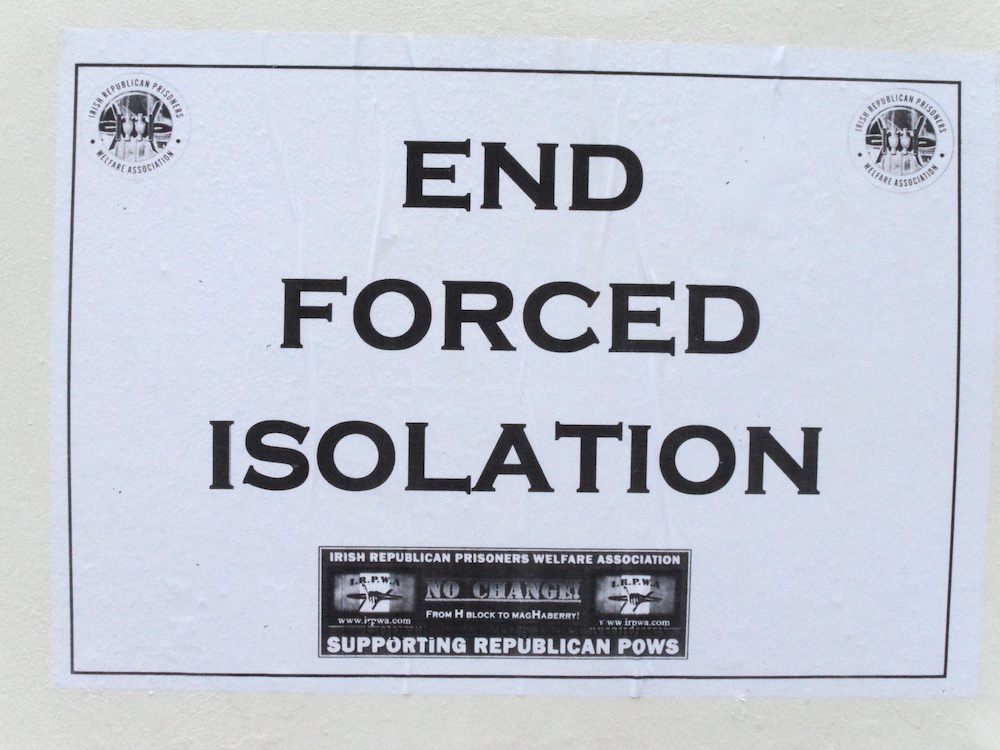
Three flyers on Free Derry Corner (Visual History) in the Bogside: “End the brutality in Maghaberry”, “End the brutality of republican prisoners”, and “End forced isolation”.
“Irish Republican Prisoners Welfare Association [web]. No change from H-Block to MagHaberry. Supporting republican POWs.”
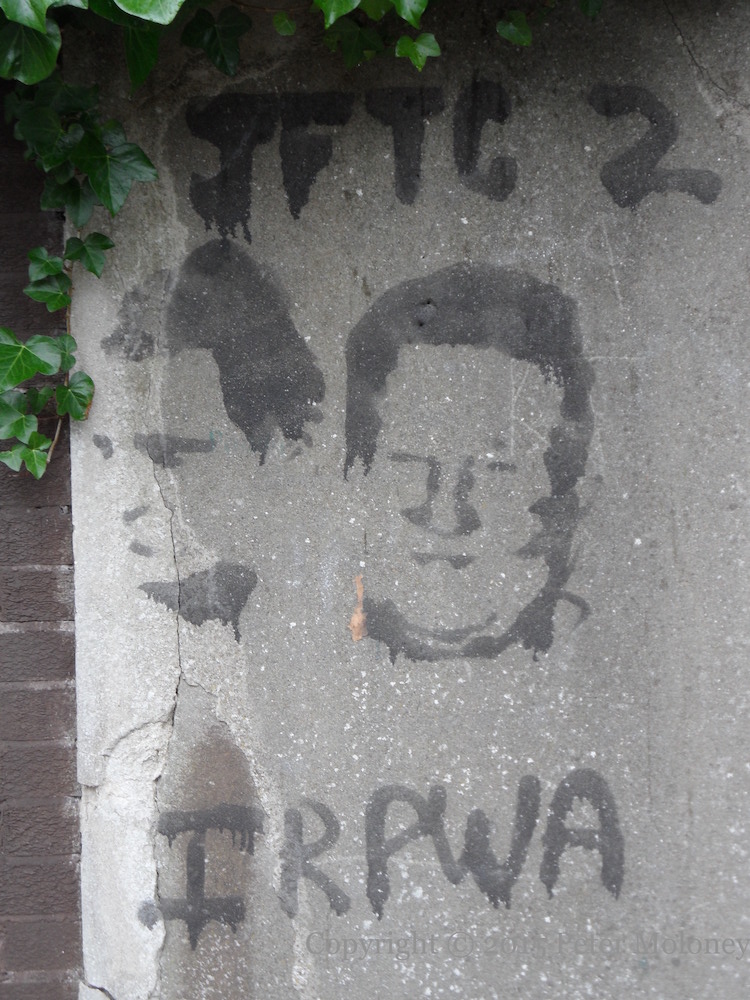
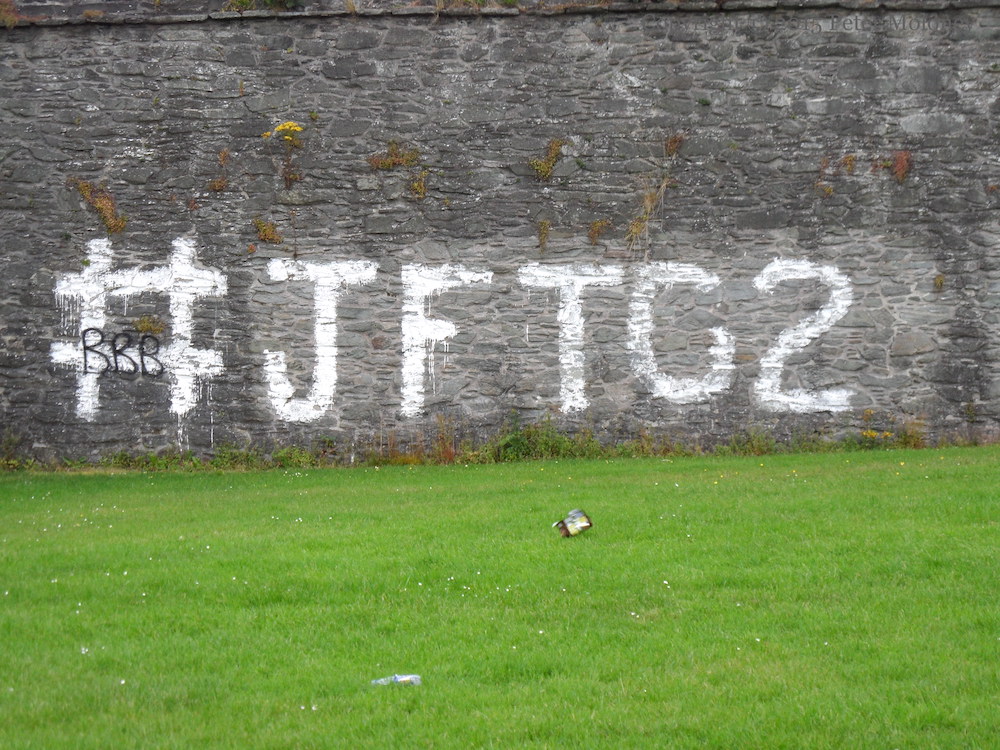
The Craigavon Two – John-Paul Wootton and Brendan McConville – were convicted in 2012 of the 2009 murder of PSNI Constable Steven Carroll (BBC) and sentenced to 18- and 25-year minimums, respectively. The case is under review (Guardian) and a campaign for their release – using the hashtag “#JFTC2” – is under way (Fb).
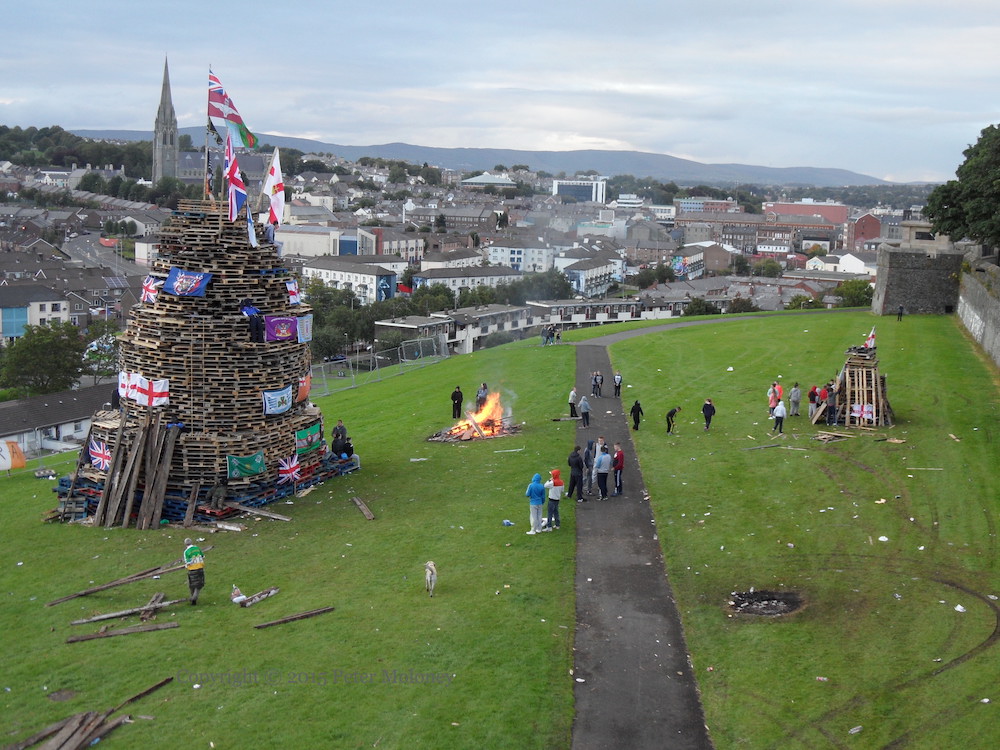
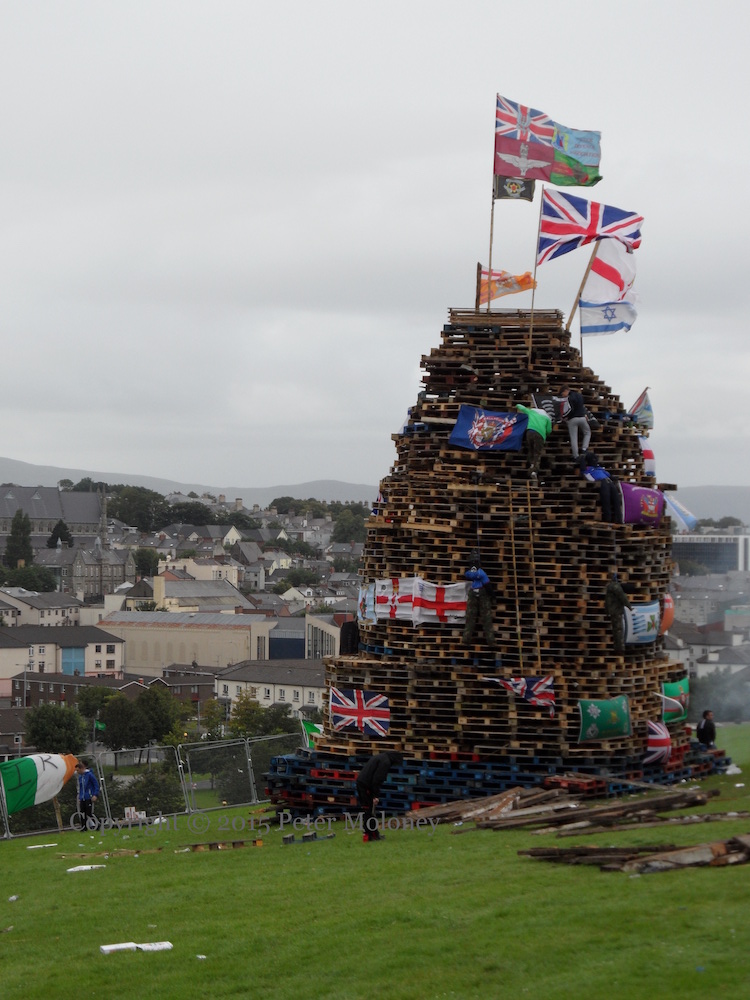
This is the internment (or “assumption”) bonfire (and mini-bonfire) in the Bogside decked with a range of flags — UVF/YCV, UDA, Orange Order, the Paras, Israel, Ulster Banner, Union Flag – and an “RUC” land-rover.
Last year (2014) it was in the Meenan Square waste-ground but this year it is at the city walls/Nailor’s Row.
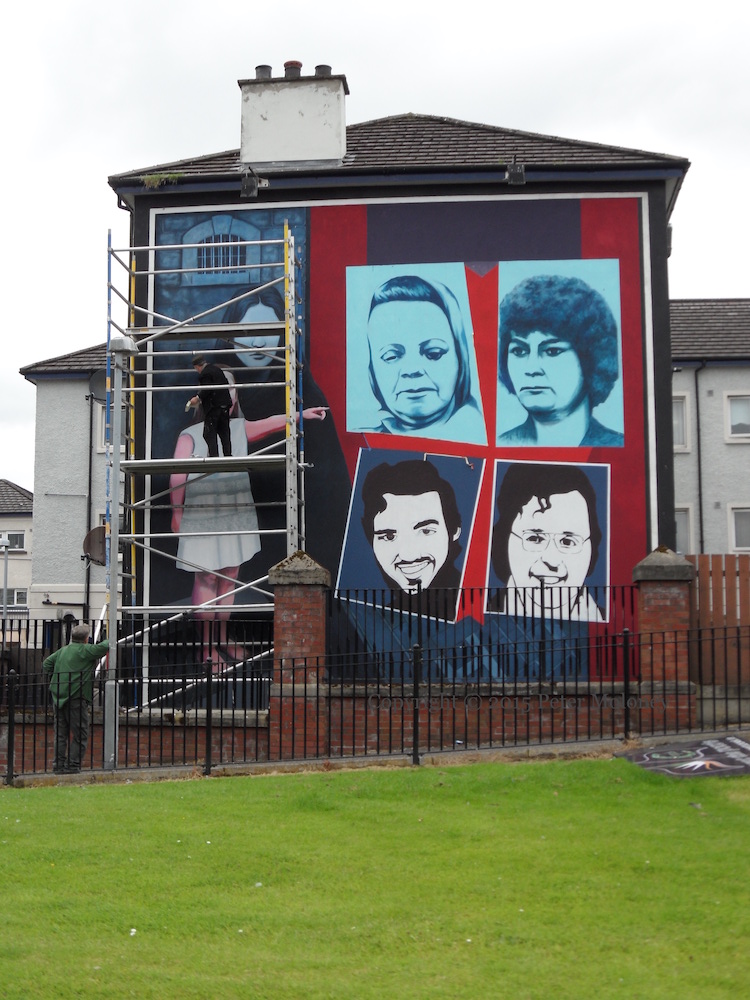
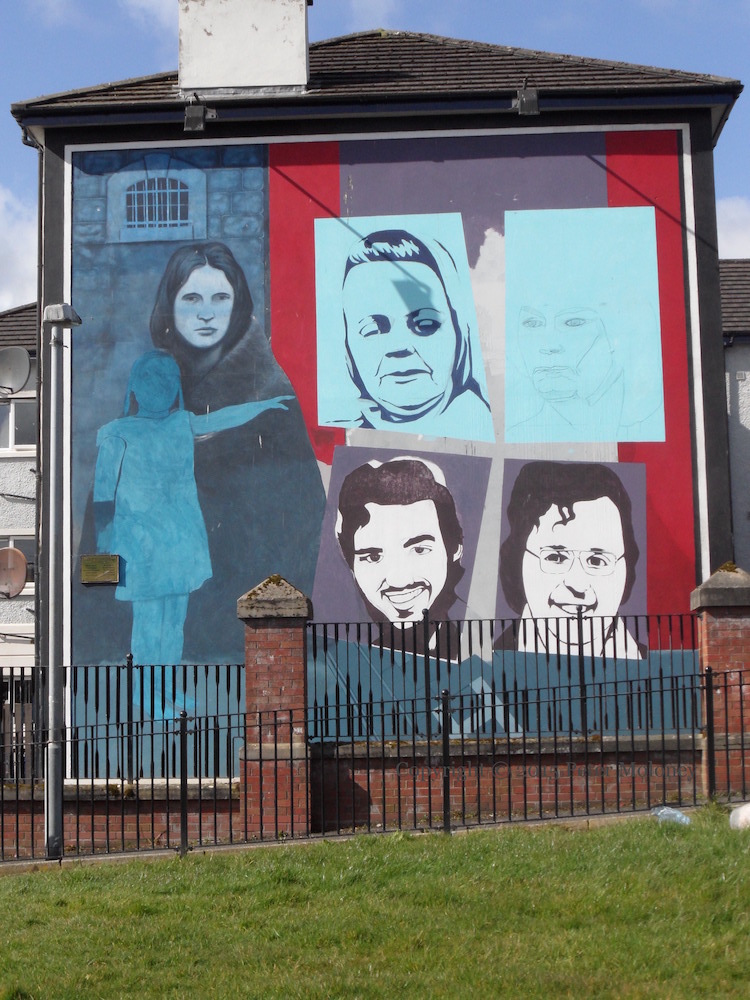
The figure in the centre of the mural above is Peggy O’Hara, mother of INLA hunger striker Patsy O’Hara, who remained active in socialist and republican circles and stood in the assembly elections in 2007 as an independent. She died in 2015 and was given a paramilitary funeral, including a volley of shots fired over the coffin (BBC | Irish Times | An Phoblacht).
The female figure above Mickey Devine (in the bottom right) is his sister Margaret, from whose house his coffin processed after his death in 1981. (See the plaque in Breaking The Chains.) The girl on the left is pointing towards another mural, a dove of peace.
The standing figure, and the plaque, are retained from the previous mural.
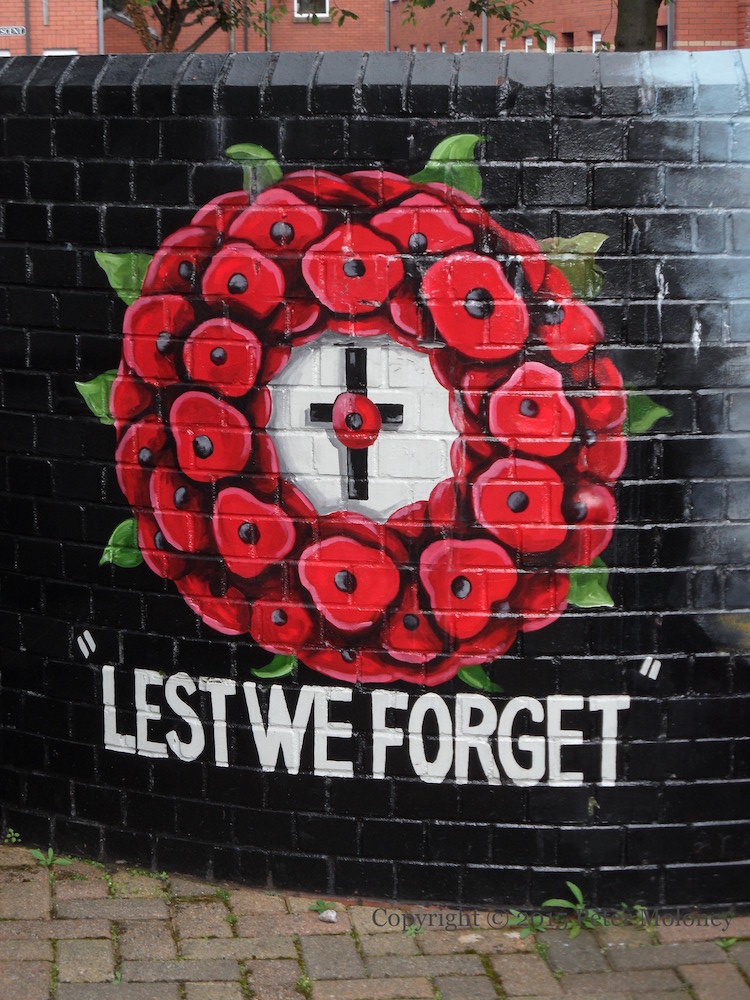
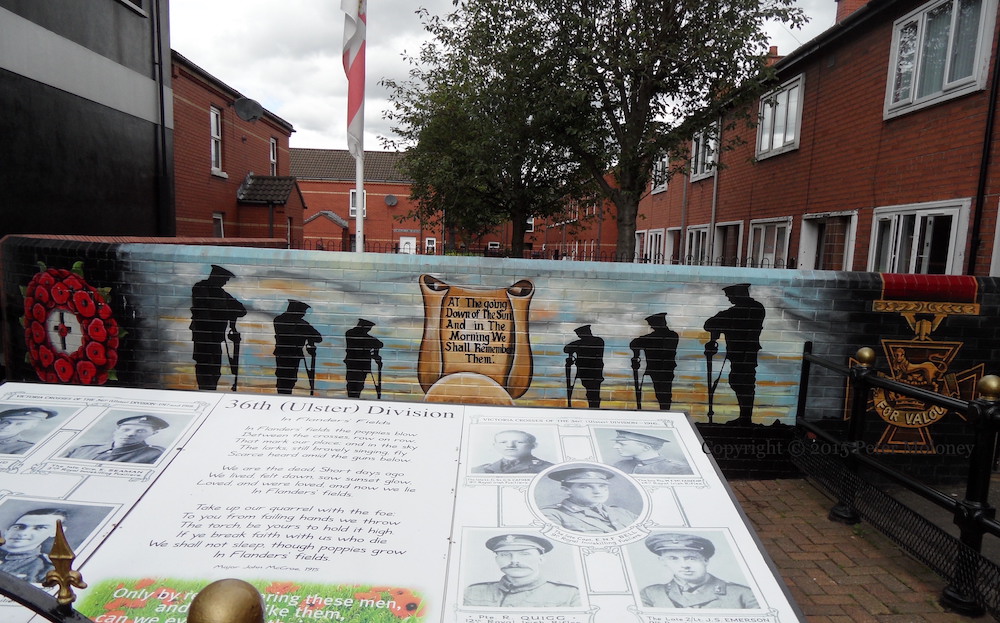
“At the going down of the sun and in the morning, we shall remember them.” The fence at the back of the Belvoir Somme Association’s Victoria Cross memorial garden on along the Newtownards (at the old Newcastle Street) has been replaced with a wall and the poppy wreath on the left (above) has been joined by a mural in memory of the Somme dead and the Victoria Crosses awarded to the 36th Division “For Valour”.
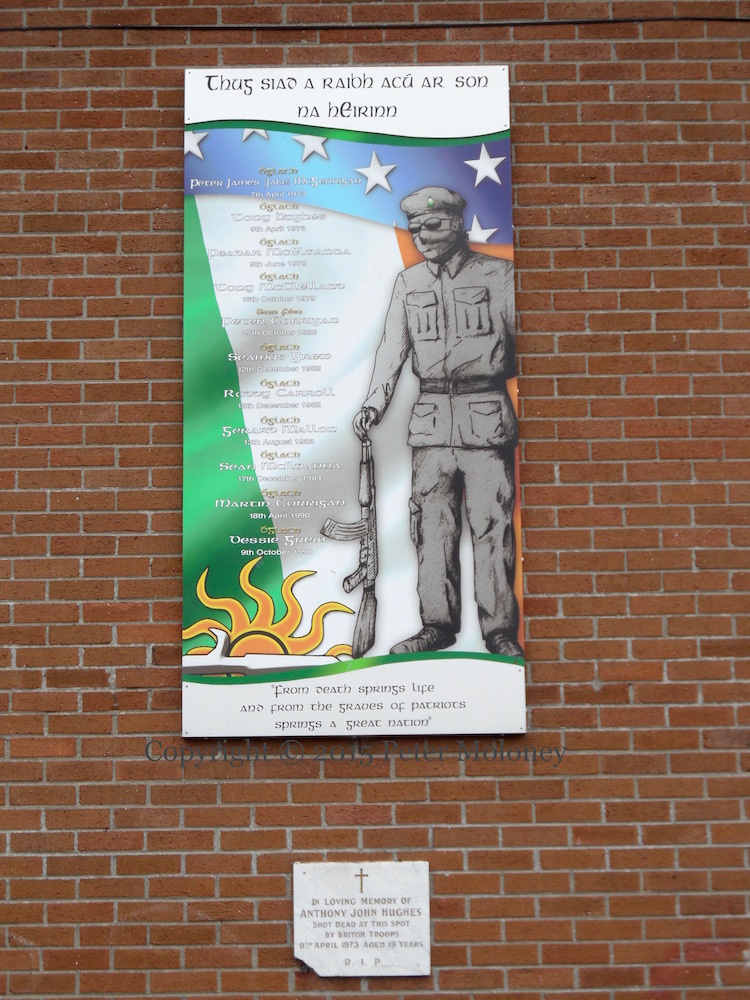
“1973-2013” Jake McGerrigan and Tony Hughes of the OIRA were both shot and killed by British forces in the Windmill Hill area of Armagh in a 48-hour period spanning April 7th and 9th, 1973. (Lost Lives #791 incorrectly gives March 7th for McGerrigan.) The board shown above was mounted in Navan Street for the 40th anniversary of their deaths, in 2013. The larger portraits on either side are of McGerrigan and Hughes; between them are (left) Peadar McElvanna, Roddy Carroll, Gerard Mallon, Martin Corrigan, (middle) Peter Corrigan, (right) Tony McClelland, Seamus Grew, Sean McIlvanna [McIlvenna], Dessie Grew.
There is an individual plaque to Hughes at the spot where he was shot, at the bottom of the second image below a board listing the same names (seen previously in 2012). “Thug sıad a raıbh acú [sic] ar son saoırse na hEırınn [sic].” “From death springs life and from the graves of patriots springs a great nation. [from Pearse’s oration at O’Donovan Rossa’s funeral].” There is stone to both McGerrigan and Hughes in the same alley (see McGerrigan – Hughes); there is also a stone to McGerrigan in Windmill Avenue.
Navan Street/Ogle Street, and Emania Terrace, Armagh
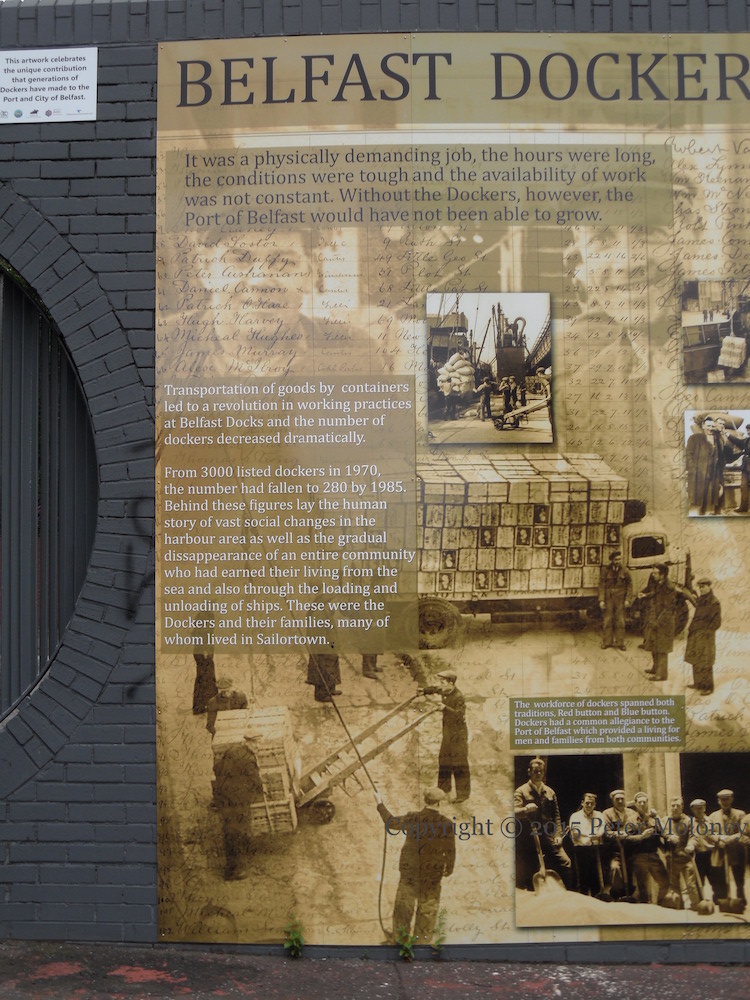
Every day, men would line up in schooling pens on the various docks of the port of Belfast to be hired by foremen. As mentioned on the left-hand side of the board above (recently erected on the New Lodge side of the Duncairn “peace” line) the rise of the shipping container in the 1970s spelled the end of the docker: “from 3000 listed dockers in 1970, the number had fallen to 280 by 1985.” Author and poet John Campbell recalls his first day on the docks in 1952, unloading cement, in this NVTv video.
“This artwork celebrates the unique contribution that generations of dockers have made to the port and City of Belfast.”
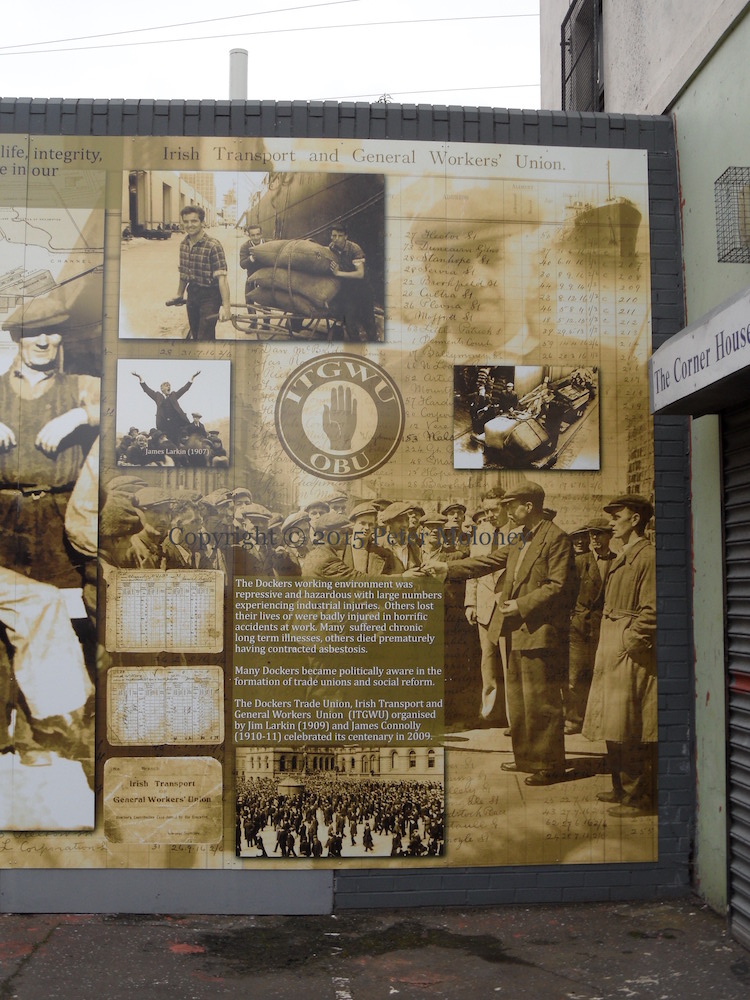
“It was a physically demanding job, the hours were long, the conditions were tough and the availability of work was not constant. Without the Dockers, however, the Port of Belfast would not have been able to grow. / Transportation of goods by containers led to a revolution in working practices at Belfast Docks and the number of dockers decreased dramatically. From 3000 listed dockers in 1970, the number had fallen to 280 by 1985. Behind these figures lay the human story of vast social changes in the harbour area as well as the gradual dissappearance [sic] of an entire community who had earned their living from the sea and also through the loading and unloading of ships. These were the Dockers and their families, many of whom lived in Sailortown. / The workforce of dockers spanned both traditions. Red button and Blue button. Dockers had a common allegiance to the Port of Belfast which provided a living for men and families from both communities. / The work was backbreaking, yet the Docks educated us about life, integrity, discipline, about standing up for our rights, about having pride in our identity as working men, as Dockers. / The Dockers[‘] working environment was repressive and hazardous with large numbers experiencing industrial injuries. Others lost their lives or were badly injured in horrific accidents at work. Many suffered chronic long term illnesses, others died prematurely having contracted asbestosis. Many Dockers became politically aware in the formation of trade unions and social reforms. The Dockers Trade Union, Irish Transport and General Workers[‘] Union (ITGWU) organised by Jim Larkin (1909) and James Connolly (1910-11) celebrated its centenary in 2009.”

















 Peter Moloney Collection