“RNU in west Belfast are today leading the way in combating anti-social behavior [sic], reclaiming republican values, fighting the benefits cuts, tackling the increased drug problem, exposing the slum landlords, rebuilding community pride.” RNU [Republican Network for Unity (Xitter)] stencil on Northumberland Street. Tommy Doherty (leaflet) is running in the local council elections taking place on May 22nd.
“Cuts: made in Britain [by the Conservative-Liberal Democrat coalition led by Cameron and Clegg government], sold by Stormont!” éırígí (web) stencil on Northumberland Street.
The words “Rise up!” were later added to the banner being carried by the protesters on the right – see X02681.
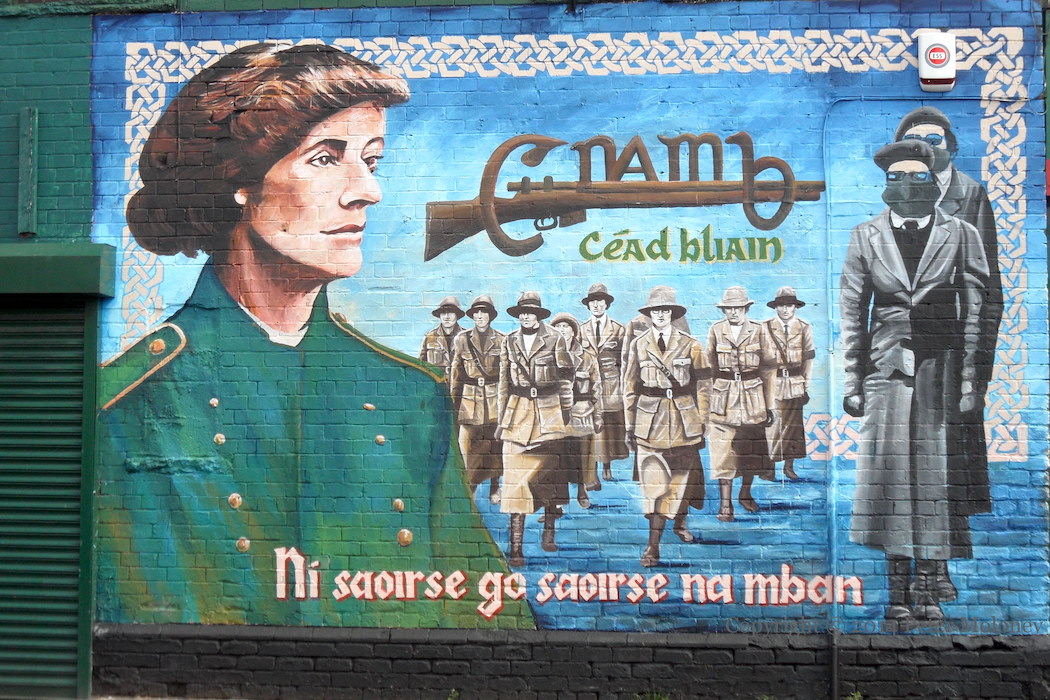
Cumann Na mBan was founded on April 2nd, 1914, and it is being commemorated in various ways, including a mural on Ascaıll Ard na bhFeá/Beechmount Avenue.
Cumann Na mBan was the women’s division of the Irish Volunteers and is best remembered for its role in the Easter Rising of 1916. Its members were involved in the occupation of many locations. Some, including (non-combatant) Winifred Carney, were in the GPO, while Countess Markievicz, the main figure of the mural, was in St. Stephen’s Green. (Here is an RTÉ gallery of vintage photographs, including one of Markievicz surrendering.)
The letters “Cnamb” on a rifle formed the badge of Cumann Na mBan. The Irish “Ní saoırse go saoırse na mban” means “[There is] No freedom until the freedom of women”.
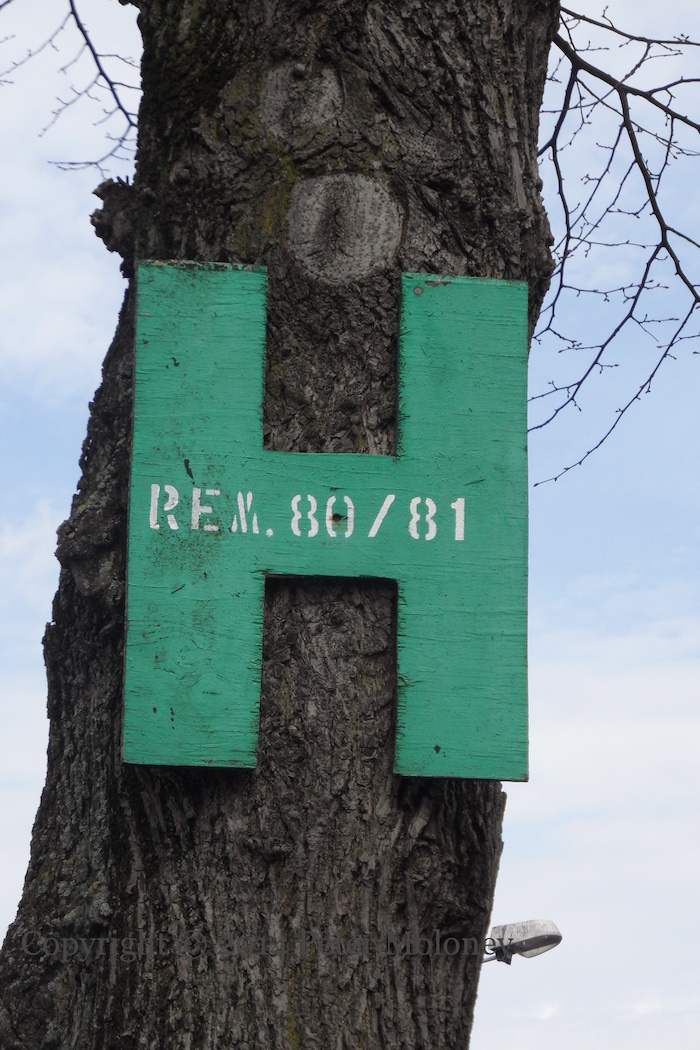
“Rem[ember] 80/81”. Here is a vintage nail-up on the Falls Road (at the Rock streets). It’s at least eight years old, and perhaps more. It notably includes the 1980 hunger strike.
Electioneering is under way in Northern Ireland, ahead of the local and European parliament elections on May 22nd.
“Vótáıl Éırígí #1 Pádraıc Mac Coıtır, Máıre Drumm”. This “Máıre Drumm” is the daughter of Sınn Féın vice-president and 1976 RHC victim Máıre Drumm.
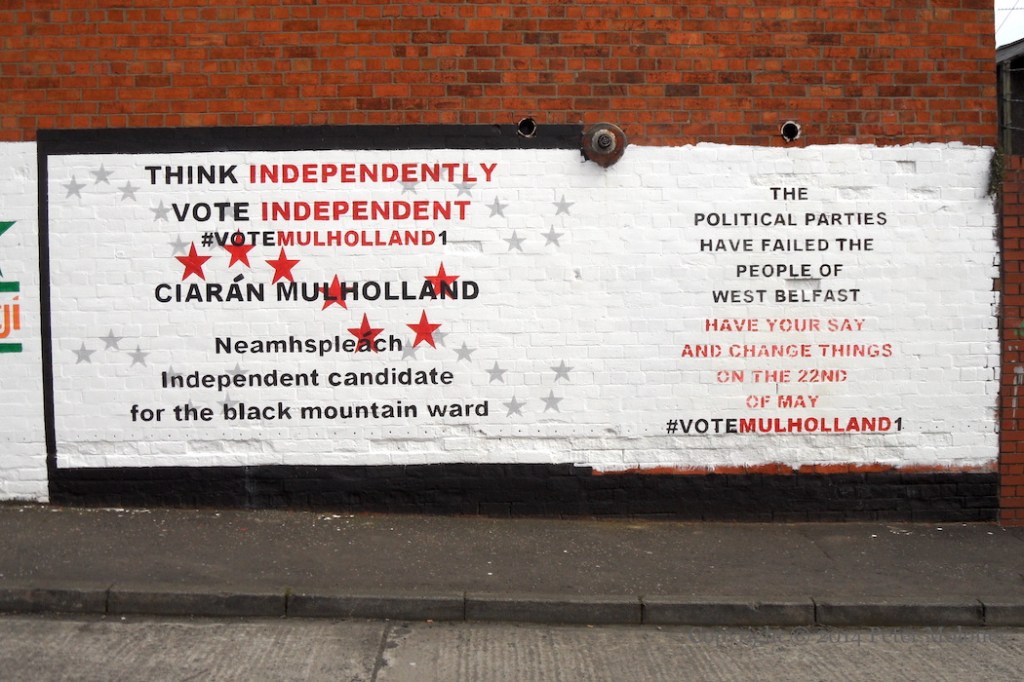
“Think Independently, Vote Independent #VoteMulholland1 Cıarán Mulholland. Neamhspleách/Independent candidate for the Black Mountain ward. The political parties have failed the people of west Belfast. Have your say and change things on the 22nd of May #VoteMulholland1”. Mulholland is an independent (socialist).
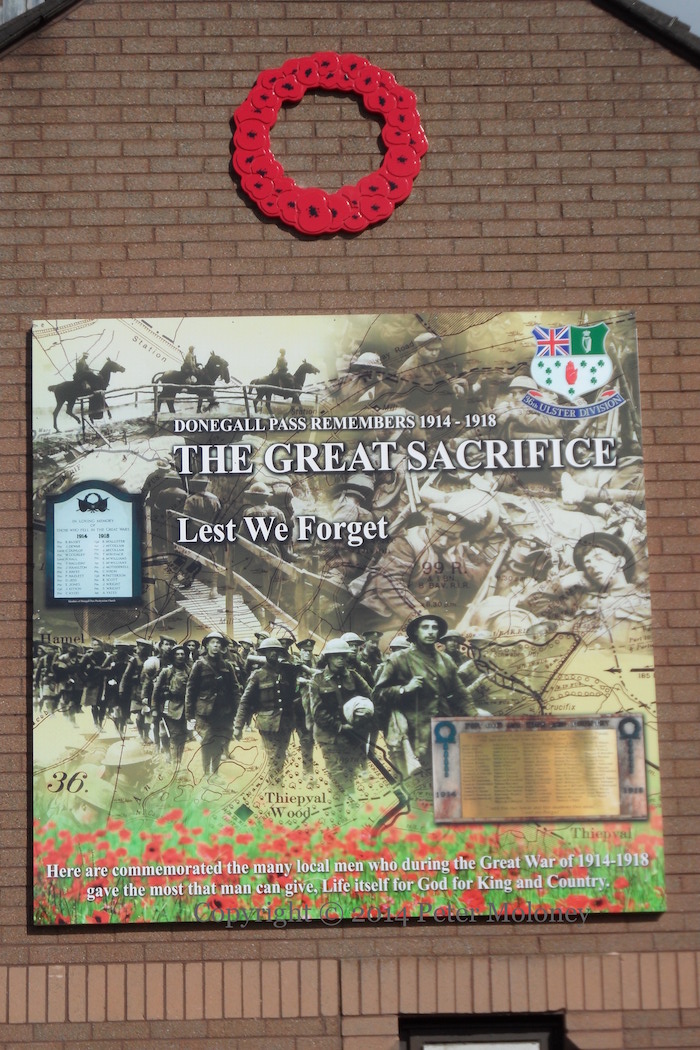
Here are three boards in Lindsay Street, south Belfast, chronicling the 1912 Covenant and the lives lost (by the 36th Division) in the Great War 1914-1918.
“It is needful that we knit together as one man, each strengthening the other, and not holding back of counting the cost” – Ulster [Unionist] Council Resolution 1912.” “Ulster’s solemn league and covenant. Ulster Day 28th September 1912.” The Council met on September 23rd and 471,000 people signed the covenant (figures here) on or around the 28th – Ulster Day – led by Sir Edward Carson.
“Donegall Pass remembers 1914-1918 – the great sacrifice. Lest we forget. Here are commemorated the many local men who during the Great War of 1914-1918 gave the most that man can give: life itself for God for King and Country.” With a map of the northern end of the Western Front and images of soldiers marching, on horseback, and in the trenches.
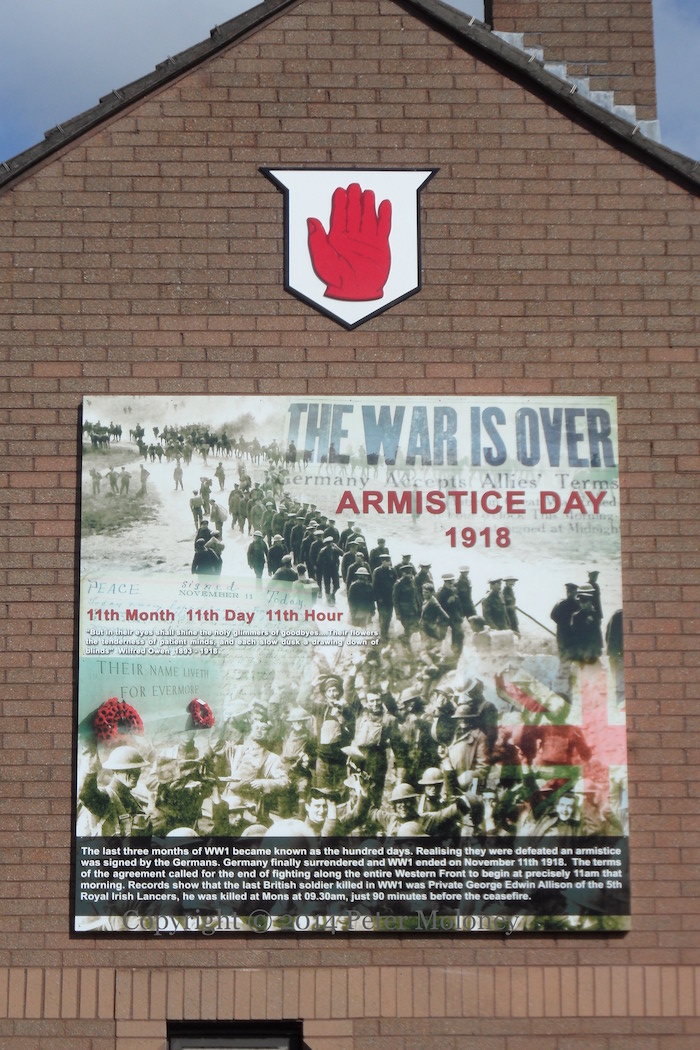
“The war is over. Armistice Day 1918. 11th month, 11th day, 11th, hour.” “But in their eyes shall shine the holy glimmers of goodbyes … Their flower the tenderness of patient minds, and each slow dusk a drawing down of blinds.” Lines from Wilfred Owens’ (1893-1918) ‘Anthem For Doomed Youth‘.
At the bottom: “The last three months of WWI became known as the hundred days. Realising they were defeated an armistice was signed by the Germans. Germany finally surrendered and WWI ended on November 11th 1918. The terms of the agreement called for the end of fighting along the entire Western Front to begin a precisely 11 am that morning. Records show that the last British soldier killed in WWI was Private George Edwin Allison of the 5th Royal Irish Lancers. He was killed at Mons at 09:30 am, just 90 minutes before the ceasefire.”
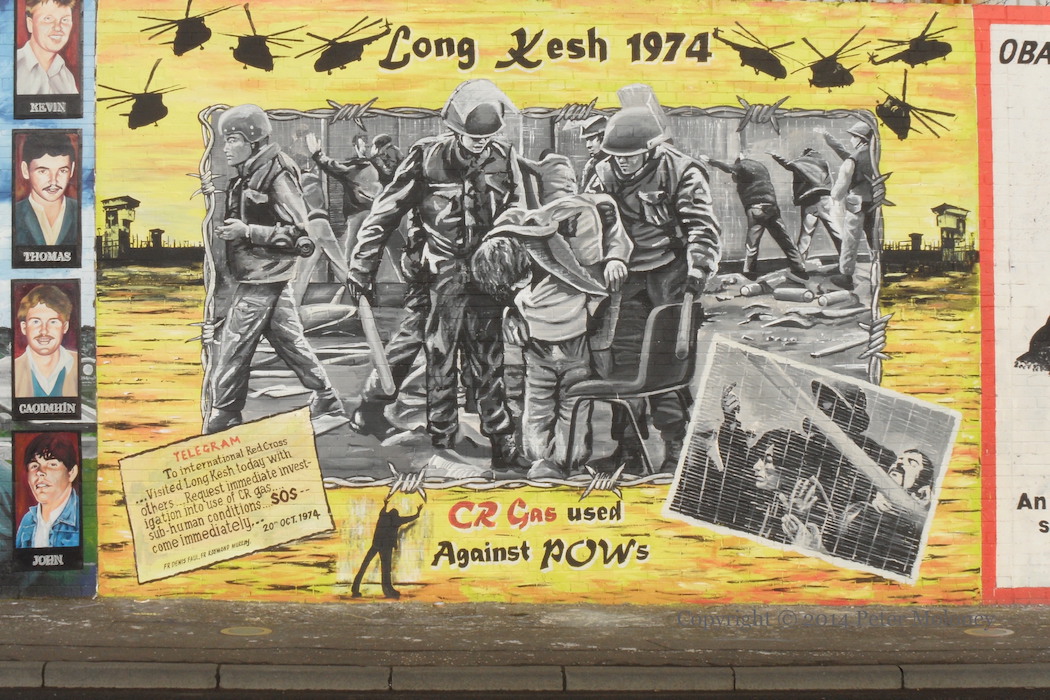
A new mural, above, on the International Wall commemorates the fortieth anniversary this year of the ‘Burning Of Long Kesh’ or the ‘Battle Of Long Kesh’, which took place on the night of October 15, 1974 and day of the 16th (when British Army units retook the camp).
The most comprehensive account available on-line of the conditions at the camp prior to the riot, the burning, and the battle on the morning of the 16th appears to be this 2004 piece in An Phoblacht by Joe Doherty and Christy Keenan. (For a virtual tour of the camp, see this video. Seamus Keenan’s Over The Wire (on again this month at the Derry Playhouse) attempts to recreate the scene.) Other accounts include those by Ronan Bennett, another inmate, in The Guardian. Here is a brief BBC News report from the 16th.
All accounts mention the use of gas and republican accounts state that CR was used on the morning of the 16th in addition to CS, dropped from helicopters as at the top of the mural. The Guardian, in 2005, confirmed that CR had been authorized for use in controlling riots and was available at the prison. CR is a carcinogen (WP) and in a post on his blog (now removed) Mairtin Óg Meehan suspects that exposure to CR is a cause of recent cancers among former prisoners.
In the lower left corner is a quoted telegram from Fr. Denis Faul, Fr. Raymond Murray: “To international Red Cross … Visited Long Kesh today with others … Request immediate investigation into use of CR gas … sub-human conditions … SOS … come immediately …” 20 Oct. 1974. These two wrote an 80-page report on the conditions at the camp following the event, entitled The Flames Of Long Kesh. See this 1999 An Phoblacht page for an image of the shelters constructed after the battle.
These Kilburn Street boards commemorate the “Young Citizen Volunteers Of Ireland” and the battle of the Somme. The text in the side-wall board (shown below) is from the diary of a Somme soldier: “We surge forward. Bayonets sparkle and glint. Cries and curses rent the air. Chums fall, some without a word … and others … Oh, my God! May I never hear such cries again! There goes the YCV flag tied to the muzzle of a rifle. That man had nerve! Through the road just ahead of us we had crossed the sunken road. We could see khaki figures rushing the German front line. The Inniskillings had got at them.”
The larger board, on the right, describes the transition from rebels in 1912 to British Army soldiers in 1914: “On the 17th May 1914 the Young Citizen Volunteers became a battalion of the Belfast regiment of the Ulster Volunteer Force. This formed part of the Ulster Division authorised on 28th October 1914 which officially became the 14th battalion of the Royal Irish Rifles, part of the 109th brigade. The 14th saw action throughout the First World War.”
It includes a quote from Edward Carson, “You will find in your ranks men with the same ideals, men with the same loyalty and the same determination to uphold the rights of their country”, and a quote from VC winner William Fredrick McFadzean, “You people at home make me feel quite proud when you tell me I am the soldier boy of the McFadzeans. I hope to play the game and if I don’t add much lustre to it I certainly will not tarnish it.”
Actor and activist Margaretta D’Arcy (here, “Margaritta” D’Arcy) was arrested in October, 2012, for climbing the perimeter of Shannon airport and standing on the runway, in protest at the use of the airport by US military planes. She was jailed – aged 79 – for nine-and-a-half weeks in 2014. (Irish Times | Journal)






 Peter Moloney Collection