Young Citizen Volunteers

These Kilburn Street boards commemorate the “Young Citizen Volunteers Of Ireland” and the battle of the Somme. The text in the side-wall board (shown below) is from the diary of a Somme soldier: “We surge forward. Bayonets sparkle and glint. Cries and curses rent the air. Chums fall, some without a word … and others … Oh, my God! May I never hear such cries again! There goes the YCV flag tied to the muzzle of a rifle. That man had nerve! Through the road just ahead of us we had crossed the sunken road. We could see khaki figures rushing the German front line. The Inniskillings had got at them.”

The larger board, on the right, describes the transition from rebels in 1912 to British Army soldiers in 1914: “On the 17th May 1914 the Young Citizen Volunteers became a battalion of the Belfast regiment of the Ulster Volunteer Force. This formed part of the Ulster Division authorised on 28th October 1914 which officially became the 14th battalion of the Royal Irish Rifles, part of the 109th brigade. The 14th saw action throughout the First World War.”

It includes a quote from Edward Carson, “You will find in your ranks men with the same ideals, men with the same loyalty and the same determination to uphold the rights of their country”, and a quote from VC winner William Fredrick McFadzean, “You people at home make me feel quite proud when you tell me I am the soldier boy of the McFadzeans. I hope to play the game and if I don’t add much lustre to it I certainly will not tarnish it.”

Click image to enlarge
Copyright © 2014 Peter Moloney
M10804 M10803 M10802
[M10805] [M10806] [M10807] [M10808] [M10809] [M10810] [M10811] [M10812]

For Me There Will Be No More War

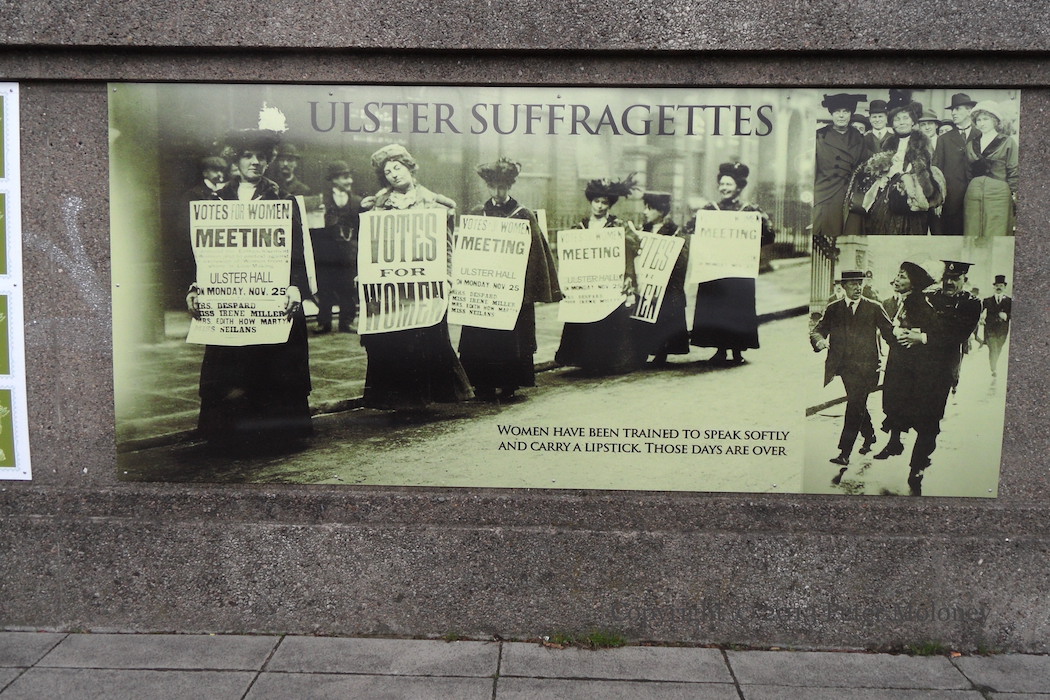
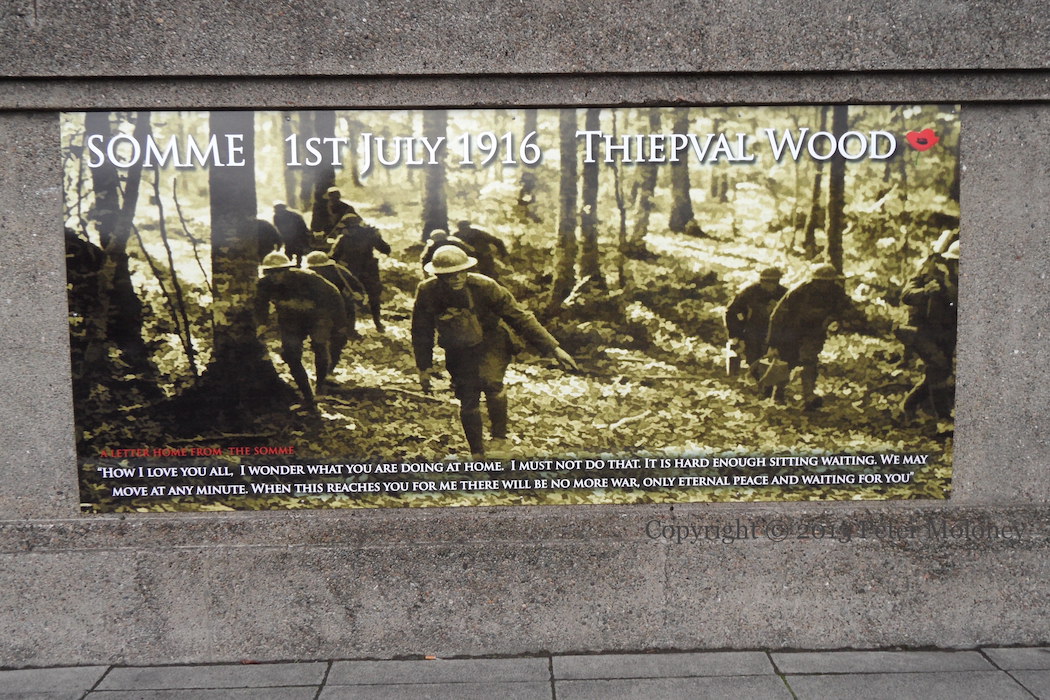
Here are three of twenty new panels on the Donegall Road bridge over the railway.

The post on the mural to James Magennis in Tullycarnet provides background information on him.

A letter home from the Somme: “How I love you all. I wonder what you are doing at home. I must not do that. It is hard enough sitting waiting. We may move at any minute. When this reaches you for me there will be no more war, only eternal peace and waiting for you.” July 1st, 1916 saw the start of the Battle Of The Somme. The 36th (Ulster) division lost over 5,000 men in an initial successful attack near Thiepval Wood, but were driven back that evening.

Ulster suffragettes: “Women have been trained to speak softly and carry a lipstick. Those days are over.” (Bella Abzug). The board shows a picture of women drumming up an audience for a suffragette meeting in the Ulster Hall in November 1912. The image in the bottom right is of Emmeline Pankhurst being arrested in London in 1914; the top image is of Pankhurst on tour in the US in 1913 (LoC; see Pieces Of History for a description of the tour; she gave a speech entitled ‘Freedom Or Death’). Pankhurst spoke in Belfast at the 1912 meeting, though the speakers advertised on the placards are “Mrs Charlotte Despard, Miss Irene Miller, Mrs Edith How-Martyn, Miss Alison Neilans“. The first suffrage group in Ireland was the North Of Ireland Women’s Suffrage Society, founded in Belfast in 1872 by Isabella Tod. See also Belfast’s Infamous Prison for information about suffragettes held in Crumlin Road Gaol.

For a complete set of panels, see north side and south side.

Click image to enlarge
Copyright © 2013 Peter Moloney
M10517 M10516 M10515

They Will Never Steal Our Culture

“They may have stole our banner but they will never steal our culture.” The banner in question was on the fencing in the street (see Welcome To Loyalist Linfield Road) but wound up on a CNR bonfire in Divis; the wider context is the on-going disputes over the routes established by the Parades Commission for Orange Order marches.

Linfield Gardens, south Belfast.

Click image to enlarge
Copyright © 2013 Peter Moloney
M10509

Faded Glory

These three pairs of UK shields (Ulster Banner, St Andrew’s Saltire, Union Flag) are in Lindsay Street, south Belfast. There was also a fourth one, with the shield of the 36th Division. The were mounted in the four spaces (and in two cases, on the backing boards) used for a set of older boards, and the old title strip is still visible in the first two images: “Relief Of Londonderry” can be seen in the first image, while “Williamite cavalry charge, Aughrim” is visible in the second.

(The other two were “Jacobites fleeing at Enniskillen” and “Battle Of The Boyne”. For the four previous pieces, from left to right, see D00353, D00355, D00354, and D00356.)

Click image to enlarge
Copyright © 2013 Peter Moloney
M10438 M10437 M10436

Donegall Pass UVF

“Donegall Pass UVF 1913-2013” Visible from the Ormeau Road, this large union flag greets visitors to Donegall Pass in the south of the city. It asserts the presence of the UVF and connects the original Ulster Volunteers of 1913 to the present-day Ulster Volunteer Force one hundred years later: the aim of the original Ulster Volunteers was to resist the impending rule by Catholics under Home Rule.

Charlotte Street, Belfast.

Click image to enlarge
Copyright © 2013 Peter Moloney
M10434 [M10435]

A Sword Bathed In Heaven

South Belfast MP Robert Bradford was assassinated by the Provisional IRA in Finaghy at a meeting with constituents; the caretaker of the community centre, Ken Campbell, was also killed by the fleeing attackers. Taking place in late 1981, with the hunger strikes having ended only a month before, the killing was noted around the world and raised fears of broad civil unrest (BBC | NYTimes). The board immediately above replaces an earlier mural to Bradford on the gable wall that now hosts the large board shown above, commemorating the Siege Of Derry and specifically the “Apprentice Boys Of Derry No Surrender Club” of south Belfast.

Oak Street.

Click image to enlarge
Copyright © 2013 Peter Moloney
M10418 M10419 [M10420] [M10421] [M10422] [M10423] [M10424] [M10425] [M10426] [M10427] [M10428] [M10429] [M10430] [M10431] [M10432] [M10433]
1688 – 1689, April 18 to July 28 played a key role in the victory of the Williamite forces in Britain and other parts of Europe. The success of William III and the Glorious Revolution effectively stopped the rise of a tyrannical Empire under Louis XIV of France and his ally the deposed king of England, James II. The theory of the divine right of Kings was replaced by reforms created by King William III and Queen Mary, establishing the supremacy of parliamentary democracy and its freedoms which continue to this day. during the war of the three kings showing the jacobite fortifications and position of the boom across the foyle gold mask of the sun king vita veritas victoria protestant nobles stewart dynasty prince of orange convention parliament abdicated battle of the boyne kingdom of england scotland ireland londonderry toleration of roman catholics dissenters cousin dutch citizens walls of derry but the cry was siege of 105 days duly initiated in apprentice boys’ memorial hall shutting of the gates rules and ritual roaring meg siege key
M10414 [M10415] [M10416] [M10417]
my role is to say harsh things oft-times, but to bathe the sharp sword of my word in heaven, to temper what I say with love and lead people from their folly to a life of fuller service with their king for seven violent year from 1974 to 1981 unionist mp for south belfast an outspoken champion for liberty in ulster unafraid to speak his mind despite the danger he faced daily from terrorist death threats finally they murdered him while he was on constituency duty doing the special work god had called him to do one of the worst political assassinations in recent british history sent shockwave around the world

British And Proud

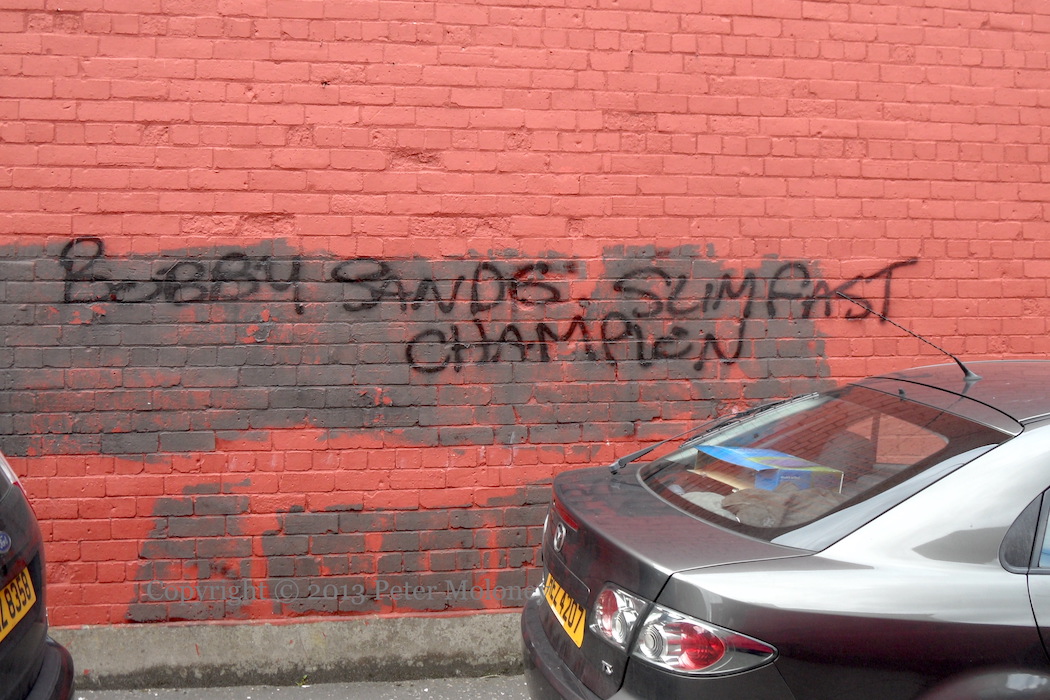
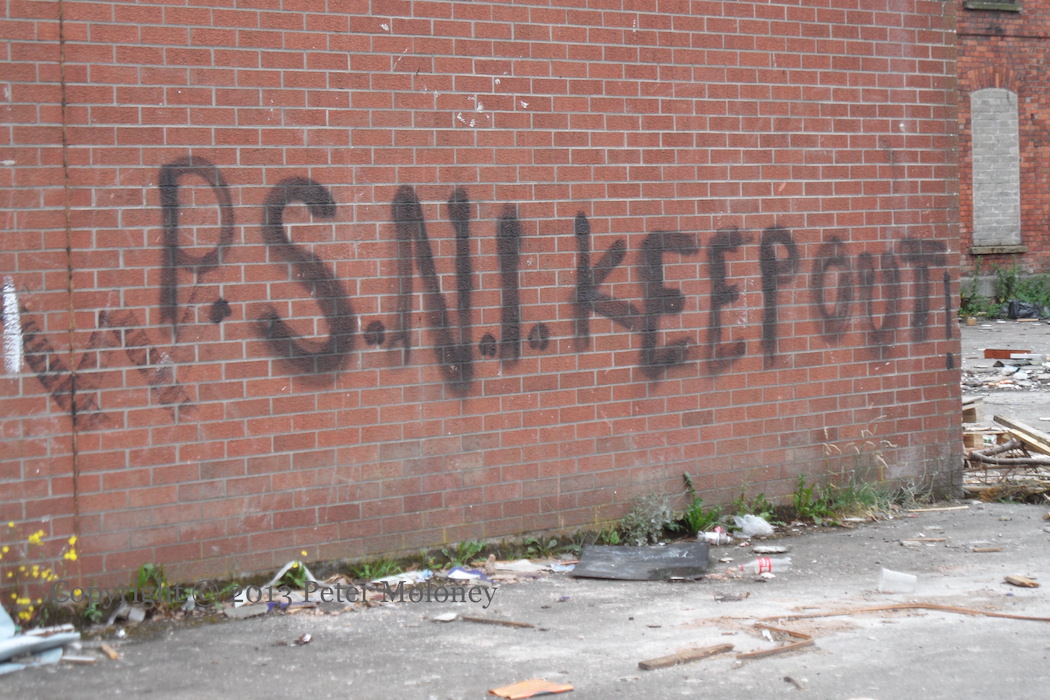
Loyalists on Sandy Row are not friends of Sinn Féin, the IRA, the PSNI, and all taigs. “We will always walk Ardoyne” is a reference to parading past the Ardoyne shops – the Parades’ Commission banned the march along that part of the route, and rioting took place (BBC).

Click image to enlarge
Copyright © 2013 Peter Moloney
M10114 M10115 M10116 M10117 M10118