“Important/Tábhachtach – Faıgh do vóta/Get your vote. Is everyone in your house on the electoral register? Gach vóta luachmhar…/Every single vote counts …” This is a generic electoral board encouraging voter registration (for Sınn Féın voters, at least) as there are elections scheduled until the local and European votes in May, 2014.
The poppy (with a skull at its centre and dripping blood) is “symbol of British imperialism around the world: Palestine, Libya, Malvinas, Ireland, Iraq, Afghanistan. Britain out of Ireland.”
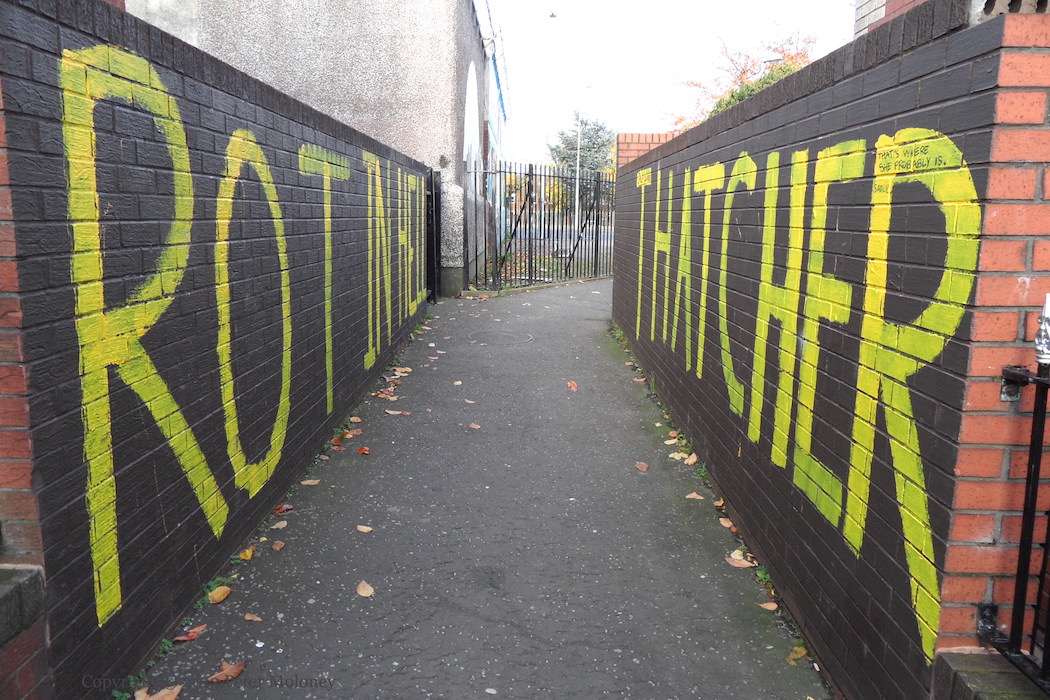
Reaction to the death (on Monday, April 8th) of Margaret Thatcher, U.K. Prime Minister 1979-1990 (WP), in an alley below Divis tower, between Divis Street and Clonfaddan Crescent.
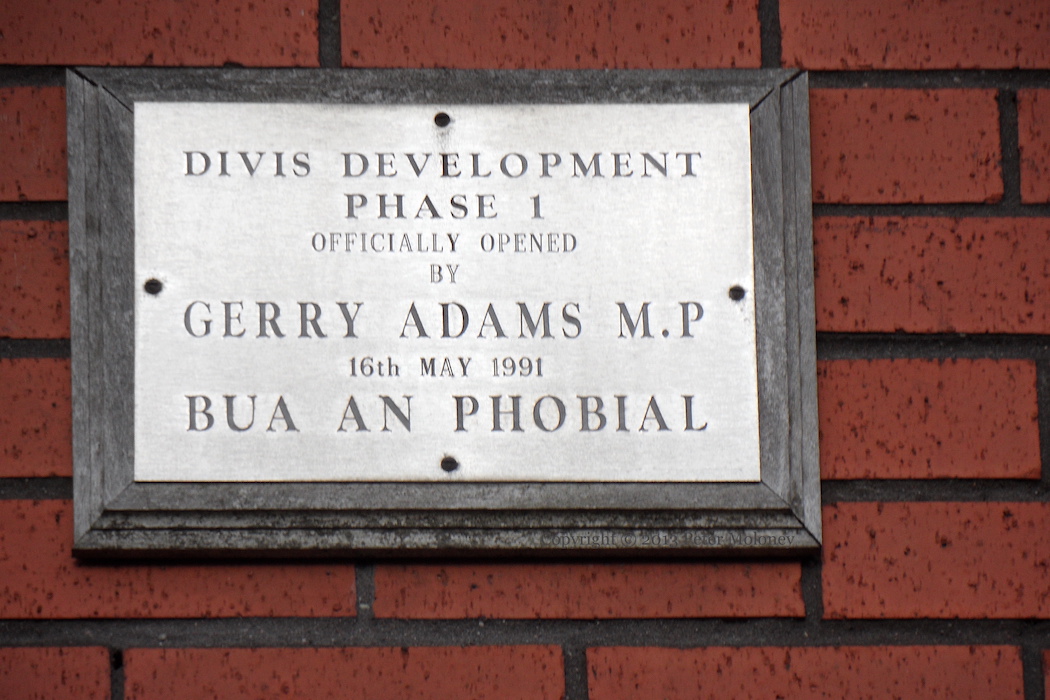
Also in Clonfadden Crescent can be seen a plaque commemorating the opening of “Divis Development Phase 1” by “Gerry Adams M.P” on May 16th, 1991. “Bua an phobıal” [“Bua an phobaıl”, “The community’s victory”] It took thirteen years of campaigning before the Executive agreed to knock down the old flats in 1986 (Alfaro & Roulston 2021).
“Mol an óıge agus tıocfaıdh sí” – “youth responds to praise”, such as when playing in the annual Easter Gaelic games tournament, now in its eighth year. Joe Cahill (WP) holds the cup aloft.
The group in the bottom left corner are Pat O’Hare, Frank Cahill, Tom Cahill, (the three Cahills were featured in the previous mural) Ned Maguire, Jr., Ned Maguire, Sr., Alec Crowe, Paddy Meenan, Tommy Crowe, Dal Delaney, and Hugh Elliot.
In the crook of Cahill’s arm are Rita McParland, Sean Wallace, Paddy Corrigan, John Pettigrew, and John Stone. None of these adults is still alive; all were from the local area.
The chalet bungalows in the background on the left are gone, but you can see images of them on the Belfast Forum.
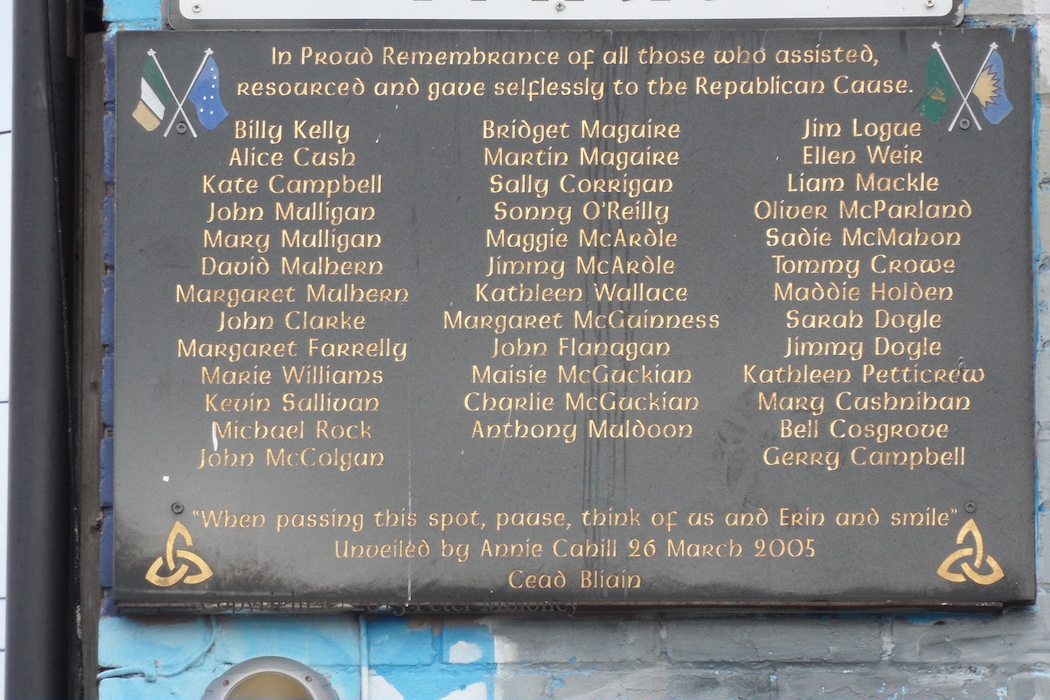
The plaque on the left names others in addition “who assisted, resourced and gave selflessly to the republican cause”: Billy Kelly, Alice Cush, Kate Campbell, John Mulligan, Mary Mulligan, David Mulhern, Margaret Mulhern, John Clarke, Margaret Farrelly, Marie Williams, Kevin Sullivan, Michael Rock, John McColgan, Bridget Maguire, Martin Maguire, Sally Corrigan, Sonny O’Reilly, Maggie McArdle, Jimmy McArdle, Kathleen Wallace, Maragret McGuinness, John Flanagan, Maisie McGuckian, Charlie McGuckian, Anthony Muldoon, Jim Logue, Ellen Weir, Liam Mackie, Oliver McParland, Sadie McMahon, Tommy Crowe, Maddie Holden, Sarah Doyle, Jimmy Doyle, Kathleen Pettigrew, Mary Cushnihan, Bell Cosgrove, Gerry Campbell.
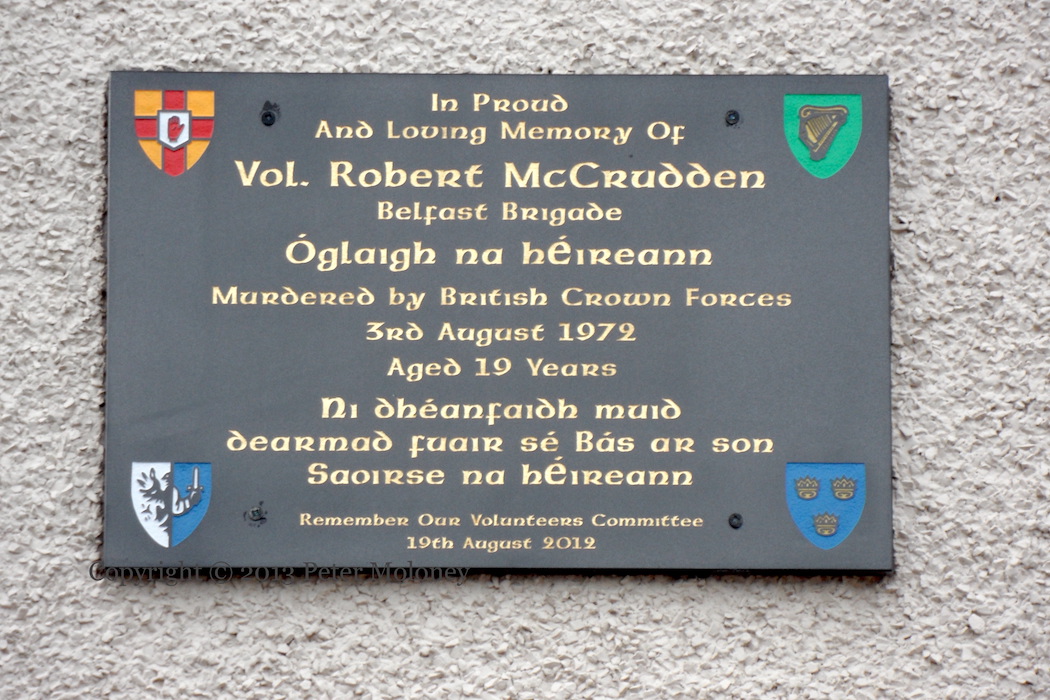
“In proud and loving memory of Vol. Robert McCrudden, Belfast Brigade, murdered by British Crown Forces, 3rd August 1972, aged 19 years. Ní dhéanfaıdh muıd dearmad [gur] fuaır sé bás ar son saoırse na hÉıreann. Remember Our Volunteers Committee 19th August 2012”
“I don’t mind being called a dissenter, I’ve been a dissenter all my life.” An anti-Agreement tribute to “The Dark” (Brendan Hughes), IRA commander, blanketman, and 1980 hunger striker, on the Springfield Road.
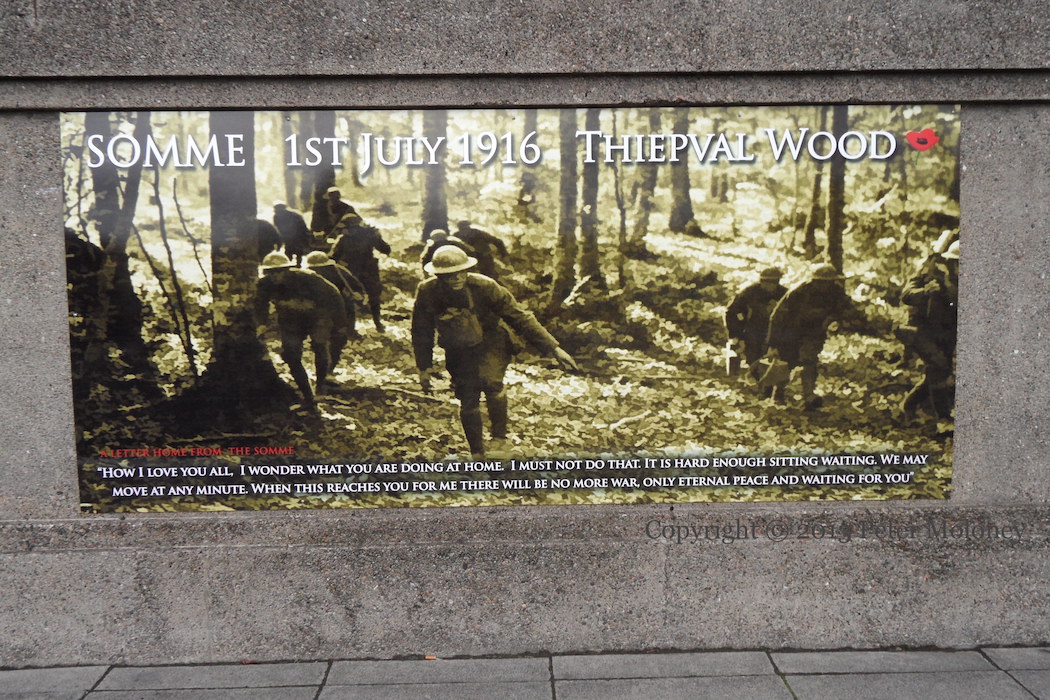
A letter home from the Somme: “How I love you all. I wonder what you are doing at home. I must not do that. It is hard enough sitting waiting. We may move at any minute. When this reaches you for me there will be no more war, only eternal peace and waiting for you.” July 1st, 1916 saw the start of the Battle Of The Somme. The 36th (Ulster) division lost over 5,000 men in an initial successful attack near Thiepval Wood, but were driven back that evening.
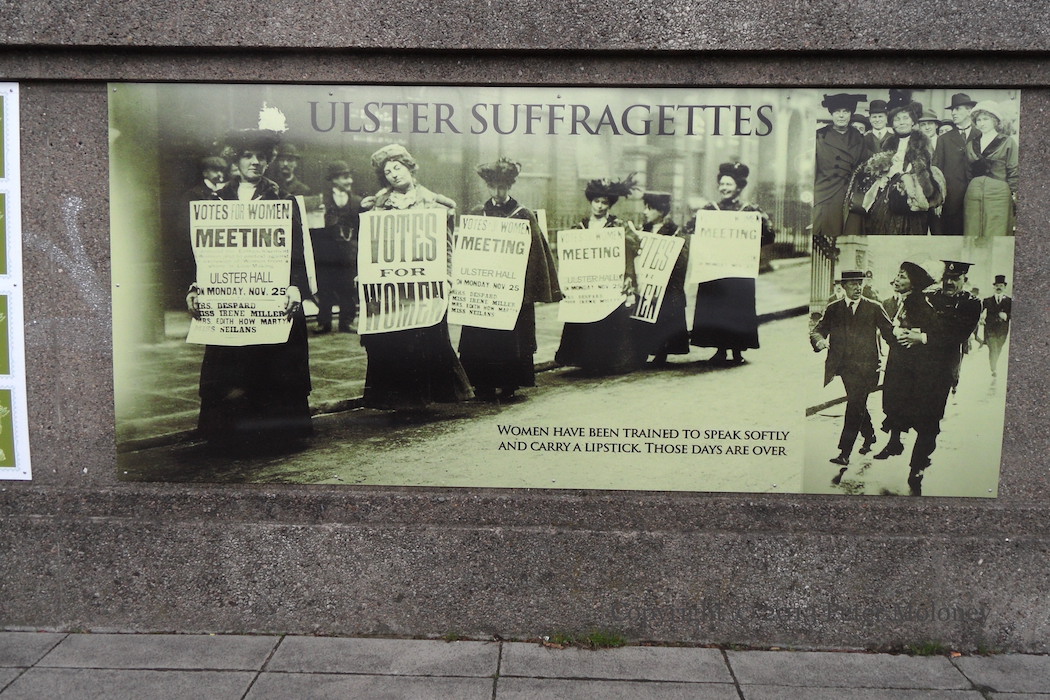
Ulster suffragettes: “Women have been trained to speak softly and carry a lipstick. Those days are over.” (Bella Abzug). The board shows a picture of women drumming up an audience for a suffragette meeting in the Ulster Hall in November 1912. The image in the bottom right is of Emmeline Pankhurst being arrested in London in 1914; the top image is of Pankhurst on tour in the US in 1913 (LoC; see Pieces Of History for a description of the tour; she gave a speech entitled ‘Freedom Or Death’). Pankhurst spoke in Belfast at the 1912 meeting, though the speakers advertised on the placards are “Mrs Charlotte Despard, Miss Irene Miller, Mrs Edith How-Martyn, Miss Alison Neilans“. The first suffrage group in Ireland was the North Of Ireland Women’s Suffrage Society, founded in Belfast in 1872 by Isabella Tod. See also Belfast’s Infamous Prison for information about suffragettes held in Crumlin Road Gaol.
Memorials in Ardoyne Martin Meehan, Sammy McLarnon, Thomas ‘Bootsey’ Begley, Seamus Morris and Peter Dolan.
Martin Meehan joined the IRA in 1966 and was one of a few IRA volunteers defending Catholics in Ardoyne (Ard Eoın) in August 1969. Rioting did not cease there until the 16th, when British troops were finally deployed to the Crumlin Road to block mobs coming from the Woodvale and Shankill. Meehan resigned after the failure of the IRA to defend Ardoyne, Clonard, and Divis. This Magill article from the time summarises the IRA’s actions as “late, amateur and uncertain”. (Meehan would later rejoin the IRA and PIRA.)
“This memorable [sic] plague [sic] is dedicated to the 1st victim of the present troubles, Sammy McLarnon, RIP, who was brutally murdered in his own home at 37 Herbert St by the RUC on 15th Aug., 1969.” For more, see this Irish Times article about a 1999 community inquest.
Thomas “Bootsey” Begley died when a bomb he was carrying into a fish shop on the Shankill Road exploded. The bomb killed Begley and nine others [plaque]. The plaque above was unveiled in Ardoyne on October 20th, 2013 – twenty years after the event – to protests from relatives of the deceased (BBC-NI).
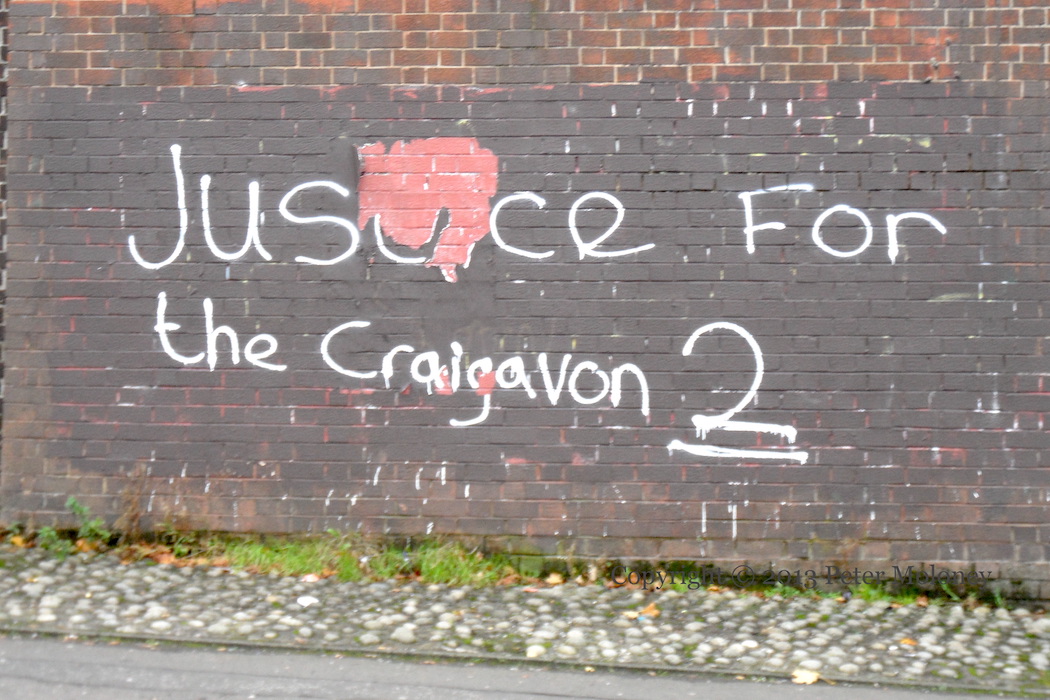
“Justice for the Craigavon 2” – this is the first piece in the Peter Moloney Collection about the campaign to release the pair convicted for their part in the murder of Stephen Carroll (BBC).
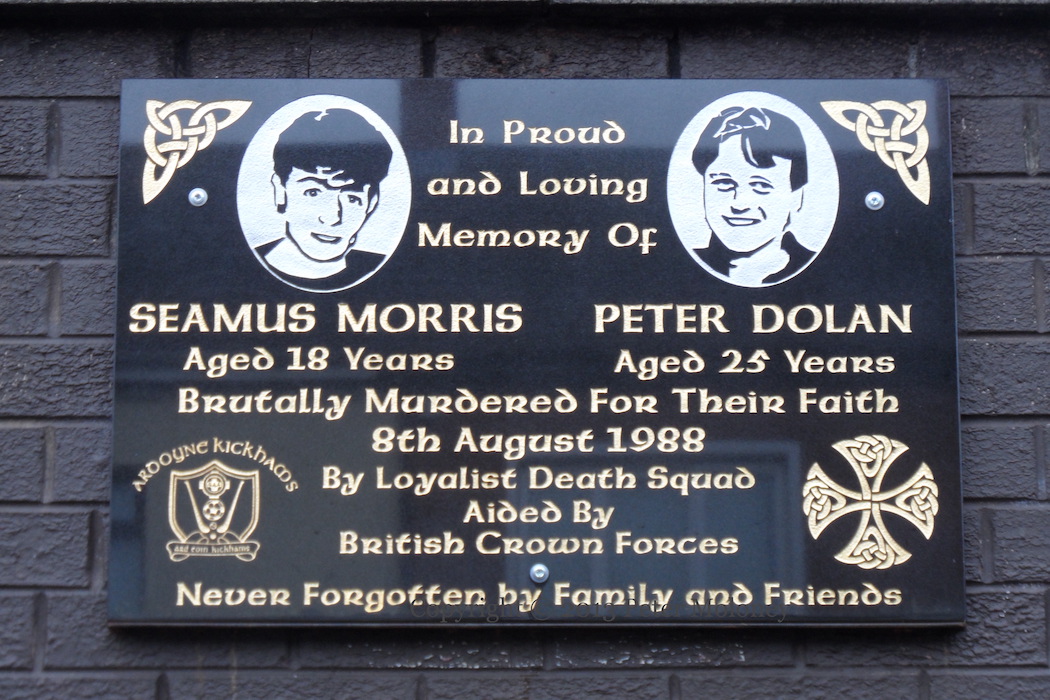
Finally, the Morris-Dolan plaque is brand new, unveiled August 11, 2013, in Etna Drive/Corán An Ardghleanna (in Ard Eoın). Seamus Morris and Peter Nolan were shot by the Protestant Action Force (UVF) twenty-five years ago, in August 1988. It reads “Brutally murdered for their faith … by loyalist death squad aided by British crown forces. Never forgotten by family and friends.”
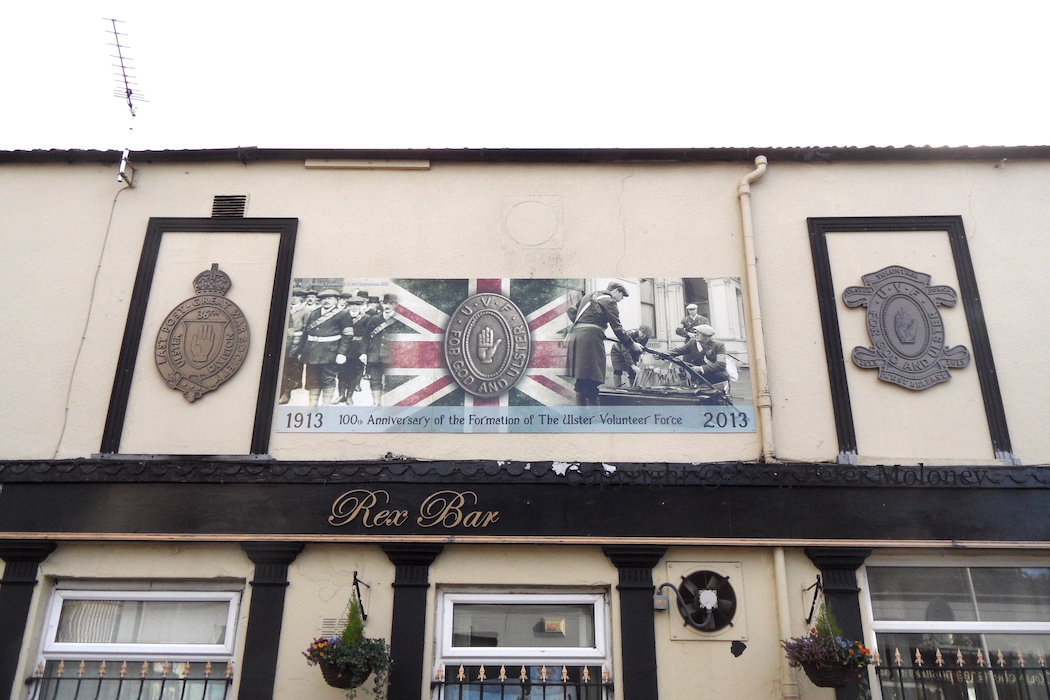
“100th Anniversary Of The Formation Of The Ulster Volunteer Force 1913-2013”, flanked by two large emblems, reading “Last Post Great War Society – 36th (Ulster) Division” and “Ulster Volunteer Force, west Belfast”.
Above the courtyard of the Rex Bar, Moscow Street, west Belfast.
“They may have stole our banner but they will never steal our culture.” The banner in question was on the fencing in the street (see Welcome To Loyalist Linfield Road) but wound up on a CNR bonfire in Divis; the wider context is the on-going disputes over the routes established by the Parades Commission for Orange Order marches.